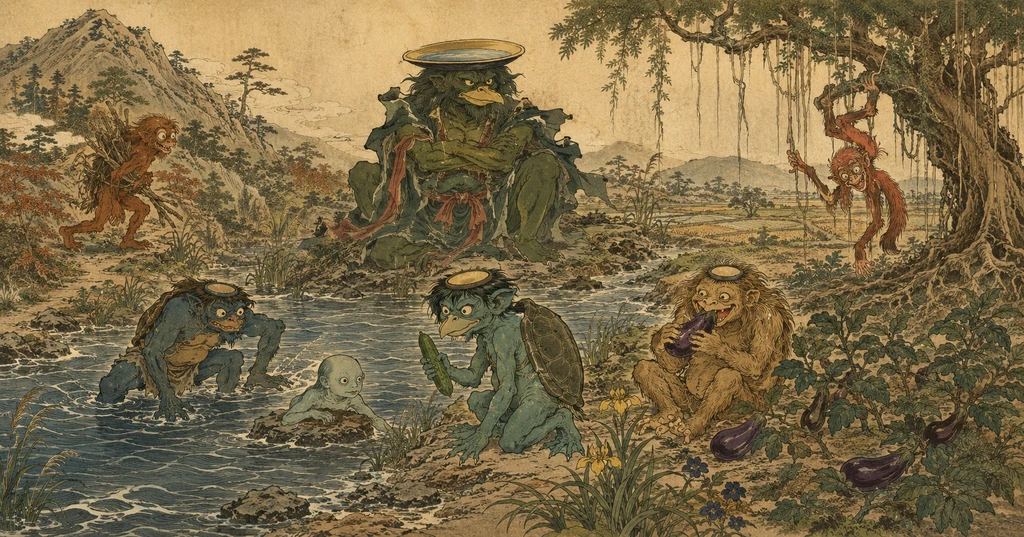
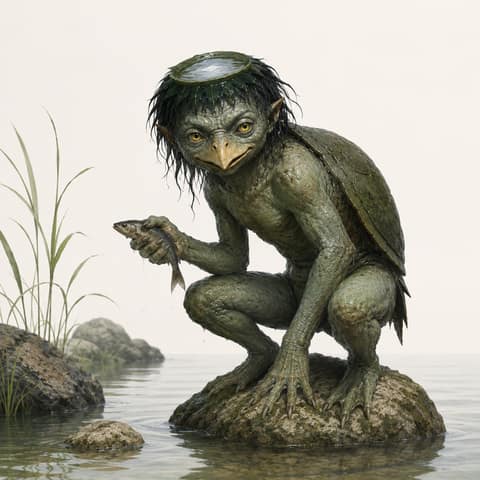
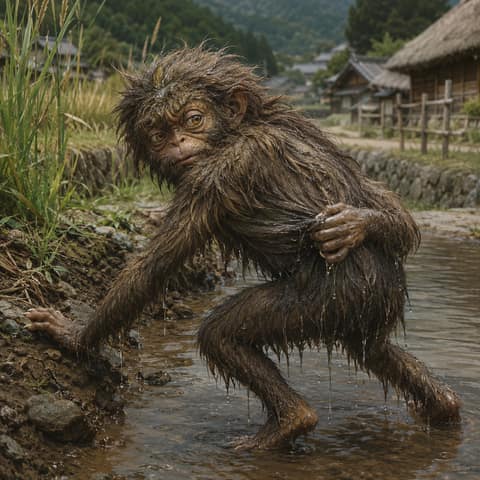
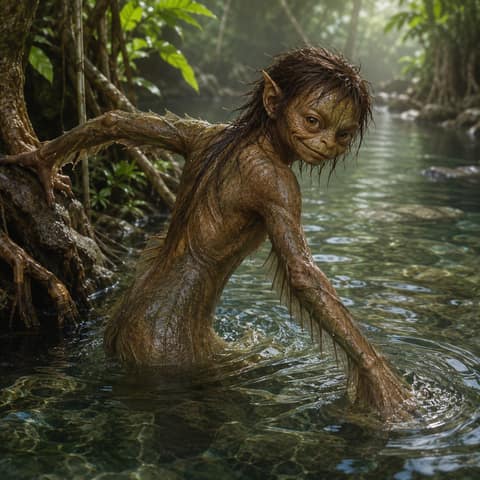
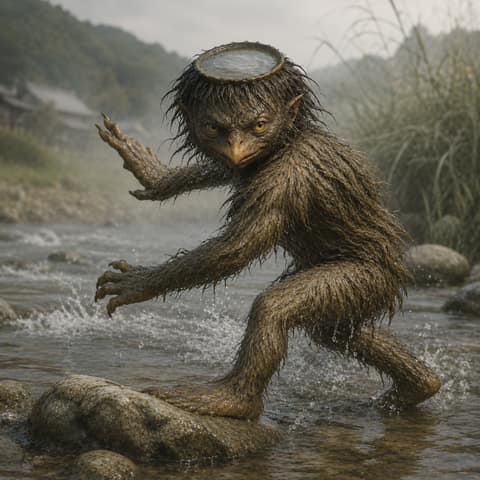
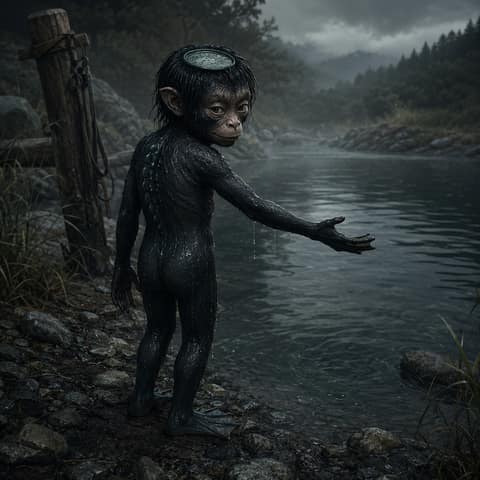
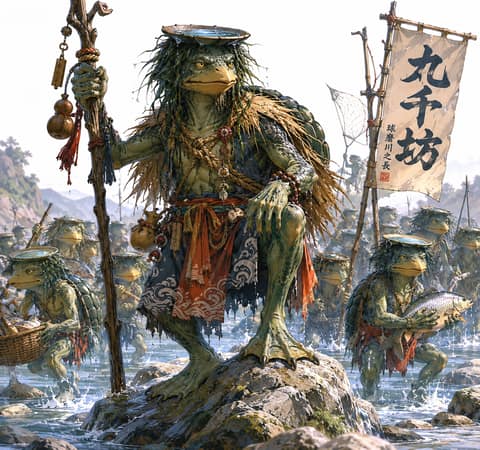
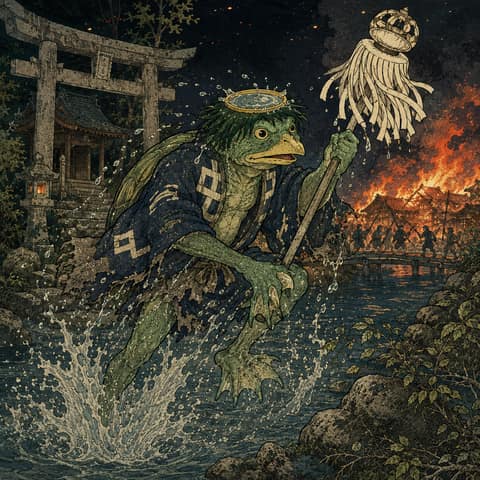
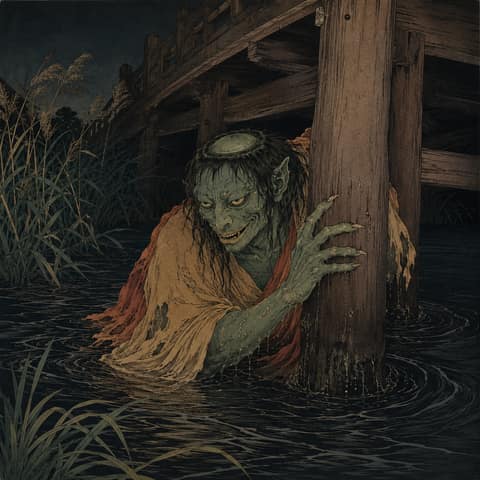
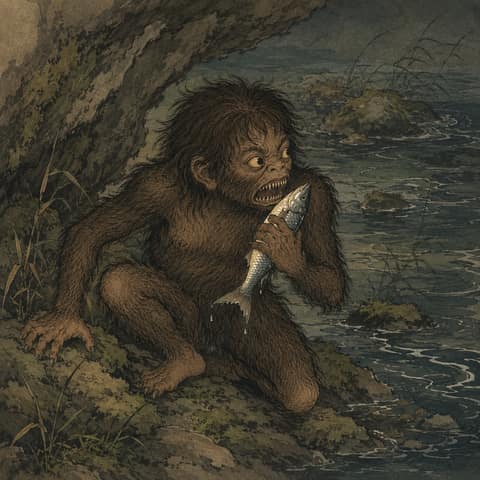
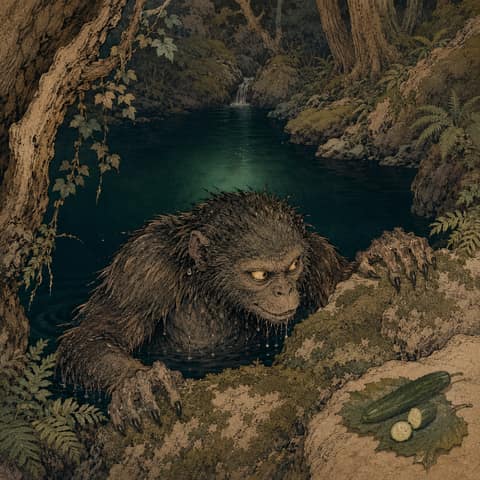
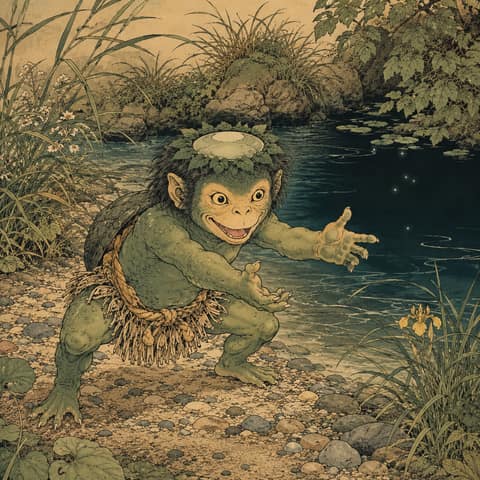
Hyōsube is a hairy, water-dwelling yokai found throughout the Kyushu region. Counted as kin to the kappa—or at least a close relative—it is said to move back and forth between the rivers and the mountains around the equinox. Its name is traced to its birdlike cry of "hyō-hyō." It is fond of eggplant, and in some areas the custom of offering the season's first eggplant still survives. The best-known stories tell of it slipping into a household bath to soak, leaving the water afterward thick with floating body hair; anyone who lays eyes on it, they say, falls ill with fever.
Folklore & Legends
In Saga and Nagasaki the names overlap with those of the kappa (gawappa, gātaro), and the creature is called "Hyōsuhe," "Hyōsubo," and other variants depending on the locale. The lore of its equinoctial wanderings and its "hyō-hyō" cry is spread widely across Kyushu.
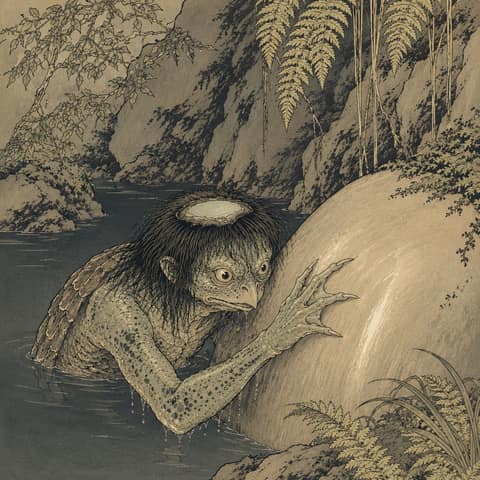
What stands out most in the Hyōsube tales is a curse bound up with bathwater and horses. A horse touches the water in which a hairy Hyōsube has soaked and dies; a bathhouse keeper drains that water and is cursed, his horse struck down. In the fields it is blamed for ravaging eggplant, and people offered the first of the crop to keep it in good humor. Its figure appears in Edo-period picture scrolls as well: in Sawaki Sūshi's Hyakkai Zukan[1] and Toriyama Sekien's Gazu Hyakki Yagyō[2], a hairy, balding, faintly comical Hyōsube can be seen. The extreme claim that "merely seeing it brings certain death" is a later embellishment; originally this was a yokai spoken of gently, bound to the hygiene and taboos of the household.
This version looks at Hyōsube as a distinctly Kyushu kind of kappa, one tightly bound to the taboos of the home. Where most kappa tales unfold at rivers and deep pools, Hyōsube's stories push indoors—into the bathroom, the bathhouse, and the stable. The water a hairy Hyōsube has used is held to be defiled, fouled with floating hair; a horse that touches it collapses, and anyone who drains the water without leave is cursed and loses his horse. Stories of this kind are told all across the region. When to drain the bath, who may use it—such admonitions about the manners of everyday life were voiced in the form of Hyōsube's curse.
In the fields it is said to love and ravage eggplant, and people offered the first of the crop to keep it content. Its birdlike cry of "hyō-hyō" is said to be the very origin of its name. The hairy, bald-crowned, comical figure drawn in the Edo-period Hyakkai Zukan[1] and Gazu Hyakki Yagyō[2] conveys less a thing of terror than a familiar creature living right beside human life.
Character Profile
This section is our own creative profile for storytelling. It is not historical fact or scholarship.
Hairy and faintly comical, it slips into homes to use the bath and raids the eggplant patch. Slight it, and it curses your horses—a neighbor you cannot let your guard down around.
Compatibility
People who value the customs and cleanliness of daily life and who respect the taboos of nature
Abilities
Lurking and swimming in the waterSeasonal passage between river and mountainSlipping into homes and bathhousesFixation on crops, eggplant above allBelieved to carry fever through its curse
Weaknesses
Soothed by an offering of the first eggplant
said to dislike fire and dry places
shuns human eyes
Habitat
Riverbanks and streams, the edges of rice paddies, mountain ravines, the villages and homes of Kyushu
The diagram below is a diagnostic evaluation chart for Hyōsube, the Hairy Riverside Kappa of Kyushu. The higher the value of each item, the stronger that characteristic is expressed.