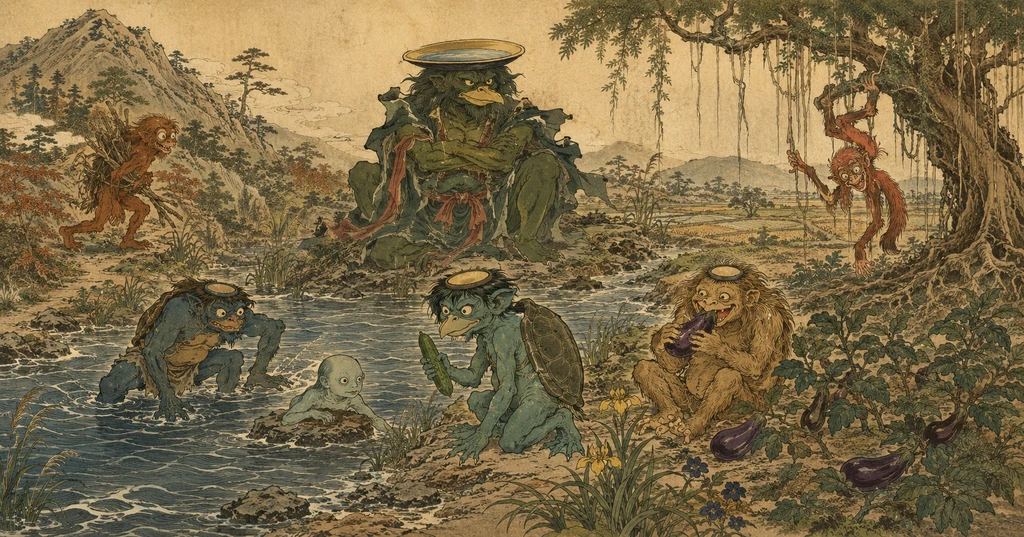
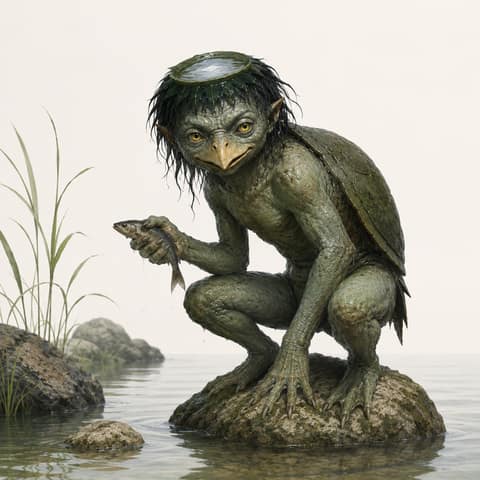
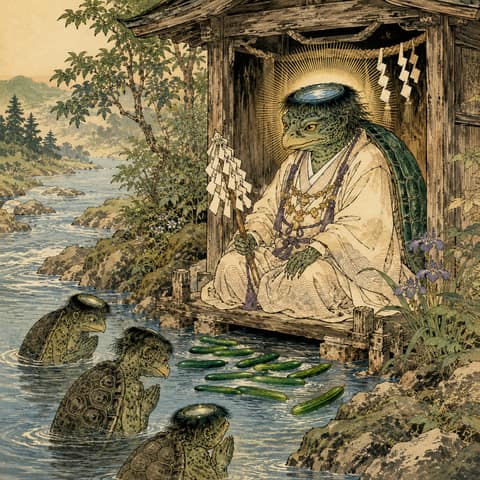
Medochi is the dialect name for the kappa across the Tsugaru region of Aomori Prefecture. The name reaches back to the water-serpent deity mizuchi (蛟) already found in the Nihon Shoki — “mi” (water) + “tsu” (of) + “chi” (spirit), that is, “spirit of the water”[1]. The kappa is a yokai into which a water-god had declined, and this ancient name of that god came to settle upon it. It is also written Medotsu or Midochi.
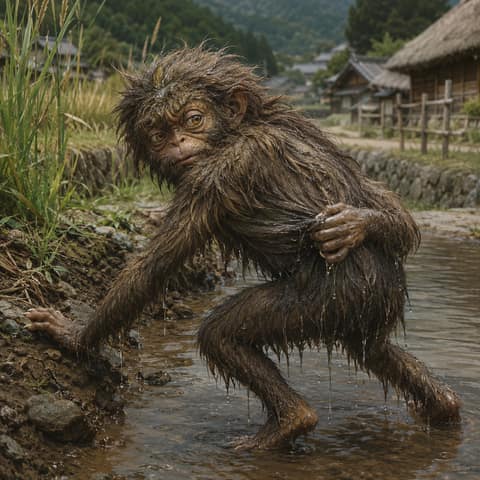
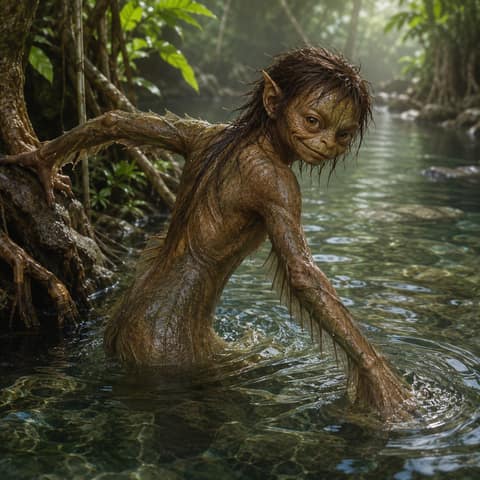
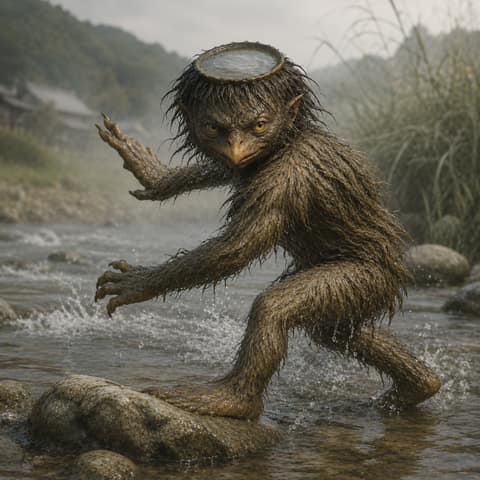
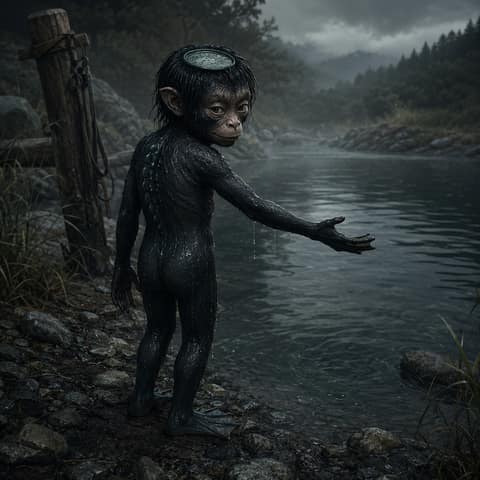
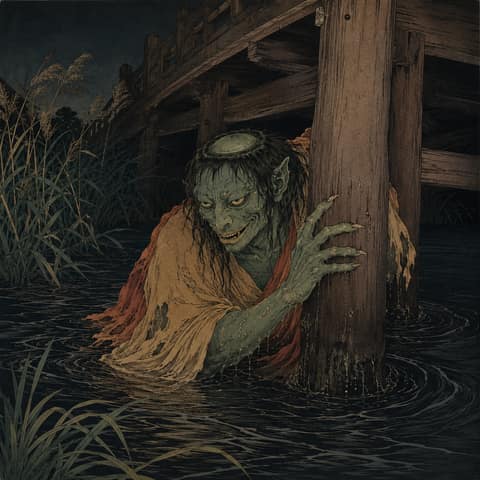
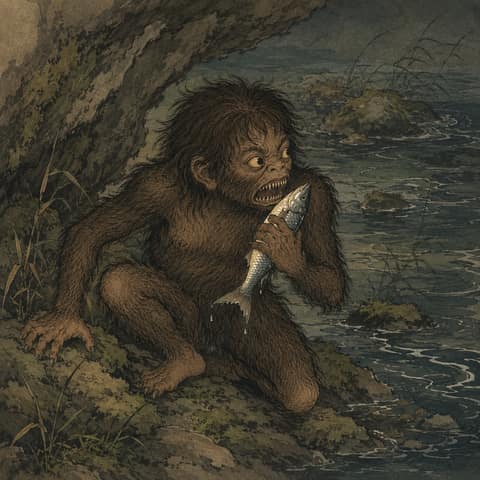
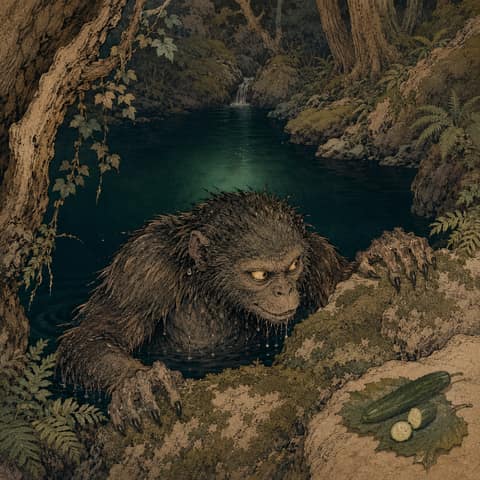
It has a monkey-like face and a wholly black body, and at a glance looks like a child of about ten[2]; at times it takes the form of a young girl to lure people into the water and drown them. The familiar marks of the kappa — the dish atop the head, the webbing between fingers and toes, a fondness for sumo — it has them all, yet what one remembers of the Tsugaru medochi is this monkey face and this black body. The riverside spots where horses were washed, and the deep pools, were feared as places where it would drag a person under, not to be approached lightly.
Folklore & Legends
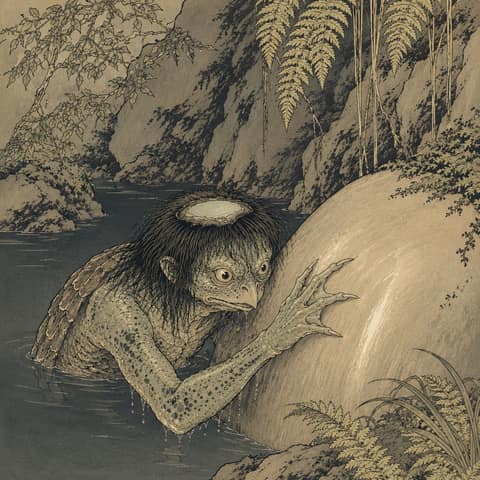
Tales of the medochi are thickest along the Iwaki River. In his miscellany Tani no Hibiki[3], Hirao Rosen records that in the Bunka era, at the Jizō pool of the Iwaki River, a hand reached out to steal an angler’s catch — a hand like a child’s arm, with four fingers, claws sharp as a bird’s beak, and skin mottled blue-black like liverwort — and the angler cut it off with a single stroke. From the castle town of Hirosaki, in the Wakadō quarter, comes a tale of the Kan’ei era: a child drowned in a small stream, and from its lower body emerged a flat, big-headed, snake-like thing, which people took for a medochi. When the people of Tsugaru speak of misfortune in the water, they say it “pulls out one’s danko (shirikodama).”
There were many ways to ward it off. Floating the first cucumbers of the season down the river as an offering before anyone ate them was a custom found throughout Tsugaru, with the elders warning, “Eat first and the kappa will take you.” Tucking a hemp stalk into one’s hair when swimming was said to make the kappa dissolve at a touch; and some gave their children false names, lest the water-god call out a true name and summon the child away.
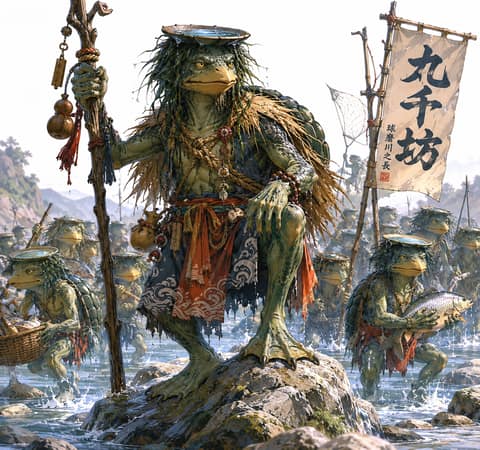
To quell the medochi, people enshrined Suiko-sama (the Suiko Daimyōjin)[4]. The story goes that in the early Meiji years, after children had drowned again and again in the Koden River, the priest of Jissō-ji at Kizukuri (now part of Tsugaru City) granted godhood to the “kappa’s chief” and gave it worship — and that is how the cult began[5]. Some say a single Suiko-sama governs forty-eight medochi, but this belongs to popular lore. In Tsugaru, the medochi and Suiko-sama are often two faces of one and the same water-spirit — one the demon that drags people under, the other the water-god that stills the floods — the two never quite to be told apart.
This version looks closely at how the medochi, though merely “a dialect name for the kappa,” carries a face all its own, belonging to the land of Tsugaru.
Begin with the name. Medochi derives from mizuchi (蛟), which once meant a water-serpent deity[1]. How it came to be the name of the kappa traces a larger current in waterside belief — a water-god declining over the ages, descending step by step from a revered deity into a dreaded yokai. The name medochi carries that memory of decline down to the present day.
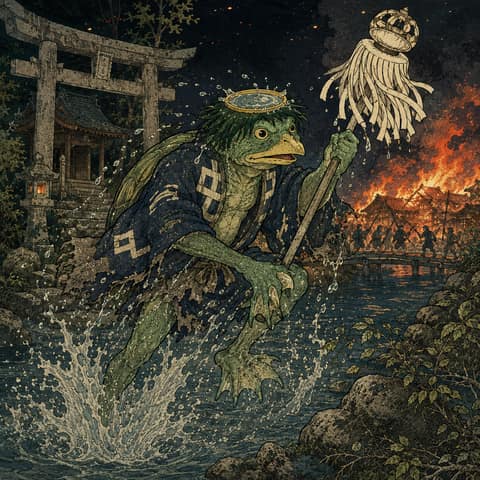
In its image, too, the Tsugaru medochi stands apart. Where the Edo artists drew the kappa with a beak and a shell, the people of Tsugaru told of a monkey face and a black body[5]. Around Towada they say the medotsu has a red face; color and form waver from place to place. All that holds constant is the stature of a child, and that eerie pull toward the water.
What must not be overlooked in matters of belief is its two-sidedness with Suiko-sama. In Tsugaru, the medochi that drags people under (the demon) and the Suiko-sama that quells it (the water-god) are often spoken of as two faces of one same being[4]. In 1934 Orikuchi Shinobu saw with his own eyes the Suiko image at Nagata, had a copy made of it, and held a river festival at Kokugakuin. The figure of “one Suiko-sama for forty-eight” has no scholarly grounding, yet the sense of rank — the medochi governed by a “chief” — is truly rooted in the water-god belief of Tsugaru.
Its weaknesses, and the means of quelling it, all come back to its bond with the river. It dissolves at the touch of a hemp stalk; offer the first cucumber of the season and it takes no one; enshrine Suiko-sama and the deep pool grows calm. The people of Tsugaru lived by the water and feared it too — and the medochi, this kappa, is something like the knot they tied of those days in their hearts.
Character Profile
This section is our own creative profile for storytelling. It is not historical fact or scholarship.
A monkey face and a black body. It takes the shape of a child, of a girl, to draw people toward the water. Feared on the one hand, yet on the other believed to be calmed by an offering of the season’s first cucumber.
Compatibility
Those who keep the taboos of the waterside and do not hoard the first of the season
Abilities
Takes the shape of a girl or child to lure people to waterDrags people and horses into the deep poolsPulls out one’s shirikodama (danko)Counted a familiar of the water-god Suiko-sama
Weaknesses
Said to dissolve at the touch of a hemp stalk
Calmed by an offering of the season’s first cucumber
Quelled through the worship of Suiko-sama
Habitat
The Iwaki River and its pools, the Koden River, riverside horse-washing spots, irrigation ponds
The diagram below is a diagnostic evaluation chart for The Kappa Lurking in Tsugaru’s Waters — Medochi. The higher the value of each item, the stronger that characteristic is expressed.