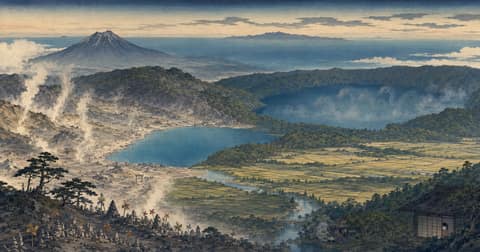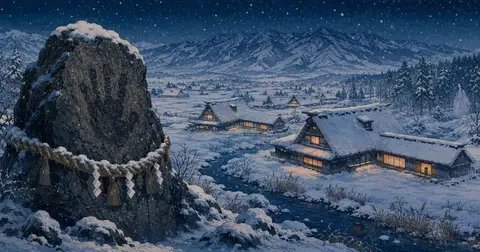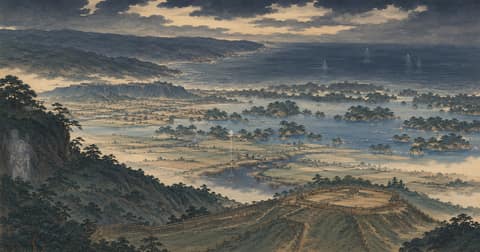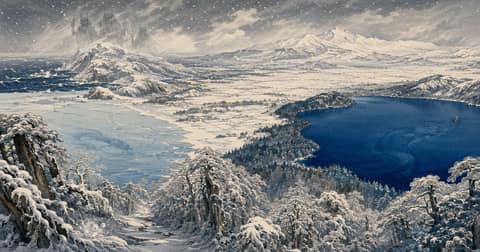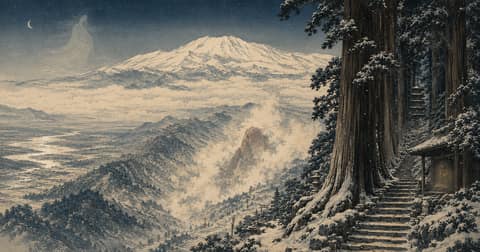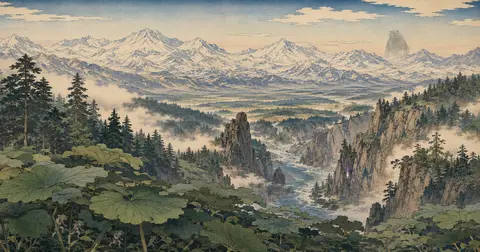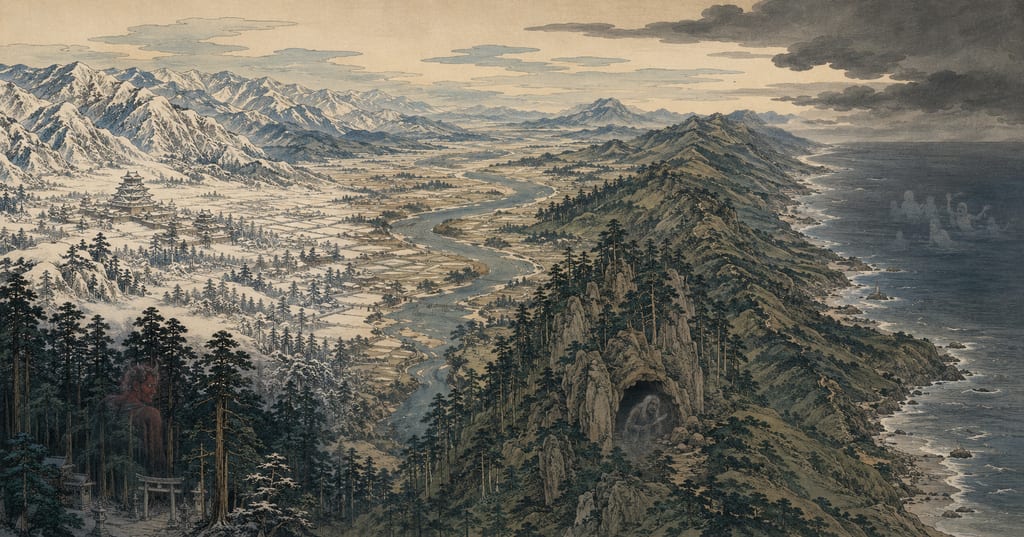
Fukushima Prefecture is sharply divided into three distinct regions from east to west by the Ou Mountains and the Abukuma Highlands running north to south: Hamadori, Nakadori, and Aizu[1]. Hamadori washed by the Pacific waves, Nakadori where the Abukuma River flows north weaving through basins, and Aizu closed off by the mountains of Echigo and Shimotsuke—these three worlds each have different climates, histories, and faiths, and the faces of the supernatural born there are also distinct. Sea apparitions in Hamadori, demon legends in the plains of Nakadori, and a giant red-faced demon dwelling in the shrines of Aizu.
Standing at the pinnacle is the Demon Hag of Kurozuka (Kurozuka no Onibaba), passed down in Adachigahara of Nihonmatsu, north of Nakadori. This karmic hag, said to have slain pregnant women to gouge out their fetuses' livers, was composed in Heian waka poetry, brought to the Muromachi Noh stage, adapted into Jōruri and Kabuki in the early modern period to spread nationwide, and still leaves her rocky cave by the Abukuma River today. With this demon hag as its backbone, this article weaves together the supernatural scattered across the three regions of Fukushima into a single narrative—from Aizu's Shu-no-ban, the Mujina shape-shifting in the fields and mountains of Mutsu, the Medochi lurking in the rivers, to the Funayurei appearing in the seas of Hamadori.
The Demon Hag of Adachigahara:
A Supernatural Tale Originating from a Single Waka Poem
When discussing the yokai of Fukushima, one must first return to a single waka poem. Composed by Taira no Kanemori, one of the Thirty-Six Immortals of Poetry: "Is it true what they say, that a demon is confined in Kurozuka of Adachigahara in Mutsu?"[2]—This poem, included in the Miscellaneous section of Volume Nine of the *Shūi Wakashū* (compiled around 1005 during the Kankō era), is considered the oldest documentary trace of the Adachigahara Demon Hag legend.
However, historical fact and legend must be carefully separated here. Kanemori's poem was originally not a blood-scented ghost story, but a witty, playful verse. According to ancient interpretations of the headnote accompanying the poem, this was a wordplay likening the sisters of Minamoto no Shigeyuki, a Mutsu poet reputed to have many daughters, to "demons confined in Kurozuka" in the distant frontier[3]. In other words, by the mid-Heian period, the verbal association connecting "Adachigahara", "Kurozuka", and "demon" was already shared among capital poets, but the bloody narrative of a demon hag who murders pregnant women and devours people was not yet contained in this waka. The gruesome plot forming the core of the supernatural tale crystallized over a long time, as the imaginations of later storytellers intertwined repeatedly around the fame of this poetic motif (utamakura). Here lies an excellent example of the relationship between place names and stories, where a poetic motif eventually gives birth to a legend.
Kurozuka
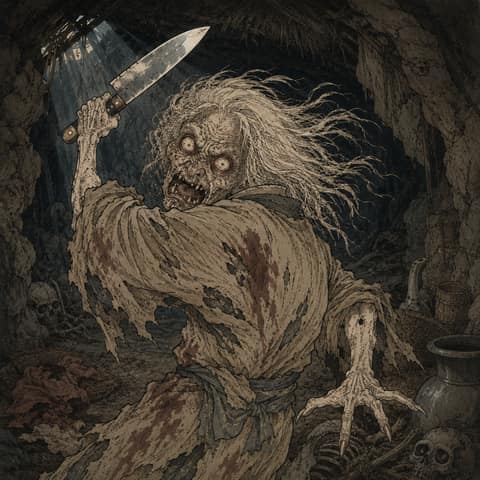
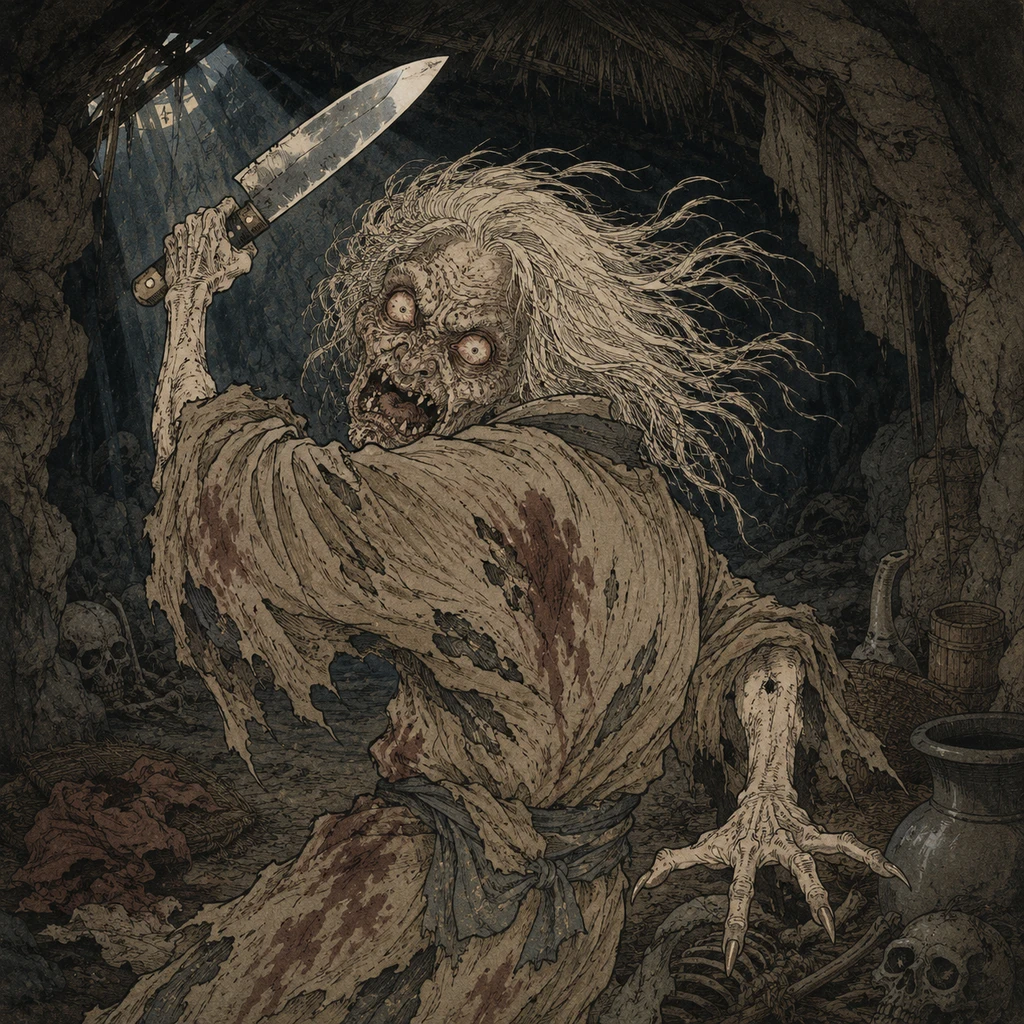
Established in prominence during the Heian period by Taira no Kanemori's poem in the *Shui Wakashu* (1006)—"Is it true what I hear, that a demon hides in the Black Mound (Kurozuka) of Adachigahara in Michinoku?"—this is the legend of the hag (Onibaba) of Adachigahara in Mutsu Province (modern-day Nihonmatsu City, Fukushima Prefecture). She is the ultimate embodiment of the yokai archetype of the "mountain crone who shelters travelers, only to attack them at midnight and devour their livers." Dramatized as the Noh play *Kurozuka* (Adachihara) by Kanze Kojiro in the medieval Muromachi period, and further perfected as the Joruri and Kabuki play *Oshu Adachigahara* (premiered 1762) by Chikamatsu Hanji and others during the Edo period, it remains the most representative Japanese hag legend, still performed today. The primary site of the legend is Kanze-ji Temple (founded 727, Nihonmatsu City), where the "Kurozuka" within the precincts is said to be her burial mound. The tragic narrative of her true identity, "Iwate"—who, in her desperate search for a liver to cure her mistress, unknowingly murders her own daughter—was added in later eras, deepening the tale from a simple monster story into a profound human tragedy.
Read moreThe standard narrative of the telling goes like this. A wet nurse serving a noble household in Kyoto, believing an oracle that the fresh liver of a pregnant woman's fetus was required to save a princess born unable to speak, leaves her own young child behind at the estate and embarks on a journey. Wandering as far as Adachigahara in Mutsu, the wet nurse takes up residence in a rocky cave looking down on the Abukuma River, waiting single-mindedly for years for a pregnant woman to pass by. After a long passage of time, a young couple asks for a night's lodging. The wife was in her final month of pregnancy. When the husband steps out to seek medicine for his wife who goes into labor, the wet nurse wields a blade, kills the wife, slices open her belly, and gouges out the sought-after fetal liver. However, among the belongings of the dead woman, the wet nurse discovers the very amulet pouch she had placed around the neck of her own young child long ago. The woman she had killed was her own daughter, who had grown up separated from her—realizing this gruesome karma, the wet nurse loses her mind from sheer grief, turning into a demon hag (onibaba) who devours travelers passing through Adachigahara. This structure, where a mother's love twists into the worst possible karma, elevates the tale of the Kurozuka Demon Hag from a mere ghost story to a profound tragedy.
Enter Tōkōbō Yūkei, a monk from Kishu. During the Jinki era of the Nara period (around 724-729)[4], Yūkei, traveling through various provinces, seeks lodging at the rocky cave in Adachigahara at nightfall. The elderly landlady kindly lights a fire for him, but leaves to gather firewood with strict instructions not to peek into the inner room. Breaking the taboo, Yūkei looks inside only to see a mountain of decaying human bones. As the terrified Yūkei flees, the demon hag, revealing her true form, fiercely pursues him. Just when all seems lost, Yūkei takes out his principal image of the Nyoirin Kannon (Cintamanicakra) from his portable shrine and recites sutras with all his heart. The Kannon then appears in the sky and shoots down the demon hag with a white-feathered arrow. Yūkei buried the hag's remains by the Abukuma River, and it is said that the mound remains today as Kurozuka[5].
The excellence of this legend lies in the fact that the story does not end as an abstract ghost story, but is anchored to the land as a concrete reality that can be "traced by walking." The Abukuma River is a great river that originates in southern Fukushima, flows north through the Nakadori basin, and pours into the Pacific Ocean at Iwanuma in Miyagi; near Nihonmatsu, strange and grotesque rocks associated with the demon hag cluster on its eastern bank[6]. Kasaisi and Hebiishi forming the rock where the hag sharpened her blade, the Blood Pond (Debaarai-no-ike) where she is said to have washed her carving knife, the Night-crying Stone (Yonaki-ishi) that wept every night—and within the precincts of Kanze-ji Temple (Buzan sect of Shingon Buddhism), Kurozuka still remains, said to bury the demon hag at the roots of an old cedar tree, enshrining the Nyoirin Kannon that saved Yūkei as its principal image[5]. The entire area is designated as a National Place of Scenic Beauty as a "Landscape of Oku no Hosomichi (The Narrow Road to the Deep North)" visited by Matsuo Bashō, and it was reported that a portion of the giant rocks forming the cave collapsed during the 2022 earthquake[7]. The Kannon statue is passed down as a hidden Buddha (hibutsu) unveiled only once every few decades, and the apparition sung of in Heian waka continues to draw pilgrims even after a thousand years have passed[4]. Here exists a rare supernatural ecosystem where associations born from a witty waka poem have multiplied in layers into temple origins, Noh, Jōruri, Kabuki, and tourism.
Noh *Kurozuka*:
When the Demon Hag Becomes Performing Art
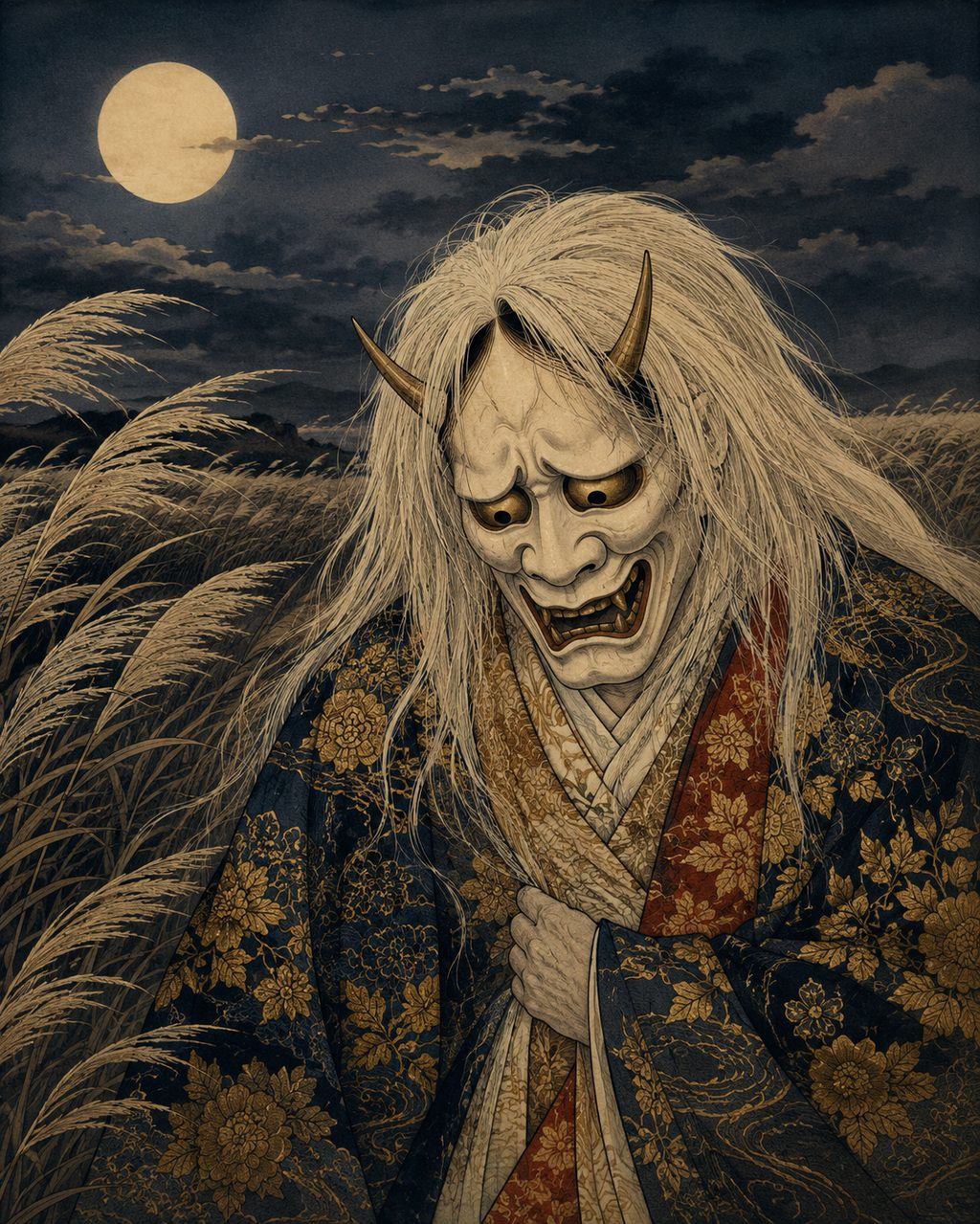
The orally transmitted demon hag ascends to the Noh stage by the Muromachi period. The fifth-category play *Kurozuka*—called *Adachihara* in the Kanze school[8]. A group of yamabushi (mountain ascetics) visiting Adachigahara borrow lodging at the hermitage of an old woman spinning thread. The old woman leaves to gather firewood telling them not to look in the inner room, but an attendant breaks the taboo and peeks, only to find a mountain of corpses emitting a foul stench. Her true identity revealed, the old woman transforms into a demoness and attacks the yamabushi, only to be subdued by prayers and disappear into a demon fence (onimagaki).
What is noteworthy is that the Noh play deliberately strips away the wet nurse's sorrowful backstory—the tragedy of murdering her own child—and condenses the drama onto the single point of the violation of the "do not look in the inner room" taboo, and the true demonic nature exposed by it. The demon of Adachigahara, sung of as a "confined demon" in Kanemori's waka, here gains a physical space to "confine" herself on stage (the demon fence), crystallizing into a play of the terror of seeing what must not be seen. The Hannya mask worn by the latter-half lead actor (nochi-shite) is said to retain not just terrifying aspects, but the sorrow of a woman lamenting her own aging and loneliness while spinning thread; the fact that human passions still dwell even within a man-eating demon elevates this piece to represent the pinnacle of female demon Noh plays[8]. The Heian wordplay was reborn into a physical, medieval performing art.
Jōruri *Ōshū Adachigahara*:
Interwoven with the Former Nine Years' War
Entering the early modern period, the tale of the demon hag is woven into an even larger historical drama. The puppet jōruri *Ōshū Adachigahara* (Adachigahara in Ōshū), premiered at the Takemoto-za theater in Osaka in Hōreki 12 (1762)—a five-act period piece co-authored by Chikamatsu Hanji and Takeda Saburobei[9]. The story intertwines the historical plot of the Abe brothers, Sadato and Muneto, secretly planning a resurgence after their defeat in the Former Nine Years' War set in mid-Heian Ōshū, with the Adachigahara demoness legend. The most famous segment today is the finale of the third act, "The Scene of Sodehagi's Festival Text" (Sodehagi Saimon no Dan)—commonly known as "Adachi San." This is one of the most difficult pieces in Gidayū-bushi, depicting Sodehagi, who was disowned by her father for her love for Abe no Sadato and now wanders through the snow as a blind female street entertainer (goze), arriving at the gates of her father's mansion with her young daughter Okimi, reciting a saimon text begging for forgiveness while strumming her shamisen[9]. The demoness of the story is identified as Iwate, a surviving vassal of the Abe clan, superimposing the Adachigahara demon hag tale and historical tragedy within a single woman. Eventually, this jōruri was adapted for Kabuki and performed on stages nationwide, and combined with modern tourism like Nihonmatsu's Adachigahara Furusato Mura, the demon legend continues to be inherited as regional culture[4]. The Demon Hag of Adachigahara is thus a rare apparition that has circulated through all the major vessels of Japanese performing arts—waka, Noh, Jōruri, and Kabuki—acquiring a new face each time.
The Red Face of Aizu:
A Giant Demon Named Shu-no-ban
While the great demon of Nakadori is a monster of karma and tragedy, what the enclosed mountain basin of Aizu nurtured was a much more viscerally terrifying apparition. The giant red-faced demon said to appear at the shrines of Aizu, Shu-no-ban.
Shu no Ban
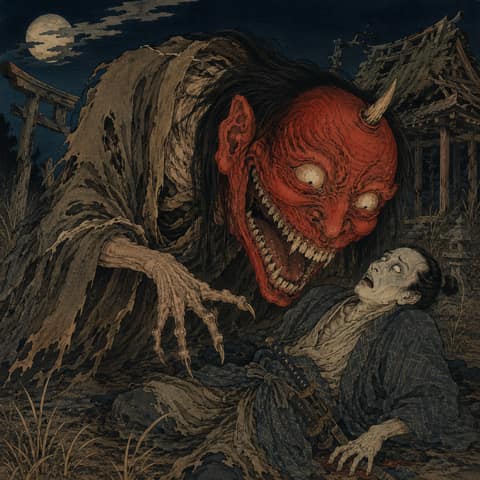
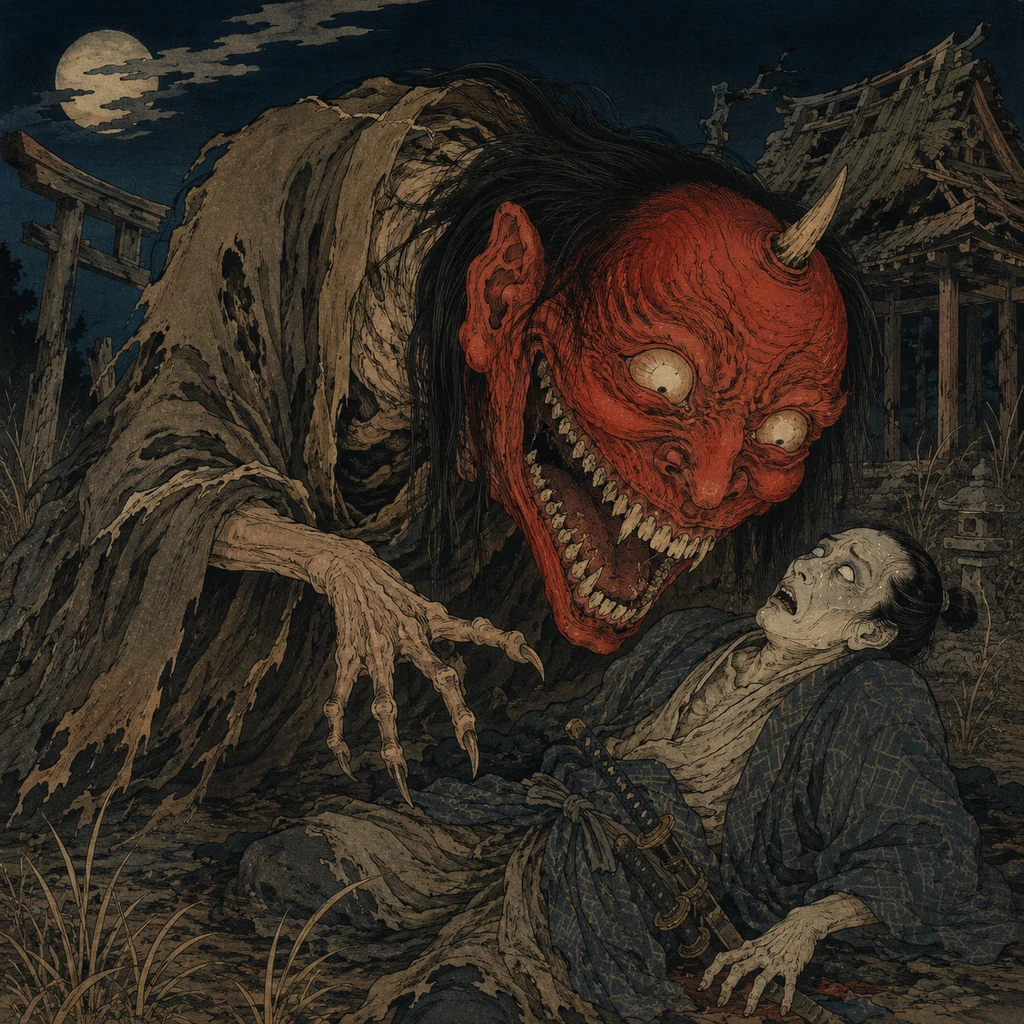
A specter recorded in Edo-period tale collections such as Shokoku Hyaku Monogatari and Rōō Zawa. Written as “首の番” or “朱の盤,” all read as shu no ban. It appears as a monk-like figure with a crimson face, terrifying onlookers with its ghastly visage and stealing their souls. Stories pair it with the Tongue-Long Crone and often use the “second scare” motif, where a victim is frightened twice; those who encounter it are said to faint, waste away, or die.
Read moreThe region of Aizu, surrounded on all four sides by the mountains of Echigo, Shimotsuke, and Dewa, has long formed a unified cultural sphere. In the Middle Ages, the Ashina clan ruled the area from Kurokawa Castle, and Ujisato Gamō, who entered the domain in Tenshō 18 (1590), renamed the castle town "Wakamatsu" and completed a seven-story keep, naming the castle Tsurugajo[10]. This basin, isolated by mountains from both the capital and the Nakadori region of the Abukuma River basin, became a hotbed that fostered a unique culture of ghost stories.
The literary lineage of this apparition is surprisingly old and firmly tied to Aizu place names. The oldest extant record dates back to the ghost story collection *Shokoku Hyakumonogatari* (One Hundred Tales from Various Provinces) published in Enpō 5 (1677). In its Volume One, "The Matter of the Monster Called Kubinoban at the Suwa Shrine in Aizu"[11]—here, the monster is written as "Kubinoban" and told as an apparition appearing at Aizu's Suwa Shrine (present-day Suwa Shrine). The plot goes like this. A young samurai, Kakunoshin Yamada, hearing that a terrifying monster called Shu-no-ban appears at the Suwa Shrine in Aizu, goes to the shrine at night as a test of courage. When he asks another young samurai he meets on the road, "What kind of thing is this Shu-no-ban that they say appears at this shrine?", the other turns around slowly, thrusting forward a face burning bright red with horns on its forehead, eyes wide as saucers, hair standing on end like needles, and a mouth torn to its ears, pressing him: "Is Shu-no-ban something like this?"—a standard jump-scare apparition. Depending on the telling, the terror is layered double or triple, claiming that when the terrified Kakunoshin fled home, even his wife or maid who greeted him transformed into that red face when they turned around.
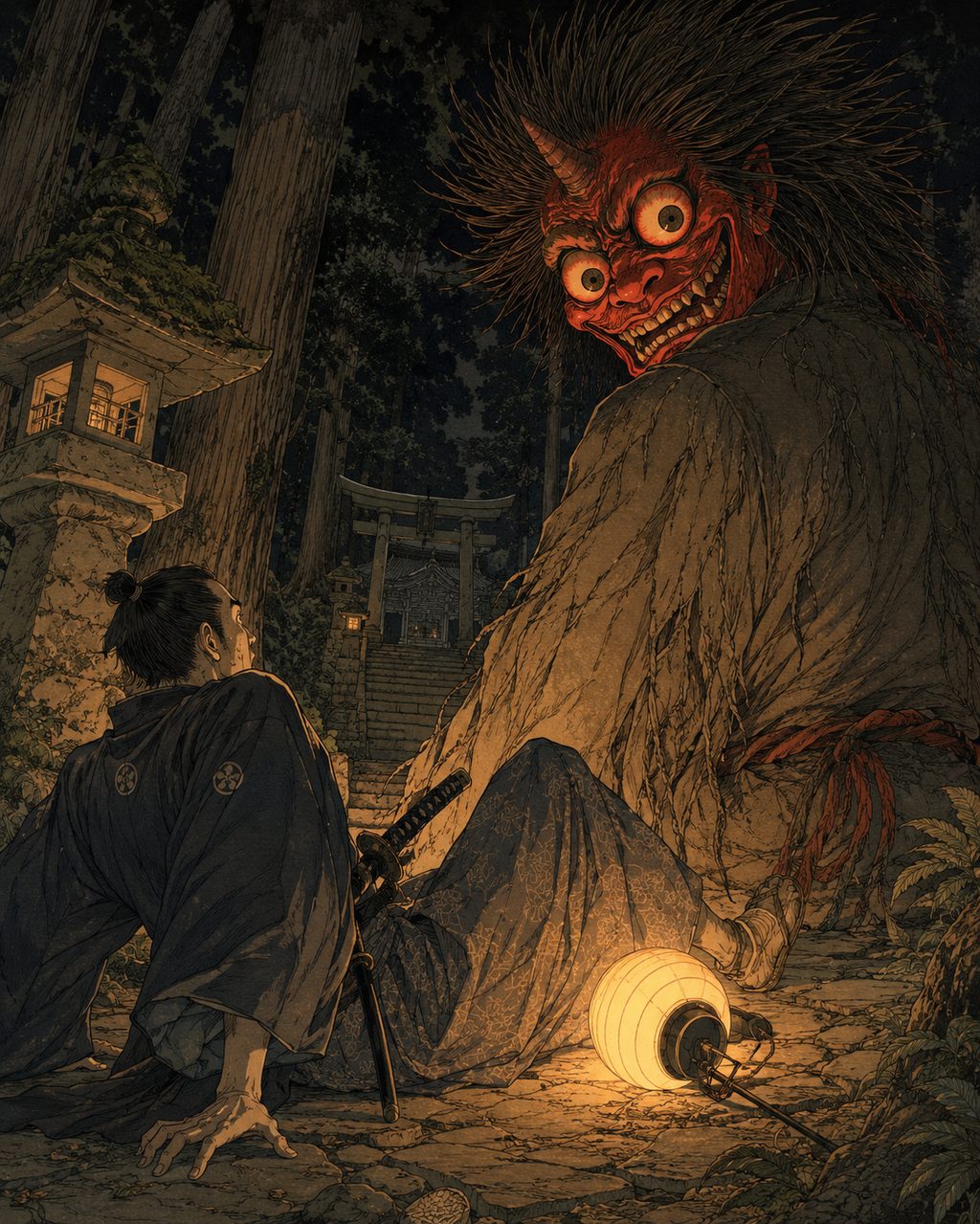
This monster migrated through literature changing its spelling, while remaining firmly tied to Aizu place names. The essay *Rōō Sawa* (Tea Chats of Old Women) (Kanpō 2, 1742) set in Aizu records it under the name "Shu-no-ban"[12], depicting it as a monk figure standing six shaku (about 1.8 meters) tall with a red face. Then, in An'ei 8 (1779), Toriyama Sekien gave it a visual form under the name "Shu-no-bon" in his *Konjaku Gazu Zoku Hyakki* (The Illustrated Demon Horde from Past and Present, Continued)[13]. What should be noted as a subtlety of early modern yokai history here is that Sekien did not create this monster himself, but fixed into a painting a ghost story that had been passed down earlier in Aizu. While the spelling wavered from "Kubinoban" to "Shu-no-ban" to "Shu-no-bon," only the core of the location—Aizu and Suwa Shrine—was consistently maintained across a century. This trajectory, transferred from ghost story collections to yokai art books while bearing the name of a specific shrine, illustrates the typical form of transmission for place-rooted early modern yokai.
In later years, Kyōka Izumi featured "Shu-no-banbō" in his play *Tenshu Monogatari* (Castle Tower Story), adapting it as a yokai living in Jūmonjigahara. The giant red demon bound to a single shrine in Aizu thus gained another life within the fantasy space of modern literature. While the Demon Hag of Adachigahara is a monster of the inner world carrying the tragedy of karma, Shu-no-ban is purely an apparition of the outer world that simply shows off "the terror of a face turned around"—even among demons in Fukushima, the nature of the supernatural differs completely between Nakadori and Aizu.
The Beasts of Mutsu and the Masters of the River:
Mujina and Medochi
While the great demon apparitions dwell in plains and shrines, the fields, mountains, and waters of Fukushima were filled with much closer, and therefore unguarded, apparitions. The shape-shifting Mujina that bewitch people, and the Kappa lurking in rivers. When read within the expanse of the Ritsuryō province of Mutsu (which includes Fukushima), the ancient strata of these two emerge.
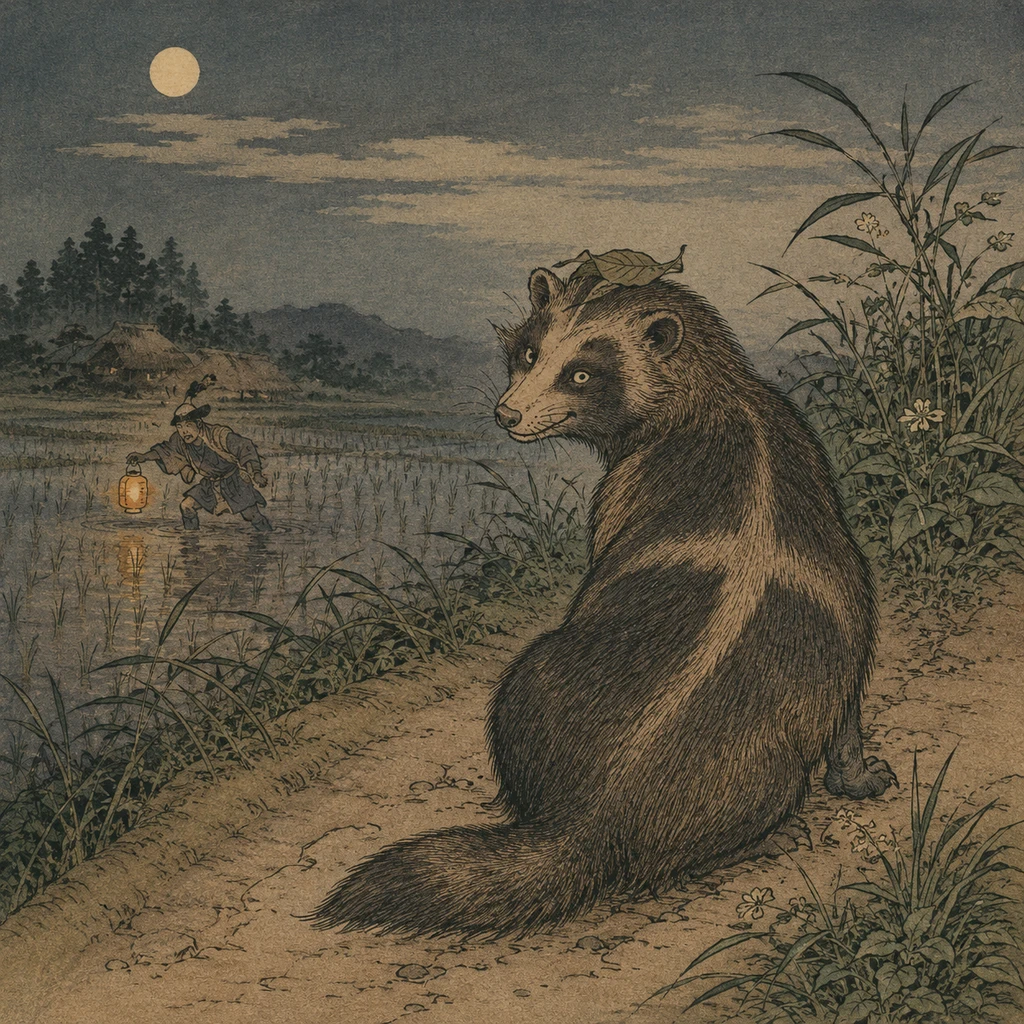

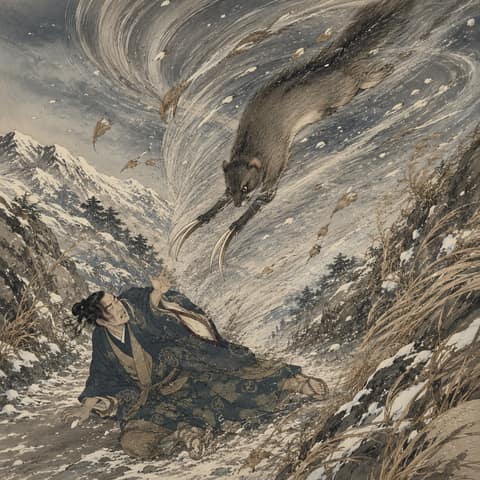
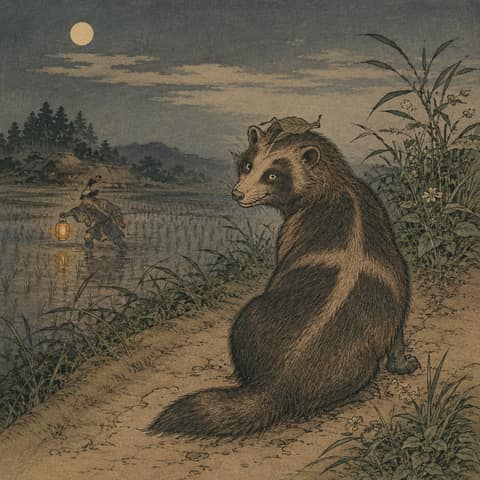
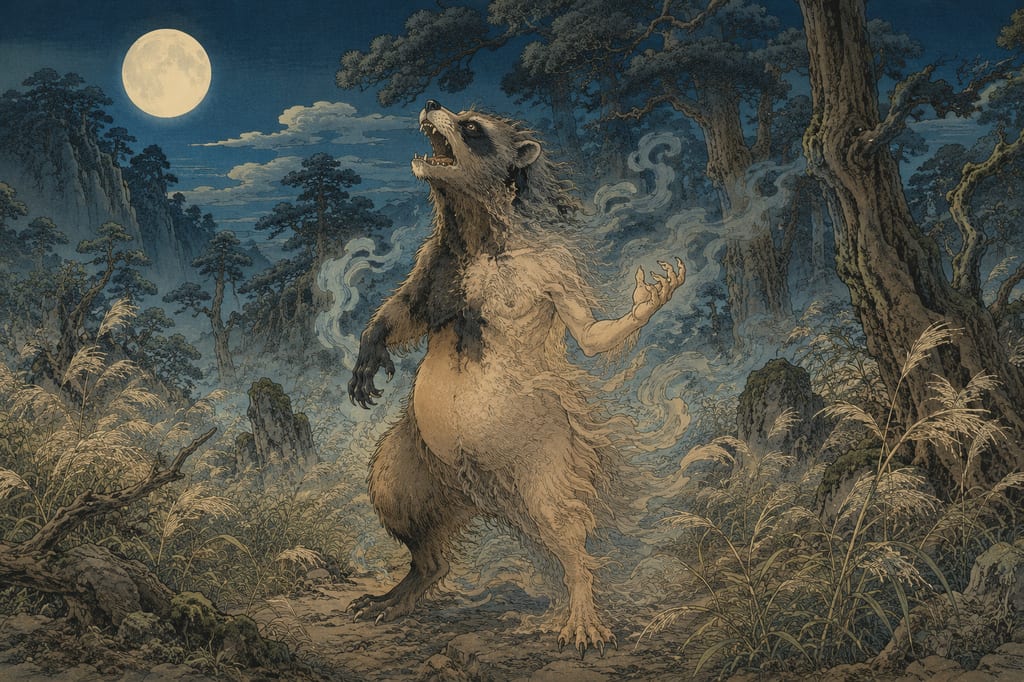
Mujina is originally a term referring to badgers or raccoon dogs (tanuki); depending on the region and era, these were not clearly distinguished but collectively called shape-shifting beasts. Along with foxes and tanuki, they have been spoken of across Japan as representatives of beasts that bewitch humans. Characterizations vary by region: in Gunma, it is said that while foxes and tanuki cast illusions, mujina actually transform their own bodies to appear; in Yamagata, lore goes as far as saying that tanuki only play pranks and foxes don't kill, but mujina bewitch and kill humans[14]. Even on night roads across Fukushima, mujina were feared as entities that would transform into lantern lights or unknown human silhouettes, calling out to travelers to confuse their sense of direction.
What is noteworthy is that the oldest record of shape-shifting mujina is set precisely in the province of Mutsu. In the entry for the 35th year of Empress Suiko (627) in the *Nihon Shoki* (The Chronicles of Japan), it states: "In the second month of spring, there was a mujina in the province of Mutsu; it turned into a human and sang"[15]—This concise sentence stating that a Mutsu mujina took human form and sang is considered the earliest testimony in yokai history, showing that the concept of a beast transforming into a human already existed in 7th-century Japan. Considering that tales of transforming foxes and tanuki appear abundantly in literature only from the Middle Ages onward, the significance of a "shape-shifting beast" appearing in one of the Six National Histories much earlier, and its setting being none other than Mutsu, is immense. Mutsu, whose southern tip was anchored by the land of Fukushima, was carved into national history as the oldest frontline of shape-shifting beast folklore. The tales of mujina bewitching travelers on mountain roads throughout Fukushima are connected to the distant descendants of this memory from over a millennium ago.
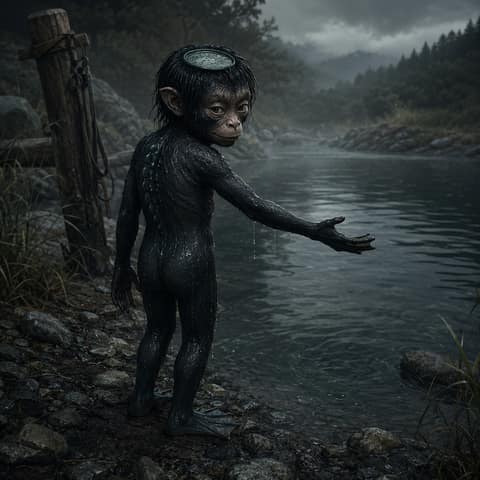
The master of the waters, Medochi (or Medotsu), is a dialect name for kappa in the northern Tohoku region. Here, historical facts must be carefully reserved. The dense distribution area of the name "medochi" is originally northern Mutsu—the Nanbu and Tsugaru regions—and is not a name unique to Fukushima Prefecture. There is a lack of reliable materials explicitly stating that Fukushima kappa were called by this specific name, and one should refrain from leaving this ambiguous and declaring it definitively a "Fukushima yokai." Still, the reason Medochi is placed alongside others in this encyclopedia is none other than because Fukushima once constituted the southern tip of the vast Ritsuryō province of Mutsu, sharing a lineage of awe toward water spirits with the northern lands. There is a theory that the word medochi/medotsu is a corruption of "mizuchi," an archaic word meaning "master of waters" such as water gods or snake/dragon deities[16], and alongside the mizushi of Noto and the mintsuchi of Ezo/Hokkaido, they form a family of "mizuchi-type" names scattered across the archipelago. The appearance of the kappa is told as having a monkey-like face and black body, sometimes transforming into a young girl to lure people into the river bottom. While called a kappa, its true identity is seen as the degraded form of an ancient water god. In Fukushima as well, in the Tadami River of Aizu, Lake Inawashiro, and the deep pools and weirs of the Abukuma River flowing north through Nakadori, an awe toward similar masters of the water certainly breathed, even if the names differed. Looking over the water apparitions through the broad framework of Mutsu, the entities lurking in the river bottoms of Fukushima are of the same family born from an imagination continuous with the northern Medochi.
The Sea of Hamadori:
Funayurei and the Dipper Taboo
Let us turn our eyes to the last of the three regions, Hamadori, facing the Pacific Ocean. This long, narrow coastal strip east of the Abukuma Highlands, where the mountains press right up to the shoreline, has been a fishing ground since ancient times, and from Matsukawaura in Soma to Onahama and Yotsukura in Iwaki, the memories of those who lost their lives to shipwrecks are thickly accumulated. It is there that the Funayurei appears.

Funayūrei
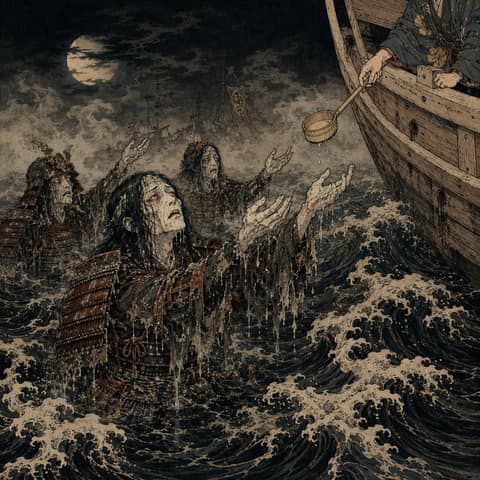
Funayūrei are maritime apparitions formed from the spirits of people who died by drowning or shipwreck. Depending on the region, they may appear as ghosts, phantom boats, eerie lights, or dark figures resembling Umibōzu. They most often emerge on stormy or fogbound nights, when they try to sink a vessel by ladling seawater aboard or confuse its course until it runs aground. Local defenses include offering a ladle with its bottom removed, throwing rice balls or ash, or meeting the ghosts with an unwavering stare. Mōjabune, Bōko, and Ayakashi are among the names applied to such spirits. Toriyama Sekien also depicted Funayūrei in Konjaku Gazu Zoku Hyakki.
Read moreFunayurei are maritime apparitions believed to be the end states of those who died in water accidents, and they are passed down widely along coasts throughout Japan rather than in one specific location. On foggy nights or after a storm, a ship's shadow or human silhouette appears dimly on the sea, approaching one's boat and demanding a dipper (hishaku). If one hands over a dipper as requested, the ghosts will use it to scoop seawater and pour it into the boat, eventually sinking the vessel and taking the crew down with them—this is the standard pattern common nationwide. It is often told that they appear around the time of Obon (the Festival of the Dead), the season when memorial services for those lost at sea are conscious, and the custom of refraining from fishing during Obon—especially after August 16th—remained long in the fishing villages of Tohoku[17].
What stands out in the folklore along the Fukushima coast is the way they call out for the dipper. Here, it is said the ghosts press the people on board, calling "Lend me an inada"[18]. "Inada" refers to the dipper used to bail water on a boat, and in Fukushima, this apparition itself was sometimes called by the alias "Inadakase." The traces of the nationwide Funayurei taking root in the language of the Hamadori fishermen remain in this dialect name.
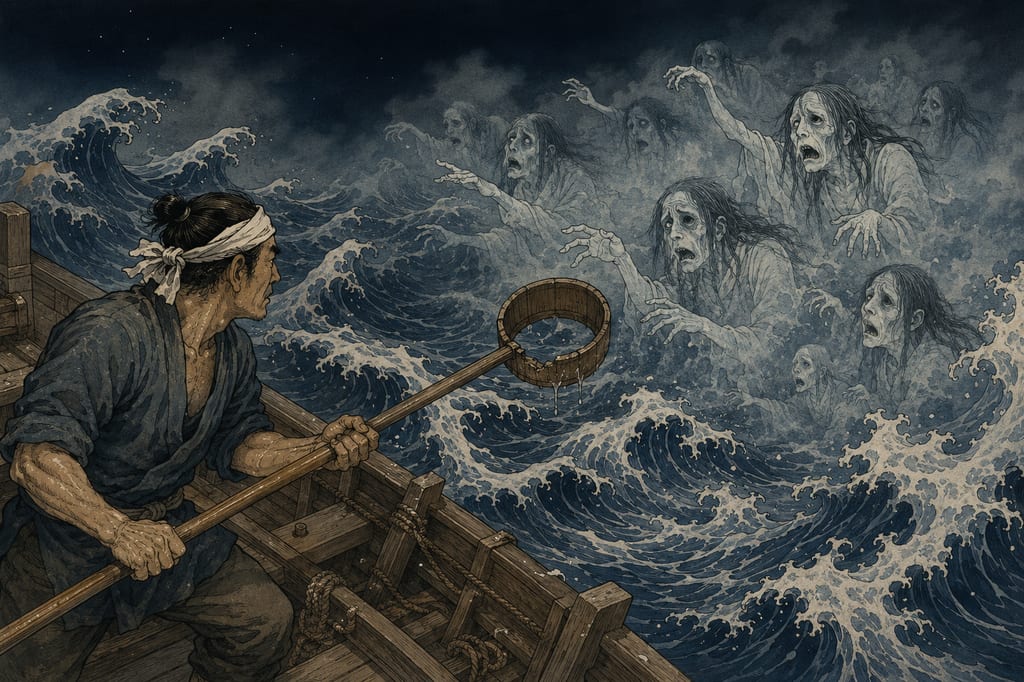
And the etiquette for escaping disaster is also passed down as wisdom inherent to the land. One must not hand over a dipper defenselessly as requested. If one prepares a dipper with its bottom knocked out beforehand and hands it over, no matter how much seawater the ghost scoops, not a single drop will accumulate in the boat, and the Funayurei will leave without causing harm[18]. Alternatively, practices such as throwing rice balls into the sea to appease the spirits of the dead, scattering ashes, or offering incense, flowers, and tributes were also passed down in various places[17]. These were not merely scary stories, but practical knowledge woven into a narrative form and passed down through generations by those who lived facing the rough Pacific Ocean—as an offering to comrades who lost their lives at sea, and as precepts to avoid disaster themselves. The Funayurei of Hamadori carry the regrets of countless dead swallowed by the rough seas east of the Abukuma Highlands, perfectly contrasting with the Demon Hag of Adachigahara, who single-handedly bears the karma of the land.
Three Regions,
One Mutsu
Reviewing the apparitions of Fukushima in this way, one finds that the geography of the three regions serves directly as a map of the supernatural. On the plains of Nakadori, the Demon Hag of Kurozuka, refined from waka to Noh and Jōruri. In the enclosed basin of Aizu, Shu-no-ban, migrating through literature alongside the name of a shrine. In the fields and mountains, the shape-shifting Mujina tracing back to official history; at the river bottoms, the masters of the water continuous with the northern Medochi; and in the seas of Hamadori, the Funayurei accompanied by the dipper taboo.
What binds these together is the fact that Fukushima once constituted the southern tip of the massive Ritsuryō province of Mutsu. From the perspective of the capital, it was "Michinoku"—a strange land at the end of the road, and this very distance made Taira no Kanemori compose "a demon is confined," and caused the song of the shape-shifting mujina to be inscribed in official history. From the rocky cave of Adachigahara to the shoreline of Hamadori, the yokai of Fukushima continue to convey the geopolitical memory of the deep interior beyond the capital's gaze, taking on the visages of their respective lands to this day.