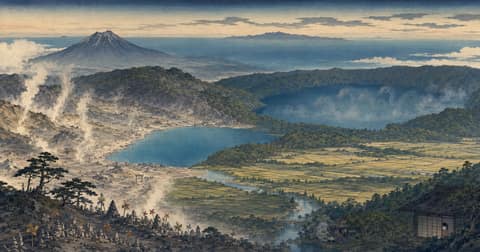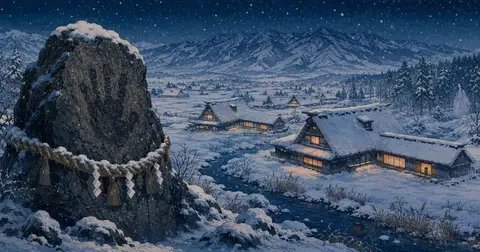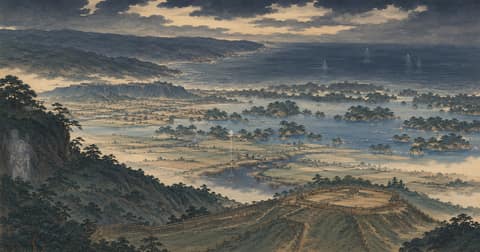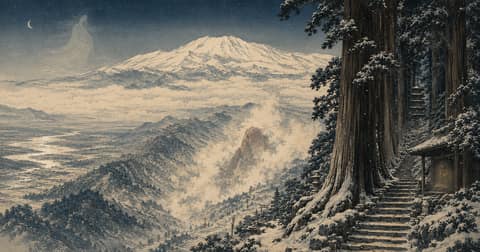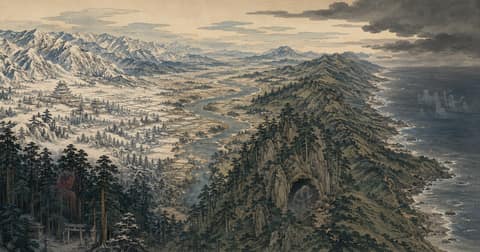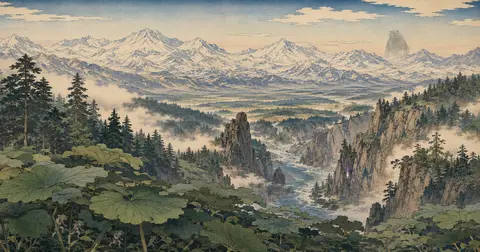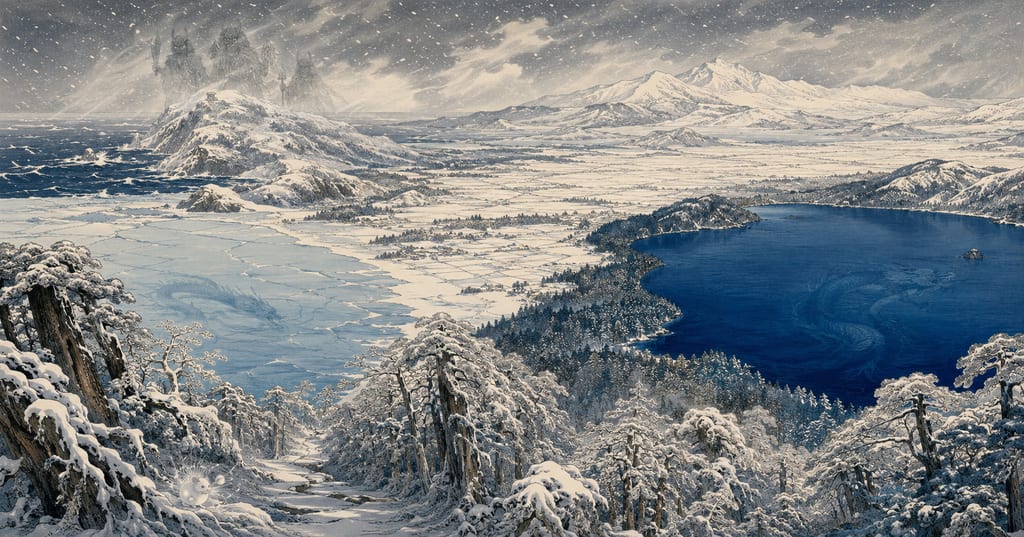
Akita Prefecture corresponds to the northern half of Dewa Province under the old Ritsuryo system—an area designated as Ugo Province during the Meiji era's provincial reorganization. The Oga Peninsula juts out into the Sea of Japan like the head of a beast; Hachirogata, once Japan's second-largest lake, formerly expanded at its base; Lake Tazawa, Japan's deepest lake, brims with lapis lazuli waters in the embrace of the Ou Mountains; and the Shirakami-Sanchi, a World Heritage site preserving pristine beech forests, lies on the border with Aomori. This snow-deep topography, where the sea, lakes, and deep mountains sit side by side, has shaped the very framework of Akita's yokai culture.
The supernatural phenomena spoken of here are not high-ranking evil demons that threaten nobles and authorities like the yokai of the capital. Servants of the gods that visit villages tearing through the winter darkness, a dragon that gouged out lakes, beasts that fall from the sky with thunder, and tiny creatures that appear only before hunters in the mountains—all are entities born from the prayers and awe of people living face-to-face with harsh nature. This article aims to retrace the yokai of snow country Dewa on foot, anchoring upon two main axes: Oga, protected by the visiting deity Namahage, and the world of lakes and marshes connected by Hachirotaro, the dragon of the Three Lakes legend.
Deities that Come from the Darkness of New Year's Eve:
Namahage and the Oga Peninsula
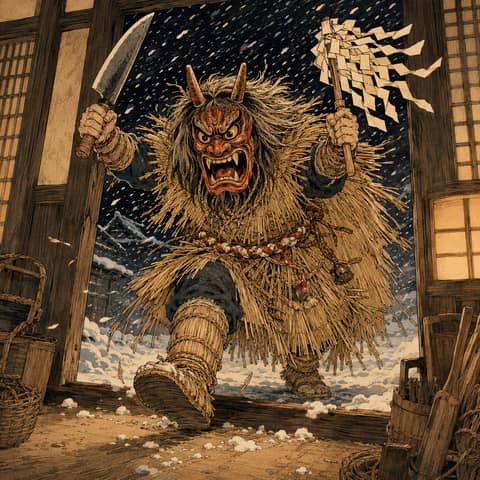
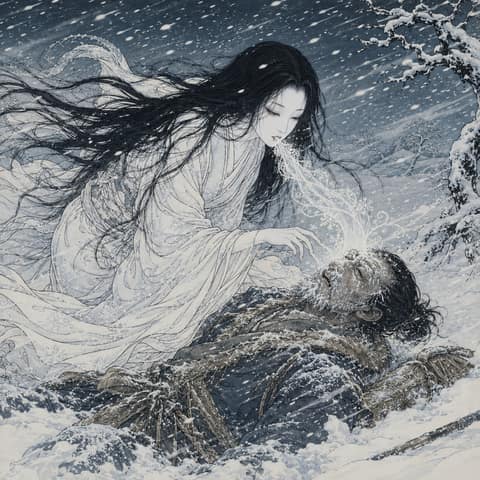
The Oga Peninsula is a peninsula that juts out westward toward the Sea of Japan. At the western tip of the peninsula lies Mount Honzan at an altitude of 715 meters, with Mount Shinzan to its north and Mount Kenashi to its east, collectively called the Three Mountains of Oga. Furthermore, the conical Mount Kanpu towers at its base, all of which have been revered as sacred mountains of Shugendo ascetics since ancient times. The faith of Namahage stands right on the boundary between this sacred ground, where yamabushi ascetics repeatedly engaged in practices known as 'oyamakake,' and the villages of the people living at its foothills. Across almost the entirety of Oga on New Year's Eve, bizarre figures wearing oni (demon) masks and dressed in kede (straw raincoats) roam from house to house, shouting, 'Are there any crying children? Are there any children who don't listen to their parents?' These are the Namahage.
Although often confused with oni due to their ferocious appearance, Namahage have originally been believed to be messengers of the deities enshrined in Mount Shinzan and Mount Honzan[1]. Visiting villages at the turn of the year, they admonish laziness and unfilial behavior, exorcise evil, and bring bountiful harvests, abundant catches, and good health—they are not oni, but rather divine entities. The master of the house politely entertains them with sake and food, promising a year of prudent behavior, and then sends the Namahage off. The very act of welcoming these fierce, intruding aberrations with sake and trays of food, and sending them back respectfully, clearly shows that Namahage are not 'disasters to be exorcised' but 'deities to be welcomed.' This format of playing otherworldly entities through masks and costumes, visiting each house to bestow blessings and warnings, is considered the most well-known representative among visiting deity events distributed sporadically across Tohoku, Hokuriku, and Southern Kyushu, such as the Amamehagi of Noto and the Toshidon of Koshikijima.
Namahage
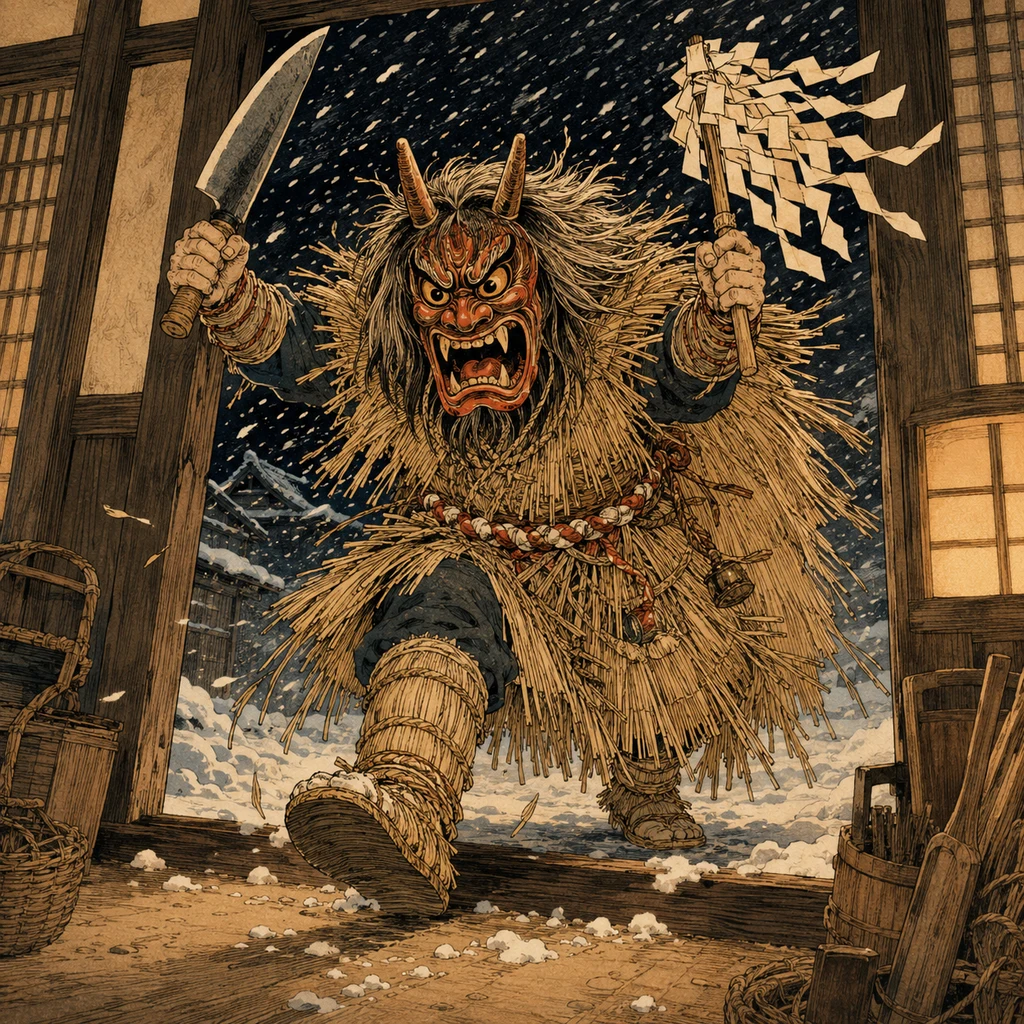
The Namahage is a "visiting deity" (raihōshin) that calls upon the villages of the Oga Peninsula in Akita Prefecture on New Year's Eve. Wearing demonic masks, kede (straw raincoats), and straw shin guards, they brandish large deba knives and gohei (ritual wands), roaring, "Are there any crying children? Are there any children who disobey their parents?" as they roam from house to house. Their fierce appearance often leads them to be mistaken for demons (oni), but they are originally messengers of the deities of Mount Shinzan and Mount Honzan. They are divine beings who arrive at the turning of the year to admonish laziness and disobedience, exorcise evil, and bring bountiful harvests, abundant catches, and good health. The head of the household entertains them respectfully with sake and food, and after promising good behavior for the coming year, formally sends the Namahage off. Their practice of wearing masks and costumes to play the role of otherworldly beings, visiting each house to bestow blessings and admonitions, makes them a prime example of the visiting deity rituals widely distributed across the Tōhoku and Hokuriku regions.
Read moreThe origin of the name 'Namahage' itself reflects life around the irori (sunken hearth). In winter, sitting by the hearth for a long time to keep warm causes red spots of low-temperature burns called 'namomi' (fire spots) to form on the hands and feet. This is proof of lazily clinging to the hearth—it is said that 'namomi wo hagu' (peeling off the namomi) to admonish this laziness was corrupted into 'namahage'[1]. The Deba kitchen knife they carry is a tool for peeling off these namomi and is by no means intended to harm people. The gohei (Shinto wand) held in their hands quietly indicates that Namahage are on the side of the gods.
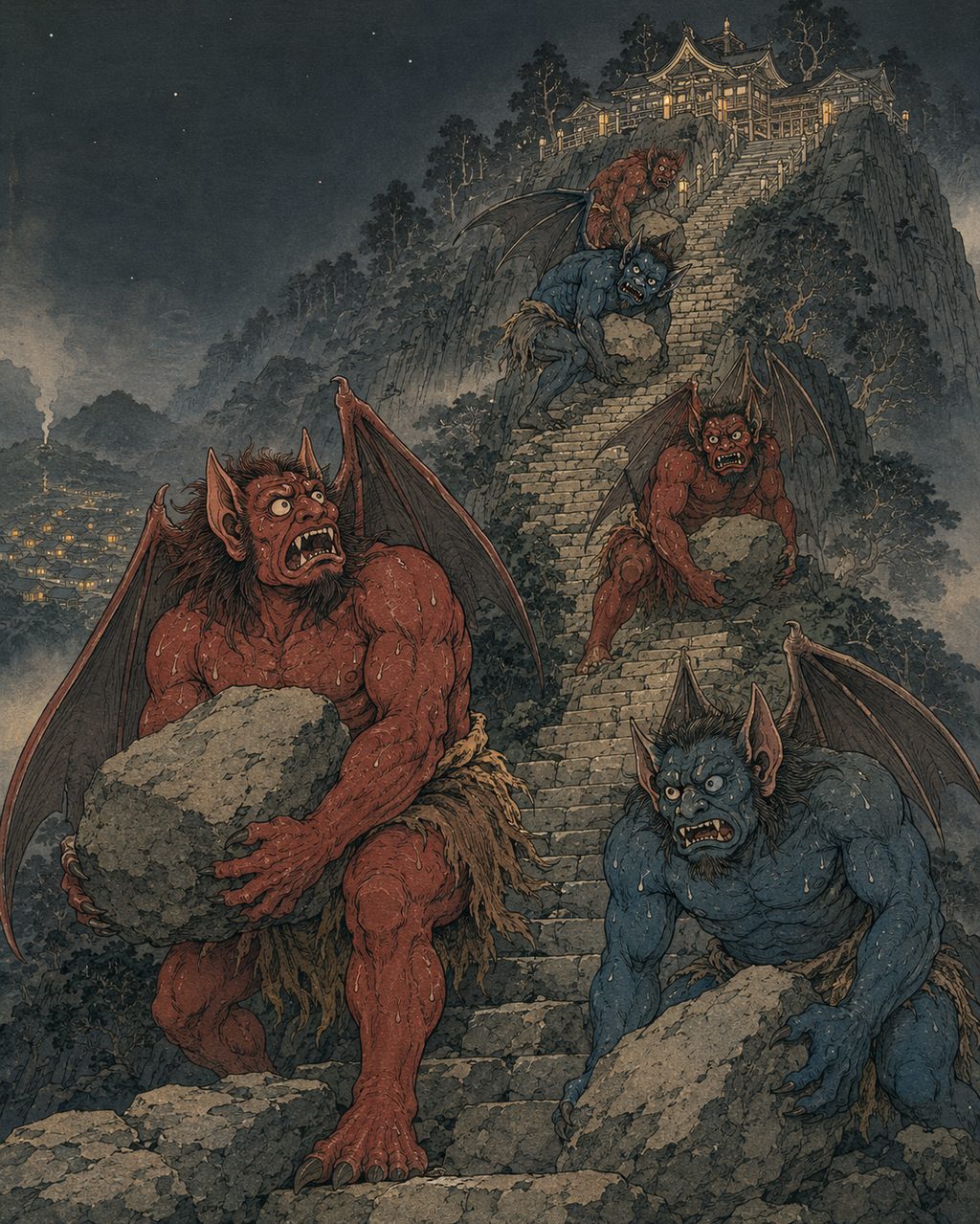
There are various theories about the origin of the Namahage, with no established consensus. The most famous among them is the legend of the '999 Stone Steps' passed down at Akagami Shrine Goshado, located at the foot of Mount Honzan on the western edge of the Oga Peninsula. About two thousand years ago, Emperor Wu of Han is said to have crossed over to Oga accompanied by five bats. The bats changed their forms into five oni, and the Emperor granted the oni a New Year's holiday only once a year. However, because the oni descended to the village and carried off crops and maidens, the troubled villagers proposed a wager: 'If you can build a thousand stone steps in a single night, we will grant your wish.' Just as the oni were one step away from finishing, they heard the crow of a rooster mimicked by a villager, assumed it was dawn, and gave up and returned to the mountain—it is passed down that these oni are the very prototypes of the later Namahage. The stone steps leading to Goshado still remain, telling the story of how Oga's Shugendo faith and visiting deity faith overlap in a single sacred place. Besides this, there are theories considering Namahage as yamabushi or mountain gods, or likening them to castaway foreigners, all of which have been passed down in the form of 'it is said that...'[1].
An early written record can be seen in the writings of the travel writer Sugae Masumi (1754-1829) when he traveled through Oga around the 8th year of Bunka (1811)[2]. Though hailing from Mikawa, this traveler who walked through Tohoku and Ezo his entire life left detailed, illustrated records of the customs he saw and heard across Oga. Masumi noted the appearance of Namahage, which was already being held as a visiting event on New Year's Eve at that time, suggesting that this event has a history of at least over two hundred years. His surviving travelogue of Oga serves as an indispensable primary source for understanding the ancient strata of the event.
The Sedo Festival and the Diversity of Masks
From the modern era onward, the Namahage event was gradually systematized. In Showa 53 (1978), the 'Namahage of Oga' was designated as an Important Intangible Folk Cultural Property of the country. Furthermore, in Heisei 30 (2018), it was registered as one of the UNESCO Intangible Cultural Heritages under 'Raiho-shin, visiting deities: masks and costumes' along with similar events across the country[3]. The Namahage of Oga has now surpassed being a local annual event to become an entity representing Japan's visiting deity culture.
At Shinzan Shrine, the 'Namahage Sedo Festival'[4], which combines the Shinto ritual 'Sedo Festival' with the folk event 'Namahage', is held in winter. Started in Showa 39 (1964), the sight of Namahage coming down the snow-covered stone steps holding pine torches while the Sedo fire burns brightly in the shrine precincts has become a festival symbolizing winter in Oga.
What should be noted is that Namahage masks are not uniform. At the Oga Shinzan Folklore Museum and the Namahage Museum, diverse masks and gestures differing by settlement are preserved and passed down throughout the year. The horns and colors of the oni masks, as well as the dialect of their dialogue, differ by settlement; some districts feature pairs of red and blue oni, while others use simple masks made of carved wood, papier-mâché, colanders, or seaweed. The Namahage of each settlement is performed by young men chosen that year, who have inherited the masks and costumes for generations. This is nothing less than the greatest proof that Namahage is not a unified event distributed from the center, but an indigenous faith that each village has protected and nurtured on its own. While some settlements have found it difficult to secure successors in recent years due to depopulation and a declining birthrate, the people of Oga continue to rack their brains to ensure this visiting deity does not die out, through the Folklore Museum and the festival.
Three Lakes Gouged by Dragons:
Hachirotaro and the Three Lakes Legend
To the east of the base of the Oga Peninsula, a massive lake called Hachirogata once expanded. With an area of approximately 220 square kilometers, it was Japan's second-largest lake after Lake Biwa. However, from the 1950s onward, large-scale land reclamation proceeded as a national project; a drainage pumping station went into operation in 1963, and in September 1964, the lake bottom dried up to reveal the central reclaimed land, accompanied by a land-drying ceremony. Thus, the majority of the lake became land, giving birth to a new village with grid-patterned farmlands: Ogata Village. The remaining water area is now called 'Lake Hachiro' or 'Hachirogata Residual Lake,' and its area has shrunk to about 18th in the country. Yet, even though the lake has disappeared, its name still etches the memory of a single dragon god: Hachirotaro.
Hachirotaro
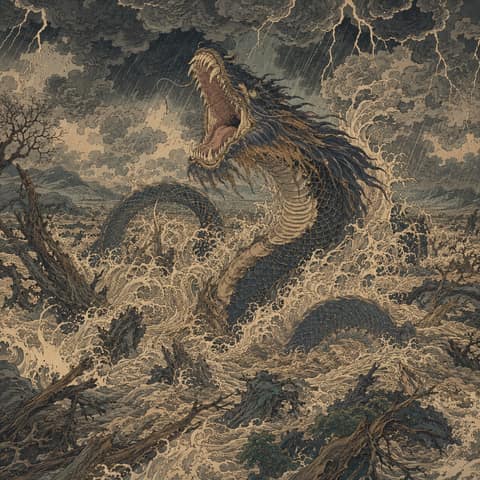
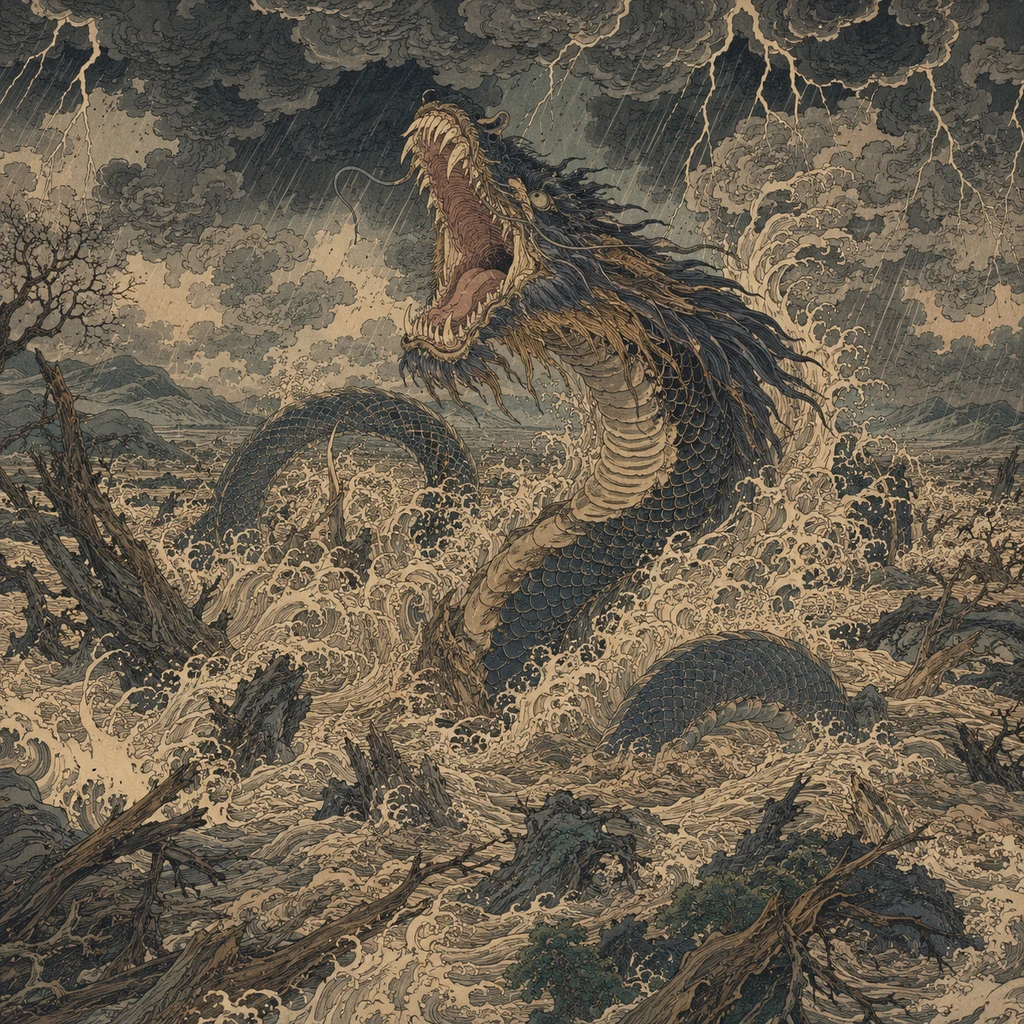
Hachirotaro is a dragon god (ryūjin) whose primary domain is Lake Hachirōgata in Akita Prefecture. Legend says he was originally a matagi (traditional winter hunter) from the Kazuno region. After breaking a taboo by roasting and eating three char (iwana) that he was supposed to share with his companions, he was struck by an insatiable thirst. As he continued to drink from the mountain stream, he transformed into a giant serpent, and eventually a dragon. The transformed Hachirotaro dammed Lake Towada to make it his home. However, he later fought the monk Nansobō from Kumano for lordship of the lake and was defeated. Fleeing to the northwest, he carved out the Hachirōgata lagoon and became its master. He stands at the center of the "Legend of the Three Lakes" (Sanko Densetsu), an epic tale of dragon gods spanning three major lakes in Akita (Lake Towada, Hachirōgata, and Lake Tazawa). Including his later romance with Princess Tatsuko of Lake Tazawa, Hachirotaro is the central protagonist in the narrative that systematizes the lake and marsh worship of the northern Tōhoku region.
Read moreThe story of Hachirotaro forms the core of the 'Three Lakes Legend,' an epic dragon god tale spanning the three lakes of Akita (Lake Towada, Hachirogata, and Lake Tazawa). Originally a Matagi (hunter) born in a village in the Kazuno region, Hachirotaro was hunting with his companions deep in the mountains of Towada when he caught and roasted three char in a mountain stream. It was prey that should inherently have been shared with his companions, but unable to withstand his hunger, he devoured all three fish himself. Then, he was struck by a severe thirst as if his throat were burning; no matter how much he drank from the mountain stream, his thirst would not stop, and it is passed down that as he continued drinking, scales sprouted on his body, and he transformed into a giant serpent and a dragon[5]. Falling into a non-human form as punishment for breaking a taboo and monopolizing the catch—here, the Matagi code of strictly dividing the catch equally is deeply embedded as the core of the story. The metamorphosis tale of Hachirotaro is not merely a ghost story, but an allegory that speaks to the ethics of the mountain people.
Hachirotaro, having become a dragon, initially dammed up Lake Towada to make it his dwelling. However, an ascetic monk named Nansobo, who came from Kumano in Kishu, appeared seeking the seat of the master of the lake. Nansobo had received an oracle from the Kumano Gongen stating, 'Make your dwelling in the land where your iron straw sandals break,' and having traveled through various provinces, the thong of his straw sandals snapped in the land of Towada. The two clashed over the lake; Hachirotaro became a nine-headed giant serpent, and Nansobo cast his sutra scrolls which turned into swords—after a fierce battle of magical powers spanning seven days and seven nights, Hachirotaro was defeated[6]. Lake Towada belonged to Nansobo (Seiryu Gongen), and the chased-away Hachirotaro fled toward the northwest. Along the way, he tried to dam up a river in Kazuno but was thwarted by local deities, eventually being guided by the mountain god of Shichikura toward a broad land. Before long, along with the crow of a rooster, the earth split open, creating Hachirogata, and he settled there as its new master[7]. This structure, where the formation of the lake and the wandering of the dragon are directly linked, systematizes the lake and marsh faith of northern Tohoku, spanning from Aomori to Akita, into a single story mediated by one dragon.
Princess Tatsuko,
and the Lake that Freezes and the Lake that Does Not
The Three Lakes Legend has a beautiful sequel. It is the story of Princess Tatsuko[8] of Lake Tazawa. A girl named Tatsuko living in Kannarisawa visited Kannon for a hundred days praying for eternal beauty, and received a divine dream stating, 'If you drink the sacred spring in the north, your wish will be granted.' When she drank the water of the spring she found in the mountains, her thirst only increased, and as she continued drinking, Tatsuko rapidly transformed into a dragon, sinking as she was into the depths of Lake Tazawa to become its master—the plotline of thirst inviting metamorphosis perfectly overlaps with Hachirotaro, showing that the two dragons belong to the same mythological sphere. And eventually, Hachirotaro, the master of Hachirogata, begins to visit Tatsuko.
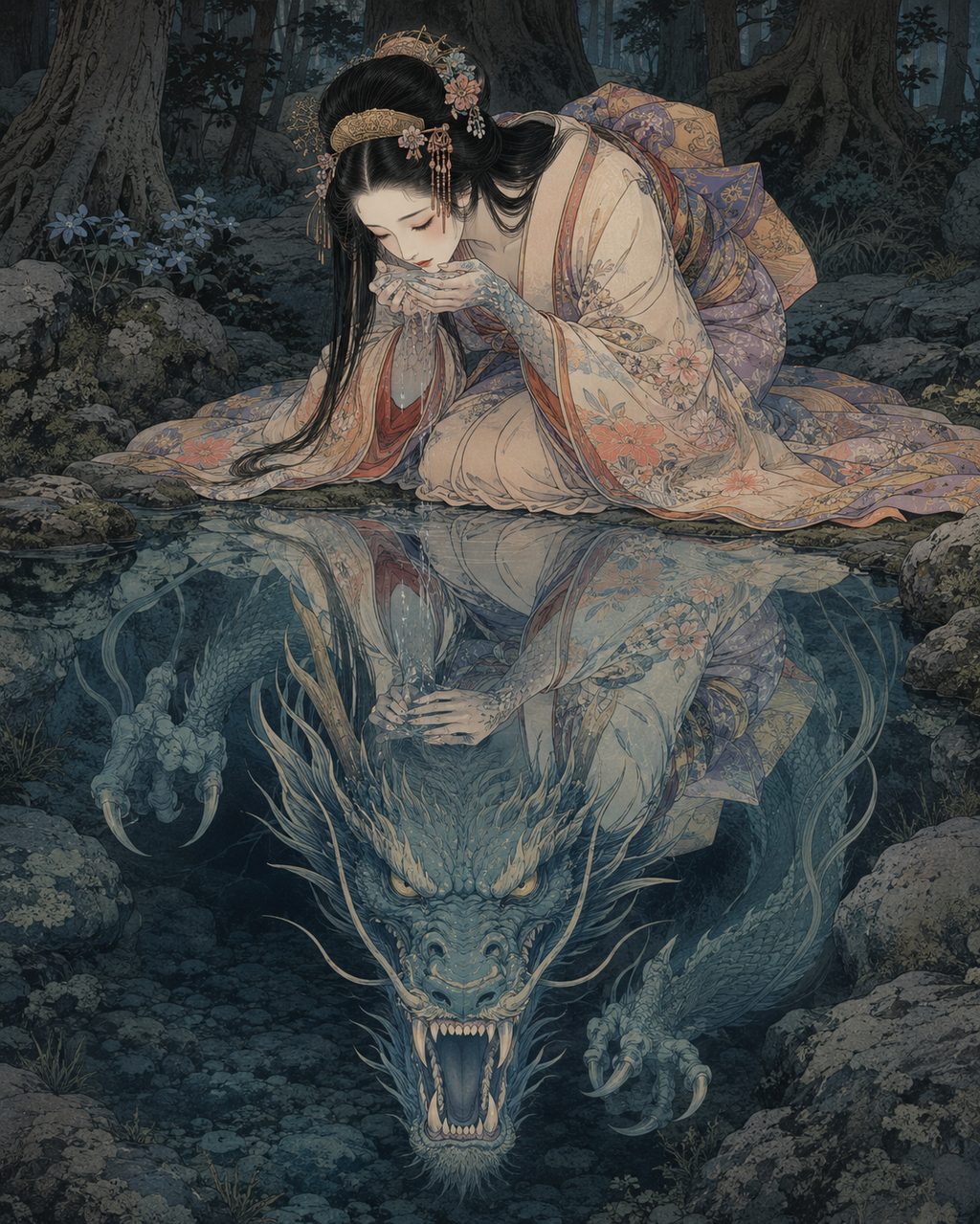
The two dragons were joined together, and it is said that Hachirotaro spends every winter with Tatsuko at Lake Tazawa. As a result, it has been told that Hachirogata, whose master departs, freezes over thickly, while Lake Tazawa, where the two dragons dwell together, is deep and warm and does not freeze even in winter[8]. In fact, Lake Tazawa is Japan's deepest lake at a depth of 423 meters, and does not completely freeze over in winter. Geographic facts and the dragon god tale correspond brilliantly. Around Hachirogata, Hachirotaro is still enshrined as a water deity, and this faith is inherited in the shrines of Ogata Village and the festivals of Katagami City[7]. Even though the lake has changed its form through land reclamation, the memory of people who found dragon gods in the water continues to live on within place names and festivals.
The three lakes of Towada, Hachirogata, and Tazawa connected by Hachirotaro form a corridor of water stretching from Aomori to the inland of Akita. The taboos of the Matagi, the magical powers of Shugendo, the wishes of a woman—the fact that these are woven into a single mythological sphere through the medium of a dragon can be said to be the very worldview of the northern people who have lived off the lakes and concurrently revered them as objects of awe.
Beasts Falling with the Thunder:
Raiju
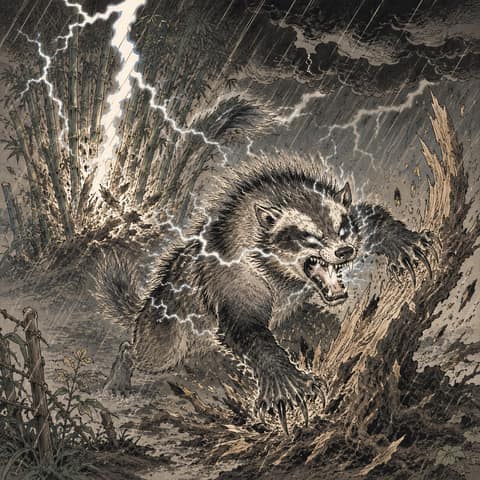
The yokai of Dewa come not only from lakes and mountains, but also from the sky. The Raiju (thunder beast), a beast-like yokai believed to plummet from the sky alongside fierce thunderstorms and lightning strikes, is one of them. Akita, a region of heavy snowfall, is also a land that echoes with winter thunder—lightning unique to the Sea of Japan coast known as 'yuki-okoshi' (snow-rouser) or 'buri-okoshi' (yellowtail-rouser)—providing the foundation for legends of beasts falling from the sky to take root. However, the Raiju is not an endemic species solely of Akita Province; it is a yokai of natural history interest that was widely transmitted throughout the country via early modern essays and topographical records. Dewa's Akita was, among them, one of the prominent record locations that left behind specific tales of their capture and consumption.
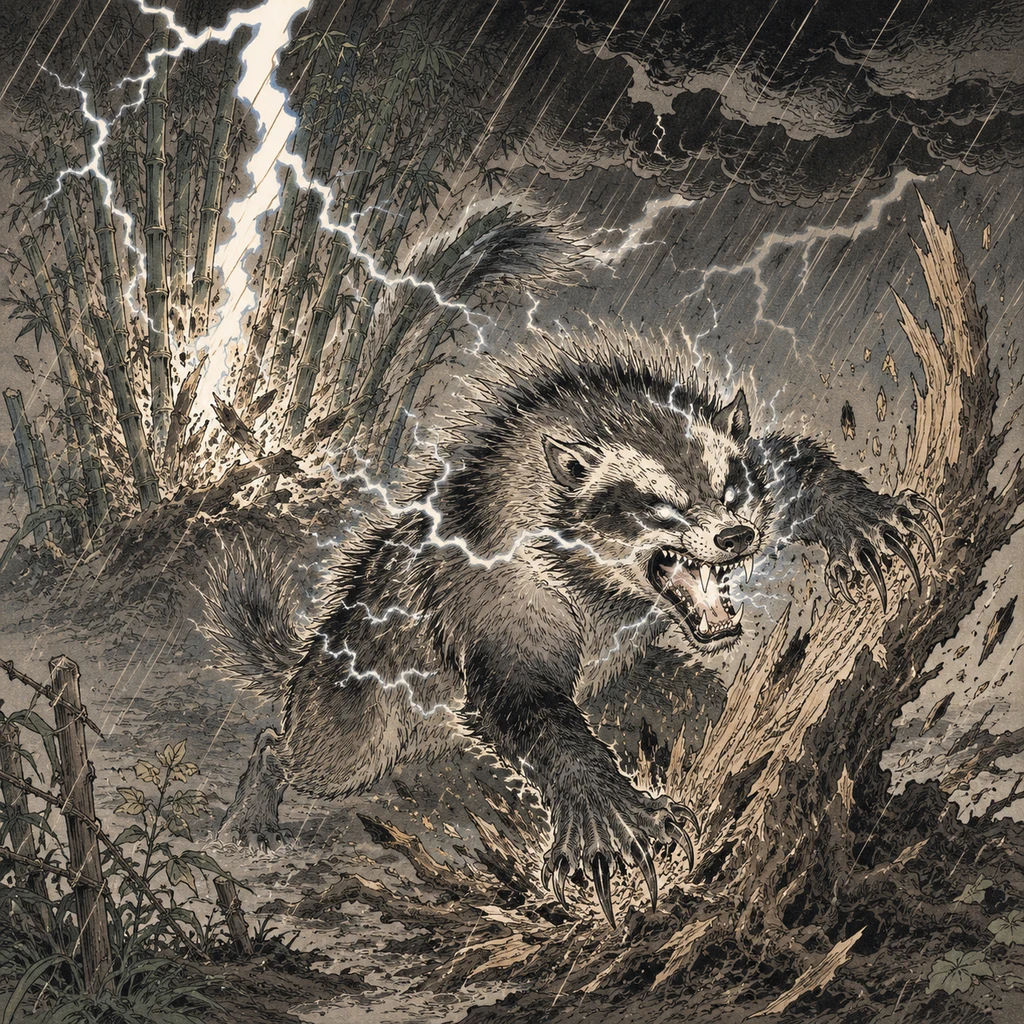
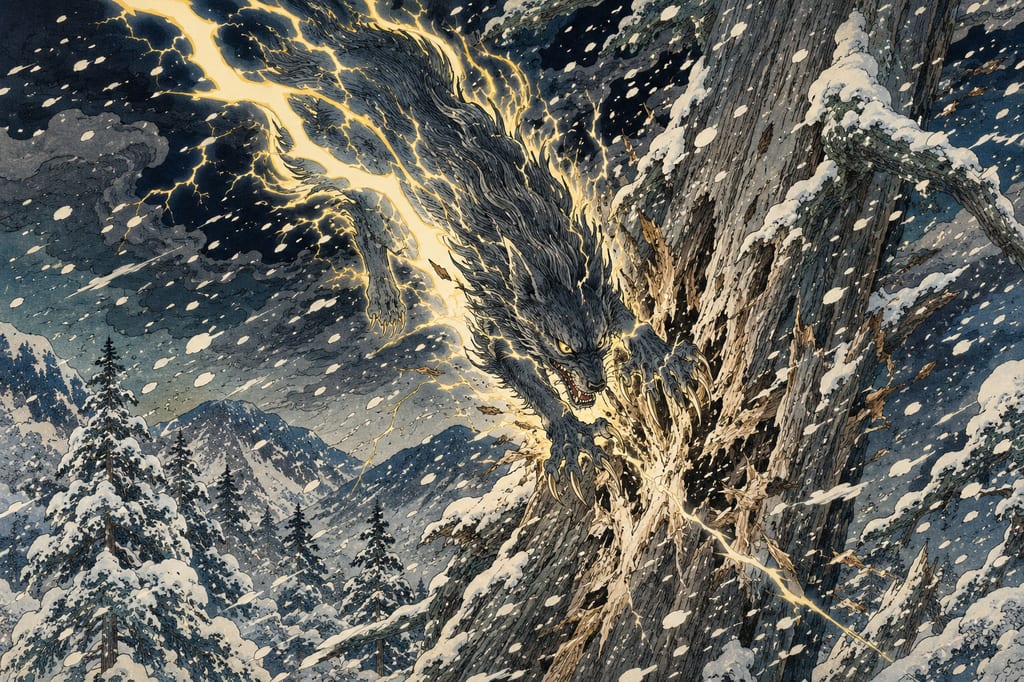
The appearance of the Raiju is inconsistent. There are illustrations depicting it as a bizarre creature resembling a wolf with two front legs, four hind legs, and a bifurcated tail; there are also theories likening it to a weasel, cat, or raccoon dog; and its size varies widely from that of a mouse to two shaku five sun (about 75 cm). What is commonly told is that it flies riding on thunderclouds with sharp claws like an eagle, and upon falling, it tears through tree bark with those claws, leaving scorch marks and clefts on the trunks.
Specific records connecting Akita and the Raiju can be seen in the voluminous essay *Kasshi Yawa*[9] by the feudal lord of Hirado in Hizen, Matsura Seizan (1760-1841). The book notes an anecdote where people in Akita of Dewa Province captured a Raiju that fell with the thunder, boiled it, and ate it. It also includes a story of someone who had their cheeks scratched by a Raiju that fell along with a ball of fire, and became bedridden, affected by its miasma. Furthermore, Seizan conveys a theory by the master of literati painting, Tani Buncho, that those near a lightning strike have their spirit snatched away and become stupefied, but can be healed by eating corn. At first glance, these seemingly absurd descriptions were the products of the early modern people's understanding of nature, who comprehended the uncontrollable disaster of lightning strikes as the 'deeds of beasts' and somehow tried to cope with it. The fear of thunder crystallized into the concrete image of a beast falling from the heavens.
As for the true identity of the Raiju, theories suggesting the misidentification of masked palm civets, martens, flying squirrels, or river otters are prominent. It is also thought that the sight of small beasts falling from trees, startled by lightning strikes, spurred the imagination. Just as Takehara Shunsen's illustrated *Ehon Hyakumonogatari*[10] depicts a beast racing through the sky alongside evening rain clouds under the title 'Kaminari', and mentions 'thunder hunting' conducted by the people, the Raiju was both an object of terror and a target of curiosity for early modern natural history enthusiasts. It should be noted that the Raiju cannot be concluded as a narrowly defined tradition endemic to Akita; Dewa was ultimately just one base of Raiju records spreading nationwide.
Omens from the Mountains:
Kodama-nezumi and the World of the Matagi
Indispensable when talking about the yokai of Akita is the Matagi culture nurtured in the deep mountain valleys of northern Akita. Settlements such as Nekko, Utto, and Hitachinai in the Ani region of Kitaakita City are hailed as the 'originators of Matagi nationwide.' It is passed down that from the early 1800s onward, the Ani Matagi traveled as far as the mountains of Chubu and Tohoku in pursuit of bears and Japanese serows, settling at their destinations as adopted sons-in-law and spreading hunter groups like branch families across various regions. As a Matagi of Miomote in Niigata stated, 'When you say Akita, it means the head family,' Ani was widely revered as the spiritual center of the hunting people. There remains a legend among the Matagi of the Shirakami-Sanchi, spanning Aomori and Akita, that migrants from Ani taught them trapping techniques.
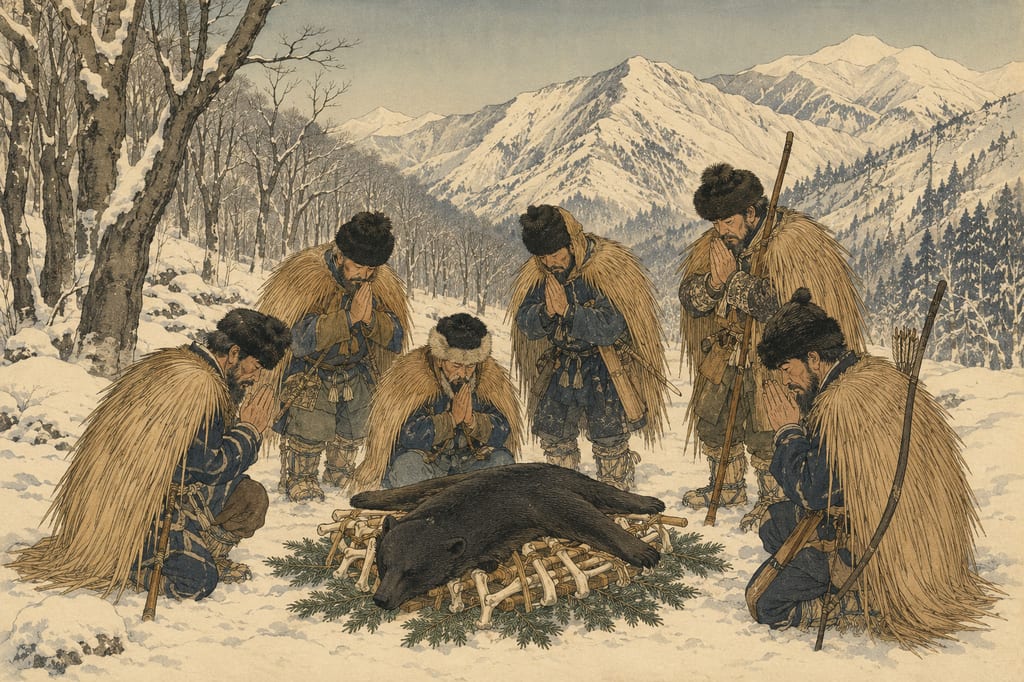
The Ani Matagi lived under a strict faith in mountain deities. On June 15th, they climbed Mount Moriyoshi, gathered branches of morobi (Aomori fir) as protective charms, and prayed for safe travels. December 12th was considered the 'Day of the Mountain God', and it is told there was a taboo prohibiting entering the mountains on this day, and dictating that the hunting catch of the year must not exceed twelve heads. Upon taking down a bear, they performed a butchering ritual called 'Kebokai', draping the pelt over the remains so the head and tail were reversed; they thanked the mountain god for the bear as a bestowed gift, and prayed for further bountiful hunts. There were thorough manners treating the entire mountain as a divine realm, such as conversing using a distinct vocabulary called 'mountain language' instead of the words used in the village. The reason the story of Hachirotaro falling into a dragon by monopolizing three char holds so much persuasive power is precisely because the world of the Matagi, who had carved such 'codes of sharing' into their very bones, lies alive and breathing behind it.
The sharpest manifestation of this mountain deity faith is the Kodama-nezumi.
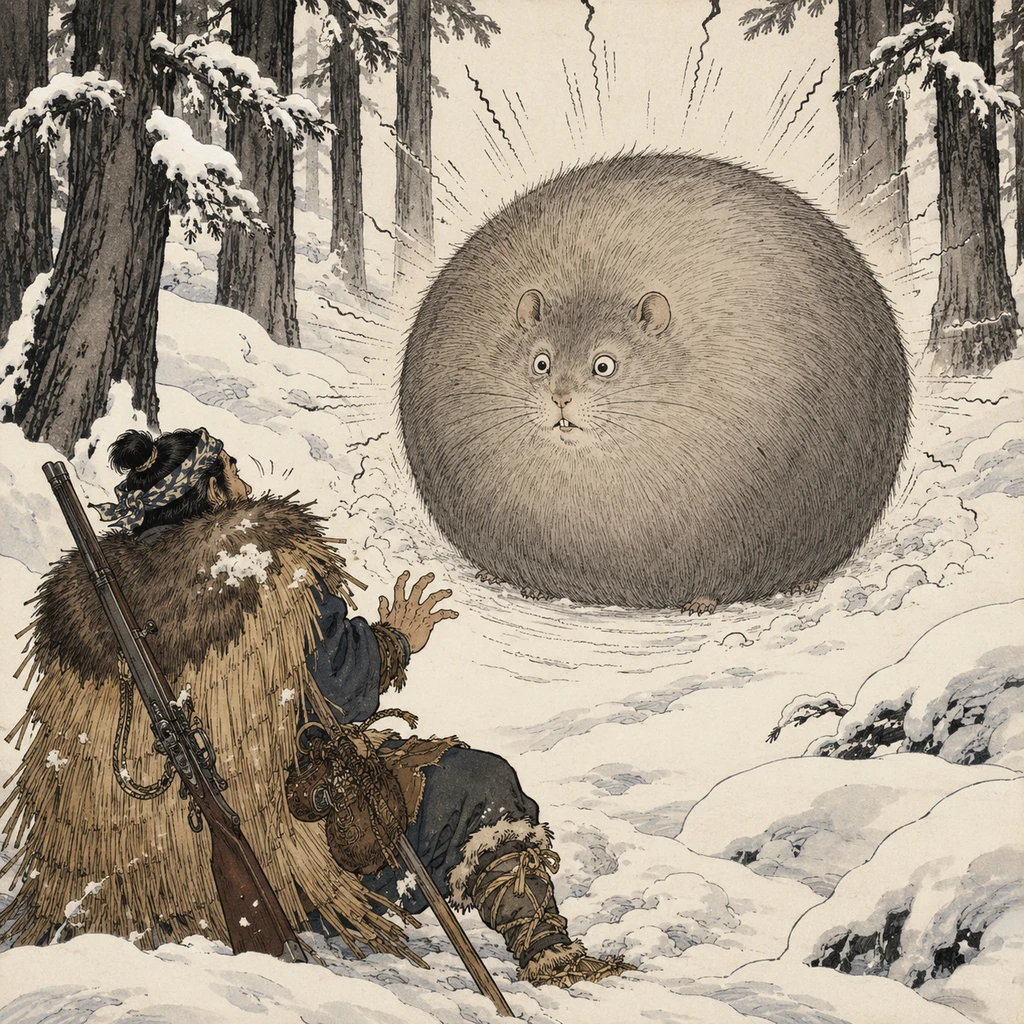
Kodama Mouse
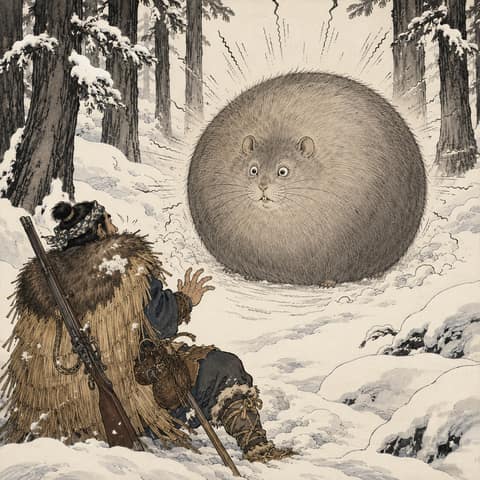
The Kodama Mouse is a mountain anomaly told among Matagi hunters of northern Akita. It looks like a tiny, round-bodied mouse—somewhere between a house mouse and a dormouse. When it meets a person, it stops, swells rapidly, and is said to burst with a gun-like boom, scattering flesh—though some accounts say it only makes a deafening blast without bursting. The encounter was read as a sign of the mountain god’s anger; hunters who saw it were to stop hunting and leave the mountain at once.
Read moreThe Kodama-nezumi is a mystery of the deep mountains passed down among the Matagi of Kitaakita District, Akita Prefecture. In appearance, it is a small beast resembling a house mouse or dormouse, with a body close to spherical in shape. It was said that upon encountering a human, it would stop in its tracks, rapidly swell up, and burst with a roaring sound like a gunshot, scattering pieces of meat (there are also theories that it only emits a loud noise without bursting). This encounter was considered a sign of the mountain god's wrath, and hunters who encountered it immediately ceased hunting and retreated from the mountain[11]. If one forcedly continued hunting, it was avoided under the belief that no prey would be obtained, and one would encounter disasters such as avalanches. It is said that those who received the curse would return home and chant 'Namu abira unken sowaka' to exorcise it.
The tradition of the Kodama-nezumi was recorded by Akita's local historian Tetsujo Muto in his *Akita Matagi Kikigaki* (Accounts of Akita Matagi)[11]. This record, meticulously gathering the oral traditions of those who actually hunted in the mountains, shows that the Kodama-nezumi was not merely a yokai from a picture book, but a bad omen that actively functioned within the living worldview of the hunting people. People entrusted and passed down the danger directly linked to death in the snowy mountains—being unable to catch prey, encountering avalanches—to the striking image of the 'bursting of a tiny mouse'. There are theories that seven Matagi of the Kodama school were transformed into Kodama-nezumi as punishment by the mountain god, or views suggesting that the guilt of digging up hibernating dormice lies behind this ghost story, but the exact origin is unknown. As discussed in *Shuryo Densho Kenkyu* (A Study of Hunting Traditions) (1969) by folklorist Tokuji Chiba[12], who compared hunting traditions nationwide, such mountain taboos and supernatural phenomena were crystals of wisdom for survival, polished through long tension surrounding the division of spoils between humans and nature. The Kodama-nezumi is the guardian of that unseen contract between the mountain god and the hunter, manifesting the moment that contract is broken.
What the Yokai of Snow Country Dewa Tell Us
Tracing from Oga to Hachirogata, Lake Tazawa, and the mountains of northern Akita in this way, it becomes clear that all of Akita's yokai stand on the 'boundary between humans and nature.' The Namahage is a deity that crosses the boundary between the village and the sacred mountain to visit on New Year's Eve, and Hachirotaro is an entity that stepped across the boundary from human (Matagi) to dragon (water deity). The Raiju falls from the boundary between heaven and earth, and the Kodama-nezumi was a guardian heralding the boundary between the human realm and the realm of the mountain gods.
While the yokai of the capital reflect power and the darkness of the city, the yokai of Dewa directly embody the ethics of living surrounded by snow, mountains, and lakes—do not be lazy, share with one another, and revere the mountain. These were not made-up stories for admonishment or threats, but the very codes for surviving one winter and welcoming the next spring amidst harsh nature. The laziness admonished by Namahage, the monopoly that caused Hachirotaro to fall into a dragon, the disrespect to the mountain god heralded by Kodama-nezumi—these are all values calculated backwards from the reality of the northern provinces, where the collapse of the community is immediately linked to death. Yokai were, so to speak, cultural devices for survival, translating those values into the form of stories that even children could understand.
People gathering while treading on snow at the Namahage Sedo Festival in Oga, the path of dragon god tales touring the three lakes from Towada to Lake Tazawa, and the mountain language and pelts preserved in the Matagi museum in Ani. The yokai of Akita are not relics of the past confined in museum glass cases. As memories of the land that can still be retraced on foot, they are certainly breathing in snow country Dewa, within events, place names, and oral traditions. If you compare them with the Yokai of Aomori Prefecture or the Yokai of Iwate Prefecture in neighboring prefectures, the face of the yokai unique to Dewa—woven by the sea, lakes, and deep mountains—will surely appear all the more distinct, even within the same Tohoku region.