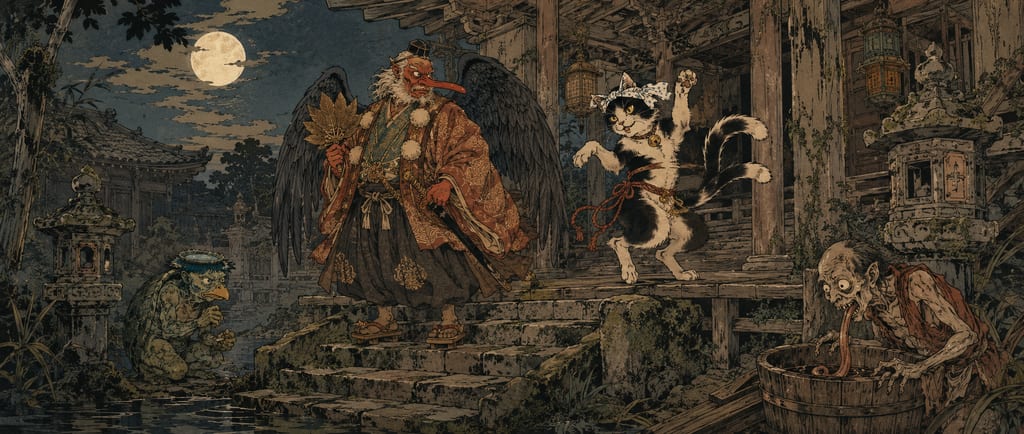
Yanari is a catchall term for uncanny creaks, tremors, and noises that seem to come from houses and furnishings for no apparent reason. Older records note ominous rumblings from hearths, storehouses, and armories, often read as ill omens. Picture scrolls personify it as little goblins shaking a house, but lore usually leaves the cause unexplained. Explanations vary by region—angry spirits, beast spirits, or a house deity’s mood—and it is said to occur most often around midnight to the Hour of the Ox.
Folklore & Legends
Edo-period essays and ghost stories frequently describe yanari in vacant homes or haunted houses. In Taihei Hyaku Monogatari, a house in Tajima Province shook as a whole; when a monk drove a small blade into a marker under the floor, the shaking stopped. Medieval sources also note it: the Azuma Kagami records a hearth groaning in the palace’s offering hall; the Nihon Shoki mentions a tripod cauldron sounding on its own; and the Shoku Nihongi reports roof-and-wall rumblings in armories, checkpoints, and at Moriya’s residence—appearing even in aristocratic and samurai records.
Yokai Cards1
House Groans (Yanari) across multiple art-style decks
In picture scrolls it appears as little goblins shaking beams and pillars, a visual rendering of the intangible phenomenon of creaks and tremors within a house. In actual lore it is often told as the house itself rumbling without a fixed cause, though in some regions it is tied to animal curses, the misdeeds of residents, or signs of spirits lingering on the estate. It is said to occur late at night, especially around the Dead of Night, and noises arising at vital spots such as the hearth, storehouse, or armory were feared as ominous. Quiet sitting or sutra chanting, checking and offering for the crawlspace, and purifying beams and pillars are said to calm it, but if it persists, moving house is sometimes recommended. Traditional advice warns against hasty causal claims, urging first a review of the property’s lineage and proper rites to ancestral and household deities.
Character Profile
This section is our own creative profile for storytelling. It is not historical fact or scholarship.
prefers quiet places, easily resonates with human anxiety
Abilities
makes beamspillarsand sliding doors creaksubtly shakes the entire housesudden rattling at key places like the hearthstorehouseor armoryamplifies human unease
Weaknesses
soothed by sutra chanting and purification rites, offerings and cleaning at the crawlspace and pillar bases, verifying house lineage and restoring household worship, avoiding long vacancy and neglect
Habitat
household beams, pillars, and crawlspaces, hearths and earthen floors, storehouses, buildings such as checkpoints and armories
The diagram below is a diagnostic evaluation chart for Ienari (Traditional Depiction). The higher the value of each item, the stronger that characteristic is expressed.
Love Yokai Type Test
The diagram below is a diagnostic evaluation chart for Ienari (Traditional Depiction). The higher the value of each item, the stronger that characteristic is expressed.