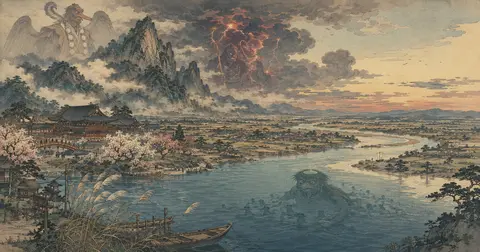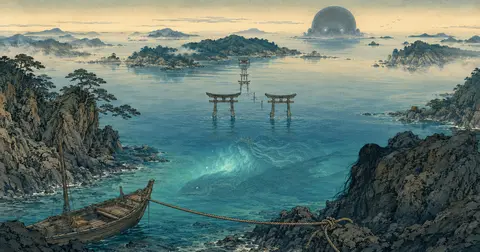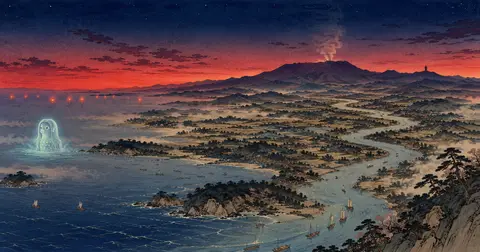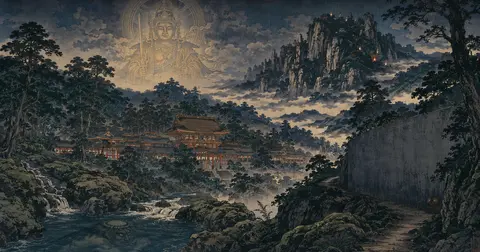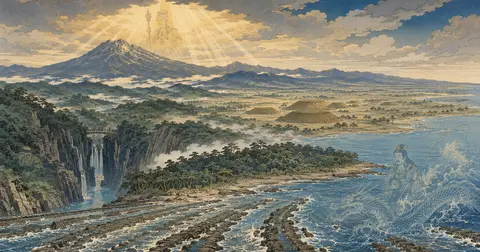
Saga Prefecture is the land of Hizen, embraced by the Genkai Sea to the north and the Ariake Sea to the south. The northern sea opens toward the Korean Peninsula, an open-water world dotted with remote islands like Kakara Island and Kashiwajima. Interaction with the peninsula dates back to ancient times; Kakara Island even preserves the legend of the birth of King Muryeong of Baekje. Meanwhile, the southern sea is a shallow, muddy expanse boasting one of Japan's largest tidal ranges, where endless mudflats stretch out after the tide recedes. This sea of mud, where mudskippers leap, is an ever-shifting realm of boundaries—a place that is ocean one moment, mud the next, and ocean once again. Nestled between these two seas lies a low, damp alluvial plain carried by the Chikugo and Kase Rivers. Sea, mud, and waterways—nearly all the yokai of Saga are born from these watery boundaries.
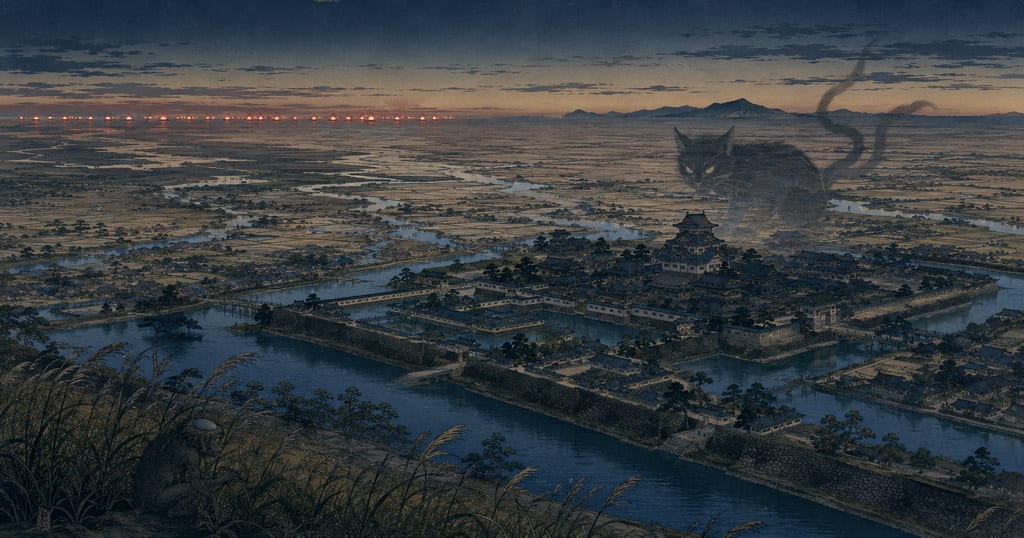
At the political center stood Saga Castle[1], an expansion of the Ryuzoji clan's Muranaka Castle by the Nabeshima clan. Drawing in water from the Tafuse River, it was a water fortress called the "Submerged Castle," designed to flood everything except the main keep in times of emergency. It was within the inner chambers of this castle that the Nabeshima bakeneko disturbance, counted as one of Japan's three great phantom cat legends, was spoken of. Sea monsters, strange fires in the mud sea, riverside kappa, and the phantom cat of the castle—this article traces the geography and history of the land of Hizen, visiting the seven supernatural oddities that took up residence in Saga one by one. Why did each monster take shape specifically in Saga and nowhere else? The answer to that question is always found beside the water.
Hizen,
Wedged Between Two Seas
To understand the yokai culture of Saga, one must first grasp the geography of this land. The ancient province of Hizen was a vast territory spanning modern-day Saga and Nagasaki, deeply tied to the two seas of Ariake and Genkai. The northern Genkai Sea is the gateway to the Korean Peninsula and the continent; from the ports of Karatsu and Yobuko, countless ships have rowed out to the open ocean since ancient times. Remote islands such as Kakara, Kashiwa, and Matsushima dot the waters, each harboring sea faiths and legends of supernatural oddities. In contrast, the southern Ariake Sea is an enclosed inland sea where the mud carried by the Chikugo, Kase, and Rokkaku Rivers has nurtured vast tidal flats. The tidal range reaches up to six meters; when the tide recedes, a plain of mud several kilometers wide appears, only to return to the sea when the tide comes in.
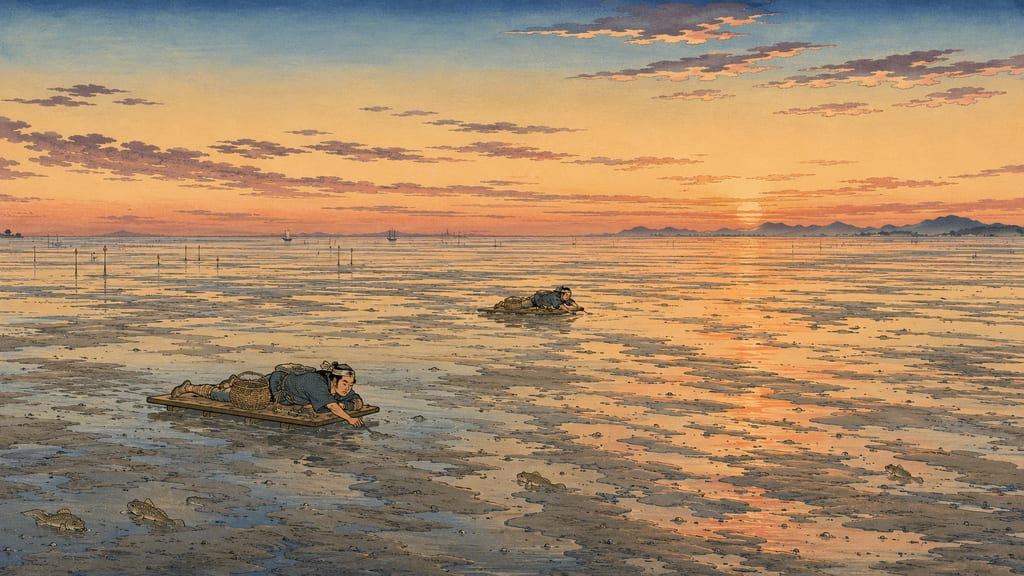
In a land where this "time that is neither sea nor land" repeats twice a day, people were highly sensitive to boundaries. Boundaries are places where different worlds touch, and where yokai materialize. Monsters of the sea, monsters of the river, and the winds that blow at the turning of the calendar—the oddities of Saga are born entirely from this sense of boundaries. The political world, too, was full of such borders. The transition of power from the Ryuzoji clan, who ruled medieval Hizen, to the Nabeshima clan in the early modern period was the most prominent among them. Yokai also dwell within those seams. First, let us look at the monster of the castle born from that political boundary—the bakeneko.
Depths of the Submerged Castle — The Nabeshima Bakeneko Disturbance
When speaking of Saga's yokai, the phantom cat of the castle is absolutely indispensable. Counted as one of Japan's three great bakeneko legends alongside those of Arima and Okazaki, it was a driving force that spread the image of the bakeneko nationwide through storytelling and theater.
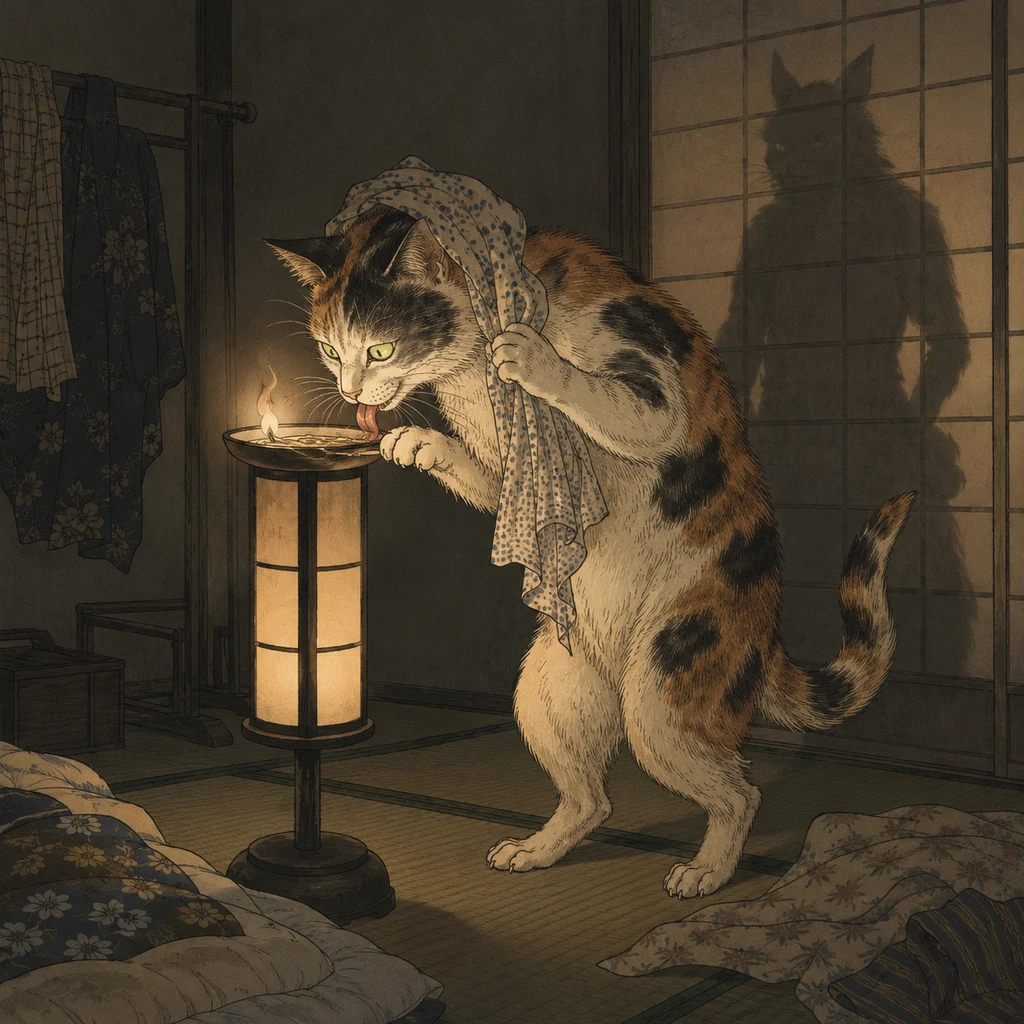
Bakeneko
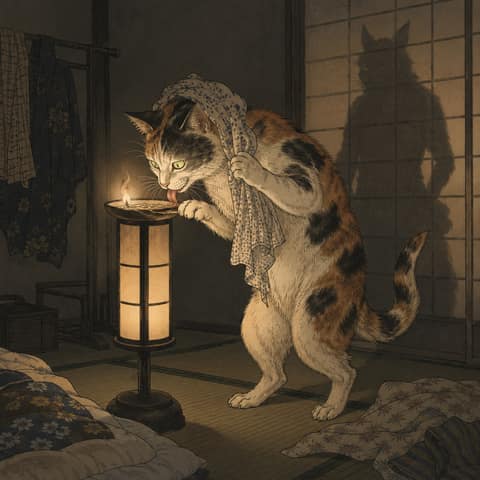
A domestic cat that has grown old and gained supernatural powers. Said to take human form, speak, manipulate the dead, cast curses, and more; often confused with the nekomata. Licking lamp oil is viewed as a sign of impending strangeness, and long-tailed cats were believed more likely to transform. As cities expanded, everyday cats took on a mystical aura, and Edo-period books and prints popularized the image.
Read moreThe plot of the tale is passed down as follows. Ryuzoji Matashichiro, who served as the Go opponent for Nabeshima Mitsushige, the second lord of the Saga Domain, incurred Mitsushige's displeasure over a trivial matter and was put to the sword. Grieving, Matashichiro's mother poured her heart out to her pet cat and took her own life. The cat, having lapped up her blood, turned into a bakeneko and slipped into the castle, tormenting Mitsushige night after night. Eventually, the loyal retainer Komori Hanzaemon vanquished the monstrous cat, saving the Nabeshima family.
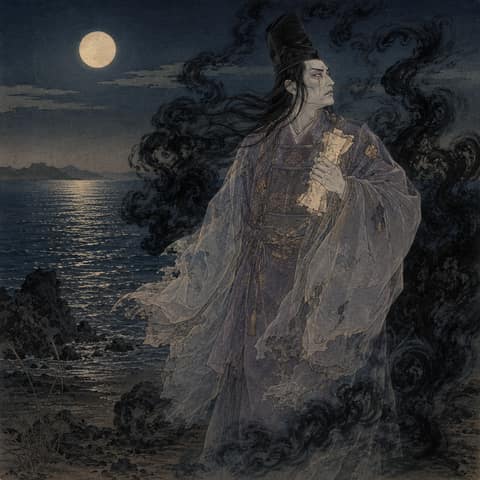
However, this is not historical fact. Behind it lies the memory of a Hizen household disturbance: after the death of the Sengoku warlord Ryuzoji Takanobu, his senior vassal Nabeshima Naoshige seized actual power, and Takanobu's grandson Takafusa and son Masaie passed away in succession. Ryuzoji Takanobu, who had vied for supremacy in Kyushu, was slain by the Shimazu forces at the Battle of Okitanawate in 1584, after which government affairs shifted into the hands of his aide, Naoshige. Though ostensibly a peaceful transfer of power, the unsettling decline of the Ryuzoji bloodline lingered like sediment in the hearts of the castle town's people. They gave shape to that lingering resentment as an imaginary feline monster. It is even said that Naoshige built Tenyu-ji Temple to appease the spirits of the Ryuzoji. Why a cat? In early modern castle towns, cats—believed to lap the oil from paper lanterns, understand human speech, and eventually split their tails as they aged—were the most familiar shape-shifting yokai. When this familiarity became imbued with the heavy theme of a nobleman's grudge, the bakeneko disturbance was born.
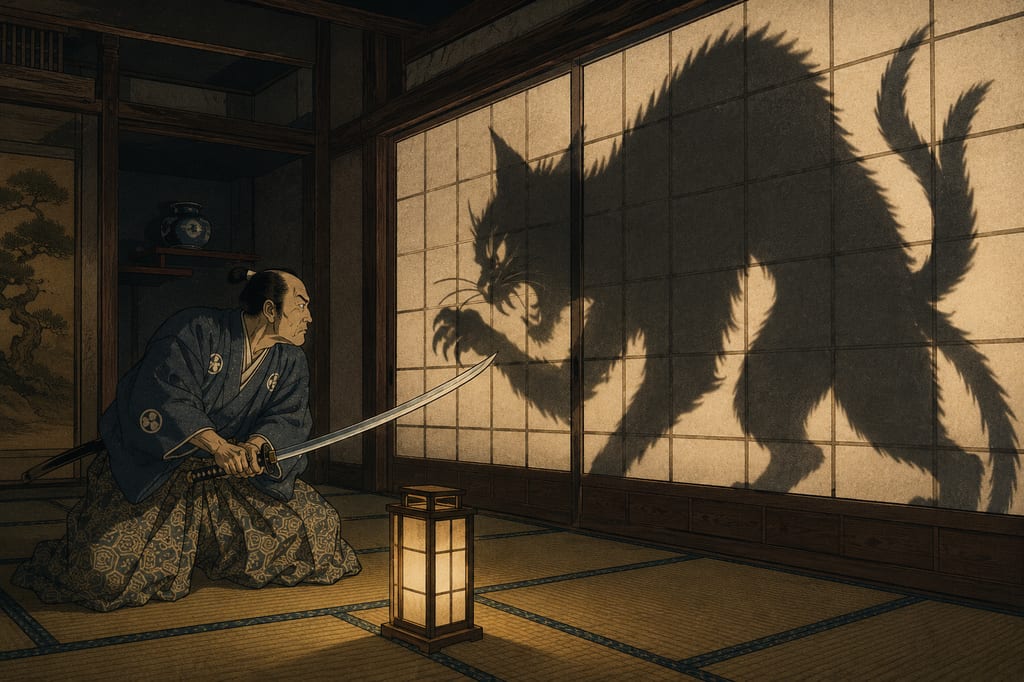
This ghost story spread like wildfire thanks to the kabuki play *Hana Saga Nekomata Zoshi*[2] written by Segawa Joko III in 1853—though it is said that performances were halted following protests from the Saga Domain, carrying the danger of challenging the domain's authority. Because real domains could not be used as subject matter, the stage employed the device of transposing place names and characters into a different narrative. Still, audiences read the shadow of Hizen Saga beneath it. From the Meiji period onward, it changed form into storytelling and film, and the Saga bakeneko became known nationwide as one of the three great phantom cat legends, alongside Arima and Okazaki. (The Okazaki cat disturbance is heavily colored by kabuki fiction, and there is also a theory that replaces it with Omatsu Daigongen of Tokushima as one of the three.) In any case, the composition of an aged pet cat's anomaly residing deep within the castle—the very center of power—is a unique Saga monster that materialized at the intersection of Hizen's political history and early modern folk beliefs.
The Mud of the Ariake Sea — The Phantom Sea Fire Known as Shiranui
Leaving the castle and heading south, one arrives at the Ariake Sea, which boasts Japan's largest tidal flats. Another core of Saga's yokai culture is the mysterious fire that appears in this shallow mud sea and the connected Yatsushiro Sea—the Shiranui.
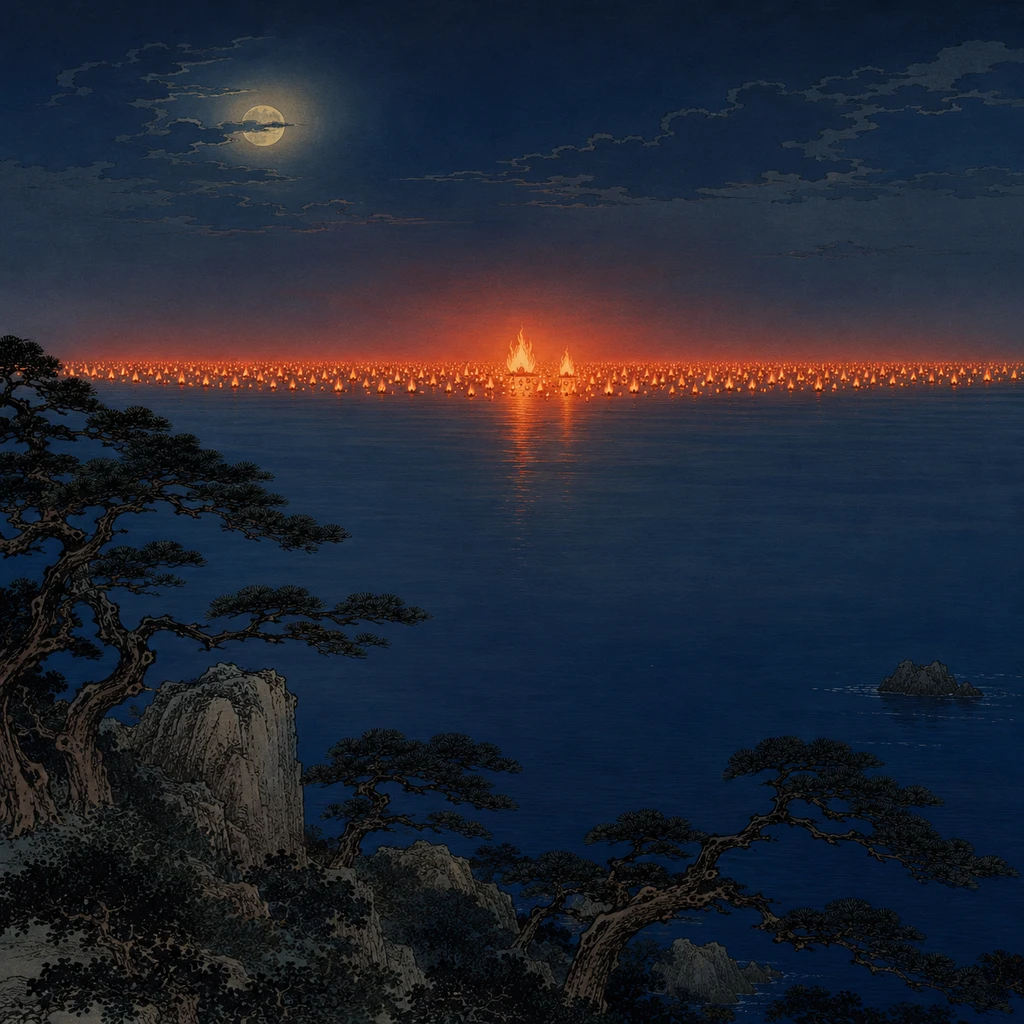
Shiranui
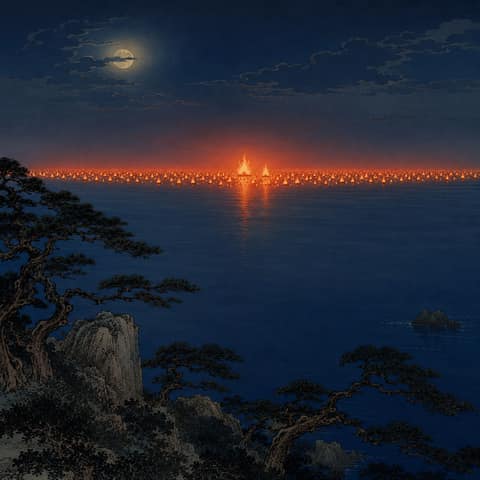
Shiranui is a mysterious light said to appear off the coast of Kyūshū, especially over the Yatsushiro and Ariake seas. On a calm night around the first day of the eighth lunar month, one or two 'parent fires' kindle offshore. They divide to either side and multiply until hundreds or thousands of lights stretch in a horizontal line. The display is difficult to see close to sea level but clear from higher ground, and the lights are said to recede when approached. Also called Thousand Lanterns or Dragon Lanterns, Shiranui was feared as a sign that fishers should not put to sea. It is now generally explained as an atmospheric optical phenomenon related to mirage formation.
Read moreThe Shiranui was spoken of as a phenomenon where, on a windless night around the first day of the eighth month of the lunar calendar (Hassaku), one or two "parent fires" would appear offshore. These would then split left and right, multiplying into hundreds or thousands of fires aligned in a horizontal row. It is said that the line of fire could stretch for several kilometers. Difficult to see from near the sea surface but clearly visible from hills and high places, it retreats if one tries to approach it—this very nature of a "fire that flees when approached" made fishermen believe the Shiranui was something extraordinary. Also called Sen-doro (a thousand lanterns) or Ryuto (dragon lanterns), it was feared as an omen warning against setting out to fish that night.
The origin of the name is ancient. The *Nihon Shoki* "Chronicle of Keiko"[3] recounts that while Emperor Keiko was touring Kyushu, he crossed the sea from Ashikita and lost his way in the night. A glowing red fire appeared in the distance, and by steering toward it, he safely reached the shore. When he asked the locals, "Who lit that fire?" they answered, "We do not know" (shiranu). Thus, the fire was named "Shiranui" (the unknown fire). The mythological memory of a fire guiding an emperor was later tied to the origin of "Hi no Kuni" (Land of Fire)—an ancient regional name encompassing Higo and Hizen. This phantom fire, with its roots in mythology, descended into the calendars of fishing villages in the early modern period.
Einoo Tsurugi Shrine[4], facing the Yatsushiro Sea, is known as a famous spot for viewing the Shiranui. Even today, the custom remains for people to gather in the early hours of the first day of the eighth lunar month, when the tide is at its lowest, to await the parent fires and split fires offshore. The best opportunity for viewing is from late night to early dawn, when the tide has drastically receded from high tide; it is said the fires rise better the greater the difference between the air temperature and the sea surface temperature. The Shiranui was also spoken of along the coast of Saga bordering the Ariake Sea, and the countless fires illuminating the night sea were deeply rooted in the lives and faiths of fishing villages. Today, it is understood as a type of mirage where the lights of fishing boats or the shore form images due to abnormal atmospheric refraction. However, this scientific explanation does not diminish the cultural weight of the fire that has bundled myth, calendar, and the awe of fishermen together for over a millennium. Rather, precisely because it is a natural phenomenon, it faithfully appears on the same night every year, and people continue to overlay names and stories onto that fire even now.
Messenger of the Dragon Palace — Jinja-hime and the Prehistory of Amabie
From the same Ariake and Genkai seas, an anomaly of a completely different nature also emerged. A prophetic beast that "predicts" disasters and allows people to escape misfortune by gazing upon its sketched image—the Jinja-hime.
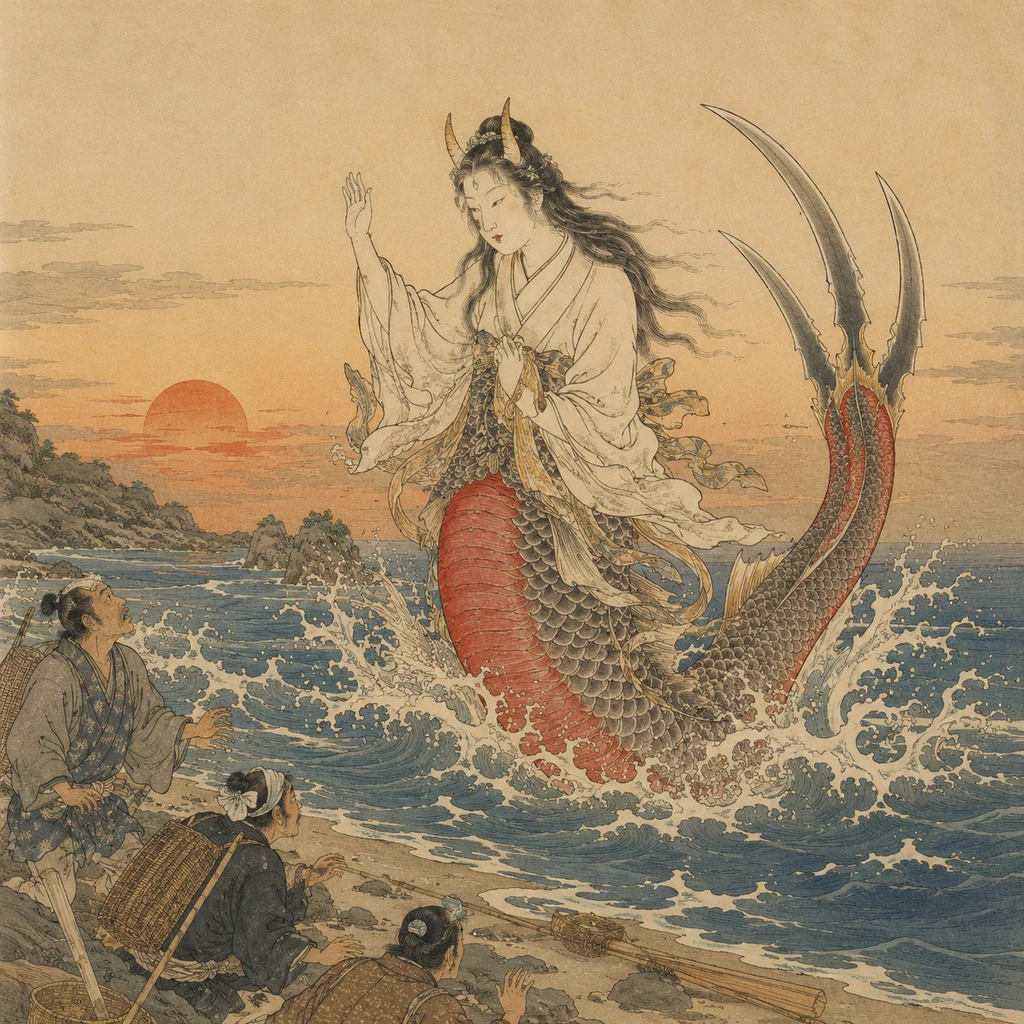
Jinja-hime
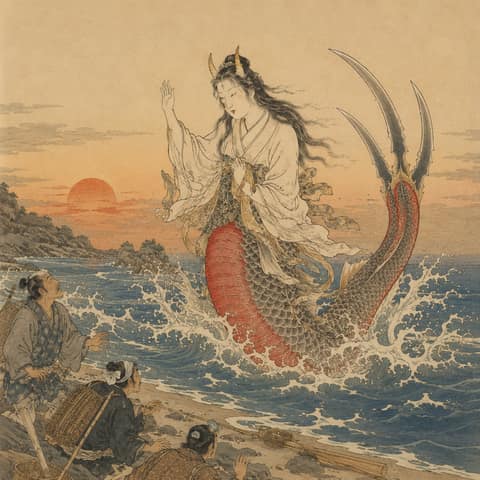
Jinja-hime is a prophetic, mermaid-like creature said to have appeared on the coast of Hizen Province in the late Edo period. It has a human face and a fish's body, with a red belly, two horns, and a tail divided into three sword-shaped points. Calling itself 'Jinja-hime, a messenger from the Dragon Palace,' it announced that a widespread illness known as korori would follow a time of abundant harvests. It also declared that anyone who viewed a copy of its image could escape the calamity and gain long life. Wording from printed sheets and copied pictures survives in records such as Waga Koromo, and the images were displayed in homes as protective charms.
Read moreAccording to Kato Eibian's essay *Wagakoromo*[5], in April of 1819, a strange fish over two *jo* (about six meters) in length appeared on the beach of Hizen. It had the face of a human, the body of a fish, a crimson belly, two horns, and a three-pronged sword-shaped tail. Calling itself the "Messenger from the Dragon Palace, Jinja-hime," it prophesied seven consecutive years of bountiful harvests followed by a spreading disease called "korori," declared that those who looked at a drawn image of its form would avoid the epidemic and gain longevity, and then departed. "Korori" was an epidemic that caused sudden death, reminiscent of later cholera outbreaks. These words and its illustration were printed as broadsheets, spread far and wide by peddlers, and posted on the pillars and doors of houses as protective talismans. Similar examples include the "Hime-uo" of Hirado and the "Dai-jinja-hime" and "Ningyo no Zu" of Echigo, all sharing the common elements of an appearance, a prophecy, and the efficacy of a copied drawing. The Jinja-hime could be considered the pioneer among them.
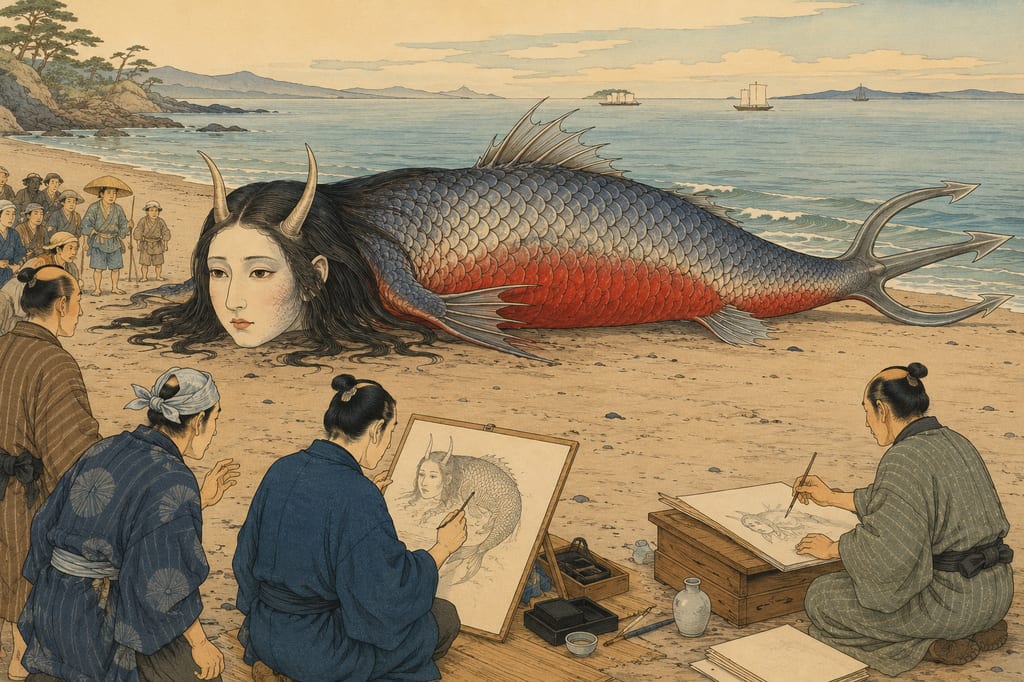
The Jinja-hime is significant because it is a precedent that predates the Amabie, which gained global attention in 2020 as a yokai for warding off epidemics, by about a quarter of a century. Announcing its appearance, prophesying good/bad harvests and disease, and imbuing its copied image with efficacy—this mold of the prophetic beast was passed down to the Amabie, said to have appeared in the sea of Higo in 1846. If the Amabie is from Higo (Kumamoto), the Jinja-hime was born from the neighboring sea of Hizen (Saga and Nagasaki). The same sea off the western coast of Kyushu consecutively sent forth prophetic female sea monsters into the world. The belief that the Dragon Palace lies beyond the ocean, from which messengers visit to tell the future, is deeply rooted in the coastal culture of western Kyushu, which was open to the peninsula and the continent. This ancient sea belief acquired the new vessel of the early modern commercial broadsheet, circulating the people's greatest anxiety—disease—in the form of a yokai. The Jinja-hime is a perfect specimen standing at the crossroads of sea faith and publishing culture. The beach of 1819 is recorded only as "Hizen" in historical documents, and there are also traditions placing it off the coast of Hirado; it can be said that the entire sea of Hizen, straddling the border of Saga and Nagasaki, is the homeland of this princess.
Islands of the Genkai Sea — Iso-onna and Isonade
Let us shift our gaze to the northern sea. Kakara Island, floating off the coast of Chinzei Town, Karatsu City at the northernmost tip of Saga Prefecture, carries the legend of the birth of King Muryeong of Baekje and is a key juncture for traffic with the Korean Peninsula, recorded as "Kakara-jima" in the *Nihon Shoki*. On this island, where camellias grow wild and cats are plentiful, the tale of the coastal female monster Iso-onna is passed down.

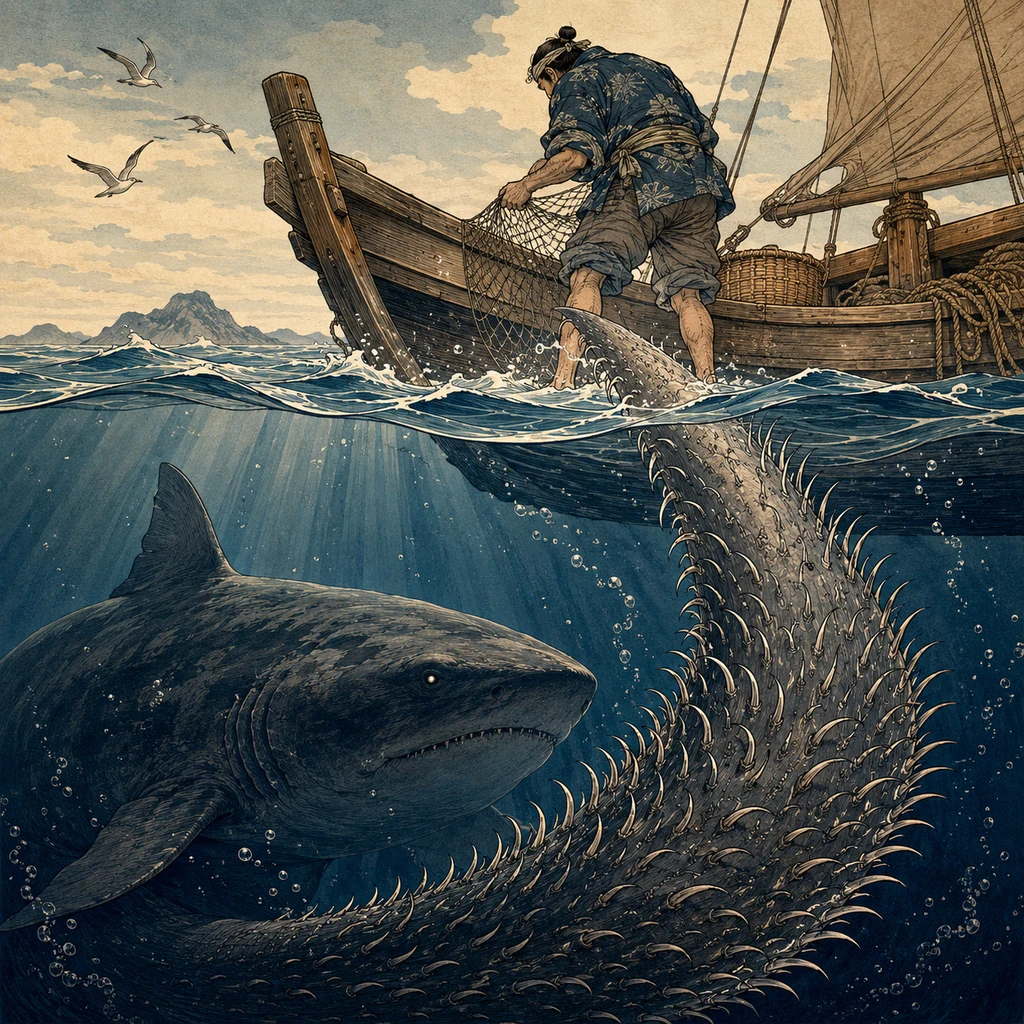
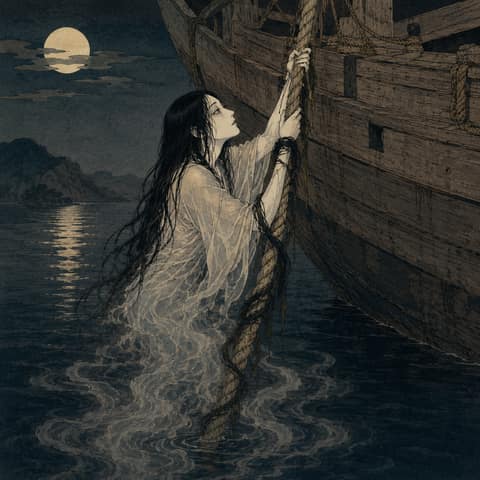
The Iso-onna is a female sea monster appearing along the coasts of northwestern Kyushu[6], such as Amakusa, Shimabara, Tsushima, and Kakara Island. Approaching sandy beaches, rocky shores, or anchored boats, she is said to cling to people with her long hair and suck their lifeblood. Her upper half resembles a beautiful woman, but her lower half is said to be hazy or snake-like, and from behind, she is said to look like nothing more than a rock. In Minamishimabara, Nagasaki Prefecture, it is told that the Iso-onna stares out at the open sea, and if someone calls out to her, she lets out a shrill shriek, entangles them in her hair, and sucks their blood. In Amakusa, it is said she creeps onto boats at night via the mooring ropes to cover sleeping sailors with her hair and harm them; thus, there was a custom of only dropping an anchor and not securing mooring ropes at unfamiliar ports. On the Shimabara Peninsula, it is said she can be warded off by sleeping with three stalks of thatch from a woven mat placed upon one's kimono. Standing precisely on the boundary of land and sea that is the rocky shore—neither truly land nor open ocean—she is a female monster of the threshold, distinct from the Umibozu or Funa-yurei that directly attack ships offshore. In northern Kyushu, there are theories equating the Iso-onna to the incarnation of a crab, and some regions linked her to the spirits of the drowned. The transmission of this monster on an isolated open-sea island like Kakara is likely because the seafaring culture of the Genkai Sea, open to the peninsula, crystallized the anxieties of sailors spending the night in foreign ports—the fear that at night, on an unfamiliar shore, something might crawl up into their boat—into an image revolving around women, hair, and blood.
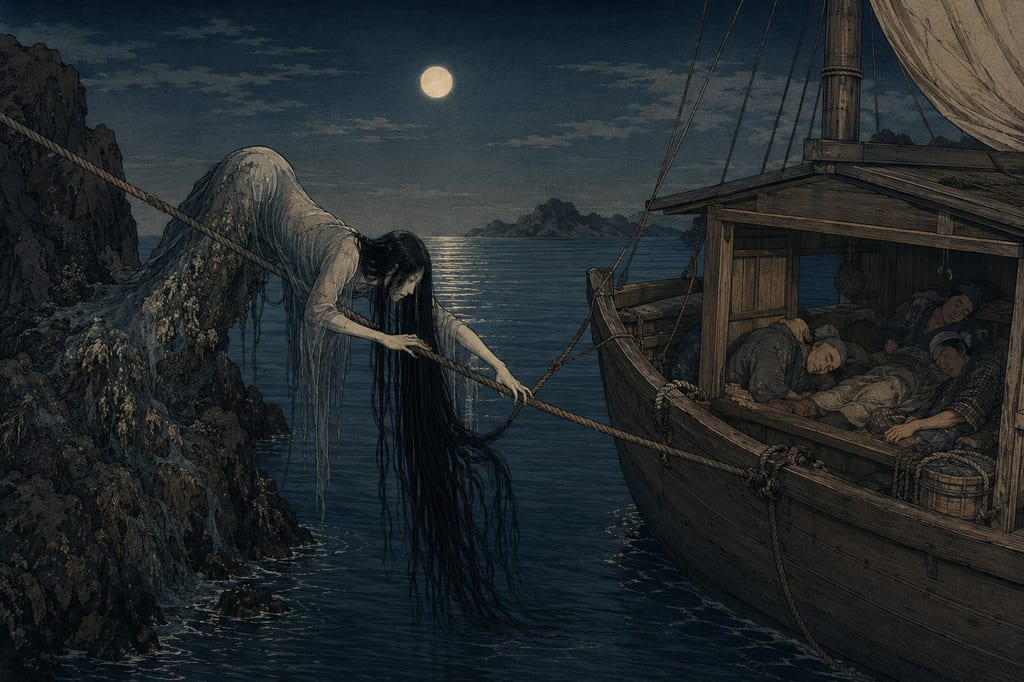
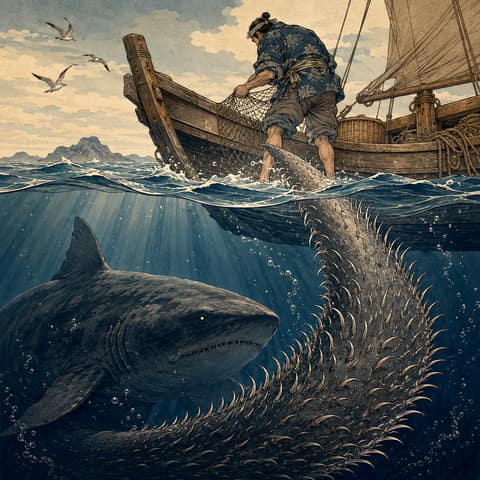
In the same waters of the Genkai Sea dwells the unseen shark monster, the Isonade. Its appearance resembles a shark, but its tail fin is equipped with countless fine needles. Appearing when the north wind blows strong, it approaches as if stroking the surface of the sea, snagging people on boats with the needles of its tail while remaining unseen, dragging them into the ocean to swallow them. In places like Hizen Matsura, it was believed that when the color of the sea suddenly changed and an updraft was felt, the Isonade's tail had already emerged on the surface as an omen. Its form remains invisible until the very moment it attacks, and by the time one notices, they are already entangled in the tail's needles. This "invisibility" makes the Isonade akin to the personification of a shipwreck itself. The *Ehon Hyakumonogatari*[7], written by Momosan-jin and illustrated by Takehara Shunsensai in 1841, depicts the "Isonade" off the coast of Hizen Matsura, likening its form to a giant shark that raises its tail to stroke sailors and drag them into the sea. Its name is also found in botanical and zoological treatises as the "giant-mouthed crocodile," and in the Kumano region of Mie Prefecture, coastal unnatural deaths were sometimes described as being "stroked by the Isonade." However, the region most deeply tied to its name is the western sea drawn by painters like Sekien—off the coast of Hizen Matsura. If the Iso-onna is the "touching female monster," the Isonade is the "stroking fish monster." The rough waters of the Genkai Sea birthed these two kinds of monsters—which gently touch the human body to spirit them away—as a pair.
The Boundary Between River and Field — The Hyosube,
Kappa of Hizen
Moving from the sea to the inland waterways. The rivers running longitudinally and latitudinally across the low, damp Saga Plains were the dwelling place of the Hyosube, a hairy kappa unique to Kyushu.

Hyōsube
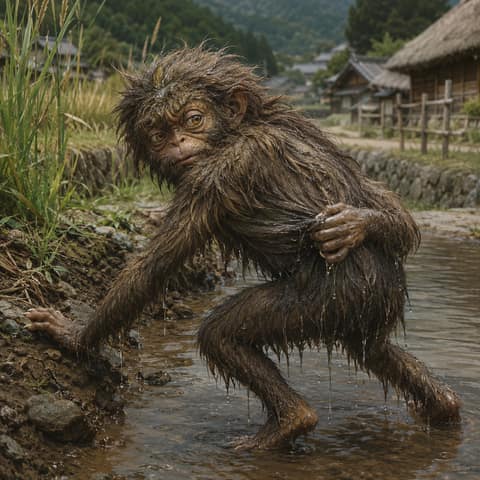
Hyōsube is a hairy, water-dwelling yokai found throughout the Kyushu region. Counted as kin to the kappa—or at least a close relative—it is said to move back and forth between the rivers and the mountains around the equinox. Its name is traced to its birdlike cry of "hyō-hyō." It is fond of eggplant, and in some areas the custom of offering the season's first eggplant still survives. The best-known stories tell of it slipping into a household bath to soak, leaving the water afterward thick with floating body hair; anyone who lays eyes on it, they say, falls ill with fever.
Read moreThe Hyosube is a hairy yokai considered to be of the same kind, or a close relative, of the kappa. It is said its name comes from its bird-like "hyo-hyo" cry, and it is told that around the time of the equinox, it travels back and forth between the rivers and the mountains. In Saga and Nagasaki, while kappa are called Gawappa or Gaataro, they are also variously distinguished as Hyosube or Hyosubo, with the boundaries between them often blurred. They favor eggplants, and the custom of offering the first eggplants of the season remains in some areas. The most widely known narrative motif is the curse involving baths and horses. It is told in various regions that after a hairy Hyosube soaked in a bath, large amounts of body hair would float in the water; horses that touched that water would die, or those who drained the water would be cursed and have their horses killed. In the fields, it is said they would ravage the eggplants, so people would appease them by offering the season's first harvest.
What makes this kappa special in Saga is that it possesses a solid origin story and places where it is enshrined. According to the Hizen military chronicle *Hokuhi Senshi*[8], the name is written as "Hyosube"—meaning those subjugated by the Ministry of Military Affairs. The story goes that during the construction of Kasuga Taisha in the Tenpyo era, dolls that craftsmen had brought to life with secret arts were thrown into the river after serving their purpose and turned into kappa. An ancestor of the Tachibana clan subdued them by imperial decree, and ever since, they have been called Hyosube. In later generations, when Tachibana Kimi'nari, a descendant of the Tachibana clan, moved from Iyo to Hizen Takeo in 1237 and built Shiomi Castle, it is said the Hyosube followed their master and moved to the Shiomi River. Shiomi Shrine in Takeo City is known as a shrine that worships this kappa. Furthermore, in the castle town of Saga, there remains a legend that the domain founder Nabeshima Naoshige reformed the kappa of the Matsubara River, turning them into guardian deities of the waterside. This narrative—of yokai reversing roles from beings to be vanquished to protectors of the land—speaks to how closely the Hyosube was intertwined with the lifestyle of the Saga Plains, which depended heavily on waterways and rice paddies.
Their hairy, bald-headed, and somewhat comical appearance was also depicted in Edo-period picture scrolls and illustrated encyclopedias—such as Sawaki Suushi's 1737 *Hyakkai Zukan*[9], Toriyama Sekien's *Gazu Hyakki Yagyo*[10], and Terajima Ryoan's *Wakan Sansai Zue*[11]. Extreme claims like "seeing one means certain death" are later exaggerations; originally, they were yokai spoken of calmly in connection with household hygiene, taboos, and the worship of the field god, existing close to daily life. Even today in Saga, making appearances at local events billed as "Ghost Streets," the Hyosube is not a pest to be exterminated but is cherished as a symbol of the land watching over the waterside.
Saga Among the Sea Monsters of the Nation
When we place the monsters we have seen so far back into the national distribution of yokai, the distinctiveness of Saga—Hizen—becomes clear. Female sea monsters exist in various regions, but the form of the Iso-onna, revolving around hair and blood, is unique to the coasts of northwestern Kyushu stretching from Amakusa, Shimabara, and Tsushima to Kakara Island. Prophetic beasts, too—the Jinja-hime, Hime-uo, and Amabie—appeared concentrated along the west coast from Hizen to Higo. While phantom fires like Ryuto and Kitsunebi are found nationwide, the Shiranui, where parent fires split and multiply into thousands on the night of Hassaku, is spoken of only in the specific inland seas of Ariake and Yatsushiro. Kappa are present throughout Japan, but the Hyosube, possessing the origin story of being transformed dolls and having shrines dedicated to them, is a tale of Kyushu centered around Hizen.
What these all have in common is that they are set on the "boundaries of water." In contrast to Kyoto's yokai, where the city of Heian-kyo and courtly culture birthed high-ranking supernatural oddities, Saga's yokai raised monsters closely tied to daily life from the natural boundaries of sea, mud, and river. Rather than in the books of nobles or monks, it is within the taboos of fishermen, the customs of sailors, the rituals of farmers, and the hands of commoners buying broadsheets that these monsters have continued to live. The yokai of Saga are thoroughly yokai of everyday life. Therefore, even when summoned into a narrative of power like the bakeneko, its form remained that of an everyday pet cat lapping oil from a paper lantern.
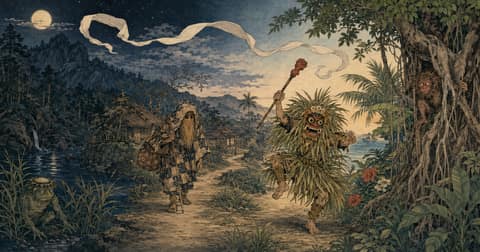
The Wind of Obon — The Formless Anomaly of Shorou-kaze
Finally, let us look at one formless supernatural anomaly. Along the coastlines from Saga to the islands of Nagasaki, an ominous wind that blows during Obon—the Shorou-kaze—is passed down.
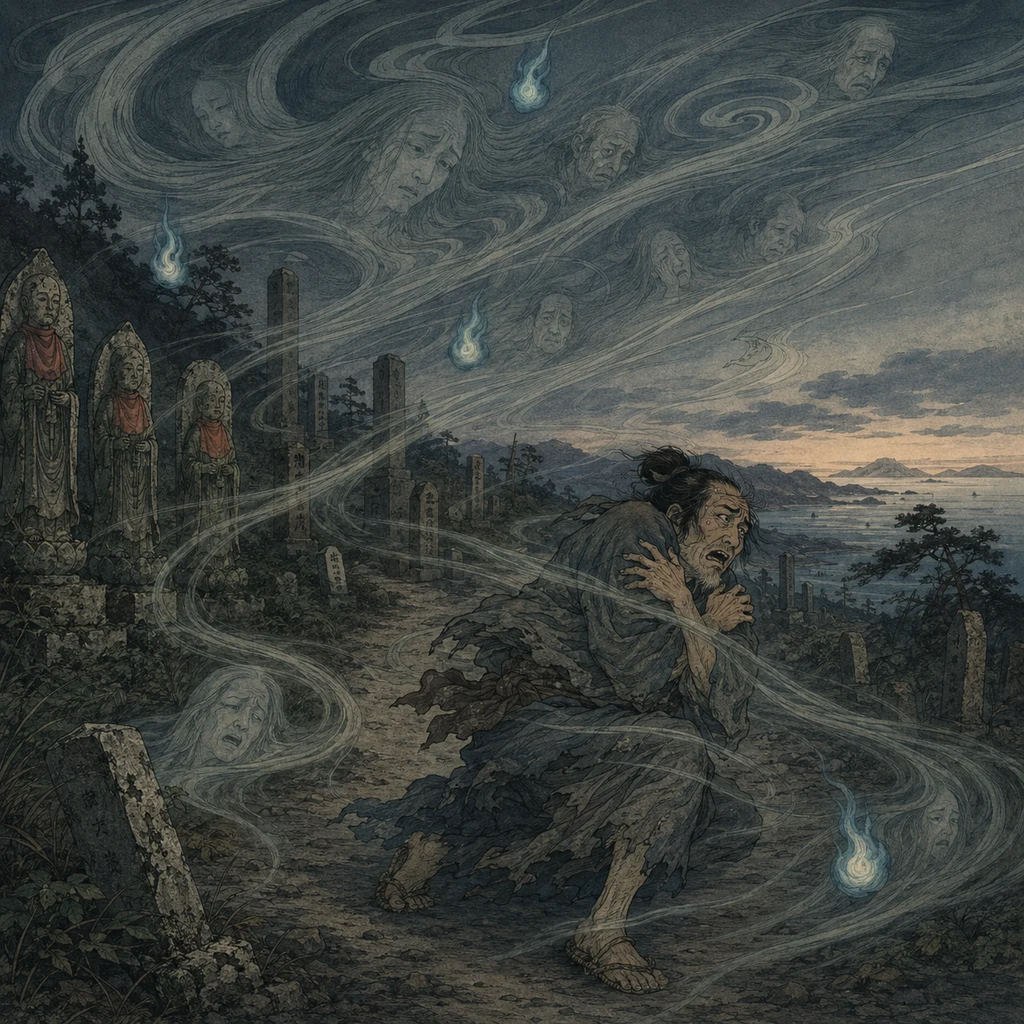
Shōrōkaze (Spirit-Wind)
Shōrōkaze, the “spirit-wind,” is a baleful breeze said to blow on the morning of the sixteenth day of Obon. It has no visible form, yet those struck by it were feared to suffer sudden fever, chills, or dizziness. Here “shōrō” means the spirits of the dead in Buddhist usage, and the wind is understood as the current that carries the departing souls at Obon. In the Goto Islands, people traditionally avoid graves and grave paths on this day to ward off spiritual harm.
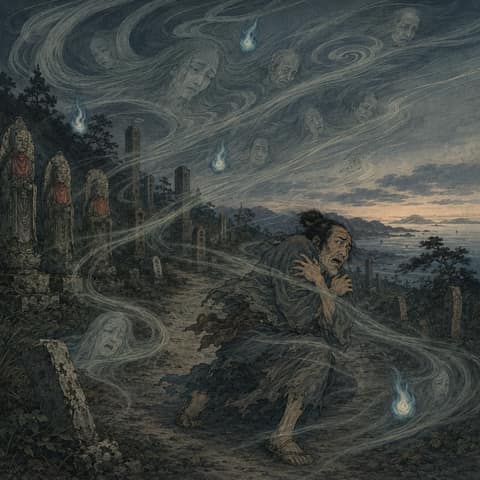
Read moreThe Shorou-kaze is a wind said to blow on the morning of the sixteenth day of Obon. Possessing no physical substance, it was feared for bringing calamities such as sudden fever, chills, and dizziness to those it struck. The word "Shorou" (spirits) here refers to the souls of the dead in Buddhism. The spirits of the dead who had returned for Obon go back to the other world on the sixteenth—and it was interpreted that the wind carrying these spirits was the Shorou-kaze. Thus, people avoided the paths of spirits on this day. In the neighboring Goto Islands, a taboo against approaching graves or grave paths was observed on this day, and in Iki, the wind bringing illness was classified into the wind of dead spirits (Shiryo-kaze) and the wind of living spirits (Ikiryo-kaze), with reports noting that the latter causes chest tightness. The wind itself was perceived as the trace of the unseen comings and goings of spirits.
Beliefs collectively known as "evil winds" exist in various regions, and examples where localized gusts were interpreted as the source of disaster—like the Kiyokawa-dashi, Yamaji, or the wind of Ichimokuren—are not uncommon nationwide. But what makes the Shorou-kaze stand out is that it is perfectly overlaid onto the calendar milestone of Obon, a time when the living and the dead travel back and forth. The Shiranui returning from the sea, the Jinja-hime emerging from the ocean, the Iso-onna standing on the rocky shore, the Isonade stroking the sea surface, the Hyosube by the riverbank—while the yokai of Saga and its surroundings all inhabited water and boundaries, the Shorou-kaze alone quietly concludes this lineage as a wind that blows not across spatial boundaries, but temporal ones.
Conclusion — Yokai Born of Watery Boundaries
Lining up the seven supernatural oddities of Saga in this way brings a single axis into focus. The two seas of Genkai and Ariake, the rivers and tidal flats that connect them, and the temporal milestone of Obon—all of these are "boundaries." The Iso-onna stands on the border of land and sea, the Isonade strokes the sea's surface, the Shiranui illuminates the offing, the Jinja-hime delivers prophecies as a messenger from the Dragon Palace, the Hyosube dwells at the border of river and field, and the Shorou-kaze blows through the boundary between life and death. Even the bakeneko lurking deep within the castle was an incarnation of resentment born on the borderline between the old and new ruling houses of Ryuzoji and Nabeshima.
Yokai materialize upon the boundary lines that people draw across the world. In the Ariake Sea, which boasts one of Japan's largest tidal ranges, what was ocean becomes mud, and mud returns to the ocean—that very instability of the boundary was surely the soil that summoned a colorful array of monsters to the land of Hizen. To visit the yokai of Saga is nothing other than reading the story of the land's boundaries woven by sea, mud, and calendar.