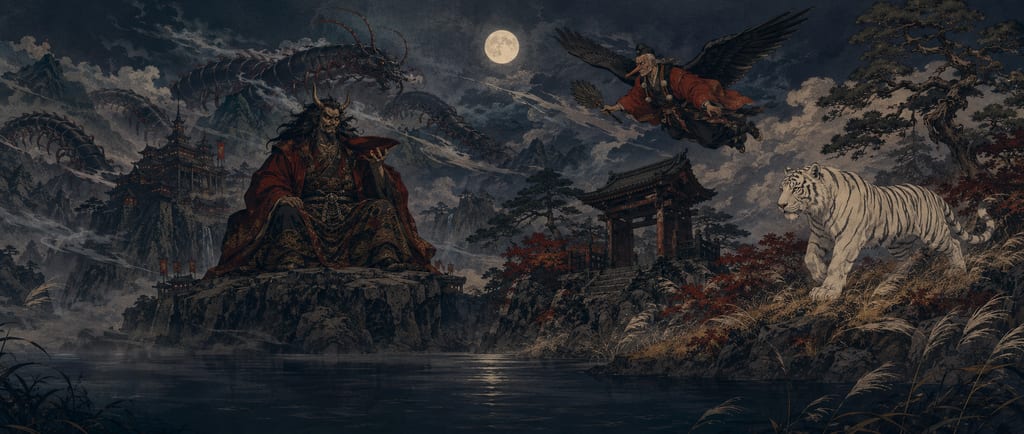
Shōrōkaze, the “spirit-wind,” is a baleful breeze said to blow on the morning of the sixteenth day of Obon. It has no visible form, yet those struck by it were feared to suffer sudden fever, chills, or dizziness. Here “shōrō” means the spirits of the dead in Buddhist usage, and the wind is understood as the current that carries the departing souls at Obon. In the Goto Islands, people traditionally avoid graves and grave paths on this day to ward off spiritual harm.
Folklore & Legends
In Goto, it is said that being caught by the morning wind on the sixteenth of Obon brings illness, so visiting graves or walking grave roads is avoided. On nearby Iki in Nagasaki, reports distinguish between “dead-spirit wind” and “living-spirit wind,” the latter causing chest tightness. Across Japan, beliefs in “evil winds” appear under various names; local winds like the Kiyokawa-dashi, Yamaji, or the wind of Hitotsume-no-Megumi (Ichimokuren) were interpreted as sources of calamity.
Yokai Cards1
Shōrōkaze (Spirit-Wind) across multiple art-style decks
Spirit Wind is spoken of as an invisible wind that brings sudden chills, fever, and lightheadedness to those it touches. Its timing on the morning of the sixteenth day of Bon is emphasized, and the “spirits” here are the souls of ancestors or the unconnected dead. The wind is understood as carrying the aura of spirits crossing the boundary between return and departure. In the Goto Islands, people strictly avoid graves and grave roads on that day and refrain from going out. On Iki Island, illness is seen as a possessing wind, with graveyard-origin termed dead-spirit wind and grievance-origin termed living-spirit wind. It aligns with regional beliefs in malign winds, where seasonal fatigue and sudden gusts intersect with folk explanations and are remembered as spirit afflictions. It is not told as a yokai with active malice, but as a taboo that warns of misfortune for those who mistake the date or place.
Character Profile
This section is our own creative profile for storytelling. It is not historical fact or scholarship.
The diagram below is a diagnostic evaluation chart for Spirit Wind (Folkloric Version). The higher the value of each item, the stronger that characteristic is expressed.