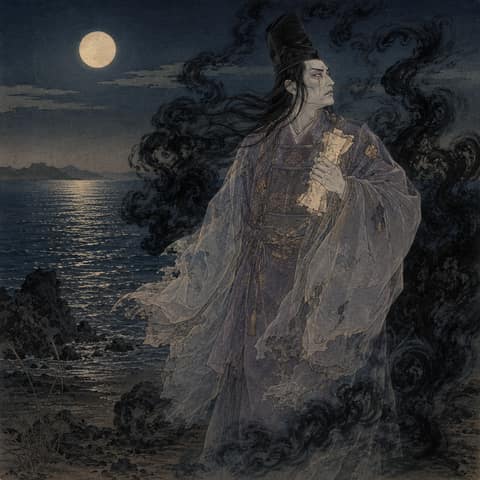
Fujiwara-no-hirotsugu
fujiwara-no-hirotsugu
The Rebel Spirit That Foreshadowed the Goryo Belief
This version of Fujiwara-no-hirotsugu bears the political history before he became a vengeful spirit (onryo). He was not a monster from the beginning. While involved in central politics as a member of the Fujiwara clan, he was distanced to Dazaifu during political strife, and raised an army claiming criticism against Kibi no Makibi and Genbo. His onryo nature is born after that defeat. Hirotsugu's rebellion was an incident where the power struggle of the capital was moved to the military space of Kyushu. Dazaifu was a key point of diplomacy and military affairs, and the dissatisfaction of Hirotsugu placed there expanded beyond mere personal feelings. Gathering an army, being pursued, captured, and executed. The plot of the rebellion is short, but the spiritual shadow it leaves behind is long. What is important in this version is not to view an onryo as a "ghost that suddenly appears after death." In Japanese Goryo belief, divine aura is created by intertwining political injustice, regretful death, fears of plagues and disasters, and pacification rituals. Hirotsugu can be read as a figure who demonstrated the structure leading to Prince Sawara and Sugawara no Michizane at an early stage. In other words, he is a foreshadowing of the Goryo belief. The folklore related to Kagami Shrine shows the process of a central rebel turning into a regional divine spirit. The name of the person defeated in the capital remains in the land of Kyushu, pacified in rituals and folklore. The one removed from the center of history gains another center in a peripheral land. This reversal pairs well with YOKAI.JP's place articles. The connection with Genbo is a strong thread that turns Hirotsugu into a narrative. The story reading the later misfortune of the monk named as a political enemy as the work of Hirotsugu's spirit shows the imagination of onryo tales, separate from the confirmation of historical facts. Grudges do not return straight to the opponent, but are spoken of over time, wrapping in anxieties about politics, religion, and disease. In modern cards and diagnoses, it is better to express Hirotsugu as a pressure lingering between the lines of records, rather than a flashy monster. Rather than armor, the dark government offices of Dazaifu, the execution ground by the sea, the torn memorial, the shrine of Kagami, and a gaze turned toward the distant capital suit him better. He demonstrates the pattern of someone nearly erased by the victor's story returning to history as a spirit. Hirotsugu is worth writing about carefully precisely because his form as an onryo is not flashily fixed. An ambiguous spirit can be expressed not as thin documentation, but as a layer of history. The rebellion recorded in the official history, the rituals remaining in the region, and the connection with political enemies overlap little by little, becoming a pressure with an unclear outline. That is where his terror lies. In the group of Goryo belief pages, Hirotsugu is suited for both introduction and deep dives. Going to Prince Sawara reveals the tragedy of imperial succession; going to Sugawara no Michizane reveals the transformation into a god of learning; going to Taira no Masakado reveals the martial might of the eastern provinces. Placing Hirotsugu before them allows one to understand how onryo are born from political history over a longer timeline. If making this version into a card, rather than terrifyingly exaggerating the face, one would want to combine the torn memorial, the sea facing the distant capital, the Kagami Shrine, and the shadow of the subjugation army. Rather than a monstrous appearance, Hirotsugu is a spirit standing between record and memory. That modest darkness fits YOKAI.JP's profound onryo lineup.