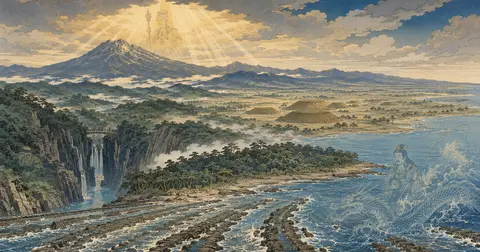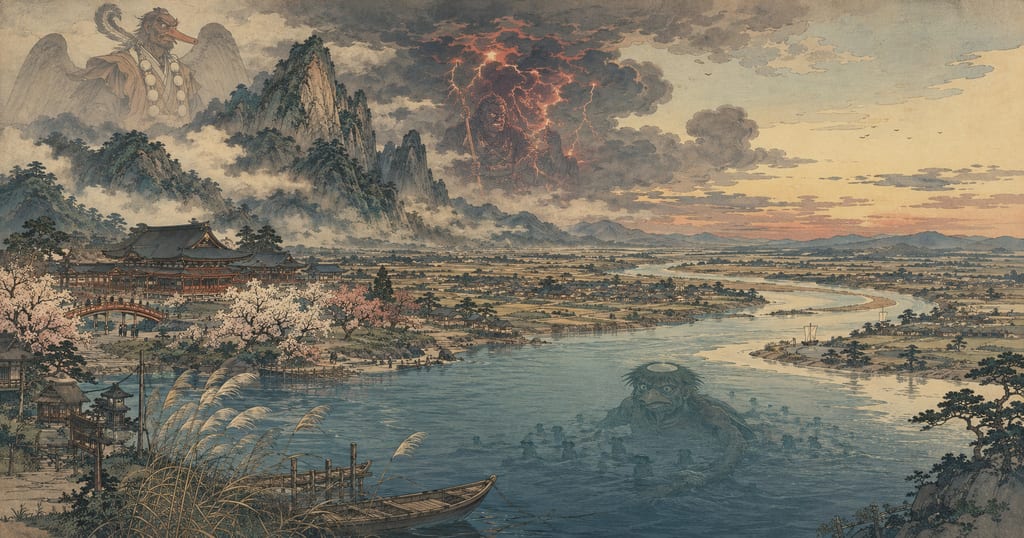
Fukuoka Prefecture, the northern gateway to Kyushu. This land, where the three ancient provinces of Chikuzen, Chikugo, and Buzen overlap, is situated between the Genkai Sea and the Ariake Sea. It stood at the forefront of interactions with the continent across the sea, while simultaneously being a 'frontier' furthest from the capital's authority. Dazaifu is the nexus of this duality. It was the western capital, termed the 'Distant Court', established by the Ritsuryo state to govern the nine provinces of Saikaido and handle diplomacy and defense. Yet, it was also a place of exile for those defeated in political struggles. A single axis runs through Fukuoka's yokai culture, rising from this geopolitical stance 'between the center and the frontier'.
A noble driven from the capital perishes in Dazaifu, becomes a vengeful spirit, and eventually ascends to the God of Learning. On Mount Hiko, a sacred peak bordering Buzen and Chikuzen, ascetic practitioners transformed into tengu, giving birth to a leader who united all the tengu across Kyushu. In the Chikugo River, Kyushu's largest raging river flowing from Aso into the Ariake Sea, 9,000 kappa exiled from Higo built a kingdom. And on the northern coast, along the dark paths of Onga, an invisible wall appeared to block the way. Vengeful spirits, tengu, kappa, and nurikabe—Fukuoka's yokai all share a narrative of 'arriving from the outside, becoming grotesque in this land, and eventually being enshrined and passed down'. Not vanquishing, but reconciling, enshrining, and turning them into allies. This imagination forms the backbone of the yokai of this region.
From Vengeful Spirit to Tenjin:
Dazaifu and Japan's Three Great Onryo
When discussing the yokai of Fukuoka, one cannot ignore Dazaifu. Sugawara no Michizane was a scholar-statesman born into the Sugawara clan, a family with a lineage of scholarship. He distinguished himself through his talent for Chinese poetry, was favored by Emperor Uda, and rose to the position of Minister of the Right during the reign of Emperor Daigo. In an era when the Fujiwara clan was solidifying its grip on the regency, his ascent without being a Fujiwara was exceptional and consequently met with intense backlash. In the first month of the fourth year of Shotai (901), Michizane was abruptly demoted to the post of Dazai no Gon no Sochi and exiled to Dazaifu in Chikuzen Province. The direct catalyst was a false accusation by Fujiwara no Tokihira and others—the 'Shotai Incident'—claiming he plotted to depose Emperor Daigo and install his son-in-law, Imperial Prince Tokiyo. This is widely considered to have been a conspiracy[1].
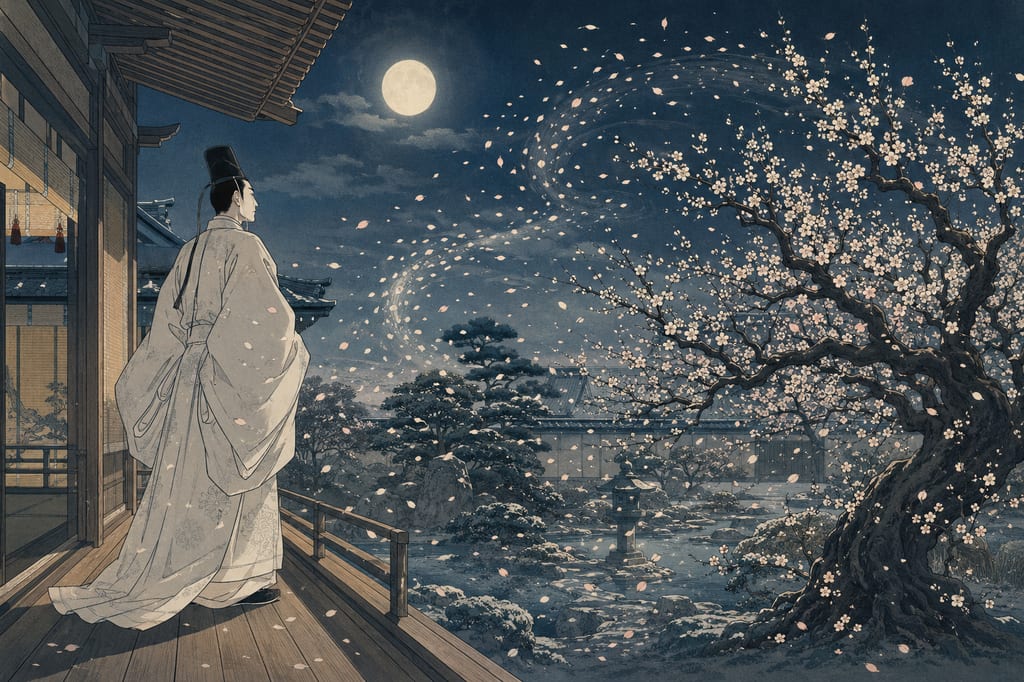
As he departed Kyoto, it is said he composed a poem to the plum tree in his garden: 'When the east wind blows, send your fragrance, oh plum blossoms; though your master is gone, do not forget the spring.' The legend of the 'Flying Plum Tree' (Tobiume)—that this very tree flew overnight from Kyoto to Dazaifu, yearning for its master—conveys the sorrow of his exile and the reverence for Michizane to this day. The title of Dazai no Gon no Sochi was merely nominal; stripped of actual power, Michizane spent his days in confinement in a dilapidated official residence with only a few attendants.
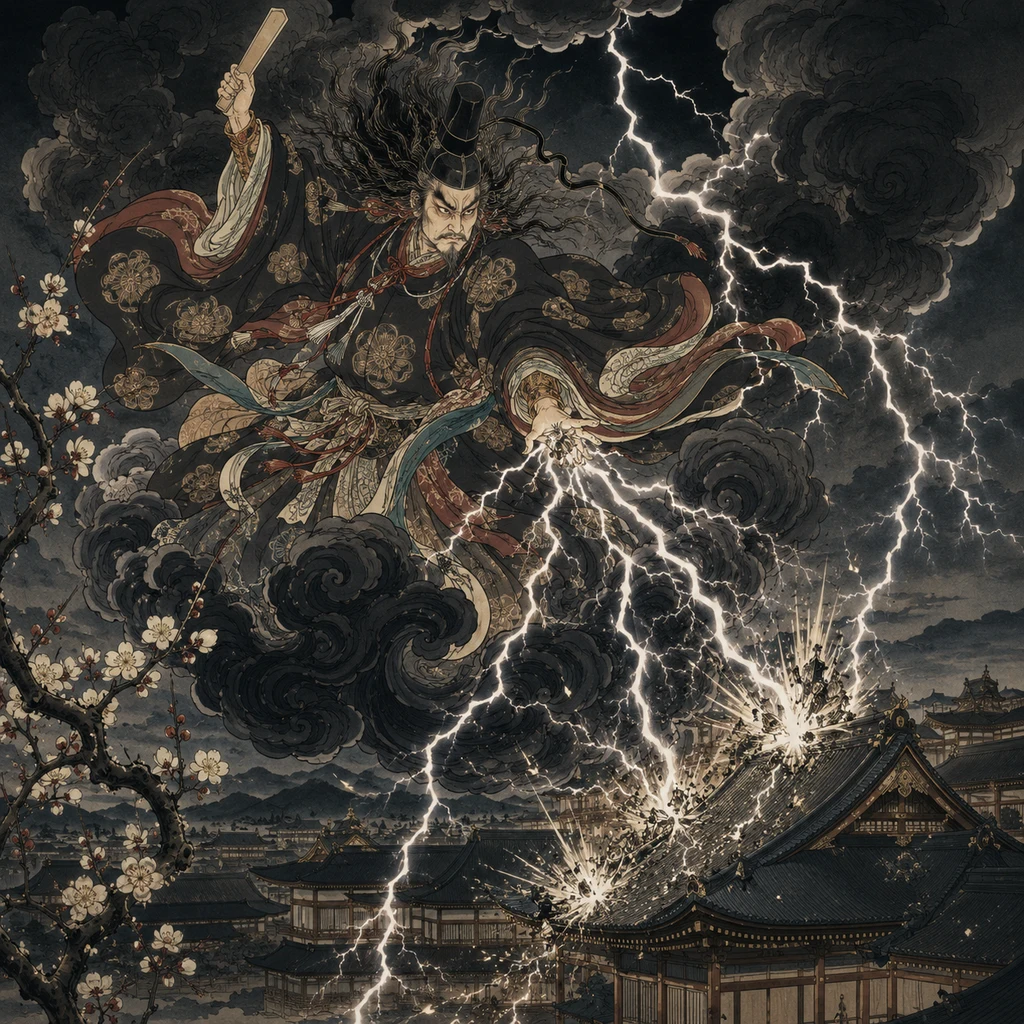
Sugawara no Michizane
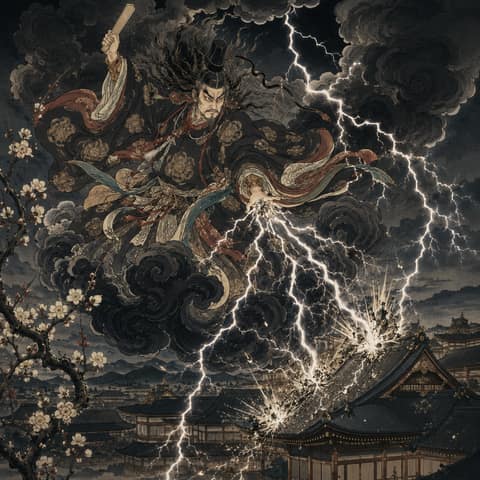
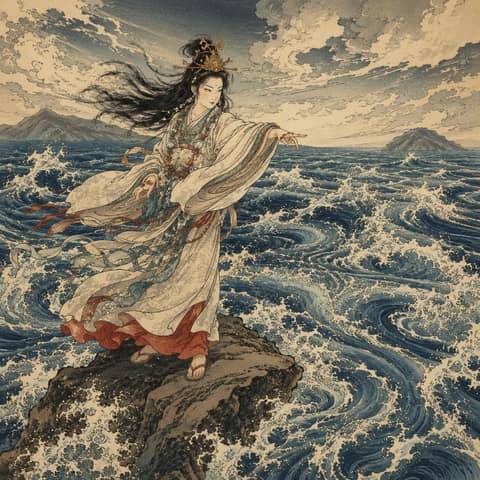
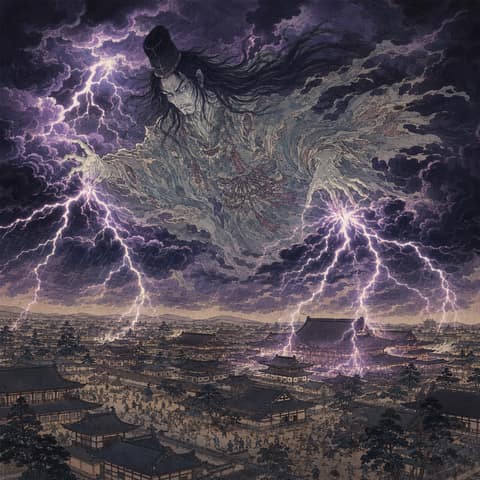
Sugawara no Michizane was a Heian-period scholar and composer of Chinese verse who rose to the office of Minister of the Right; after his death he came to be counted among the most dreaded vengeful spirits in Japan, and was in time enshrined nationwide as Tenman-Tenjin, the god of learning. Born into the scholarly Sugawara house, he was favored under the two reigns of Uda and Daigo, but in the fourth year of Shōtai (901), slandered by the Minister of the Left Fujiwara no Tokihira, he was demoted to Dazaifu, where he died in despair in the third year of Engi (903). After his death, the capital saw a succession of deaths among his political enemies, beginning with Tokihira, followed by plague and drought, all whispered to be the curse of Michizane, who had been sunk by a false charge. Above all, the lightning strike on the palace's Seiryōden in the eighth year of Enchō (930), which killed and wounded many nobles, fixed the conception of Michizane as Karai-Tenjin, the thunder-wielding "Fire-and-Thunder Heavenly Deity." To pacify that raging spirit, the court enshrined him as a god, and the cult of Tenjin spread outward from Kitano Tenmangū in Kyoto and Dazaifu Tenmangū, built over his grave. Feared at first as a curse-bringing deity, Tenjin gradually changed in character—on account of Michizane's own outstanding learning in life—into a guardian of scholarship and letters; and in the early-modern era, as terakoya schools spread, he became beloved even among commoners as the god who grants success in study and clears false accusations. The plum he loved so dearly in life, and the thunder he wielded as a vengeful spirit, survive to this day as his emblems.
Read moreIn the third year of Engi (903), Michizane passed away in despair at Dazaifu and was buried at Anrakuji. He was 59 years old[1]. The issue arose afterward. In Kyoto, his political rival Fujiwara no Tokihira died an early death at thirty-nine in the ninth year of Engi (909), and subsequently, the princes and grandsons of Emperor Daigo passed away one after another. Then, in the eighth year of Encho (930), lightning struck the Seiryoden (the Emperor's living quarters) in the Imperial Palace, causing a horrific incident where the Major Counselor Fujiwara no Kiyotsura and others attending to political affairs were struck and killed. Emperor Daigo also fell ill shortly after this, soon abdicating and passing away. The people feared these successive calamities as Michizane's curse, and began to enshrine his wrathful spirit, associating it with the lightning god 'Karai Tenjin'. The vengeful spirit became a lightning god, and eventually sublimated into 'Tenjin', the guardian deity of scholarship and literature. This dramatic process of reincarnation would later be meticulously depicted in words and pictures in the *Kitano Tenjin Engi Emaki* (Scrolls of the Legends of Kitano Tenjin; Jokyu edition and others, circa 1219)[2]. Michizane is counted alongside Taira no Masakado and Emperor Sutoku as the foremost of Japan's Three Great Vengeful Spirits[3].
What must be emphasized here is that Michizane himself was a real historical figure, and the events of his exile and death are historical facts. On the other hand, his transformation into a vengeful spirit (onryo) and then into Tenjin is a matter of interpretation by the people of the capital and the provinces, belonging to the realm of faith. The two must not be conflated. From the perspective of Fukuoka, the starting point of this epic tale is the Dazaifu Tenmangu Shrine, which originated when his disciple Misake no Yasuyuki built a mausoleum at Michizane's tomb in the fifth year of Engi (905), followed by the construction of the first shrine building by the imperial decree of Emperor Daigo in the nineteenth year of Engi (919)[1]. While the Kitano Tenmangu Shrine in Kyoto was established after the fifth year of Tengyo (942) and became the central hub of Tenjin worship, Dazaifu, as the place of Michizane's final moments, remained the 'source' of the faith. The fact that the head shrine of the God of Learning, which attracts worshipers from all over the country during exam season today, was originally a shrine to pacify a vengeful spirit perfectly symbolizes Fukuoka's yokai culture.
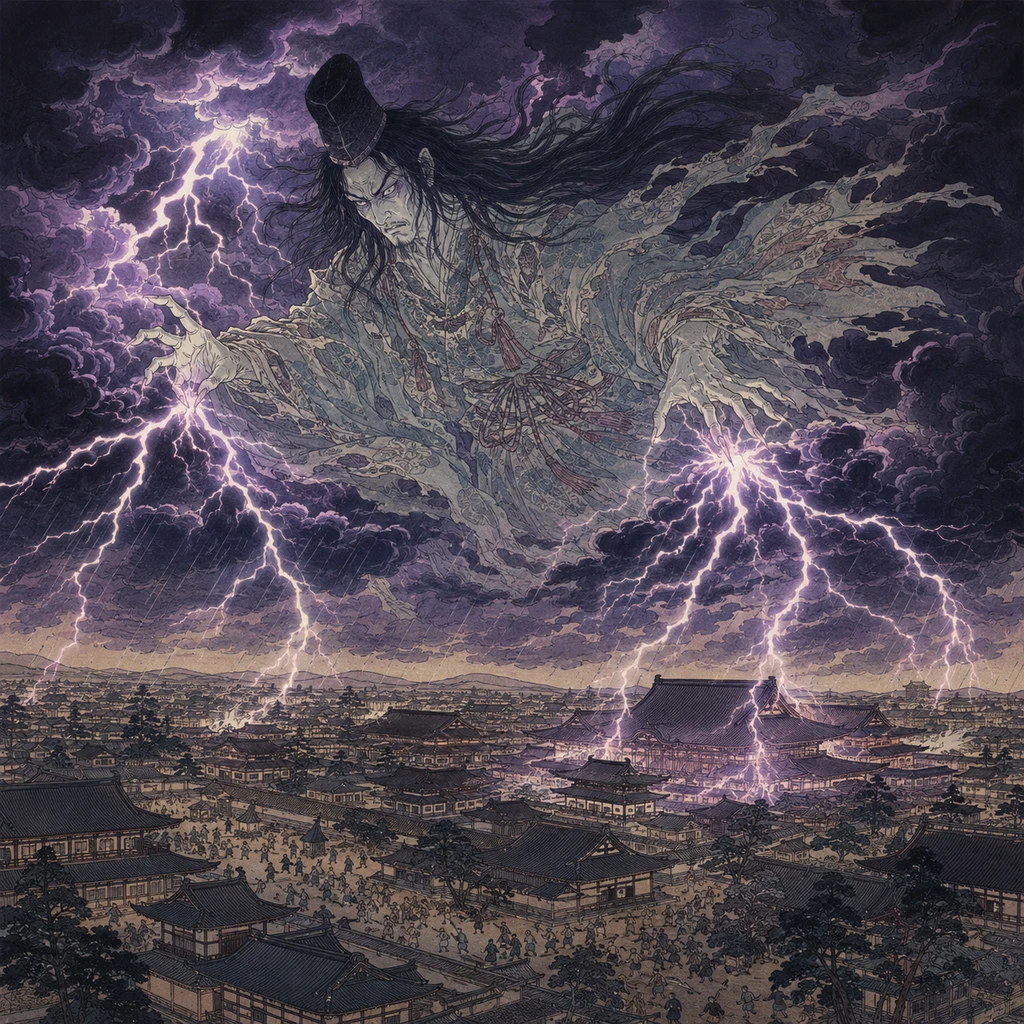
Onryō (Vengeful Spirit)
An onryō is a vengeful spirit born from an untimely or unjust death, or a living person’s overwhelming grudge that manifests harm. From antiquity through the medieval era, disasters such as plagues, cosmic portents, and political upheavals were attributed to such spirits. Communities widely practiced goryō worship, enshrining and pacifying them at temples and shrines. Many famed historical figures were feared and revered as onryō, their dreaded power inseparable from rites meant to appease them.
Read moreIt was not only Michizane's resentment that swirled in Dazaifu. Since the Ritsuryo era, this land was also a place where royalty and nobility defeated in political strife were exiled. The memories of those who were driven from the capital and met tragic ends at the western edge—such as a figure who rose to Minister of the Left during the Jinki era only to fall due to conspiracies, and Fujiwara no Hirotsugu, who raised an army in Dazaifu in the twelfth year of Tenpyo (740) and was defeated—are layered many times over. The Onryo as a yokai is not a specific entity, but a generic term embodying the Japanese religious view of 'the spirit of the dead that will curse if not appeased'. However, there is no doubt that its greatest and first embodiment in Fukuoka was Michizane. Fearing the wrathful spirits of the dead and, rather than vanquishing them, reverently enshrining them to turn them into guardian deities—this logic of the 'Goryo faith' (belief in vengeful spirits) matured precisely on the stage of Dazaifu. In the world of Noh theater as well, the onryo is not treated as an evil to be slain, but as a protagonist who dances, speaks, and is eventually pacified. The archetype of the idea of 'enshrining to turn into an ally' demonstrated by Fukuoka's yokai lies right here.
The Tengu Nurtured by the Shugendo of Mount Hiko:
Kyushu's Leader,
Hiko Buzenbo
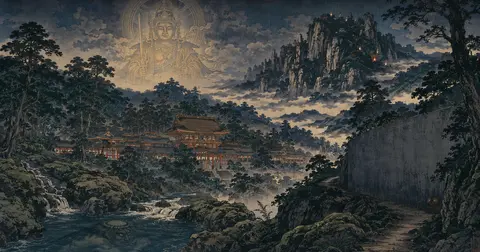
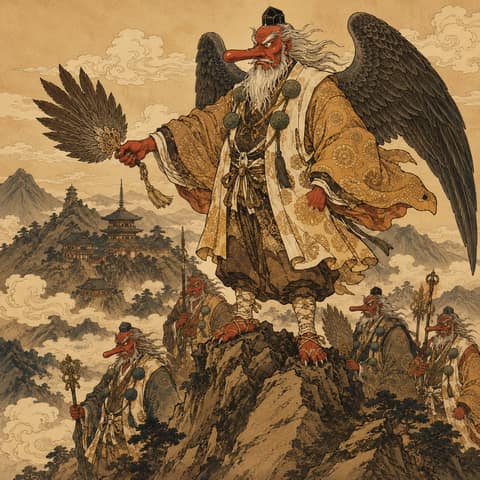
Mount Hiko (elevation 1,199 meters), towering on the borders of Chikuzen, Buzen, and Bungo, is counted as one of Japan's three major Shugendo training grounds, alongside Mount Haguro in Dewa and Mount Omine in Kumano. Centered around an ancient shrine dedicated to Emperor Jimmu's son, Ame-no-Oshihomimi-no-Mikoto, it became a massive stronghold for Tendai-sect Shugendo from the 12th century onwards. At its peak, it is said that over three thousand monks' quarters stood on the mountain, and forty-nine ascetic caves were carved out[4]. The fact that the name 'Hikosan' (彦山) was later changed to 'Hikosan' (英彦山, adding the character for 'heroic' or 'outstanding') to praise its divine majesty speaks volumes about how deeply this mountain was revered. The image of ascetic practitioners (yamabushi) delving into deep mountains, seeking superhuman powers through fasting, cold water ablutions, and mountain confinement—possessing powers beyond ordinary people, the art of flying, and an aura that is neither fully divine nor fully demonic—was eventually superimposed onto the figure of the Tengu, embodying the spiritual power of the mountain itself. This phenomenon is common to sacred mountains across the country, such as Atago, Kurama, and Omine, not just Mount Hiko. While tengu are spoken of as 'incarnations of corrupted high priests' or 'demons hindering the Buddhist path', their duality of also being revered as guardian deities of the mountain stems from this connection with Shugendo.
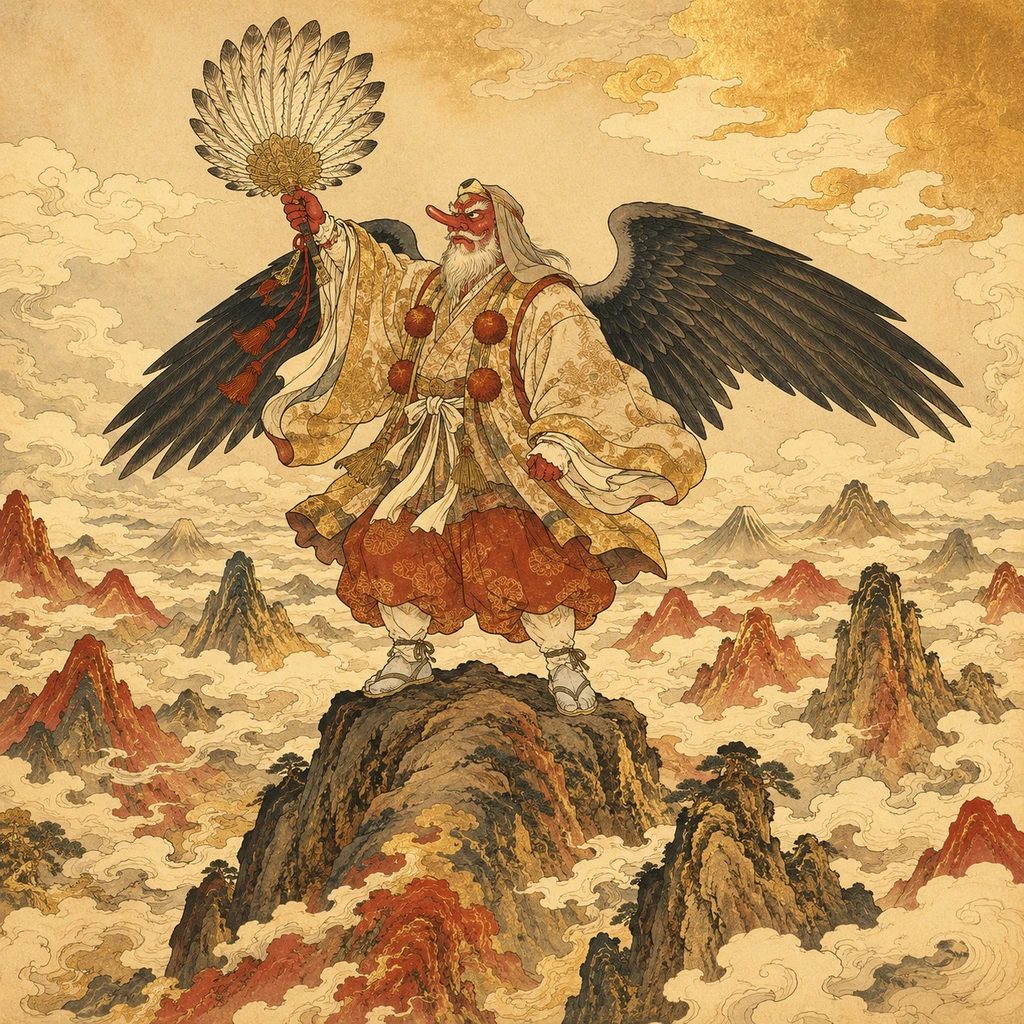
Tengu
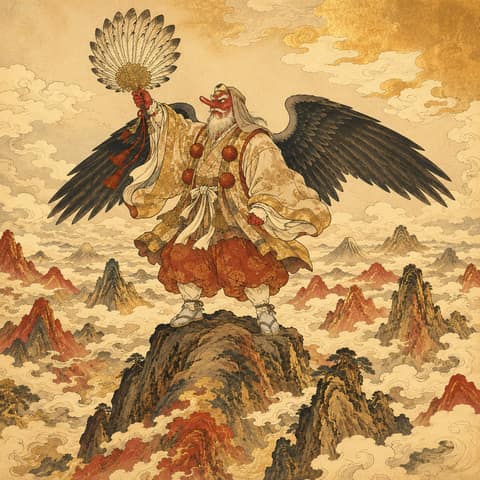
The tengu is a yokai and quasi-divine being said to dwell in the mountains of Japan, a lord of the heights inseparably bound to the yamabushi ascetics of Shugendō. Its forms fall broadly into two lineages. One is the long-nosed tengu, with a ruddy face and high nose, clad in the garb of a mountain ascetic, bearing a feather fan and one-toothed high clogs; the other is the crow tengu, with a crow's beak and wings, and beneath them follow lesser kin such as the leaf tengu and the wood-chip tengu. What was once conceived as a bird like a black kite hardened, over the medieval period, into the image of the long-nosed mountain ascetic. The tengu is at once a demon that obstructs the Buddhist Law and, once subdued, a guardian deity who protects it—this dual nature is the essence of the tengu. The notion that an arrogant high monk falls and becomes a tengu was bound to the Buddhist "way of the tengu," and was depicted as satire in late-Kamakura picture scrolls. Within mountain worship, on the other hand, the tengu was revered as guardian of the mountain and master of martial and magical arts, a being that tests or guides the practitioner. From Mount Kurama and Mount Atago in Kyoto onward, each of the sacred mountains of the realm was said to have its own great tengu, and the early-modern Tengu Sutra counts their number at forty-eight.
Read moreTengu are not uniform. There is a clear hierarchy even in iconography, such as the long-nosed, red-faced Daitengu (Hanakatengu), the crow-beaked and winged Karasu Tengu (Kotengu), and the Konoha Tengu that blend into the leaves. Early modern collections of yokai illustrations, starting with Toriyama Sekien's *Konjaku Gazu Zoku Hyakki* (Illustrated Hundred Demons from the Present and the Past, Continued; 1779), visually established these typologies and formed the archetype of the tengu image we have today[5]. And when the legend of the 'Eight Great Tengu of Japan'—ranking the famous major tengu across the country—was born, one of them was said to reside on Mount Hiko. This is the great tengu representing Kyushu, Hiko Buzenbo.
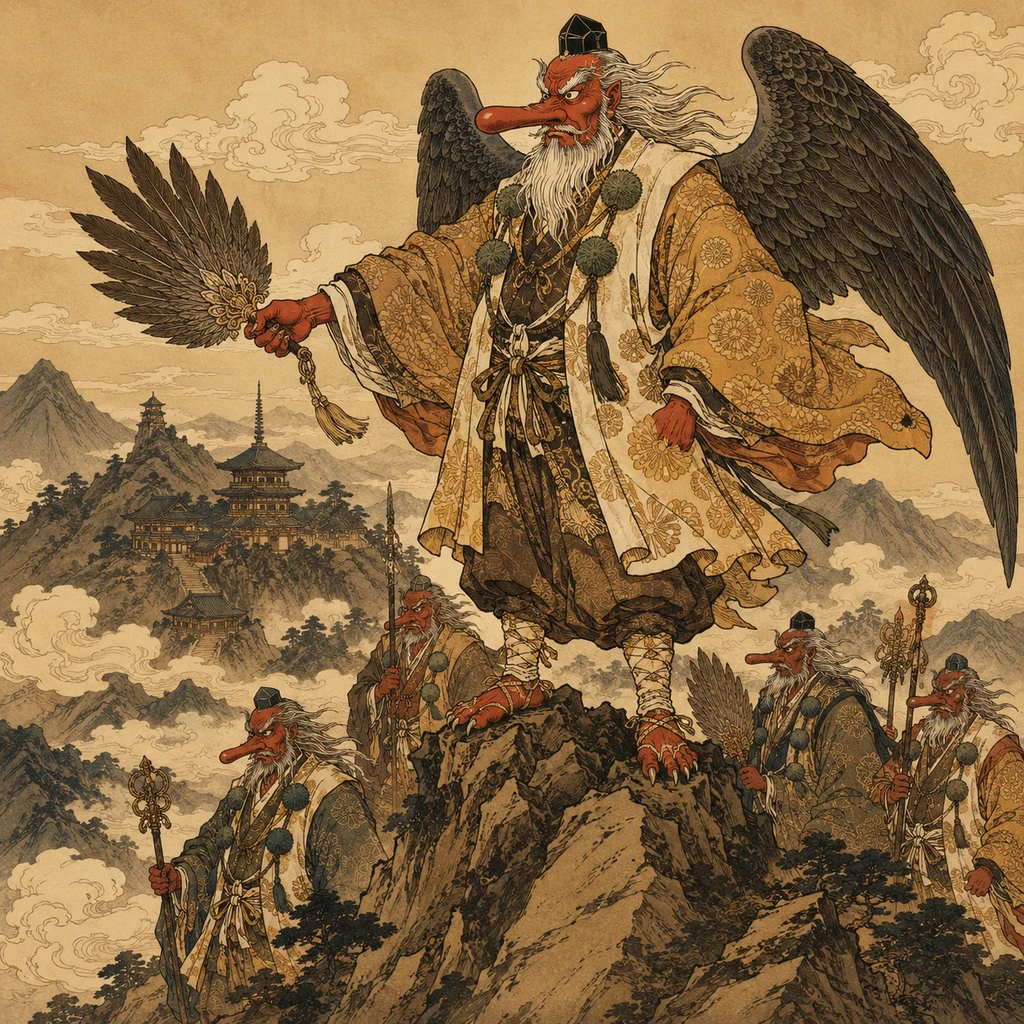
Hiko-san Buzenbō
Hiko-san Buzenbō is a great tengu enthroned on Mt. Hiko (Hikosan) in Buzen Province, and is held to be the chief—the head—of the tengu of Kyūshū. Counted among the Eight Great Tengu, he is chanted in the Muromachi Noh play Kurama Tengu as "in Tsukushi, the Buzenbō of Hikosan." Hikosan is the foremost Shugendō sacred site of northern Kyūshū, counted—together with the Dewa Sanzan and Ōmine—among the three great centers of Shugendō in Japan. The first textual appearance of his name and seat is in the Kamakura-period engi the Hikosan Ruki (1213), where Buzenbō is recorded as the eighteenth of Hikosan's forty-nine grottoes, the "Buzen-kutsu." Buzenbō is enshrined at what is today Takasumi Shrine (Soeda, Fukuoka, called "Buzenbō" until the Edo period), and as a tengu of both reward and punishment—visiting chastisement upon the greedy, protection upon the upright—he has struck deep roots in the mountain faith of Kyūshū.
Read moreBuzenbo is counted as one of the Eight Great Tengu of Japan, alongside Atagoyama Tarobo of Kyoto, Hirasan Jirobo of Omi, Kuramayama Sojobo, Izuna Saburo of Shinano, Omineyama Zenkibo, Daisen Hokibo of Hoki, and Sanuki Shiramine Sagamibo. He was considered the leader commanding all tengu throughout Kyushu[4]. His character is not merely that of a demon. Rather, he is closer to a god administering rewards and punishments. Using his subordinate tengu, he punishes the greedy and the arrogant by spiriting away their children or setting fire to their houses. On the other hand, for the righteous, he hears their prayers and protects their surroundings. These strict yet reliable legends of reward and punishment remain deeply ingrained in the Mount Hiko area[4]. Seeing through the hearts of those who enter the mountain, helping the pious, and punishing the insolent—this character can be said to be a personification of the precepts of the Shugendo mountain. *Tengu no Kenkyu* (A Study of Tengu; 1975) by Kosei Chigiri, known as a culmination of tengu research, meticulously gathers the legends of these regional great tengu and positions Buzenbo as the commander-in-chief of the Kyushu tengu realm[6].
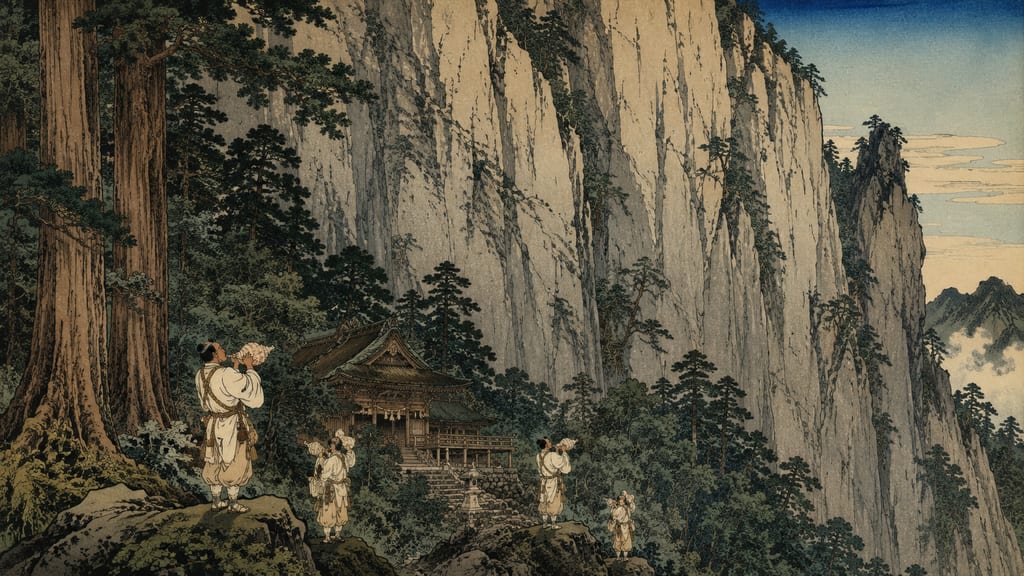
Enshrining Buzenbo is Takasumi Shrine, situated halfway up the northern peak of Mount Hiko against a colossal rock wall. Until the Edo period, the shrine itself was named 'Buzenbo', retaining the remnants of tengu worship in its very name[4]. The main deity is Toyohiwake-no-Mikoto, considered an ancient god personifying the lands of Buzen and Bungo, upon which tengu beliefs have intricately syncretized. This sacred site, where gods and tengu, Shugendo and Shinto seamlessly blend, continues to pass down the memory as a mountain of tengu, even as many Shugendo sacred sites suffered during the separation of Shinto and Buddhism in the Meiji era. Standing in the precincts, one should be able to feel the awe toward the spiritual power nurtured by the mountain of asceticism, crystallized in the space between the divine and the tengu.
The Kappa Kingdom of the Chikugo River:
The Exiled Supreme Commander from Higo,
Kyusenbo
The Chikugo River, originating in Aso, piercing through the Tsukushi Plain, and flowing into the Ariake Sea, is the largest river in Kyushu by basin area. Since ancient times, its current has been rough, and because it could change its course overnight, it was also called the 'Overnight River' (Ichiya-gawa), frequently claiming fields and lives through floods. A land where water and people face each other so pressingly naturally becomes the heartland of 'water monsters'. Fukuoka, particularly the Chikugo River basin, is a treasure trove of Kappa folklore, arguably the most prominent in the country. Kappa are originally said to be the fallen forms of water gods or remnants of beliefs in agricultural gods traveling between the mountains and rivers in spring and autumn. They are also spoken of as the monsters of 'komahiki' (horse pulling), attempting to drag horses into the water. Regarding their origins and distribution, folklorist Eiichiro Ishida's comparative study *Kappa Komahiki Ko* (A Study on Kappa and Horse-Pulling; 1948) is known as a classic that positioned kappa within the water-horse beliefs on a Eurasian scale.

Kappa
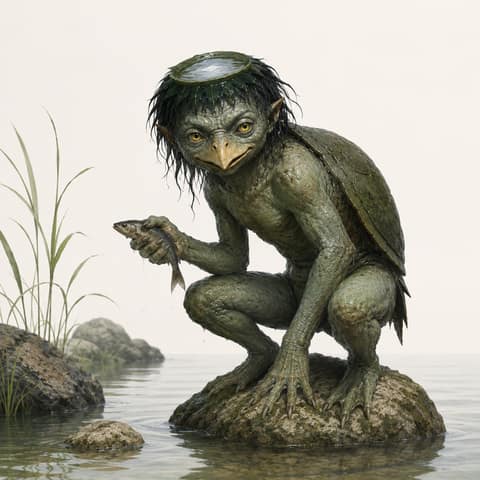
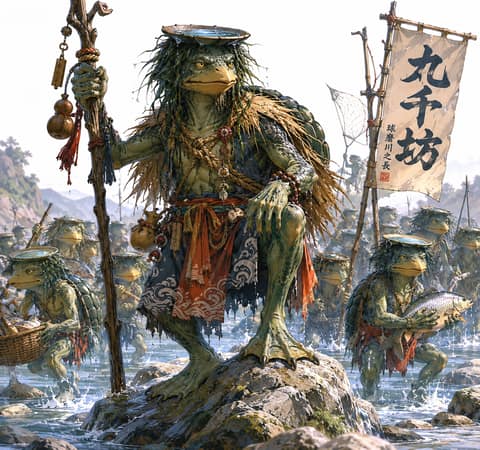
The kappa is among the most famous of all Japanese yokai, said to dwell wherever there is water—rivers, ponds, and marshes alike. It stands about the height of a four- or five-year-old child, with a water-filled dish (sara) set into the crown of its head, a shell on its back, a beak for a mouth, and webbed hands and feet. Its body is greenish or reddish in hue and is sometimes described as smelling fishy. That dish on its head is the very source of its power: should the water spill or dry out, the kappa is believed to lose its strength at once. From this came the well-known trick of bowing deeply to a kappa so that, returning the courtesy, it tips the water from its dish and can be caught. The kappa has two faces. One is fearsome—dragging people and horses into the water and taking their lives. The other is dutiful—keeping its promises faithfully, delighting in sumo, and sometimes passing on miraculous bone-setting remedies. Found across the whole country, it goes by more than eighty regional names: Garappa, Medochi, Enko, Hyosube, and many more. Among all the yokai of Japan, few are so deeply rooted in local life.
Read moreIn the Chikugo River basin, specifically in Tanushimaru Town, Kurume City, over twenty stone statues and monuments of kappa are still scattered today, and a wooden statue that has long been revered as the 'Lord of the River' (Kawa no Tonosama) has been passed down at the Gion Shrine.
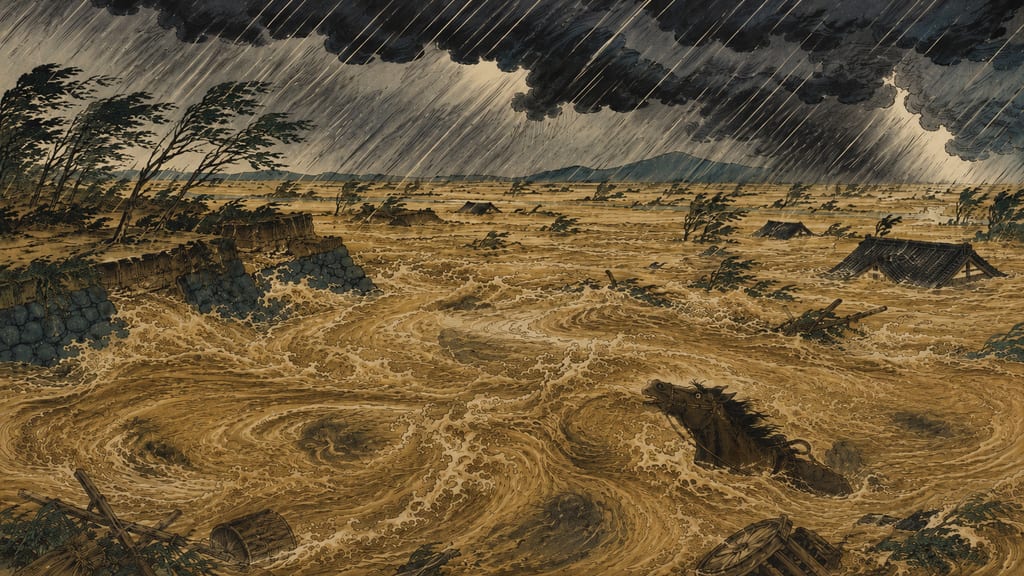
Behind this dense accumulation of kappa folklore was the pressing reality of flood control and water disasters. Fearing the river and offering prayers and tributes to its ruling entities form the foundation of kappa belief. Lest children drown in the river, lest horses be dragged into the water—kappa tales were not mere ghost stories, but also the wisdom of living alongside the river.
The supreme commander uniting this group of kappa in the Chikugo River is Kyusenbo, who is said to lead a retinue of 9,000 followers. According to folklore, Kyusenbo originally lived in the Kuma River of Higo with his clan of 9,000 kappa. However, angered by their outrageous behavior—which reportedly included kidnapping women and children and harming Kiyomasa's favored pages—the lord of Higo, Kato Kiyomasa, gathered monkeys (the natural enemies of kappa) from all over Kyushu to attack them, throwing poison and heated stones into the river. Left with no recourse, the exiled Kyusenbo clan crossed the sea and fled to the Chikugo River[7].

Kyūsenbō
Kyūsenbō (also Kusenbō) is the legendary grand chief said to command every kappa of Kyushu. According to the Edo-period Honchō Zokugenshi, he was a kappa who led his clan across from the Yellow River in China, came ashore at Yatsushiro in Higo, and settled on the Kuma River; because the clan grew to nine thousand, its headman took the name Kyūsenbō (“nine-thousand boss”). In form he is no different from an ordinary kappa, bearing no strange shape of his own. What sets Kyūsenbō apart is not his looks but his standing as the chief who governs nine thousand kappa across Kyushu. He holds power enough to trouble a whole province, yet is helpless before the monkey, the kappa’s natural enemy — the kappa’s twofold nature, at once formidable and fearful, writ large at the scale of a whole clan. He is known, too, for a tale of reform: later he moved to the Chikugo River and turned from a man-harming demon into a familiar of the water-god, guarding people against flood.
Read moreUpon arriving at the Chikugo River, Kyusenbo appealed to the Lord of Kurume, Arima, and was permitted to live in the river on the condition that they 'would do no harm to humans or livestock'. Deeply grateful for this, the Kyusenbo clan is said to have sworn to serve as the guardians of the Kurume Suitengu Shrine and protect the domain's people from water disasters ever since[7]. Kurume Suitengu is the head shrine of all Suitengu shrines nationwide, gathering faith from across the country for safe childbirth and protection from water disasters. The monsters of the raging water reconciled with humans through a covenant and transformed into the shrine's familiars—its guardian deities. This framework beautifully resonates with the tale of Michizane, the vengeful spirit sublimated into Tenjin. Not vanquishing the violent entities, but forging a pact, enshrining them, and turning them into allies. The imagination running through Fukuoka's yokai culture is exactly this. However, this tale of Kyusenbo was organized and passed down after the time of Kato Kiyomasa (1562–1611), namely in the early modern period, and is not backed as historical fact. It should be read strictly as a narrative of faith taking root in the land of Kurume.
The lineage of kappa literature is also unforgettable when discussing Fukuoka. Ashihei Hino (1907–1960), an Akutagawa Prize-winning author born in Wakamatsu, Onga District (now Wakamatsu Ward, Kitakyushu City), deeply loved kappa throughout his life. He named his home 'Kahakudo' (The Cave of the River God)—meaning the cave where the kappa (Kahaku) lives—and in his second-floor study, he continued to write over a hundred kappa-related works spanning novels, essays, and children's stories. His passion, to the point of declaring, 'Kappa are the pillar of my literature,' is deeply rooted in the climate of Kitakyushu[8]. His representative collection of tales, *Kappa Mandara* (1957), which originated from a reading program on NHK Radio, is a work that delicately reweaved local kappa folktales into modern literature through the eyes of a Kitakyushu writer[9]. From the stone statues in Tanushimaru, Chikugo, to the literature of Kahakudo in Onga, the kappa in Fukuoka have consistently continued to dwell right beside people's lives.
The Invisible Wall on the Dark Path:
The Nurikabe of Onga District
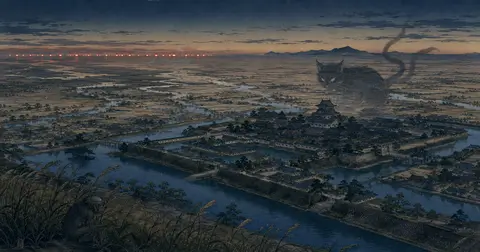
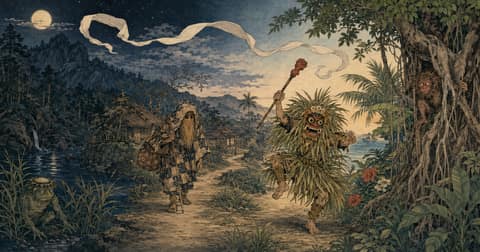
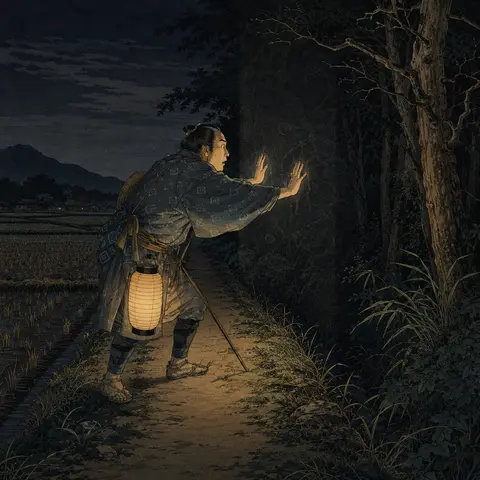
Finally, there is another name that Fukuoka has etched into the history of Japanese yokai: the Nurikabe. Walking along a dark path at night, a wall suddenly looms before one's eyes, making it impossible to move forward. Even if one tries to sidestep it, the wall continues endlessly to the left and right, and striking its upper part has no effect; however, it is said that sweeping the lower part with a stick makes it vanish.
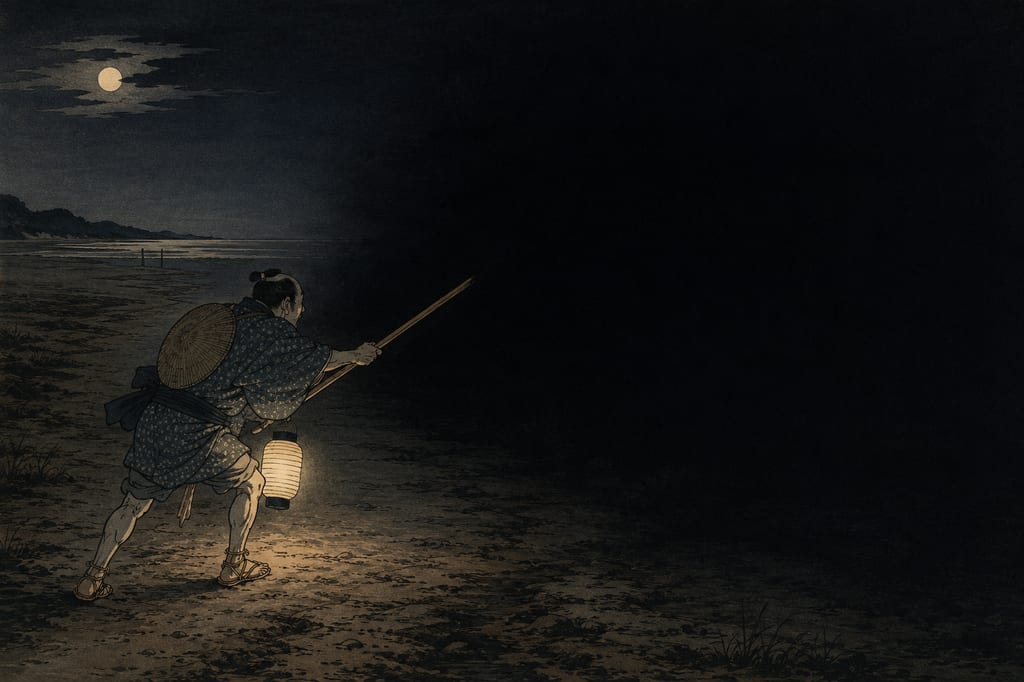
It is a simple bizarre phenomenon that expressed the helplessness of losing one's way in the vast plains or the darkness of the seaside as a formless 'wall' monster.
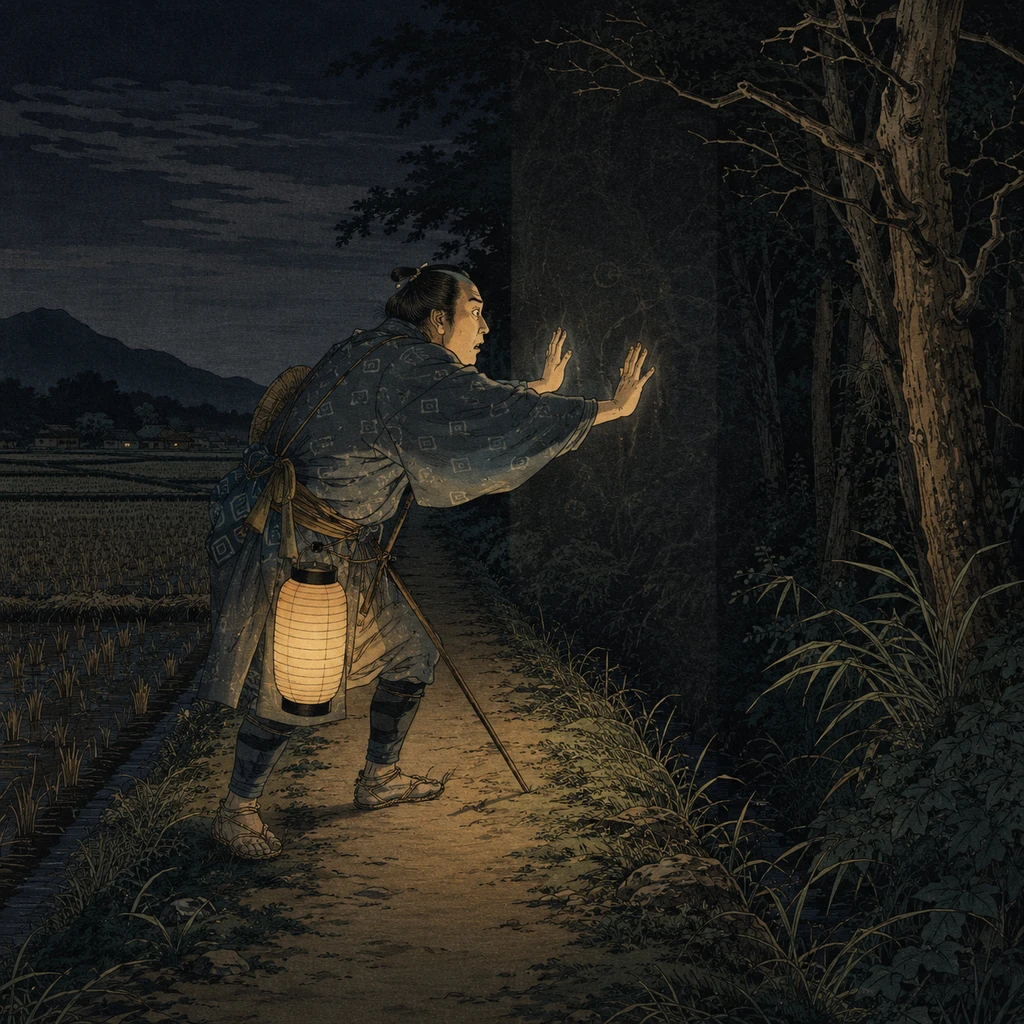
Nurikabe
A yokai famed as an invisible wall that blocks travelers on night roads. People suddenly find they can’t move forward, their hands meeting a flat, unyielding surface. The spell is said to break if one waits, sidesteps, or taps the ground with a cane. Its form is unfixed—often described as unseen or like a featureless wall. It rarely harms beyond causing confusion, feared mainly as a nuisance that makes people lose their way.
Read moreThe source that made this bizarre phenomenon widely known is the series 'Yokai Meii' (A Glossary of Yokai), published by folklorist Kunio Yanagita in the magazine *Minkan Densho* (Issue 37, 1938) and later included in *Yokai Dangi* (Discussions on Yokai, 1956). There, it is recorded: 'Nurikabe. Spoken of on the coast of Onga District, Chikuzen. When walking on a night road, the path ahead suddenly becomes a wall, and one cannot go anywhere. It is feared and called a painted wall (nurikabe). It is said that if you sweep the bottom with a stick, it disappears, but tapping the top does nothing'[10]. In other words, the nurikabe was a genuine Chikuzen phenomenon originally spoken of in the coastal regions of Onga District in Fukuoka Prefecture—a land continuous with the hometown of Ashihei Hino. In fact, a massive rock called 'Nurikabe Iwa' has been passed down in the Onga region, suggesting the deep connection between the place name and the phenomenon.
Here, I wish to strictly separate the layers of historical fact and fiction. What Yanagita recorded was merely a first-hand account of 'the path ahead becoming a wall, preventing progress', and the original text explicitly states neither 'an invisible wall' nor 'a wall with eyes and a nose'. The giant square wall equipped with eyes and limbs that most people immediately imagine today is a design created by Shigeru Mizuki for *GeGeGe no Kitaro*. Mizuki gave unique iconography to a yokai that had no classical illustrations and existed only in texts and oral traditions. He himself spoke of his experience of his path being blocked by a massive wall in Rabaul in the south, and it is said that this actual feeling crystallized into the character. In short, the nurikabe is a rare case where a folk phenomenon orally passed down on the shores of Fukuoka transformed into a national character through post-war manga and anime. The core of the folklore lies in Onga, Fukuoka, while the endearing form known worldwide resides in modern creation. Reading these two layers distinctly is the proper etiquette for correctly appreciating yokai.
A Single Logic Uniting the Yokai:
Turning 'Curse' into 'Spiritual Power'
The four yokai of Fukuoka we have examined so far—Michizane's Onryo/Tenjin, the Tengu of Mount Hiko, Kyusenbo of the Chikugo River, and the Nurikabe of Onga—appear at first glance to be completely different in type and character. However, when placed side by side, one realizes that the same logic flows at their roots. That is the philosophy: 'Rather than vanquishing and erasing a mighty power capable of harming humans, turn it into an ally by revering and enshrining it.'
The vengeful spirit is the most typical. Michizane's wrathful spirit, left alone, would burn Kyoto to the ground with calamities. However, by enshrining him respectfully, bestowing posthumous court ranks, building shrines, and worshipping him as Tenjin, that power is entirely reversed into the grace that protects scholarship and literature. Kyusenbo, too, was an unruly figure in Higo, attacked by monkeys and targeted for subjugation, but in the Chikugo River, by making a covenant, he changed into a guardian deity averting water disasters. Subjugation (Higo) versus Enshrinement (Chikugo)—the contrast of these diametrically opposed treatments of the same kappa highlights the Fukuoka-esque solution. Even the tengu of Buzenbo is a god of reward and punishment who punishes the insolent and protects the pious, revered as a power that can be either an enemy or an ally.
This mindset of 'fearing a strong power while incorporating it through enshrinement' is likely not unrelated to the history of this land, which faced the continent and was repeatedly exposed to disasters and foreign enemies. Not forcibly eliminating what is difficult to control, but coexisting by elevating it while maintaining distance—the yokai culture of Fukuoka is the crystallization of that wisdom.
What the Sea and the Continent Brought:
The Geography of Fukuoka's Yokai
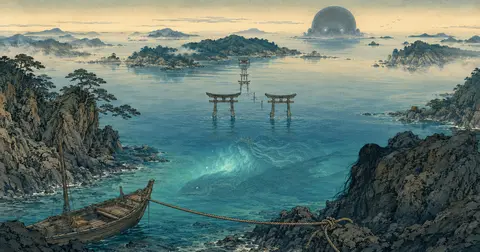
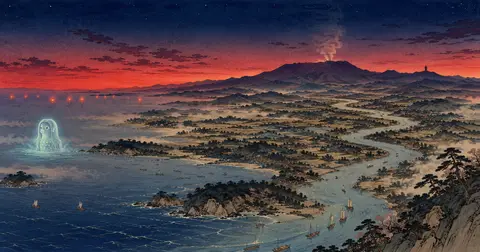
To understand Fukuoka's yokai a step deeper, one must remember that this is a 'prefecture of the sea'. To the north, it faces the Korean Peninsula and the continent across the Genkai Sea, and Hakata has been an international trading port since ancient times. In antiquity, envoys to the Sui and Tang dynasties departed from here, and foreign emissaries were welcomed at the Korokan. During the Kamakura period, it became the battlefield for the Mongol invasions, and remains of defensive walls still stand along Hakata Bay. The awe and anticipation toward what comes from across the sea have lent a unique tension to the culture of this land. Even the absurd folklore that kappa migrated from around the Yellow River on the continent in ancient times becomes all the more profound if read as reflecting the sensibilities of a port town where foreign objects wash ashore via the sea.
In contrast, the Ariake Sea to the south is gentle, a sea of tidal flats and mud. The water district of Chikugo and Yanagawa is a network of countless canals, and the distance between water and people is exceedingly close. It is no coincidence that kappa folklore took deep root in this land. The rough open waters of the Genkai Sea and the soft inner waters of the Ariake Sea, with the Tsukushi Plain and the Chikugo River spreading between them—Fukuoka's yokai are also products directly born from this diverse waterside geography. In the mountains, the Shugendo of Mount Hiko nurtured the tengu; in the waters, the threat of the Chikugo River nurtured the kappa; in the city, the politics of Dazaifu nurtured the vengeful spirit. The richness of different yokai arising depending on the topography is a characteristic of Fukuoka.
Conclusion:
A Frontier That Gives Birth to Gods
When one arrays the yokai of Fukuoka, a single unwavering common denominator emerges. Dazaifu, where a noble driven from the capital became a vengeful spirit, and eventually the God of Learning, Tenjin. Mount Hiko, where the spiritual power of ascetics crystallized into the great tengu, giving birth to a leader administering reward and punishment. The Chikugo River and Kurume Suitengu, where a clan of kappa driven from Higo formed a covenant and became guardian deities averting water disasters. And Onga District, where a nameless wall blocking the darkness of the seaside was reincarnated as the protagonist of a post-war manga. All are variations of the same narrative: 'arriving from the outside, becoming grotesque in this land, and eventually being enshrined or passed down'.
Because this land was a frontier at the western edge from the perspective of the center, it fostered a resilient imagination that sublimates fear and awe into the divine. A vengeful spirit into the God of Learning, the monster of a raging river into a guardian deity averting water disasters, the spiritual power of an ascetic mountain into a tengu of reward and punishment, and the seaside anxiety into an endearing yokai. The yokai culture of Fukuoka Prefecture is not about merely vanquishing cursing and terrifying things to end them, but enshrining them, forging covenants, reconciling, and turning them into allies. It is the very spiritual history of northern Kyushu itself. Students press their hands together before Tenjin-sama, children by the riverbank watch out for kappa, and climbers bow their heads to the tengu at Takasumi Shrine. The yokai of Fukuoka continue to live quietly amidst the lives of the people today.