Ame-no-Oshihomimi
あめのおしほみみのみこと
Ame-no-Oshihomimi, the Crown Prince Deity Who Passes the Mission to His Child on the Floating Bridge of Heaven
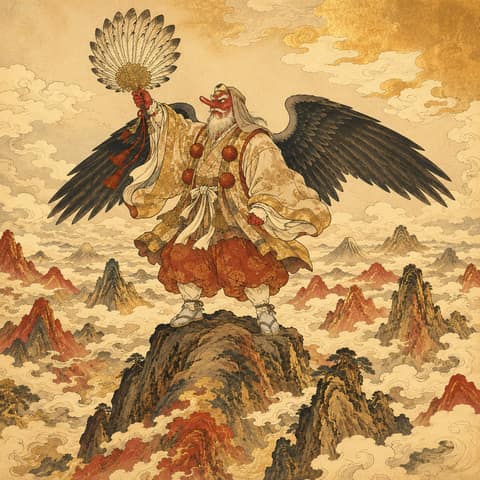
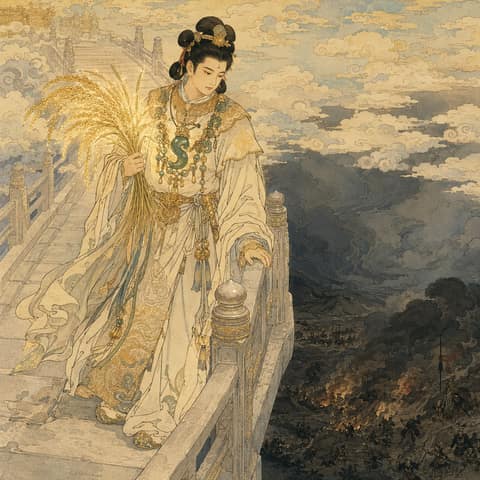
Ame-no-Oshihomimi, who passes the mission to his child on the Floating Bridge of Heaven, is the deity who brings the Tenson Korin into reality precisely by "not descending" himself. In the *Kojiki* myth of the *ukehi*, Susanoo washes Amaterasu's beads in the Heavenly True Well, crunches them, and blows out a mist from which Masakatsu-Akatsu-Katsuhayahi-Ame-no-Oshihomimi-no-Mikoto is born. His very birth is situated within a ritual concerning objects, belonging, and victory. From the beginning, Ame-no-Oshihomimi is a deity questioned about "whose child he is" and "what he inherits." Amaterasu claims the five male gods as her own children because the *monozane* (source objects) belonged to her. Through this passage, Ame-no-Oshihomimi enters the lineage of Takamagahara as Amaterasu's child. However, the character for "victory" engraved in his name is not a simple mark of triumph. Just as the Kokugakuin University commentary links it to the victory in the ukehi, Ame-no-Oshihomimi's name carries multiple meanings: Susanoo's boast of victory, his belonging as Amaterasu's child, and the emergence of male gods. Victory is not only bright but also requires defining where it belongs. In the Pacification of Ashihara-no-Nakatsukuni, Ame-no-Oshihomimi becomes the first candidate to rule the earth. Amaterasu entrusts the Land of Fresh Rice Ears to him as the land ruled by my child, Masakatsu-Akatsu-Katsuhayahi-Ame-no-Oshihomimi-no-Mikoto. However, standing on the Floating Bridge of Heaven, he sees that the earth is "exceedingly tumultuous" and returns. To read this as a cowardly retreat is to overlook the structure of the myth. Ame-no-Oshihomimi is the first observer to report that the earth has not yet been pacified. Without this report, the council for pacifying Ashihara-no-Nakatsukuni would never have begun. Amaterasu and Takamimusubi gather the gods at the Heavenly River of Tranquility, have Omoikane devise a strategy, and choose envoys. Ame-no-Oshihomimi's role was not to recklessly descend into a chaotic world and fail, but to clarify that the conditions for descent were not yet met. The Floating Bridge of Heaven is the boundary between Takamagahara and Ashihara-no-Nakatsukuni, and standing there, Ame-no-Oshihomimi measures the gap between heavenly commands and earthly realities. After the pacification, Amaterasu and Takagi-no-Kami command Ame-no-Oshihomimi to descend and rule at last. Here, he states that a child was born to him while he was preparing, and suggests that this child should be sent down. This is not a second retreat, but a judgment of succession. By not descending himself and passing the mission to the next generation, Ame-no-Oshihomimi transforms the Tenson Korin into a much deeper story of lineage. The fact that this child is Ninigi-no-Mikoto is highly significant. The *Kojiki* notes that Ninigi is the child born to Takagi-no-Kami's daughter, Yorozuhata-Toyoakitsushi-Hime. Ame-no-Oshihomimi is the child of Amaterasu, marries the daughter of Takagi-no-Kami, and fathers Ninigi. Amaterasu's light, Takamimusubi's generative power, and the Tenson Korin's earthly rule all converge around this single deity. He is not the protagonist of the descent, but the god who gives birth to the protagonist. The history of Hikosan Jingu reconnects Ame-no-Oshihomimi to mountain worship. Its official website states that because the enshrined deity is Amaterasu's child, Mount Hiko was called "the Mountain of the Sun's Child". Furthermore, its divine virtues revere him as a god of rice ears and agriculture who arrived from the east in the form of a hawk, protecting agricultural production, mining, and factory safety, and bringing victory. The heavenly crown prince becomes the guardian of rice, production, and victory in the mountains. The appeal of Ame-no-Oshihomimi lies not in a heroic finishing blow, but in the judgment of succession. Precisely because he bears a name of victory, he does not err in timing his descent just to win. He observes the earthly chaos from the Floating Bridge of Heaven, returns to prompt its pacification, and ultimately passes the mission to his child. This deity understands the value of "not acting." Rather than rushing into an unprepared field, he sets the stage and leaves it to the next generation. That quiet judgment drives the grand myth of the Tenson Korin.