Legendary
Traditional Yokai

Tengu

Tengu

Also Known As
Daitengu(大天狗)Kotengu(小天狗)Karasu Tengu(烏天狗)
Category
Mountain & Wilderness Spirits
Personality
Lord of the mountain, bearing the dual nature of guardian and demon. It most detests arrogance, tests the practitioner, and at times guides him.
Origin
Kyoto, Shiga, and Wakayama Prefectures (the seats of the great tengu on the various sacred mountains)
  • 愛宕山太郎坊(京都府 京都市右京区)八大天狗の一
  • 比良山次郎坊(滋賀県 大津市北小松)八大天狗の一
  • 鞍馬山僧正坊(京都府 京都市左京区)八大天狗の一
  • 飯綱三郎(長野県 長野市)八大天狗の一
  • 大山伯耆坊(神奈川県 伊勢原市)八大天狗の一
  • 彦山豊前坊(福岡県 田川郡添田町)八大天狗の一
  • +2 more
View on map
For Children
Read on Yokai Kids

We also have a page that explains Tengu in a way that is easy for children to understand.

Basic Description

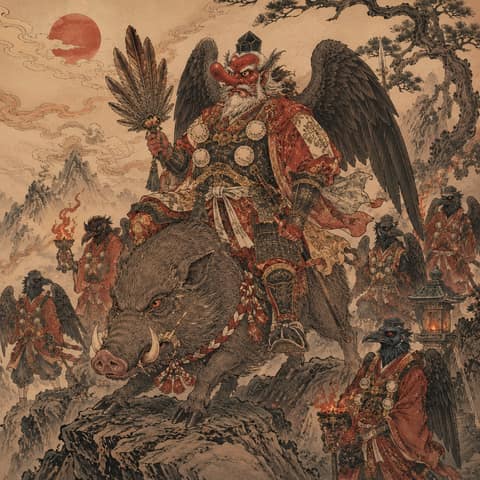
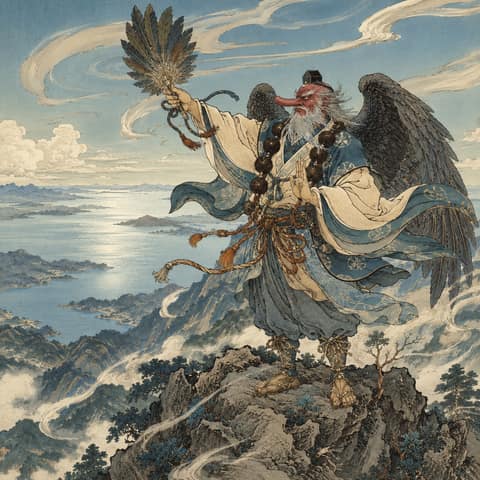
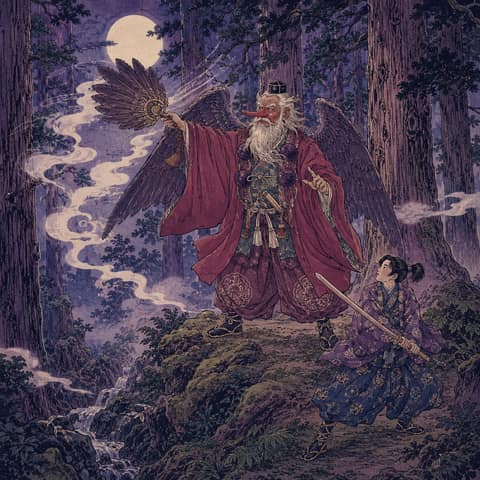
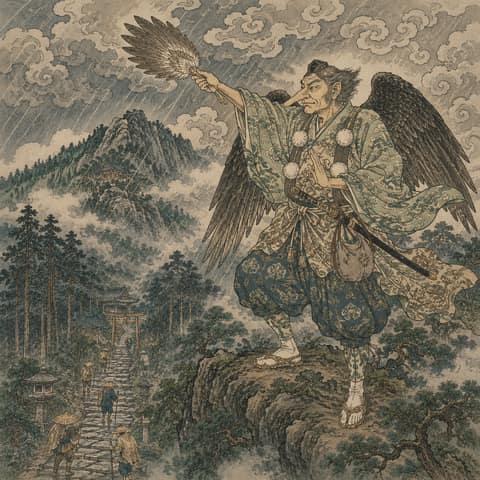
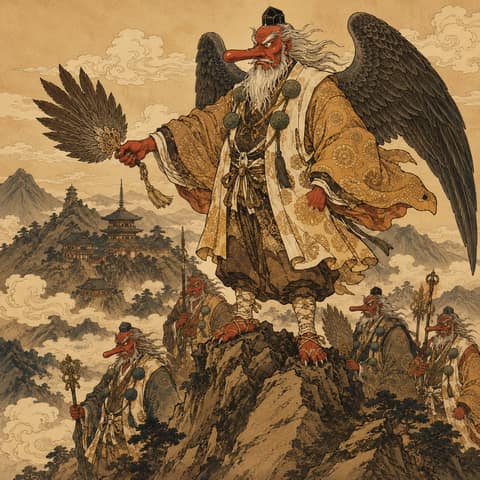
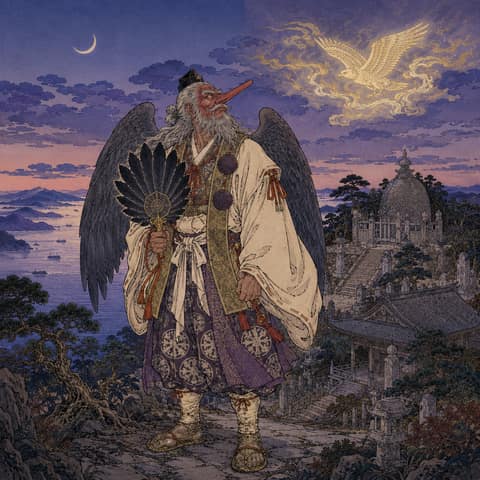
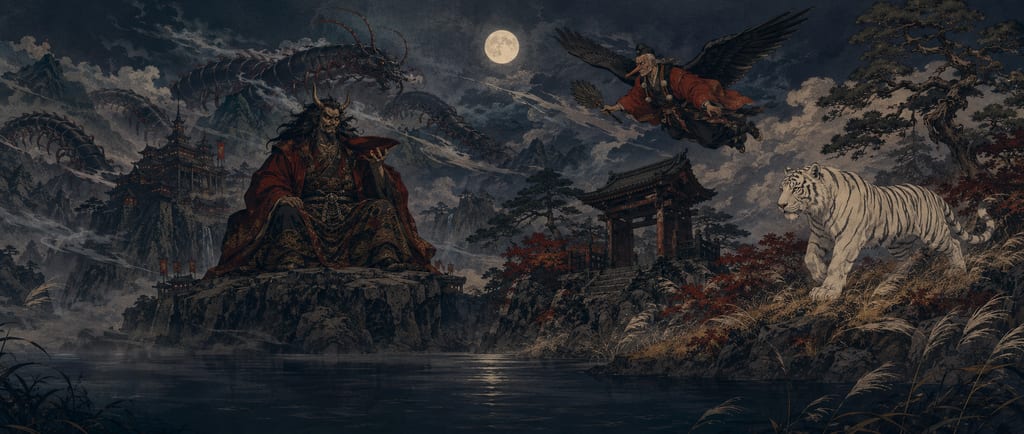
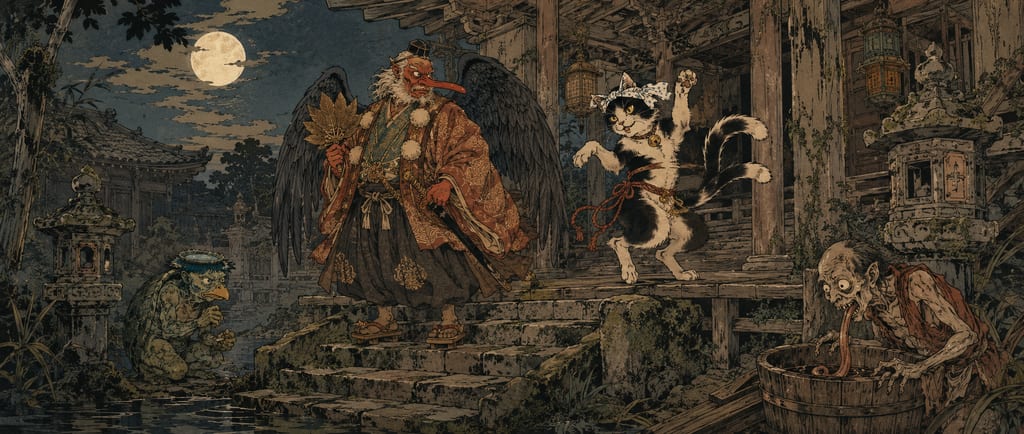
The tengu is a yokai and quasi-divine being said to dwell in the mountains of Japan, a lord of the heights inseparably bound to the yamabushi ascetics of Shugendō. Its forms fall broadly into two lineages. One is the long-nosed tengu, with a ruddy face and high nose, clad in the garb of a mountain ascetic, bearing a feather fan and one-toothed high clogs; the other is the crow tengu, with a crow's beak and wings, and beneath them follow lesser kin such as the leaf tengu and the wood-chip tengu. What was once conceived as a bird like a black kite hardened, over the medieval period, into the image of the long-nosed mountain ascetic.

The tengu is at once a demon that obstructs the Buddhist Law and, once subdued, a guardian deity who protects it—this dual nature is the essence of the tengu. The notion that an arrogant high monk falls and becomes a tengu was bound to the Buddhist "way of the tengu," and was depicted as satire in late-Kamakura picture scrolls. Within mountain worship, on the other hand, the tengu was revered as guardian of the mountain and master of martial and magical arts, a being that tests or guides the practitioner. From Mount Kurama and Mount Atago in Kyoto onward, each of the sacred mountains of the realm was said to have its own great tengu, and the early-modern Tengu Sutra counts their number at forty-eight.

Folklore & Legends

The word "tengu" was originally, in ancient China, a term for a shooting star that announced calamity. Its first appearance in Japanese texts is in the Nihon Shoki, in the ninth year of Emperor Jomei (637), which records that a great star streaming across the sky with a sound like thunder was judged by the scholar-monk Min, returned from Tang China, to be "not a shooting star, but a tengu (amatsukitsune)." The tengu here is a celestial portent, severed from the later mountain yokai; no continuity between the two has been demonstrated, and the image of the tengu dwelling in the mountains takes hold only from the Heian period onward.

In the medieval age, the tengu was spoken of as a symbol of Buddhist arrogance. The Tengu Zōshi, of around the fourth year of Einin (1296), satirizes the proud monks of the great temples of Nara and the northern peaks by likening them to tengu, and the tale of the Zegaibō Emaki—in which a great Chinese tengu comes to Japan and is defeated by the magical power of a high monk of Mount Hiei—was also widely known. Its source tale goes back to the story of Chira Eiju in Book Twenty of the Konjaku Monogatari-shū. Within these scrolls, a tengu disguised as a human is drawn with its nose lengthening when it reveals its true form, and the image of the long-nosed tengu took shape.

In folklore, the tengu was the master of mountain marvels. The tengu-snatching (spiriting away) in which a person vanishes suddenly; the tengu-felling in which the sound of a great tree being cut down echoes, yet nothing is there the next morning; the tengu-laughter that resounds through the mountains; the tengu-pebbles that come raining down—all spoke of the inexplicable in the mountains as the work of tengu. In the early-modern era it was depicted in ukiyo-e and kabuki, becoming a yokai familiar even to common folk.

Each of the sacred mountains of the realm was believed to have its own great tengu. The framework that binds Atago-san Tarōbō, Hira-san Jirōbō, and Kurama-san Sōjōbō at the head, together with Iizuna Saburō, Ōyama Hōkibō, Hiko-san Buzenbō, Ōmine Zenkibō, and Shiramine Sagamibō, as the "Eight Great Tengu," already has their names listed in the Muromachi-period Noh play Kurama Tengu; it is not an Edo-period invention but a product of belief and performing arts reaching back to the medieval age. Yet the lineup differs by source and is no fixed doctrine. Chigiri Kōsai, who compiled the study of tengu, organized these mountain tengu into a single system.

Detailed Analysis

4 different forms of Tengu have been confirmed. Each has unique characteristics and personality, with various ways of interacting with people. Details of each form are introduced below.

What Is a Tengu? An Overview of Types and Iconography

To explain What Is a Tengu? An Overview of Types and Iconography in detail:

This edition is not about a single seat on a particular sacred mountain, but a general treatise that thoroughly unravels "what a tengu is" from the history of its iconography and types. The individual traditions of each seat are left to the page of each great tengu.

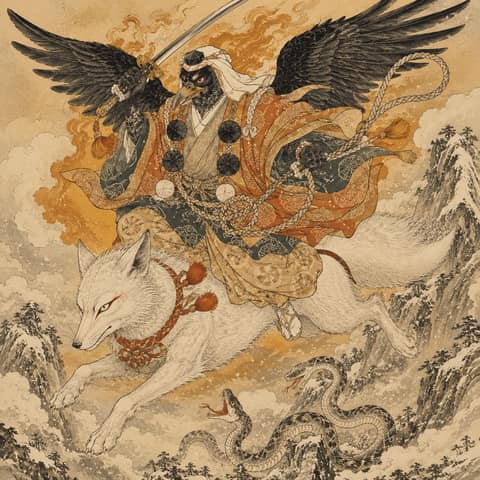
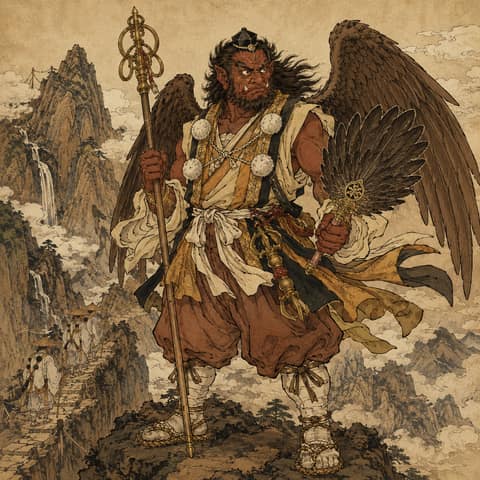
The form of the tengu is not uniform. The first type is the long-nosed tengu—ruddy face and high nose, clad in the ascetic's headcloth (tokin) and the suzukake robe, a feather fan in hand and one-toothed high clogs on the feet. The second is the crow tengu, with a crow's beak and wings, grasping a sword or a vajra staff. The third are the lesser tengu called leaf tengu and wood-chip tengu, held to be weak and numerous kin. Rather than a fixed classification, these reflect the breadth of the tengu image across eras and regions.

The iconography shifted over time. The Heian-period tengu was first conceived as a bird like a black kite, and the image of the crow tengu retains that vestige. The long nose grows prominent only from the late Kamakura period; the Zegaibō Emaki depicts a scene in which a tengu that had disguised itself as a human has its nose lengthen as it returns to bird form. As for the origin of the long nose, there are theories that derive it from the high-nosed Jidō mask of gigaku and link the crow tengu to the Karura (Garuda) mask, and a view that sees the long nose as an iconographic vestige of a bird's beak—but none can be called settled doctrine. It was overlaid with the god Sarutahiko, described in the Nihon Shoki as having a nose seven hand-spans long, and the custom arose of using a tengu mask for the role of Sarutahiko in festivals.

The tengu's dual nature is rooted in the Buddhist notion of the way of the tengu. Because it studies the Buddhist path it does not fall into hell, and because it handles heterodox arts it cannot reach paradise either—an intermediate state, and the one who falls there was held to be the arrogant monk. The Tengu Zōshi depicts this notion as satire of the monks of the seven great temples, yet Chigiri Kōsai too warns that the simplification "only arrogant monks become tengu" goes too far. Demon though it is, once subdued it turns to guardianship, and it was held that if a Shugendō practitioner recites the Tengu Sutra he may summon the tengu of the various provinces to grant his wishes—this amplitude between guardian and demon is the very core of the tengu.

The certain medieval source for the grouping called the "Eight Great Tengu" lies in the libretto of the Muromachi-period Noh play Kurama Tengu. The passage in which the great tengu calls up the tengu of the provinces he commands in geographical order—"In Tsukushi, Buzenbō of Hiko-san; in the four provinces of Shikoku, Sagamibō of Shiramine; Hōkibō of Ōyama; Saburō of Iizuna… the host of Zenki of Ōmine, Takama of Katsuragi"—shows that the Eight Great Tengu were rooted in medieval belief and performing arts, not an Edo invention. Still, the composition wavers by source, with a variant that adds Hōkibō of Ishizuchi-san; it is no fixed roster.

Character Profile

This section is our own creative profile for storytelling. It is not historical fact or scholarship.

Personality
Lord of the mountain, bearing the dual nature of guardian and demon. It most detests arrogance, tests the practitioner, and at times guides him.
Compatibility
Those who fear and revere the mountains, those who aspire to the paths of asceticism and martial arts, those who are not shamed even when their pride is chastised
Abilities
Flight and supernatural power (raising wind and cloud with the feather fan)Transformation (into bird, human, or mountain ascetic)Concealment in the mountains and tengu-snatchingThe transmission of martial arts, strategy, and magical powerThe protection of a guardian deity, and the beguilement of a demon
Weaknesses
  • Subdual by strong magical power and sutra recitation
  • having its arrogance struck at
  • its power wanes when it strays far from the mountain
Habitat
The sacred mountains across Japan (Atago, Kurama, Hira, Iizuna, Ōyama, Hiko-san, Ōmine, Shiramine, and others)
🔮妖怪相性診断

For more detailed information and diagnosis results about What Is a Tengu? An Overview of Types and Iconography, please click here.

Hieizan Hōshōbō, Great Tengu of Mount Hiei

To explain Hieizan Hōshōbō, Great Tengu of Mount Hiei in detail:

Hōshōbō of Mount Hiei is a great tengu who ranges the peaks of Hiei, where the capital meets the lake, dwelling between cedar and cypress crowns and the sea of clouds. Cloaked in the ridge winds of the Sannō shrines, he bears crow’s wings and a feather fan like a yamabushi’s ritual tool, said to appear at midnight with the lingering echo of a conch. His face is severe, ruddy with a high nose, eyes keen as if seeing through the ages. Yet his bearing recalls a monk, and the folds of his robes carry the scent of sutras. Named among the forty‑eight tengu of the Tengu Sutra since olden times, he guards Enryakuji’s teachings and the mountain’s vital currents, and in the era of the monastery’s ascendancy was said to guide and correct the conduct of its students both openly and unseen. Hōshōbō is not merely masterful in martial arts but cuts through the frayed edges of words to reveal a thing’s true nature. When a seeker loses their way, he thickens the mist and erases the markers, or lures an unsettled heart into the shadows of halls and pagodas—not to mislead, but to teach that wavering within is what leads one astray. When that is realized, the fog clears at once and Hiei’s ridgeline turns blade‑bright. Conversely, those who climb seeking fame and profit or who slight the Sannō deities are driven off by winds that make leaves into blades, never again permitted a frivolous ascent. Elders of Hiei whisper that Hōshōbō entrusts the essence of Lotus and Esoteric teachings to the wind, marshals flocks of birds to the cadence of chanting, and governs prayers for rain and for clearing skies. If Enryakuji’s bell tolls strangely, it is a sign of his feather fan stirring on the heights, and there were nights when sutra characters trembled across the lake’s ripples. At times he appears at a young ascetic’s bedside, delivering a single thunderous admonition that severs the root of delusion, leaving at dawn a single drop of white dew—medicine when diligence holds, poison when sloth prevails. He most abhors when urban rumors and power struggles spill onto the mountain, and bears an art that stills the blades of speech. When people wound each other with slander, a downslope wind rattles the town eaves and falsehoods collapse under their own weight; thus those who guard their tongues gain his protection. Yet he shows no mercy to those who hide pride behind practice: he lightens their footsteps until they lose the ground and wander forbidden paths of empty theory, and only when they admit their fault do their feet return to earth. On nights when the bush warbler in Hiei’s forest falls suddenly silent and distant thunder rings pure, Hōshōbō is near. If pilgrims bare their heads and pay full respect before the Sannō, the ridge wind softens and a single shaft of light breaks the clouds. This is called the Return of Hōshō—a sign that prayers in the mountain have been rightly answered. Hōshōbō is both guardian of the mountain and tester of the teaching; fear becomes reverence, and reverence opens the way. Only those who grasp this find his wings a sheltering shade for the road.

Character Profile

This section is our own creative profile for storytelling. It is not historical fact or scholarship.

Personality
stern yet compassionate, laconic but never sparing a needed rebuke, honors vows and covenants, detests vainglory and pretension, fierce like a gale to foes, warm like a winter sun to sincere seekers
Compatibility
practitioners who keep decorum, ascetics and scholar monks who train diligently, seekers who enter the mountain with questions, those resolved to set their path straight
Abilities
summoning Dharma winds with a feather fan to command mist and clouds, Mirror‑of‑the‑Heart shout that cuts doubt and reveals true intent, command of mountain birds and crows for guidance and guard, bell resonance augury that answers and portends through temple chimes
Weaknesses
powers dull where arrogance prevails, arts falter in places lacking reverence, dislikes dilapidated shrines and grows heavy‑winged near defilement
Habitat
the peaks and sacred groves of Mount Hiei, pilgrimage roads and holy sites from Sakamoto to Yokogawa

🔮妖怪相性診断

For more detailed information and diagnosis results about Hieizan Hōshōbō, Great Tengu of Mount Hiei, please click here.

Kakukai-bō of Yokogawa

To explain Kakukai-bō of Yokogawa in detail:

Kakukai-bō of Yokogawa is said to be a tengu variant who turned from human monk to winged guardian of the Dharma from the late Heian into the early Kamakura era. Once a virtuous priest of deep Shingon lineage, he ran himself ragged settling mountain disputes until he grasped a boundary no worldly rule could protect, becoming a winged keeper of sacred law. In Kōya’s inner precincts, they tell how one night a gale whirled through a hall and the middle gate shuddered, then its doors shed their hinges, unfurled as twin feathers, and split the black clouds to fly off. Those doors became Kakukai-bō’s wings. Ever since, he appears with the comings and goings at temple gates, raising a fierce wind before those who disturb the rule and presenting a single line of precept. He resembles a karasu-tengu, yet his face keeps the gaunt trace of an old monk and his long nose curves like a mountain ridge. His feathered robe echoes priestly vestments, layered in cinnabar and ink, its cuffs frayed like the edges of ancient sutras. He carries a feather fan akin to a monk’s staff, and when he sweeps it, seed-syllables rise like chaff off paper, racing along the ground as ropes of warding. He speaks sparingly, but his words hang like a bell’s aftertone, stopping the feet of those who have strayed. He guards the mountain’s thresholds—the shrine and temple gates, the bends of approach paths, the joins of ridge and valley—where human law brushes mountain law, serving as their mediator. When a practitioner keeps purity, he lets fall a single white feather from the cloudbreak as a sign of safe passage. But if pride sprouts, the vigil lamp flickers once and a cold wind runs down the back. Feeling this thrice, one must follow his guidance to descend the mountain or doff one’s robe and return to first intent. He also teaches the ‘Doctrine of Drying’: to clear the heart, remove needless damp—a metaphor tied on the mountain to drying beans for stores and keeping offerings pure. Though unproven, it stands as a sign of turning the mountain’s rigor into daily sustenance. Late at night when mist pools in the valleys, he patrols with a train of crows. They are his eyes and ears, giving short signals to those swayed by rumor. Read rightly, the signs lead one off the wandering path, read wrongly, one circles the same ground three times. This is called Kakukai’s Rounds, and on the third turn, if one straightens the crook in the heart, the eastern ridge pales and the path opens naturally to the main gate.

Character Profile

This section is our own creative profile for storytelling. It is not historical fact or scholarship.

Personality
stoic and unyielding, intolerant of warped law, shows authority when needed yet fundamentally compassionate, aids lost practitioners, speaks little and teaches by example
Compatibility
gets along with seekers who persist in discipline and accept guidance sincerely, favorable to those who honor the mountain’s codes, ill-suited to the fame-obsessed, incompatible with impostors who merely don a monk’s guise
Abilities
Barrier-Cutting (cleanses defilement with a feather fan and temporarily expands a pure domain), Word of Wind-Precept (a single utterance that quells conceit and halts agitation), Gate-Wing Transmutation (turns doors and gates into wings to cross boundaries swiftly), Crow Mastery (commands mountain crows to relay messages and omens)
Weaknesses
power dulls in places steeped in conceit and his wards thin, cannot remain at temples where the bell tone is disordered and will not appear until it is stilled
Habitat
temple and shrine precinct thresholds and key bends of approach paths around Mount Kōya, confluences of nearby ridge lines and valley runs

🔮妖怪相性診断

For more detailed information and diagnosis results about Kakukai-bō of Yokogawa, please click here.

The Forty-Eight Tengu – The Great Tengu of the Provinces in the Tengu Sutra

To explain The Forty-Eight Tengu – The Great Tengu of the Provinces in the Tengu Sutra in detail:

The tengu do not stop at the Eight Great Tengu. Each of the sacred mountains of the provinces was believed to have its own great tengu, and the early-modern esoteric prayer-scripture the Tengu Sutra lists their representatives as forty-eight seats—the "Forty-Eight Tengu." This edition is an overview that surveys the full roster and the provenance of the scripture itself.

The Tengu Sutra is an esoteric, Shugendō-lineage prayer text said to have been compiled in the Edo period. It is not an orthodox sutra of the Buddhist canon, but belongs to the lineage of incantation-scriptures that a yamabushi recites in his devotions to summon (invoke the descent of) the tengu of the sacred mountains of the provinces, borrowing their numinous power to pray for the dispelling of demons, the subjugation of enemies, and the fulfillment of all wishes. The text begins with the chant "Homage to the great tengu and the small tengu," lists the names of the various tengu, then gives the total of the tengu as "one hundred twenty-five thousand five hundred in all," and closes with the mantra "On aromaya tengusumanki sowaka." This "one hundred twenty-five thousand five hundred" is not a real count but a symbolic number representing innumerable tengu, and the forty-eight seats named by their proper names are positioned as the representatives among them. As for the transmission of the manuscripts and printed editions of the Tengu Sutra, there are philological studies such as Takahashi Sei's "The Tengu Sutra: Its Present State and Whereabouts" (2016), and it is difficult to fix the date of compilation strictly to a single point.

The roster of the Forty-Eight Tengu runs in the form of "bō" titles (sacred-mountain name + the name of the bō). The opening begins with the great tengu of the Kinai—Atago-san Tarōbō, Hira-san Jirōbō, Kurama-san Sōjōbō—and is followed by the tengu of the Shugendō sacred mountains across the land such as Fuji, Nikkō, Haguro, Akiba, Hikosan, and Ishizuchi. Below are listed all forty-eight seats, collated against two confirmable lines of sources, together with the bō title, sacred mountain, and province (present-day prefecture). ★ marks the Eight Great Tengu that have their own pages in this encyclopedia.

1. ★Atago-san Tarōbō (Mt. Atago, Yamashiro / Kyoto)

2. ★Hira-san Jirōbō (Mt. Hira, Ōmi / Shiga)

3. ★Kurama-san Sōjōbō (Mt. Kurama, Yamashiro / Kyoto)

4. Hiei-zan Hosshōbō (Mt. Hiei, Yamashiro / Kyoto)

5. Yokawa Kakkaibō (Yokawa, Mt. Hiei, Yamashiro / Kyoto)

6. Fuji-san Daranibō (Mt. Fuji, Suruga / Shizuoka)

7. Nikkō-san Tōkōbō (Mt. Nikkō, Shimotsuke / Tochigi)

8. Haguro-san Konkōbō (Mt. Haguro, Dewa / Yamagata)

9. Myōgi-san Nikkōbō (Mt. Myōgi, Kōzuke / Gunma)

10. Tsukuba-san Hōinbō (Mt. Tsukuba, Hitachi / Ibaraki)

11. ★Hiko-san Buzenbō (Mt. Hiko (Hikosan), Buzen / Fukuoka)

12. Ōhara Sumiyoshi Kenbō (Kengamine, Mt. Daisen (disputed), Hōki / Tottori (tentatively identified))

13. Etchū Tateyama Nawadarebō (Mt. Tate, Etchū / Toyama)

14. Amanoiwafune Dantokubō (Amanoiwafune, location unknown)

15. Nara Ōku Sugisakabō (unknown, location unknown)

16. Kumano Ōmine Kikujōbō (Kiku-no-iwaya, Mt. Ōmine, Yamato / Nara)

17. Yoshino Minasugi Kozakurabō (Mt. Yoshino, Yamato / Nara)

18. ★Nachi Takimoto Zenkibō (Nachi Takimoto, Kii / Wakayama)

19. Kōya-san Kōrinbō (Mt. Kōya, Kii / Wakayama)

20. Niitayama Satokubō (Mt. Niita (disputed), Kōzuke / Gunma (tentatively identified))

21. Kikaigashima Garanbō (Kikaigashima, Satsuma / Kagoshima (tentatively identified))

22. Itatōyama Tondonbō (Mt. Itatō, location unknown)

23. Saifu Takagaki Kōrinbō (Mt. Kamado (Mt. Hōman), Chikuzen / Fukuoka (tentatively identified))

24. Nagato Fumyō Kishukubō (unknown, Nagato / Yamaguchi (tentatively identified))

25. Tsudoki Oki Fugenbō (Oki Island (disputed), Oki / Shimane (tentatively identified))

26. Kurokenzoku Konpirabō (Mt. Zōzu, Sanuki / Kagawa)

27. Hyūga Obata Shinzōbō (unknown, Hyūga / Miyazaki (tentatively identified))

28. Iōjima Kōtokubō (Iōjima, Satsuma / Kagoshima (tentatively identified))

29. Shiōzan Rikyūbō (Mt. Shibi, Satsuma / Kagoshima (tentatively identified))

30. ★Hōki Daisen Seikōbō (Mt. Daisen, Hōki / Tottori)

31. Ishizuchi-san Hōkibō (Mt. Ishizuchi, Iyo / Ehime)

32. Nyoigatake Yakushibō (Nyoigatake, Yamashiro / Kyoto)

33. Tenmanzan Sanmanbō (Mt. Tenman (disputed), Mino / Gifu (tentatively identified))

34. Itsukushima Sankibō (Mt. Misen (Itsukushima), Aki / Hiroshima)

35. Shiragayama Kōshakubō (Mt. Shiraga, Tosa / Kōchi (tentatively identified))

36. Akiba-san Sanshakubō (Mt. Akiba, Tōtōmi / Shizuoka)

37. Takao Naigubu (Mt. Takao, Yamashiro / Kyoto)

38. ★Iizuna Saburō (Mt. Iizuna, Shinano / Nagano)

39. Ueno Myōgibō (Mt. Myōgi, Kōzuke / Gunma)

40. Higo Ajari (Mt. Kinpō (disputed), Higo / Kumamoto (tentatively identified))

41. Katsuragi Takamabō (Mt. Kongō (Katsuragi), Yamato / Nara)

42. ★Shiramine Sagamibō (Shiramine, Sanuki / Kagawa)

43. Kōra-san Chikugobō (Mt. Kōra, Chikugo / Fukuoka)

44. Zōzu-san Kongōbō (Mt. Zōzu, Sanuki / Kagawa)

45. Kasagi-san Daisōjō (Mt. Kasagi, Yamashiro / Kyoto)

46. Myōkō-san Adachibō (Mt. Myōkō, Echigo / Niigata)

47. Ontake-san Rokkokubō (Mt. Ontake, Shinano / Nagano)

48. Asamagatake Kinpeibō (Mt. Asama, Kōzuke / Gunma (tentatively identified))

Three cautions are needed in reading this roster. First, the bō titles (the names of each seat) agree across multiple sources and are reliable, but errors mixed into secondary web information mar the identification of the province and prefecture. For instance, Mt. Shibi is in Kagoshima Prefecture (Satsuma), and "Hyūga" is the old province name of Miyazaki Prefecture—misattributions confusing these with places in the Kantō or Tōhoku are in circulation. In this roster, "tentatively identified" is appended to seats whose identification has latitude, and "location unknown" to seats whose whereabouts cannot be confirmed among the sources. Second, there are seats such as Amanoiwafune Dantokubō, Nara Ōku Sugisakabō, and Itatōyama Tondonbō whose location multiple sources hold to be "unknown," and no place name has been forced upon these. Third, there is variation between the bō titles of the Eight Great Tengu and the wording of the Tengu Sutra text. For example, the Ōyama Hōkibō of the Eight Great Tengu appears in the text as "Hōki Daisen Seikōbō," and Ōmine Zenkibō appears in the "Nachi Takimoto Zenkibō" / "Kumano Ōmine Kikujōbō" line of wording. The Eight Great Tengu are commonly explained as eight representative seats drawn from among these forty-eight, but the bō titles do not agree word for word.

The framework of the Forty-Eight Tengu shows most plainly that the tengu was not a solitary yokai but a deity of mountain worship seated throughout the sacred mountains of the whole country. Chigiri Kōsai, who compiled the study of tengu, likewise organized these mountain tengu into a single system. Each seat of the Eight Great Tengu (★) is treated in detail on its own page, but they too are simply the especially high peaks within this sea of one hundred twenty-five thousand five hundred tengu.

Character Profile

This section is our own creative profile for storytelling. It is not historical fact or scholarship.

Personality
The totality of the tengu pervading the sacred mountains of the provinces. It consists of the Eight Great Tengu at its apex, the forty-eight representative seats, and the one hundred twenty-five thousand five hundred innumerable kin.
Compatibility
Those who hold to mountain worship and Shugendō, those who tour the sacred mountains of the provinces, those who seek to know the whole image of the tengu
Abilities
The summoning (invoked descent) of the tengu pervading the sacred mountains of the provincesThe blessing of dispelling demons, subjugating enemies, and fulfilling all wishesRule over the tengu world with the Eight Great Tengu at its apexThe innumerable kin said to number one hundred twenty-five thousand five hundred
Weaknesses
  • Subdual by the orthodox Law and sutra recitation
  • arrogance
  • the waning of power away from the sacred mountain
Habitat
The sacred mountains across Japan (Atago, Hira, Kurama, Fuji, Nikkō, Haguro, Akiba, Hikosan, Ishizuchi, Ōmine, and the other forty-eight seats)

🔮妖怪相性診断

For more detailed information and diagnosis results about The Forty-Eight Tengu – The Great Tengu of the Provinces in the Tengu Sutra, please click here.

Sources & References

8
  1. 天狗草紙(絵巻、作者未詳)((鎌倉末期の風刺絵巻), 1296頃) [絵巻]南都北嶺の名刹の慢心した僧を天狗に擬えて風刺した絵巻。天狗道と鼻高天狗像の中世的典拠。
  2. 天狗経(密教系祈祷秘経)((修験の祈祷経典), 江戸中期) [古典文献]諸国の大天狗四十八座を列挙する祈祷秘経。山伏が誦して天狗を招き悪魔退散・調伏を願ったとされる。
  3. 日本書紀(舒明天皇九年条)舎人親王ほか((奈良時代の勅撰正史), 720) [古典文献]舒明天皇九年(637)、空を流れた大星を学僧旻が「天狗(あまつきつね)」と評した、天狗の語の日本初出。
  4. 是害房絵巻(絵巻、作者未詳)((曼殊院本ほか、重要文化財), 1354頃) [絵巻]中国の大天狗是害房が来日し比叡山の僧の法力に敗れる説話の絵巻。化身が鳥へ戻る際に鼻が伸びる描写を含む。
  5. 今昔物語集(巻二十)(編者未詳)((平安後期の説話集), 12世紀前半) [古典文献]震旦の天狗智羅永寿が来日し比叡山の僧に阻まれる説話。是害房絵巻の原話となった天狗説話群を収める。
  6. 鞍馬天狗(謡曲)宮増(伝)((能・五番目物), 室町期) [謡曲]鞍馬山僧正坊が牛若丸に兵法を授ける能。詞章に諸国の大天狗を地理順に列ね、八大天狗の中世的典拠となる。
  7. 天狗の研究知切光歳(大陸書房, 1975) [研究書]天狗研究を集大成した基本文献。諸山の大天狗を体系的に整理し、相模坊↔伯耆坊の移座説などを論じる。
  8. 天狗経――その現状と所在高橋成(西郊民俗236号, 2016) [学術論文]『天狗経』の写本・版本の伝来と所在を扱った文献学的研究。天狗経の現状を知る現時点で最も確かな入口。

Interested in this type of yokai?

Discover the yokai most similar to your personality with our yokai diagnosis

Start Yokai Diagnosis

Meet your guardian yokai at the shrine

Draw an omikuji fortune and discover the yokai watching over you today.