
TenguWhat Is a Tengu? An Overview of Types and Iconography
Tengu
Detailed Description
This edition is not about a single seat on a particular sacred mountain, but a general treatise that thoroughly unravels "what a tengu is" from the history of its iconography and types. The individual traditions of each seat are left to the page of each great tengu.
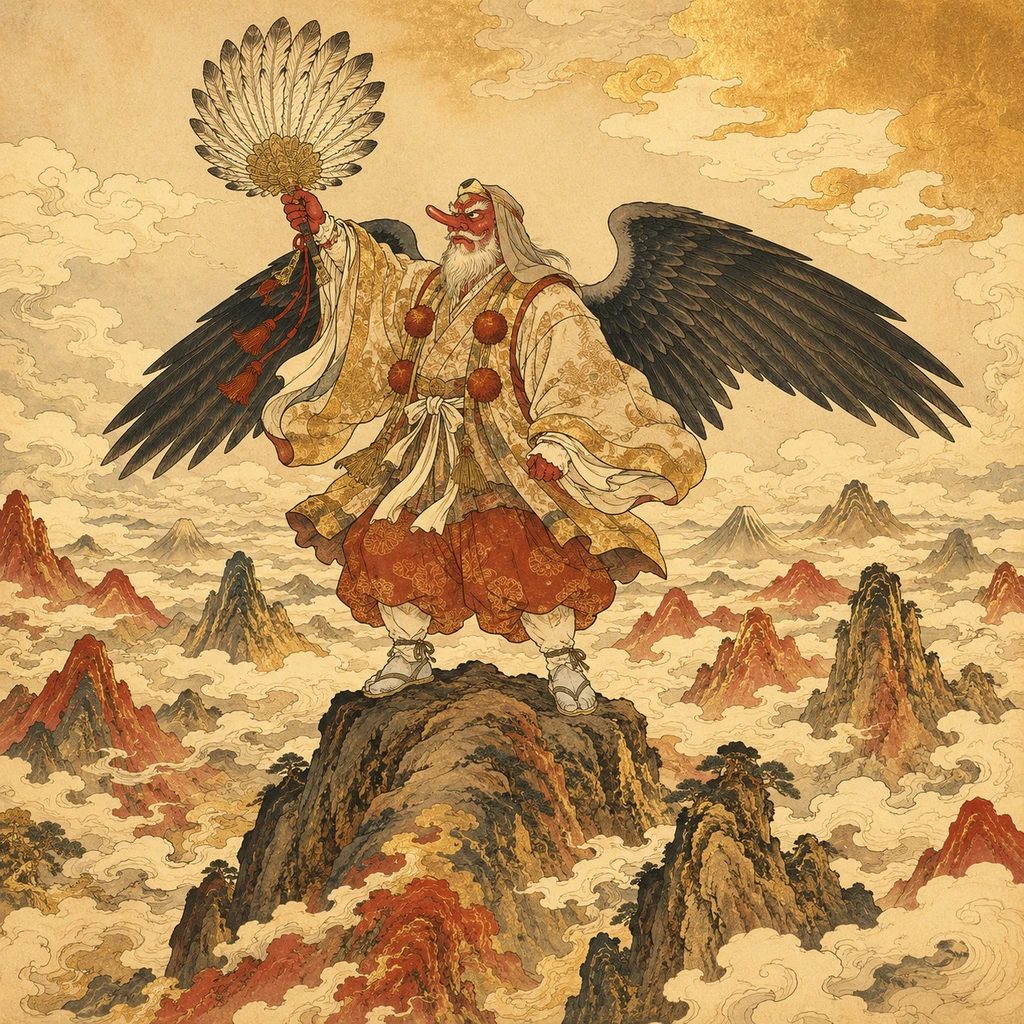
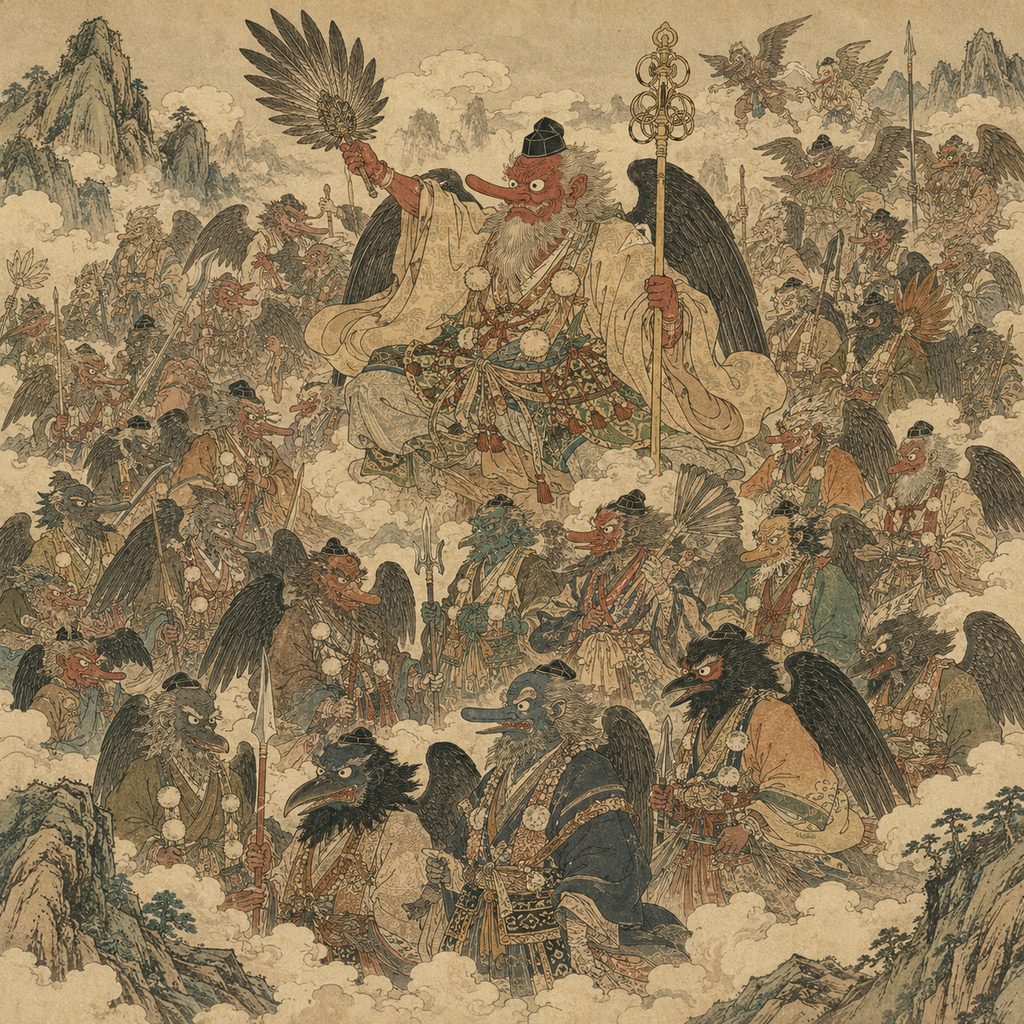
The form of the tengu is not uniform. The first type is the long-nosed tengu[1]—ruddy face and high nose, clad in the ascetic's headcloth (tokin) and the suzukake robe, a feather fan in hand and one-toothed high clogs on the feet. The second is the crow tengu, with a crow's beak and wings, grasping a sword or a vajra staff. The third are the lesser tengu called leaf tengu and wood-chip tengu, held to be weak and numerous kin. Rather than a fixed classification, these reflect the breadth of the tengu image across eras and regions.
The iconography shifted over time. The Heian-period tengu was first conceived as a bird like a black kite, and the image of the crow tengu retains that vestige. The long nose grows prominent only from the late Kamakura period; the Zegaibō Emaki[2] depicts a scene in which a tengu that had disguised itself as a human has its nose lengthen as it returns to bird form. As for the origin of the long nose, there are theories that derive it from the high-nosed Jidō mask of gigaku and link the crow tengu to the Karura (Garuda) mask, and a view that sees the long nose as an iconographic vestige of a bird's beak—but none can be called settled doctrine. It was overlaid with the god Sarutahiko, described in the Nihon Shoki as having a nose seven hand-spans long, and the custom arose of using a tengu mask for the role of Sarutahiko in festivals.
The tengu's dual nature is rooted in the Buddhist notion of the way of the tengu. Because it studies the Buddhist path it does not fall into hell, and because it handles heterodox arts it cannot reach paradise either—an intermediate state, and the one who falls there was held to be the arrogant monk. The Tengu Zōshi[1] depicts this notion as satire of the monks of the seven great temples, yet Chigiri Kōsai[3] too warns that the simplification "only arrogant monks become tengu" goes too far. Demon though it is, once subdued it turns to guardianship, and it was held that if a Shugendō practitioner recites the Tengu Sutra[4] he may summon the tengu of the various provinces to grant his wishes—this amplitude between guardian and demon is the very core of the tengu.
The certain medieval source for the grouping called the "Eight Great Tengu" lies in the libretto of the Muromachi-period Noh play Kurama Tengu[5]. The passage in which the great tengu calls up the tengu of the provinces he commands in geographical order—"In Tsukushi, Buzenbō of Hiko-san; in the four provinces of Shikoku, Sagamibō of Shiramine; Hōkibō of Ōyama; Saburō of Iizuna… the host of Zenki of Ōmine, Takama of Katsuragi"—shows that the Eight Great Tengu were rooted in medieval belief and performing arts, not an Edo invention. Still, the composition wavers by source, with a variant that adds Hōkibō of Ishizuchi-san; it is no fixed roster.
Source Information
種類全体の出典primary
天狗の研究
著者: 知切光歳
年代: 1975
出版社: 大陸書房
種類全体の出典primary
今昔物語集(巻二十)
著者: (編者未詳)
年代: 12世紀前半
出版社: (平安後期の説話集)
種類全体の出典primary
鞍馬天狗(謡曲)
著者: 宮増(伝)
年代: 室町期
出版社: (能・五番目物)
種類全体の出典primary
日本書紀(舒明天皇九年条)
著者: 舎人親王ほか
年代: 720
出版社: (奈良時代の勅撰正史)
種類全体の出典primary
天狗経――その現状と所在
著者: 高橋成
年代: 2016
出版社: 西郊民俗236号
種類全体の出典primary
天狗経
著者: (密教系祈祷秘経)
年代: 江戸中期
出版社: (修験の祈祷経典)
種類全体の出典primary
天狗草紙
著者: (絵巻、作者未詳)
年代: 1296頃
出版社: (鎌倉末期の風刺絵巻)
種類全体の出典primary
是害房絵巻
著者: (絵巻、作者未詳)
年代: 1354頃
出版社: (曼殊院本ほか、重要文化財)
種類全体の出典primary
画図百鬼夜行
著者: 鳥山石燕
年代: 安永5年(1776年)
出版社: 国文学研究資料館国書データベース(東京藝術大学附属図書館所蔵)
Personality
Lord of the mountain, bearing the dual nature of guardian and demon. It most detests arrogance, tests the practitioner, and at times guides him.
Compatibility
Those who fear and revere the mountains, those who aspire to the paths of asceticism and martial arts, those who are not shamed even when their pride is chastised
Abilities & Skills
Weaknesses
Subdual by strong magical power and sutra recitation / having its arrogance struck at / its power wanes when it strays far from the mountain
Collection Inclusion
This yokai is included in the following collections:
診断評価
妖怪バウンダリー・タイプ指標
いたずら濃度
2.0high: 戯 low: 護
📝 メモ
天狗攫い・惑わし・修行者への試練という戯れと魔性を持つ
変化適応
3.0high: 化 low: 定
📝 メモ
鳥・人・山伏への化身、隠形、神通を明記される
夜話度
1.0high: 夜 low: 昼
📝 メモ
夜の山の怪異にも通じるが、昼夜より山岳の神威が本体
情の深さ
-2.0high: 縁 low: 境
📝 メモ
孤高の山岳存在で、個人への情より修行と山の理を重んじる
結界強度
3.0high: 律 low: 流
📝 メモ
霊山・禁制・山岳修験の領域を守る性格が強い
表舞台圧
3.0high: 表 low: 影
📝 メモ
山の主として正面に立ち、山伏姿や烏天狗像で場を圧する
妖怪相性診断
喜び
3.5喜びと楽しさの程度
📝 メモ
厳粛で修行者的。喜びを前面に出す描写は乏しい。
怒り
8.0怒りの激しさの程度
📝 メモ
短気で怒りやすい一面が明記され、力も強大で怒りは激しい。
慈悲深い
5.0慈悲深さの程度
📝 メモ
正義感は強いが高慢で厳格。慈悲は状況次第で中庸。
憂鬱
4.5憂鬱で思慮深い程度
📝 メモ
思慮深さはあるが憂鬱さの描写は弱い。やや低め。
静寂
6.5内なる平静の程度
📝 メモ
長年の修行で内的平静はあるが、短気ゆえ高くは安定しない。
いたずら好き
2.5いたずら好きで活発な程度
📝 メモ
伝承にある人迷わせ要素はあるが本個体は厳格で遊戯性は低い。
やさしい
3.0やさしく親しみやすい程度
📝 メモ
導き手の側面はあるが、誇り高く厳格で短気。親しみやすさは低め。
厳格
9.0厳格で真面目な程度
📝 メモ
タイプが厳格で山伏的規律を重んじる。指導者的側面も強い。
守護的
8.0他者を守る傾向
📝 メモ
山の守護者としての伝承が強く、邪悪を見抜き導く性質を持つ。
神秘的
8.5神秘的で不思議な程度
📝 メモ
山岳の守護者で超常の飛行・瞬間移動・風操作など神秘性が高い。
霊性の深さ
9.5精神的境界の深さ
📝 メモ
千年修行・山伏装束・守護と導きの役割から霊性は非常に深い。
Similar Yokai
Yokai with similar personality and characteristics to What Is a Tengu? An Overview of Types and Iconography


Opposite Yokai
Yokai with opposite personality and characteristics to What Is a Tengu? An Overview of Types and Iconography
🔮Test your compatibility with Tengu now!
Analyze your personality and values to get a detailed compatibility rating with this yokai.
Free, simple, and results in just minutes.
