
TenguThe Forty-Eight Tengu – The Great Tengu of the Provinces in the Tengu Sutra
Tengu
Detailed Description
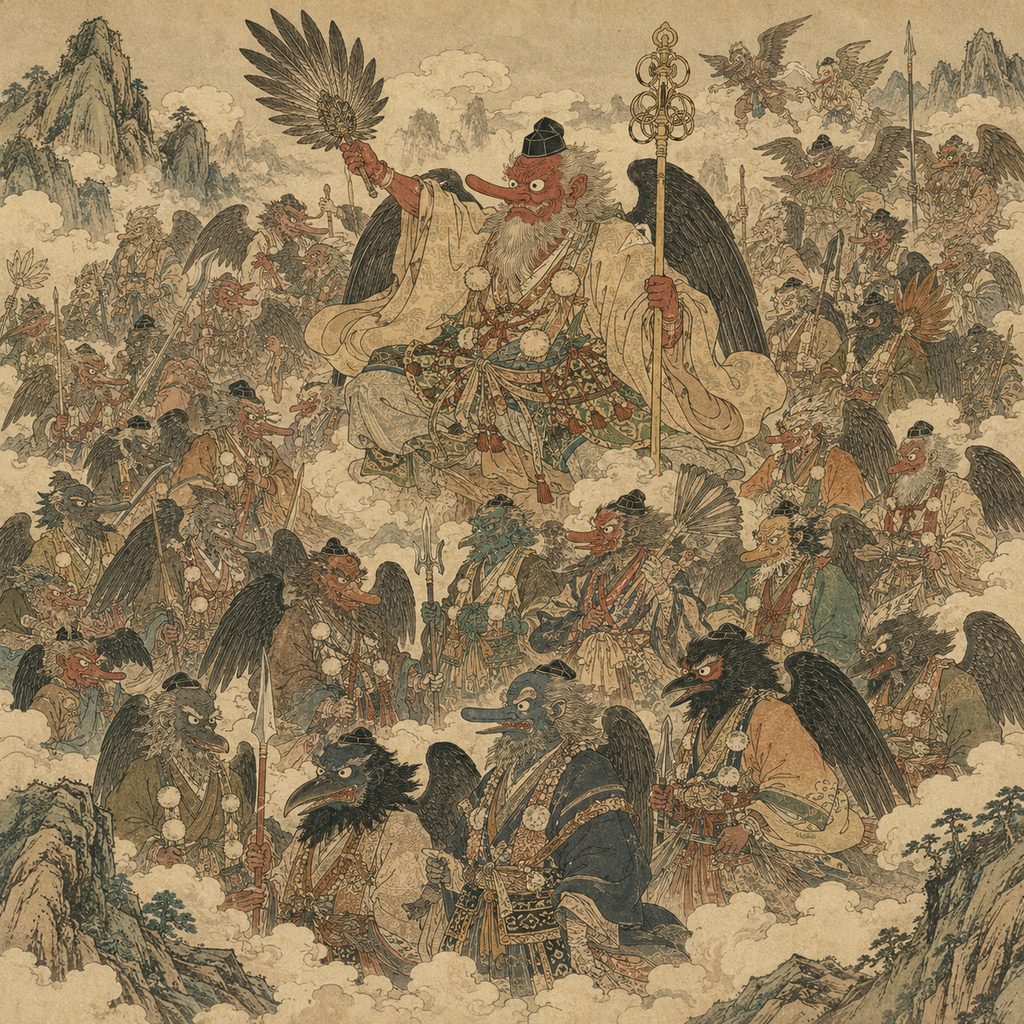
The tengu do not stop at the Eight Great Tengu. Each of the sacred mountains of the provinces was believed to have its own great tengu, and the early-modern esoteric prayer-scripture the Tengu Sutra[1] lists their representatives as forty-eight seats—the "Forty-Eight Tengu." This edition is an overview that surveys the full roster and the provenance of the scripture itself.
The Tengu Sutra is an esoteric, Shugendō-lineage prayer text said to have been compiled in the Edo period. It is not an orthodox sutra of the Buddhist canon, but belongs to the lineage of incantation-scriptures that a yamabushi recites in his devotions to summon (invoke the descent of) the tengu of the sacred mountains of the provinces, borrowing their numinous power to pray for the dispelling of demons, the subjugation of enemies, and the fulfillment of all wishes. The text begins with the chant "Homage to the great tengu and the small tengu," lists the names of the various tengu, then gives the total of the tengu as "one hundred twenty-five thousand five hundred in all," and closes with the mantra "On aromaya tengusumanki sowaka."[1] This "one hundred twenty-five thousand five hundred" is not a real count but a symbolic number representing innumerable tengu, and the forty-eight seats named by their proper names are positioned as the representatives among them. As for the transmission of the manuscripts and printed editions of the Tengu Sutra, there are philological studies such as Takahashi Sei's "The Tengu Sutra: Its Present State and Whereabouts" (2016)[2], and it is difficult to fix the date of compilation strictly to a single point.
The roster of the Forty-Eight Tengu runs in the form of "bō" titles (sacred-mountain name + the name of the bō). The opening begins with the great tengu of the Kinai—Atago-san Tarōbō, Hira-san Jirōbō, Kurama-san Sōjōbō—and is followed by the tengu of the Shugendō sacred mountains across the land such as Fuji, Nikkō, Haguro, Akiba, Hikosan, and Ishizuchi. Below are listed all forty-eight seats, collated against two confirmable lines of sources, together with the bō title, sacred mountain, and province (present-day prefecture). ★ marks the Eight Great Tengu that have their own pages in this encyclopedia.
1. ★Atago-san Tarōbō (Mt. Atago, Yamashiro / Kyoto)
2. ★Hira-san Jirōbō (Mt. Hira, Ōmi / Shiga)
3. ★Kurama-san Sōjōbō (Mt. Kurama, Yamashiro / Kyoto)
4. Hiei-zan Hosshōbō (Mt. Hiei, Yamashiro / Kyoto)
5. Yokawa Kakkaibō (Yokawa, Mt. Hiei, Yamashiro / Kyoto)
6. Fuji-san Daranibō (Mt. Fuji, Suruga / Shizuoka)
7. Nikkō-san Tōkōbō (Mt. Nikkō, Shimotsuke / Tochigi)
8. Haguro-san Konkōbō (Mt. Haguro, Dewa / Yamagata)
9. Myōgi-san Nikkōbō (Mt. Myōgi, Kōzuke / Gunma)
10. Tsukuba-san Hōinbō (Mt. Tsukuba, Hitachi / Ibaraki)
11. ★Hiko-san Buzenbō (Mt. Hiko (Hikosan), Buzen / Fukuoka)
12. Ōhara Sumiyoshi Kenbō (Kengamine, Mt. Daisen (disputed), Hōki / Tottori (tentatively identified))
13. Etchū Tateyama Nawadarebō (Mt. Tate, Etchū / Toyama)
14. Amanoiwafune Dantokubō (Amanoiwafune, location unknown)
15. Nara Ōku Sugisakabō (unknown, location unknown)
16. Kumano Ōmine Kikujōbō (Kiku-no-iwaya, Mt. Ōmine, Yamato / Nara)
17. Yoshino Minasugi Kozakurabō (Mt. Yoshino, Yamato / Nara)
18. ★Nachi Takimoto Zenkibō (Nachi Takimoto, Kii / Wakayama)
19. Kōya-san Kōrinbō (Mt. Kōya, Kii / Wakayama)
20. Niitayama Satokubō (Mt. Niita (disputed), Kōzuke / Gunma (tentatively identified))
21. Kikaigashima Garanbō (Kikaigashima, Satsuma / Kagoshima (tentatively identified))
22. Itatōyama Tondonbō (Mt. Itatō, location unknown)
23. Saifu Takagaki Kōrinbō (Mt. Kamado (Mt. Hōman), Chikuzen / Fukuoka (tentatively identified))
24. Nagato Fumyō Kishukubō (unknown, Nagato / Yamaguchi (tentatively identified))
25. Tsudoki Oki Fugenbō (Oki Island (disputed), Oki / Shimane (tentatively identified))
26. Kurokenzoku Konpirabō (Mt. Zōzu, Sanuki / Kagawa)
27. Hyūga Obata Shinzōbō (unknown, Hyūga / Miyazaki (tentatively identified))
28. Iōjima Kōtokubō (Iōjima, Satsuma / Kagoshima (tentatively identified))
29. Shiōzan Rikyūbō (Mt. Shibi, Satsuma / Kagoshima (tentatively identified))
30. ★Hōki Daisen Seikōbō (Mt. Daisen, Hōki / Tottori)
31. Ishizuchi-san Hōkibō (Mt. Ishizuchi, Iyo / Ehime)
32. Nyoigatake Yakushibō (Nyoigatake, Yamashiro / Kyoto)
33. Tenmanzan Sanmanbō (Mt. Tenman (disputed), Mino / Gifu (tentatively identified))
34. Itsukushima Sankibō (Mt. Misen (Itsukushima), Aki / Hiroshima)
35. Shiragayama Kōshakubō (Mt. Shiraga, Tosa / Kōchi (tentatively identified))
36. Akiba-san Sanshakubō (Mt. Akiba, Tōtōmi / Shizuoka)
37. Takao Naigubu (Mt. Takao, Yamashiro / Kyoto)
38. ★Iizuna Saburō (Mt. Iizuna, Shinano / Nagano)
39. Ueno Myōgibō (Mt. Myōgi, Kōzuke / Gunma)
40. Higo Ajari (Mt. Kinpō (disputed), Higo / Kumamoto (tentatively identified))
41. Katsuragi Takamabō (Mt. Kongō (Katsuragi), Yamato / Nara)
42. ★Shiramine Sagamibō (Shiramine, Sanuki / Kagawa)
43. Kōra-san Chikugobō (Mt. Kōra, Chikugo / Fukuoka)
44. Zōzu-san Kongōbō (Mt. Zōzu, Sanuki / Kagawa)
45. Kasagi-san Daisōjō (Mt. Kasagi, Yamashiro / Kyoto)
46. Myōkō-san Adachibō (Mt. Myōkō, Echigo / Niigata)
47. Ontake-san Rokkokubō (Mt. Ontake, Shinano / Nagano)
48. Asamagatake Kinpeibō (Mt. Asama, Kōzuke / Gunma (tentatively identified))
Three cautions are needed in reading this roster. First, the bō titles (the names of each seat) agree across multiple sources and are reliable, but errors mixed into secondary web information mar the identification of the province and prefecture. For instance, Mt. Shibi is in Kagoshima Prefecture (Satsuma), and "Hyūga" is the old province name of Miyazaki Prefecture—misattributions confusing these with places in the Kantō or Tōhoku are in circulation. In this roster, "tentatively identified" is appended to seats whose identification has latitude, and "location unknown" to seats whose whereabouts cannot be confirmed among the sources. Second, there are seats such as Amanoiwafune Dantokubō, Nara Ōku Sugisakabō, and Itatōyama Tondonbō whose location multiple sources hold to be "unknown," and no place name has been forced upon these. Third, there is variation between the bō titles of the Eight Great Tengu and the wording of the Tengu Sutra text. For example, the Ōyama Hōkibō of the Eight Great Tengu appears in the text as "Hōki Daisen Seikōbō," and Ōmine Zenkibō appears in the "Nachi Takimoto Zenkibō" / "Kumano Ōmine Kikujōbō" line of wording. The Eight Great Tengu are commonly explained as eight representative seats drawn from among these forty-eight, but the bō titles do not agree word for word.
The framework of the Forty-Eight Tengu shows most plainly that the tengu was not a solitary yokai but a deity of mountain worship seated throughout the sacred mountains of the whole country. Chigiri Kōsai[3], who compiled the study of tengu, likewise organized these mountain tengu into a single system. Each seat of the Eight Great Tengu (★) is treated in detail on its own page, but they too are simply the especially high peaks within this sea of one hundred twenty-five thousand five hundred tengu.
Source Information
種類全体の出典primary
天狗の研究
著者: 知切光歳
年代: 1975
出版社: 大陸書房
種類全体の出典primary
今昔物語集(巻二十)
著者: (編者未詳)
年代: 12世紀前半
出版社: (平安後期の説話集)
種類全体の出典primary
鞍馬天狗(謡曲)
著者: 宮増(伝)
年代: 室町期
出版社: (能・五番目物)
種類全体の出典primary
日本書紀(舒明天皇九年条)
著者: 舎人親王ほか
年代: 720
出版社: (奈良時代の勅撰正史)
種類全体の出典primary
天狗経――その現状と所在
著者: 高橋成
年代: 2016
出版社: 西郊民俗236号
種類全体の出典primary
天狗経
著者: (密教系祈祷秘経)
年代: 江戸中期
出版社: (修験の祈祷経典)
種類全体の出典primary
天狗草紙
著者: (絵巻、作者未詳)
年代: 1296頃
出版社: (鎌倉末期の風刺絵巻)
種類全体の出典primary
是害房絵巻
著者: (絵巻、作者未詳)
年代: 1354頃
出版社: (曼殊院本ほか、重要文化財)
種類全体の出典primary
画図百鬼夜行
著者: 鳥山石燕
年代: 安永5年(1776年)
出版社: 国文学研究資料館国書データベース(東京藝術大学附属図書館所蔵)
Personality
The totality of the tengu pervading the sacred mountains of the provinces. It consists of the Eight Great Tengu at its apex, the forty-eight representative seats, and the one hundred twenty-five thousand five hundred innumerable kin.
Compatibility
Those who hold to mountain worship and Shugendō, those who tour the sacred mountains of the provinces, those who seek to know the whole image of the tengu
Abilities & Skills
Weaknesses
Subdual by the orthodox Law and sutra recitation / arrogance / the waning of power away from the sacred mountain
診断評価
妖怪バウンダリー・タイプ指標
いたずら濃度
2.0high: 戯 low: 護
📝 メモ
魔として仏法を妨げ怨敵降伏にも関わる天狗的な攪乱性がある
変化適応
2.0high: 化 low: 定
📝 メモ
鼻高・烏・木の葉など天狗類型が複数に分岐する
夜話度
1.0high: 夜 low: 昼
📝 メモ
山岳怪として夜気は帯びるが、出現時刻より霊山性が中心
情の深さ
-2.0high: 縁 low: 境
📝 メモ
霊山の総体として個人より山岳秩序に属する
結界強度
3.0high: 律 low: 流
📝 メモ
四十八座の霊山と眷属階層に明確な領域秩序を持つ
表舞台圧
3.0high: 表 low: 影
📝 メモ
諸国霊山の大天狗総覧で、天狗界を統べる圧が強い
妖怪相性診断
喜び
3.5喜びと楽しさの程度
📝 メモ
天狗笑いの怪音や戯れの側面はあるが、全体像は修験・武芸・調伏の厳めしさが中心。
怒り
7.0怒りの激しさの程度
📝 メモ
怒りや傲慢が堕して天狗となる観念、天狗礫・天狗倒しなど苛烈な振る舞いが多い。
慈悲深い
4.0慈悲深さの程度
📝 メモ
導きはするが基本は試練を課す存在で、仏菩薩的な慈悲よりは峻厳な態度が主。
憂鬱
5.0憂鬱で思慮深い程度
📝 メモ
山中の孤高・憂いを想起させるが、典拠は性情よりも行為に偏るため中庸評価。
静寂
6.0内なる平静の程度
📝 メモ
山の霊格として静謐さや修行的沈潜を帯びるが、しばしば騒擾も起こす。
いたずら好き
4.5いたずら好きで活発な程度
📝 メモ
天狗攫い・幻術・からかい等の戯れは見られるが、本質は試練と権能。
やさしい
3.0やさしく親しみやすい程度
📝 メモ
山の主で試練を与え導く面はあるが、人を攫う・礫を投げるなど威圧的で、基本は親しみやすい存在ではない。
厳格
8.0厳格で真面目な程度
📝 メモ
修行者を試す峻厳さ、慢心を戒める象徴性、法力・規律への厳しさが顕著。
守護的
7.5他者を守る傾向
📝 メモ
調伏後は護法神として霊山・修行者を守護し祈祷でも悪魔退散に用いられる。一方で敵対もする両義性がある。
神秘的
9.0神秘的で不思議な程度
📝 メモ
来臨影向や無数の眷属、鳥形と長鼻の二系統、天体怪からの転義など成立自体が神秘性に富む。
霊性の深さ
9.5精神的境界の深さ
📝 メモ
修験道と密接、護法神化の両義、四十八座と十二万五千五百の体系、招請・加持法の実践性が極めて深い。
Similar Yokai
Yokai with similar personality and characteristics to The Forty-Eight Tengu – The Great Tengu of the Provinces in the Tengu Sutra

Opposite Yokai
Yokai with opposite personality and characteristics to The Forty-Eight Tengu – The Great Tengu of the Provinces in the Tengu Sutra
🔮Test your compatibility with Tengu now!
Analyze your personality and values to get a detailed compatibility rating with this yokai.
Free, simple, and results in just minutes.

