
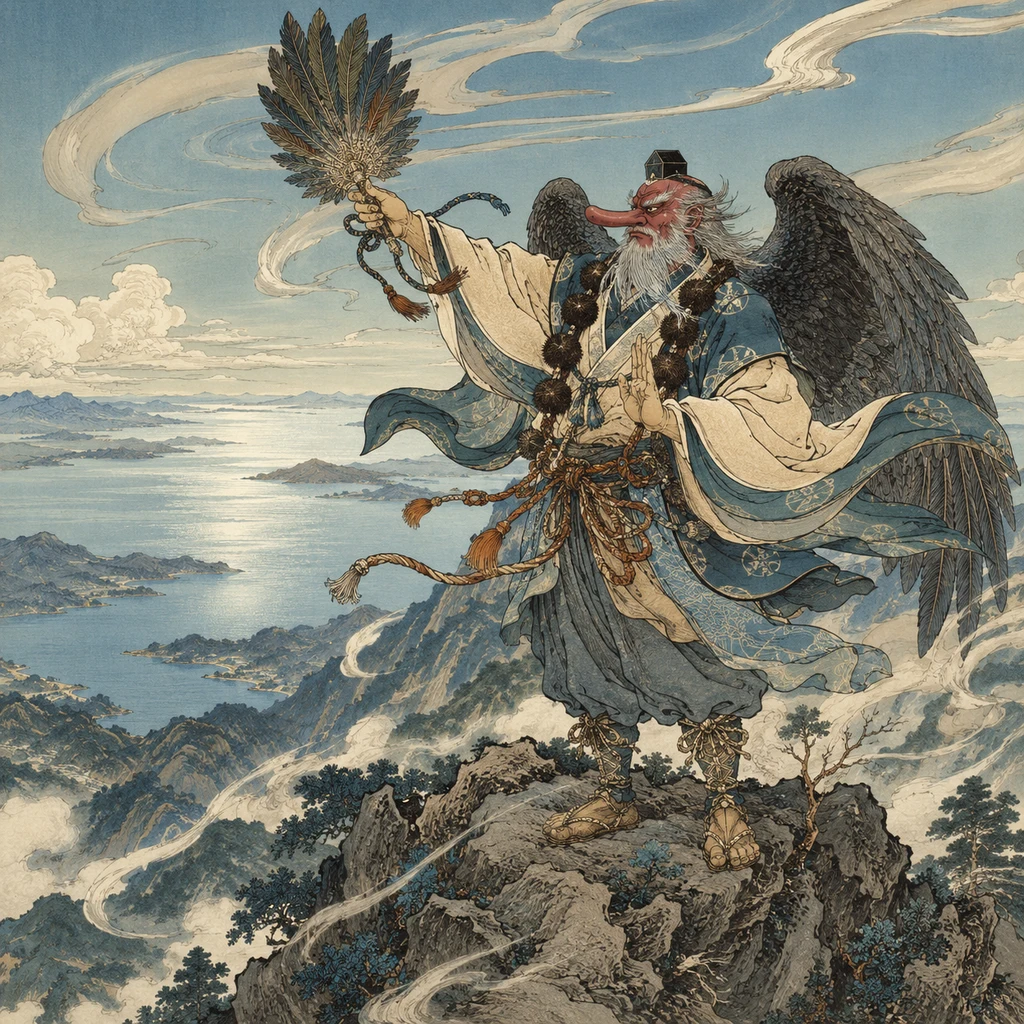
Hira-san JirōbōThe Second-Seat Great Tengu — Hira-san Jirōbō
Hira-san Jirōbō
Detailed Description
The key to reading Hira-san Jirōbō lies in the meaning of the rank "second seat, next after Tarōbō," and in the medieval sources particular to Mt. Hira.
In the tengu hierarchy, Jirōbō is held to be the second after Atago-san Tarōbō. This ordering appears almost in common both in the forty-eight tengu of the Tengu-kyō[1] and in the Eight Great Tengu framework, and the very names Tarōbō and Jirōbō derive from the ordinals "one" and "two." Rather than being told of alone, Jirōbō appears more often paired with Tarōbō as the twin pillars of the tengu world.
The firm ancient layer of Hira's tengu lies in the Hirasan Kojin Reitaku[2] (by Keisei, 1239). This dialogue, in which the aged tengu of Mt. Hira answers Keisei's questions and speaks of the tengu world and the afterlife, is a primary source particular to Mt. Hira, showing that Hira held a firm place as a tengu sacred mountain in the medieval age.
Here one common confusion should be set right. Jirōbō is often bound to the tale of the Chinese tengu Chira Eiju (= Zegaibō), but the original story in the Konjaku Monogatarishū, Book 20[3] runs on the plot of a tengu of Shintan defeated by a monk of Mt. Hiei, and does not name Mt. Hira as the seat of the Japanese tengu. Making Chira Eiju the tengu of Hira is a later arrangement; the tradition proper to Mt. Hira itself should rather be sought in the aforementioned Kojin Reitaku. The tale of relocation from Mt. Hiei is likewise understood not as historical fact but as a later narrative telling the changeover of a sacred mountain's leadership. Based at Mt. Hira, the sacred peak of Ōmi, fearing Buddhist law while testing human conceit—this coexistence of modesty and fortitude is the image of Jirōbō. Chigiri Kōsai[4] of tengu scholarship, too, set Jirōbō in the place next after Tarōbō.
Source Information
種類全体の出典primary
天狗の研究
著者: 知切光歳
年代: 1975
出版社: 大陸書房
種類全体の出典primary
比良山古人霊託
著者: 慶政
年代: 1239
出版社: (中世の宗教問答記録)
種類全体の出典primary
今昔物語集(巻二十)
著者: (編者未詳)
年代: 12世紀前半
出版社: (平安後期の説話集)
種類全体の出典primary
鞍馬天狗(謡曲)
著者: 宮増(伝)
年代: 室町期
出版社: (能・五番目物)
種類全体の出典primary
天狗経
著者: (密教系祈祷秘経)
年代: 江戸中期
出版社: (修験の祈祷経典)
Personality
Proud and steadfast, yet cautious before the ritual power of the clergy. He tests the arrogance of men, but does not refuse to withdraw before strong Buddhist power.
Compatibility
He favors the strong and chastens the conceited; to travelers and ascetics who revere the mountain he shows the way.
Abilities & Skills
Weaknesses
Subdual by strong ritual power or the recitation of sutras / Being struck at through his conceit / He does not refuse to withdraw before the Buddhist law
診断評価
妖怪バウンダリー・タイプ指標
いたずら濃度
2.0high: 戯 low: 護
📝 メモ
人の驕りを試し天狗らしく惑わす
変化適応
3.0high: 化 low: 定
📝 メモ
鳥への化身、飛翔、隠形が明記される
夜話度
2.0high: 夜 low: 昼
📝 メモ
山中の隠形や天狗譚は夜側に寄る
情の深さ
-2.0high: 縁 low: 境
📝 メモ
人に執着せず霊山の大天狗として超然とする
結界強度
3.0high: 律 low: 流
📝 メモ
比良山の天狗領域と序列を統べる
表舞台圧
3.0high: 表 low: 影
📝 メモ
八大天狗の次席として山中で強い威を持つ
妖怪相性診断
喜び
2.5喜びと楽しさの程度
📝 メモ
剛毅・慎重で儀礼的。歓楽や愉悦の描写は乏しい。
怒り
6.0怒りの激しさの程度
📝 メモ
鼻高の大天狗として威圧と懲罰性を帯び、怒りの側面は中程度以上。ただし仏法には退く抑制もある。
慈悲深い
4.0慈悲深さの程度
📝 メモ
仏法を畏れ退く慎みはあるが、慈恵より戒めが前面。限定的な導きにとどまる。
憂鬱
4.5憂鬱で思慮深い程度
📝 メモ
憂愁の直接描写は少ないが、古人との問答や思慮深さからやや高め。
静寂
6.5内なる平静の程度
📝 メモ
霊山の主としての静けさと、強き法力に対し退く慎重さが内的平衡を示す。
いたずら好き
3.0いたずら好きで活発な程度
📝 メモ
天狗一般の戯れはあるが、本個体は序列第二の大天狗として端正で、悪戯性は低め。
やさしい
3.0やさしく親しみやすい程度
📝 メモ
矜持高く剛毅で、人の慢心を試す性格。山を敬う者には道を示すが、親しみやすさは高くない。
厳格
8.0厳格で真面目な程度
📝 メモ
慢心を戒め、序列と規律を体現。試練を課す厳格さが強い。
守護的
6.5他者を守る傾向
📝 メモ
山を敬う旅人や修行者に道を示すなど守護面があるが、基本は試す存在で選別的。
神秘的
8.5神秘的で不思議な程度
📝 メモ
霊山の大天狗として風・変化・隠形を操り、中世一次史料に名が現れる神秘性が強い。
霊性の深さ
9.0精神的境界の深さ
📝 メモ
『比良山古人霊託』の問答に見える来世論・戒め・仏法への畏敬など、霊性的深みが顕著。
Similar Yokai
Yokai with similar personality and characteristics to The Second-Seat Great Tengu — Hira-san Jirōbō

Opposite Yokai
Yokai with opposite personality and characteristics to The Second-Seat Great Tengu — Hira-san Jirōbō
🔮Test your compatibility with Hira-san Jirōbō now!
Analyze your personality and values to get a detailed compatibility rating with this yokai.
Free, simple, and results in just minutes.
Like this yokai?
Visit a shrine to discover your guardian yokai