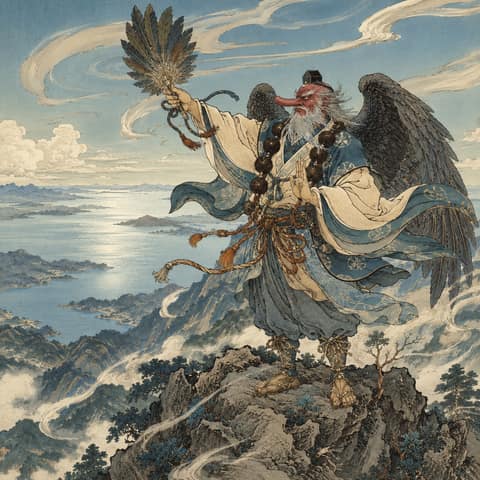
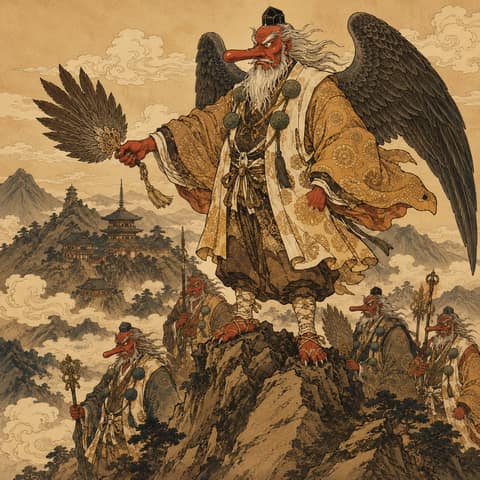
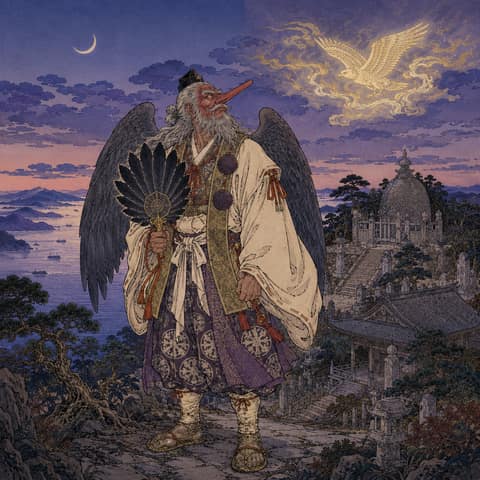
Hira-san Jirōbō is a great tengu who strikes his roots into Mt. Hira in Ōmi Province; within the forty-eight tengu[1] and the Eight Great Tengu, his name stands in the second seat (rank two), next after Atago-san Tarōbō. Drawn as a long-nosed great tengu, he is held to command the mountain air and the wind and to govern the tengu beneath him.
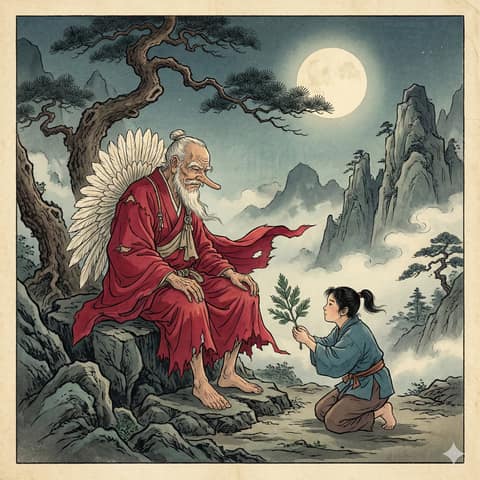
Based in the Hira range that towers along the western shore of Lake Biwa, the tengu of this mountain appears by name in medieval texts. The Hirasan Kojin Reitaku[2], written by Keisei in the first year of Enō (1239), records a dialogue with the aged tengu (the "old man") of Mt. Hira, conveying that Hira had long been conceived as a sacred mountain where tengu dwell. Within the tengu hierarchy headed by Atago Tarōbō, Jirōbō, as the second seat, has often been spoken of in a pair with Tarōbō.
Folklore & Legends
Hira-san Jirōbō is placed within the tengu hierarchy as the "second-seat great tengu," forming a pair with Atago-san Tarōbō. Both in the forty-eight tengu of the Tengu-kyō[1] and in the Eight Great Tengu framework that follows from the Muromachi Noh play Kurama Tengu[3], the order Tarōbō (one) and Jirōbō (two) broadly agrees.
The most reliable medieval source telling of the tengu of Mt. Hira is the Hirasan Kojin Reitaku[2]. The monk Keisei, who prayed for the recovery of Kujō Michiie, recorded in the first year of Enō (1239) some fifty-odd articles of dialogue exchanged three times over with the aged tengu (the "old man") of Mt. Hira, ranging from the ecology of tengu to the afterlife of the dead and predictions of this world. As a primary historical source that speaks of Hira's tengu by name, it carries decisive weight for the study of Jirōbō.
On the other hand, the tale of the Chinese tengu Chira Eiju, often linked to Jirōbō, calls for care. The story of Chira Eiju in the Konjaku Monogatarishū, Book 20[4] (the original of the later Zegaibō emaki) runs on the plot of a tengu of Shintan (China) coming to Japan and being thwarted by the ritual power of a monk of Mt. Hiei; the original does not point to Mt. Hira as the seat of the Japanese tengu. To bind Chira Eiju to the tengu of Hira is, rather, an arrangement by later yokai scholarship. Likewise the tale of relocation—that Jirōbō was the lord of Mt. Hiei but moved to Mt. Hira because eminent monks gathered at the Enryaku-ji founded by Saichō—has scant support in medieval primary sources, and is understood as a later narrative arrangement that tells, as a tengu's removal, the handover of a sacred mountain's lordship from mountain spirit to Buddhist law. Chigiri Kōsai[5] of tengu scholarship, too, places Jirōbō within the system of the many mountains as the great tengu next after Tarōbō.
The key to reading Hira-san Jirōbō lies in the meaning of the rank "second seat, next after Tarōbō," and in the medieval sources particular to Mt. Hira.
In the tengu hierarchy, Jirōbō is held to be the second after Atago-san Tarōbō. This ordering appears almost in common both in the forty-eight tengu of the Tengu-kyō[1] and in the Eight Great Tengu framework, and the very names Tarōbō and Jirōbō derive from the ordinals "one" and "two." Rather than being told of alone, Jirōbō appears more often paired with Tarōbō as the twin pillars of the tengu world.
The firm ancient layer of Hira's tengu lies in the Hirasan Kojin Reitaku[2] (by Keisei, 1239). This dialogue, in which the aged tengu of Mt. Hira answers Keisei's questions and speaks of the tengu world and the afterlife, is a primary source particular to Mt. Hira, showing that Hira held a firm place as a tengu sacred mountain in the medieval age.
Here one common confusion should be set right. Jirōbō is often bound to the tale of the Chinese tengu Chira Eiju (= Zegaibō), but the original story in the Konjaku Monogatarishū, Book 20[4] runs on the plot of a tengu of Shintan defeated by a monk of Mt. Hiei, and does not name Mt. Hira as the seat of the Japanese tengu. Making Chira Eiju the tengu of Hira is a later arrangement; the tradition proper to Mt. Hira itself should rather be sought in the aforementioned Kojin Reitaku. The tale of relocation from Mt. Hiei is likewise understood not as historical fact but as a later narrative telling the changeover of a sacred mountain's leadership. Based at Mt. Hira, the sacred peak of Ōmi, fearing Buddhist law while testing human conceit—this coexistence of modesty and fortitude is the image of Jirōbō. Chigiri Kōsai[5] of tengu scholarship, too, set Jirōbō in the place next after Tarōbō.
Character Profile
This section is our own creative profile for storytelling. It is not historical fact or scholarship.
Proud and steadfast, yet cautious before the ritual power of the clergy. He tests the arrogance of men, but does not refuse to withdraw before strong Buddhist power.
Compatibility
He favors the strong and chastens the conceited; to travelers and ascetics who revere the mountain he shows the way.
Abilities
Transformation (taking the form of birds and the like)Raising the windCommanding the tengu beneath himFar-travel and flightConcealment within the mountains
Weaknesses
Subdual by strong ritual power or the recitation of sutras
Being struck at through his conceit
He does not refuse to withdraw before the Buddhist law
Habitat
Around Mt. Hira in Ōmi Province (Shiga); the vicinity of Mt. Hiei (in old tradition); the peaks along the western shore of Lake Biwa
The diagram below is a diagnostic evaluation chart for The Second-Seat Great Tengu — Hira-san Jirōbō. The higher the value of each item, the stronger that characteristic is expressed.