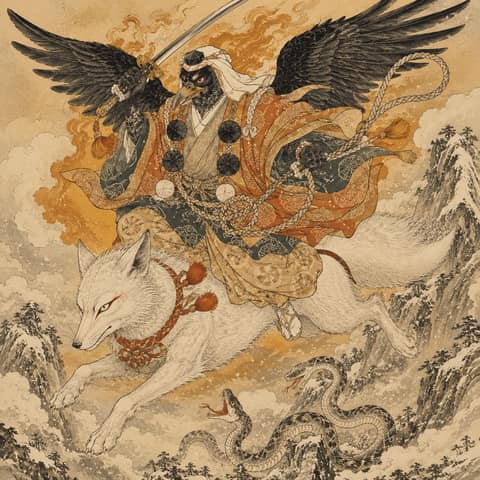
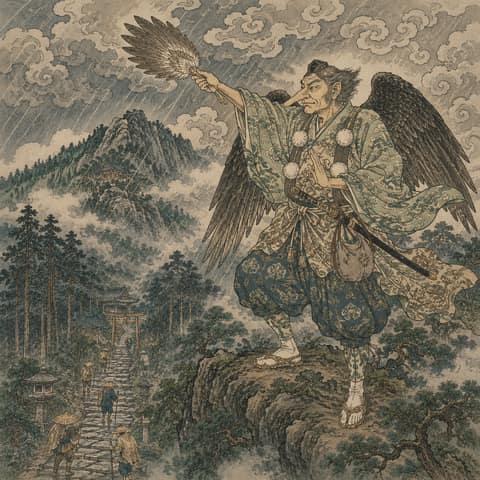
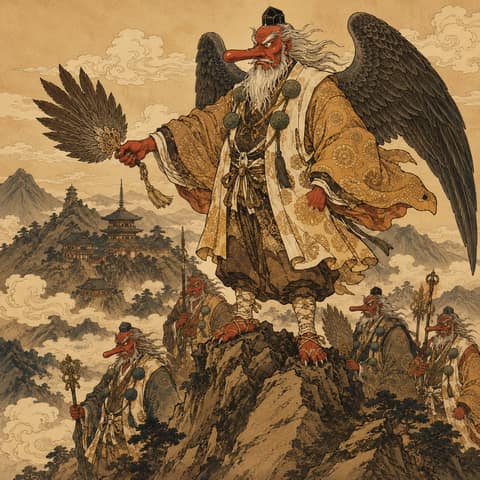
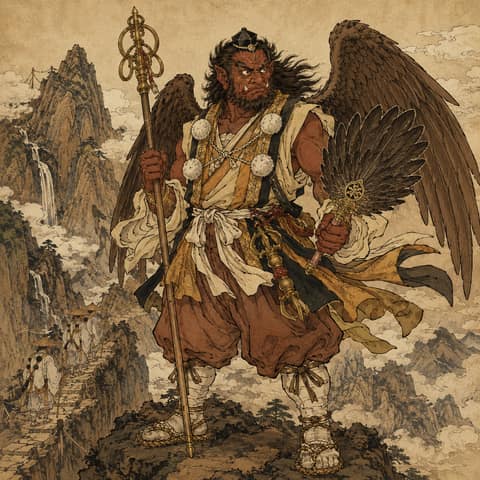
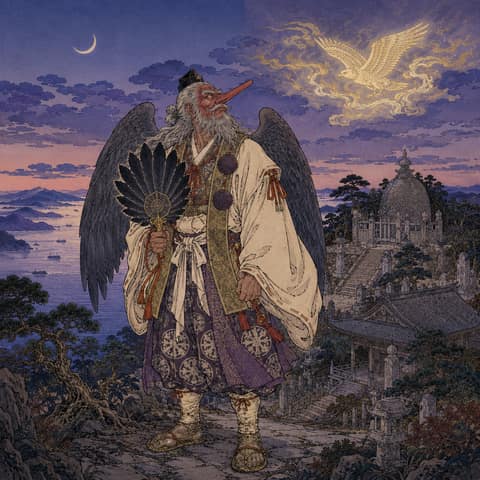
Shiramine Sagamibō is a great tengu enthroned at Shiramine in Sanuki Province, and is counted among the Eight Great Tengu. He is chanted in the Muromachi Noh play Kurama Tengu[1] as "in Shishū, the Sagamibō of Shiramine." His greatest distinction lies in being the tengu who guards the Shiramine mausoleum of the Retired Emperor Sutoku[2], who lost the Hōgen Rebellion, was exiled to Sanuki, and died there.
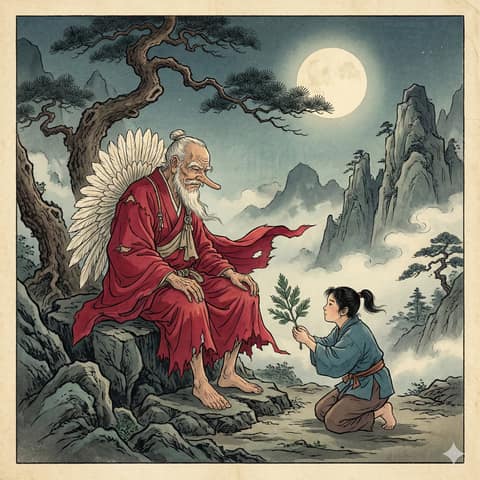
There are two theories on the origin of his name. One holds that it derives from Sagami Ajari Shōson, the monk who took Sutoku's side in the Hōgen Monogatari[2]; the other, that a great ascetic come from Mt. Ōyama in Sagami became the tutelary guardian of Sutoku's spirit—the latter forming a pair with the "seat transfer" tradition of Ōyama Hōkibō. Sutoku, one of Japan's three great vengeful spirits and called "the greatest tengu in Japan," and the tengu who guards his tomb—their two stories are bound together inseparably.
Folklore & Legends
The core of Shiramine Sagamibō converges upon one single point: the guarding of the vengeful spirit and the tomb of the Retired Emperor Sutoku.
The Retired Emperor Sutoku, defeated in the Hōgen Rebellion (1156), was exiled to Sanuki and died there in the second year of Chōkan (1164). His remains were cremated at Chigo-ga-take above Shiramine-ji, and the Shiramine mausoleum (the only imperial tomb in Shikoku, managed by the Imperial Household Agency) was raised. This Sutoku, whom Minamoto no Yoritomo is said to have called "the greatest tengu in Japan," inclined his heart toward the demon-path while still living and, even after his death, is said to have laid a curse upon the court—one of Japan's three great vengeful spirits. Shiramine Sagamibō was conceived as the tengu who guards and attends Sutoku's Shiramine mausoleum.
His figure crystallized vividly within literature. Its original source is the mid-Kamakura tale collection the Senjūshō[3], attributed to Saigyō, whose Book 1, "On the New Retired Emperor's Tomb at Shiramine," carries a tale of Saigyō visiting Sutoku's tomb at Shiramine. This was dramatized in the Noh play Matsuyama Tengu[4], which takes Sutoku-in as the shite and the poet-monk Saigyō as the waki, and brings on Sagamibō as a tengu attending Sutoku. Further, the opening tale "Shiramine" of Ueda Akinari's Ugetsu Monogatari[5] is a story in which Saigyō comes to the Shiramine mausoleum to mourn Sutoku's spirit and exchanges poems with the wrathful Sutoku-in; Sagamibō is the common element binding these requiem tales reaching back to the Senjūshō.
As for the origin of Sagamibō's name, there is the theory that it derives from Sagami Ajari Shōson, who sided with Sutoku in the Hōgen Monogatari[2], and the theory that he was a tengu who came from Mt. Ōyama in Sagami. The latter forms a pair with the seat-transfer tradition of Ōyama Hōkibō—that the Sagamibō of Sagami Ōyama, in devotion to Sutoku, removed to Sanuki, and Hōkibō entered the vacant seat—arranged by Chigiri Kōsai[6] of tengu scholarship. To tell of Shiramine Sagamibō leads naturally to telling of Sutoku's vengeful spirit, and of his counterpart, Ōyama Hōkibō.
Shiramine Sagamibō is, among the Eight Great Tengu, the tengu most firmly bound to a single person—the Retired Emperor Sutoku. His image cannot stand apart from the story of Sutoku's vengeful spirit.
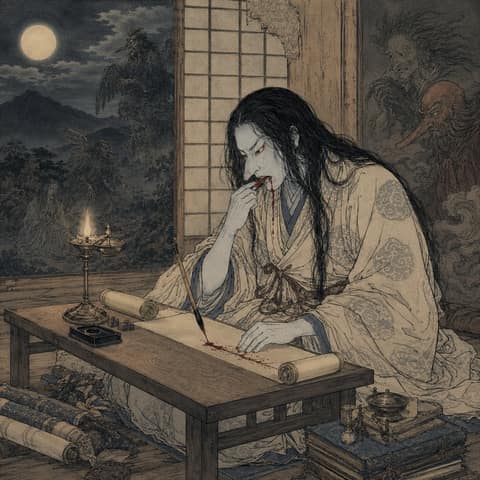
The Retired Emperor Sutoku, defeated in the Hōgen Rebellion (1156), was exiled to Sanuki and died in the second year of Chōkan (1164) without ever being permitted to return to the capital[2]. At his place of exile he copied out the five Mahāyāna sutras and sent them to the capital, but, suspected of a curse, had them flung back at him; in fury he swore an oath written in blood and is said to have become, while still living, a great tengu and a great demon (daimaen). Sagamibō guards the Shiramine mausoleum of this Sutoku, whom Yoritomo called "the greatest tengu in Japan." Shiramine-ji is the eighty-first station of the eighty-eight temples of Shikoku, the Shiramine mausoleum is the only imperial tomb in Shikoku, and beside it stands the Tonshō-ji-den, which enshrines the spirit of Sutoku-in.
It was literature that made Sagamibō immortal. Its original source is the mid-Kamakura Senjūshō[3], attributed to Saigyō, whose "On the New Retired Emperor's Tomb at Shiramine" carries a tale of Saigyō mourning Sutoku's tomb at Shiramine. The Noh play Matsuyama Tengu[4], which dramatized it, takes Sutoku-in as the shite and Saigyō as the waki, and depicts Sagamibō as a tengu attending Sutoku. Further, the "Shiramine" of Ueda Akinari's Ugetsu Monogatari[5] is a story in which Saigyō mourns Sutoku's spirit at the Shiramine mausoleum and converses with the wrathful Sutoku-in; Sagamibō became the being running through this lineage since the Senjūshō. The vengeful spirit and the tengu who stays beside it—the relation of Sutoku and Sagamibō is a rare point where the faith in goryō (vengeful spirits) and the faith in tengu meet.
There are two theories on Sagamibō's origin: that it derives from Sagami Ajari Shōson, who sided with Sutoku in the Hōgen Monogatari[2], and that he was a tengu who came from Mt. Ōyama in Sagami. The latter forms a pair with the seat-transfer tradition arranged by Chigiri Kōsai[6]—that the Sagamibō of Ōyama, in devotion to Sutoku, removed to Sanuki, and Hōkibō entered the vacant Sagami Ōyama. Either way, Shiramine Sagamibō sits at the western end of the Eight Great Tengu, transmitted at Shiramine in Sanuki as the tengu who keeps guarding the soul of Sutoku, one of Japan's three great vengeful spirits.
Character Profile
This section is our own creative profile for storytelling. It is not historical fact or scholarship.
An attendant tengu who keeps close to Sutoku's bitterness and goes on guarding his mausoleum. He calms the raging vengeful spirit, and also upholds it.
Compatibility
Those who have been unjustly cast down; those with the heart to mourn the dead; those whose hearts incline to the tale of Sutoku and Shiramine
Abilities
The guarding of and attendance upon Sutoku's vengeful spiritThe tutelary protection of the Shiramine mausoleumThe ritual power to calm a vengeful spirit, and to uphold itFlight that commands wind and cloudThe guardianship of the sacred precincts of Sanuki
Weaknesses
If Sutoku's bitterness runs deep, he cannot fully calm it
He requires reverent requiem and rites
He turns away those who treat the mausoleum with neglect
Habitat
Shiramine in Sanuki Province (Sakaide, Kagawa); Shiramine-ji and the Shiramine mausoleum (the tomb of Emperor Sutoku); the Tonshō-ji-den
The diagram below is a diagnostic evaluation chart for The Tengu Who Guards the Mausoleum of Sutoku — Shiramine Sagamibō. The higher the value of each item, the stronger that characteristic is expressed.