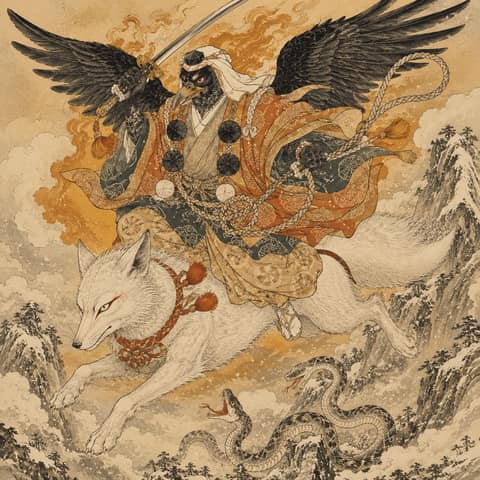
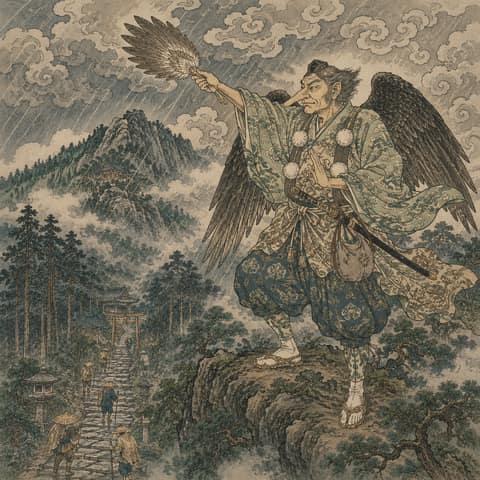
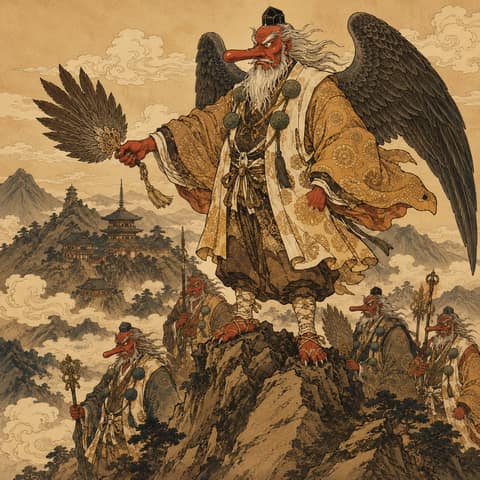
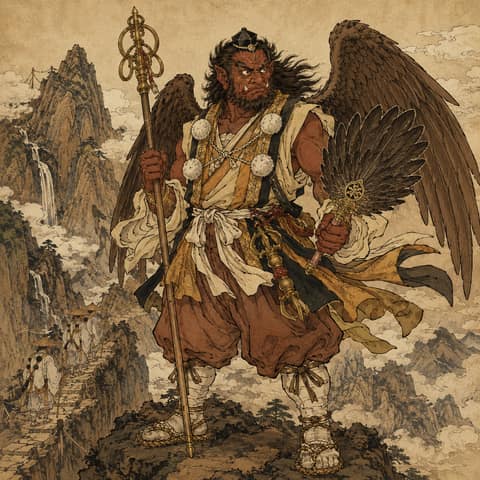
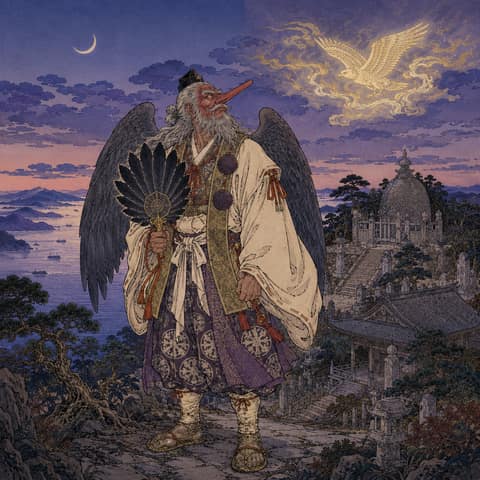
Ōyama Hōkibō is a great tengu enthroned on Mt. Ōyama in Sagami Province (also called Afuri-yama, the "Rain-falling Mountain"), and is counted among the Eight Great Tengu. His name appears as "Hōkibō of Ōyama" in the Muromachi Noh play Kurama Tengu[1].
The Mt. Ōyama on which he sits is a sacred mountain reaching back to the ancient official histories. The Engishiki Jinmyōchō (927)[2] lists the Afuri Shrine on its summit as an official shrine (shikinai-sha) of Sagami Province, showing that Ōyama's divinity had received state recognition in antiquity. The name Hōkibō is wreathed in a tradition of "seat transfer" within the tengu world. Mt. Ōyama of Sagami originally had a great tengu named Sagamibō, but he removed to Shiramine to console the spirit of the Retired Emperor Sutoku, exiled to Sanuki. Into the vacant seat of Sagami Ōyama, Hōkibō entered as successor from Mt. Daisen in Hōki Province (Tottori)—a paired structure set in order by Chigiri Kōsai[3] of tengu scholarship. For this reason Ōyama Hōkibō and Shiramine Sagamibō are always told as a pair.
Folklore & Legends
The tale of Ōyama Hōkibō stands upon the history of the sacred mountain Sagami Ōyama and upon the distinctive lore-structure of a tengu's "seat transfer."
Mt. Ōyama of Sagami, also called Afuri-yama, had its divinity established in antiquity. The Engishiki Jinmyōchō (927)[2] ranks the Afuri Shrine on its summit among the official shrines of Sagami Province, with Ōyamatsumi-no-kami as the enshrined deity. On the Buddhist side, the Ōyama-dera engi emaki[4] opens with the wife and husband of the Sagami governor praying to Kannon for the gift of a child, and depicts how Rōben—carried off by an eagle and raised in Nara—opened Ōyama-dera in the Tenpyō-shōhō era and enshrined the honzon Fudō Myōō (this Sagami version of the engi emaki is, moreover, a different work from the engi of the same-named Daisen-ji of Hōki Province). From the medieval period onward, Shugendō flourished with this Ōyama-dera as its base.
In early-modern times the "Ōyama pilgrimage" (Ōyama mairi) became a great popular event. The official gazetteer the Shinpen Sagami no Kuni Fudoki-kō (1841)[5] sets the festival from the twenty-seventh of the sixth month to the seventeenth of the seventh, and records that pilgrims from many provinces were exceedingly numerous. Pilgrims took the water-austerity (mizugori) at two waterfalls before making the ascent; Ōyama confraternities (Ōyama-kō) were organized throughout the Kantō, and the guiding sendatsu-shi (oshi) marshaled the pilgrimage.
What characterizes Hōkibō as a tengu is this "seat transfer" tradition. When Sagamibō, originally lord of Sagami Ōyama, removed to Shiramine to guard the spirit of the Retired Emperor Sutoku—who lost the Hōgen Rebellion and died in Sanuki—Hōkibō came from Hōki's Daisen to Sagami as his successor. This paired structure, as far as can be verified, is something Chigiri Kōsai[3] arranged in the course of systematizing the tengu tales of the provinces, and an explicit textual source is hard to find in the classical literature. Telling of Ōyama Hōkibō therefore leads naturally to telling of Shiramine Sagamibō and Sutoku's vengeful spirit, while the seat-transfer itself should be read as a later arrangement. After the Meiji separation of Shintō and Buddhism (shinbutsu-bunri), an interpretation arose at Ōyama Afuri Shrine assigning Ōikazuchi-no-kami as the great tengu and Takaokami-no-kami as the lesser tengu; but this is a modern reinterpretation accompanying Shintoization, of a different stratum from the image of Hōkibō handed down since the medieval age.
The core of Ōyama Hōkibō lies in a tale of succession to a seat within the tengu world—the "seat transfer." Yet the Mt. Ōyama on which he sits was a sacred mountain established in antiquity, without need of the transfer legend.
The Engishiki Jinmyōchō (927)[2] ranks the Afuri Shrine among the official shrines of Sagami Province, showing that Ōyama's divinity was recognized by the ancient state. On the Buddhist side, the Ōyama-dera engi emaki[4] depicts how Rōben—carried off by an eagle and raised in Nara—opened Ōyama-dera and enshrined Fudō Myōō (the Sagami version; a different work from the engi of Hōki's Daisen-ji). And in early-modern times the official gazetteer the Shinpen Sagami no Kuni Fudoki-kō (1841)[5] conveys the summer ascent season and the bustle of pilgrims from many provinces. The manners of pilgrimage—purifying oneself at the waterfalls under a sendatsu's guidance before climbing—and the Ōyama confraternities everywhere: this density of faith gave Hōkibō, the successor tengu, the character of a guardian watching over the common people.
The seat-transfer tradition overlays this sacred-mountain history. According to the arrangement of Chigiri Kōsai[3] of tengu scholarship, Sagami Ōyama originally had a great tengu named Sagamibō. But when the Retired Emperor Sutoku—defeated in the Hōgen Rebellion (1156) and exiled to Sanuki—passed away, Sagamibō removed to Shiramine in Sanuki to console and guard his bitter spirit (= Shiramine Sagamibō). The one who succeeded to the vacant seat of Sagami Ōyama was Hōkibō, come from Mt. Daisen in Hōki. This symmetrical transfer—"Sagamibō to the west, Hōkibō to the east"—is a Chigiri-derived arrangement lacking explicit sources in the classical literature, and should be read not as historical fact but as lore that mirrors the notion that a tengu's seat is succeeded through mountain and bond (en) rather than being a fixed individual. Chanted as "Hōkibō of Ōyama" in the Muromachi Noh play Kurama Tengu[1], and standing among the forty-eight tengu of the Tengu-kyō[6], his seat continues to be remembered, together with this distinctive engi, as one of the Eight Great Tengu.
Character Profile
This section is our own creative profile for storytelling. It is not historical fact or scholarship.
A modest tengu who took up the seat as a successor. He watches over the common folk of the Ōyama pilgrimage and grants protection to those who keep the mountain's prohibitions.
Compatibility
Those who revere the mountain and make the pilgrimage; those who bear the charge of succeeding to a seat; those who pray for rain and harvest
Abilities
Calling the rain and bringing the harvestGuarding the pilgrims of the Ōyama pilgrimageFlight that commands wind and cloudThe ritual power to make the mountain's prohibitions keptMediation as one who succeeds to a seat
Weaknesses
He grants no protection to those who violate the mountain's prohibitions
The recession of his image through the separation of Shintō and Buddhism
Restraint by Buddhist law and interdiction
Habitat
Mt. Ōyama in Sagami Province (Isehara, Kanagawa); Ōyama Afuri Shrine and Ōyama-dera; the Ōyama confraternities throughout the Kantō
The diagram below is a diagnostic evaluation chart for The Great Tengu of the Transferred Seat — Ōyama Hōkibō. The higher the value of each item, the stronger that characteristic is expressed.