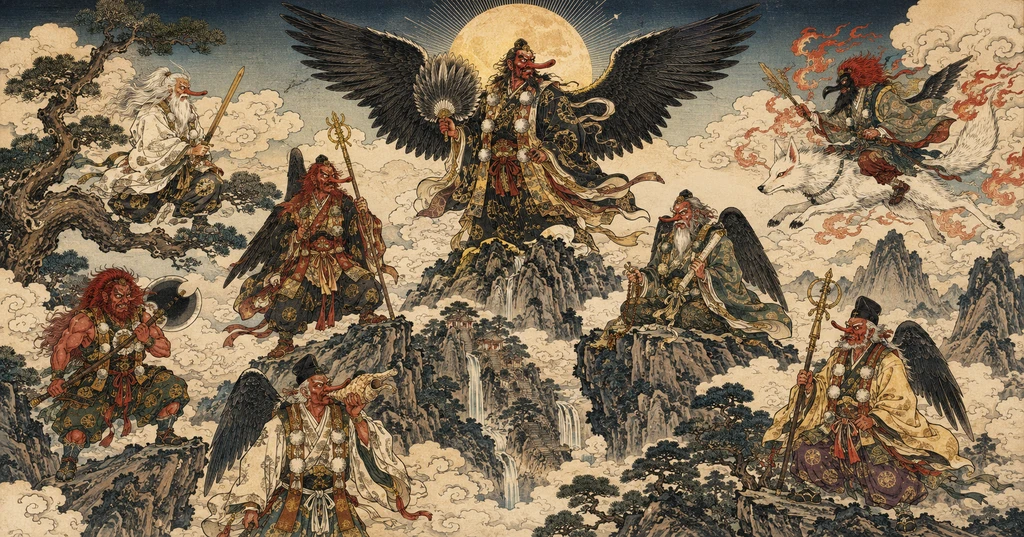
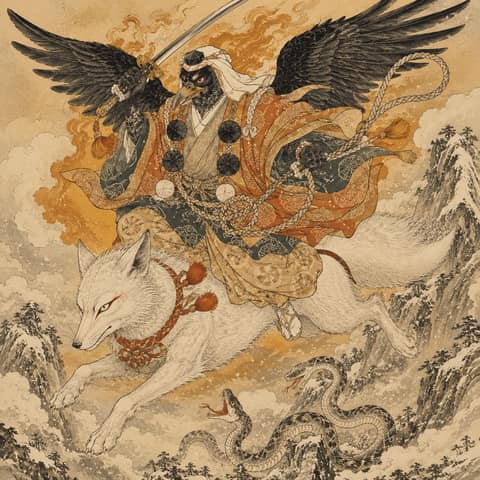
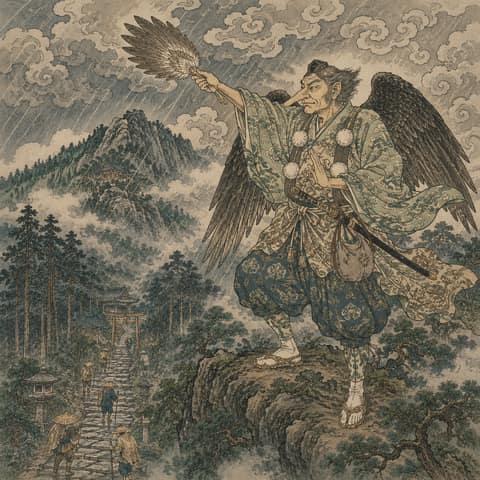
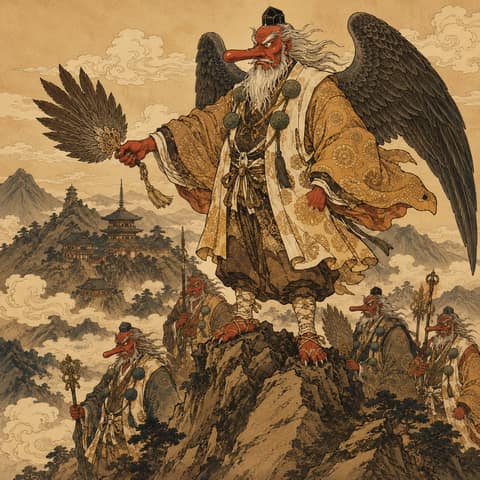
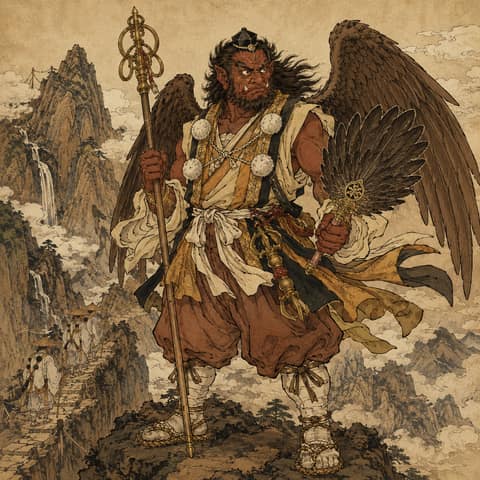
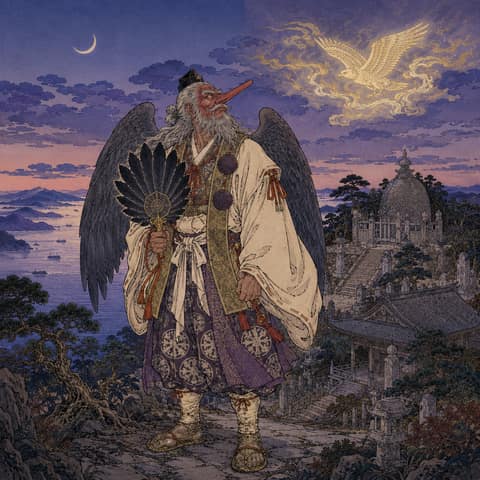
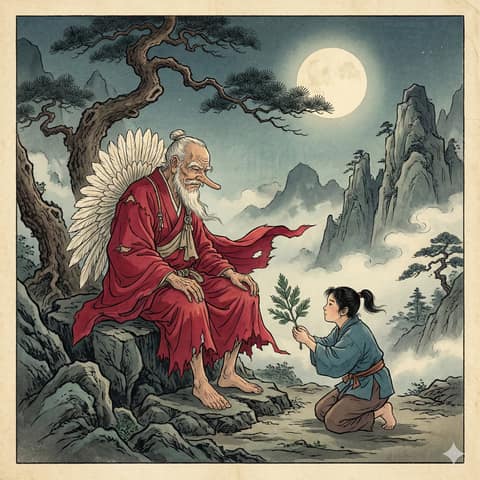
Atago-san Tarōbō is a great tengu enthroned on Mt. Atago in Yamashiro Province, the supreme commander who governs the tengu of every province and, as the foremost of the forty-eight tengu[1], is hailed as "the greatest tengu in all Japan." He is also known by the name Eijutsu Tarō. Leading a retinue of crow-tengu (karasu-tengu) and commanding such lesser lords as Hira-san Jirōbō, he has long been cast as the sovereign of the tengu realm.
His name appears early in the Kamakura-period war chronicle the Genpei Jōsuiki, Book Eight[2], which explains that Tarōbō was in truth Kakimoto no Ki Sōjō—that is, the monk Shinzei, a senior disciple who had inherited Kūkai's secret rites—fallen into a tengu through his arrogance. Mt. Atago was also a sacred mountain warding off fire and theft, and through syncretism with the cult of the Atago Gongen, whose original Buddhist form is Shōgun Jizō, Tarōbō came to be spoken of as a thaumaturge who averts conflagration and bestows martial fortune.
Folklore & Legends
At the trunk of the lore surrounding the Atago tengu, two strands intertwine: the divinity of Mt. Atago itself, and the figure of the tengu called Tarōbō. Since antiquity, Mt. Atago in Yamashiro Province was revered as a sacred mountain that wards off fire, and the cult of the Atago Gongen—whose original Buddhist form is Shōgun Jizō—spread throughout the land. The Hakuun-ji engi[3], which transmits its origins, holds that En no Ozunu and Taichō opened Mt. Atago in the Taihō era and built a shrine on Asahi Peak, expounding its syncretism with Shōgun Jizō. Pilgrims were given star anise (shikimi) as the sacred flower of fire-warding, and to this day Atago talismans are pasted above the hearth of many a household.
The proper name Tarōbō appears in the war chronicles of the Kamakura period. The Engyō-bon Tale of the Heike[4] records him as "the foremost great tengu of Japan" and "Tarōbō of Mt. Atago," while the Genpei Jōsuiki, Book Eight[2] raises his name within a dialogue between the Cloistered Emperor Go-Shirakawa and the deity of Sumiyoshi, setting down one tradition that Tarōbō's true identity was the fall of Shinzei—Kakimoto no Ki Sōjō, a senior disciple of Kūkai. Yet Shinzei was a man of the early Heian period, and the dates do not agree with the era the Jōsuiki depicts; this should be read strictly as "one tradition," and one cannot conclude as historical fact that Tarōbō was Shinzei.
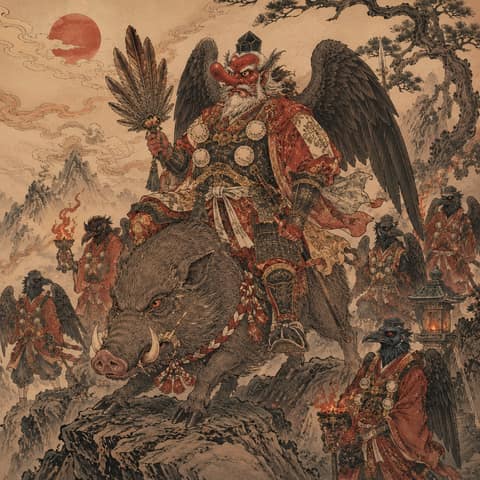
His standing as supreme commander is attested by both the performing arts and the scriptures. The Noh play Kurama Tengu[5] of the Muromachi period chants the great tengu of the provinces in geographical order, and the early-modern Tengu-kyō[1] arrays the forty-eight tengu and places Tarōbō at their head. The image of him leading a retinue of crow-tengu and commanding the lords from Hira-san Jirōbō downward rests upon this accumulation of medieval tengu tales. An iconography of him armed and astride a boar is also transmitted, yet his essence lies in being a Gongen-like presence enthroned on the peak, guarding the sacred precincts across Yamashiro. Chigiri Kōsai[6], who compiled the study of tengu, likewise placed Tarōbō at the apex of the great tengu of all the mountains.
What made Atago-san Tarōbō "the supreme commander of the tengu"? The question lies in the overlap between the history of the Atago cult and the figure of this single tengu.
As a sacred mountain of fire-warding, Mt. Atago was the center of the Atago Gongen cult, syncretized with its original Buddhist form, Shōgun Jizō. The Hakuun-ji engi[3], which transmits its founding, tells of the ascent of En no Ozunu and Taichō, the shrine on Asahi Peak, and the syncretism with Shōgun Jizō. Shōgun Jizō is an armored Jizō mounted on horseback, joining victory in war with protection from fire. Bearing the numinous power of this Atago Gongen, Tarōbō took on the character of a thaumaturge and guardian deity surpassing any mere mountain apparition. The star-anise flower against fire, the talismans above each hearth, the Atago confraternities (kō) across the land—this density of folk practice was the foundation that raised Tarōbō to the summit of the tengu of every province.
The oldest-class textual witness to his proper name is found in the Engyō-bon Tale of the Heike[4] (transcribed 1309–10), where he appears as "the foremost great tengu of Japan" and "Tarōbō of Mt. Atago." As to his identity, the theory in the Genpei Jōsuiki[2] of the fallen Shinzei (Kakimoto no Ki Sōjō) is renowned; but Shinzei was a man of the early Heian period, and since the dates do not match the era the Jōsuiki sets, this is an undeterminable "tradition." It should be read as a tale that lays over Tarōbō the Buddhist notion that arrogance casts a high monk down into a tengu, and his origin cannot be fixed to a single source.
His standing as supreme commander is attested by both the performing arts and the scriptures. The Noh play Kurama Tengu[5] of the Muromachi period chants the great tengu of the provinces in geographical order, and the early-modern Tengu-kyō[1] arrays the forty-eight tengu and places Tarōbō at their head. The image of him leading a retinue of crow-tengu and commanding the lords from Hira-san Jirōbō downward rests upon this accumulation of medieval tengu tales. An iconography of him armed and astride a boar is also transmitted, yet his essence lies in being a Gongen-like presence enthroned on the peak, guarding the sacred precincts across Yamashiro. Chigiri Kōsai[6] of tengu scholarship likewise set Tarōbō at the apex of the great tengu of all the mountains.
Character Profile
This section is our own creative profile for storytelling. It is not historical fact or scholarship.
Stern and exacting in judging right from wrong, aloof even before court and warrior houses. He chastens conceit and grants protection to those who keep the mountain's prohibitions.
Compatibility
Those who revere the mountain and keep its taboos; those who pray for protection from fire and for martial fortune; those with the heart to be ashamed of pride
Abilities
Protection against fireDivine power to summon wind, cloud and thunderVisions and oraclesPassage through the peaks (flight)Command over the tengu beneath himResponse to ritual power
Weaknesses
Grants no protection to those who violate the mountain's prohibitions
His workings may be checked by Buddhist law and interdiction
Being struck at through his pride
Habitat
Mt. Atago, Yamashiro Province (Ukyō-ku, Kyoto); the peaks of the Tanba highlands; Atago shrines and Atago Gongen halls across Japan
The diagram below is a diagnostic evaluation chart for Supreme Commander of the Tengu — Atago-san Tarōbō. The higher the value of each item, the stronger that characteristic is expressed.