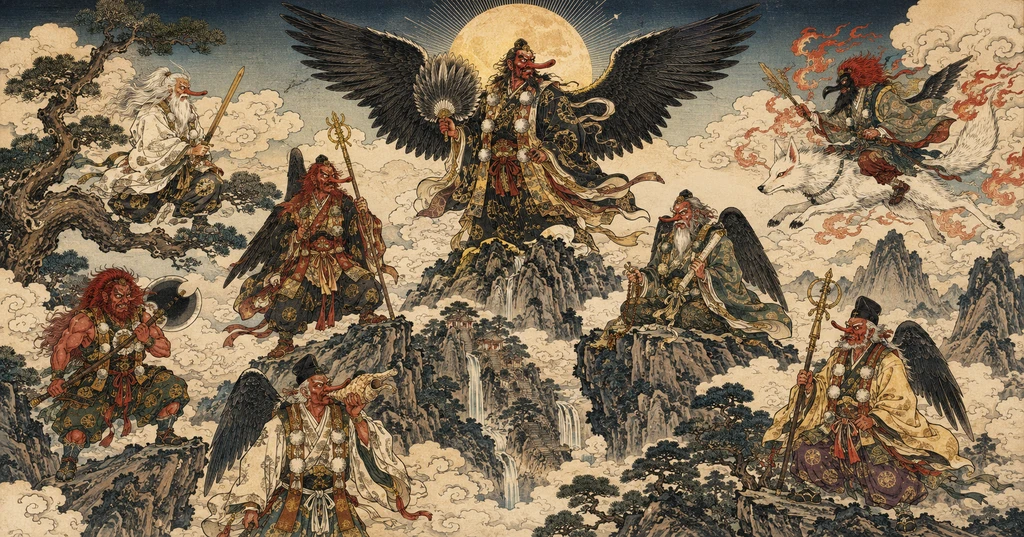
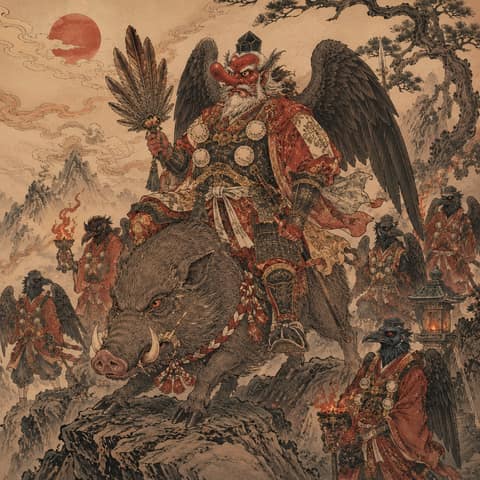
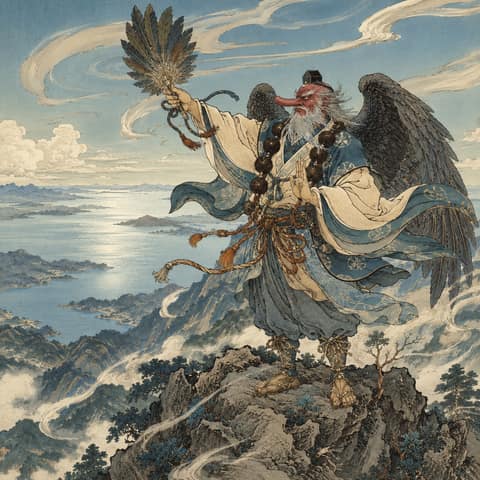
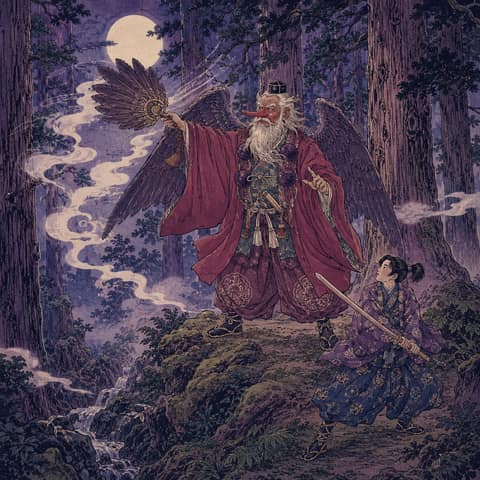
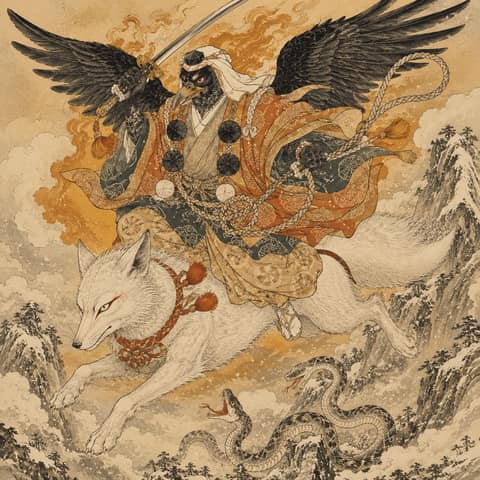
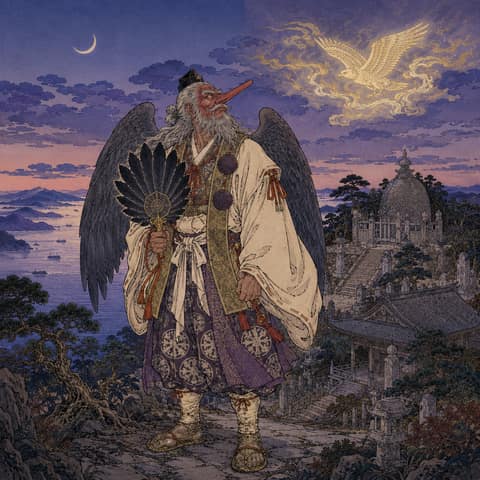
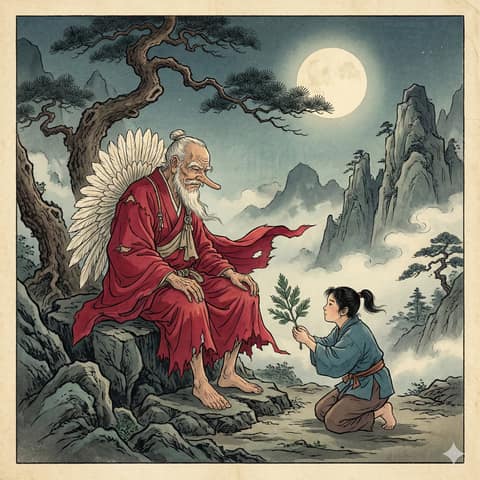
Iizuna Saburō is a great tengu enthroned on Mt. Iizuna in Shinano Province, and the lord of that mountain, who as Izuna Gongen drew a syncretic Shintō-Buddhist devotion. Counted among the Eight Great Tengu, he is said to have styled himself "the third tengu of Japan." He is figured as a crow-tengu bearing a sword and a rope (saku), mounted upon a white fox, and was deeply revered by the warrior houses as a war-god of victory.
His name is recorded as "Izuna Saburō" in the medieval Togakushi-san Kenkō-ji Ruki (1458)[1], which transmits that in the first year of Tenpuku (1233) the Izuna Daimyōjin named himself "the third tengu of Japan"—the reason for the "Saburō" (third son), ranking after Atago Tarōbō and Hira Jirōbō. He also stands named as "Izuna no Saburō" in the Muromachi Noh play Kurama Tengu[2].
Folklore & Legends
Iizuna Saburō is a crystallization of a complex faith, holding together four faces at once: tengu, syncretic Shintō-Buddhist deity, the sorcery of heterodox arts, and the war-god of the warrior houses.
The ancient layer of Izuna belief reaches back to the Kamakura period. The esoteric Buddhist compendium the Asabashō[3], compiled in the first year of Kenji (1275), already carries the name of Mt. Iizuna, recording that the ascetic "Gakumon," who practiced on Mt. Iizuna in the Kashō era, opened Togakushi. Somewhat later, the Togakushi-san Kenkō-ji Ruki (1458)[1] sets down Iizuna Saburō as "Izuna Saburō" and transmits that in the first year of Tenpuku (1233) the Izuna Daimyōjin named himself "the third tengu of Japan"—the reason for the "Saburō," ranking after Atago Tarōbō and Hira Jirōbō. His origin is told in detail by the Iizuna-san Meguri Saimon (1546)[4], which makes the third prince of King Myōzen Gekkō of Tenjiku (India)—the one who did not take the tonsure but remained in the lay world—into the Chira Tengu, and identifies him with the Izuna Daimyōjin of Shinano. The late-Edo Iizuna-san Ryaku Engi[5] sets in order the ascetic Gakumon's entry into the mountain, the Tenpuku oracle, the founder-legend of the Sennichi-dayū, and the honji-butsu (Dainichi, Fudō, Jizō).
Its iconography is singular. The crow-tengu honzon, holding a sword and a rope, rides upon a white fox, with its honji-butsu given as Fudō Myōō or Dakini-ten. A deity-image bearing the date Ōei 13 (1406) is held to be the oldest extant.
What made Iizuna Saburō known to the world were his character as a war-god and the heterodox "Izuna-no-hō" (the Izuna method). The Izuna method is a sorcery that employs tengu and kuda-gitsune (pipe-foxes) to cure illness or to obtain oracles, counted as a heterodox, dark art alongside the Atago Shōgun-hō and the Dakini-ten-hō. In the age of the Warring States, Uesugi Kenshin raised an image of Izuna Gongen on the crest of his helmet, the Takeda house too worshipped him devoutly, and Iizuna Saburō was revered as a war-god who grants victory. He stands among the forty-eight tengu of the Tengu-kyō[6], and Chigiri Kōsai[7] of tengu scholarship, too, discusses Iizuna Saburō as one of the great tengu of the many mountains.
To read Iizuna Saburō, one must overlay three strata: the syncretic honzon-image of "Izuna Gongen," the heterodox art of the "Izuna method," and the devotion of the Warring-States commanders.
The antiquity of this faith is backed by the texts. The Asabashō[3] of the first year of Kenji (1275) carries the name of Mt. Iizuna and its founding ascetic; the Togakushi-san Kenkō-ji Ruki (1458)[1] records "Izuna Saburō" and "the third tengu of Japan"; the Iizuna-san Meguri Saimon (1546)[4] gives the origin as the Chira Tengu come from Tenjiku; and the Iizuna-san Ryaku Engi[5] transmits the honji-butsu and the lineage of the Sennichi-dayū. From Kamakura to Edo, it is a faith handed down in layers.
The iconography of the honzon is profoundly distinctive. A crow-tengu holding a sword and a rope rides upon a white fox, with a snake often coiling about the fox. Its honji-butsu is expounded now as Fudō Myōō, now as Dakini-ten, varying by source. It is precisely this composite character—"tengu, fox, Fudō and Dakini" joined in a single body—that is the reason Izuna Gongen, surpassing a mere mountain tengu, became a point of concentration of esoteric ritual power. At Takaosan Yakuō-in, the Iizuna Shrine of Shinshū, Jinya-ji on Mt. Kano in Chiba and elsewhere, the faith is especially deep in Kantō and to the north.
The "Izuna method" is the practical face of this ritual power. This sorcery, which employs tengu and kuda-gitsune to heal illness and, by possession, to deliver oracles, was counted a heterodox art alongside the Atago Shōgun-hō and the Dakini-ten-hō, and those who wielded it were called Izuna-tsukai. The folk belief that one kept and employed kuda-gitsune within a bamboo tube made the very name "Izuna" a byword for witchcraft.
And it was the devotion of the warrior houses that raised Iizuna Saburō to a war-god. It is famous that the crest of Uesugi Kenshin's helmet was an image of Izuna Gongen; there is also the case of Takeda Katsuyori granting the name Nishina to the adopted son of the Sennichi-dayū, and commanders such as Hosokawa Masamoto who practiced the Izuna method itself. As a god who governs victory in war, Iizuna Saburō is, even among the forty-eight tengu of the Tengu-kyō[6], the seat most bound to this-worldly benefit. Chigiri Kōsai[7] of tengu scholarship placed this many-sided Iizuna Saburō within the system of the great tengu of the many mountains.
Character Profile
This section is our own creative profile for storytelling. It is not historical fact or scholarship.
Fierce and potent in his efficacy. To those he grants the method he lends his power; on those who slight the heterodox art he visits a curse. He honors martial valor and answers those who seek victory in war.
Compatibility
Those who pray for martial fortune and victory; those who walk the path of mountain asceticism and sorcery; those who revere the mountain and the fox
Abilities
The Izuna method, employing pipe-foxes and tenguProtection of victory and martial fortuneFlight mounted upon a white foxHealing illness and delivering oraclesThe ritual power of warding and subjugation
Weaknesses
He curses those who slight the heterodox art and depart from its observances
Subjugation by the Buddhist law and the orthodox dharma
The conceit of the Izuna-wielder
Habitat
Mt. Iizuna in Shinano Province (Nagano City); Takaosan Yakuō-in; the Iizuna shrines and Iizuna temples of the Kantō region and the north
The diagram below is a diagnostic evaluation chart for The War-God Who Rides a White Fox — Iizuna Saburō. The higher the value of each item, the stronger that characteristic is expressed.