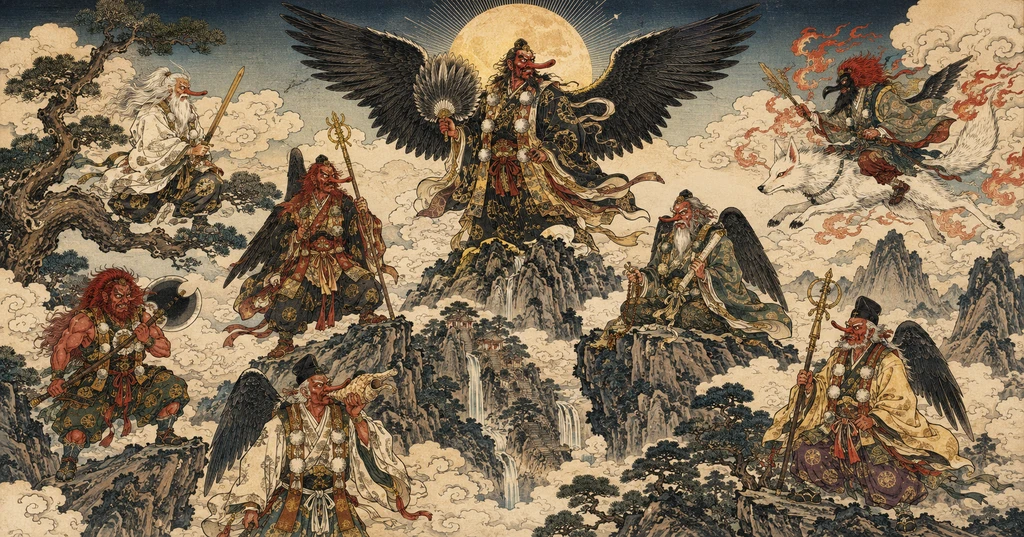
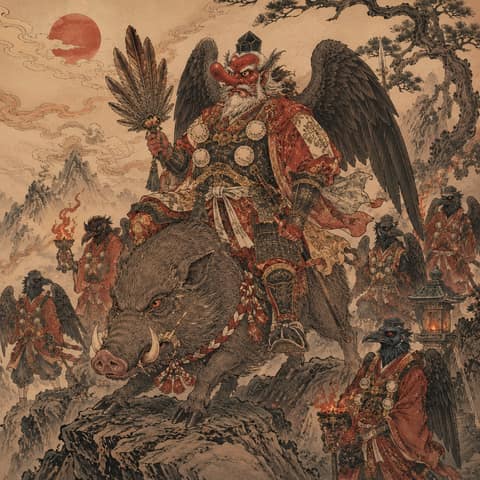
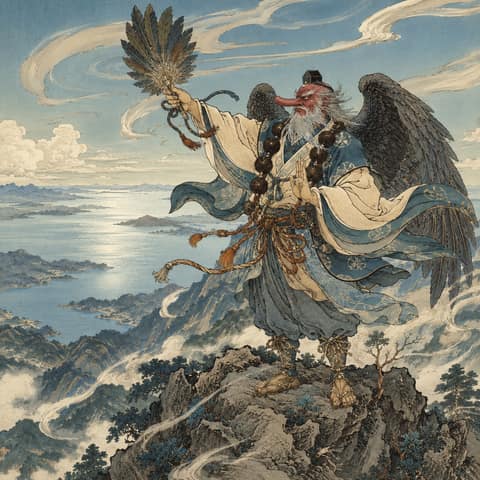
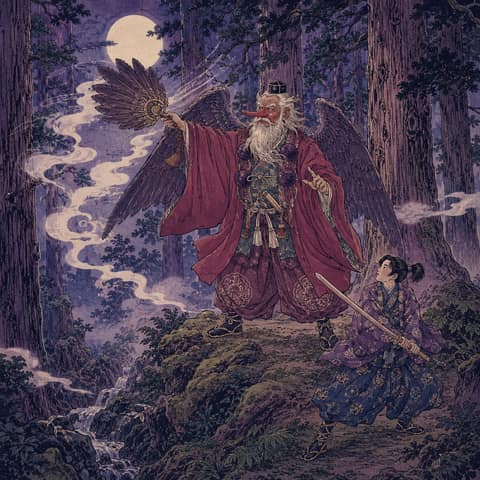
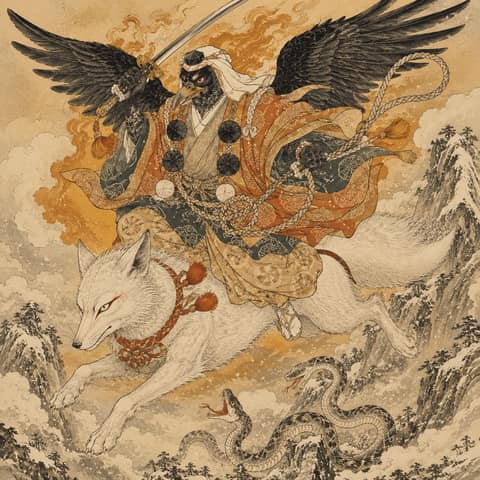
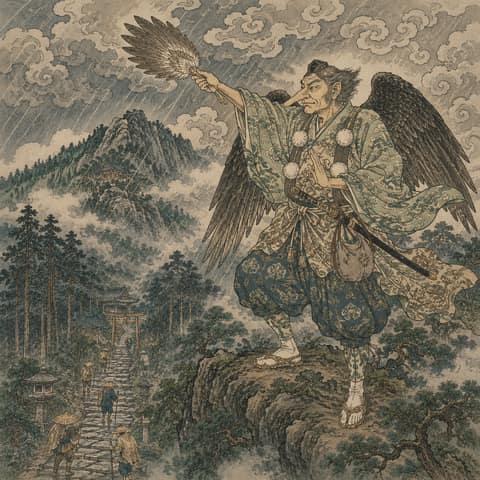
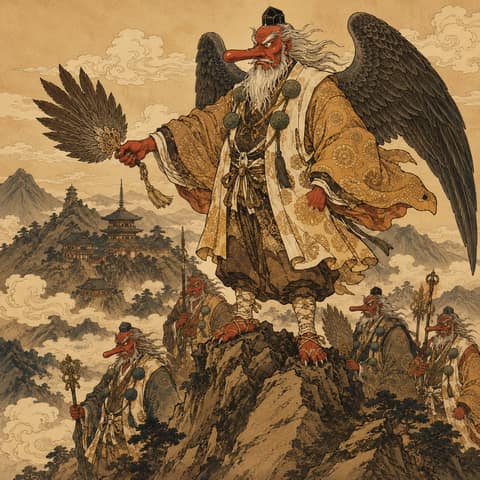
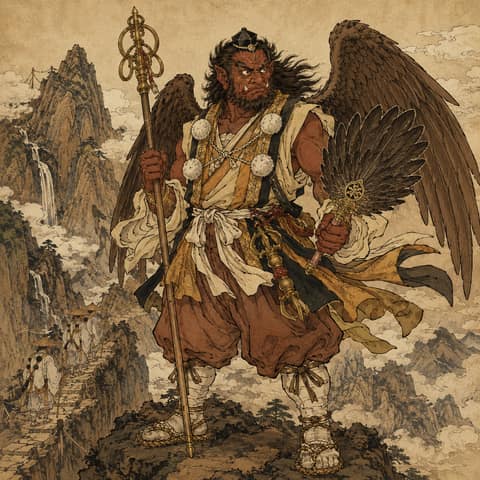
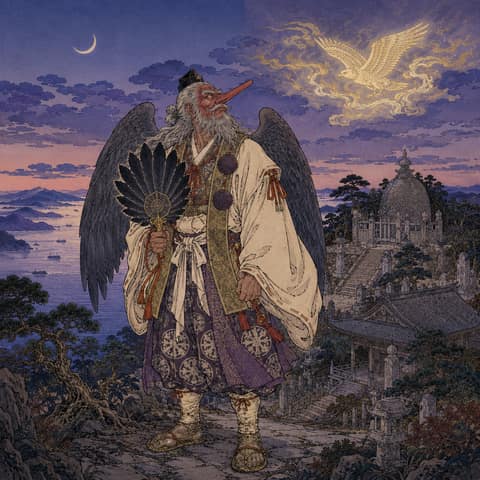
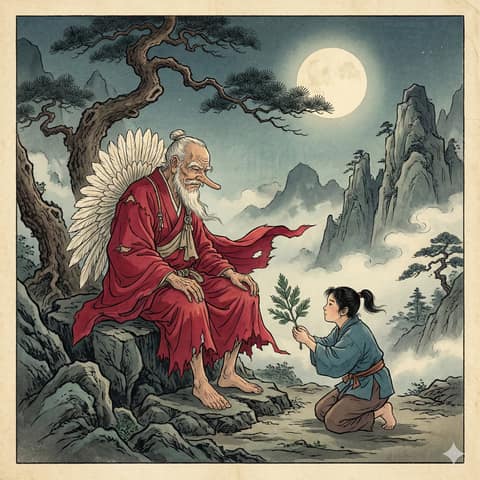
Ōmine Zenkibō is a great tengu enthroned on Mt. Ōmine in Yamato Province, and is counted among the Eight Great Tengu. He is chanted in the Muromachi Noh play Kurama Tengu[1] as "the band of Zenki of Ōmine."
His name derives from Zenki, the oni who followed En no Gyōja (En no Ozunu), the founder of Shugendō. En no Gyōja is depicted in the oldest extant tale collection, the Nihon Ryōiki[2], as a thaumaturge who commanded demons and flew through the air. Zenki was originally an oni who carried off human children, but he was captured by En no Gyōja, repented, and with Goki became his attendant. As an instance of an oni transformed into a great tengu through austerities, Zenkibō sits at Ōmine, the heart of Shugendō, and is handed down as one of the forty-eight tengu[3].
Folklore & Legends
Ōmine Zenkibō is a singular great tengu who bears upon himself both the tale of rebirth "from oni to tengu" and the history of Ōmine, the holy ground of Shugendō.
At his source lies the tale of En no Gyōja and the oni. The oldest extant text depicting En no Ozunu is the Nihon Ryōiki[2], Book 1, no. 28 (early Heian), which records that he mastered the mantra-art of the Peacock King, became an immortal, and flew through the air commanding demons. Somewhat later, the Konjaku Monogatarishū, Book 11[4] carries the tale of En no Gyōja making demons build a bridge across the mountains, showing that the image of En no Gyōja as one who commands demons had become fixed by the medieval age. The couple Zenki and Goki were originally oni in the Ikoma mountains who carried off and devoured human children; En no Gyōja captured them with the secret rite of Fudō Myōō (it is also told that he hid their youngest child in an iron cauldron and, through the grief of having one's own child taken, taught them their sin), reformed them, and made them dharma-protecting oni. This Zenki, it is said, later turned into a tengu and became "Ōmine Zenkibō," one of the Eight Great Tengu. In the Tengu-kyō[3] some sources give "Nachi Takimoto Zenkibō"; the notation varies.
The Ōmine on which Zenkibō sits is the most important training ground of Shugendō. The Ōmine Okugake-michi forms part of the World Heritage "Sacred Sites and Pilgrimage Routes in the Kii Mountain Range," and ascetics tread it still. The notion of an oni turning into a tengu—a violent, child-snatching being sublimated through austerities into a guardian of the Buddhist law—symbolizes the very heart of Shugendō.
What deserves special note is that his bloodline is said to continue to the present day. The five children of Zenki and Goki (Gokijo, Gokitsugu, Gokijō, Gokidō, Gokikuma) are each said to have kept a pilgrim's lodge. The four families closed with the Meiji prohibition of Shugendō (1872), but only the Onakabō of the Gokijo family survives even now, and the present-day Gokijo Yoshiyuki continues to support the ascetics of the Ōmine Okugake-michi. These genealogies are hard to source explicitly in old documents and are transmitted as the oral lore of the surviving lodge; yet the tradition that the descendants of an oni reformed by En no Gyōja thirteen hundred years ago still guard the path of Shugendō is the greatest weight that clings to the lore of Ōmine Zenkibō. Chigiri Kōsai[5] of tengu scholarship, too, discussed Zenkibō as one of the great tengu of the many mountains.
The essence of Ōmine Zenkibō lies in the structure of rebirth: "an oni turning into a tengu." It is a tale that embodies the heart of Shugendō in a single being.
His source lies in the old tales of En no Gyōja and the oni. The oldest extant text depicting En no Ozunu is the Nihon Ryōiki[2] (early Heian), which portrays him as a thaumaturge who flew through the air commanding demons. The Konjaku Monogatarishū, Book 11[4] carries the tale of En no Gyōja having demons build a bridge across the mountains, showing the fixing of the image of En no Gyōja as one who commands demons. Zenki was originally a violent oni who carried off human children. En no Gyōja captured him with the secret rite of Fudō Myōō and reformed him into an attendant. By one account, En no Gyōja hid the youngest child of the Zenki couple in an iron cauldron and, through the grief of having one's own child taken, brought them to realize the sin of carrying off the children of others. The reformed Zenki and Goki became dharma-protecting oni and supported En no Gyōja's practice. This Zenki, sublimated into a great tengu at the end of long austerities, is Ōmine Zenkibō. This plot, of a violent being turning into a guardian of the Buddhist law, shows most clearly that the dread of a child-snatching tengu and the faith in a tengu who guards people share a single root.
The Ōmine on which Zenkibō sits is the holy ground of Shugendō. The Ōmine training ground founded by En no Gyōja, and the Ōmine Okugake-michi registered as World Heritage, is a perilous route that ascetics still tread at the risk of their lives, and Zenkibō was conceived as its guardian. He is chanted as "the band of Zenki of Ōmine" in the Muromachi Noh play Kurama Tengu[1], and stands among the forty-eight tengu of the Tengu-kyō[3] (some sources give "Nachi Takimoto Zenkibō").
And the heaviest single point of this lore is that the bloodline of Zenki is said to live on into the present. Of the five lodges kept by the five children of Zenki and Goki, only the Onakabō of the Gokijo family remains today, and the present-day Gokijo Yoshiyuki continues to receive the ascetics of the Ōmine Okugake-michi. This genealogy is hard to source explicitly in old documents and is transmitted as the oral lore of the surviving lodge; yet this real continuity—descendants of a reformed oni guarding the path of Shugendō beyond thirteen hundred years—makes Ōmine Zenkibō not a mere legend but a symbol of living faith. Chigiri Kōsai[5] of tengu scholarship, too, placed him within the system of the great tengu of the many mountains.
Character Profile
This section is our own creative profile for storytelling. It is not historical fact or scholarship.
Once a violent oni, devoted wholly to guarding the dharma after his repentance. He honors austerity and protects those who walk the path of Shugendō.
Compatibility
Those who aspire to the path of Shugendō; those who mend their faults and strive on; ascetics who fear and revere Ōmine
Abilities
The dharma-guarding power, versed in the rite of Fudō MyōōThe protection of the mountain ascetic's journeyPassage along the perilous mountain pathsThe brute strength of an oni and the supernatural power of a tenguThe admonition that brings one to realize his faults
Weaknesses
If he loses his repentant heart, his power grows turbid
He follows the orthodox dharma and the rite of Fudō
He does not draw near to those who slight the path of Shugendō
Habitat
Mt. Ōmine in Yamato Province (Yoshino District, Nara); the village of Zenki and the Onakabō; the Ōmine Okugake-michi
The diagram below is a diagnostic evaluation chart for The Dharma-Guarding Tengu Turned from an Oni — Ōmine Zenkibō. The higher the value of each item, the stronger that characteristic is expressed.