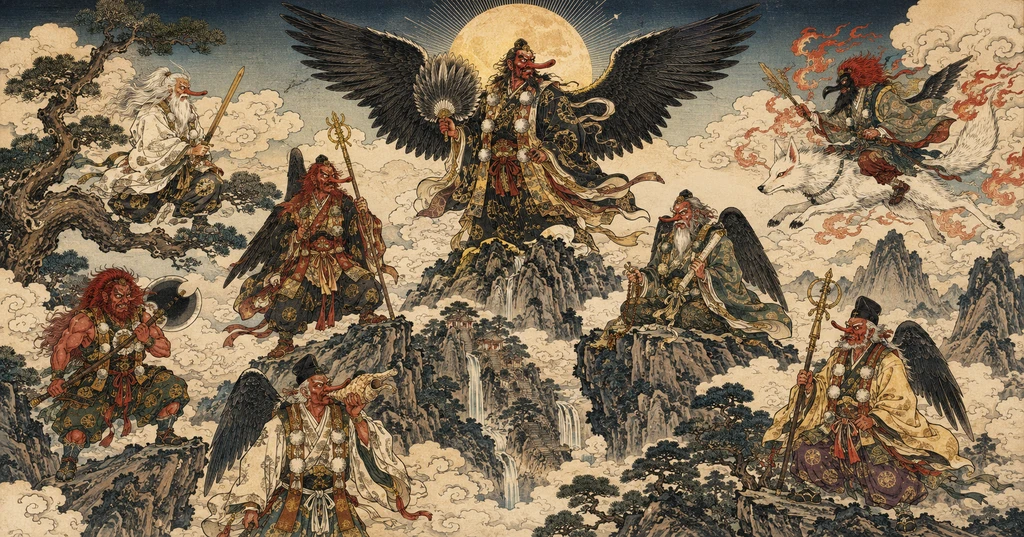
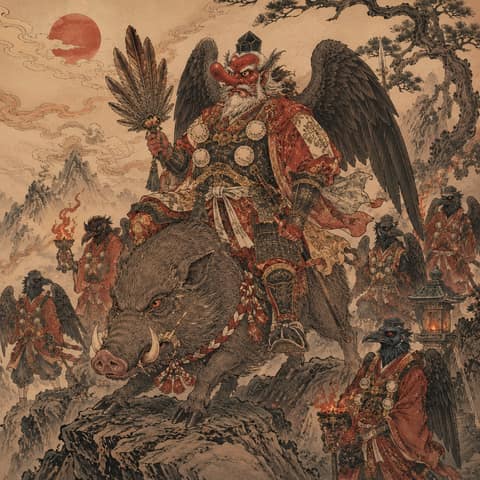
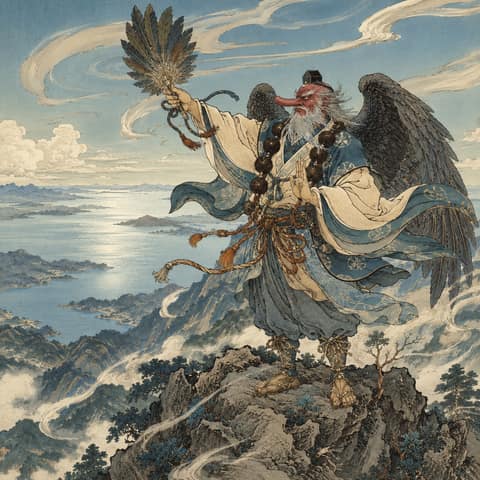
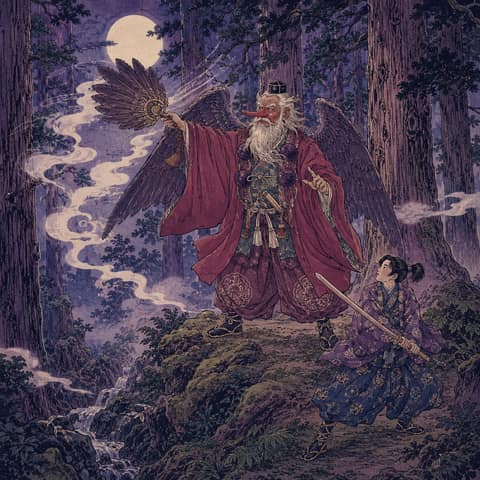
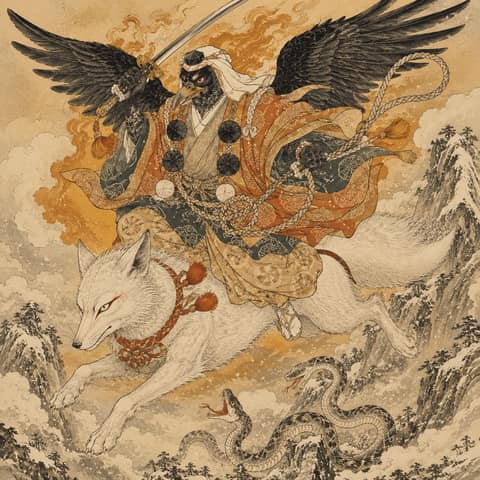
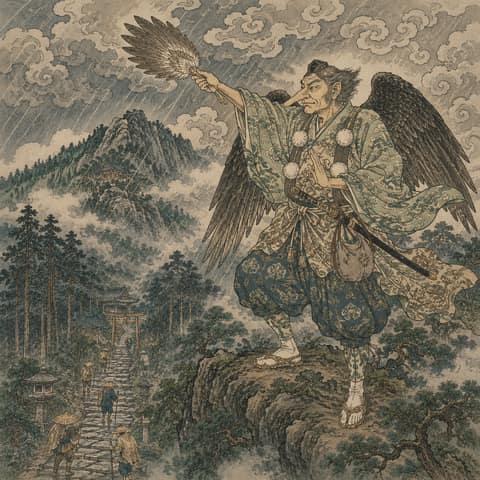
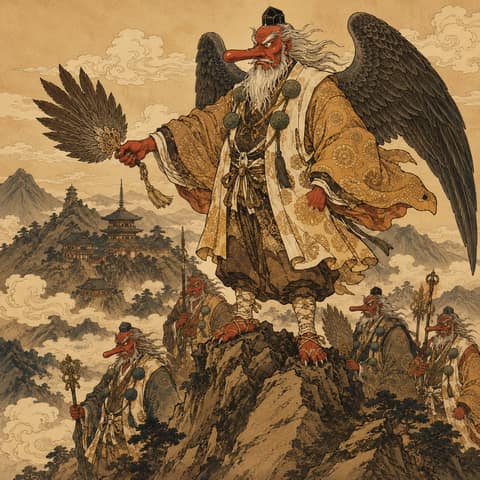
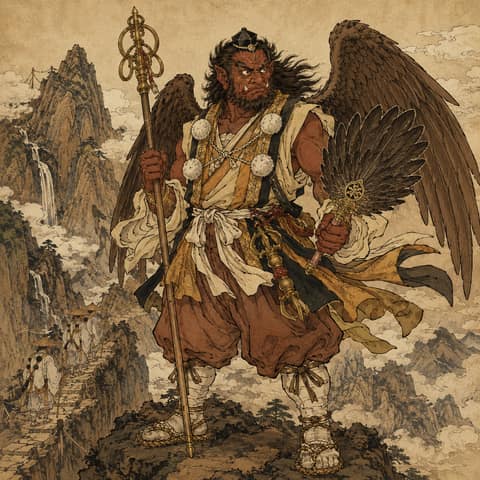
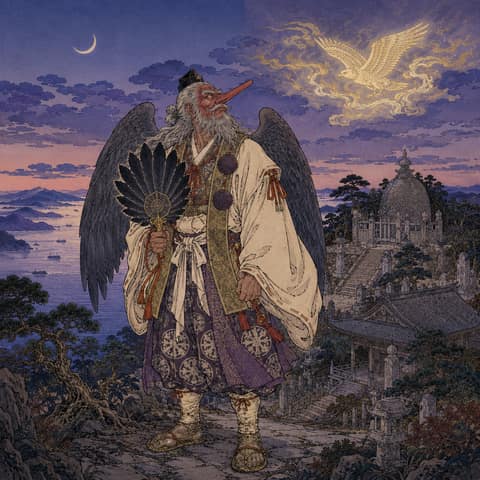
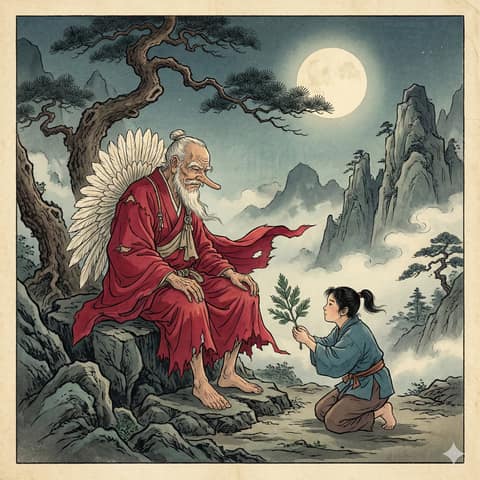
Kurama-yama Sōjōbō is a great tengu said to dwell deep in Kurama, north of Kyoto, in the valley of Sōjō-ga-tani, famed in legend for having taught swordsmanship and the art of war to Ushiwakamaru—the future Minamoto no Yoshitsune. Counted among the Eight Great Tengu (hachidai tengu), he is depicted as an aged, long-nosed yamabushi.
This tale of martial transmission was put on stage in the Muromachi-period Noh play Kurama Tengu[1], and in early-modern times it was widely beloved through the ukiyo-e of Kawanabe Kyōsai and Tsukioka Yoshitoshi. One must note, however, that the plot of Ushiwaka learning from the Kurama tengu does not appear in the Gikeiki (Chronicle of Yoshitsune)[2]; it is a tradition formed and added in later ages. What the Gikeiki transmits is the tale of the onmyōji Kiichi Hōgen bestowing books of strategy upon Ushiwaka, and in time a theory arose identifying "the Kurama tengu" with Kiichi Hōgen.
Folklore & Legends
The core of Kurama-yama Sōjōbō lies in the legend of his transmission of the art of war to Ushiwakamaru. The young Ushiwaka, entrusted to Kurama-dera, would steal each night to Sōjō-ga-tani to receive the principles of the sword and of strategy from the great tengu—a tale made famous by the Muromachi Noh play Kurama Tengu[1] and unfolded thereafter in kabuki and in the warrior prints of Kawanabe Kyōsai and Tsukioka Yoshitoshi.
The stage of that tale, Mt. Kurama, is an ancient sacred mountain. The Kurama-buki-dera engi[3] relates that Ganchō built a hermitage in the first year of Hōki (770) and enshrined Bishamonten there, and that Fujiwara no Iseto raised the temple halls in the fifteenth year of Enryaku (796). This sacred mountain came to be conceived as the place of descent of Gohō Maō-son, held to be the very body of Sōjōbō.
Yet the tale of Ushiwaka's martial instruction is not set down in the Gikeiki[2] itself. What the Gikeiki recounts is how Ushiwaka obtained the secret books of strategy—the Rikutō and Sanryaku—treasured by the onmyōji Kiichi Hōgen of Ichijō Horikawa. The theory identifying the Kurama tengu with Kiichi Hōgen was born much later, in the early-modern age. The jōruri play Kiichi Hōgen Sanryaku no Maki[4] (Kyōhō 16 = 1731, premiered at the Takemoto-za) frames Kiichi Hōgen as "the tengu who long ago taught swordsmanship to Ushiwaka on Mt. Kurama," and here the Gikeiki's Kiichi Hōgen tradition was fused with the Noh's tengu-transmission tradition. Thus "Kurama Tengu = Kiichi Hōgen" is an Edo-period fusion by literary invention; before the medieval period they were separate traditions.
It should also be noted that Kurama-dera today enshrines Gohō Maō-son as one of its principal images and links it to Sōjōbō; but the grand present-day doctrine that Gohō Maō-son flew down from Venus is a modern teaching arranged only after 1949 (Shōwa 24), when Kurama-dera became independent of the Tendai school and founded Kurama-kōkyō—a lineage distinct from the medieval tengu lore. The Sōjōbō of the medieval tradition was, throughout, a master tengu who imparted the martial arts and the way of the mountains, one of the forty-eight tengu[5].
The legend of Kurama-yama Sōjōbō is a subject to be read with careful separation of historical fact from later accretion.
The credibility of its setting rests in the history of Kurama-dera. The Kurama-buki-dera engi[3] relates that Ganchō built a hermitage in the first year of Hōki (770) and that Fujiwara no Iseto raised the temple halls in the fifteenth year of Enryaku (796). This ancient sacred mountain holds the valley of Sōjō-ga-tani where Sōjōbō dwells, and was held to be the place of descent of Gohō Maō-son.
The firm dramatization of the tale of martial transmission to Ushiwakamaru begins with the Muromachi-period Noh play Kurama Tengu[1]. In its plot the great tengu of Kurama teaches the art of war to Ushiwaka, who, pursued by the Heike, had taken refuge at Kurama-dera; performed as a fifth-category Noh, it unfolded widely into later kabuki and ukiyo-e. Yet this transmission tale does not exist in the older Gikeiki[2]. What the Gikeiki transmits is the tale of Ushiwaka's acquiring the books of strategy (the Rikutō and Sanryaku) treasured by the onmyōji Kiichi Hōgen—no tengu appears.
The identification that binds the two, "Kurama Tengu = Kiichi Hōgen," arose in early-modern times. Its source is the jōruri Kiichi Hōgen Sanryaku no Maki[4] (1731, premiered at the Takemoto-za), which has a scene calling Kiichi Hōgen "the tengu who long ago taught swordsmanship to Ushiwaka on Mt. Kurama." Here the Gikeiki's Kiichi Hōgen and the Noh's tengu-transmission tradition were fused into one. Thus the story widely known today—that Ushiwaka learned the art of war from the Kurama tengu—is rightly seen not as deriving from the Gikeiki, but as a layered legend that began with the Muromachi Noh and was bound to Kiichi Hōgen in the Edo jōruri.
One further point to note is the relation to Gohō Maō-son. The grand present-day doctrine by which Kurama-dera links it to Sōjōbō is a modern teaching arranged only after the temple became independent of the Tendai school and founded Kurama-kōkyō in Shōwa 24 (1949)—a lineage apart from the medieval Sōjōbō tradition. The Sōjōbō of the medieval tradition was, as one of the forty-eight tengu[5], a master tengu who imparted the martial arts and the way of the mountains.
Character Profile
This section is our own creative profile for storytelling. It is not historical fact or scholarship.
Composed and proud, a keeper of his word. Toward the gifted he is severe yet not without mercy, and toward conceit he shows no quarter. Sparing of words, his teachings are rich in metaphor and keen.
Compatibility
Practitioners who spare no effort in their training; martial artists who know courtesy; travelers who fear and revere the mountains
Abilities
Comprehensive martial instruction encompassing strategy, footwork and breathingThe art of the feather-fan that commands the wind and cleaves the mistDivination that reads the omens of the mountainFar-travel and flightConcealment within the mountains
Weaknesses
He loathes clamor full of worldly thoughts
To those who break their word he gives no teaching and departs
Kept long from the mountains, his power wanes
Habitat
Sōjō-ga-tani on Mt. Kurama, Kyoto; the groves of ancient cedars deep behind Kurama-dera; the mountain pass from Kibune
The diagram below is a diagnostic evaluation chart for Kurama-yama Sōjōbō, Who Taught the Art of War to Ushiwaka. The higher the value of each item, the stronger that characteristic is expressed.