Tengu
Tengu
What Is a Tengu? An Overview of Types and Iconography
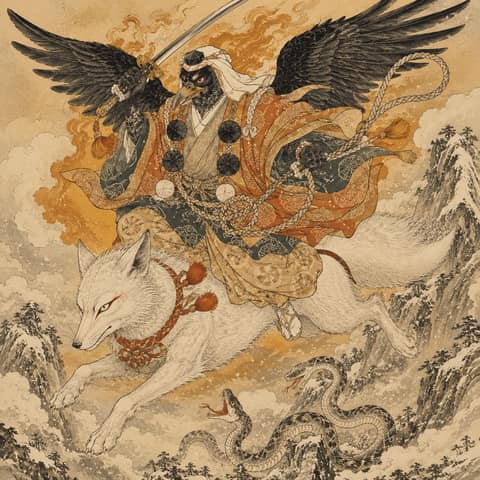
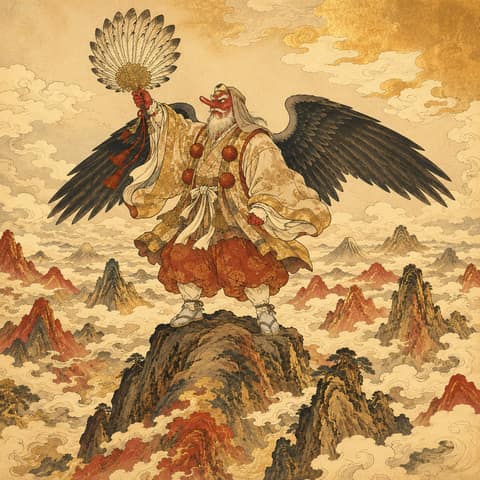
This edition is not about a single seat on a particular sacred mountain, but a general treatise that thoroughly unravels "what a tengu is" from the history of its iconography and types. The individual traditions of each seat are left to the page of each great tengu. The form of the tengu is not uniform. The first type is the long-nosed tengu—ruddy face and high nose, clad in the ascetic's headcloth (tokin) and the suzukake robe, a feather fan in hand and one-toothed high clogs on the feet. The second is the crow tengu, with a crow's beak and wings, grasping a sword or a vajra staff. The third are the lesser tengu called leaf tengu and wood-chip tengu, held to be weak and numerous kin. Rather than a fixed classification, these reflect the breadth of the tengu image across eras and regions. The iconography shifted over time. The Heian-period tengu was first conceived as a bird like a black kite, and the image of the crow tengu retains that vestige. The long nose grows prominent only from the late Kamakura period; the Zegaibō Emaki depicts a scene in which a tengu that had disguised itself as a human has its nose lengthen as it returns to bird form. As for the origin of the long nose, there are theories that derive it from the high-nosed Jidō mask of gigaku and link the crow tengu to the Karura (Garuda) mask, and a view that sees the long nose as an iconographic vestige of a bird's beak—but none can be called settled doctrine. It was overlaid with the god Sarutahiko, described in the Nihon Shoki as having a nose seven hand-spans long, and the custom arose of using a tengu mask for the role of Sarutahiko in festivals. The tengu's dual nature is rooted in the Buddhist notion of the way of the tengu. Because it studies the Buddhist path it does not fall into hell, and because it handles heterodox arts it cannot reach paradise either—an intermediate state, and the one who falls there was held to be the arrogant monk. The Tengu Zōshi depicts this notion as satire of the monks of the seven great temples, yet Chigiri Kōsai too warns that the simplification "only arrogant monks become tengu" goes too far. Demon though it is, once subdued it turns to guardianship, and it was held that if a Shugendō practitioner recites the Tengu Sutra he may summon the tengu of the various provinces to grant his wishes—this amplitude between guardian and demon is the very core of the tengu. The certain medieval source for the grouping called the "Eight Great Tengu" lies in the libretto of the Muromachi-period Noh play Kurama Tengu. The passage in which the great tengu calls up the tengu of the provinces he commands in geographical order—"In Tsukushi, Buzenbō of Hiko-san; in the four provinces of Shikoku, Sagamibō of Shiramine; Hōkibō of Ōyama; Saburō of Iizuna… the host of Zenki of Ōmine, Takama of Katsuragi"—shows that the Eight Great Tengu were rooted in medieval belief and performing arts, not an Edo invention. Still, the composition wavers by source, with a variant that adds Hōkibō of Ishizuchi-san; it is no fixed roster.