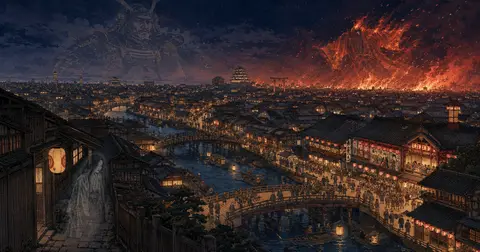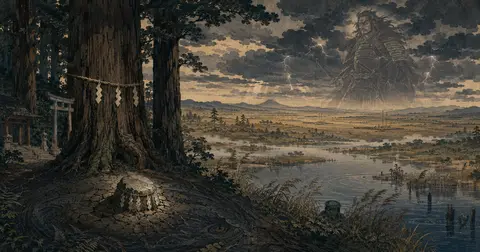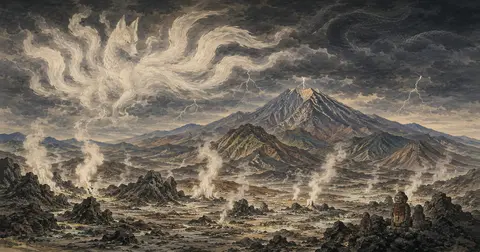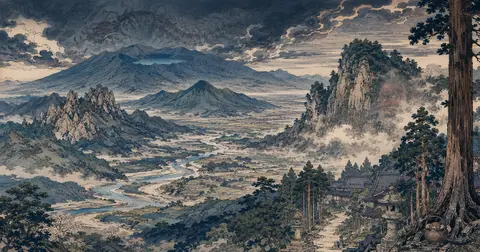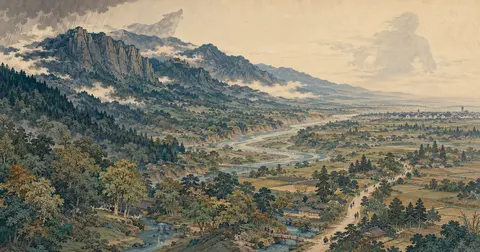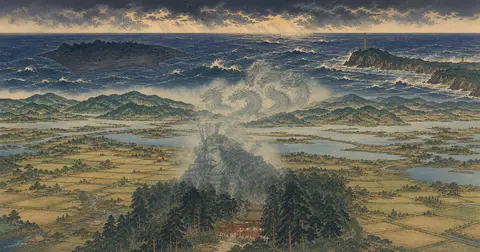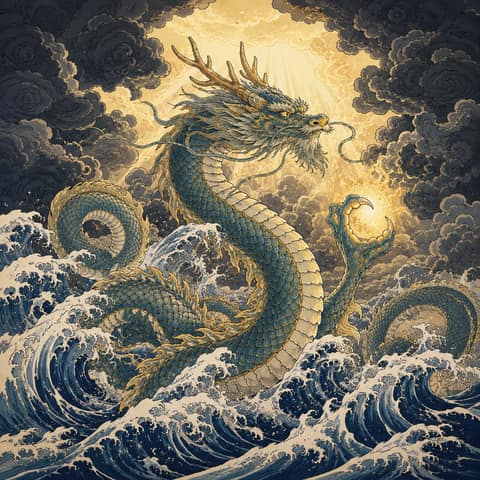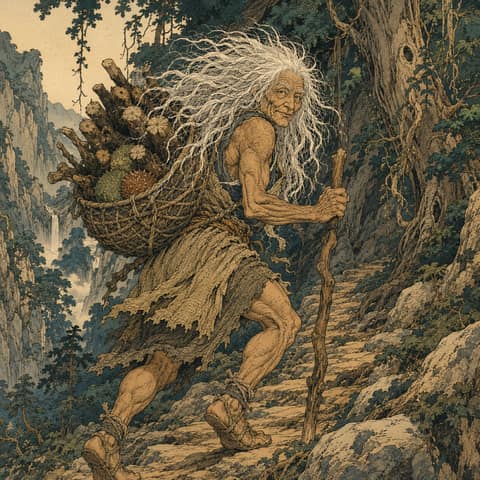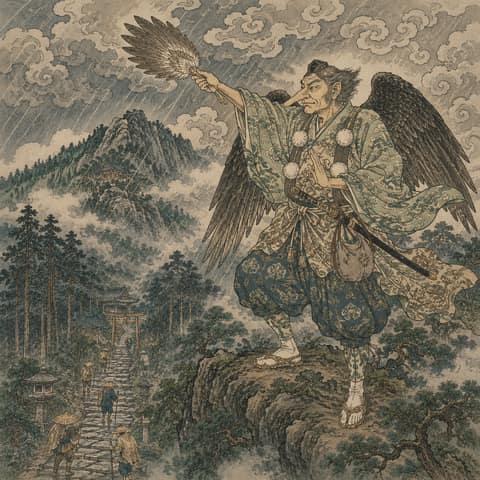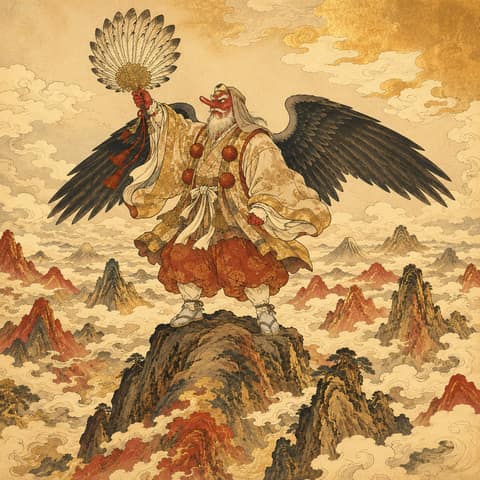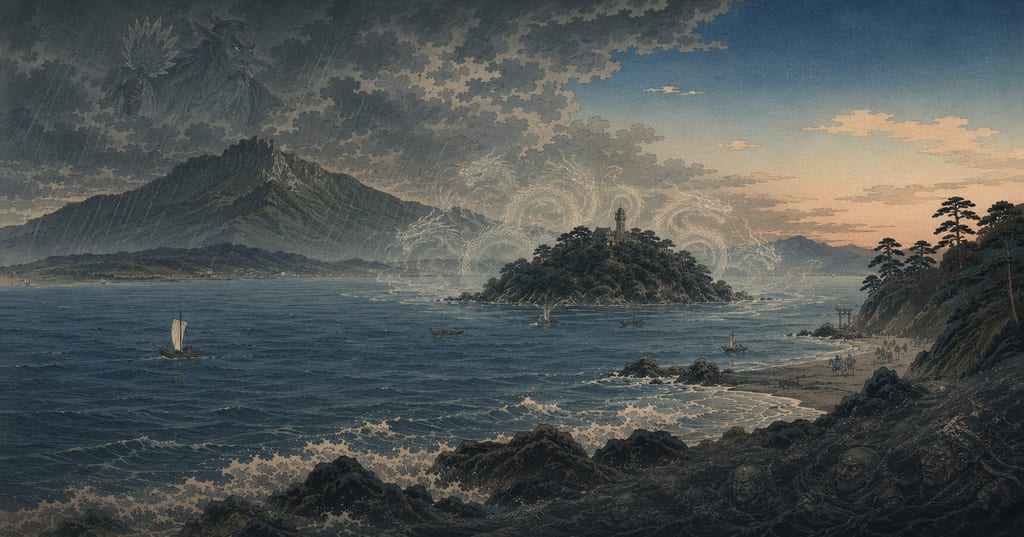
Embracing the bow-shaped Sagami Bay and backed by the Tanzawa and Mount Oyama massifs, the land of Kanagawa has historically encompassed two distinct spiritual domains: the sea and the mountains. In the open waters to the south, dragons commanding the tides lie in wait, while upon Mount Afuri in the west, tengu hold their seats. Nestled between them, the Kamakura warriors who established their capital on the shores of Yuigahama spawned countless grudges amidst war and political strife. Sea dragons, mountain tengu, and the phantoms born from the samurai capital—these three magnetic fields form the foundation of Sagami Province's yokai culture.
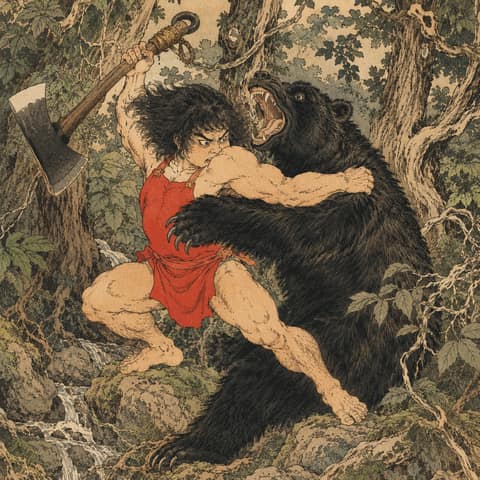
On the sea's side, the Five-Headed Dragon (Gozuryu) dwelling in the Enoshima Iwaya caves fell in love with a celestial maiden, repenting of its evil ways, while at Lake Ashi in Hakone, Mangan Shonin subdued the Nine-Headed Dragon (Kuzuryu). On the mountain's side, the Great Tengu of Mount Oyama in Sagami was counted among the Eight Great Tengu, and it is said that a Yama-uba raised Kintaro on Mount Ashigara. As for the samurai capital, tales spread of the Maikubi, three severed heads biting at each other in the waters of Manazuru, and the Mizoidashi, singing bleached bones washed ashore at Yuigahama. This article examines the supernatural phenomena of the sea, the mountains, and the capital across the three dimensions of geography, history, and folklore.
The Dragons of Enoshima and Hakone — Water Gods of the Sea and Lakes
When discussing the yokai of Kanagawa, one must begin with the dragons of the sea. Enoshima, a small island jutting into Sagami Bay, has been the core of regional religious faith since ancient times.
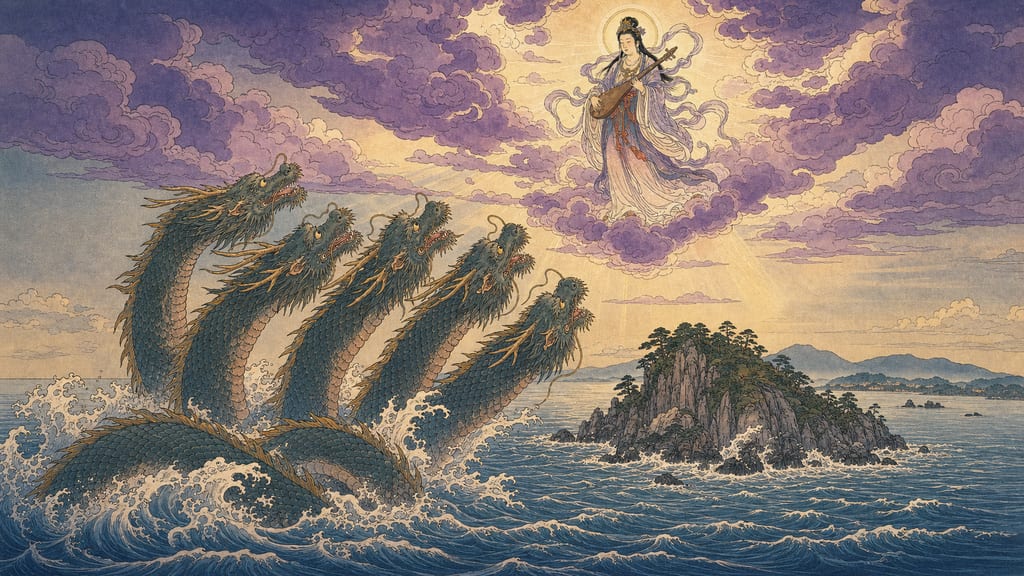
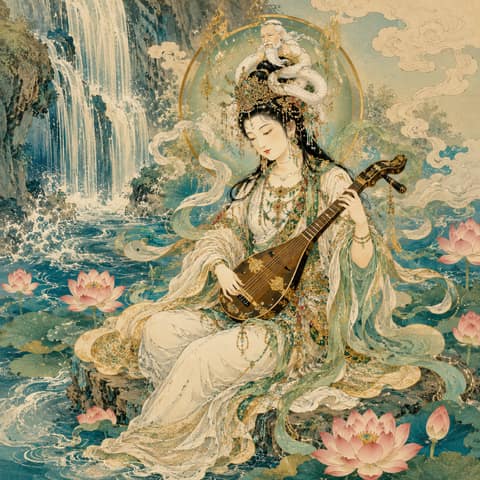
The *Enoshima Engi*[1], passed down at Enoshima Shrine, recounts that in the thirteenth year of Emperor Kinmei's reign (552 CE), a wicked dragon with five heads resided in a large lake in Fukasawa (present-day Fukasawa, Kamakura City). This Five-Headed Dragon (Gozuryu) was a tempestuous force that toppled mountains, brought floods and plagues, and kidnapped children as sacrifices. One day, however, the sky darkened, the earth shook, and an island rose from the sea, upon which a celestial maiden descended. The Five-Headed Dragon fell in love with her and sought her hand in marriage, but she rejected him, admonishing him for his evil deeds. The dragon repented and transformed into a benevolent entity, becoming a guardian deity who brought rain during droughts and calmed storms to protect the villages. This is the origin story of Enoshima, asserting that the celestial maiden was Benzaiten, enshrined at Enoshima Shrine, and the reformed dragon was the Gozuryu Great Deity, enshrined at Ryukou Myojin Shrine in Katase and Koshigoe.
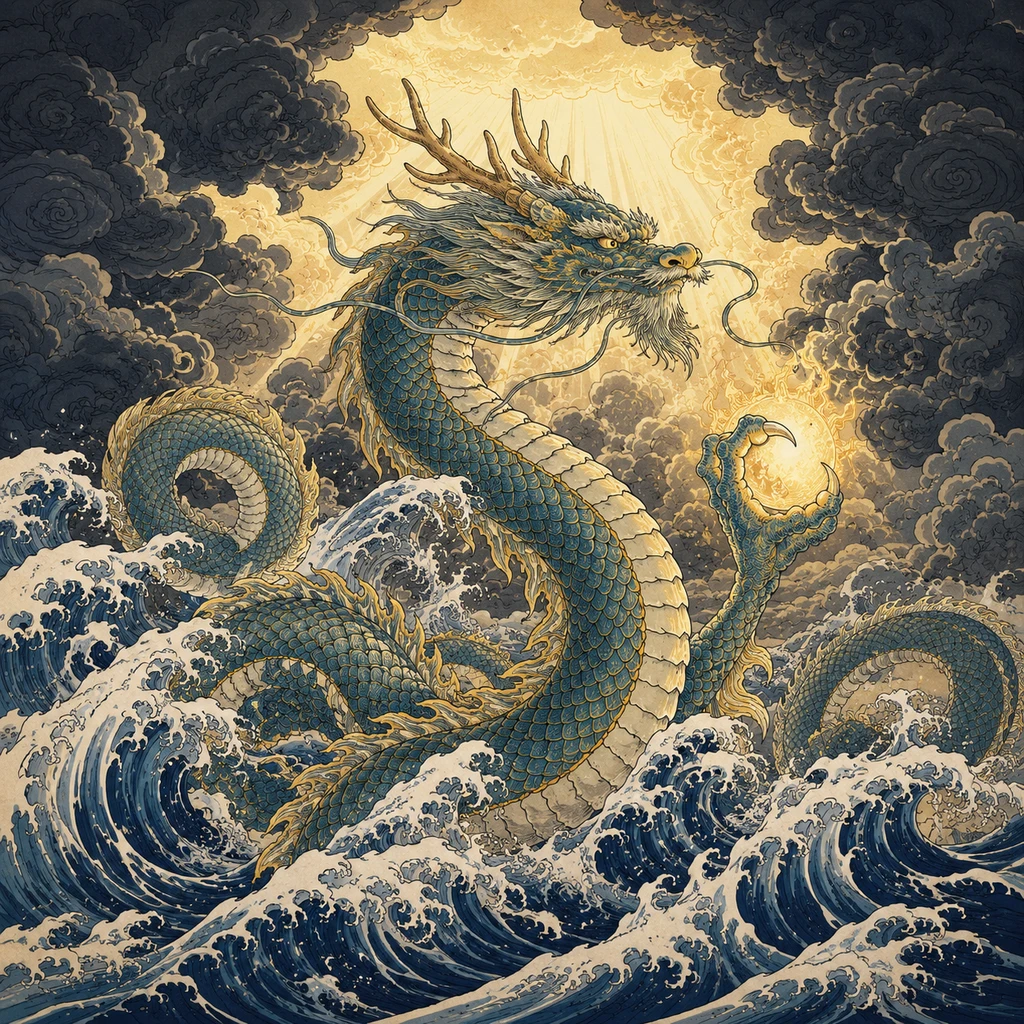
Ryūjin
Ryūjin is a dragon- or serpent-shaped deity who governs water, rain, and the sea. Rather than descending from a single tradition, the god took shape where Japan's older worship of serpents as water spirits met the Chinese dragon and the Buddhist nāga, including the Eight Dragon Kings. In the early chronicles, the ruler of the sea appears as Watatsumi. In the Yamasachi-hiko myth told by the Kojiki and the Nihon Shoki, the sea god's daughter Toyotama-hime reveals at childbirth that her true form is a wani—an ancient sea creature—or a dragon. Because Ryūjin can call rain and quiet water, shrines across Japan receive prayers for rain during drought and for clear skies when floods threaten. Images often show the god holding the tide-controlling jewels or a wish-granting jewel. Sea, lake, great river, and deep pool all lie within this supreme water deity's domain.
Read moreThe dragon god (Ryujin) is a serpentine deity presiding over water, rain, and the sea. It is a complex syncretic figure formed by blending Japan's indigenous snake-and-water-god worship with Chinese "dragons" and Buddhist Nagas (the Eight Great Dragon Kings). As the supreme god of water, its domain encompasses the sea, lakes, major rivers, and deep pools. The dragon of Enoshima is a prime example of this nationwide dragon worship crystallizing into the foundational myth of a single island.
At the southern tip of the island, where the origin story is set, lies the Enoshima Iwaya, a sea cave carved by wave erosion. Revered as a sacred site where historical figures like Kobo Daishi Kukai and Nichiren reportedly practiced asceticism, it served as a portal to the otherworldly realm inhabited by dragons. The deep devotion shown to this island by medieval samurai was undoubtedly rooted in their awe of the dragon's power, connecting the far reaches of the sea to the depths of the earth. The military epic *Taiheiki*[2] records that when Hojo Tokimasa secluded himself on Enoshima to pray for the prosperity of his descendants, Benzaiten manifested as a dragon and left behind three scales, which became the Hojo clan's "Mitsu-uroko" crest. The dragon of the sea was thus the guardian deity of the Kamakura shogunate itself. During the Edo period, with the rise of Benzaiten worship, pilgrimages to Enoshima became a popular recreational activity for commoners, and the island overlooking Sagami Bay frequently appeared in ukiyo-e prints as a scenic spot blending faith with leisure.
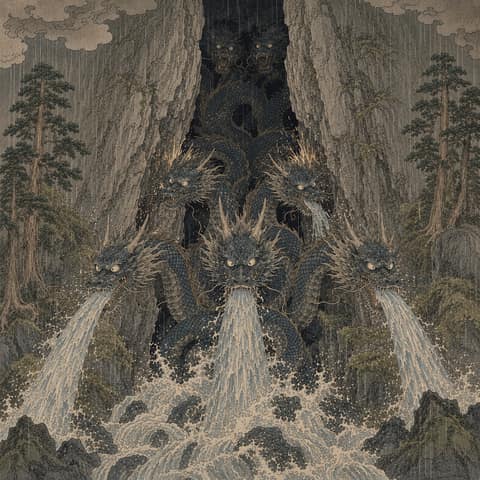
Despite sharing the draconic nature, a different tale is told at Lake Ashi in inland Hakone. According to the history of Hakone Shrine and Kuzuryu Shrine[3], in the first year of Tenpyo-hoji (757 CE), Mangan Shonin, endowed with the divine power of Hakone Okami, subdued a nine-headed venomous dragon that had kidnapped maidens and caused floods and plagues at Lake Ashi (formerly Manjigaike). He accomplished this by constructing an altar at the bottom of the lake and praying for twenty-one days.
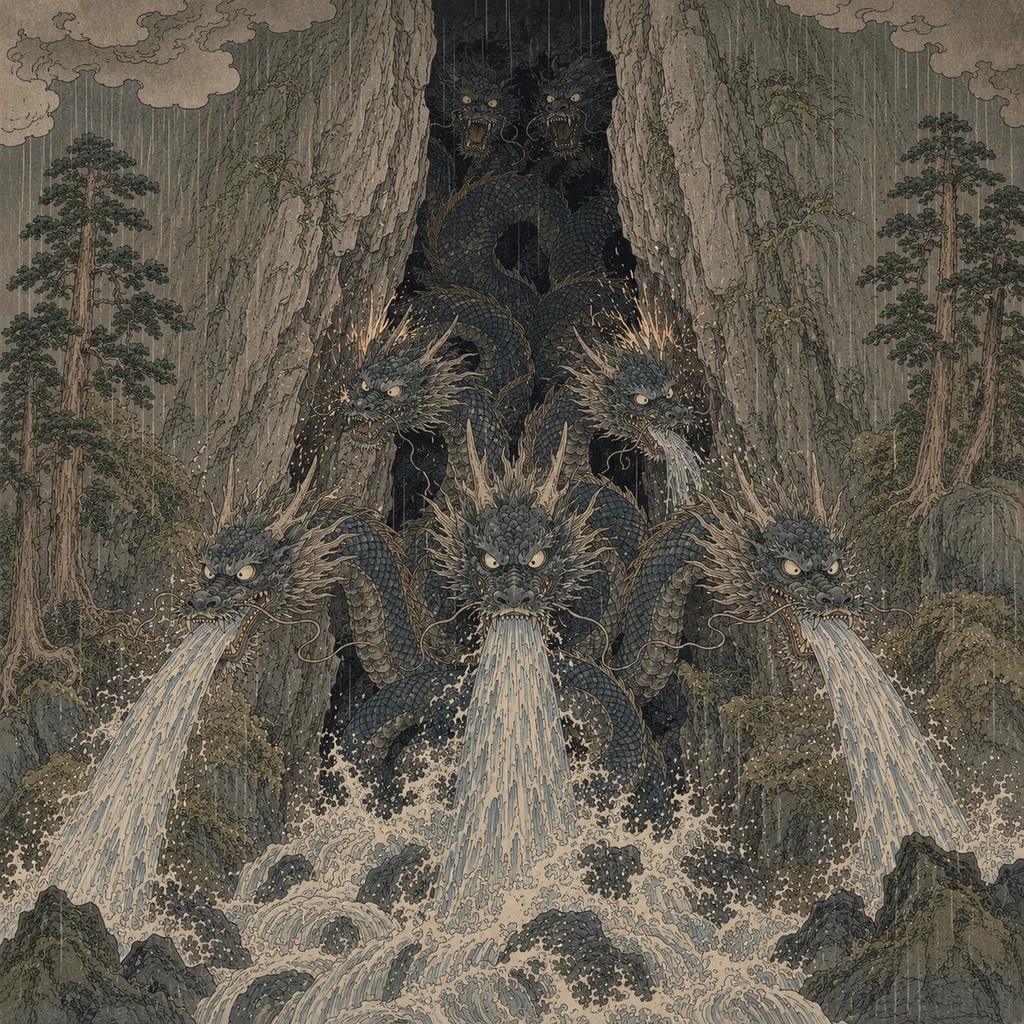
Kuzuryū
Kuzuryū, also written with the character for 'dragon' in an older form, is a nine-headed dragon worshipped as a water and rain deity and as a guardian of particular landscapes. Many traditions turn on the same transformation: a poisonous or violent dragon that once harmed people is subdued by an ascetic or eminent monk, abandons its demonic nature, and becomes a benevolent god. At Togakushi in Nagano, a nine-headed, dragon-tailed demon is said to have been sealed in a rock chamber through the merit of the Lotus Sutra by the ascetic Gakumon, also known as Gakumon Gyōja. It then settled as the local tutelary deity Kuzuryū Ōgami. At Hakone in Kanagawa, the monk Mangan is said to have subdued the poisonous dragon of Lake Ashi in the Nara period and enshrined it as the lake's guardian. In Echizen, Fukui, a Hakusan Gongen origin story tells of a nine-headed dragon swimming with a sacred image on its head, an episode said to explain the name of the Kuzuryū River. Rainmaking and flood control remain central, but regional worship also seeks relief from toothache, good relationships, and peace for the realm.
Read moreThe subjugated Nine-Headed Dragon abandoned the practice of human sacrifice and was enshrined as the Kuzuryu Great Deity, the guardian god of Lake Ashi, alongside Ichikishimahime-no-Mikoto. A festival commemorating the completion of these prayers on the fourteenth day of the sixth lunar month (Kosuisai) continues to this day. This narrative motif of a violent dragon being subdued by a spiritually powerful individual and transforming into a benevolent deity can be found nationwide, such as in Togakushi (Nagano) and Echizen (Fukui). However, while the Five-Headed Dragon of Enoshima reformed through "love," the Nine-Headed Dragon of Hakone yielded through "subjugation," forming a striking contrast. The sea dragon repented of its own accord after falling for a celestial maiden, whereas the lake dragon was wrestled into submission by ascetic prayers. Thus, Kanagawa encapsulates two distinct paths by which dragons transform into benevolent deities within a single prefecture.
And the one the dragon loved was none other than Benzaiten.
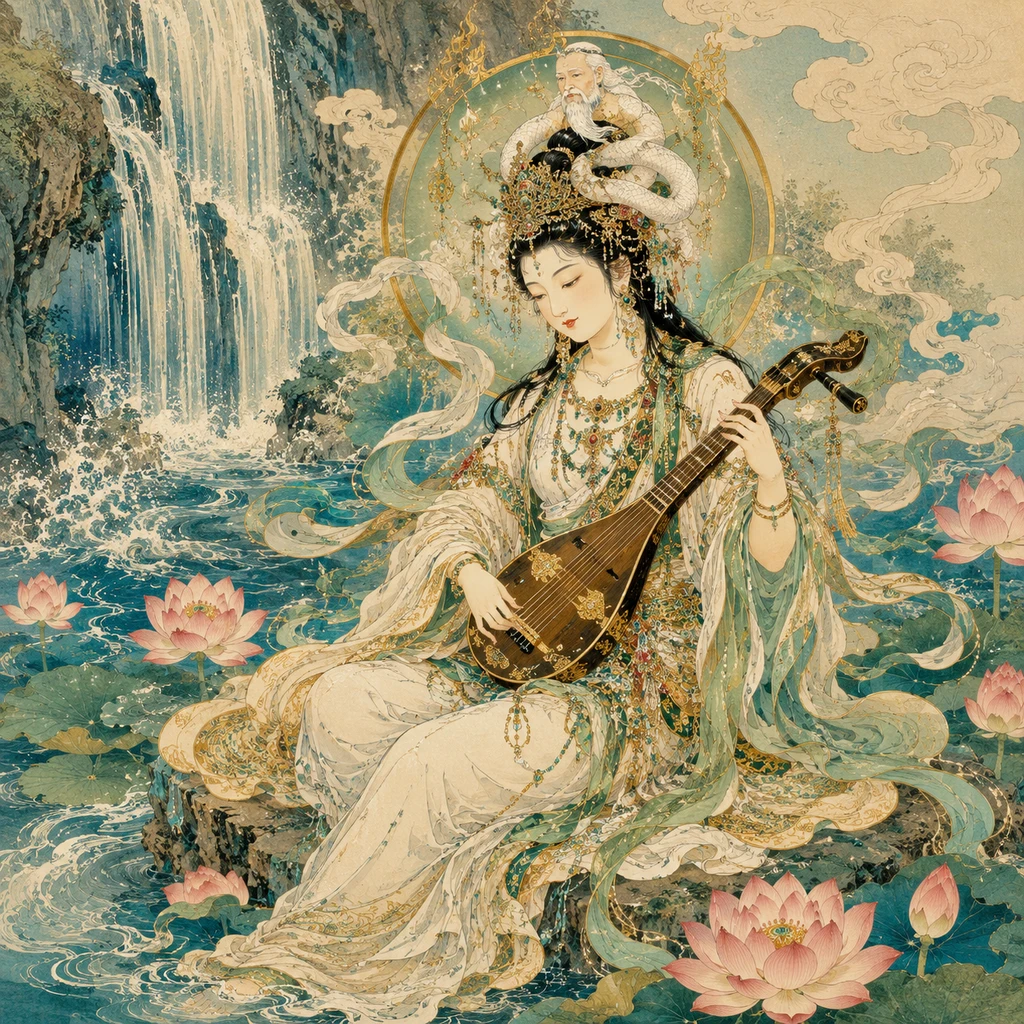
Benzaiten
Benzaiten (also spelled Benten) is a Buddhist tutelary deity originating from the ancient Indian Hindu goddess Sarasvatī, who underwent a unique evolution in Japan from the Middle Ages onwards. The Sanskrit name "Sarasvatī" was translated into Chinese scriptures as "Benzaiten" (goddess of eloquence). The original Sarasvatī was the goddess of music, arts, language, and rivers; after being adopted by Buddhism, she was venerated as a protector deity in texts like the Lotus Sutra and the Golden Light Sutra. In Japan from the Kamakura period onwards, she merged with Ugajin, an indigenous human-headed snake deity, to form the unique divine figure of Uga-Benzaiten. This marked the decisive turning point for her transformation into a deity of wealth and fortune, reflected in the change of the kanji used for her name from "Benzaiten" (goddess of eloquence) to "Benzaiten" (goddess of wealth). She has major sanctuaries centered around the Three Great Benten Shrines of Japan (Enoshima Shrine in Kanagawa, Hogon-ji on Chikubu Island in Shiga, and Itsukushima Shrine in Hiroshima), as well as Zeniarai Benzaiten Ugafuku Shrine in Kamakura and Tenkawa Daibenzaiten-sha in Nara. In the Edo period, she was widely revered as the sole goddess among the Seven Lucky Gods. Today, she remains a vital subject in folklore and yokai studies, surrounded by popular beliefs involving her serpent nature, wealth-bringing attributes, and taboos against couples visiting her shrines.
Read moreBenzaiten originated as Saraswati, the Hindu river goddess of ancient India, before becoming a Buddhist guardian deity. In Japan, starting in the Kamakura period, she merged with Ugajin, a deity with a human head and snake body, undergoing a unique evolution. Enoshima Shrine is counted among Japan's Three Great Benten shrines, alongside Hogonji Temple on Chikubushima in Shiga and Itsukushima Shrine in Hiroshima. By associating with the serpentine Ugajin, Benzaiten acquired a tripartite nature encompassing snake, water, and wealth/fortune characteristics. Her original name, "Bensaiten" (goddess of eloquence), gradually shifted to "Benzaiten" (goddess of wealth) due to her new role as a bestower of fortune. In the Enoshima myth, her union with the dragon is deeply rooted in this conceptual vein linking Benzaiten, snakes, and water. A nude statue of Benzaiten (Myoon Benzaiten) is preserved near the Okutsumiya shrine at Enoshima, continually drawing worshippers praying for success in the arts and financial prosperity.
The Tengu of Oyama and the Yama-uba of Ashigara — Gods and Mysteries Embraced by the Mountains
Opposing the sea dragons are the mountain tengu. Looming west of the Sagami Plain, Mount Oyama is also known as Afuriyama (the raining mountain), and its spiritual authority dates back to antiquity. The officially commissioned *Engishiki Jinmyocho* (927 CE)[4] lists the mountaintop Afuri Shrine as an elite shrine of Sagami Province, with Oyamatsumi-no-Kami as its principal deity. On the Buddhist side, the *Oyamadera Engi*[5] records that the temple's origins trace back to the provincial governor of Sagami and his wife praying to Kannon for a child. Their child, Roben, was snatched by an eagle and raised in Nara, eventually founding Oyamadera during the Tenpyo-shoho era and enshrining the main image of Fudo Myoo (this Sagami-version scroll differs from the origin story of the identically named Oyamadera in Hoki Province). From the Middle Ages onward, Oyamadera served as a base for Shugendo ascetics (Oyama Shugen), becoming a training ground for yamabushi who would purify themselves in waterfalls like Niju-no-taki and Roben-no-taki before ascending. Its identity as a mountain that calls forth rain also intertwined with agricultural prayers, leading Mount Oyama to be revered as a sacred peak symbolizing the water source for the entire Sagami region.
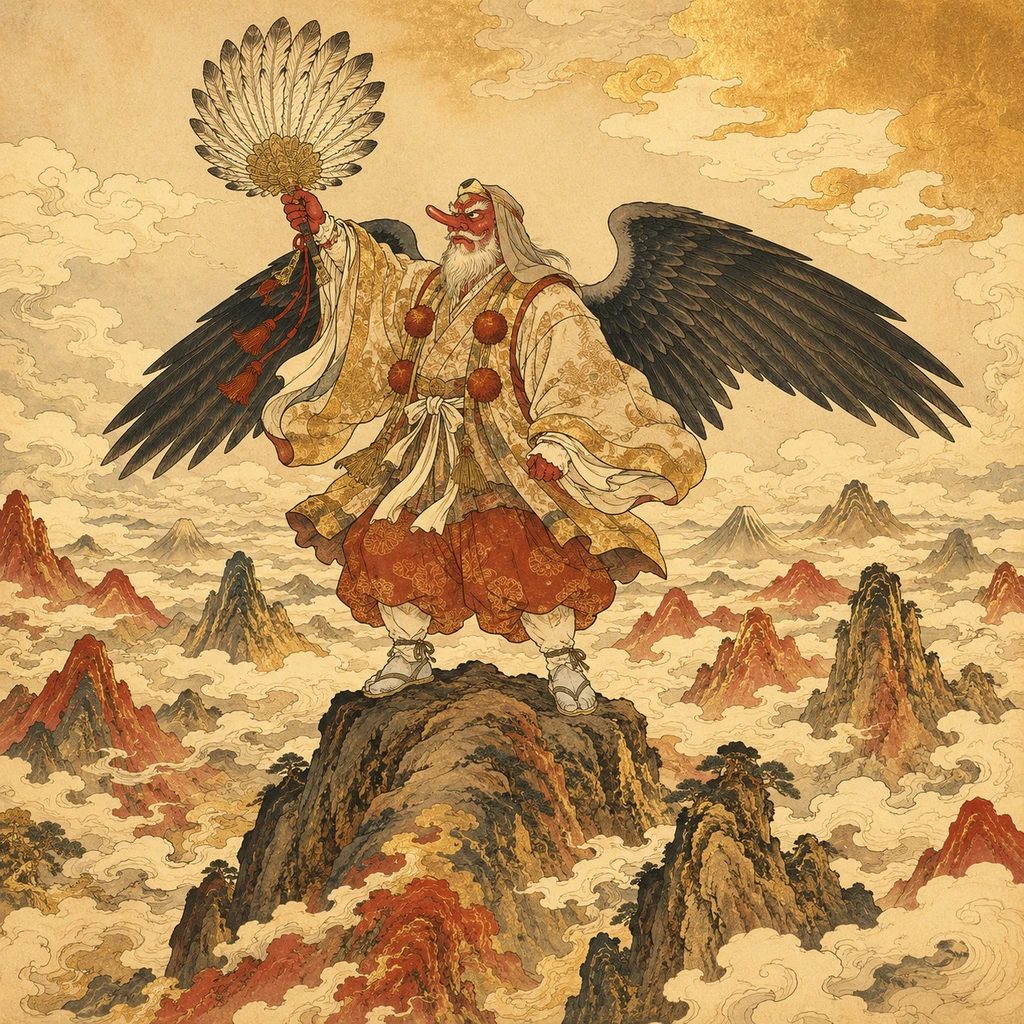
Tengu
The tengu is a yokai and quasi-divine being said to dwell in the mountains of Japan, a lord of the heights inseparably bound to the yamabushi ascetics of Shugendō. Its forms fall broadly into two lineages. One is the long-nosed tengu, with a ruddy face and high nose, clad in the garb of a mountain ascetic, bearing a feather fan and one-toothed high clogs; the other is the crow tengu, with a crow's beak and wings, and beneath them follow lesser kin such as the leaf tengu and the wood-chip tengu. What was once conceived as a bird like a black kite hardened, over the medieval period, into the image of the long-nosed mountain ascetic. The tengu is at once a demon that obstructs the Buddhist Law and, once subdued, a guardian deity who protects it—this dual nature is the essence of the tengu. The notion that an arrogant high monk falls and becomes a tengu was bound to the Buddhist "way of the tengu," and was depicted as satire in late-Kamakura picture scrolls. Within mountain worship, on the other hand, the tengu was revered as guardian of the mountain and master of martial and magical arts, a being that tests or guides the practitioner. From Mount Kurama and Mount Atago in Kyoto onward, each of the sacred mountains of the realm was said to have its own great tengu, and the early-modern Tengu Sutra counts their number at forty-eight.
Read moreTengu are the masters of the mountains, inextricably linked with these yamabushi ascetics. They are categorized into two lineages: the long-nosed Hanataka Tengu, characterized by red faces, high noses, yamabushi attire, feather fans, and single-toothed wooden clogs (geta); and the crow-beaked Karasu Tengu. Their core nature is highly ambivalent; they act as demons obstructing Buddhist teachings, yet transform into protective deities when subdued. The concept of arrogant high priests falling from grace and becoming tengu appeared as satire in picture scrolls depicting tengu from the late Kamakura period. It was believed that a Great Tengu presided over each sacred mountain across the provinces, and by the early modern period, a framework arose that grouped the most prominent ones into the "Eight Great Tengu," led by Tarobo of Mount Atago, Jirobo of Mount Hira, and Sojobo of Mount Kurama. Included among these Eight Great Tengu is the Great Tengu of Sagami's Mount Oyama.
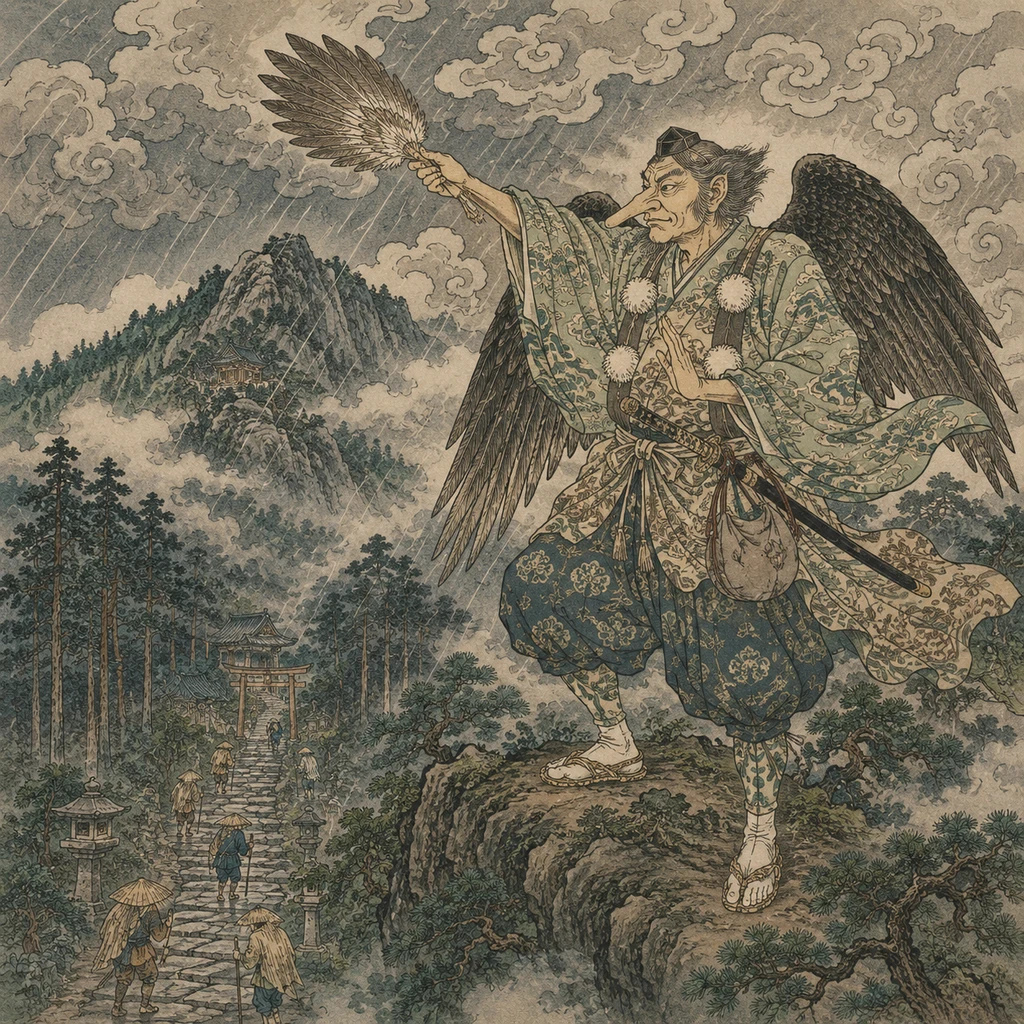
Ōyama Hōkibō
Ōyama Hōkibō is a great tengu enthroned on Mt. Ōyama in Sagami Province (also called Afuri-yama, the "Rain-falling Mountain"), and is counted among the Eight Great Tengu. His name appears as "Hōkibō of Ōyama" in the Muromachi Noh play Kurama Tengu. The Mt. Ōyama on which he sits is a sacred mountain reaching back to the ancient official histories. The Engishiki Jinmyōchō (927) lists the Afuri Shrine on its summit as an official shrine (shikinai-sha) of Sagami Province, showing that Ōyama's divinity had received state recognition in antiquity. The name Hōkibō is wreathed in a tradition of "seat transfer" within the tengu world. Mt. Ōyama of Sagami originally had a great tengu named Sagamibō, but he removed to Shiramine to console the spirit of the Retired Emperor Sutoku, exiled to Sanuki. Into the vacant seat of Sagami Ōyama, Hōkibō entered as successor from Mt. Daisen in Hōki Province (Tottori)—a paired structure set in order by Chigiri Kōsai of tengu scholarship. For this reason Ōyama Hōkibō and Shiramine Sagamibō are always told as a pair.
Read moreHis name is Oyama Hokibo. Cited as "Hokibo of Oyama" in the Muromachi-period Noh play *Kurama Tengu*[6], he is the preeminent Great Tengu representing Sagami. His name carries a legend of a "transfer of seats" within the tengu realm. Originally, a Great Tengu named Sagamibo resided on Mount Oyama in Sagami, but he departed for Shiramine (Kagawa) to protect the spirit of Retired Emperor Sutoku, who had been defeated in the Hogen Rebellion and died in exile in Sanuki. To fill the vacant seat on Sagami's Mount Oyama, Hokibo moved from Mount Daisen in Hoki Province (Tottori) as his successor. This structural shift, as far as verification shows, was presented in Chigiri Kosai's *Tengu no Kenkyu* (A Study of Tengu)[7] while systematizing regional tengu lore, and explicit evidence is scarce in classical texts. Therefore, while speaking of Oyama Hokibo naturally connects to the tales of Shiramine Sagamibo and Sutoku's vengeful spirit, it is reasonable to interpret the transfer itself as a later systematization.
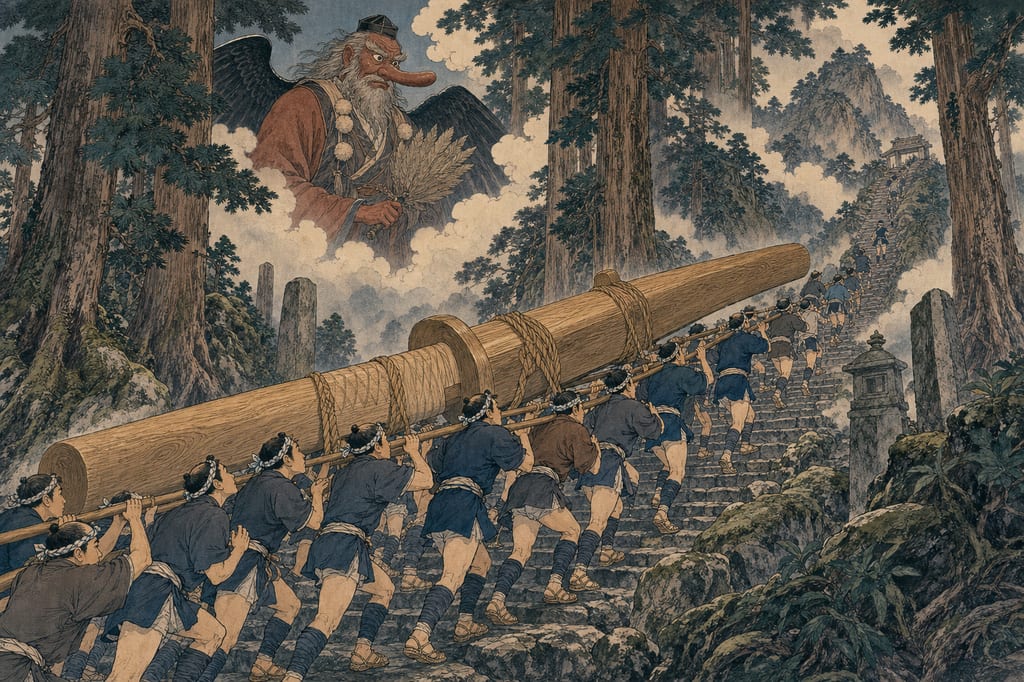
In the early modern period, the tengu of Mount Oyama descended into commoner folklore. The officially commissioned topography *Shinpen Sagami no Kuni Fudokiko* (1841)[8] notes the enormous number of pilgrims from various provinces attending Mount Oyama's annual festival. Edo craftsmen, such as scaffolders and carpenters, formed associations (Oyama-ko) to ascend the mountain carrying massive wooden swords (kidachi). They would offer their old swords at the summit and receive new ones to take home. This custom of "kidachi dedication" even became the subject of the rakugo story "Oyama-mairi." The "Oyama-mairi" pilgrimage, blending faith and leisure for Edo's commoners, is still recognized today as a Japan Heritage tradition. Before long, the mountain of the tengu had become a bustling hub for the people.
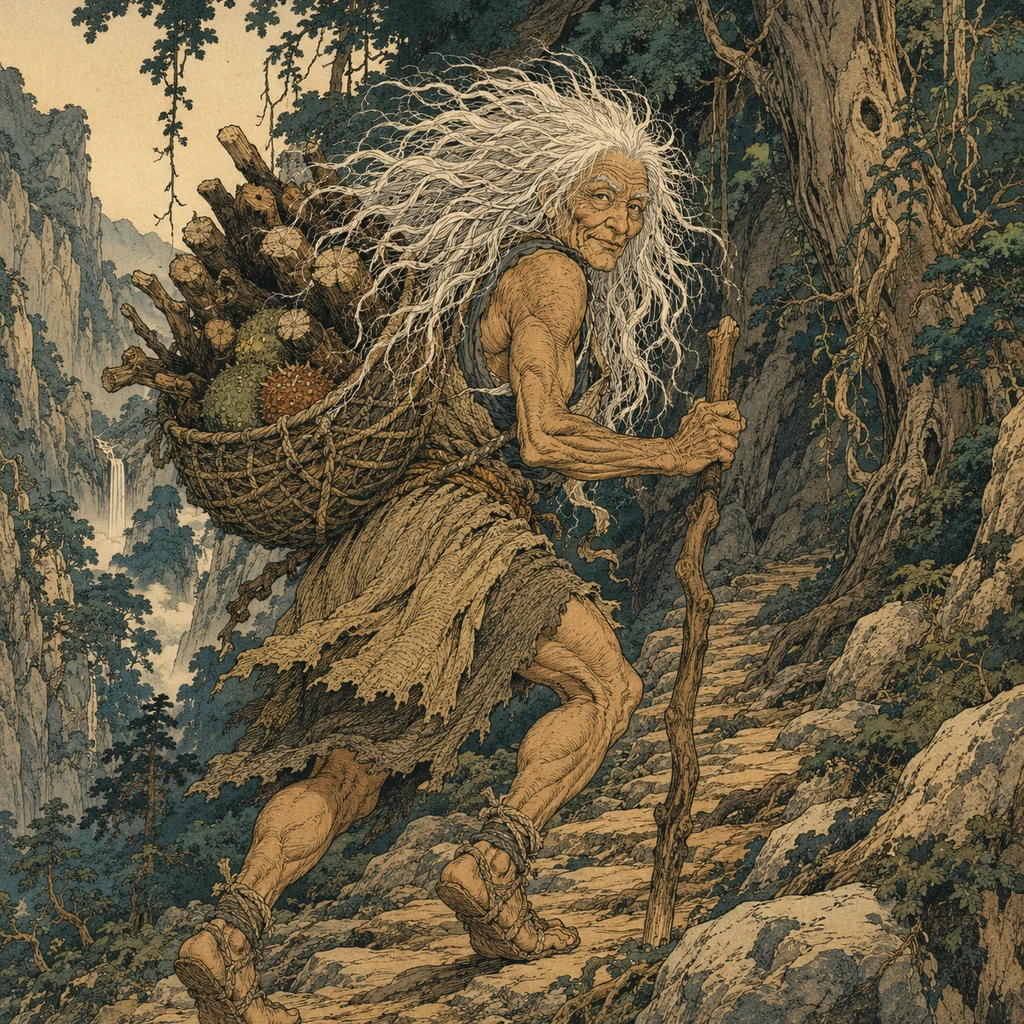
Tengu were not the only entities harbored by the mountains. Mount Ashigara in the western part of the prefecture was said to be home to an elderly mountain woman: the Yama-uba.
Yamauba
An old witch-like yokai who dwells deep in the mountains. She is also known as the foster mother of the folk hero Kintaro.
Read moreThe Yama-uba is an apparition in the form of an old woman residing deep in the mountains. While often depicted as a man-eating ogress with a mouth split ear-to-ear, she is also spoken of as a "mountain mother" who bestows the bounties of nature and brings wealth, embodying a duality of terror and benevolence. The *Konjaku Monogatari-shu*[9] includes a tale where Minamoto no Yorimitsu, arriving at Mount Ashigara, finds an old woman and a young boy living in a deep mountain hermitage; this boy is none other than Sakata no Kintoki (Kintaro). This story laid the groundwork for early modern legends positing Kintaro as the child of a Yama-uba. The narrative of Kintaro, "carrying a broadaxe," growing up on Mount Ashigara inextricably links this region with the Yama-uba. The Muromachi-period Noh play *Yama-uba*[10] portrayed her as an entity wandering the mountains to assist humans with their toils, profoundly influencing later depictions. Kunio Yanagita theorized that the Yama-uba figure might represent mountain inhabitants or shrine maidens serving mountain gods who fell into ruin and were subsequently deemed monsters. Awe for the mountainous realm and gratitude for its blessings coalesced into the image of a single old woman.
Vengeful Spirits of Kamakura and Sagami's Shores — Phantoms Born of the Samurai Capital
Sagami's seas did not belong solely to dragons. Since Minamoto no Yoritomo established the shogunate beyond Yuigahama, Kamakura had served as the samurai capital, swallowing countless deaths amidst battles and political intrigues. The lingering grudges from these events have been passed down as coastal mysteries.

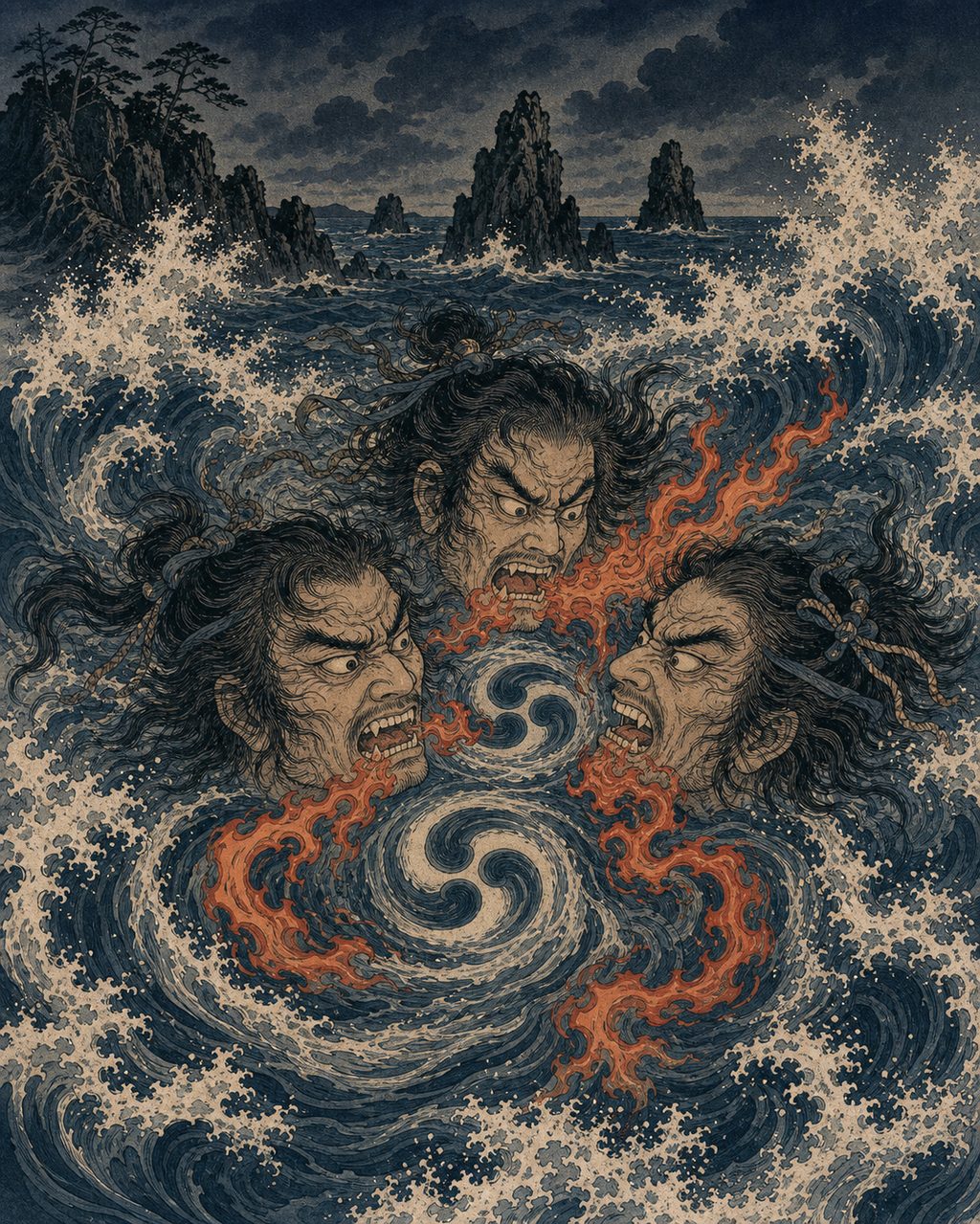
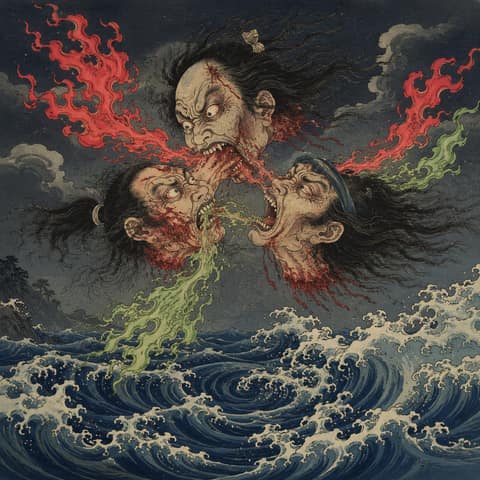
Off the cape of Manazuru at the prefecture's western edge, near the border with Izu, lies a reef called Mitsuishi. Featured in the Edo-period collection of strange tales *Ehon Hyaku Monogatari (Tohoujin Yawa)*[11], the Maikubi is a ghost story tied to these waters. During a festival in Manazuru in the mid-Kamakura period, a drunken argument escalated into a sword fight, resulting in the deaths of three men: Kosanta, Matashige, and Akugoro. Their severed heads plummeted into the sea, where they continued to bite and fight one another underwater. It is said they breathed fire from their mouths at night and stirred up tomoe-shaped waves by day, leading the deep pool to be named "Tomoegafuchi." Three heads that refused to stop fighting even after decapitation perfectly encapsulate the zenith of samurai feuds and festering grudges.
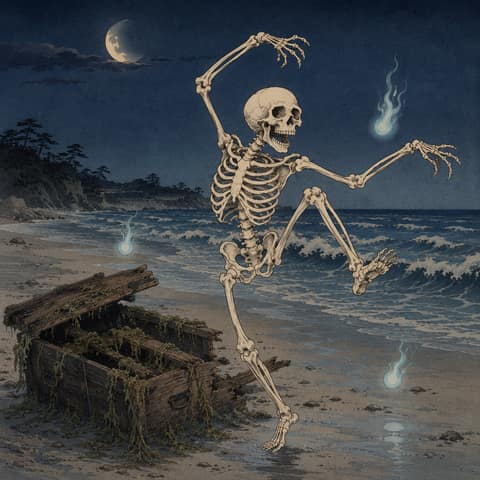
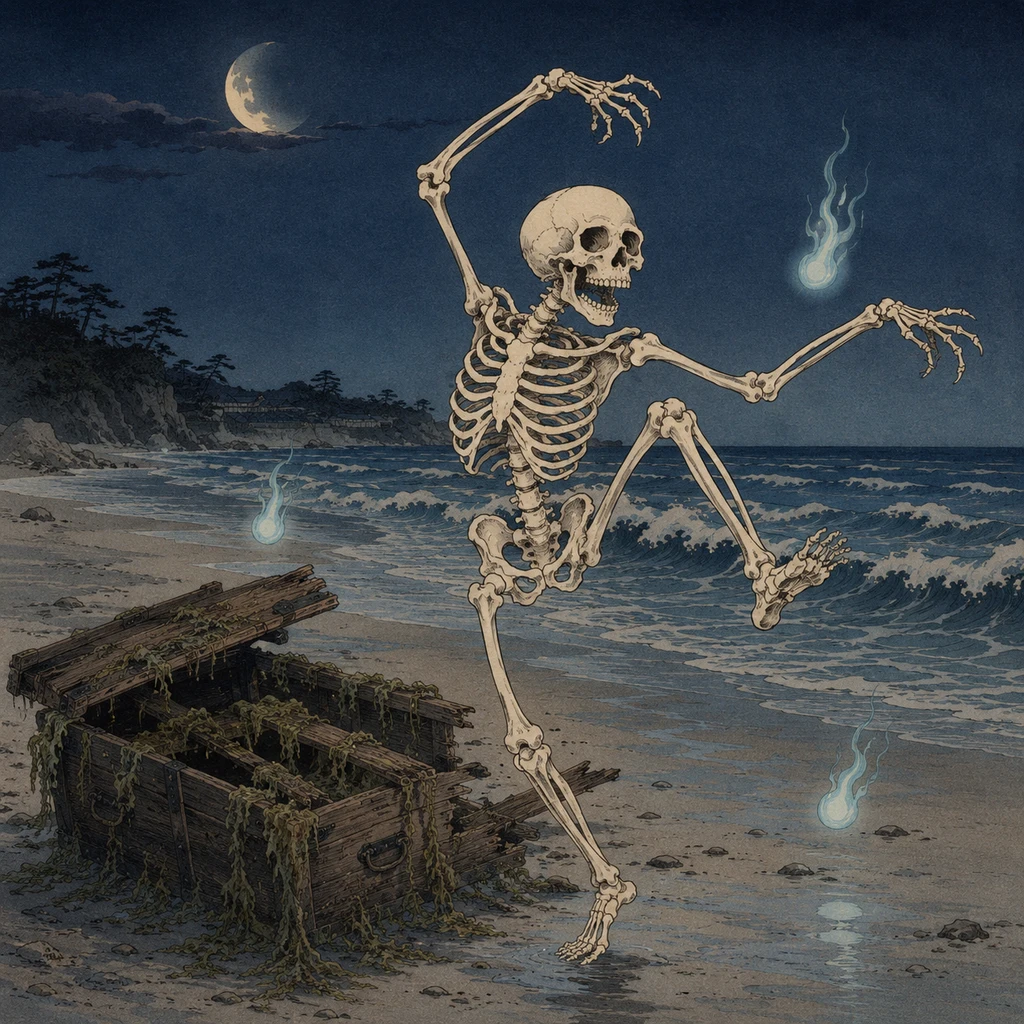
Serving as a counterpart to the Maikubi is the Mizoidashi, an apparition from the shores of Kamakura. Also recorded in the *Ehon Hyaku Monogatari*, this ghost story states that during the era of Hojo Takatoki, a Kamakura samurai named Tone no Hachiro stuffed a retainer's corpse into a chest and dumped it at Yuigahama. Later, a singing voice was heard coming from the washed-up chest, and when temple monks inspected it, they found bleached bones exposed to seawater. After respectfully burying them, Hachiro marched to defend against Nitta Yoshisada's attack on Kamakura, but he fell behind his unit and was shot by an arrow at Yuigahama. Because he died in the exact spot where he had abandoned the body, it was deemed divine retribution for his lack of reverence for the dead. If the Maikubi speaks of the "malice of a sword fight," the Mizoidashi speaks of "retribution for neglecting mourning rites." On the shores of the samurai capital Kamakura, these two phantoms drift side by side—one a manifestation of wartime malice, the other a cautionary tale of proper memorialization.
It must be frankly acknowledged that these stories owe much to the secondary creative layer of late Edo-period picture books. Both the Maikubi and Mizoidashi are tales relayed by the *Ehon Hyaku Monogatari*[11], and while they bear specific place names like Kamakura and Manazuru, their details were refined by the pens of early modern ghost story writers. Nevertheless, without the accumulated memory of death spawned by the samurai capital, such coastal ghost stories could never have been conceived. Place names invite narratives, and narratives imbue those places with new meaning—this is how supernatural phenomena take root in the land.
Contrasting with the early modern coastal capital, phantoms were also spoken of in the corners of modern cities. One such example is Akashi-sama, passed down in Hodogaya Ward, Yokohama.
Akashi-sama
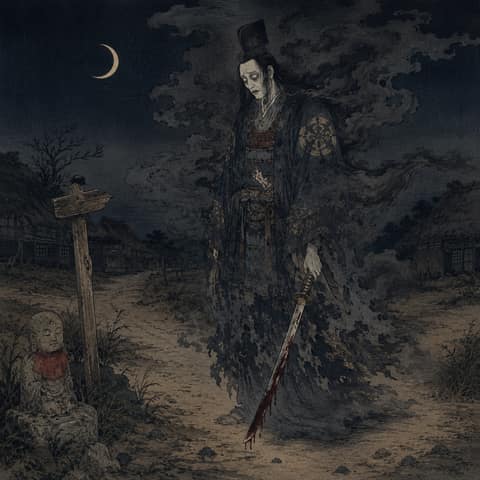
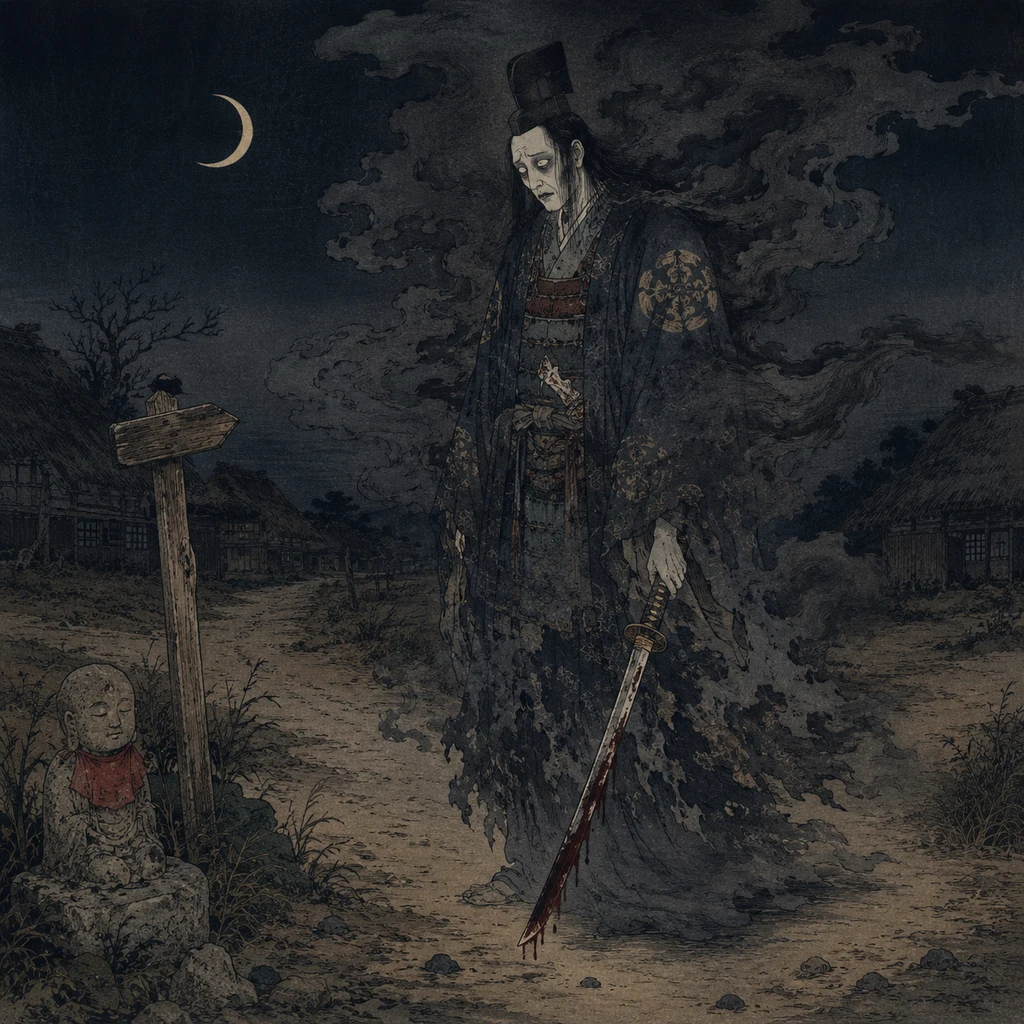
Akashi-sama is a vengeful ghost legend from Hodogaya Ward in Yokohama, dating to the late Edo period. Said to be the spirit of a feudal lord who went mad, it is also called Akashi Gozen. Parents warned children that Akashi-sama would appear if they wandered outside, especially at night, making it a cautionary apparition. Its specific form is unclear in most tellings; the name itself served as the object of fear in this local haunting.
Read moreAkashi-sama (also known as Akashi Gozen) is considered the spirit of a lord who went mad around the late Edo period. According to legend, the deranged lord desired to cut down a person and, breaking through attempts to restrain him, murdered a hunter's daughter who happened to be outside. In retaliation, her hunter father struck him down. Thereafter, his vengeful spirit was spoken of as "Akashi-sama" and used as a warning that he would appear if children wandered out at night. He possessed no fixed physical form in the retellings; his name alone became the object of fear. This is a classic example of a yokai functioning within a local community as a "bogeyman to deter nighttime excursions." A tale of a vengeful ghost had gradually morphed into practical wisdom for disciplining children.
Village Monsters of Kotoyoka — Yokai Shaping the Rhythms of Life
While coastal phantoms speak of "death and malice," the villages of Sagami pass down tales of yokai who govern the "milestones of daily life." The most prominent among these are the Atooi-Kozo of Tanzawa and the Mikari-Baba, distributed throughout the Kanto region.
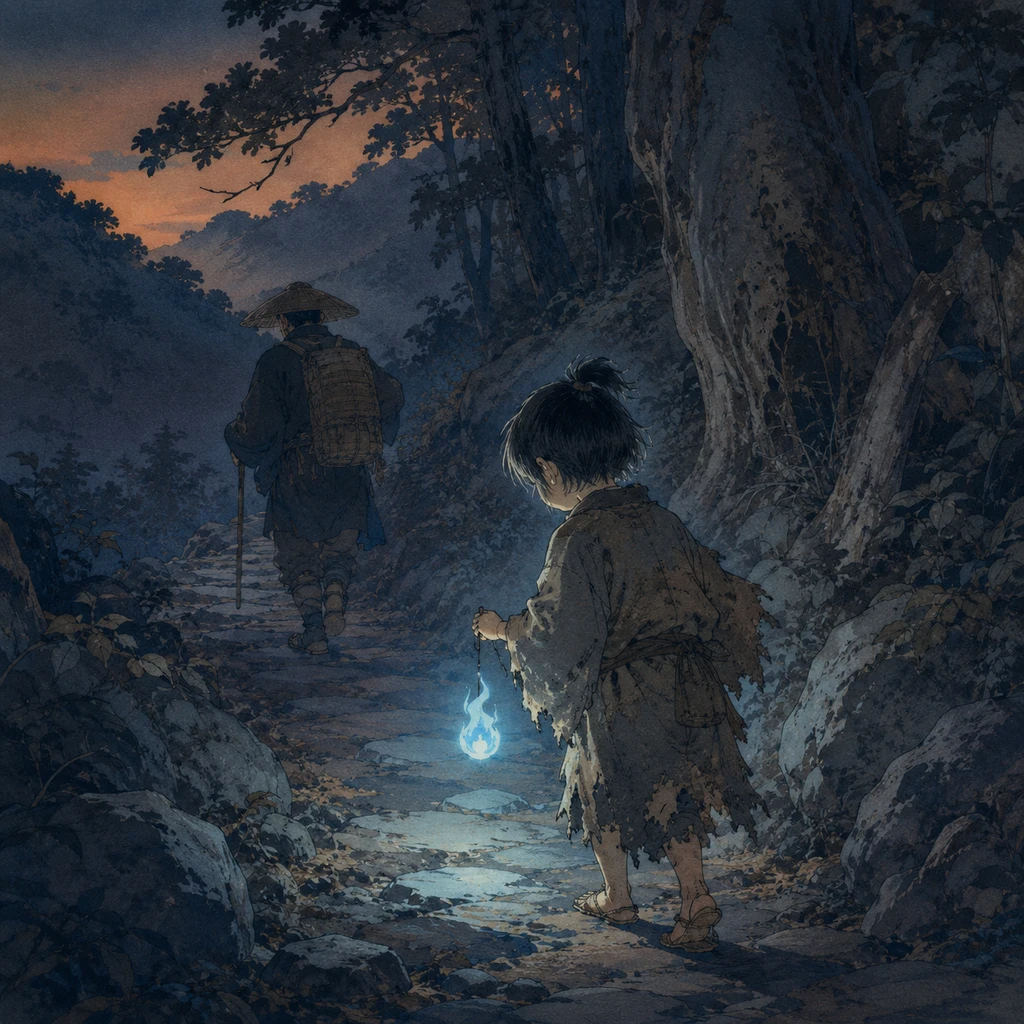
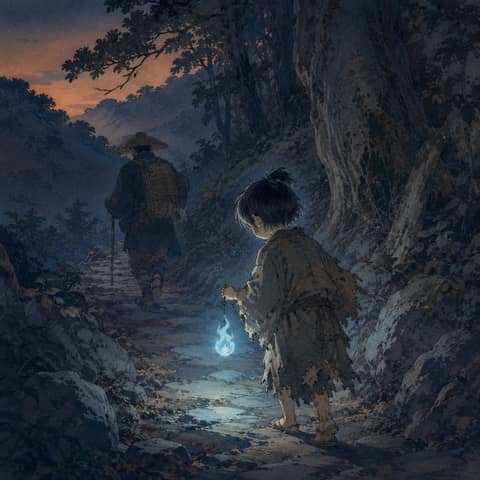
In the eastern part of the Tanzawa Mountains, tales are told of a mountain spirit called the Atooi-Kozo (trailing boy). Appearing as a child between four and ten, or sometimes up to fifteen years old, clad in woven straw or kasuri-patterned kimono, he silently trails behind travelers on mountain paths. If one looks back, he hides behind trees or rocks and vanishes without causing any harm. Sometimes he walks ahead as if guiding the way, lighting a small, lantern-like flame after dusk, which naturally disappears as they approach the village. Elders recounted that he often appeared in the late afternoon, and those who encountered him frequently would leave offerings of rice balls, potatoes, or dried persimmons on rocks or tree stumps. Based on the notion that mountains border the realm of the dead, he was sometimes interpreted as the spirit of a lost child taking a liking to the living. The act of leaving an offering reveals the poignant prayer of parents hoping it might be the spirit of their own child. The Atooi-Kozo is a gentle apparition of Sagami's mountains, born from the fusion of mountain anxieties and deep parental affection.
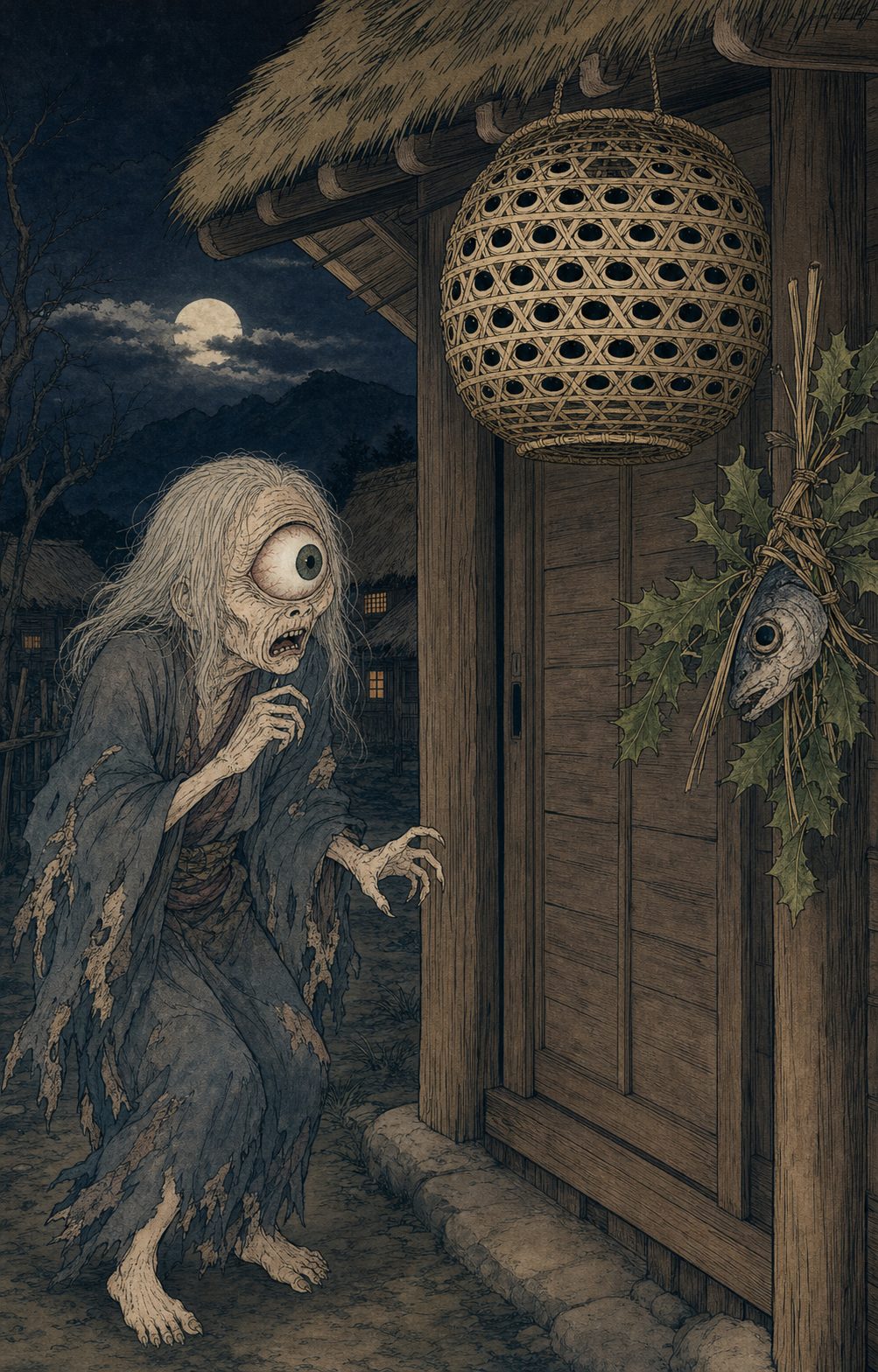
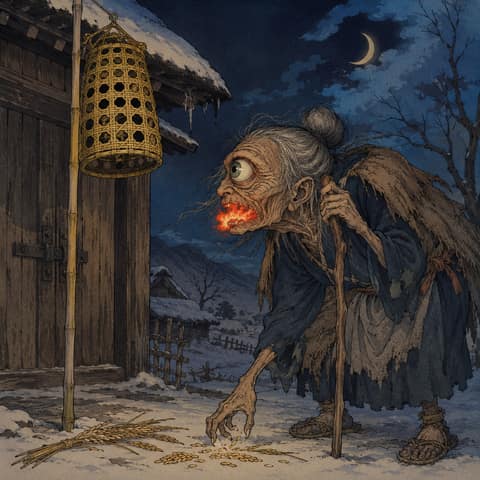
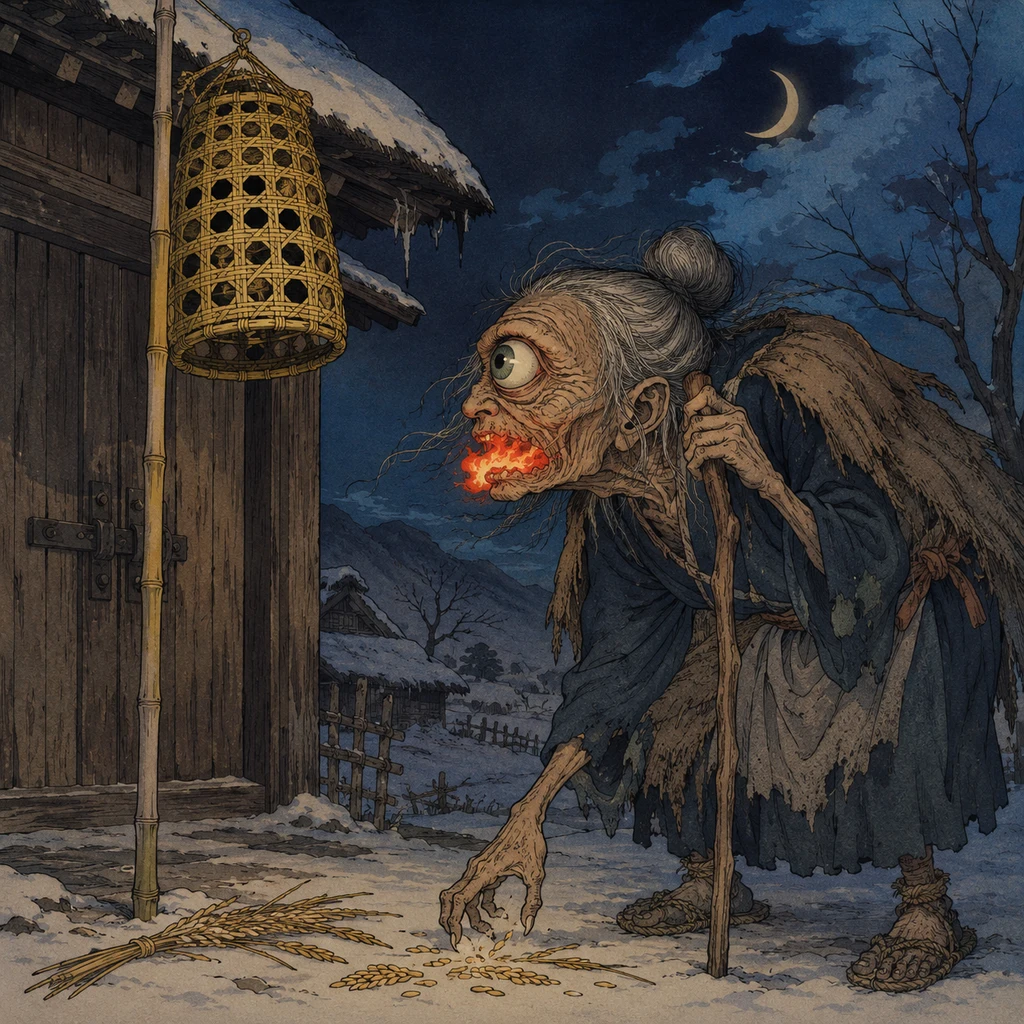
A highly feared entity on the village calendar was the Mikari-Baba. This one-eyed elderly female yokai, known throughout the Kanto region, supposedly visited houses on the eighth day of the twelfth or second lunar month—dates known as "Kotoyoka"—to "borrow" winnowing baskets (mi) or human eyes. She was said to be accompanied by the Hitotsume-Kozo. Villagers believed they could ward her off by placing heavily woven baskets and sieves with many "eyes" (openings) at their doors, or by hoisting a woven basket atop a pole on their roofs, as she was terrified of the multitude of "eyes." In Kanagawa, a unique tradition exists in Kohoku Ward, Yokohama: the Mikari-Baba was feared to come picking up fallen grains of rice and cause fires with a flame held in her mouth. To avert this disaster, on the first day of the twelfth month, people made "Tsujo Dango" from gleaned rice and pierced them at their doors to signal there was no more rice left to gather. Kotoyoka was a day for staying indoors, observing taboos, and quietly marking the turning point of the year. The Mikari-Baba served as a calendar guardian, punishing those who dared to break these periods of ritual avoidance.
Borrowed Sieve Hag
The Borrowed Sieve Hag is a one-eyed crone yokai from the Kantō region. On Koto-no-Hachi (the 8th day of the 12th or 2nd lunar month), she visits homes to “borrow” a winnowing basket (mi) or even a person’s eye. She is sometimes said to travel with the One-Eyed Boy (Hitotsume-kozō). People believed she could be averted by setting out baskets or sieves with many mesh “eyes” at the gate, or by mounting a mesh basket on a pole at the roof ridge. The tale is tied to house-seclusion and taboo-observance customs, serving as a symbol to enforce prohibitions.
Read moreThe connection between the Kotoyoka customs and one-eyed yokai contains deep folkloric layers. Since Kunio Yanagita's time, it has been argued that one-eyed monsters might be remnants of human sacrifices originally dedicated to mountain or festival gods. Individuals blinded in one eye moved closer to the divine realm, only to later degrade into yokai. The single eye of the Mikari-Baba may very well harbor the traces of such ancient beliefs. The nature of Kotoyoka varies by region. In southern Chiba, a period of abstinence known as "Mikari (Mikawari)" was established, during which nocturnal outings, mountain entry, noise, lighting lamps, dressing hair, and even bathing were avoided. Kanagawa villagers similarly placed woven baskets at each house, hung sardine heads pierced with holly (hiiragi-iwashi) at their doorways, and offered mochi or dango to weather the yokai's visit. Kotoyoka was the nexus of the annual cycle—the day the god of the rice paddies returned to the mountains and the mountain god descended to the village—making it the day the boundary between humans, gods, and yokai was at its thinnest. From Yokohama, situated on the border of Sagami and Musashi, to the mountain hamlets of Tanzawa, people marked every calendar milestone by setting up baskets, offering dango, and refraining from venturing out at night. Yokai were the very entities that shaped the rhythm of their daily lives.
The Wonders of Sagami Interwoven by Sea,
Mountain,
and Capital
Viewed in this light, Kanagawa's yokai culture emerges as the convergence of three distinct magnetic fields. The open Sagami Bay to the south is inhabited by dragons that command tides and rain—the Five-Headed Dragon of Enoshima, the Nine-Headed Dragon of Lake Ashi, and Benzaiten, who is bound to the dragons. On the towering peaks of Mount Oyama and Ashigara to the west, the tengu, such as Oyama Hokibo, and the Yama-uba hold their domains. Midway between them, the samurai capital of Kamakura and its coast birthed vengeful phantoms like the Maikubi, the Mizoidashi, and Akashi-sama, while in the mountain villages of Tanzawa and the local lands of Yokohama, the Atooi-Kozo and Mikari-Baba dictated the milestones of daily life.
Sea dragons transformed into benevolent deities through love and subjugation, mountain tengu governed peaks of faith and recreation, phantoms of the samurai capital spoke of death and mourning, and village monsters enforced calendars and ritual avoidance. Even among "dragons," Enoshima and Hakone offer different paths to redemption, and even among "vengeful spirits," the Maikubi and Mizoidashi present different themes of admonition. This sheer diversity is the direct result of distinct spiritual domains—sea, mountain, and capital—being condensed into a single prefecture. Kanagawa remains a rare crossroads of yokai, having simultaneously nurtured supernatural beings perfectly suited to each locale. Between the crash of waves in Sagami Bay and the howl of winds on Mount Oyama, the voices of dragons, tengu, and phantoms can still be faintly heard today.