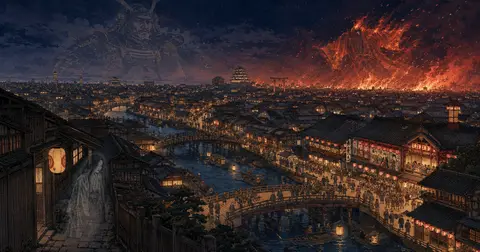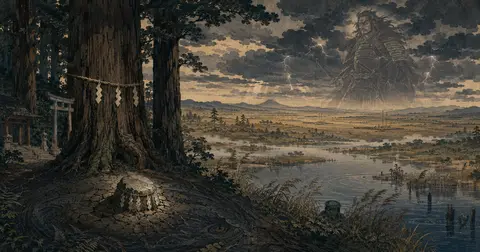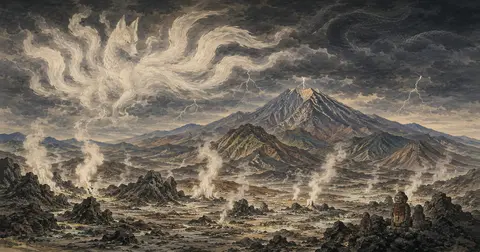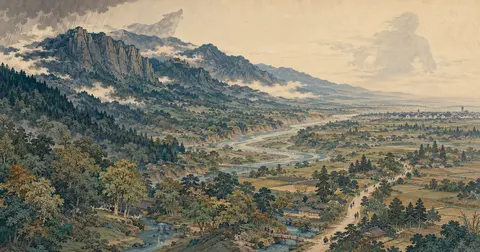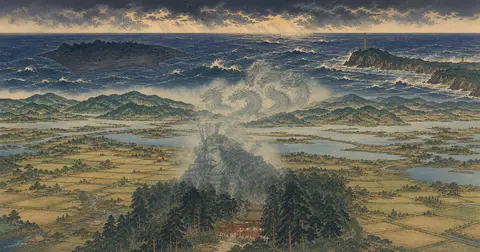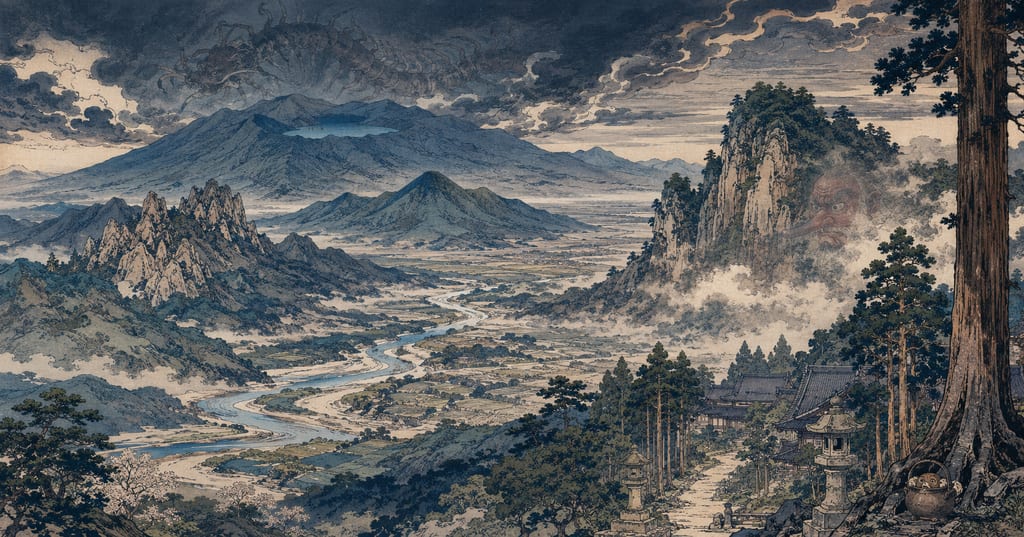
Spreading across the northwest of the Kanto Plain in the headwaters of the Tone River, Gunma Prefecture is a land of mountains and rivers formerly known as Kozuke Province. Symbolizing the prefecture are the three sacred peaks that rise abruptly from the plains: Mount Akagi, Mount Haruna, and Mount Myogi—collectively known as the Jomo Sanzan[1] (Three Mountains of Jomo). Traces of ritual worship have been carved into their foothills since the Jomon period, and with shrines enshrined on each mountain, Gunma's faith has primarily been tied to its mountains[1].
The higher the mountains, the larger the gods and yokai that dwell there. Gunma's supernatural phenomena are deeply rooted in local mountain worship and temple legends: the "divine battle" over a lake fought against the mountain god of neighboring Shimotsuke (present-day Tochigi Prefecture) in Nikko, the high priest who left behind a tengu mask on a sacred peak in Numata, and the old tanuki that transformed into an inexhaustible tea kettle at an ancient temple in Tatebayashi. This article explores five supernatural beings nurtured by the land of Jomo, tracing them through their primary literature and local folklore.
The Jomo Sanzan — Three Sacred Peaks Rising from the Plains
Before exploring the yokai of Gunma, one must first look up to its three mountains. Lining the northern edge of the Kanto Plain, which occupies the southern half of the prefecture, Mount Akagi, Mount Haruna, and Mount Myogi stand side by side like a folding screen. These are the Jomo Sanzan[1]. Each possesses a rugged appearance carved by volcanic activity, and their forms thrusting up from the flatlands must have seemed to ancient people as gods themselves. Traces of ritual worship from the Jomon period remain at the foothills of these three mountains, testifying to a long history of mountain faith[1].
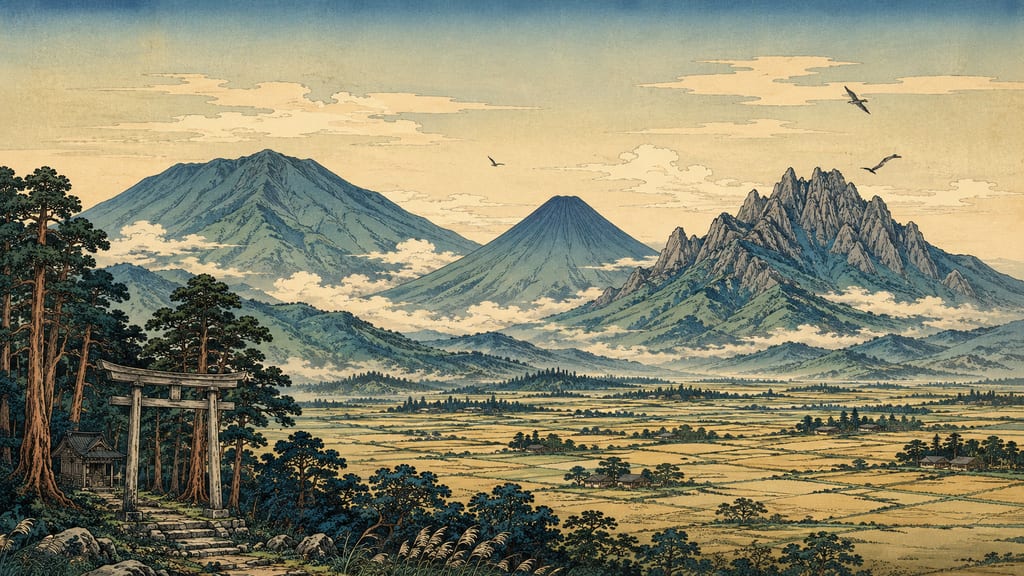
Each of the three mountains has an enshrined shrine. On Mount Haruna in Takasaki sits the Haruna Shrine, primarily worshipping the god of fire, Homusubi-no-kami, and the goddess of earth, Haniyama-hime-no-kami. Recorded as one of the twelve shrines of Kozuke Province in the Engishiki Jinmyocho (Register of Deities) in the fifth year of Encho (927), it has been a sacred site for Shugendo ascetics since the Middle Ages, venerated as "Mangyo Gongen"[2]. Mount Myogi, with its towering bizarre rock formations, also houses the Myogi Shrine, and together, the three mountains have served as sanctuaries for mountain asceticism. The steeper the mountain, the greater the gods and yokai that inhabit it—it can be said that Gunma's supernatural tales were born from the heights of these three mountains.
Akagi and Nikko,
the Battle of the Gods over a Lake
Among the three mountains, Mount Akagi is the one that conveys the most tales of the supernatural. Standing at an elevation of 1,828 meters, Mount Akagi is a complex volcano cradling Lake Ono (Great Marsh) and Lake Kono (Small Marsh) within its summit caldera. The lakes and the mountain itself have been deified and worshipped as Akagi Daimyojin. With some 300 affiliated Akagi shrines scattered throughout the Kanto region, the head shrines are said to be Miyosawa Akagi Shrine on the mountainside and Daido Akagi Shrine at the summit, conveying the wide spread of the Akagi faith even today[3].
Alongside the heroic tales of divine battles, Akagi's deity is also accompanied by the quiet legends of a goddess. According to local lore, Princess Fuchina, who drowned, and her younger sister, Princess Akagi, became the deities of Akagi and are enshrined to this day at the Akagi Shrine on Kotorigashima (Little Bird Island), which floats in Lake Ono[3]. This tradition, which reveres the Akagi deity as a goddess and a protector of women, coexists with the lineage that identifies the deity with Toyoki-irihiko-no-mikoto—a regional administrator mentioned in the *Kojiki* and *Nihon Shoki*—or with Oanamuchi-no-mikoto (Okuninushi), reflecting the multi-layered nature of the Akagi faith[3].
Akagi Daimyojin
Akagi Daimyojin is a mountain deity that represents the deification of Mount Akagi itself in the former Kozuke Province (present-day Gunma Prefecture). The caldera lakes at the summit, Lake Ono and Lake Kono, are revered as its physical embodiment (shintai). Since ancient times, it has been deeply worshipped as a god of the mountain, water, and agriculture. It is frequently identified with Toyoki-irihiko-no-mikoto, an early regional governor appearing in classical mythology, or with Oanamuchi-no-mikoto (Okuninushi). Concurrently, there exist traditions that revere it as the goddess "Akagi-hime," acting as a protector of women. With about three hundred branch shrines centered around the Kanto region, the grand head shrines of Akagi Shrine are said to be Miyosawa Akagi Shrine on the mountainside and Daido Akagi Shrine at the summit, preserving the widespread influence of the Akagi faith to this day. In the realm of folklore, Akagi Daimyojin is widely known for the "Battle of the Gods" (Shinsen), where it fought against the deity of Mount Futarasan in the neighboring Shimotsuke Province (present-day Tochigi Prefecture) over the territory of Lake Chuzenji, famously transforming into a giant centipede (O-mukade) during the conflict.
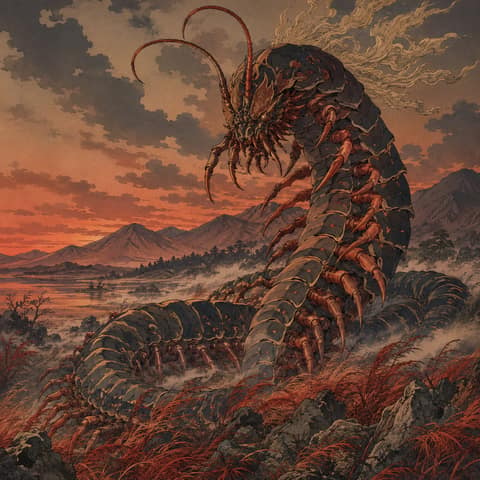
Read moreWhat made the deity of Akagi famous overnight was the "divine battle" with the deity of Mount Nikko Futarasan (Mount Nantai) in the neighboring province of Shimotsuke. The two deities fought long and hard over the territorial rights to Lake Chuzenji, eventually changing their forms to do battle. According to the standard account in the mid-Muromachi period *engi* (temple legend), the Nikkosan Engi[4], the deity of Mount Futarasan transformed into a giant serpent, while the deity of Akagi manifested as a Giant Centipede (Omukade), clashing at what is now Senjogahara (the Moor of the Battlefield)[[/cite:nikko-akagi-densetsu]]. The place name "Senjogahara" originates from this divine battle, and it is said that the moor was also called "Akanumagahara" (Moor of the Red Marsh) because the spilled blood dyed it red[5].
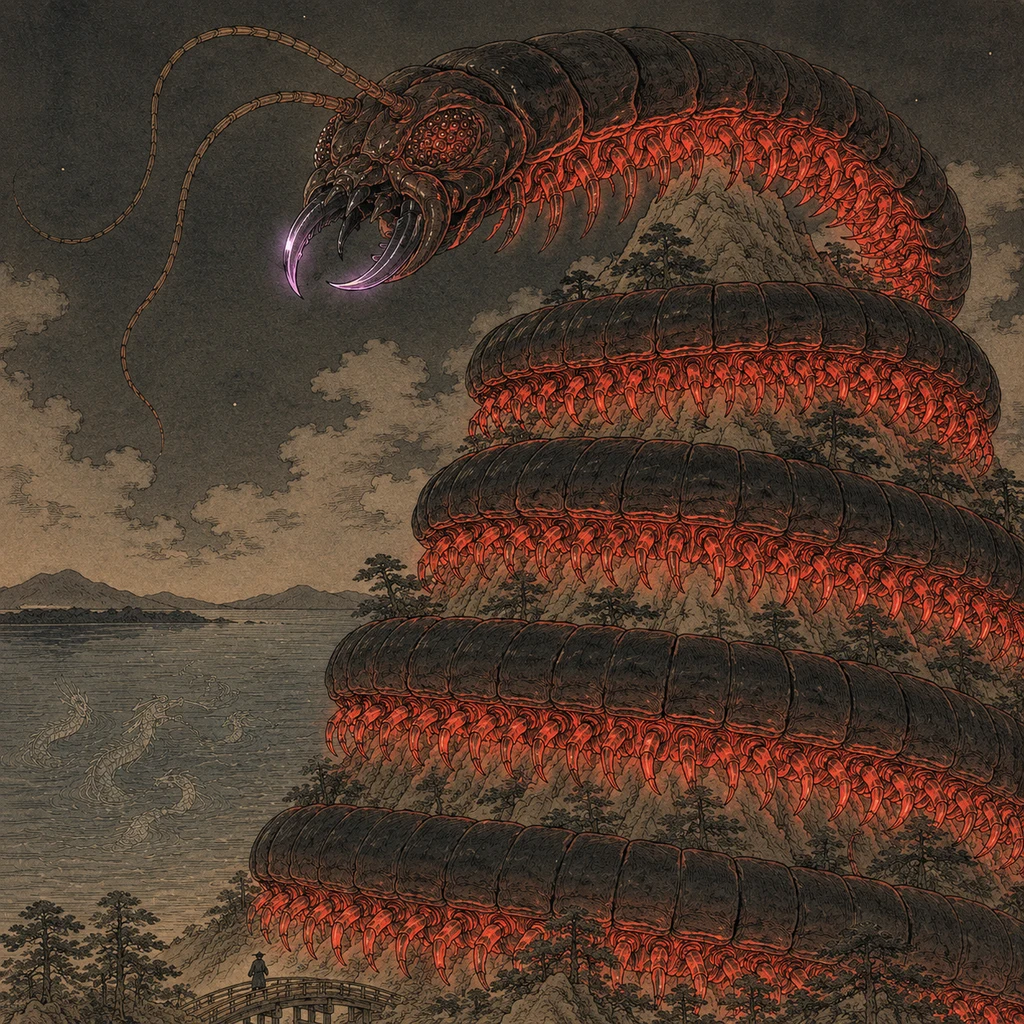
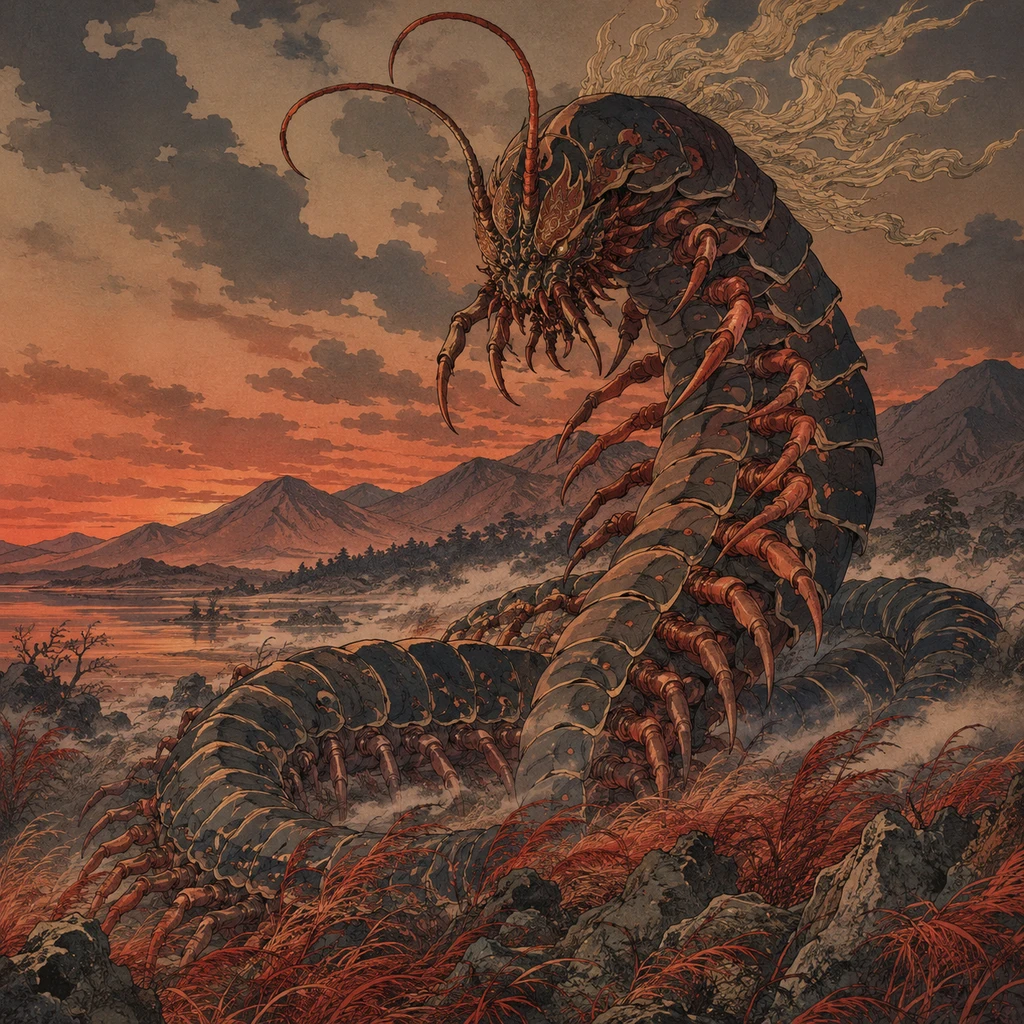
Giant Centipede
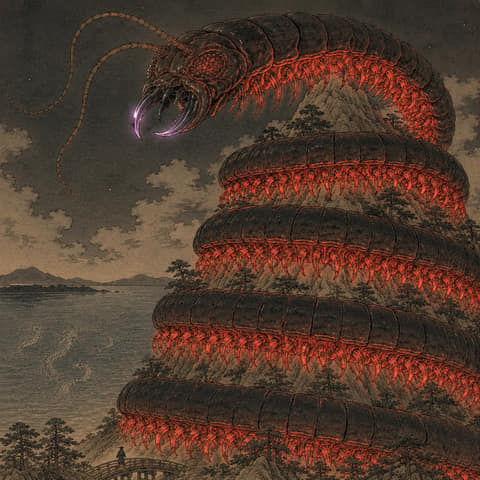
The Giant Centipede is a monstrous centipede yokai whose carapace is so hard it deflects blades and arrows. Its body is long enough to coil around mountains, its many legs glow a fiery red, and its venomous fangs were said to bite through armor. It is portrayed as an adversary of great serpents and dragons—water deities—with whom it battles in lakes, marshes, and the wilds. Centipedes symbolized fearless resolve and were seen as auspicious by warriors and merchants, though details of this creature vary widely by region.
Read moreAt first, the Akagi side's Giant Centipede had the upper hand. In dire straits, the deity of Mount Futarasan received advice from Kashima Daimyojin and summoned Ono-no-Sarumaru, a master archer from Oshu, whose arrow pierced the Giant Centipede's left eye. Gravely wounded, the Akagi side retreated to their mountain—this is the "Victory of Futarasan" passed down on the Nikko side[5]. The oldest extant text, the Nikkosan oyobi Tōsha Engi[4], bears a colophon dated the ninth year of Bunmei (1477), indicating that the memory of the divine battle was established in literature by the Muromachi period at the latest[4].
What must not be overlooked here is that both the victor and the incarnations are recounted in exactly the opposite manner depending on the region. In the hot spring discovery legend passed down in Oigami Onsen in Numata City, Gunma Prefecture, the roles are entirely reversed. Here, the deity of Mount Akagi is the giant serpent, and the deity of Nikko is the giant centipede[6]. When the serpent deity of Akagi was wounded by an arrow, he pulled it out and thrust it into the ground at the foot of the mountain, causing a hot spring to gush forth. He healed his wounds with its waters and drove away the enemy. It is said that the name of the place, "Oigami" (pursuing god), changed over time to "Oigami" (old god), and even today, the "Giant Serpent Festival" is held every May, with a long serpent mikoshi parading through the hot spring town[6].
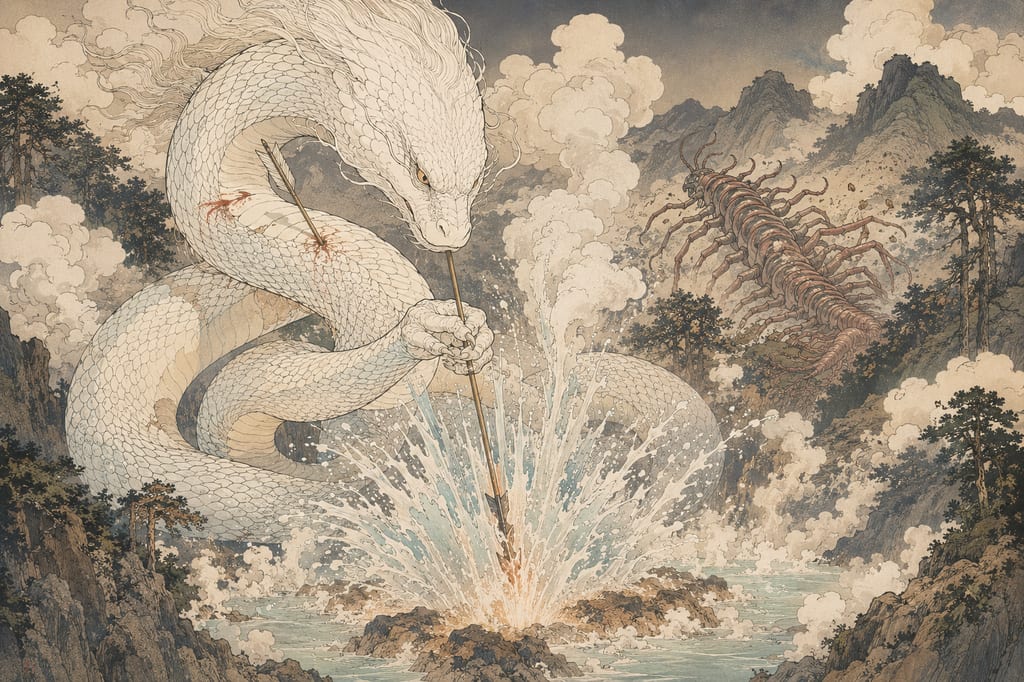
In other words, the same divine battle is transmitted like a mirror image across the provincial border: as a tale of "Futarasan winning by becoming a serpent" in Shimotsuke, and as a tale of "Akagi repelling the enemy by becoming a serpent" in Kozuke. Rather than determining which is correct, it is reasonable to read this as the rivalry itself between mountain deities spanning borders giving rise to two narratives, each claiming its own local deity as the victor. In myths, victory takes the side of the land that tells it.
It should be noted that both Lake Chuzenji and Senjogahara, the stages of the divine battle, are currently located in Tochigi Prefecture, and the place name "Senjogahara" also remains on the opposite shore in Nikko. Yet, the reason the deity of Akagi continues to be the protagonist of this battle is undoubtedly because the people of Gunma have proudly revered Akagi as a "great deity capable of challenging the gods of other provinces." The tale of the divine battle is not merely a ghost story, but an expression of the regional pride Kozuke Province held against its neighbor. This narrative, whose prototype has been passed down since the Kamakura period and was crystallized in text as an *engi* in the Muromachi period, is a piece that forms the backbone of Gunma's yokai culture[4].
The Bug That Never Retreats,
the Behemoth Known as the Omukade
The Giant Centipede that the deity of Akagi transformed into is a yokai that casts a large shadow outside of Gunma as well. The most famous tale of exterminating a giant centipede is set in Omi Province (present-day Shiga Prefecture), first appearing in Volume 15 of the *Taiheiki*[7], and popularized during the Muromachi period by the *Tawara Toda Emaki* (Scroll of Tawara Toda)[8]. When Tawara Toda (Fujiwara no Hidesato) fearlessly stepped over a giant serpent lying across the Seta Karahashi Bridge, the serpent transformed into a dragon woman, pleading with him to exterminate a giant centipede coiled seven and a half times around Mount Mikami that was tormenting her clan. Toda's first and second arrows bounced off, but the third arrow, its arrowhead moistened with his saliva, pierced the space between the centipede's eyes, finishing it off—this is the Omi lineage's narrative[8].
In Omi, the Giant Centipede is a villain threatening dragons and serpents; in Gunma, it is the incarnation of a mountain god matching blows with a dragon or serpent (the serpent deity of Nikko)—its position differs completely by region. What they share, however, is that the Giant Centipede is a formidable foe that only falls when shot in the "left eye" or "between the eyebrows," and was viewed as a symbol of brave, unyielding spirit as a bug that only moves forward and never retreats. In the Toda extermination tale, the first and second arrows are repelled by its hard shell, and it is finally slain by the third arrow, tipped with saliva believed to possess demon-quelling power—this "method of extermination using saliva" is sometimes interpreted in connection with Onmyodo concepts of spell-binding[7]. In gratitude, Toda was given inexhaustible bales of rice and rolls of silk by the dragon god, and he is said to have dedicated a bronze temple bell to Mii-dera (Onjo-ji)[[/cite:tawara-toda-emaki]].
Due to this virtue of non-retreat, folklore later arose that worshipped the Giant Centipede as an envoy of Bishamonten or as an envoy of the gods of mines. This is a belief system separate from the extermination tales, a theory from the early modern period onward. The reason the deity of Akagi chose the form of the Giant Centipede was not simply because of its massive size, but because this insect embodied an "unyielding power" fitting for a mountain god. The fact that two distant sacred mountains—Mount Mikami in Omi and Mount Akagi in Kozuke—are linked to their respective dragon and serpent tales through the same behemoth of the Giant Centipede is proof that the universal theme of conflict between mountain and water deities was repeatedly told across various regions.
The High Priest Who Left a Tengu Mask on Numata's Sacred Peak
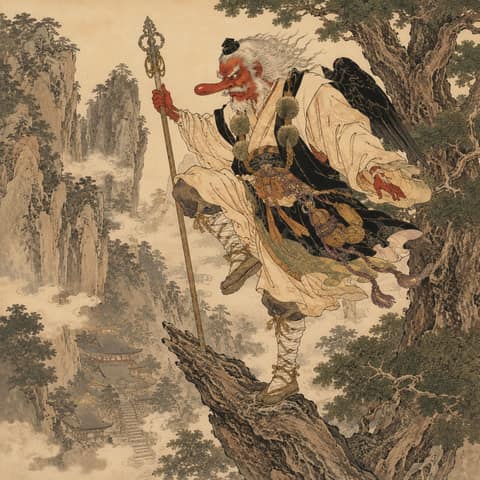
Further up the Tone River in Numata lies another of Gunma's sacred sites. Numata opened up on the grand river terrace carved by the Tone, Usune, and Katashina rivers; it was a strategic point in the northern Kanto region fought over by the Uesugi, Later Hojo, and Takeda clans during the Sengoku period, and later its town layout was developed by the Sanada clan[9]. Enshrined on the sacred peak of Mount Kasho, about 16 kilometers north of the city center, is the Tengu of Mount Kasho. Counted as one of the "Three Great Tengu of Japan" alongside Yakuo-in on Mount Takao in Tokyo and Kurama-dera in Kyoto, it is the preeminent center of tengu worship in Gunma[10].
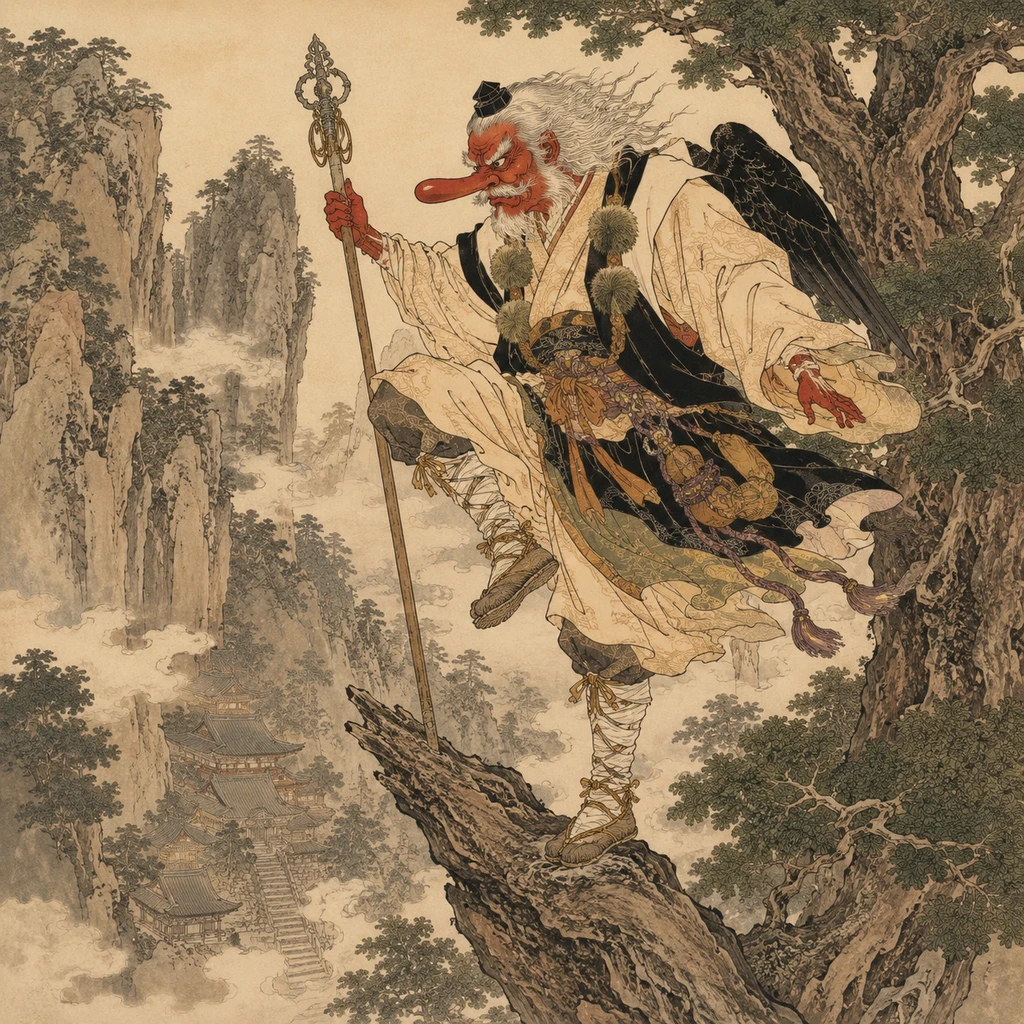
Kasho Tengu
The Kasho Tengu is a tengu enshrined at Mount Kasho, a sacred peak in Numata, Kōzuke Province (present-day Gunma Prefecture). It is counted among the "Three Great Tengu of Japan," alongside those of Mount Takao's Yakuō-in in Tokyo and Kurama-dera in Kyoto. Its true identity is said to be Chūhōson (the Venerable Chūhō), a high-ranking disciple of Zen Master Tenson Keijun, who converted Miroku-ji to the Sōtō sect of Zen Buddhism. Endowed with supernatural powers, Chūhōson guided ascetic practitioners to the cavern at the temple gate and up precipitous rocky crags that no human could climb by ordinary means. Legend has it that he ascended to heaven as an incarnation of Kasho Buddha, leaving behind only a tengu mask. Locals affectionately refer to Mount Kasho as "Tengu Mountain." The enormous "Great Tengu Mask" housed in the Chūhōdō hall—measuring 6.5 meters in length and featuring a 2.8-meter-tall nose—is famous as the largest tengu mask in Japan.
Read moreHis true identity is said to be Chuho Son (Chuho Sonja), a high disciple of Zen Master Tenson Keijun, who converted Kashozan Ryuge-in Miroku-ji into a Soto Zen temple. Chuho Son was a monk endowed with divine powers to guide ascetics to steep rock caves unreachable by human effort; it is told that he ascended to heaven as an incarnation of the Kasho Buddha, leaving behind a tengu mask in his wake[10]. According to temple tradition, the temple was founded by Ennin (Jikaku Daishi) of the Tendai sect in the first year of Kasho (848), but the actual foundation is thought to be later; it is an ancient temple that was converted to the Soto sect and restored by Tenson Keijun in the second year of Kosho (1456). During the Edo period, it gained the status of a prayer site for Tokugawa Ieyasu, receiving a red seal estate of 100 koku and the prestige of 100,000 koku[10].
What characterizes the tengu worship of Mount Kasho is the unique custom of "borrowing and returning a mask." Pilgrims first borrow a single tengu mask from the Chuho-do Hall to take home, and on their next visit, they offer the borrowed mask along with a new one purchased at the temple gates, then borrow another mask—this ritual of reciprocal exchange continues to this day[10]. The locals affectionately call Mount Kasho "Tengu Mountain." The enormous "Great Tengu Mask" enshrined in the Chuho-do Hall, measuring 6.5 meters in face length and 2.8 meters in nose height, is renowned as the largest tengu mask in Japan[11].
Tengu worship does not remain confined to the mountaintop temple; it also descends to the festivals of the castle town at the foot of the mountain. Every August at the Numata Festival, a giant tengu mask mikoshi inspired by the Great Tengu of Mount Kasho appears, and the "Tengu Mikoshi," carried exclusively by about 300 women, becomes the highlight of the festival[9].
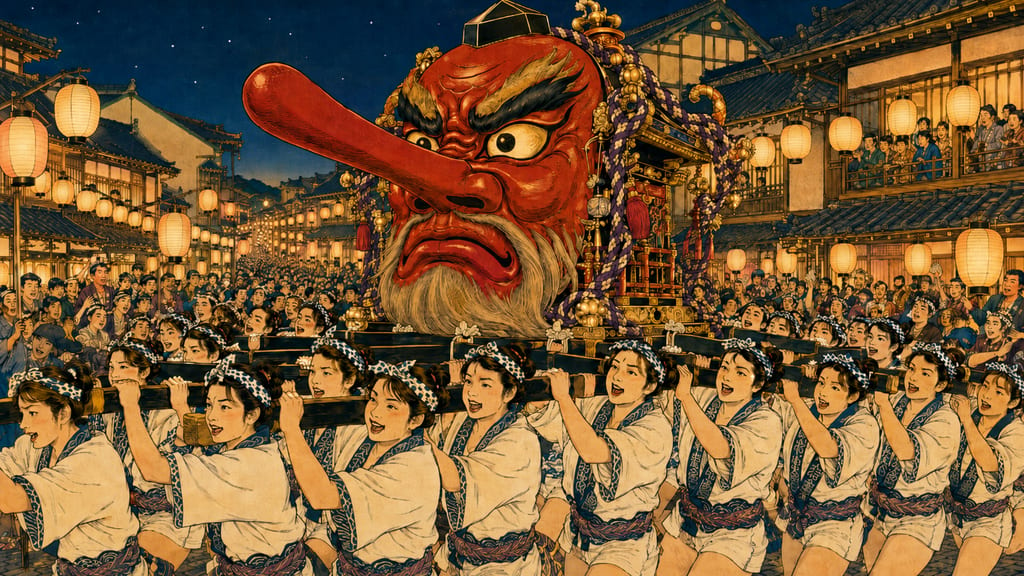
The mountain god takes the form of a tengu, which as an incarnation of the high priest Chuho Son becomes the temple's tutelary deity, and is then carried by the people in the castle town's festival—a multi-dimensional manifestation of Gunma's prayers, distinct from the mountain god of Akagi, where Buddhism and mountain worship are intertwined in many layers.
The Chariot of Fire Attacking Funeral Processions,
Gunma's Kasha
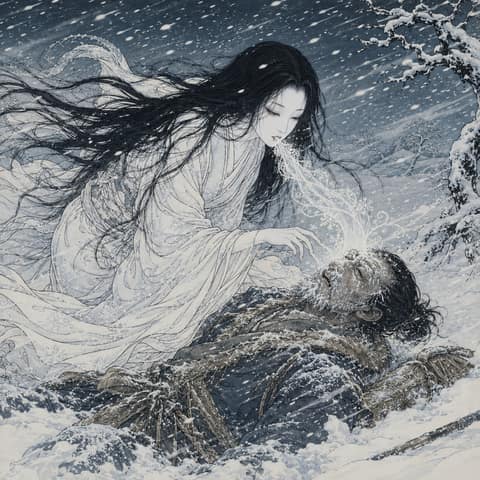
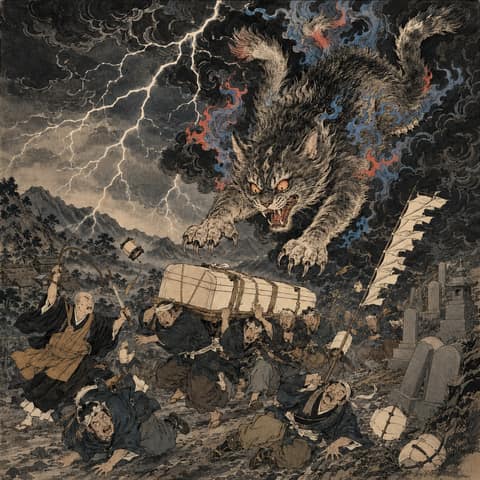
Gunma's supernatural phenomena do not only dwell on sacred mountains and in temples. In the scenes of village funerals as well, there was a yokai that people deeply feared. It is the Kasha, said to appear at funerals, funeral processions, and graveyards to snatch away coffins and corpses.
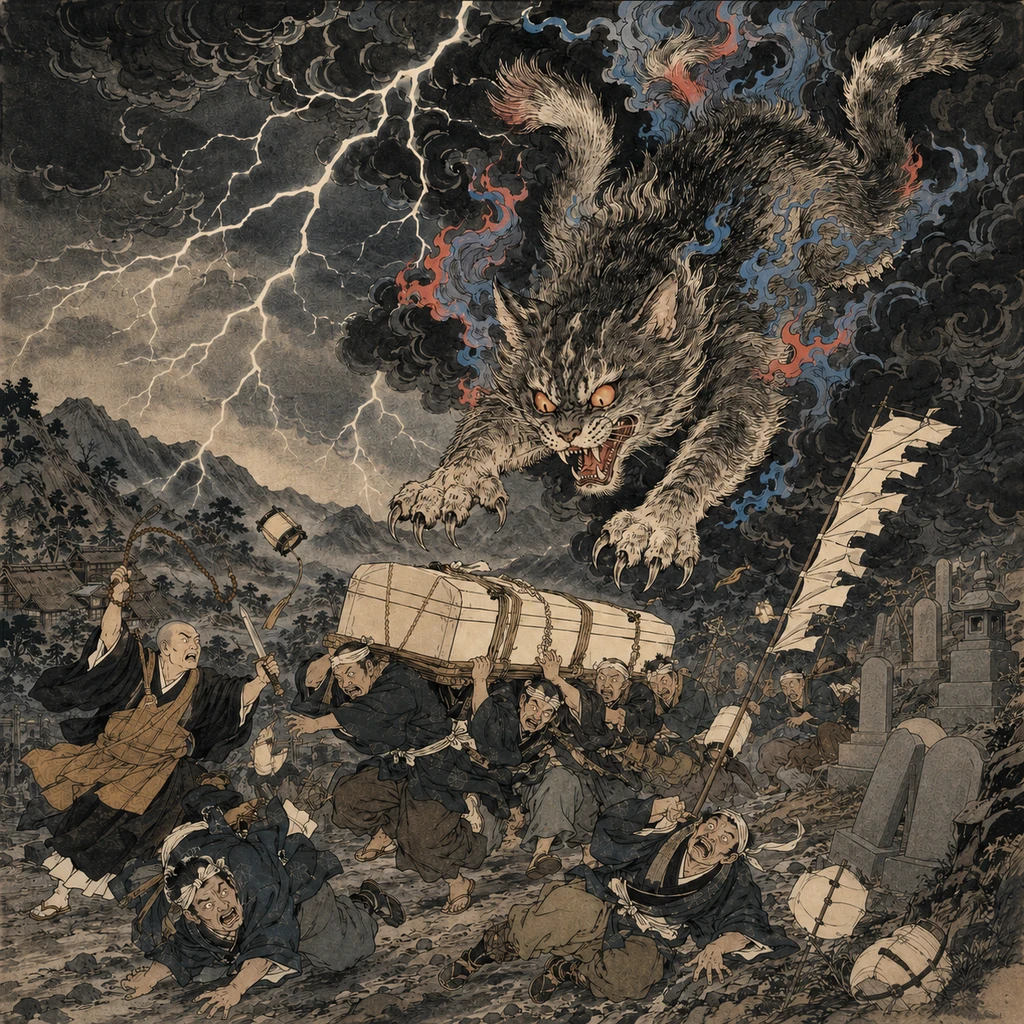
Kasha (Corpse-Dragging Fiend)
A yokai said to appear at funerals, funeral processions, and graveyards to snatch coffins and corpses. In the early modern period it was told as a hellish jailer or thunder god’s doing, stealing bodies amid black clouds and lightning. Later it merged with bakeneko lore, spreading the belief that an aged cat becomes a kasha and preys on the dead. Reports occur nationwide and are not strictly framed as moral retribution. Traditional countermeasures include blades, prayer beads, mounded earth, and constant vigil.
Read moreThe name Kasha originates from the "chariot of fire" (hi-no-kuruma) in Buddhism that transports wicked people to Hell. In the early modern period, it was spoken of as the work of Hell's jailers or Raijin (the god of thunder), and was said to spirit away corpses along with dark clouds and lightning. In Kikuoka Senryo's *Shokoku Rijindan* (Tales of Village Folk from Various Provinces)[12] (published in the third year of Kanpo, 1743), there is a story of dark clouds and lightning attacking a funeral procession to snatch the corpse from the coffin, and a monk preventing this through his dharma power[12]. Matsura Seizan's *Kasshi Yawa* (Night Tales of the Rat)[13] also contains accounts of strange phenomena stealing corpses during funerals[13].
Eventually, the Kasha syncretized with nekomata legends, spreading the theory that old cats turn into Kasha to target corpses. Momosan-jin's illustrated ghost story collections present this Kasha with illustrations and commentary, depicting it as a demon that snatches the remains of those who have accumulated evil deeds. Similar entities under different names have been recorded in Gunma as well as in Nagano, Tono in Iwate, and elsewhere, all sharing the trait of targeting funeral processions and coffins. In various regions, customs have been passed down such as temple monks driving away the "Kasha-neko" and dedicating its remaining tail as a charm, or keeping a constant watch during wakes and not allowing cats to approach. Using bladed tools, prayer beads, mounds of salt or dirt, and standing guard overnight were also common practices across regions to keep the Kasha at bay.
Compared to the grand tales of mountain gods and tengu like Akagi and Kasho, the Kasha is a yokai belonging to the darkness of a nameless village's funeral. However, in the deeply mountainous and snowy villages of Joshu—the old name for Gunma—the feeling that supernatural horrors creep in precisely on the nights when mourning the dead has kept these customs of keeping watch alive for a long time. The depth of Gunma's yokai culture lies in seeing the shadows of the supernatural not only in high mountain deities but even in the mourning spaces of villages.
The Ancient Temple of Tatebayashi,
the Inexhaustible Bunbuku Chagama
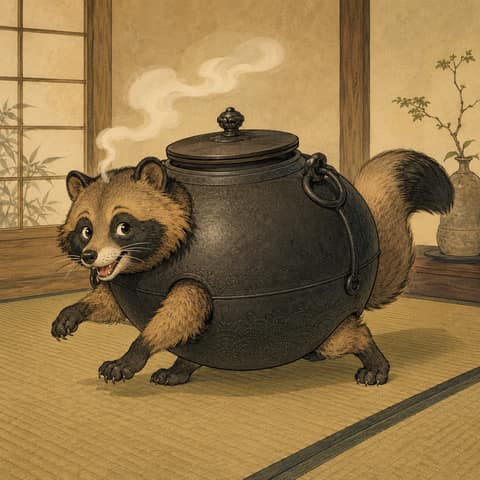
In Tatebayashi, at the southeastern edge of Gunma, there is a beloved yokai known throughout the country. It is the wondrous tea kettle with an inexhaustible supply of hot water passed down at the Soto Zen temple Morin-ji—the Kettle of Morin-ji, or the Bunbuku Chagama.
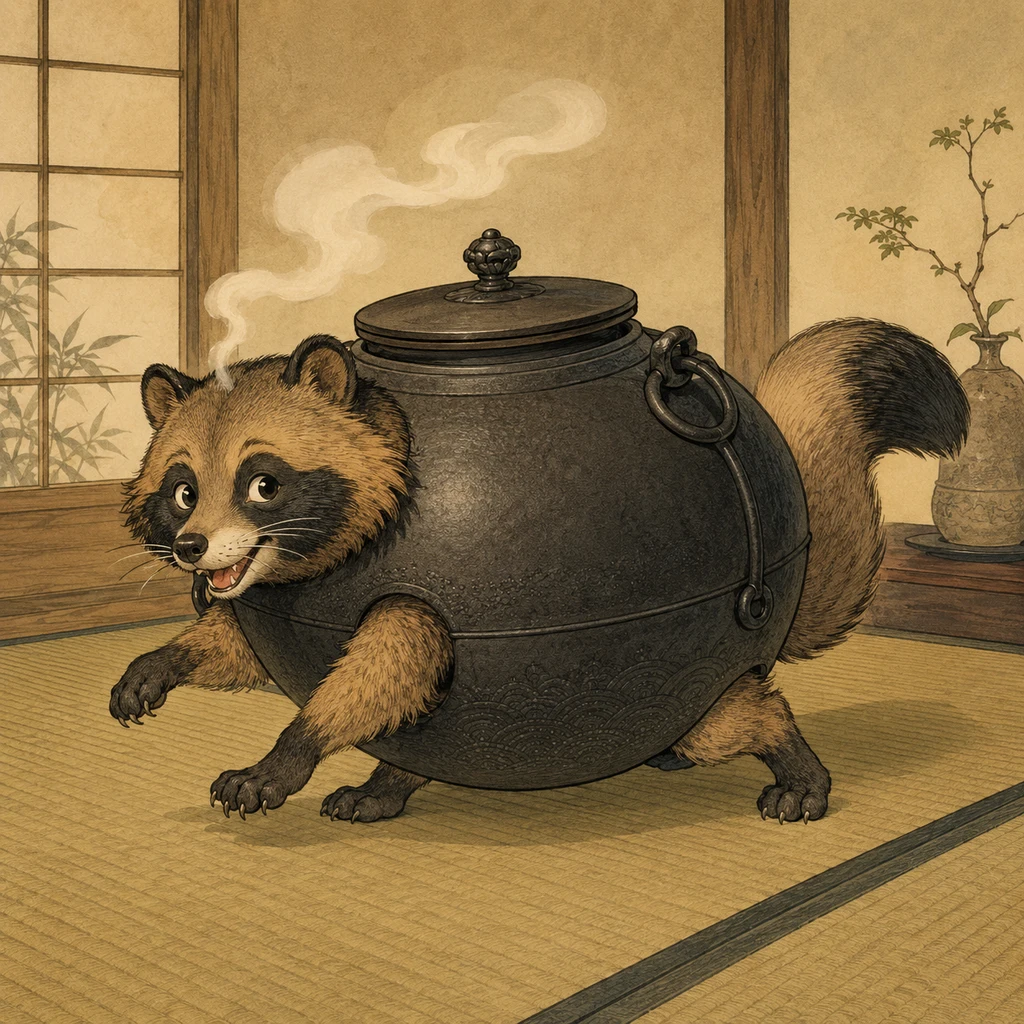
The Kettle of Morinji
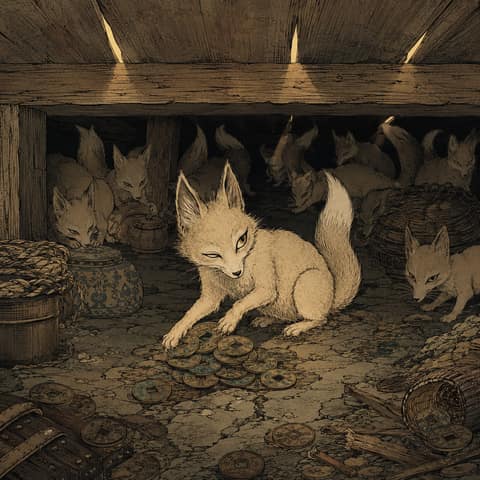
A mysterious tea kettle linked to Shukaku, the shape-shifting tanuki of Morinji recorded in Kōshi Yawa. The kettle poured endless hot water to serve tea to monks—said to be Shukaku’s sorcery. Shukaku’s true form is an ancient tanuki who heard the Dharma in distant India and came to Japan via China. The tale is regarded as the prototype of the later folktale "Bunbuku Chagama" and became entwined with the temple’s treasures and local lore.
Read moreAccording to the origins of Morin-ji, it was the old monk Shukaku, who came to Tatebayashi accompanying the founder, Dairin Shotsu, who brought about the miracle of this tea kettle[14]. Temple tradition holds that Dairin Shotsu built a small hermitage in Tatebayashi around the thirty-third year of Oei (1426), and in its history, Shukaku met Shotsu at the foot of Ikaho in Kozuke Province, and they traveled down to Tatebayashi together. In the first year of Genki (1570), during the time of the seventh abbot, Gesshu Shosho, a grand Thousand-Monk Assembly was held, and when a vast amount of hot water was needed to serve the guests, Shukaku brought a tea kettle from somewhere overnight and placed it in the tea hall. It is said that no matter how much water was scooped from this kettle, it never ran dry, and it was praised as the "Bunbuku Chagama" (the tea kettle that shares blessings). It was also said that those who quenched their thirst with its water would receive virtues such as good fortune, career success, and longevity[14].
Eventually, during the time of the tenth abbot, Tennan Shosei, in February of the fifteenth year of Tensho (1587), Shukaku's true identity was exposed when he was peeked upon while napping, revealing the form of a mujina (or tanuki) with furry limbs and a tail. It is said that upon his departure, he manifested two illusions—the Battle of Yashima and the preaching of the Buddha—and left the temple forever[14]. Shukaku is spoken of as an old tanuki who lived for many centuries, traveling from faraway India and China[13], and is popularly counted as one of the Three Great Tanuki of Japan.
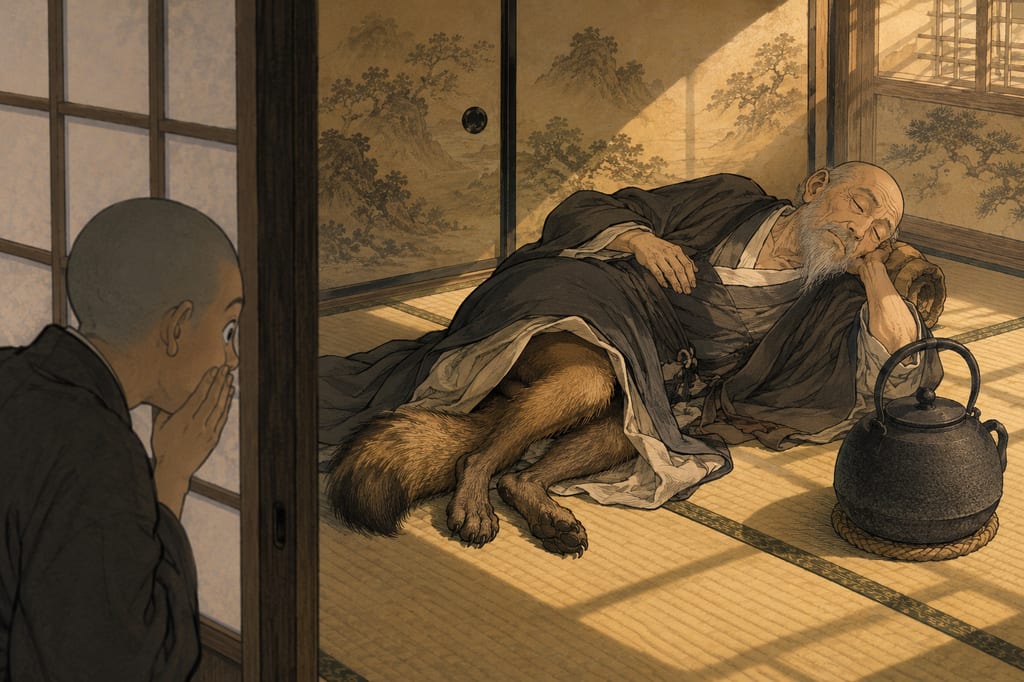
What should be noted here is that the adorable story we are familiar with—of a tanuki sprouting limbs and a face from a tea kettle and performing tightrope walking and acrobatics—is not the Shukaku tale of the temple's tradition itself. That endearing plot spread after Sazanami Iwaya[15] adapted it into a fairy tale from the late Meiji to Taisho periods, and it differs from the original lore's image of "Shukaku as an old mujina monk"[15]. The miracle of the inexhaustible kettle is proof of Shukaku's dharma power, while the tightrope-walking tanuki is an invention of modern children's stories—under the same name of "Bunbuku Chagama," the narratives of two different eras are layered. Even today, Morin-ji houses a temple treasure called the Bunbuku Chagama, and numerous tanuki statues line the approach, deeply rooting it in Tatebayashi's folklore of famous places as one of the "Three Great Tanuki of Japan," alongside Kincho of Tokushima in Shikoku and Inugami Gyobu of Ehime.
While the Giant Centipede of Akagi and the Tengu of Kasho were monsters of the "mountains," the tanuki of the Bunbuku Chagama is a monster of the "temple" and the "village." Disguising itself as a high priest to serve the temple and transforming into a kettle that shares blessings, this tanuki carries a familiarity as if humans and yokai have spent years together under one roof, rather than the awe inspired by the gods of the mountains. It can be said that the characteristic of Gunma's yokai lies precisely in the breadth of their habitats, ranging from steep mountain peaks to the warm tea halls of temples.
The Shapes of the Supernatural Connected by the Land of Jomo
Looking across the landscape in this way, it becomes clear that Gunma's yokai are not scattered haphazardly, but are connected in a single thread by the geography and faith of this land. The height of the Jomo Sanzan rising from the plains gave birth to the divine battle of mountain gods over a lake and the Giant Centipede; on the terraces of Numata carved by the Tone River stood a tengu transformed from a high priest; and in Tatebayashi to the southeast, where the Tone flows, the tale of the old tanuki with its inexhaustible tea kettle was passed down. The sanctuaries of mountain faith—Akagi, Haruna, and Myogi—and the lineage of Shugendo mountains elevated the status of these supernatural beings, and even a nationwide funeral horror like the Kasha took root and has been told and retold in the snowy villages of Joshu. From the caldera lakes at the summits to the festivals of the castle towns, and to the mourning nights of the villages—the vertical range of the places where the supernatural dwell directly reflects the depth of the faith of the land called Gunma.
- Akagi DaimyojinAkagi Daimyojin
- Kasho TenguKasho-tengu
- The Kettle of Morinjimoh-RIN-jee no KAH-mah
- Kasha (Corpse-Dragging Fiend)KAH-shah
And what best symbolizes Gunma's supernatural tales is the fact that the divine battle of Akagi and Nikko is told in exactly the opposite manner across the provincial border. In Shimotsuke, Futarasan became a serpent and won; in Kozuke, Akagi became a serpent and repelled the enemy—the same battle is conveyed in both lands with their own local deity set as the protagonist. The tales of yokai are never a single, fixed truth. The prayers and pride of the land that tells them have chosen the victor, the incarnation, and the origins of place names.
In literature as well, the supernatural beings of this land have left distinct footprints. The prototype of the divine battle has been passed down since the Kamakura period and settled in the mid-Muromachi *Nikkosan Engi*[4]; the extermination of the Giant Centipede first appeared in the *Taiheiki*[7] and was depicted in the *Tawara Toda Emaki*[8]; the Kasha was recorded in the *Shokoku Rijindan*[12] and *Kasshi Yawa*[13]; and the Bunbuku Chagama was told in the origins of Morin-ji[14] and spread nationwide through the fairy tales of Sazanami Iwaya[15]. The yokai born in this province looking up at the Jomo Sanzan continue to quietly speak today of what the land of Gunma itself has feared and what it has relied upon.