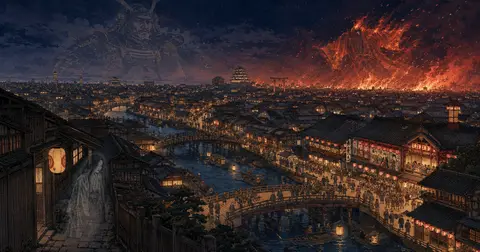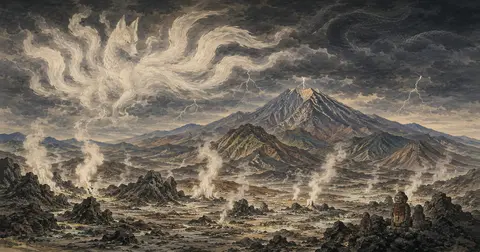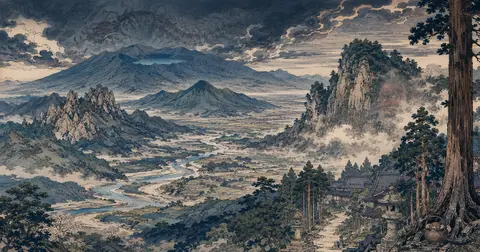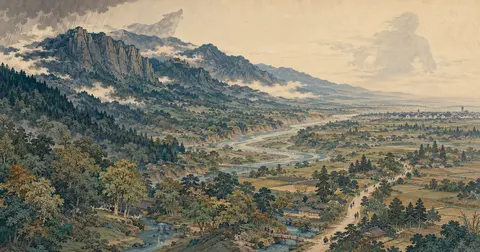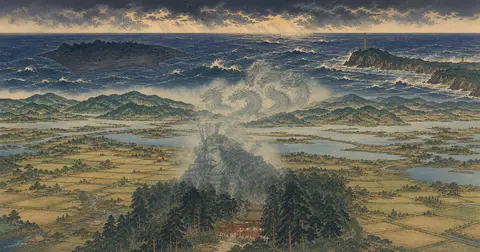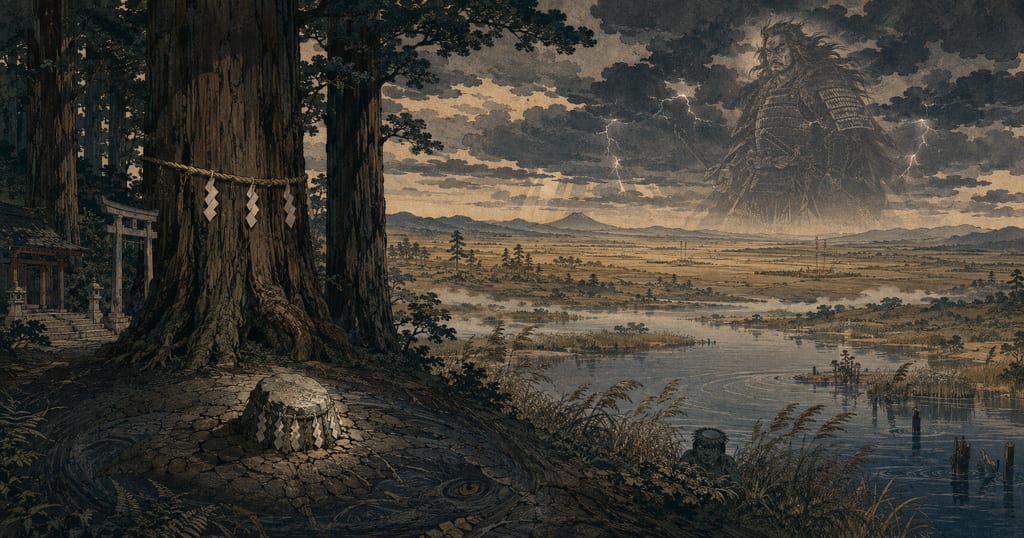
Stretching outward toward the Pacific Ocean in the northeast of the Kanto Plain, Ibaraki Prefecture was known in ancient times as Hitachi Province. Compiled by imperial decree in the sixth year of Wado (713), the *Hitachi no Kuni Fudoki* (Topography of Hitachi Province)[1] praises this land, stating "the soil is fertile and excellent for cultivation," depicting it as a rich realm blessed with the sea, lakes, and rivers. A legend of a giant is recorded at Okushi Hill in Naka District—a person so extraordinarily tall that they could stretch their hands from the hilltop to the seashore to dig for and eat clams, the shells of which piled up to form the hill. This tale, which remains today as the Okushi Shell Mound, is known as one of Japan's oldest giant stories and is considered one of the origins of the giant-worship later collectively termed Daidarabou (Daidarabocchi).
While being a land of fertility, Hitachi was simultaneously a province of "shaking earth." Facing the Kashima-nada Sea, this lowland, where vast lakes and marshes like Lake Kasumigaura, Lake Kitaura, and Lake Ushiku connect with the Tone River system, is constantly subjected to earthquakes and floods. For this very reason, the worship of a war god who holds down the earth itself coexists here with the illusion of a giant fish writhing in the depths. Moreover, this land of Bando was the birthplace of a man who rebelled against the imperial court and proclaimed himself the New Emperor—Taira no Masakado—a place that transformed him into a vengeful spirit.
The central axis running through the yokai culture of Ibaraki Prefecture is, in a word, "quelling and cursing." The war god of Kashima quells the earth with a keystone, the slain hero becomes a vengeful spirit bringing curses, and kappa dwell in the depths of the water town. Let us explore this land where gods, vengeful spirits, and water monsters intertwine in a three-way struggle, using historical documents as our guide.
A Province of Ancient Anomalies Recorded in the Fudoki
Before discussing Ibaraki's yokai culture, we must touch upon its oldest stratum. Following the imperial decree to compile provincial topographies issued nationwide by Empress Genmei in the sixth year of Wado (713), the *Hitachi no Kuni Fudoki*[1], believed to have been completed during the Yoro era, is one of the five surviving *Fudoki*. It conveys just how ancient and rich the memories held by the province of Hitachi truly were.
The seeds of anomalies are already recorded there. The tale of the giant of Okushi Hill in Naka District—an extraordinarily tall person who lived on the hill and could stretch their hands to the beach while lying down to dig up and eat clams, their discarded shells piling up to form a hill—eventually leads to the giant-worship of land-pulling and mountain-making, collectively known in later eras as Daidarabou (Daidarabocchi). Even today, a statue of Daidarabou stands in Ibaraki Prefecture in connection with the Okushi Shell Mound, and tales of giants carrying Mount Fuji on their backs or places named after where the giant sat down remain throughout the area. The *Fudoki* also recounts a myth where Yatonokami, horned snake deities, clashed with people clearing new fields, conveying to the present the worldview of ancient Hitachi where human endeavors and the spirits of the land vied against each other. Fertility and the supernatural coexist inseparably—the yokai culture of Ibaraki had already etched this characteristic during the stage of this ancient topography.
The War God of Kashima,
the Keystone,
and the Giant Catfish
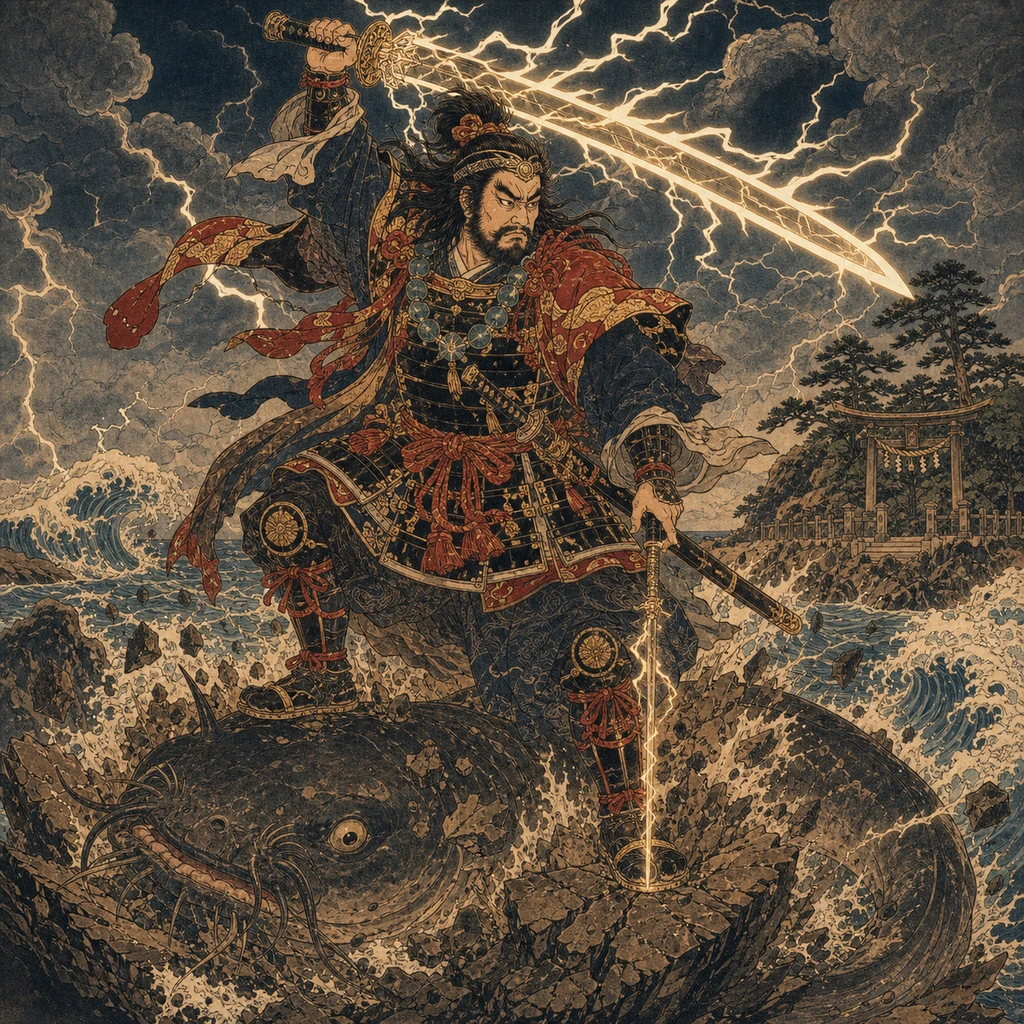
Enshrined on the plateau nestled between Lake Kitaura and the Kashima-nada Sea in southeastern Ibaraki Prefecture, Kashima Jingu is the supreme shrine of Hitachi Province and the head shrine of all Kashima shrines nationwide. Its enshrined deity is Takemikazuchi-no-Kami[2]. In the *Kojiki* and *Nihon Shoki*, he is the god of thunder and swords, dispatched from the heavens to negotiate the transfer of the land from Okuninushi, overwhelming his opponent by sitting cross-legged on the tip of his sword. His anecdote of winning a test of strength against Takeminakata-no-Kami is also spoken of as the origin of sumo wrestling, and he has been deeply revered as a god of martial arts and victory, serving as the tutelary deity for the Nakatomi/Fujiwara and Mononobe clans.
Takemikazuchi
Takemikazuchi-no-Kami is a deity of thunder, swords, and martial arts appearing in the *Kojiki* and *Nihon Shoki*. When his father, Izanagi-no-Mikoto, slew the fire god Kagutsuchi with the Totsuka-no-Tsurugi sword, the blood from the base of the sword splashed onto a rock, giving birth to three deities, of which Takemikazuchi is one. As the main figure in the Kuniyuzuri (Transfer of the Land) myth, he descended from Takamagahara to Izumo Province, engaging in a test of strength with Takeminakata-no-Kami. Turning his hand into an icicle and then a sword, he crushed Takeminakata's hand and chased him to Suwa in Shinano Province. This test of strength is considered the origin of Japanese sumo. In the myth of Emperor Jimmu's Eastern Expedition, Takemikazuchi's sword, Futsu-no-Mitama, was presented to Emperor Jimmu, becoming a crucial artifact in pacifying evil deities. This sword is still enshrined as the sacred body of Isonokami Shrine. Revered as the main deity of Kashima Shrine, the Nakatomi (Fujiwara) clan historically worshipped him as their tutelary deity, later enshrining him at Kasuga Grand Shrine in 768. From antiquity to the present, he has been deeply venerated as the guardian deity of martial arts, sumo, kendo, and the pacification of earthquakes.
Read moreAccording to shrine traditions, Kashima Jingu is an ancient shrine founded in the first year of Emperor Jimmu's reign, serving as the stronghold for the war god positioned at the forefront of the administration of the eastern provinces. In ancient times, soldiers and border guards heading toward the Emishi in the Tohoku region prayed for martial fortune at this shrine, making Kashima a "sacred site of departure" for those advancing north. When Takemikazuchi was invited to Kasuga Taisha in Nara, it is said the god departed riding a white deer, which is why the deer of Kashima are still cherished as divine messengers today. Presiding over swords and thunder, securing victory, and considered the ancestral god of sumo—Takemikazuchi was a deity who established order through martial prowess.
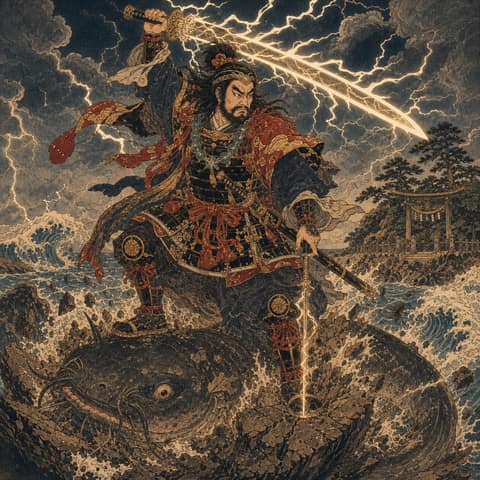
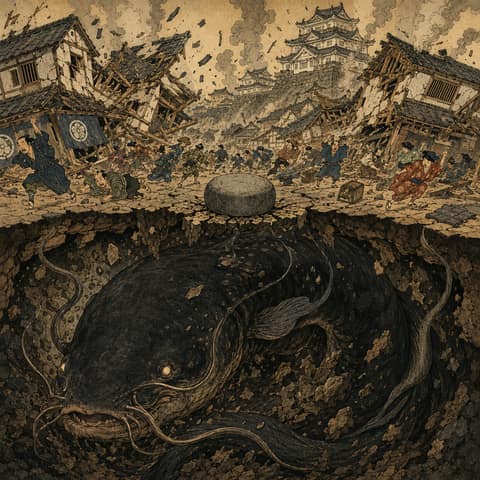
Another aspect this war god assumed in the land of Hitachi—that is, the "god who quells earthquakes." Deep within Kashima Jingu lies a mysterious stone that reveals only a tiny fraction of its head above ground. This stone, called the Keystone (*kanameishi*), is said to stretch impossibly deep into the earth, pinning down the head of a giant catfish dwelling in the subterranean depths. According to ancient lore, Takemikazuchi thrust a stone rod into the ground, pinning down the head and tail of the violently thrashing fish to quell the earth. It is often spoken of in pairs: the Keystone of Katori Jingu in the neighboring province of Shimosa (enshrining Futsunushi-no-Kami) pins down the catfish's tail, while Kashima's Keystone holds down its head. The Kashima Keystone is said to be concave in the center, while Katori's is convex, forming a complementary pair. This composition of the gods of the two shrines gripping the subterranean fish from east and west has been superimposed upon the earthquake-prone eastern Kanto region.
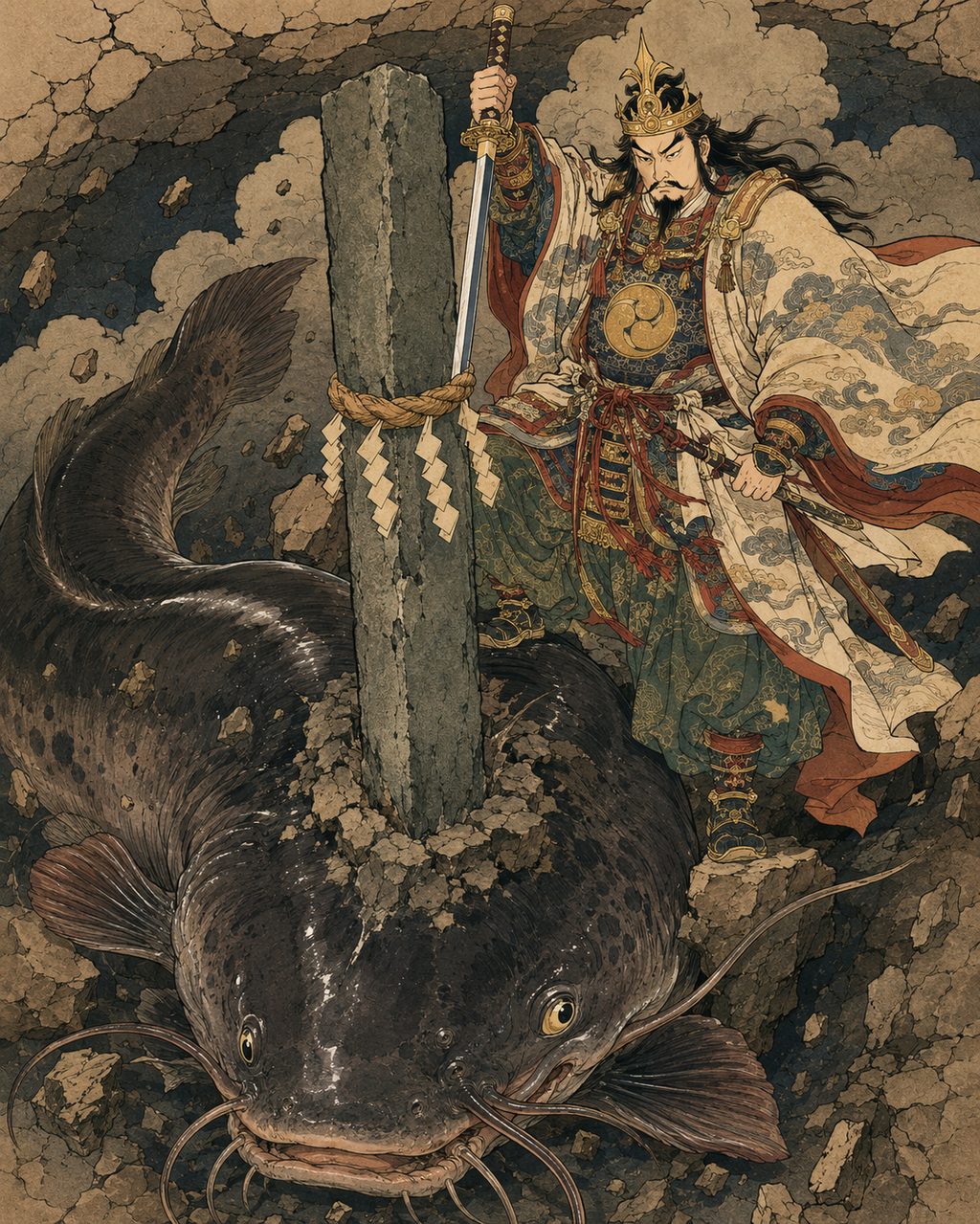
The earthquake ideology that the earth shakes when the giant subterranean catfish writhes its body was a folkloric answer to explain the frequent earthquakes in an era without geology. Why a catfish? The empirical rule that well water muddies and catfish act violently before an earthquake had been spoken of since ancient times, and the slippery, elusive figure of the large fish likely felt appropriate for the unseen forces of the earth's depths. Tokugawa Mitsukuni, famously known as Mito Komon, had the Keystone excavated, but even after digging for seven days and seven nights, they could not reach its root; furthermore, people were injured, leading them to abandon the excavation—such anecdotes were even born. The unfathomable depth of the Keystone is also a reflection of just how profound the unease regarding the earth truly was.
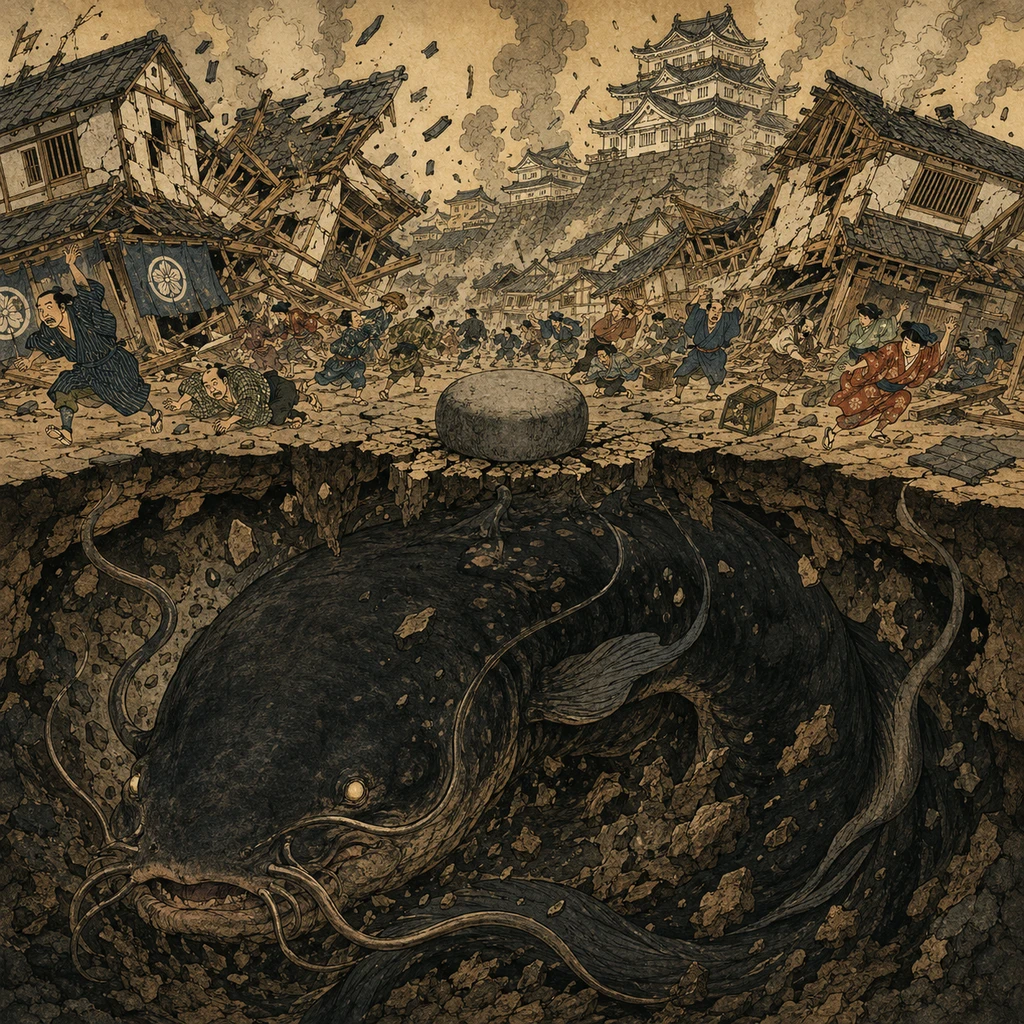
It was at the end of the Edo period that this belief was suddenly visualized. On the night of October 2nd, the second year of Ansei (1855), the Ansei Edo Earthquake struck Edo, estimated at a magnitude of 7.0 and causing as many as 10,000 deaths. In the approximately two months immediately following, around two hundred types of woodblock prints called *namazu-e* (catfish prints)[3] were printed and became explosively popular. Most were unauthorized editions published without the shogunate's permission, depicting a personified giant catfish as the culprit behind the earthquake. In the early *namazu-e*, compositions where Kashima Daimyojin (Takemikazuchi) punishes the catfish using the Keystone were favored, and it was believed that pasting these up would ward off earthquakes. There are also illustrations that adapt the natural disaster into a narrative using myth, claiming the catfish wreaked havoc during a window when the god was away in Izumo just before the earthquake.
Eventually, as the reconstruction boom began, the meaning of the catfish reversed. Because carpenters, plasterers, scaffolders, and lumber merchants who gained work due to the collapse and fires prospered, the catfish was rewritten into a clown who actually sided with the commoners—a "world-rectifying catfish" (*yonaoshi namazu*) that redistributed wealth. A catfish making the rich vomit gold coins to distribute to the poor, a catfish being worshipped by artisans—the wit of the Edoites, who turned disaster and terror into laughter and even embedded prayers for reconstruction within it, adapted the Kashima myth into an urban caricature. The subterranean belief of the supreme shrine of Hitachi became an alleyway caricature of Edo over a century later—the giant catfish of Kashima can be said to be a rare yokai that bore myth, disaster, and laughter all on its own.
The Vengeful God of Bando,
Taira no Masakado
When discussing the history of Bando (the Kanto region), including Hitachi, Taira no Masakado is an unavoidable figure. Born into a branch of the Bando Taira clan carrying the blood of Emperor Kanmu, Masakado launched successive attacks on provincial capitals over disputes concerning territory and clan affairs, ultimately conquering eight provinces of Bando. He established his own independent government based in Iwai, Sashima District, Shimosa Province (present-day Bando City, Ibaraki Prefecture), and openly rebelled against the imperial court by styling himself the "New Emperor."
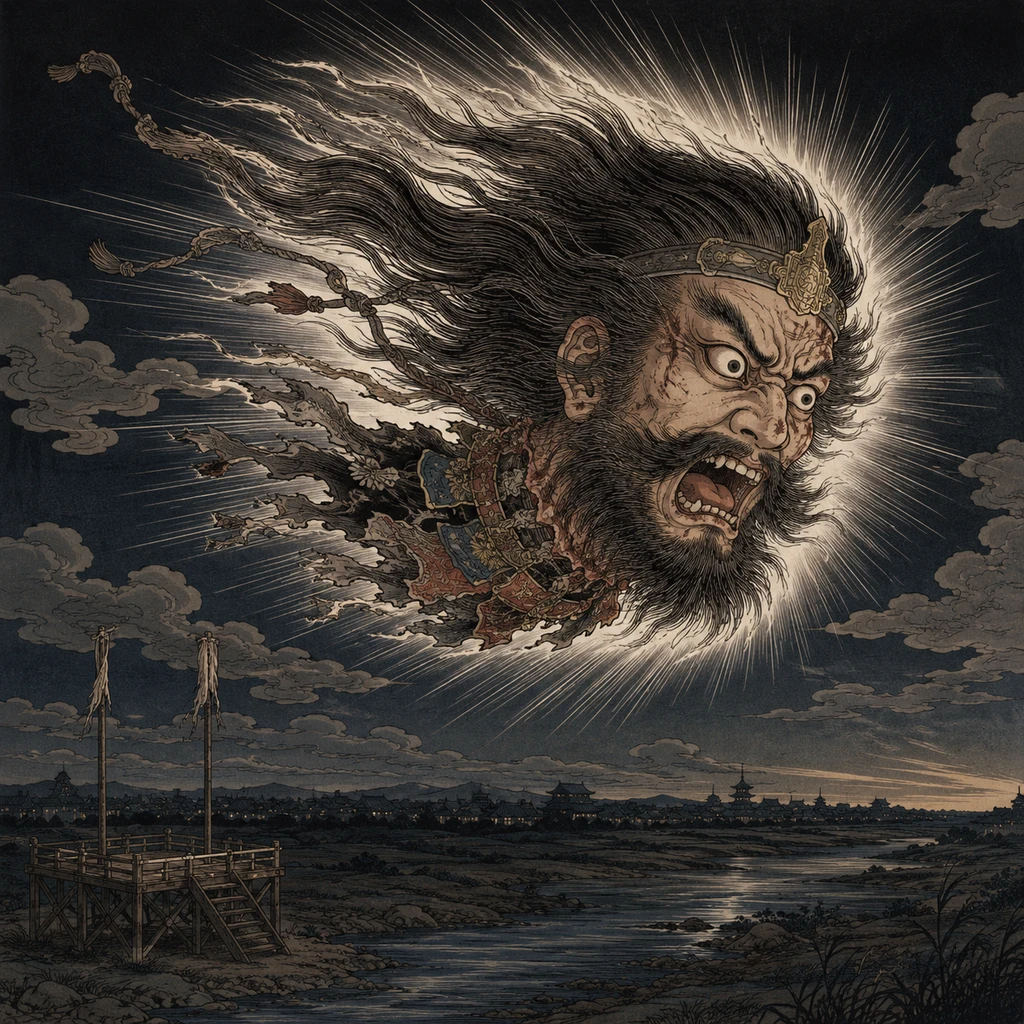
Taira no Masakado
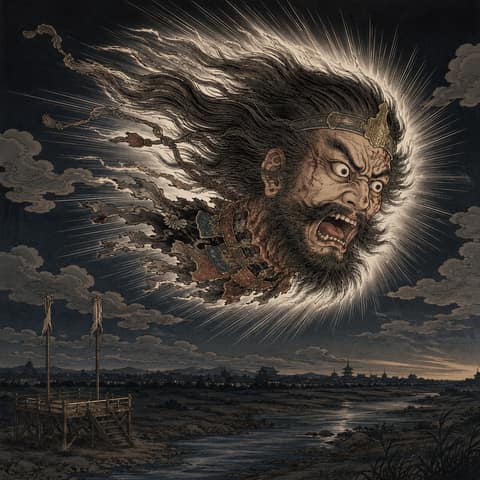
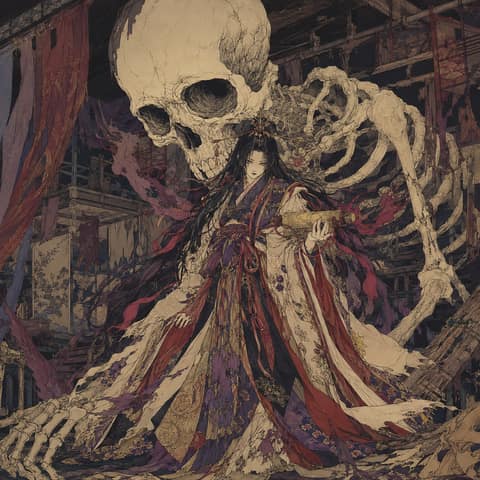
Taira no Masakado was a warrior of the Kanmu-Taira line who held sway over the Bandō region in the mid-Heian period, a man who raised the banner of revolt against the court, styled himself "New Emperor" (Shinnō), and was struck down. After his death, the uncanny tales surrounding his severed head made him one of the most dreaded vengeful spirits in Japan, and in time he was enshrined as a guardian deity of the Kantō and a goryō god at shrines such as Kanda Myōjin. In the Jōhei and Tengyō years, Masakado rose from private feuds within his own clan, and in the second year of Tengyō (939) he overran the provincial seats of Hitachi and other Kantō provinces to subjugate the eastern lands, proclaiming an oracle of Hachiman Daibosatsu and styling himself New Emperor . But the following year, the third of Tengyō (940), he was shot in the forehead and killed in battle by the punitive army of Taira no Sadamori and Fujiwara no Hidesato (Tawara Tōda). His life is recounted in detail in the contemporary war chronicle Shōmonki. What made Masakado a yokai and a vengeful spirit was less the historical revolt itself than the legend of the head, told in later ages. The story that his head, exposed in the capital, would not rot and cried out night after night before flying off to the east is bound up with the dread of the Masakado Grave-Mound (the "Head Mound") at Ōtemachi in Tokyo, and transmits to this day the belief that to move it brings a curse. At Kanda Myōjin, by contrast, he is fervently revered as the great tutelary of Edo and a god of martial fortune and thriving commerce—embodying the two faces of a goryō god: curse and protection.
Read moreDuring the Johei and Tengyo eras (early 10th century), Masakado, who rose from private feuds within the clan over territory, successively conquered the provincial capitals of Hitachi, Shimotsuke, and Kozuke while engaging in repeated conflicts with his uncles, placing the entirety of Bando under his control through sheer force. He is said to have declared himself the New Emperor, independently conducted the appointment of officials, and assigned provincial governors—this went beyond a mere rebellion and was an attempt to establish a kingship in the eastern provinces entirely separate from the imperial court. The aristocrats in Kyoto trembled at this anomaly in Bando.
Documenting the course of this rebellion is the *Shomonki*[4], believed to have been completed shortly after the rebellion's suppression in the third year of Tengyo (940). Written in variant Kanbun (Chinese-style Japanese), this work is Japan's first war chronicle with battle itself as the central theme, positioning it as a pioneer of the military literature that would eventually lead to the *Heike Monogatari*. Although some theories suggest it was written a mere four months after the rebellion was put down, the exact year of its creation is debated; the original text does not survive, and it is handed down today through copies such as the Shinpukuji manuscript, the manuscript formerly owned by Yang Shoujing, and about eleven excerpted versions.
The New Emperor's reign ended in a mere two months. In February of the third year of Tengyo, Masakado, facing a punitive expedition from the imperial court, engaged in his final battle in Iwai against the allied forces of his cousin Taira no Sadamori and the inspector of Shimotsuke, Fujiwara no Hidesato. Though initially fighting with the advantage of having the wind at his back, an arrow flew from nowhere during a shift in the wind and pierced his forehead, and it is passed down that he died an ignoble death. In Iwai, Bando City, Kokuo Shrine—said to have been built thirty-two years after his death by Masakado's third daughter, Nyozouni, who returned to the site of her father's demise after fleeing to Oshu—still stands today, enshrining Masakado as its deity. The man who was executed as an enemy of the court has been continuously revered as a hero in his stronghold of Iwai.
However, the slain Masakado acquired a new aspect after death. Masakado's severed head, which was exposed in the capital of Kyoto, is said to have opened its eyes night after night, shouting, "Where is my body? Connect my head, and let us fight another battle!" and finally flew off toward the eastern provinces in search of his torso—through this terrifying severed head legend, the rebel transformed into a vengeful spirit bringing curses. The grave of his head, which remains in Otemachi, Tokyo, is said to bring a curse if treated disrespectfully, and it is still carefully enshrined after tales of a string of mysterious accidents and sudden deaths occurring when land readjustment was attempted following the Great Kanto Earthquake and after the war. Thus, Masakado was counted as one of Japan's Three Great Vengeful Spirits alongside Sugawara no Michizane and Sutoku-in, while simultaneously becoming the tutelary deity of Edo and Tokyo as the enshrined god of Kanda Myojin.
The ambivalence of being a vengeful god that must be appeased while simultaneously being worshipped as a guardian deity perfectly embodies the spirit of this land where "quelling and cursing" are two sides of the same coin. In contrast to the war god Kashima quelling the curses (earthquakes) of the earth, Bando gave birth to a human vengeful god. Yet that vengeful god, too, turns into a protector when feared and revered—in the concept of calming an angry force to make it an ally, it is fair to say that both the giant catfish of the Keystone and the vengeful spirit of Masakado were born from the exact same mentality of Hitachi.
The Kappa of the Water Town and the Raiju Falling from the Sky
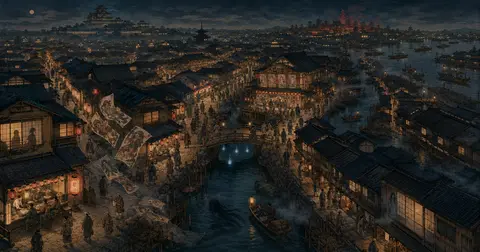
The water town area in southern Ibaraki, where Lake Kasumigaura, Lake Kitaura, and Lake Ushiku connect with the Tone River, and countless small valleys (*yatsu*) and irrigation channels run like a web, is the true home of water yokai—especially the kappa. Among them, the kappa of Lake Ushiku are famous.

Kappa
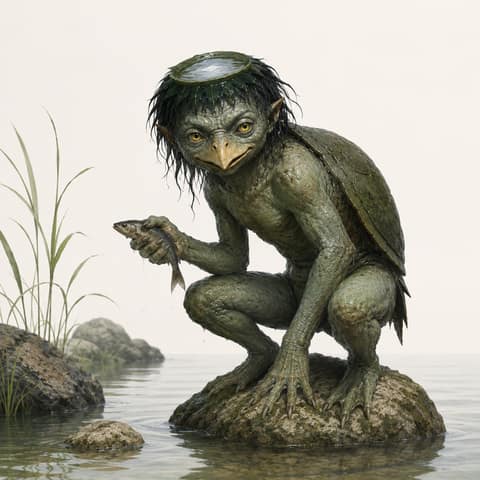
The kappa is among the most famous of all Japanese yokai, said to dwell wherever there is water—rivers, ponds, and marshes alike. It stands about the height of a four- or five-year-old child, with a water-filled dish (sara) set into the crown of its head, a shell on its back, a beak for a mouth, and webbed hands and feet. Its body is greenish or reddish in hue and is sometimes described as smelling fishy. That dish on its head is the very source of its power: should the water spill or dry out, the kappa is believed to lose its strength at once. From this came the well-known trick of bowing deeply to a kappa so that, returning the courtesy, it tips the water from its dish and can be caught. The kappa has two faces. One is fearsome—dragging people and horses into the water and taking their lives. The other is dutiful—keeping its promises faithfully, delighting in sumo, and sometimes passing on miraculous bone-setting remedies. Found across the whole country, it goes by more than eighty regional names: Garappa, Medochi, Enko, Hyosube, and many more. Among all the yokai of Japan, few are so deeply rooted in local life.
Read moreKappa are said to be the ruined forms of gods who originally governed water, and while they are distributed nationwide, southern Ibaraki, which encompasses Lake Kasumigaura and Lake Ushiku, is an area particularly dense with kappa tales. While feared for lurking in swamps and deep pools to drag people and horses into the water and extract their *shirikodama* (mythical organ), there are also many stories showing an endearing side: they love sumo, have a fondness for cucumbers, and when captured, would write a letter of apology and bestow a secret bone-setting medicine. Around Lake Ushiku, such legends of kappa have been continuously passed down since ancient times.
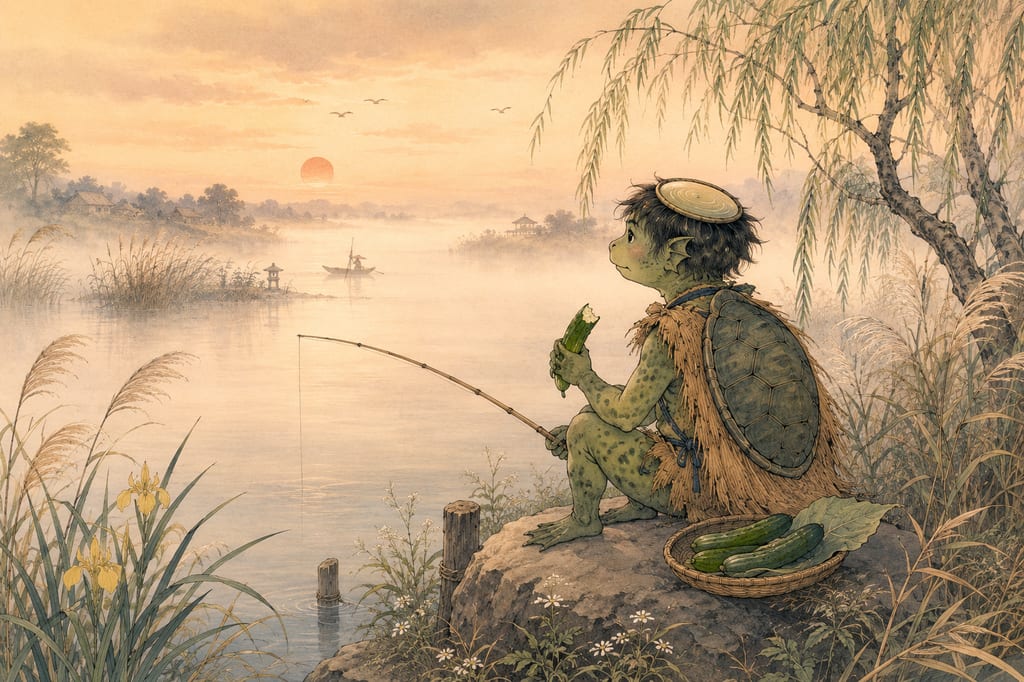
It was a single painter who made Lake Ushiku known nationwide. Usen Ogawa (1868–1938)[5], who lived on the shores of the lake, was a Nanga painter who continued to paint kappa playing by the waterside throughout his life, and was praised with the words, "When it comes to drawing kappa, there is no one who surpasses him." His atelier and residence was built on a hill overlooking Lake Ushiku and named Ungyotei (Cloud Fish Pavilion), and nearby, in 1952 (Showa 27) after Usen's passing, a "Kappa Monument" was erected, spearheaded by his friend Ryuichi Ikeda and others. An illustration of a kappa is carved on the front of the monument, inscribed with seven characters meaning, "Who could understand the heart of the ancient painter who drew dragons?" Usen's gaze, which continued to see the figures of kappa in the mist of the lake, conveyed the illusion of the water town to the present in the form of paintings, sublimating the kappa of Ushiku into art. Usen is said to have remarked, "My paintings are like gleaning fallen ears of grain at Lake Ushiku," continuing to scoop up kappa from the livelihoods of those living with the lake even in an era of advancing modernization. That Lake Ushiku is still beloved today as the "Village of Kappa" owes much to the perspective left behind by this painter. The low, damp water town connecting the Tone River and Lake Kasumigaura—the sky reflected in the marsh, the shores sinking into the mist, the unseen depths of the lake bottom—all these stage elements necessary to summon the existence of the kappa were perfectly aligned in this land.
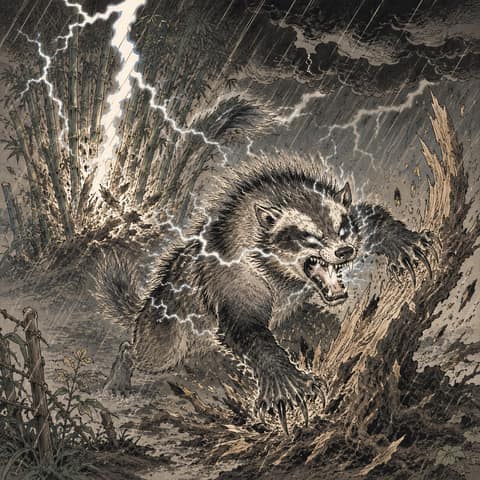
While water monsters hid by the riverbanks, beasts falling from the sky were spoken of in the mountainous areas of Hitachi. This is the Raiju. This beast, said to descend to the earth alongside lightning on days of fierce thunderstorms, was a rare yokai that left behind numerous sighting reports, sketches of its appearance, and even records of it being kept as a sideshow attraction during the Edo period. In the Kanto Plain, where lightning is frequent, the simple, tangible feeling of perceiving a lightning strike as "a beast falling" supported the image of the Raiju.
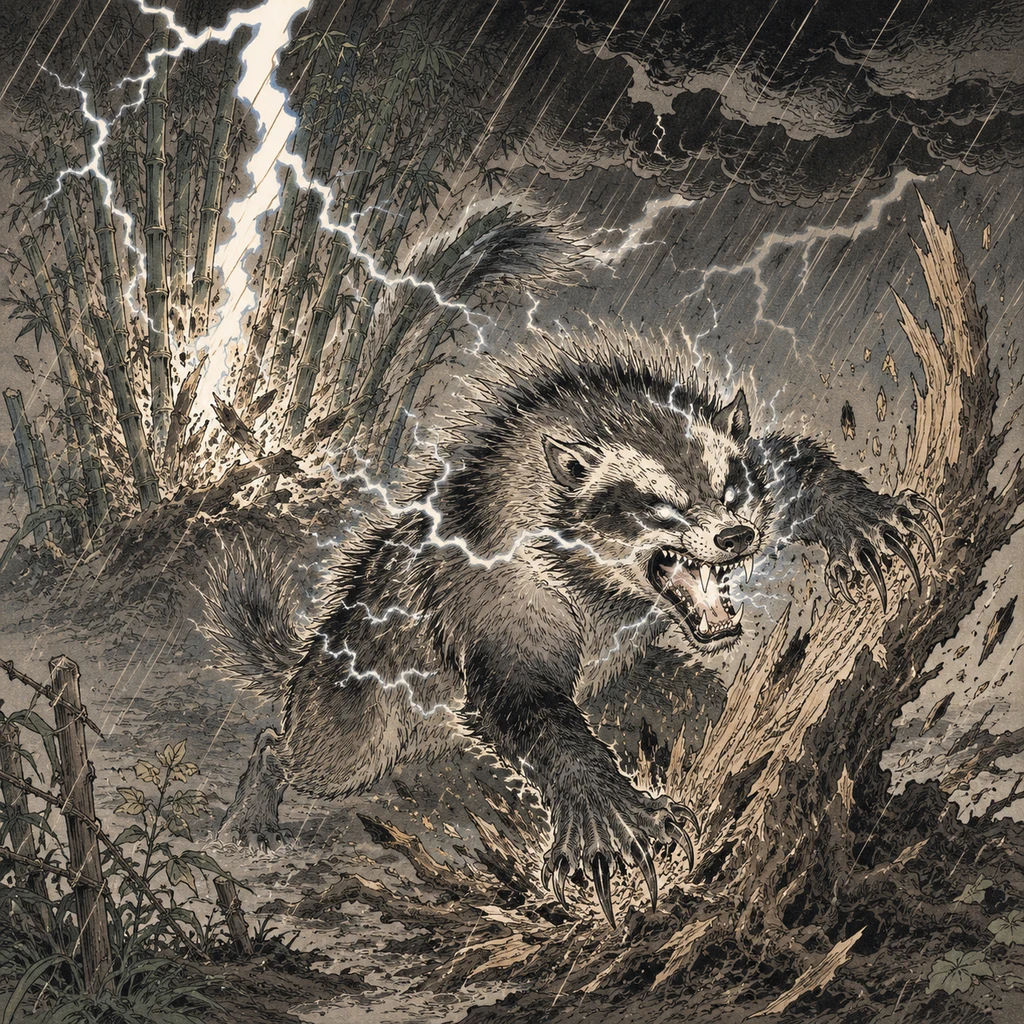
Descriptions of the Raiju[6] vary greatly depending on the record: one account says it had a body like a mole or badger with a snout like a wild boar, and that it ate snakes, frogs, and spiders; another record states it was about sixty centimeters long, resembled a weasel, flew on clouds, and when it accidentally fell, it tore through trees and harmed people. It was also believed that its claws were sharp, and the tearing of trees during a lightning strike was the work of this beast. Today, the prevailing theory is that its true identity is the misidentification of animals such as weasels, masked palm civets, flying squirrels, badgers, or otters, and it is particularly pointed out that the Raiju illustrations of Edo were actually depictions of the masked palm civet. People likely saw small animals that fell from trees, startled by lightning, as beasts sent from the heavens—this very imagination of giving the form of a beast to natural phenomena is the matrix that births yokai.
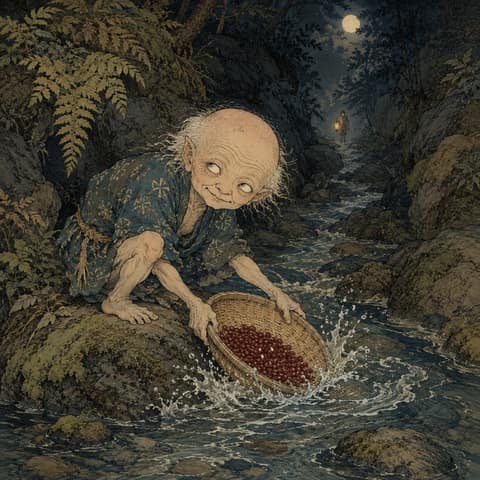
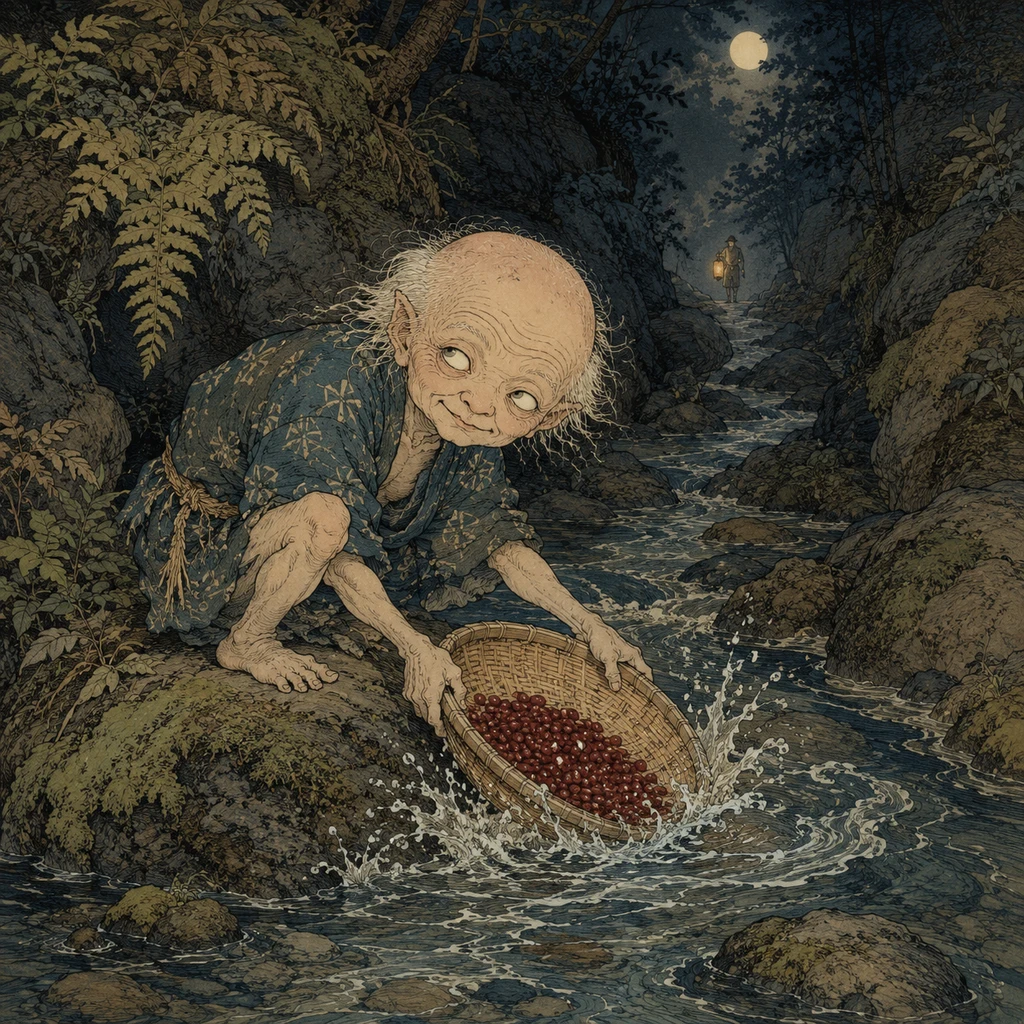
Another water's edge monster that must not be forgotten is the Azukiarai. It echoes the sound of washing adzuki beans—"shoki, shoki"—by the riverbank late at night, and lets slip an eerie voice saying, "Shall I wash my beans, or shall I catch and eat a person?"—a classic "sound monster" that was feared more for its sound than its appearance. There is often a punchline where someone who tries to approach and confirm the source slips and falls into the river. In Naka District, Ibaraki Prefecture, the Azukiarai is said to be female, tracing its origins to a princess who offered red bean rice to a feudal lord heading off to battle over four hundred years ago[7]. Around Katsuta in Hitachinaka City, it is spoken of under the name "Azuki Baasan" (Bean Old Woman), and is said to be the wife of the Azukiarai or an old woman washing beans. There is also a pattern in Azukiarai tales nationwide accompanied by a sorrowful story where the spirit of someone who threw themselves into the river after being scolded for mixing stones into the beans began to make the sound. By the side of flowing water, only the presence of a person remains as sound—the unease of the water town's night, lacking in lamplight, nurtured such auditory horrors. If the kappa is the "visible terror" dragging people from the water, the Azukiarai is the "invisible terror" that frightens people only with a formless sound, serving as a pair born from the same darkness of the water's edge.
The Anomalies of Hitachi Drawn by Sekien — Hiyoribo and Waira
In the late Edo period, there was a painter who illustrated yokai one by one and lined them up like an "encyclopedia." This was Sekien Toriyama. In his collection of yokai illustrations, there are two monsters drawn in connection with the land of Hitachi.

Hiyori-bō (Fair-Weather Monk)
A yokai depicted by Toriyama Sekien in Konjaku Gazu Zoku Hyakki, said to preside over clear weather. It appears on sunny days and not in the rain. Beyond Sekien’s notes, verified folk reports are scarce and oral traditions remain uncertain. Scholars have linked it to teru-teru bōzu, but no definitive source confirms this origin. Its name is discussed in relation to regional weather-prayer terms like “hiyori-bōzu.”
Read more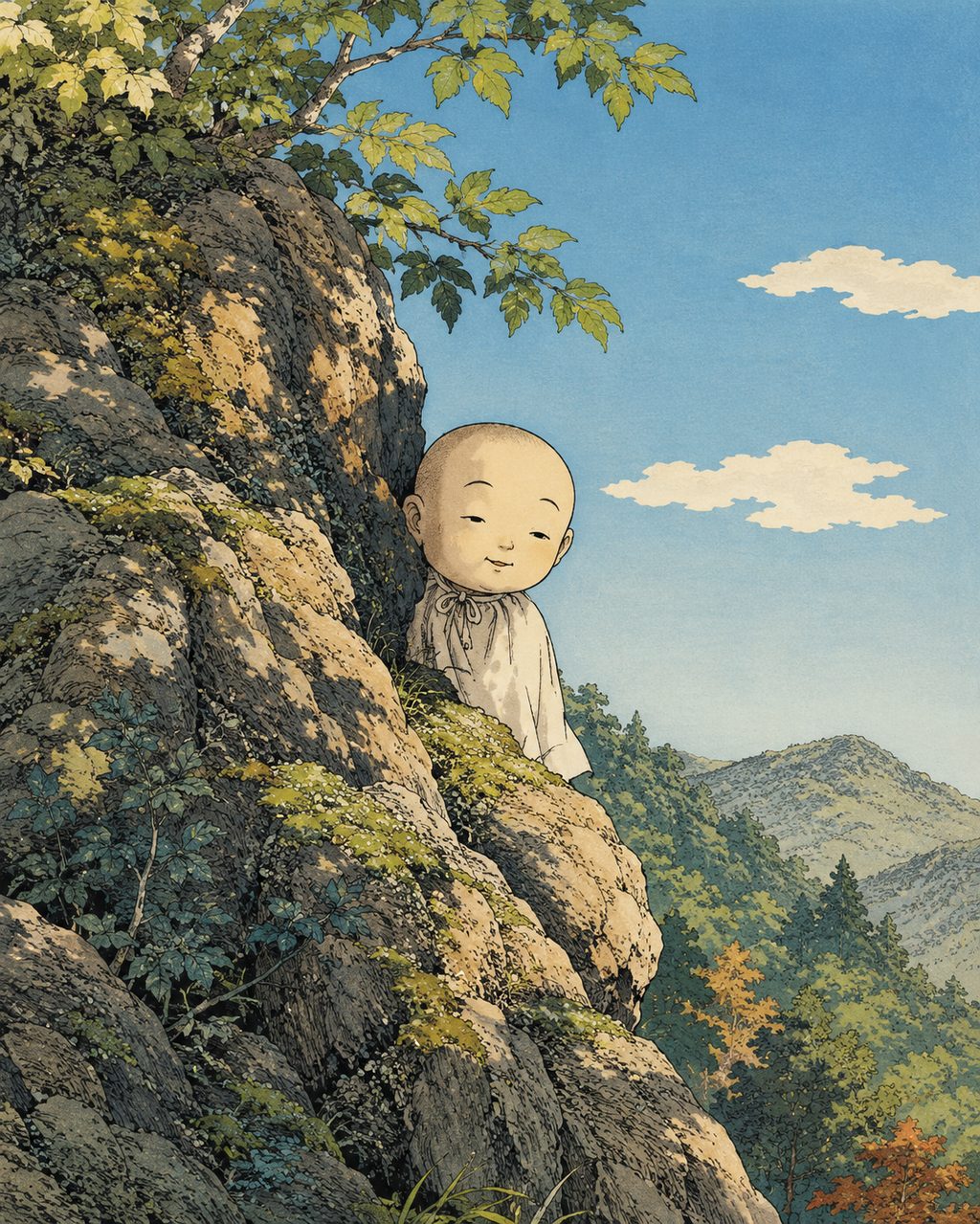
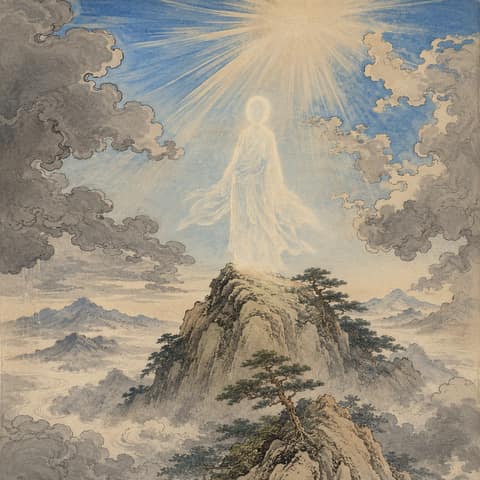
One is the Hiyoribo. Regarding this yokai depicted in the *Konjaku Gazu Zoku Hyakki* (More Illustrated Night Parade of a Hundred Demons from Past and Present)[8] published in the eighth year of An'ei (1779), Sekien noted, "It is said to live deep in the mountains of Joshu (Hitachi Province). It hides its figure when it rains, and appears only on clear days," adding, "Perhaps the *teruteru bozu* that women and children craft from paper today to pray for clear skies is something that enshrines this spirit." In the illustration, it is drawn as a bald-headed figure calmly peeking out from behind a rock. The setting of a spirit governing the clear skies of the mountains of Hitachi evokes the simple prayers of the *satoyama* (village forest) standing on the boundary between rain and shine, in an era when both agriculture and laundry were dictated by the weather. That modesty of hiding behind rocks and showing its face only on sunny days certainly wears the aura of the gentle *satoyama* of Hitachi.

A careful reservation is required here. Regarding the Hiyoribo, it must be noted upfront that there are no reports of folkloric transmission for this yokai other than Sekien's description, and there is no concrete proof that this yokai is truly the origin of the *teruteru bozu*. Rather, it has been pointed out that Sekien may have conversely molded the image of the yokai from the *teruteru bozu* custom that was already widespread at the time. What is definitively true is that "Sekien drew the Hiyoribo as a mountain spirit of Joshu," and it is correct to read the causal relationship with the *teruteru bozu* strictly as Sekien's conjecture.
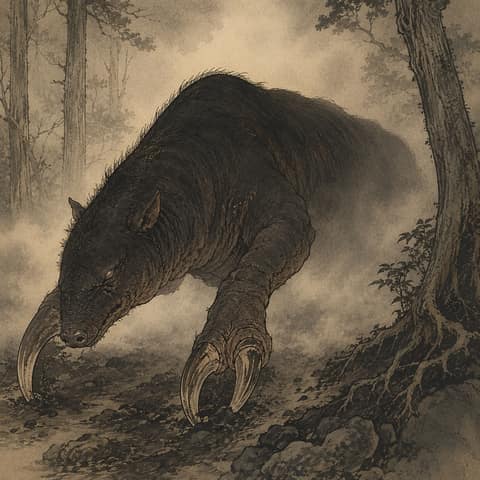
The other is the Waira. It is depicted in scrolls and collections such as the *Hyakkai Zukan* by Suushi Sawaki and the *Gazu Hyakki Yagyo* (Illustrated Night Parade of a Hundred Demons)[9] published in the fifth year of An'ei (1776), with a massive body like an ox and sharp hooked claws sprouting from its front legs. However, it must be noted that these picture scrolls and collections contain absolutely no explanatory text other than the name, and even the lower half of its body is not drawn. Explanations such as "It lives deep in the mountains and uses its hooked claws to dig the earth and eat small animals like moles" or "A large yokai that attacks and eats people" are all characterizations given retroactively by yokai encyclopedias and children's books from the Showa period onward; there is absolutely no folklore or similar records left in the primary sources of the Edo period. Even the origin of its name is uncertain, and it is unknown what "waira" means.
The Waira is a creature where the picture came first and the story followed—an anomaly of unknown origin whose name and iconography alone floated in midair. Yet the reason modern encyclopedias continue to assign habitats and diets to the Waira is likely because people cannot endure "a figure without explanation" and constantly seek to supplement it with narrative. It is fascinating that the Hiyoribo went from "custom to yokai," while the Waira went from "iconography to folklore"—both being examples of tracing the original sequence backward. These two entities that Sekien left behind along with the name of Hitachi narrate the very act of early modern painters gathering fragments from various regions, supplementing them with imagination, and "editing" yokai into a single system. In this way, the mountains of Hitachi also became a stage for birthing new anomalies within the pages of books.
The Province of Quelling and Cursing
Tracing the yokai of Ibaraki Prefecture in this way, a single thread running through this land becomes visible. In this lowland opened to the sea and lakes, shaken by earthquakes, and moistened by water, people wished above all to "quell." The Keystone suppresses the giant catfish, and the war god of Kashima calms the anger of the earth. But unquelled anger becomes a curse—Taira no Masakado, slain for turning against the imperial court, transformed into a vengeful spirit alongside the legend of his severed head, and was eventually re-enshrined as a guardian deity.
Kappa dwell in the depths of the water town, the sound of washing adzuki beans echoes by the riverbank at night, and beasts fall from the stormy skies. Deep in the mountains, the Hiyoribo heralding clear skies and the storyless Waira live only within Sekien's brushstrokes. The abundance of water from the sea, lakes, and rivers birthed the kappa and Azukiarai; the frequent lightning of the plains birthed the Raiju; the ceaseless earthquakes birthed the Keystone and the giant catfish; and the geopolitical position of Bando, far from the capital, birthed the vengeful god Masakado—all of Ibaraki's yokai arise almost inevitably from the nature and history of this land.
From the giant Daidarabou of the *Hitachi no Kuni Fudoki* to An'ei-era Sekien, the *namazu-e* of the late Edo period, and the modern Usen Ogawa, the land of Hitachi has continued to speak of, draw, and enshrine anomalies for thirteen hundred years. The Keystone of Kashima Jingu still holds down the head of the giant catfish, Kokuo Shrine in Bando City enshrines Masakado, and the kappa monument of Lake Ushiku continues to stand by the water's edge. That anomalies breathe in places one can walk to and trace—that is the richness of Ibaraki. It is precisely within the tension between quelling and cursing that the core of Ibaraki Prefecture's yokai culture lies.