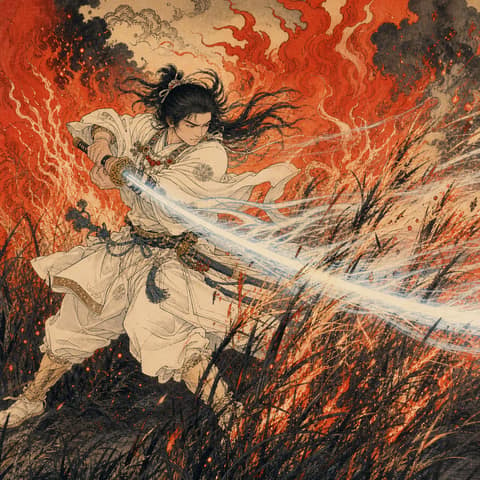
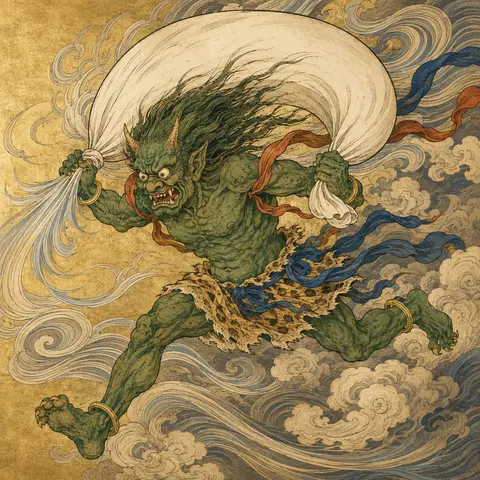
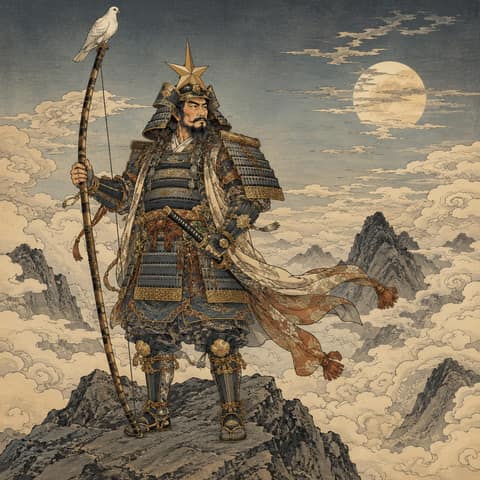
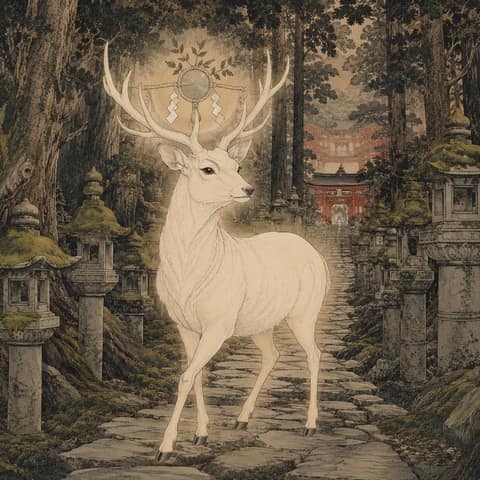
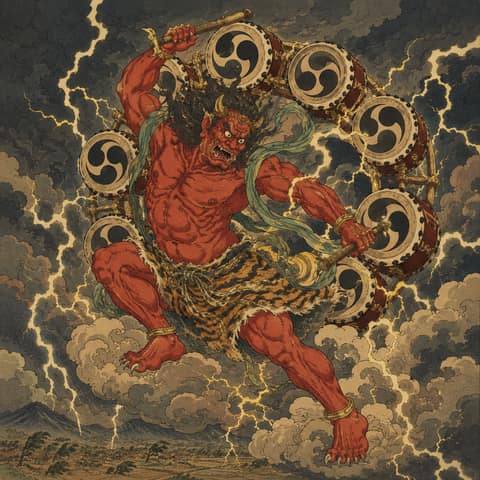
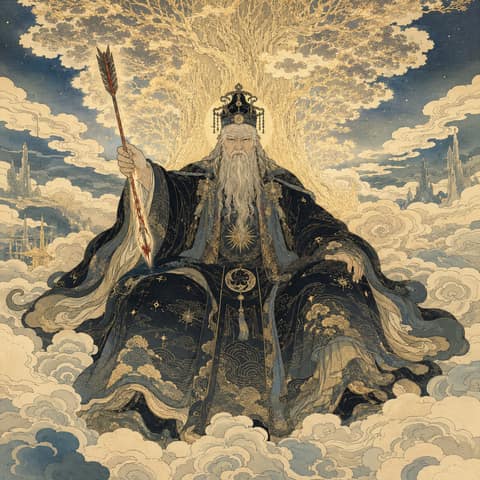
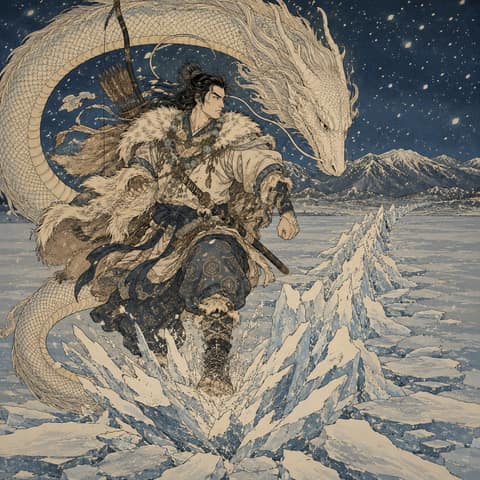
Takemikazuchi-no-Kami is a deity of thunder, swords, and martial arts appearing in the *Kojiki* and *Nihon Shoki*. When his father, Izanagi-no-Mikoto, slew the fire god Kagutsuchi with the Totsuka-no-Tsurugi sword, the blood from the base of the sword splashed onto a rock, giving birth to three deities, of which Takemikazuchi is one[1][2]. As the main figure in the Kuniyuzuri (Transfer of the Land) myth, he descended from Takamagahara to Izumo Province, engaging in a test of strength with Takeminakata-no-Kami. Turning his hand into an icicle and then a sword, he crushed Takeminakata's hand and chased him to Suwa in Shinano Province. This test of strength is considered the origin of Japanese sumo. In the myth of Emperor Jimmu's Eastern Expedition, Takemikazuchi's sword, Futsu-no-Mitama, was presented to Emperor Jimmu, becoming a crucial artifact in pacifying evil deities. This sword is still enshrined as the sacred body of Isonokami Shrine. Revered as the main deity of Kashima Shrine, the Nakatomi (Fujiwara) clan historically worshipped him as their tutelary deity, later enshrining him at Kasuga Grand Shrine in 768. From antiquity to the present, he has been deeply venerated as the guardian deity of martial arts, sumo, kendo, and the pacification of earthquakes.
The Futsu-no-Mitama Sword. During Emperor Jimmu's Eastern Expedition, Takemikazuchi played a decisive role[1]. When Jimmu's army was incapacitated by an evil god, Takemikazuchi presented his sword, Futsu-no-Mitama, reviving the army and securing their victory. Enshrined at Isonokami Shrine, this sword became the core of the Mononobe clan's worship.
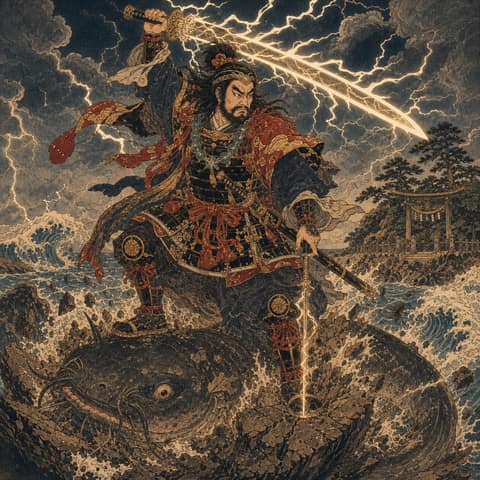
Kashima Shrine and the Keystone Belief. Kashima Shrine, dedicated to Takemikazuchi, is a prestigious ancient shrine[3]. Its unique "Kaname-ishi" (Keystone) belief asserts that a sacred stone suppresses a giant subterranean catfish, preventing earthquakes. This belief spread nationwide after the 1855 Ansei Edo earthquake via "namazu-e" prints.
The Ancestral God of Sumo. The test of strength with Takeminakata forms the religious foundation of sumo culture, spanning over two millennia. The rituals of modern Grand Sumo trace their origins back to these ancient divine ceremonies.
Samurai Worship and Later Developments. Since the Middle Ages, Takemikazuchi has been revered as a guardian of warriors and swordsmen. Traditional martial arts schools originated from Kashima and Katori Shrines, and his worship remains a spiritual pillar for modern practitioners of kendo, judo, and sumo.
Two Thousand Years of Sumo. The religious essence of sumo, persisting from ancient court rituals to the modern Grand Sumo, stems from Takemikazuchi's mythological origins. Sumo remains a rare example of a globalized sport retaining its ancient mythological roots.
Takemikazuchi in the 21st Century. Today, he is revered as a guardian of martial artists, the ancestral god of sumo, and a protector against disasters. As Japanese martial arts spread globally, his worship garners international attention as the religious origin of these disciplines.
Character Profile
This section is our own creative profile for storytelling. It is not historical fact or scholarship.
Strict, fierce, and possessing overwhelming power. Embodies both divine wrath and the nature of a guardian who suppresses chaos. Values tests of strength and righteous judgment.
Compatibility
Deep connections with practitioners of martial arts, sumo, and kendo; those praying for protection against earthquakes; worshippers at Kashima, Kasuga, and Isonokami shrines; and those inheriting the history of the Nakatomi, Fujiwara, and Mononobe clans.
Abilities
Dominion over thunder, swords, and martial powerOverwhelming martial force that subdued TakeminakataDivine transformation of his hand into ice and swordsPossession of the Futsu-no-Mitama swordCore of ancient Kanto Shinto via Kashima ShrineIntervention in ancient politics as the patron of Fujiwara/Mononobe clansTwo millennia of cultural legacy as the god of sumoGuardian nature of earthquake pacification via the Keystone
Weaknesses
Limitations as an ancient male deity reliant on martial force; the perpetrator aspect of exiling Takeminakata to Shinano (historical tension with Suwa worship); dilution of peaceful
agricultural attributes due to medieval samurai bias; and political exploitation by militaristic State Shinto before WWII.
Habitat
Kashima Shrine (Ibaraki), Kasuga Grand Shrine (Nara), Isonokami Shrine (Nara), Suwa Grand Shrine (Nagano), and martial arts dojos, sumo stables, and shrines across Japan.
The diagram below is a diagnostic evaluation chart for God of Thunder, Swords, Martial Arts, Sumo, and Earthquake Pacification. The higher the value of each item, the stronger that characteristic is expressed.