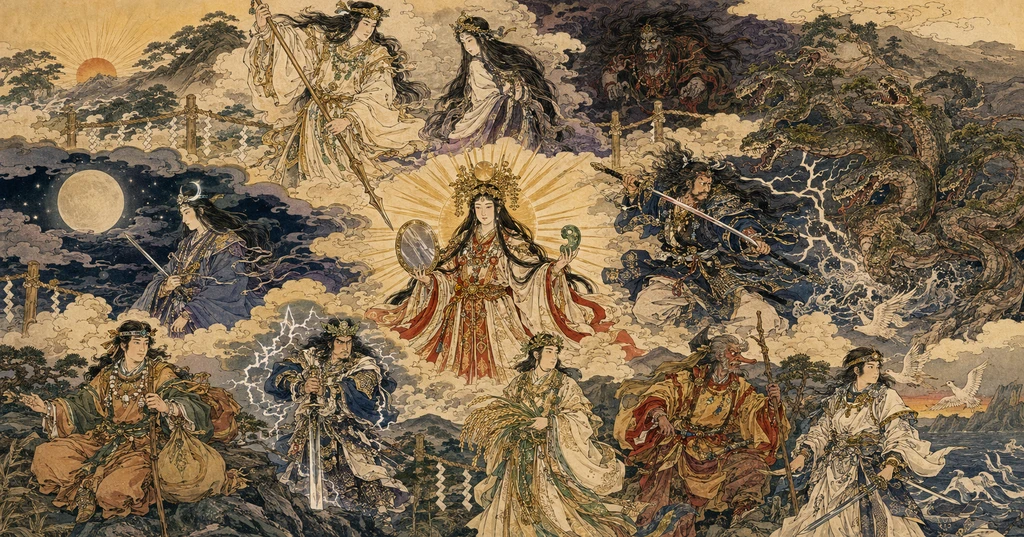
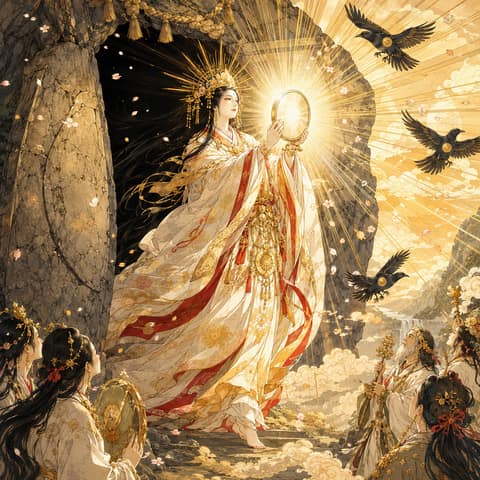
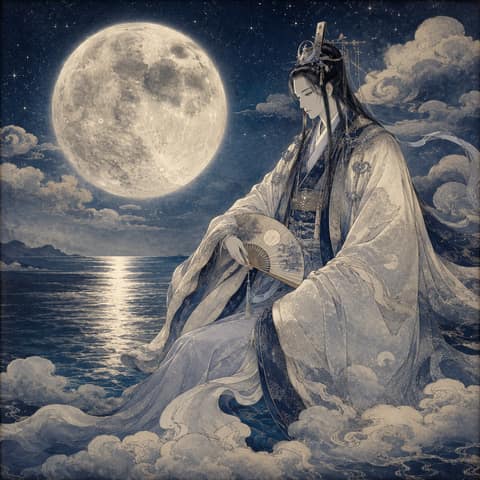
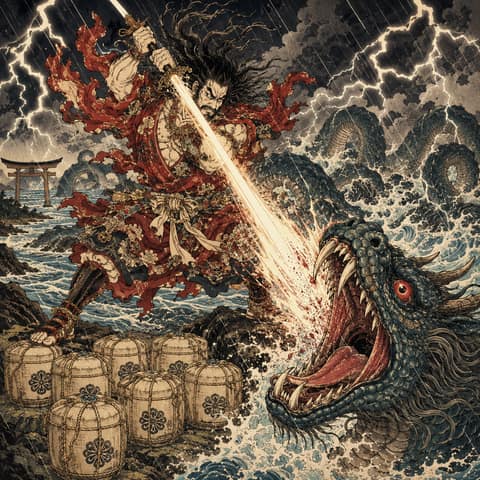
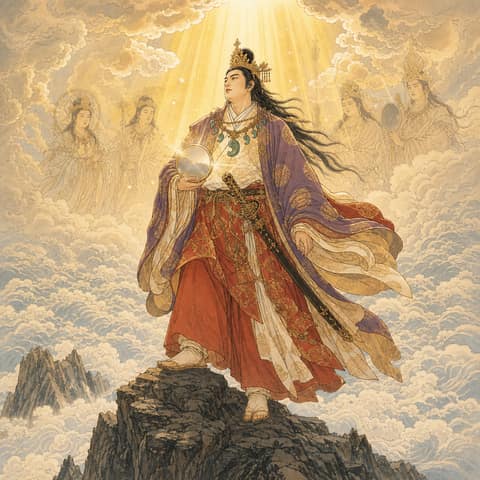
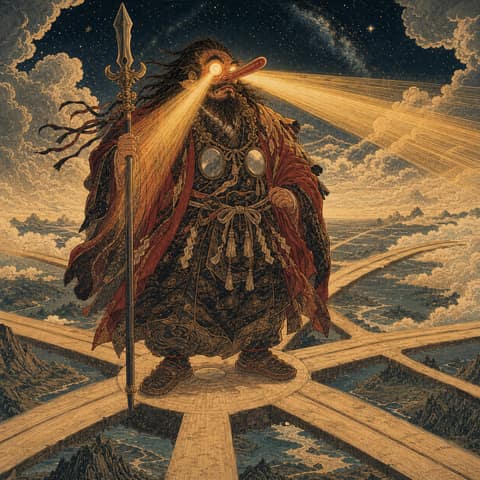
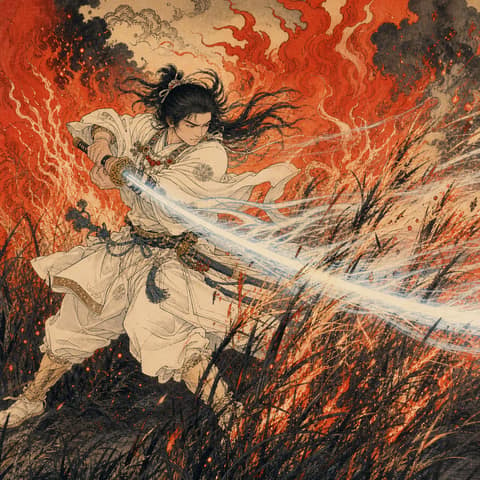
Tsukuyomi's Position Among the Three Precious Children. While the basic description touches upon Tsukuyomi's primary myth, this detailed explanation delves into the deity's unique structural position within the "Three Precious Children" (Mihashira-no-uzu-no-miko). The tripartite rule by Amaterasu Omikami (Takamagahara, day, light), Tsukuyomi (Yoru-no-Oskuni, night, moon), and Susanoo-no-Mikoto (the sea, untamed force) established the three domains of day, night, and wild power in ancient Japanese cosmology[1]. However, Tsukuyomi alone has almost no detailed mythological narratives throughout the *Kojiki* and *Nihon Shoki*, disappearing from the center of the story immediately after being entrusted with the "Yoru-no-Oskuni." The discrepancy between the high structural position as the middle child and the sparsity of mythological activity is a major point of discussion in the study of ancient Japanese mythology.
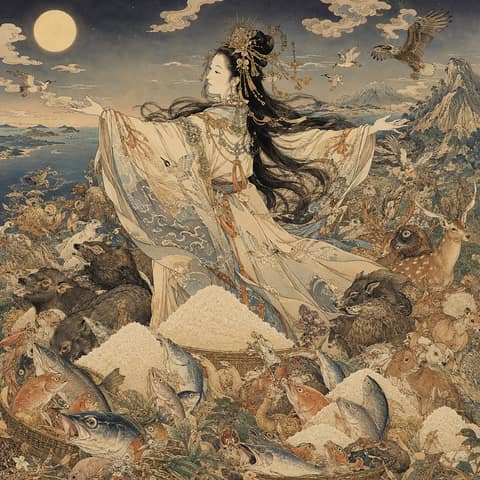
The Slaying of Ukemochi — A Contrast with the Kojiki. Tsukuyomi's primary mythological tale, the slaying of the food deity Ukemochi, is recorded only in the *Nihon Shoki* and does not appear in the *Kojiki*[2]. In the *Kojiki*, this identical narrative motif is performed by Susanoo-no-Mikoto against Ogetsuhime. This indicates that ancient Japanese mythology possessed a single narrative template for the "origin of grain = five cereals sprouting from a deity's corpse," which was assigned to different deities (Susanoo vs. Tsukuyomi) in the two texts. The difference in this allocation is a vital piece of evidence for examining the compilation process, variant transmissions, and cosmological consistency of ancient Japanese myths. The editorial intent of the *Nihon Shoki* in assigning the Ukemochi murder to Tsukuyomi is interpreted as an effort to emphasize the connection between the moon and the agricultural calendar.
Comparative Religion of a "Quiet Deity". Tsukuyomi's "quiet, reclusive" personality is unique even when compared to lunar deities worldwide. From Selene and Artemis in Greece, to Luna in Rome, the Persian moon god Māh, the Chinese lunisolar calendar, and Korean lunar spirits, moon deities across the ancient world are often depicted as highly active and central figures. In contrast, Japan's Tsukuyomi is rare for having few myths and an emphasized serene, introverted, and mediatory nature. Scholars such as Shinobu Orikuchi and Eiichiro Ishida deciphered this characteristic, concluding that "the Japanese moon deity has a 'watchful' nature," and organized the ancient Japanese relationship with the moon not as one of "direct worship" but as a connection of "quiet watchfulness."
Moon and Immortality Beliefs — Okinawa and East Asian Comparisons. Nikolai Nevsky, Shinobu Orikuchi, and Eiichiro Ishida positioned Tsukuyomi's primitive attributes within the broader East Asian beliefs linking the "moon and immortality"[2]. In Okinawa and the Ryukyu Islands, there is a tradition of "Sudemizu" (water of molting or rejuvenation), a water of immortality bestowed upon humanity from the moon, indicating a symbolic link between the moon's "molting" (the cycle from full moon to new moon) and immortality/rebirth. Similar "moon and immortality" beliefs are distributed across China, Korea, Mongolia, and Southeast Asia, framing the prototype of Tsukuyomi as a Japanese variation of this widespread belief system. The moon's periodicity, its association with feminine tides, the agricultural calendar, and the mystery of its waxing and waning all multi-layered the ancient faith.
Gassan Shrine and Shugendo. Gassan Shrine in Yamagata Prefecture, a former Kanpei-taisha (Imperial shrine, 1st rank), served as the core of the Three Mountains of Dewa (Mt. Haguro, Mt. Gassan, Mt. Yudono) and became a center for mountain worship and Shugendo from the Heian period onward[3]. Mt. Gassan is an extinct volcano standing 1,984 meters tall, where Shugendo practitioners envisioned a "Pure Land where Tsukuyomi resides" at the summit, aiming for the rebirth of the soul through rigorous mountain asceticism. Within Shugendo, Tsukuyomi developed uniquely as a deity symbolizing the "moon of death and rebirth," occupying a significant position within the complex evolution of mountain worship, Shugendo, and Pure Land Buddhism during the Heian, medieval, and early modern periods. Even today, the "Gassan-mode" (pilgrimage to Mt. Gassan) is carried on as a symbolic custom of Tohoku folklore and Shugendo.
The Geography of Tsukuyomi Shrines. The enshrinement sites of Tsukuyomi are distributed across four main lineages: (1) Gassan Shrine in Yamagata Prefecture (Tohoku mountain worship); (2) Tsukiyomi Shrine in Kyoto (central Shinto under the ancient Ritsuryo system); (3) Tsukiyomi-no-miya and Tsukiyomi-no-miya as auxiliary shrines of the Inner and Outer Shrines at Ise Jingu in Mie Prefecture (State Shinto and the Ise Jingu system); and (4) Tsukiyomi Shrine in Iki City, Nagasaki Prefecture (the oldest Tsukuyomi shrine in Japan, tracing the Korean Peninsula route). The Kyoto shrine is considered to have derived its spirit from the Iki shrine, serving as valuable folkloric-geographical evidence showing the route through which lunar worship originating from the continent and the Korean Peninsula was transmitted to ancient Japan. This demonstrates that Tsukuyomi worship is not an isolated phenomenon unique to Japan but the result of formation within a broad East Asian network of lunar beliefs.
Tsukuyomi in the 21st Century. In postwar Japanese subculture works—such as the *Megami Tensei* game series, *Okami*, and the "Moon Breathing" in the manga *Demon Slayer*—Tsukuyomi's attributes of tranquility, mystery, isolation, and dark-night moonlight have a high affinity with modern character design. The symbolic deity of "night, moon, tides, calendar, and immortality" in ancient Japanese cosmology continues to acquire new meanings in the 21st-century era of globalization, space exploration, and social media. Pilgrimages to Mt. Gassan, Ise, and various Tsukiyomi shrines are inherited today, and the serene, mysterious lunar faith has been deeply rooted in the spiritual culture of the Japanese from ancient times to the present. The fact that the deity with the least mythological activity continues to live on in the most serene form within modern Japanese spiritual culture symbolizes the profound wonder of how mythological culture is passed down.
Character Profile
This section is our own creative profile for storytelling. It is not historical fact or scholarship.
Yokai Type - Kami
Category - Deities & Divine Spirits
Rarity - Legendary
Personality - A serene and mysterious deity governing the night, the moon, the tides, and the calendar. In contrast to the eldest sister and youngest brother of the Three Precious Children, Tsukuyomi is quiet and introverted, preferring not to stand at the center of myths. However, the slaying of Ukemochi reveals a duality that includes sudden outbursts of passion. Tsukuyomi embodies the ancient Japanese sensibility toward the moon as a source of "quiet watchfulness."
Compatibility - Deeply connected with those who revere the cycles of the night, moon, tides, calendar, and agriculture; those who make pilgrimages to Mt. Gassan, Tsukiyomi Shrines, or the lunar auxiliary shrines at Ise; and those who inherit the beliefs of serene mystery, dark-night moonlight, and immortality/rebirth. Resonates more with an introspective, watchful religious sensibility than with flamboyant activities.
Abilities - Rule over the domain of night and the moon (Yoru-no-Oskuni)Cosmological governance of tides and lunar phasesOrigin deity of the calendar and agricultural cycleTransfer of the five cereals, livestock, and silkworms to the mortal world through the slaying of Ukemochi (Nihon Shoki)Establishment of cosmic order through the separation of the sun and moon (eternal parting from Amaterasu)Symbolism of the moon, immortality, and rebirth (comparative East Asia)Deification of death and rebirth in Mt. Gassan, Shugendo, and Pure Land beliefs
Weaknesses - Eternal separation from Amaterasu Omikami (divided by one day and one night), the trait of being the "least appearing deity" who drops out of the narrative's center, the duality of having the same role assigned to Susanoo in the compilation of the Kojiki and Nihon Shoki, and the dilution of mythological presence due to a quiet, reclusive personality.
Habitat - Gassan Shrine (Three Mountains of Dewa) in Yamagata Prefecture; Tsukiyomi Shrine in Nishikyo Ward, Kyoto; Tsukiyomi-no-miya (auxiliary shrine of the Inner Shrine) and Tsukiyomi-no-miya (auxiliary shrine of the Outer Shrine) at Ise Jingu in Mie Prefecture; Tsukiyomi Shrine in Iki City, Nagasaki Prefecture; various Tsukuyomi-related shrines nationwide, Gassan pilgrimages, night festivals, and spaces within modern lunar-themed subculture works.