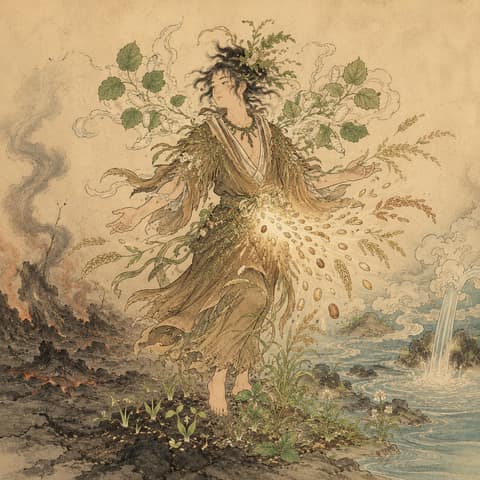
Ukemochi-no-Kami is a deity appearing in Book 5, Alternate Writing 11 of the *Nihon Shoki*[1], who single-handedly undertakes the generation of food. Hearing that this deity existed in Ashihara-no-Nakatsukuni, Amaterasu-Omikami dispatched Tsukuyomi-no-Mikoto[1] to observe her. To welcome her guest, Ukemochi turned toward the land and produced boiled rice from her mouth, turned toward the sea and produced fish, and turned toward the mountains and produced beasts. She prepared these items and offered them as a feast. However, Tsukuyomi viewed offering things produced from the mouth as food as a defilement, and in a rage, struck and killed her. Here, Ukemochi appears not merely as a "god who provides food," but as a deity standing at the boundary where the sacredness and the defilement of eating have not yet been separated.
The death of Ukemochi does not cause food to be lost from the world; rather, it becomes the catalyst for fixing food upon the earth. The *Nihon Shoki* recounts that when Ame-no-Kumahito verified her corpse, cattle and horses had grown from the crown of her head, millet from her skull, silkworms from her eyebrows, barnyard grass from her eyes, rice from her belly, and wheat, soybeans, and adzuki beans from her genitals. Amaterasu received these, designating millet, barnyard grass, wheat, and beans as seeds for dry fields, and rice as seeds for wet paddies. Furthermore, she placed the silkworm cocoons in her mouth and drew thread, thus opening the path of sericulture—the origin of the five grains, livestock, and sericulture[1]. Therefore, Ukemochi is simultaneously a food deity generated from a corpse, and a deity who hands over the foundations of life—agriculture, animal husbandry, and silk—to the order of Amaterasu.
A similar type of story is seen with Ogetsuhime-no-Kami in the *Kojiki*. However, as summarized in the Kokugakuin University entry for Tsukuyomi, the murderer there is Susanoo, and the rupture between Tsukuyomi and Amaterasu—so prominent in the Ukemochi tale—does not come to the forefront. This is the difference with Ogetsuhime-no-Kami[2]. The significance of the Ukemochi tradition lies in the fact that the myth of the origin of food is simultaneously the myth of the separation of the sun and moon. The rift between the moon god, who views food as defilement, and the sun god, who transforms it into sustenance for the human world, simultaneously articulates day and night, food and defilement, and death and harvest. Ukemochi is the deity who was struck down at that boundary, yet still fills the world.
Folklore & Legends
The story of Ukemochi is placed within an "Alternate Writing" (issho), a format in the *Nihon Shoki* that collects variant traditions. The Kokugakuin University Deity Name Database entry for "Tsukuyomi-no-Mikoto" lists his appearances in other texts as the main text and Alternate Writing 11 of Book 5 of the Nihon Shoki[2]. It further explains that in Alternate Writing 11, Tsukuyomi goes to Ashihara-no-Nakatsukuni on Amaterasu's orders to visit Ukemochi-no-Kami. This positioning is crucial. Rather than a deity with a long, independent genealogy, Ukemochi appears at the single point where the division of rule among the Three Precious Children, the character of the moon god, the origin of food, and the separation of sun and moon all intersect. More than the name itself, she stands at the center of a scene demonstrating how the world's order was divided.
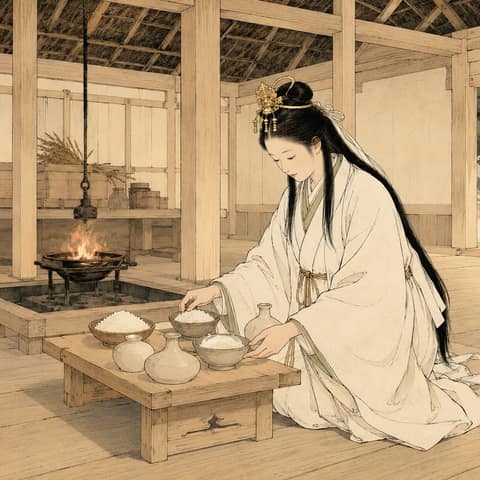
The instigation of the story is the command of Amaterasu-Omikami. Hearing that "Ukemochi-no-Kami is in Ashihara-no-Nakatsukuni," Amaterasu dispatches Tsukuyomi. Here, Ukemochi appears not as a localized deity closed off somewhere on earth, but as the source of food that must be verified by Takamagahara (the High Plain of Heaven). When Tsukuyomi arrives, Ukemochi turns her body in different directions to entertain him. Turning to the land, boiled rice comes from her mouth; to the sea, fish; to the mountains, beasts—a feast of rice, fish, and beasts[1]. This scene, where sea, mountain, and land emerge as food from a single body, demonstrates that this food goddess contains the entire realm of nature within her belly.
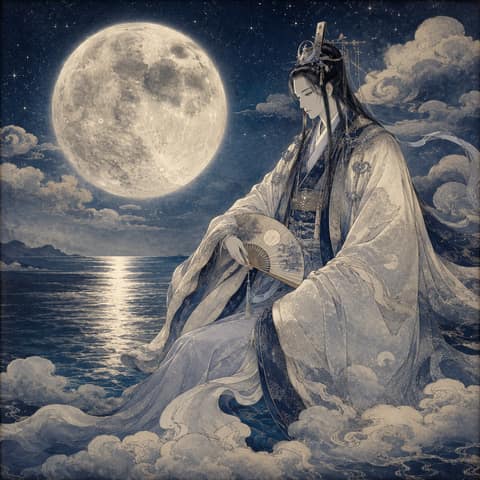
However, Tsukuyomi did not read this fertility as fertility. Seeing the food produced from her mouth, he became angry, thinking it filthy and asking if she intended to feed him with vomit, and he killed her—the murder by Tsukuyomi-no-Mikoto[1]. Here lies a rejection of food being too close to the body. Food sustains humans, but the moment it touches the realm of saliva, vomiting, or excretion, it turns into defilement. Because Ukemochi crosses that dangerous boundary to produce food, Tsukuyomi perceived her not as a deity showing courtesy, but as one insulting him. The violence in the myth is born from a gaze that cannot endure the raw reality of food.
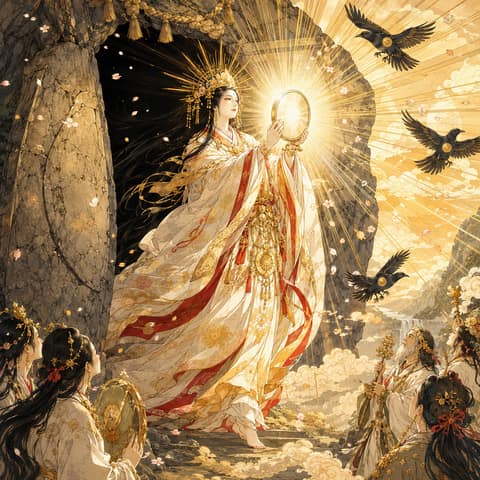
Following the murder, Amaterasu rejected Tsukuyomi as an "evil god," declaring she would not see him again. The *Nihon Shoki* narrates this as the reason the sun and moon came to live separated by a day and a night—the origin of the separation of sun and moon[1]. Because of this, the tale of Ukemochi cannot be contained merely as an agricultural myth. By the moon god killing the food god, his relationship with the sun god is severed, establishing the rhythm of day and night. The origin of food is simultaneously the origin of the order of time. The world where humans eat by day and sleep by night is opened through the death of Ukemochi and the exit of Tsukuyomi.
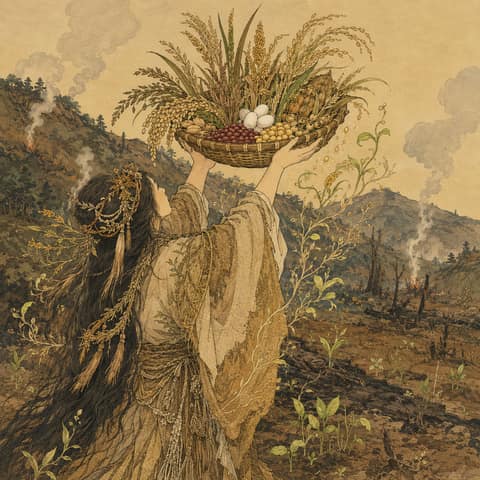
The enumeration of what springs from her corpse makes Ukemochi's divinity most vivid. Cattle and horses form from the crown of her head, millet grows from her skull, silkworms from her eyebrows, barnyard grass from her eyes, rice from her belly, and wheat, soybeans, and adzuki beans from her genitals—cattle/horses, millet, silkworms, barnyard grass, rice, wheat, soybeans, adzuki beans[1]. Here, not only grains but also livestock and sericulture are generated from the same body. When Ame-no-Kumahito brings these back to Amaterasu, she rejoices, recognizing them as things people will eat to live. She divides them into seeds for dry fields and wet paddies, and has the rice planted in the fields of Ame-no-sada and Naga-ta. Furthermore, placing cocoons in her mouth to draw thread, the path of sericulture begins. The body of the dead god is dismantled into fields, mulberry silkworms, and livestock, and rearranged as the techniques of living.
A comparison with Ogetsuhime-no-Kami in the *Kojiki* is unavoidable when reading Ukemochi. The Kokugakuin entry for Tsukuyomi points out that while an origin myth where a food god is murdered is also found in the *Kojiki*, there it is Susanoo—not Tsukuyomi—who kills Ogetsuhime. This is the difference between Tsukuyomi and Susanoo[2]. That is, even in the same "food generated from the body of a food god" pattern, the *Nihon Shoki*'s Ukemochi tale emphasizes the moon god's rejection and the separation of sun and moon, whereas the *Kojiki*'s Ogetsuhime tale emphasizes Susanoo's violence and the origin of grains. Among food myths, Ukemochi carries a particularly heavy cosmological weight.
In later beliefs, deities governing food and rice spirits—such as Toyouke-Omikami, Uka-no-Mitama, and Inari—formed rich spheres of worship. Within that context, rather than standing largely at the center of shrine worship, Ukemochi is important as a presence deep within the Kiki myths illuminating the relationship between food and death. If Toyouke is the god who prepares Amaterasu's sacred meals every day, Ukemochi is the god who narrates where that food came from, and why food is so close to the body and death. Behind the purity of the dining table are the memories of a slashed body, divided seeds, and deities separated by day and night. The name Ukemochi points to that dark yet abundant starting point.
The core of Ukemochi lies in food being narrated not as a clean, finished product, but as something emerging from the body. Welcoming Tsukuyomi-no-Mikoto, Ukemochi does not bring rice out of a storehouse. Turning to the land, boiled rice comes from her mouth; turning to the sea, fish; turning to the mountains, beasts—food generated from the mouth[1]. This is not an act lacking courtesy, but shows that the god's body itself is the food storehouse of the mountains, sea, and land. Food in the natural world, before being arranged into the formats of human kitchens or sacred offerings, exists chaotically inside the god's body. Ukemochi offers this chaotic abundance to her guest.
However, Tsukuyomi did not see abundance there; he saw defilement. Food is the most intimate thing that sustains human life, but the moment it comes from the mouth, it takes on imagery of saliva and vomit. Myth does not hide this duality. Tsukuyomi's anger, while unreasonable, reflects the fear that food is inseparable from the body. Against a consciousness that wants to see the blessings of food only as pure offerings, Ukemochi bluntly presents the reality: to eat is inherently to touch other lives and the inside of the body. Therefore, the hospitality of this deity is a blessing, but simultaneously an unbearable proximity.
Through murder, the narrative is inverted. When Tsukuyomi strikes down Ukemochi, food does not disappear; rather, it appears as a fixed resource. Cattle and horses form from the crown of her head, millet grows from her skull, silkworms from her eyebrows, barnyard grass from her eyes, rice from her belly, and wheat, soybeans, and adzuki beans from her genitals—food generating from a corpse[1]. This enumeration of body parts assigned to livestock, grains, and sericulture is not merely a grotesque transformation. It gives mythic form to the sensation at the root of agricultural societies—that food is obtained by dismantling the life of the divine. Seeds are not pure abstractions; they come from the side of death.
The role of Amaterasu-Omikami is not merely to lament Ukemochi's death. Seeing what Ame-no-Kumahito brought back, Amaterasu receives them as things people will eat to live, dividing millet, barnyard grass, wheat, and beans as seeds for dry fields, and rice as seeds for wet paddies—seeds for dry and wet fields[1]. She further places cocoons in her mouth to draw thread, beginning the path of sericulture. Here, the result of violence is rewoven into the techniques of living by the hands of the sun goddess. Ukemochi's body becomes not just a corpse, but raw materials transferred to fields, livestock, mulberry silkworms, and seasonal labor. Amaterasu is a god who transforms what emerged from death into order.
This myth is heavy because the origin of food and the separation of sun and moon occur in the exact same scene. Hearing of Ukemochi's murder, Amaterasu rejects Tsukuyomi as an evil god and refuses to see him again. The *Nihon Shoki* narrates this as the origin of why the sun and moon came to be separated by a day and a night—the reason day and night separated[1]. That is, the establishment of a world where humans eat is also the event where the sun and moon can no longer exist in the same place. The origin of food overlaps with the origin of time. The daily routine of looking at the fields in the morning and the moon at night is a world ordered through the death of Ukemochi.
When compared to Ogetsuhime-no-Kami of the *Kojiki*, this difference becomes even clearer. The Kokugakuin University entry for Tsukuyomi notes that while the myth of a food god being murdered is also found in the *Kojiki*, there it is organized as Susanoo killing Ogetsuhime—the pattern of Susanoo and Ogetsuhime[2]. In Susanoo's case, the narrative gravity is on the violence of a rough god and the origin of grains. In Ukemochi's case, because the murderer is Tsukuyomi, the silence of the moon god, the rupture with the sun god, and the separation of day and night are unified. Despite being a similar pattern, the resonance of the myth is vastly different. Ukemochi expands the food myth all the way to the timetable of the cosmos.
Therefore, treating Ukemochi merely as a "convenient god who produces food" loses the most important darkness. Ukemochi is a god who narrates that food is always adjacent to death; that before a pure meal, there is the tearing of a body; and that an order is needed to transform that tearing into human living. When rice, millet, wheat, beans, fish, beast, and silk thread are lined up, they overlap with mythological violence and gratitude that cannot be diluted simply by the phrase "I humbly receive this life" (Itadakimasu). Ukemochi bears that overlap entirely upon herself. This is precisely why the food born from the death of this deity does not merely fill the stomach, but becomes the sustenance that supports the very world of humans living between day and night.
Character Profile
This section is our own creative profile for storytelling. It is not historical fact or scholarship.
A deity who gives excessively, offering food from her own body as hospitality. But because her fertility is too close to the body, it is misread as defilement, and only after her murder is it transformed into the order of fields and sericulture.
Compatibility
Resonates with food, agriculture, sericulture, offerings, the kitchen, corporeality, and stories of rebirth from death. She appeals to those who can look at not just purity, but the rawness and sacrifice behind food.
Abilities
Produces boiled rice from her mouth toward the land, fish toward the sea, and beasts toward the mountainsPrepares a feast, gathering the foods of the natural world onto a single trayGenerates cattle/horses, millet, silkworms, barnyard grass, rice, wheat, soybeans, and adzuki beans from her post-mortem corpseHands over the seeds of dry and wet fields, and the beginning of sericulture, to AmaterasuConnects the myth of the origin of food to the cosmology of the separation of sun and moonShakes the boundary between defilement and fertility, birthing the world's sustenance from her body
Weaknesses
Because her method of generating food is too corporeal, it is rejected as defilement by those who only wish to see pure offerings. Her well-intentioned hospitality is misread as an insult, inviting violence.
Habitat
Ashihara-no-Nakatsukuni, the mythological place of a feast, the boundary where rice farming, dry-field farming, and sericulture begin. Rather than a point on a map, she resides in the mythological space where food transfers from nature into human life.