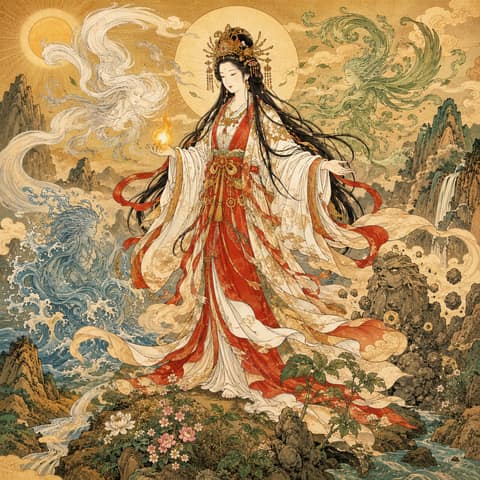
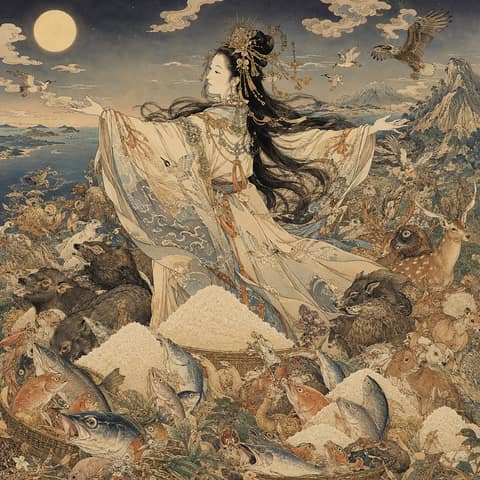
Wakumusubi-no-Kami is a deity of *Musuhi* (generative force) bearing young generative power, who appears in the *Kamiumi* (Birth of the Gods) of the *Kojiki*. The Kokugakuin University Deity Name Database notes that this deity appears in Volume 1, "Kuniumi Kamiumi"[1], positioning Wakumusubi-no-Kami as the second of two deities formed from the urine of Izanami-no-Kami as she lay ill after her genitals were burned giving birth to the fire god Kagutsuchi-no-Kami. In the same scene, deities such as Kanayamabiko-no-Kami, Kanayamabime-no-Kami, Haniyasu-biko-no-Kami, Haniyasu-bime-no-Kami, and Mitsuha-no-Me-no-Kami are formed from vomit and feces, leading Wakumusubi-no-Kami to be read as a deity in which new productive power rises from the very midst of death and impurity.
The name of this deity layers youth with generation. Kokugakuin's section on various theories clarifies that "Waku" comes from the *Nihon Shoki*'s character for "young" (waka/chigo), meaning young, and "Musuhi" is a word in the same category as Takamimusubi-no-Kami and Kamimusubi-no-Kami[1]. *Musuhi* has been understood not merely as "giving birth," but as the power to tie things together, cause them to become, and trigger the workings of life. The unsettling origin of being formed from the urine of a mother goddess burned by fire prevents this deity from being a pure creator god. Rather, it places the deity in the scene of agricultural generation where fire, urine, water, fertilizer, soil, and grain are interconnected.
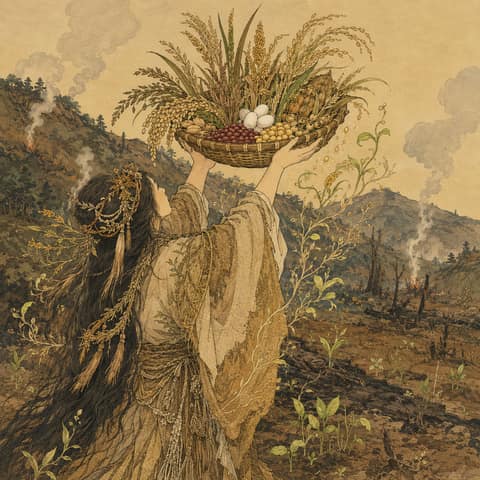
Furthermore, in the second alternative writing of the *Nihon Shoki*, it is told that Wakamusuhi[2] was born between the fire god Kagutsuchi and the earth goddess Haniyamahime, and that silkworms and mulberries grew on its head, and the five grains grew in its navel. In the *Kojiki*, Toyoukebime-no-Kami[3] appears as the child of Wakumusubi-no-Kami, connecting to food or the spirit of rice. In other words, Wakumusubi-no-Kami is not a deity who produces food directly from a corpse like Ukemochi-no-Kami or Ogetsuhime-no-Kami, but is the generative power that gives birth to a food deity—a "young generative spirit" heading toward grains and sericulture through fire, earth, and water.
Folklore & Legends
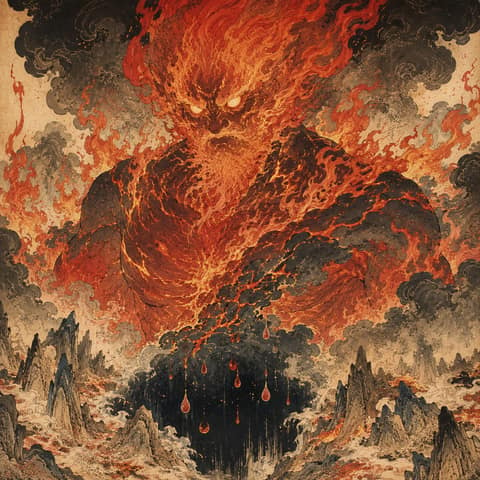
The scene where Wakumusubi-no-Kami appears is the moment when the bright multiplication of the *Kuniumi* and *Kamiumi* tilts toward death. After giving birth to many deities, Izanami-no-Kami gives birth to Hinokagutsuchi-no-Kami, burns her genitals, and lies ill. Amidst that suffering, Kanayamabiko-no-Kami and Kanayamabime-no-Kami are formed from vomit, Haniyasu-biko-no-Kami and Haniyasu-bime-no-Kami from feces, and Mitsuha-no-Me-no-Kami and Wakumusubi-no-Kami from urine. Kokugakuin explains Wakumusubi-no-Kami as the second of the two deities formed from urine[1]. This sensation of "becoming" or "forming" (naru) rather than "being born" (umareru) is important. Gods are not only born as normal children from a mother goddess, but also transform and form from the excretions of a sick body.
This procession of deities formed from excretions is not simply dismissed as something to be abhorred. Regarding their significance, Kokugakuin lists several theories, such as reflections of agriculture like volcanic eruptions and slash-and-burn farming, the Five Elements (Wuxing) philosophy, fire subjugation folklore, and the rituals of Mount Kagu—various theories on deities formed from vomit and excretions[1]. The composition where gods of metal, earth, water, and generation rise from the burned body of a mother goddess evokes both natural phenomena and agricultural techniques simultaneously. Wakumusubi-no-Kami appears at the end of that procession as a deity who turns what is not mere excretion into youthful productive power.
In terms of the meaning of the name, Wakumusubi-no-Kami is also important. Kokugakuin defines "Waku" as young, and "Musuhi" as the same word as Takamimusubi-no-Kami and Kamimusubi-no-Kami[1], stating that regarding the divine character and semantics, there are diverse views centered on the common theory of a god of production. *Musuhi* is a term acting as a fundamental force causing the world to form in the upper strata of ancient mythology. If Takamimusubi-no-Kami and Kamimusubi-no-Kami bear cosmic generative power, Wakumusubi-no-Kami can be seen as a deity who re-receives that generative power in the bodily sphere closer to the human world, represented by Izanami-no-Kami's illness.
The second alternative writing in the *Nihon Shoki* brings the character of Wakumusubi-no-Kami even closer to the origin of food. There, the fire god Kagutsuchi takes the earth goddess Haniyamahime as a wife and gives birth to Wakamusuhi, and it is said that silkworms and mulberries on the head, and the five grains in the navel[2] grew. Grains and sericulture dwell in a god born from the union of fire and earth. This form differs from the corpse transformation tales like those of Ukemochi-no-Kami or Ogetsuhime-no-Kami, but it shares the sensation that crops and silkworms arise from body parts. It is an example showing that myths of the origin of fire and the origin of food are closely related.
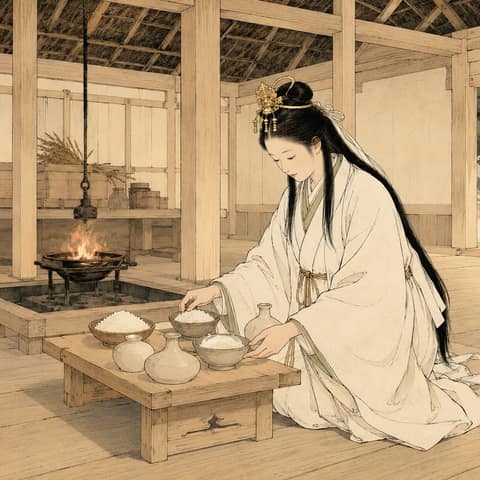
In the *Kojiki*, Toyoukebime-no-Kami appears as the child of Wakumusubi-no-Kami. Kokugakuin's entry on Toyoukebime-no-Kami describes this deity as the child deity of Wakumusubi-no-Kami[3], explaining that "Uke" means food or rice. Here, Wakumusubi-no-Kami does not produce food directly, but works as the generative power that gives birth to the spirit of food. Considering the Toyouke lineage of deities connecting to Toyouke-no-Okami, Wakumusubi-no-Kami can be said to be an inconspicuous but deeply rooted deity behind sacred offerings, rice spirits, and fertility.
Regarding the relationship with agriculture, Kokugakuin also presents multiple readings. There is a theory viewing him as a god of agricultural production based on primitive slash-and-burn farming due to his connection with the fire god; a theory interpreting him as representing youthful agricultural productivity born through fire stimulating the earth, feces and urine becoming fertilizer, and irrigation water; and a theory viewing him as the deity of generative power giving birth to the rice spirit since his child Toyoukebime-no-Kami is the divine spirit of rice—relationship with agricultural production[1]. Regardless of which theory one adopts, Wakumusubi-no-Kami is placed at the juncture where fire, water, and earth transform into productive power.
Furthermore, being formed from urine also connects to the issue of water. Kokugakuin introduces a theory that associates "Waku" with "springing forth" (waku), and since urine (yumari) connects to hot springs (yu), it is a deification of the action of hot springs gushing out. There is also a theory likening the gushing of hot and cold springs accompanying volcanic activity to urine, viewing it as representing water essential for production—theories surrounding urine, spring water, and hot springs[1]. At the same time, the fact that Mitsuha-no-Me-no-Kami, who was formed from the same urine, is a water deity supports this reading. Wakumusubi-no-Kami is situated in a place where the impurities of water and the blessings of water have not yet fully separated.
Wakumusuhi-no-Kami is not a deity possessing a flamboyant myth on his own. However, he stands at the intersection where multiple themes converge: the birth of the fire god, the death of Izanami-no-Kami, deities from excretions, Toyoukebime-no-Kami, silkworms and the five grains, slash-and-burn farming, and water. If Ukemochi-no-Kami and Ogetsuhime-no-Kami dramatically narrate "where food comes from," Wakumusubi-no-Kami is the deity who narrates "where the power to produce food itself is activated." Young *Musuhi* rises from the depths of impurity. That quiet transformation is the very core of this deity.
The true nature of Wakumusubi-no-Kami becomes visible not by viewing him as a frontline food deity, but as the underlying power that gives birth to food deities. In the *Kojiki*, when Izanami-no-Kami gives birth to Hinokagutsuchi-no-Kami, gets burned, and lies ill, Mitsuha-no-Me-no-Kami and Wakumusubi-no-Kami are formed from her urine—Wakumusubi-no-Kami formed from urine[1]. Here, gods do not descend from a pure sky. They arise from places close to life crises and impurity—burns, illness, and urine. Therefore, Wakumusubi-no-Kami's generative power is from the outset earthy, bodily, and close to agriculture.
The name "Waku" carries youthfulness. Using the *Nihon Shoki*'s character for "young" as a clue, Kokugakuin states that Waku means young[1] and considers "Musuhi" to be the same word as Takamimusubi-no-Kami and Kamimusubi-no-Kami. *Musuhi* is the power to generate, tie, and form things. If Takamimusubi-no-Kami and Kamimusubi-no-Kami are *Musuhi* close to the beginning of the universe, Wakumusubi-no-Kami is a young *Musuhi* standing in the scene where Izanami-no-Kami's body breaks down. Creation restarts not from completed order, but from the bottom of a wounded body.
That this deity is formed from urine is not merely a bizarre birth. Through the eyes of agriculture, urine and feces become fertilizer, water becomes irrigation, and fire leads to slash-and-burn farming and soil renewal. Kokugakuin introduces a theory viewing it as youthful agricultural productive power being born from receiving fire, fertilizer, and water, as well as a theory viewing it as a reflection of slash-and-burn agriculture—agricultural productive power born from fire, fertilizer, and water[1]. In this reading, Wakumusubi-no-Kami is not a deity who avoids impurity, but one who transforms impurity into crops. He can be said to be an existence that mythologizes the cycles at the base of life.
The *Nihon Shoki*'s Wakamusuhi demonstrates this character more concretely. Wakamusuhi is born between Kagutsuchi and Haniyamahime, and silkworms and mulberries grow on its head, and the five grains in its navel—Wakamusuhi harboring sericulture and the five grains[2]. Being born from the fire god and the earth goddess is also agricultural. The burning fire, the receiving earth, and the mulberry, silkworms, and five grains arising from there. While this differs from corpse transformation after murder like Ukemochi-no-Kami or Ogetsuhime-no-Kami, it shares a mythic sensibility that the source of food and sericulture dwells in body parts. Wakumusubi-no-Kami is the generative power at the preliminary stage of food origin myths.
The relationship with Toyoukebime-no-Kami firmly ties Wakumusubi-no-Kami to the genealogy of food deities. Kokugakuin's entry on Toyoukebime-no-Kami describes her as the child deity of Wakumusubi-no-Kami[3] and explains that "Uke" means food or rice. Toyoukebime-no-Kami is an important name when considering the later Toyouke-no-Okami faith, connecting to the realms of sacred offerings, food, and the rice spirit. As her parent deity, Wakumusubi-no-Kami does not become food himself, but bears the root function of making food form. Before the dining table is the rice paddy; before the rice paddy are water, fertilizer, and fire; and deeper still in myth stands Wakumusubi-no-Kami.
This deity also draws in readings related to water. Being formed from urine, the water goddess Mitsuha-no-Me-no-Kami being formed from the same urine, and the association of "Waku" with "springing forth" (waku) lead to theories surrounding the gushing of hot and cold springs—relationship with spring water and hot springs[1]. Just as volcanic activity shows fire and water simultaneously, in myth too, water and generative deities appear immediately after the birth of the fire god. Water and productive power emerge from a body burned by fire. This reversal well expresses the ancient sensation that resources supporting life appear after calamity.
In reading Wakumusubi-no-Kami, brevity of appearance is not a flaw. Rather, overlapping within the short description are the birth of the fire god, the death of Izanami-no-Kami, deities from excretions, Toyoukebime-no-Kami, the five grains, sericulture, slash-and-burn farming, water, and fertilizer. He is not a deity who shouts as a protagonist of a story, but one who connects multiple myths in the background. If Ukemochi-no-Kami and Ogetsuhime-no-Kami show that "food comes from the body and death," Wakumusubi-no-Kami declares that "the generative power to produce that food arises young from the depths of impurity." Therein lies the depth of the name "Young Generative Spirit" (Waku-musuhi).
Character Profile
This section is our own creative profile for storytelling. It is not historical fact or scholarship.
A quiet deity who activates generative power in the depths of impurity, water, fire, and earth, rather than a deity who flamboyantly dispenses food. Re-ties youthful power even from a broken body, opening the path to grains and sericulture.
Compatibility
Highly compatible with contexts reading the birth of the fire god, Izanami-no-Kami's illness, agriculture, slash-and-burn farming, irrigation, fertilizer, hot springs, and the background of Toyoukebime-no-Kami and Toyouke-no-Okami.
Abilities
Formed as a young generative power from urine during the scene of Izanami-no-Kami's illnessRe-ties fire, earth, water, and excretions into agricultural productive powerGives birth to Toyoukebime-no-Kami as a child, opening the genealogy of food and rice spiritsAs Wakamusuhi in the Nihon Shoki, harbors sericulture and the five grains in the bodySymbolizes the deep layers of production such as slash-and-burn, fertilizer, irrigation, and hot spring emergenceReceives the power of Musuhi connected to Takamimusubi-no-Kami and Kamimusubi-no-Kami on a grounded level
Weaknesses
Mythological appearances are brief, with few flamboyant anecdotes. Because his origins are tied to urine and illness, his core is difficult to see through a lens that seeks only pure fertility.
Habitat
Izanami-no-Kami's Kamiumi, the illness scene after the birth of the fire god, the mythological boundary where fire, earth, and water transform into agriculture.