YOKAI.JP

Mythical Realm

5 yokai rooted in Mythical Realm. Explore the legends tied to this land.

  • 瀬織津姫

    瀬織津姫

    Divine

    せおりつひめ

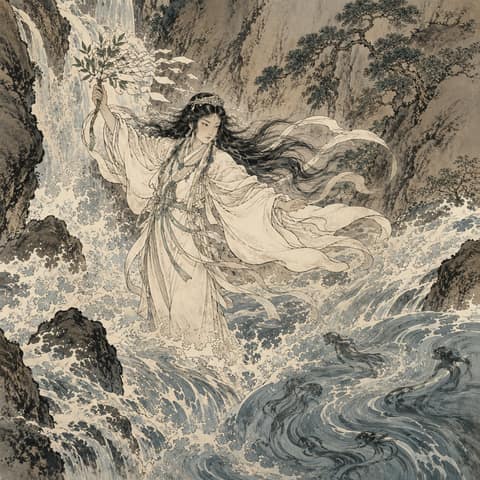
    速川の瀬に立つ祓戸の水神・瀬織津姫

    神霊・神格大祓詞の速川の瀬/佐久奈度神社 (現·滋賀県大津市、祓戸信仰)

    The key to reading Seoritsuhime lies in placing purification not on "making white" but on "making move." The sins and impurities in the Oharai-no-Kotoba are not things merely to be reflected upon in the mind. They are transferred onto purification objects, named by the incantation, and handed over to the water falling from the mountains. Seoritsuhime is their first carrier. The place she resides is not a calm lake surface, but the rapids of a swift river. In places where water hurries, where currents swirl, where footing becomes unstable, sins are separated from the human domain. The work of this deity differs from gentle comforting. Seoritsuhime does not envelop and preserve impurities. She receives what has been purified and carries it straight out to the great ocean. There is an ancient wisdom here that, rather than continually analyzing sin, one should change its location at a certain point. A human community would break if it only accumulated sins and impurities internally. Thus, purification reveals sins through words, places them on objects, and returns them to the natural cycle. Seoritsuhime is the deity of that switch, the power itself that returns stagnant things to the flow. Observing the chain of the four Haraedo deities makes Seoritsuhime's role even clearer. When she carries them from river to sea, Hayaakitsuhime swallows them in the tide's whirlpool, Ibukidonushi blows them away with his breath to the Root Country and Bottom Country, and Hayasasurahime finally causes them to be lost. In other words, Seoritsuhime is not the completion of eradication, but the initiation of the transfer toward eradication. The deity who handles the first step is often the closest to humans. In the moment a person lets go of a sin or impurity, it has not yet disappeared. However, it is no longer in the owner's hands. Seoritsuhime stands in that suspended time. Seoritsuhime's charm as a water goddess is also born from this. Water is precious not because it is pure, but because it purifies by flowing. It does not reject turbidity; it carries it. It is natural that faiths drawn to waterfalls and rapids turn toward Seoritsuhime. Falling water continuously crosses boundaries: from top to bottom, from mountain to river, from river to sea. The goddess standing there is not the guardian of a fixed sanctuary, but a deity who facilitates passage across boundaries. Her purity is not a halted innocence, but an order maintained by flow. On the other hand, one should keep a distance from the temptation to speak of Seoritsuhime as the "hidden true body" of Amaterasu Omikami. In the official explanation of Ise Jingu, Aramatsuri-no-Miya is the first auxiliary shrine of the Naiku, enshrining the Aramitama of Amaterasu Omikami, and the Aramitama is explained as a particularly conspicuous manifestation of divine power. Seoritsuhime's name is not placed there. Therefore, narratives connecting the two are safely treated as later annotations, folk beliefs, and modern reception. There is no need to deny such layers, but mixing them with the deity's character in the original texts ironically causes Seoritsuhime's own contours to be lost. Seoritsuhime's uniqueness lies not as a shadow name for the sun, but in the procedure of water. If Amaterasu Omikami is the deity who illuminates and orders the world, Seoritsuhime is the deity who hands over the sins and impurities inevitably generated within that order to the water for circulation. A bright order requires a system to process shadows. The place where Seoritsuhime works in the Oharai-no-Kotoba is exactly that location. To maintain a world ruled by light, water must carry the dirt away. She is not an opponent of light, but the waterway ensuring the world of light does not break. Praying to this deity does not mean pretending the dark things inside oneself never existed. Rather, it is about giving them a name, giving them a form, and handing them over to where they should flow. Seoritsuhime does not condemn those holding sins, but she refuses to let them hold onto them forever. Sadness, regret, anger, the turbidity of old relationships. She carries such things to the water's edge and creates a moment to let go. Her purification is not forgetting but transferring, not forgiveness but a flow path. Therefore, before Seoritsuhime is a pure goddess, she is a goddess of movement. In this sense, Seoritsuhime's divine authority is easily reinterpreted into modern emotional organization, but she should not be confined to simplistic psychology. The purification of the Oharai-no-Kotoba was a public word meant to rebuild a grand order encompassing not just the individual's inner self, but the community, officials, and the nation. Seoritsuhime connects that word to the water. She is a deity who hands over what cannot be resolved by the heart alone to space, current, and time.
  • Wakumusubi-no-Kami

    Wakumusubi-no-Kami

    Divine

    わくむすひのかみ

    Wakumusubi-no-Kami, the Young Generative Spirit Tying Grain from Fire and Urine

    神霊・神格Divine birth in mythology

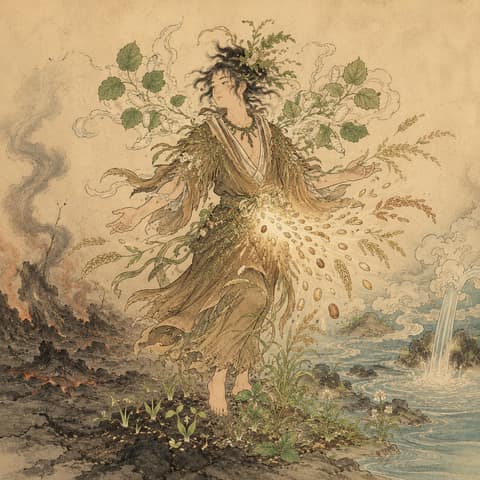
    The true nature of Wakumusubi-no-Kami becomes visible not by viewing him as a frontline food deity, but as the underlying power that gives birth to food deities. In the *Kojiki*, when Izanami-no-Kami gives birth to Hinokagutsuchi-no-Kami, gets burned, and lies ill, Mitsuha-no-Me-no-Kami and Wakumusubi-no-Kami are formed from her urine—Wakumusubi-no-Kami formed from urine. Here, gods do not descend from a pure sky. They arise from places close to life crises and impurity—burns, illness, and urine. Therefore, Wakumusubi-no-Kami's generative power is from the outset earthy, bodily, and close to agriculture. The name "Waku" carries youthfulness. Using the *Nihon Shoki*'s character for "young" as a clue, Kokugakuin states that Waku means young and considers "Musuhi" to be the same word as Takamimusubi-no-Kami and Kamimusubi-no-Kami. *Musuhi* is the power to generate, tie, and form things. If Takamimusubi-no-Kami and Kamimusubi-no-Kami are *Musuhi* close to the beginning of the universe, Wakumusubi-no-Kami is a young *Musuhi* standing in the scene where Izanami-no-Kami's body breaks down. Creation restarts not from completed order, but from the bottom of a wounded body. That this deity is formed from urine is not merely a bizarre birth. Through the eyes of agriculture, urine and feces become fertilizer, water becomes irrigation, and fire leads to slash-and-burn farming and soil renewal. Kokugakuin introduces a theory viewing it as youthful agricultural productive power being born from receiving fire, fertilizer, and water, as well as a theory viewing it as a reflection of slash-and-burn agriculture—agricultural productive power born from fire, fertilizer, and water. In this reading, Wakumusubi-no-Kami is not a deity who avoids impurity, but one who transforms impurity into crops. He can be said to be an existence that mythologizes the cycles at the base of life. The *Nihon Shoki*'s Wakamusuhi demonstrates this character more concretely. Wakamusuhi is born between Kagutsuchi and Haniyamahime, and silkworms and mulberries grow on its head, and the five grains in its navel—Wakamusuhi harboring sericulture and the five grains. Being born from the fire god and the earth goddess is also agricultural. The burning fire, the receiving earth, and the mulberry, silkworms, and five grains arising from there. While this differs from corpse transformation after murder like Ukemochi-no-Kami or Ogetsuhime-no-Kami, it shares a mythic sensibility that the source of food and sericulture dwells in body parts. Wakumusubi-no-Kami is the generative power at the preliminary stage of food origin myths. The relationship with Toyoukebime-no-Kami firmly ties Wakumusubi-no-Kami to the genealogy of food deities. Kokugakuin's entry on Toyoukebime-no-Kami describes her as the child deity of Wakumusubi-no-Kami and explains that "Uke" means food or rice. Toyoukebime-no-Kami is an important name when considering the later Toyouke-no-Okami faith, connecting to the realms of sacred offerings, food, and the rice spirit. As her parent deity, Wakumusubi-no-Kami does not become food himself, but bears the root function of making food form. Before the dining table is the rice paddy; before the rice paddy are water, fertilizer, and fire; and deeper still in myth stands Wakumusubi-no-Kami. This deity also draws in readings related to water. Being formed from urine, the water goddess Mitsuha-no-Me-no-Kami being formed from the same urine, and the association of "Waku" with "springing forth" (waku) lead to theories surrounding the gushing of hot and cold springs—relationship with spring water and hot springs. Just as volcanic activity shows fire and water simultaneously, in myth too, water and generative deities appear immediately after the birth of the fire god. Water and productive power emerge from a body burned by fire. This reversal well expresses the ancient sensation that resources supporting life appear after calamity. In reading Wakumusubi-no-Kami, brevity of appearance is not a flaw. Rather, overlapping within the short description are the birth of the fire god, the death of Izanami-no-Kami, deities from excretions, Toyoukebime-no-Kami, the five grains, sericulture, slash-and-burn farming, water, and fertilizer. He is not a deity who shouts as a protagonist of a story, but one who connects multiple myths in the background. If Ukemochi-no-Kami and Ogetsuhime-no-Kami show that "food comes from the body and death," Wakumusubi-no-Kami declares that "the generative power to produce that food arises young from the depths of impurity." Therein lies the depth of the name "Young Generative Spirit" (Waku-musuhi).

  • Moon Rabbit

    Moon Rabbit

    Epic

    TSOO-kee-noh oo-SAH-ghee

    Moon Rabbit Pounding Mochi

    Animal ShapeshiftersAcross Japan (widespread after the arrival of Buddhism)

    An image of the Moon Rabbit grounded in Japanese iconography. From Asuka-period examples onward, the rabbit within the lunar disk was paired with the solar crow in medieval Buddhist painting and received as a bearer of celestial phenomena. In early modern times, depictions of a rabbit using a Chinese-style mortar and pestle spread through books and prints, and by the eighteenth century the mortar shifted into a characteristically Japanese hourglass shape. The rabbit came to be understood not as compounding an elixir of immortality but as pounding mochi, linking it through wordplay to moon viewing and full-moon festivals. In lore, a self‑sacrificing rabbit ascends to the moon by Indra’s grace, with the lunar shadows and smoke-like markings read as its traces. In folk practice, people gazed at the moon seeking the rabbit’s silhouette, and the theme persisted in moon‑vigil gatherings and storytelling, overlapping with other celestial yokai and lunar deities.

  • Amano-zako (Heaven-Contrary Deity)

    Amano-zako (Heaven-Contrary Deity)

    Epic

    ah-mah-noh-ZAH-koh

    Zukai-Conformant Demon-Deity Form

    Deities & Divine SpiritsUncertain (descriptions chiefly in Edo-period encyclopedias)

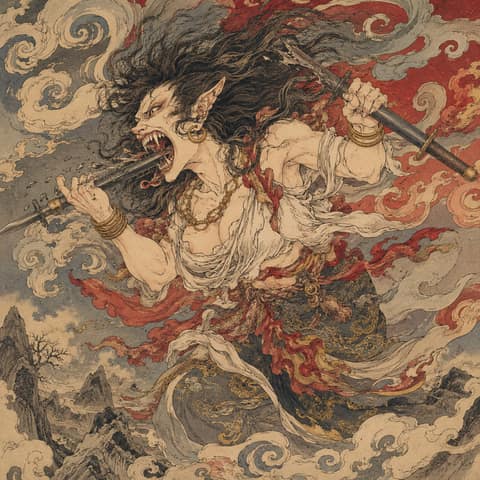
    This version follows the core account in Wakan Sansai Zue, depicting Amanozako as a ferocious demon-deity born from turbulent qi. Her appearance blends human and beast, with a high nose, long ears, and powerful fangs. Her temper is ever contrary, shunning proper procedure and delighting in reversals. She is said to wield overwhelming spiritual force, boasting the strength and presence to hurl even mighty gods afar. While conceptually akin to the Amanojaku, her lineage is unsettled, and claims that she is progenitor of the Tengu are limited. The note that she is mother of Tenma-no-O is confined to the Zue citation, with little broad support in oral tradition. Here the focus remains on her classical traits as a demon-deity—contrary speech, contrary action, and ferocious might—kept within the bounds of early-modern images and texts.

  • Amanojaku

    Amanojaku

    Epic

    ah-mah-noh-JAH-koo

    Traditional Iconography and Folktale

    Demons & GiantsVarious regions of Japan (ancient strands linked to Yamato and Izumo mythic cycles)

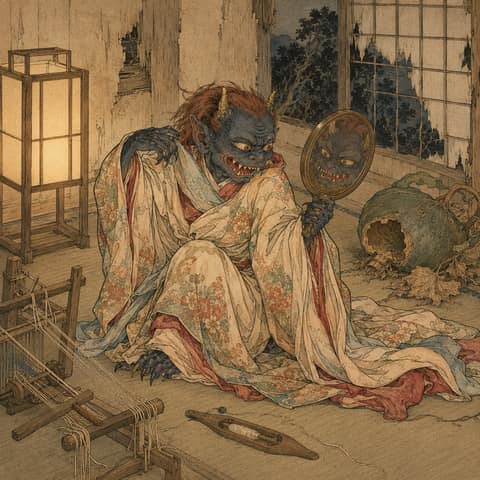
    Amanojaku is understood as a fusion of the trampled demon in Buddhist iconography and the folk image of a small imp fond of mimicry and speaking in reversals. Many temple and shrine statues of the Four Heavenly Kings or Shukongōshin place a small demon underfoot, signifying the subjugation of worldly desires and wicked intent. In stories, Amanojaku habitually reads people’s hidden thoughts, balks at requests, and does the opposite of commands to sow confusion. In mountain lore it is told as a being of tremendous strength, with unfinished stone piles, bridge piers, and toppled boulders on peaks attributed to its failed feats. Interpreting echoes as the voice of Amanojaku is a personification of natural phenomena, overlapping regionally with names like kodama and yamabiko. In fairy tales such as Uriko-hime, it serves as a touchstone-like adversary that preys on carelessness or greed, carrying a moral lesson. Overall, Amanojaku lives across iconography, folktales, and dialect traditions as a mirror of human contrariness and the gaps in the heart.