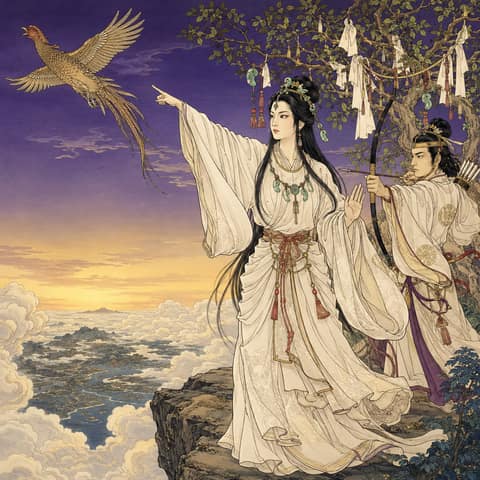
Amanojaku is a small demon known for defying people, twisting words and actions, and teasing by doing the opposite of what is asked. In Buddhist iconography it appears as a wicked imp trampled underfoot by the Four Heavenly Kings or Shukongōshin, symbolizing human passions and delusions. In mythic lore its name connects to figures like Ama-no-Sagume and Ame-wakahiko, suggesting an old deity or shamanic spirit later reduced and recast as a mischievous goblin. Local traditions portray it variously as a voice-mimicker, a mountain echo, or even a giant.
Folklore & Legends
Traits vary by region. In eastern Japan it is said to mimic voices and mislead travelers, sometimes identified with mountain echoes such as kodama or yamabiko. Around Hakone and Izu, giant-tale motifs explain the making of mountains and islands, with stone piles and boulders atop peaks attributed to Amanojaku’s deeds. In the Tōhoku region, the name is used for hearthside sprites or small insects and pupae, and appears in child-rearing sayings meant to keep babies from crying. In folktales like The Melon (Uriko) Princess, Amanojaku plays the scheming villain, reflecting its broad narrative role.
Amanojaku is understood as a fusion of the trampled demon in Buddhist iconography and the folk image of a small imp fond of mimicry and speaking in reversals. Many temple and shrine statues of the Four Heavenly Kings or Shukongōshin place a small demon underfoot, signifying the subjugation of worldly desires and wicked intent. In stories, Amanojaku habitually reads people’s hidden thoughts, balks at requests, and does the opposite of commands to sow confusion. In mountain lore it is told as a being of tremendous strength, with unfinished stone piles, bridge piers, and toppled boulders on peaks attributed to its failed feats. Interpreting echoes as the voice of Amanojaku is a personification of natural phenomena, overlapping regionally with names like kodama and yamabiko. In fairy tales such as Uriko-hime, it serves as a touchstone-like adversary that preys on carelessness or greed, carrying a moral lesson. Overall, Amanojaku lives across iconography, folktales, and dialect traditions as a mirror of human contrariness and the gaps in the heart.
Character Profile
This section is our own creative profile for storytelling. It is not historical fact or scholarship.
The diagram below is a diagnostic evaluation chart for Traditional Iconography and Folktale. The higher the value of each item, the stronger that characteristic is expressed.