Yokai Encyclopedia

Encyclopedia of Japanese Yokai

28 Yokai|14 Category|Page 1 of 2
Localization in Progress - More content available in Japanese version
View Japanese
Sort by: NameAscending
鬼・巨怪
  • Amanojaku

    Amanojaku

    Epic

    ah-mah-noh-JAH-koo

    Traditional Iconography and Folktale

    Demons & GiantsOkayamaShizuoka

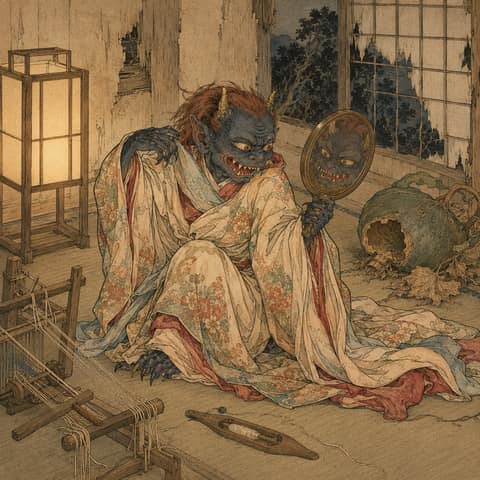
    Amanojaku is understood as a fusion of the trampled demon in Buddhist iconography and the folk image of a small imp fond of mimicry and speaking in reversals. Many temple and shrine statues of the Four Heavenly Kings or Shukongōshin place a small demon underfoot, signifying the subjugation of worldly desires and wicked intent. In stories, Amanojaku habitually reads people’s hidden thoughts, balks at requests, and does the opposite of commands to sow confusion. In mountain lore it is told as a being of tremendous strength, with unfinished stone piles, bridge piers, and toppled boulders on peaks attributed to its failed feats. Interpreting echoes as the voice of Amanojaku is a personification of natural phenomena, overlapping regionally with names like kodama and yamabiko. In fairy tales such as Uriko-hime, it serves as a touchstone-like adversary that preys on carelessness or greed, carrying a moral lesson. Overall, Amanojaku lives across iconography, folktales, and dialect traditions as a mirror of human contrariness and the gaps in the heart.
  • Battlefield Will-o'-Wisp

    Battlefield Will-o'-Wisp

    Uncommon

    koh-SEN-joh-bee

    Battlefield Will-o’-the-Wisp (Classical Form)

    Demons & GiantsOsaka

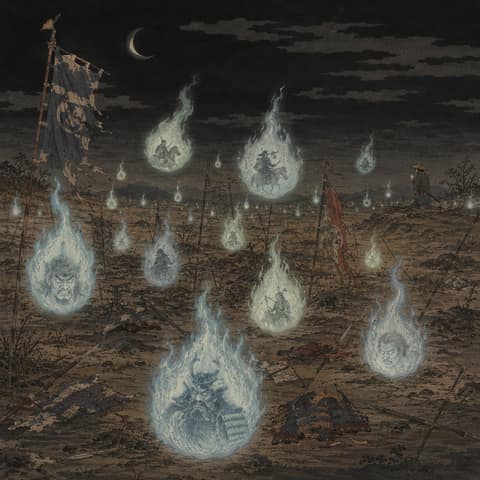
    A standardized image of the battlefield will-o’-the-wisp as seen in Edo-period picture scrolls and ghost tales. Most appear as multiple pale fireballs at midnight, drifting low as if against the wind. They are thought to rise as spirit-fire from the defilement of blood and corpses saturating the ground, each flame regarded as a fragment of the aura of soldiers and horses. Accounts describe repetitive behavior—circling fixed spots, appearing and vanishing, crossing rice-field ridges—rather than chasing people. Witnesses would recite prayers to withdraw, and villages calmed them with memorial services. Sekien used the term “Kosenjō-bi” to group uncanny fires at battle sites, framing many postwar fire tales found in works like Yadonokigusa. Malice is rarely attributed; they were respected as signs of unsettled souls.

  • Daidarabotchi

    Daidarabotchi

    Rare

    Daidarabotchi

    The Terrain-Shaping Giant Who Trampled the Lands of Musashi

    Oni / Giant MonstersSaitamaTokyo

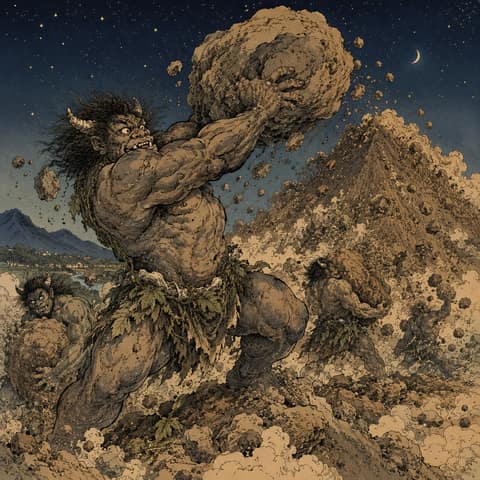
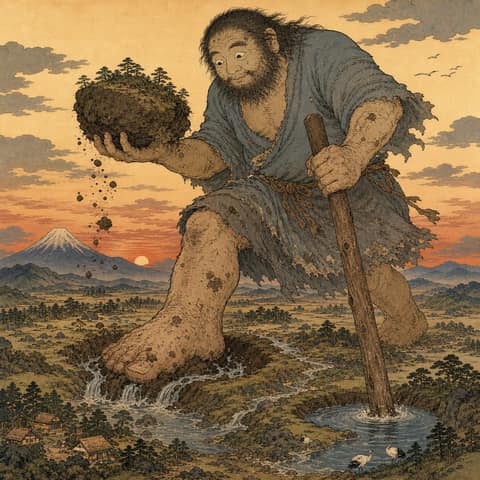
    Daidarabotchi is not so much a terrifying monster as a giant whose existence serves to explain the origins of the land. He has been debated both as a degraded folk version of the nation-building deities from the *Kojiki* and *Nihon Shoki* myths, and as a product of ancient peoples' imagination trying to explain Jomon period shell mounds or natural terrain features. Musashi Province is one of the areas where these legends are particularly strong, dotted with origin stories of place names—such as "Ootakubo" in Saitama City—where his footprints turned into depressions, marshes, and wells. Even massive geographical features like Mount Fuji, Lake Biwa, and Lake Haruna are attributed to this giant's deeds, operating on a scale far exceeding a single prefecture. Ever since Kunio Yanagita compiled the footprint legends from across the country, Daidarabotchi has become a "giant bearing the memory of place names and terrain," blending seamlessly into the very landscape of Japan.

  • Demons of Mt. Ichiya

    Demons of Mt. Ichiya

    Rare

    ichiyazan-no-oni

    The Demons of Kinasa Who Built a Mountain in One Night

    Demons / Giant MonstersNagano

    Unlike the demoness Momiji, who was refined on the Noh and Kabuki stages, the demons of Mt. Ichiya are indigenous demons who bear the very origin of the place name. Their action is singular—to build a mountain overnight and block the arrival of the capital. The desperation of a local existence refusing to be stripped of its home is condensed into this single point. While the Momiji legend is a story of descent—'a noblewoman exiled from the capital falls into a demon'—the demons of Mt. Ichiya are depicted as entities that existed in the village from the beginning and resist the capital coming from the outside. The name of the real-life general Abe no Hirafu overlaps with the quasi-historical framework of Emperor Tenmu's capital relocation, giving the legend a strange sense of reality. The conclusion, where the demons are defeated and the name 'Kinasa' is born, is also a story of renaming the land from the perspective of the victor (the center), and the bitter aftertaste of this legend lies in the fact that the defeat of the demons itself was permanently carved as a place name. The cluster of Kyoto-derived place names remaining in Kinasa are scattered in the valley even today, serving as evidence of the victor's memory.

  • Demons of Tateyama Jigoku

    Demons of Tateyama Jigoku

    Rare

    Tateyama-jigoku-oni

    Demonic Jailers of the Tateyama Mandala Hells

    Oni / Giant MonstersToyama

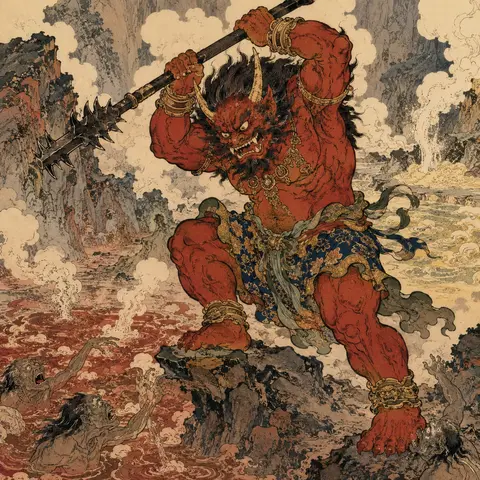
    Rather than being a single, independent yokai, the Demons of Tateyama Jigoku are an ensemble cast constituting the underworld as projected onto the sacred Mount Tateyama. The Tateyama Mandala consists of five elements: the founding legend, hell, the Pure Land, the ascetic climbing path, and the Nunobashi Kanjō-e ritual. In the scenes of hell, it is these demons who stoke the cauldrons, herd the dead up the Mountain of Swords, and drown them in the Blood Pool. Notably, Tateyama's hell was not purely a product of imagination, but was based on the actual landscape of Hell Valley—its fumaroles, sulfur springs, and desolate volcanic plains. With Mikurigaike as the Blood Pool Hell and Mount Tsurugi as the Mountain of Swords Hell, the visible natural world was directly translated into the iconography of hell, giving the Demons of Tateyama Jigoku a palpable sense of reality as denizens of that very landscape. The etoki preaching tours by Ashikuraji guides flourished in the late Edo period under the patronage of the Kaga domain, spreading the image of these demons to villages nationwide through the mandala. The tortures inflicted by the demons of hell serve to accentuate the salvation offered by their counterparts, Ubagami and Amida Buddha. The view of the underworld in the Tateyama faith is thus constructed upon this tension between punishment and salvation.

  • Fujiwara no Chikata’s Four Oni

    Fujiwara no Chikata’s Four Oni

    Uncommon

    fooj-ee-WAH-rah no chee-KAH-tah no yohn-kee

    Taiheiki Tradition Version: The Four Oni

    Demons & GiantsMieIwate

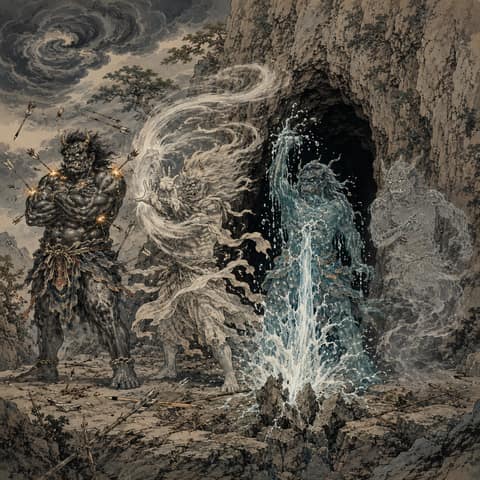
    This version follows the Taiheiki, Book 16 “Affairs of Japan’s Enemies.” The Four Oni serve under Fujiwara no Chikata with clearly divided roles, complementing each other’s arts in battle. The Gold Oni forms the vanguard with a body that repels blades and arrows, the Wind Oni scatters ranks with gales, the Water Oni summons flood and torrent across any terrain, and the Hidden Oni erases form and presence to handle scouting and ambush. Their might is framed less as stratagem than as a tendency to yield before kotodama and prayer, epitomized by their dispersal through a waka by Ki no Asao. Later legends of Sakanoue no Tamuramaro and Kumano slayings alter their order and exploits, yet the core remains: four disparate powers combine to overmatch human effort, but bow to righteous words. The notion of ninja origins is a later reading; in folklore studies this is a case of war-epic demon tales binding to local toponymic lore. Creative variants abound, but this version keeps to gunki conventions and limits places and figures to sources within the epic.

  • Gaki Possession (Starving-Ghost Affliction)

    Gaki Possession (Starving-Ghost Affliction)

    Uncommon

    GAH-kee TSOO-kee

    Traditional Version: Gaki Possession of the Mountain Pass

    Demons & GiantsVarious regions (Kanagawa, Wakayama, Kochi, Niigata, and elsewhere)

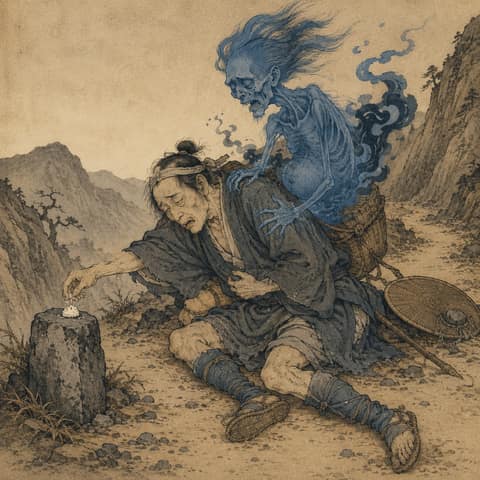
    A classic image of gaki possession said to occur on mountain passes and in the hills. It is understood to stem from the spirits of those starved to death in battles or as wayfarers, so travelers carried a little food and offered it to the pass before crossing to avert harm. Onset is sudden, marked by fierce hunger, weakness in the limbs, and feet that refuse to move, often leaving one unable to rise in shade or where wind passes through. The remedy is simple: even a single grain of rice, a pinch from a salty rice ball, or a scrap of dried fish in the mouth is said to loosen the grip. As prevention, people scattered a bite of their lunch to the mountain deity or the spirits of the unburied dead, or made offerings at roadside Jizo. One should avoid heavy meals at once, easing the stomach with rice porridge or zosui. Though names vary—Iso-gaki on the coast, Hidarugami in basins and farm villages, Jikitori in Shikoku—the symptoms and remedies are nearly identical and closely tied to local practices of memorial and roadside offerings for the dead.

  • Giant Centipede

    Giant Centipede

    Epic

    OH-oh-MOO-kah-deh

    Giant Centipede (Mikami-yama Tradition)

    Demons & GiantsShigaTochigi

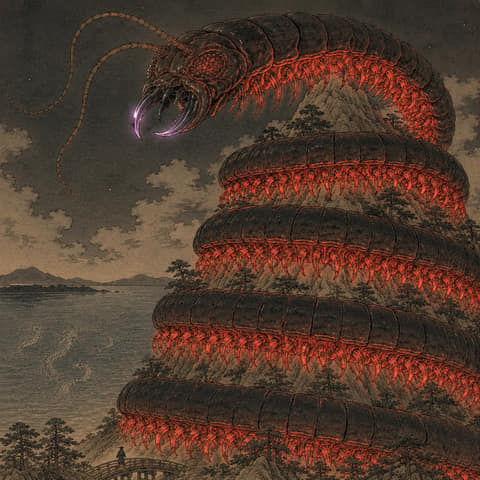
    A famed form tied to legends of Mount Mikami in Ōmi and the shores of Lake Biwa. Said to coil around the mountain seven and a half times, its shell is as hard as metal or stone, impervious to arrows and blades. At night its legs gleam crimson, casting a long shadow over the lake and mountain skirts. Tales of its slaying are linked to martial valor and understood in relation to dragon-god worship and the numinous power of bridges. Connections to mining and blacksmith lore have been noted, though details remain unclear.

  • Great Nyūdō (Giant Priest Apparition)

    Great Nyūdō (Giant Priest Apparition)

    Epic

    oh-oh-nyoo-DOH

    Annotated Traditional Edition: Ōnyūdō (Giant Priest)

    Demons & GiantsMie

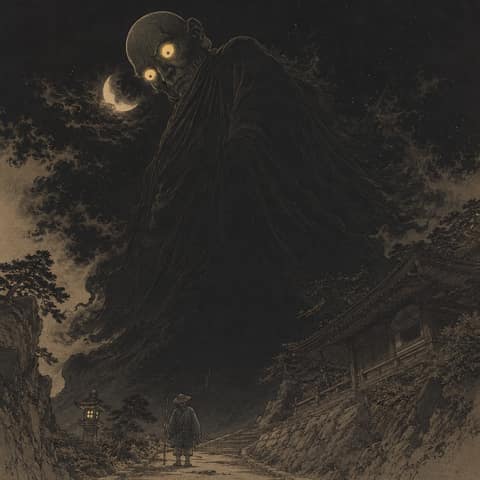
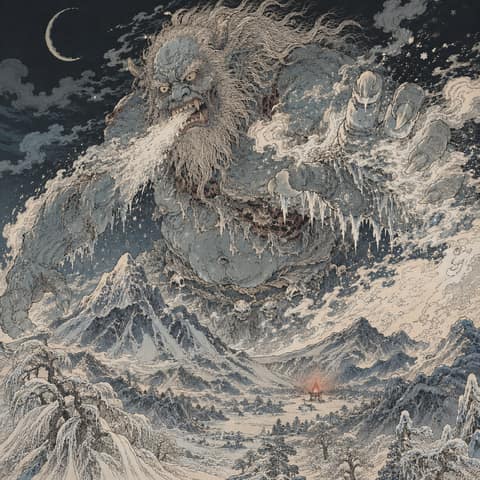
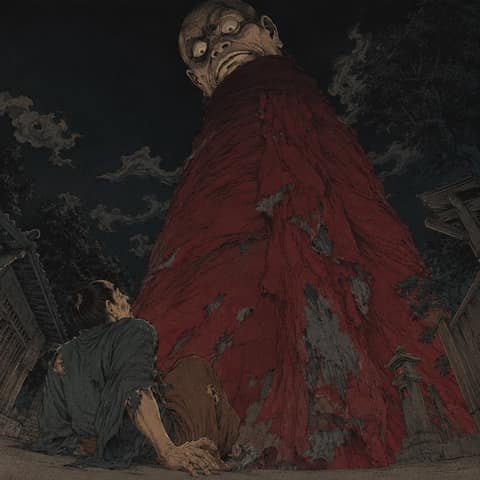
    The Ōnyūdō is defined by its sheer size and piercing glare. Reports range from a monk-like giant with a topknot to a vague shadowy figure, appearing in liminal places such as night roads, temple and shrine grounds, mountain passes, and lakesides. It draws the gaze of onlookers and, the instant they look up, grows taller to assert its might. Explanations of its nature vary by locale: a transformed animal, the spirit of an old stone pagoda or boulder, or an unclassified anomaly. Harmful cases include people collapsing under its stare or developing fever afterward, yet in places like Awa it is also told as a semi-guardian that helps with labor. Countermeasures follow traditional banishment methods: do not fear or avert your eyes, break its menace with arrows or prayer beads, or expose the true form of the shapeshifter. Historical sources sometimes mix names like Ōbōzu and Ōnyūdō, so it is best understood within local traditions.

  • Hannya

    Hannya

    Epic

    HAHN-nyah

    Noble Living Ghost - White Hannya (Lady Rokujo)

    Oni / Giant SpecterNaraKyoto

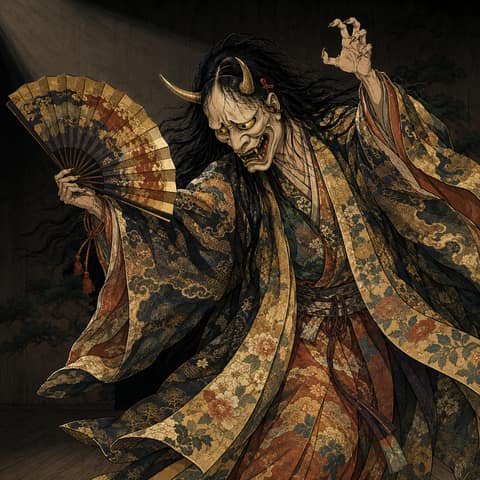
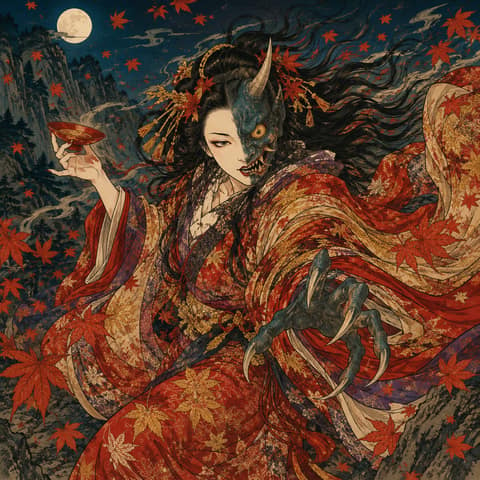
    Among the numerous variations of Hannya, this is an interpretation of the 'White Hannya (Shiro-hannya)', which embodies the highest dignity and the deepest psychological terror. The prototype for this version is the spiritual form of Lady Rokujo, a royal consort appearing in *The Tale of Genji* and the Noh play *Aoi no Ue*. She was a noble lady possessing peerless beauty, exceptionally high culture well-versed in waka and Chinese poetry, and immense pride. However, loneliness from the waning visits of her beloved Hikaru Genji, combined with a decisive, public humiliation suffered at the hands of the attendants of Genji's lawful wife, Aoi no Ue, during a 'carriage dispute' (a fight for viewing space for oxcarts) at a festival, birthed jealousy and resentment within her heart that exceeded her limits. Terrifyingly, even though Lady Rokujo herself tried to maintain her reason and not hate Genji, the massive passions suppressed in her subconscious slipped out of her body night after night as a 'living ghost (ikiryo)', standing by Aoi no Ue's bedside to curse her to death. This White Hannya is fundamentally different from the savage demons living deep in the mountains. The paleness of her face represents the nobility unique to aristocratic women, while simultaneously expressing the pale agony of having her blood drained and life force whittled away by the flames of jealousy. She does not use violent physical attacks, but slowly erodes the target's mind and body in the form of illness and nightmares. On the Noh stage, the figure of the White Hannya appearing in a broken carriage is a symbol of her shattered pride and deep sorrow. Swords and military might are entirely useless to defeat this noble living ghost. She can only be countered when high-ranking monks like Yokawa no Kohijiri sound the strings of an azusa-yumi (catalpa bow) to ward off evil and fiercely recite the Lotus Sutra or the Heart Sutra. And ultimately, the White Hannya retreats not because she was exorcised (overpowered by force) through prayer, but because the voice of the sutra chanting makes her realize her own hideous demonic form (the sin of attachment), allowing her to attain religious ecstasy (Buddhist salvation) and calm her heart. She perfectly dramatizes the spirituality of Japanese Buddhism: the fragility where humanity's highest intellect can so easily fall into becoming a monster, and the eventual salvation through enlightenment.

  • Kanatsubute

    Kanatsubute

    Uncommon

    kah-nah-TSOO-boo-teh

    Canon-Conforming (Traditional Lore)

    Demons & GiantsNaraKyoto

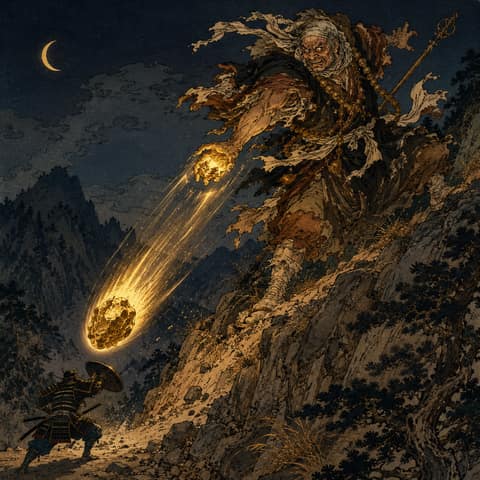
    Rooted in the Treasure Compendium account and given concrete form in the Otogizōshi Tamura tales, this type portrays the yokai as a shape-shifting brigand haunting the strategic pass at Narazaka, preying on travelers and tribute. The monk guise, gigantic body, and golden sling-stones became fixed traits. The golden stones are ranked as Tarō, Jirō, and Saburō, each escalating in power and boasted to shatter mountains and armor. The usual slayer is Inase Gorō Sakanoue no Toshimune, who leads troops, blunts the stones with traps and quick wits, and relentlessly pursues the creature with secret whistling arrows. The tale ends in surrender and execution, restoring safety to a key route. It is understood as a specter embodying the dangers and brigandage of local slopes and passes, emphasizing metallic gleam and the terror of flying stones.

  • Kidōmaru (Demon Prodigy)

    Kidōmaru (Demon Prodigy)

    Epic

    kee-DOH-mah-roo

    Classical Lore Version

    Demons & GiantsKyoto

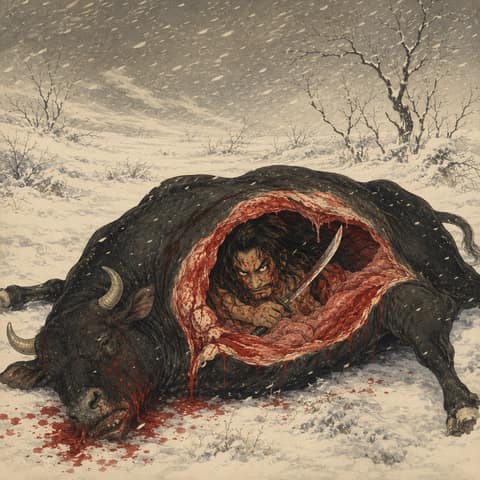
    Centered on Kokon Chomonjū, this version frames Kidōmaru as an oni confronting Minamoto no Yorimitsu (Raikō) and Watanabe no Tsuna. After escaping capture, he shadows his targets and, anticipating them on the road to Kurama, lies in wait at Ichiharano by hiding inside the body of a cow—an audacious ruse seen through by Raikō’s caution. When Tsuna’s arrow breaks the concealment, Kidōmaru reveals his oni form and charges, only to be felled by a single stroke from Raikō. Iconography was fixed by Toriyama Sekien as a figure draped in cowhide in the snow, and early modern warrior prints often depict him as a rival in contests of sorcery. His lineage is unsettled: in the Unbara tradition he is the child of Shuten Dōji, while in war tales he is a novice from Mount Hiei. In all strands he is understood as a being who hides in wilds, watching for opportunity through brute strength, transformation, and stealth. Avoiding later embellishments, this reconstruction centers on his core behaviors of concealment, transformation, and ambush.

  • Kihachi

    Kihachi

    Epic

    Kihachi

    Kihachi, the Savage God of Aso's Frost

    Oni / GiantKumamoto

    Kihachi was a savage deity who served as an arrow retriever for Takeiwatatsu-no-Mikoto, the pioneer god of Aso. Exhausted from his duties, he kicked an arrow back with his foot, enraging the god, who chased him to Takachiho and struck him down. Yet his severed body attempted to knit itself back together to revive, and even when buried in three separate pieces, he laid a curse, swearing to "make frost fall upon the Aso Valley." Left with no choice, Takeiwatatsu-no-Mikoto enshrined Kihachi as a deity at Shimo Shrine, where every year for fifty-nine days, a young maiden keeps a sacred fire burning day and night to warm his cold, severed body—a ritual that continues to this very day. A demon that brings the chill of frost to Aso, the Mountain of Fire. Slain only to become a god, he is the embodiment of the deep, complex layers of mythology woven into this land.

  • Kijo (Demon Woman)

    Kijo (Demon Woman)

    Uncommon

    KEE-joh

    Canonical Folkloric Type: Kijo (Ogress)

    Demons & GiantsVarious regions (notably Tōhoku, Shinano, Ōmi, and around Ise)

    A standardized profile of the archetypal kijo found across regional tales. She embodies the belief that human passions can ripen into demonic nature, appearing as anything from a beauty to an old woman. By night she lures travelers in mountains or at crossroads, invites them into a lodge or hermitage, then reveals her true form. Many stories end with her being driven off or laid to rest by Buddhist rites, serving as both horror and moral instruction. Depending on locale she may eat humans, target infants, or drink blood, all understood as outcomes of taboo-breaking, suspicion, and obsessive attachment. In Noh, sekkyō, and origin-picture scrolls she is depicted with horns, fangs, and bristling hair, the shock between human guise and oni form being a key dramatic moment.

  • Konpeika, the Golden Ogre of Kumano

    Konpeika, the Golden Ogre of Kumano

    Uncommon

    kohn-PAY-kah

    Kumanō Onigajō Legend Variant

    Demons & GiantsMie

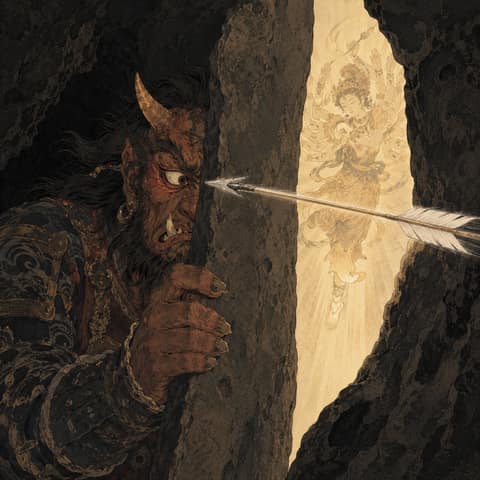
    A compiled variant portraying the ogre-general aspect of Kanekira Shika within Tamuramaro-style oni-slaying tales along the Kumanonada coast. He is said to have ruled from the ogres’ sea-eroded cavern known as the Demon’s Rock Dwelling, commanding a band of oni to disrupt maritime routes. In the clash with Tamuramaro, he feared Kannon’s protection, tightened his wards, and barred the stone door to endure a siege. Entranced by the dance led by a child avatar of Senju Kannon, he peered through the doorway and was fatally shot in the left eye. After his defeat, the head was buried in a ravine and ritually pacified. Local lore sometimes names him the pirate chief Tagamaru, with traces preserved in temple-shrine origin tales and toponyms such as Mamigashima, Tomari Kannon (Seimizu-dera), Ōma Shrine, and Onimoto. Historicity is uncertain; some see memories of suppressing revolts or local powers in Kumano later recast into Tamuramaro legend, yet all survive as narrative tradition.

  • Kurozuka

    Kurozuka

    Legendary

    kurozuka

    The Tragedy of Adachigahara: The Hag of Kurozuka

    鬼・巨怪Fukushima

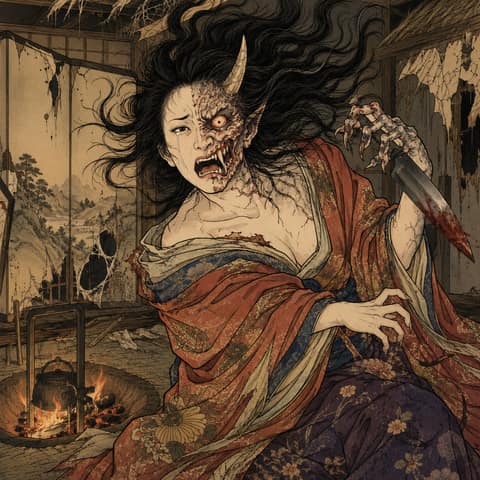
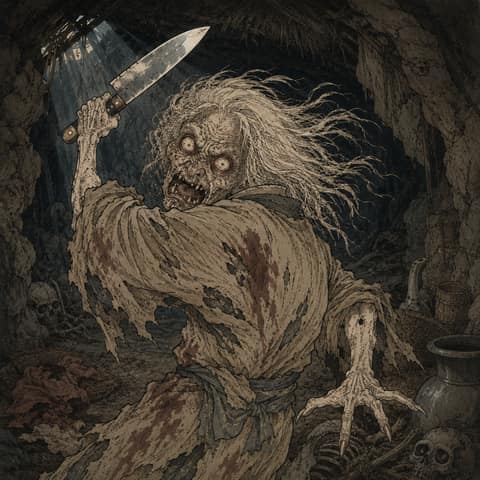
    The Embodiment of the Abyss of "Karma". Kurozuka (Iwate) is not merely a flesh-eating monster lurking in the mountains. Originally a refined wet nurse for Kyoto aristocrats, she resorted to the madness of murder to cure her mistress's illness, only to plunge into utter insanity and devolve into a demon after unwittingly killing her own daughter. This sequence of events is Japanese literature and theater's most harrowing depiction of "maternal devotion gone rogue," "blind loyalty," and the "inescapable retribution of karma." Her image, brandishing a butcher knife, radiates not just monstrous terror, but the bottomless sorrow and despair of a human toyed with by the cruelty of fate. The "Taboo of Looking" and the Boundary to the Otherworld. In the Kurozuka legend, the taboo of "do not look into the inner room" plays a pivotal role. The front room of the hut represents the "mundane human space," while the inner room is the "otherworld of death and demons" filled with white bones. The moment the traveling monk breaks the taboo, everyday reality collapses, exposing the "monstrous abnormality" hidden within the old woman. This is a perfect medieval adaptation of the ancient Japanese mythic motif of "forbidden viewing" (like Izanagi looking at Izanami in the underworld), symbolizing how terrifyingly fragile the boundary between human and demon, life and death, truly is. Immortal Rebirth Through Art and Tourism. Continuously reinterpreted across Noh, Joruri, Kabuki, and Ukiyo-e (such as Yoshitoshi's bloody prints), Kurozuka established itself as a core repertoire of Japanese theater history. In the modern era, it remains vividly alive as an "active folklore" through works like Baku Yumemakura's *Onmyoji*, Osamu Tezuka's manga, and the tourism efforts in Nihonmatsu City, Fukushima (Adachigahara Furusato Village, Kurozuka Historical Site). Kurozuka has transcended a simple ghost story, elevating into an eternal symbol exploring the philosophical question of the "demonic nature lurking within the human heart."

  • Maki-jo (Demon Woman)

    Maki-jo (Demon Woman)

    Uncommon

    MAH-kee-joh

    Recorded Tradition Edition

    Demons & GiantsMiyagi

    Maki-onna is a demon-woman figure found in temple chronicles and local histories around Ishinomaki, paired with the ogre Ōtakemaru of Mt. Nōgatake. While the slaying tales center on Ōtakemaru, she appears as his consort and later becomes an object of memorial rites and pacification. In the legend where General Tamura subdues various demons with a Kannon image attributed to Enchin and installs Kannon statues on each mountain, Makiyama preserves a tale of dedicating Maki-onna’s cut hair. Place-name and temple-name origin lore (Magiyama to Makiyama) and the transfer of Kannon images are recounted as religious history. Her concrete figure remains understated, yet she stands as a symbol of mountain dread fused with Kannon devotion. Anecdotes with strong fictional color are avoided, and some sources omit her entirely, showing the range of the tradition.

  • Mikoshi-nyūdō (Looming Priest)

    Mikoshi-nyūdō (Looming Priest)

    Epic

    mee-KOH-shee nyoo-DOH

    Mikoshi-nyūdō (Edo Kaidan Record Type)

    Demons & GiantsTokyoSaitama

    An Edo-period anecdotal and ghost-story variant in which a giant priest-like figure blocks the night road, chilling the heart of anyone who looks up. In some regions it is treated as a plague-bringing deity that can cause fever or sudden death, and is taboo to step over. Its true nature is left unclear, sometimes taken as a disguise of a shape-shifting animal or a haunted object. Methods of banishment emphasize conduct unshaken by fear, such as calling it out by name, looking down on it, or pretending to measure its height.

  • Misogoro

    Misogoro

    Rare

    みそごろう

    The Gentle Giant of the Shimabara Peninsula: Misogoro

    Oni / Giant ApparitionsNagasaki

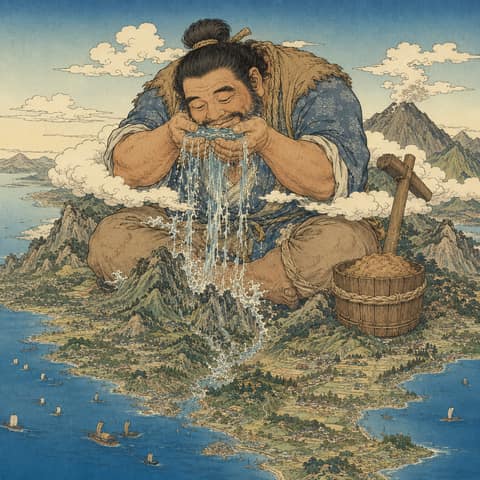
    Misogoro boasts a body so massive that he can sit on Mount Unzen and wash his face in the Ariake Sea, and his every movement is said to have carved the geography of the Shimabara Peninsula. His braced footprint on Mount Takaiwa became Suwa Pond, and the dirt he tossed aside while farming became Yushima (Dangoshima) Island. This chain of origin tales elevates him from a mere apparition to a creator-giant who birthed the peninsula's landscape. The extraordinary diet of licking four *to* of miso a day is a rustic narrative device measuring the giant's body against local staple goods, inseparably linked to the miso-brewing lifestyle of the peninsula. While belonging to the *Daidarabotchi* giant lineage, the unique aspect of the Shimabara version is that he is described with a mildness that helps people without malice. Today, he lives on as a symbol of local heritage in Minamishimabara City through statues and festivals.

  • Momijigari (The Demon of the Maple Viewing)

    Momijigari (The Demon of the Maple Viewing)

    Uncommon

    moh-MEE-jee-GAH-ree

    Demoness Momiji (Performing Arts Tradition)

    鬼・巨怪Nagano

    A demoness archetype fixed in Noh, joruri, and kabuki from the Muromachi to Edo periods. She appears under the pretext of autumn leaf viewing as a courtly lady-in-waiting or princess’s attendant, lulling suspicion with music and dance. At the feast she inebriates warriors, but near midnight her nature is exposed by divine protection or a sacred blade, and she reveals her true form in the wilds of Mount Togakushi. Commonly called Momiji, she bears aliases such as Princess Sarashina depending on the work. Her slaying tales extol martial virtue and reflect awe of the mountains, inheriting Togakushi worship and the rhetoric of oni-hunting lore. On stage, the contrast between the elegant disguise of the first act and the ferocious demon visage of the second is emblematic.

  • Oni

    Oni

    Legendary

    OH-nee

    Oni (Traditional Folklore Form)

    Demons & GiantsKyoto

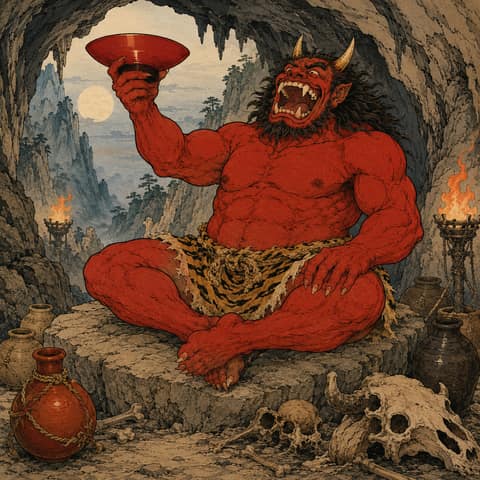
    A classic oni with red skin, proud horns, and a tiger-skin loincloth. Despite the fearsome look, he carries a warm heart. His booming laughter echoes through the mountains, and he treasures bonds with his comrades above all. Though terrifying when roused to anger, he is usually jovial and a dependable, big-brother figure.

  • Oni Hitokuchi

    Oni Hitokuchi

    Uncommon

    OH-nee HEE-toh-KOO-chee

    Tradition-Faithful Edition

    Demons & GiantsOsaka

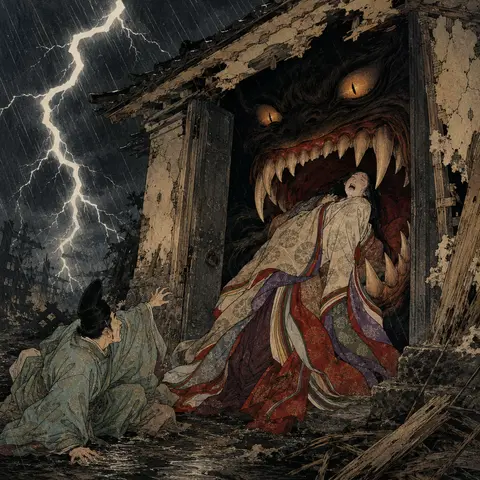
    Oni Hitokuchi appears in pre-medieval tales less as a fixed figure than as a term for a demonic being that fells a human with a single bite. It typically emerges in liminal scenes—at night, in thunderstorms, near storehouses or by the roadside—often intruding upon lovers’ trysts or flights. In The Tales of Ise (the Akutagawa episode), thunder drowns out the screams, and the lack of remains underscores the instantaneous “one bite.” Nihon Ryōiki and Konjaku Monogatari depict its mimicry as a man, serving as a warning against deviating from social bonds such as marriage or vows. After Sekien’s imagery fixed the name, folklore used it to reframe wartime, famine, and disaster disappearances as otherworldly devourings. Thus “Oni Hitokuchi” here is a type-name: its form is not fixed, and its essence is speed of consumption and absence of traces.

  • Oni of Rajōmon (Rashōmon Demon)

    Oni of Rajōmon (Rashōmon Demon)

    Epic

    rah-JOH-mohn no OH-nee

    Canonical Lore: Oni of Rashomon Gate

    Demons & GiantsKyoto

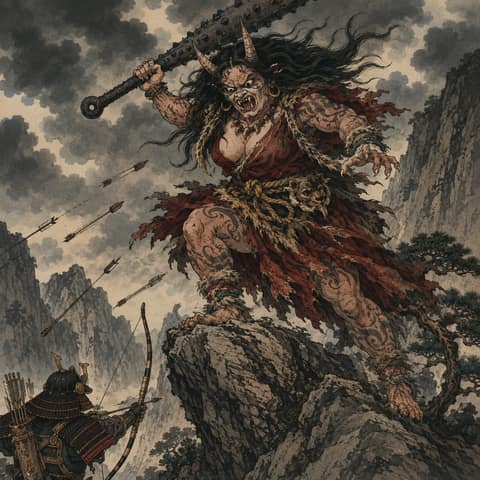
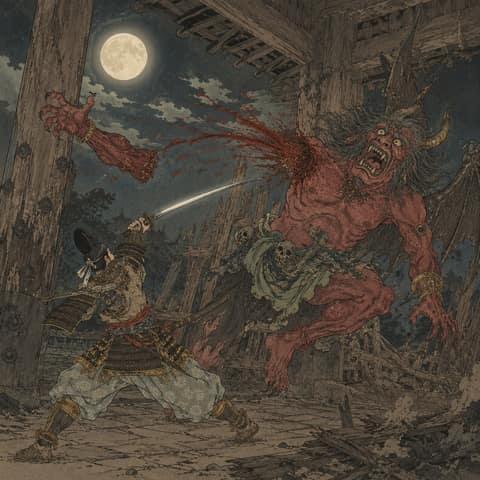
    An oni that appears at Rashomon Gate and on the outskirts of the capital, serving to highlight a warrior’s valor. Medieval war tales and Noh plays preserve multiple versions with differing stages and details, but the core remains: a lone warrior meets an oni at a gate or bridge and severs its arm. The arm is treated as a symbol of impurity and numinous power, leading to later tales of its recovery. Its conflation with Ibaraki-dōji intensified in early modern retellings, shifting names and locales, yet overall it embodies a liminal threat haunting the edges of the capital. Iconography shows an iron staff, horns, red-black skin, and wild hair, often set amid stormy weather and black clouds. Representations rooted in warrior lore, Noh, and picture scrolls continue to shape its image today.

  • Ootakemaru

    Ootakemaru

    Legendary

    おおたけまる

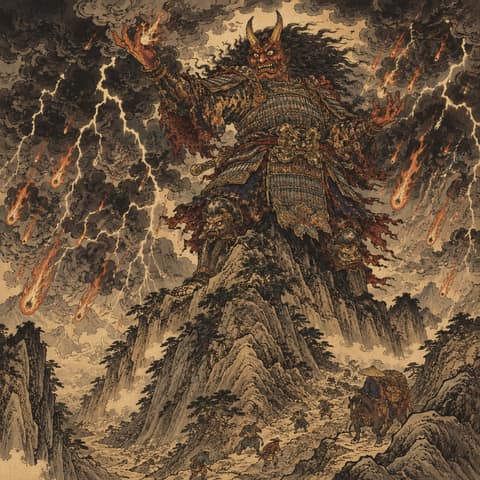
    Ootakemaru, the Demon King God Holed Up in Mount Suzuka

    Oni / Giant MonsterMieKyoto

    This version's Ootakemaru is not treated as a game-like "strongest demon," but as a demon king god born from the boundary space of the Suzuka Mountains. His terror lies not only in his massive size or martial prowess. By blocking the pass connecting the capital and the eastern provinces, halting tributes and traffic, and stalling armies with black clouds, lightning, and rain of fire, he disrupts the very pathways of the state. That is why Tamuramaru's victory is told not just as a feat of individual swordsmanship, but as a tale of pacifying the deities of the pass through the protection of Kiyomizu Kannon, the cunning of Suzuka Gozen, and the spiritual power of the sacred sword. Furthermore, Ootakemaru is not confined solely to Suzuka. In the *Tamura Sandaiki* lineage, the story moves to the Tohoku region, resonating with names like Akuro-o, Ootakemaru, Mount Kiri, and Takkoku-no-Iwaya. Here, Ootakemaru becomes not so much a demon sleeping in one land, but a core for the Tamuramaro legend to travel while absorbing the origins of various regional shrines and temples. If Shuten-doji carries the burden of the feast and severed head at Mount Oe, and Tamamo-no-Mae carries the court and the Sessho-seki, then Ootakemaru is the yokai who bears the "path of subjugation tales" stretching from the Suzuka Pass to Tohoku.

Showing 1 - 24 of 28 yokai