White Hannya in Aoi no Ue
White Hannya is a name for a coloration and stage use of a Noh mask, not a proper name for Lady Rokujo herself. The National Theatre explains that Aoi no Ue uses the highest-ranking White Hannya for Lady Rokujo, the high-born shite in the latter half of the play[6]. White skin, hair strokes slanting across the forehead, two horns, and a mouth split to the ears mark a demonic aspect, yet beneath fierce resentment they retain dignity and solitude.
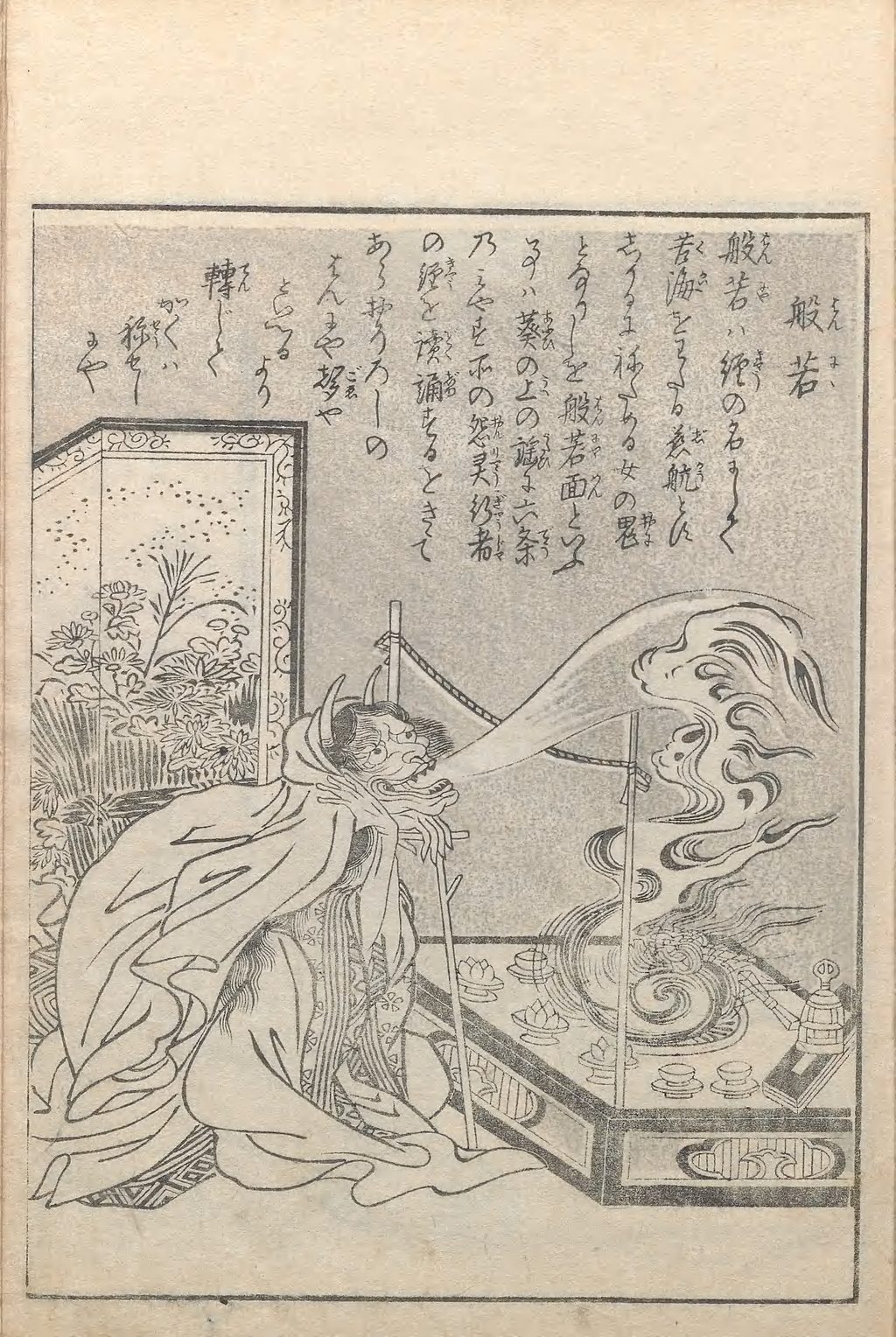
The National Theatre's guide to Aoi no Ue describes the later principal character as Lady Rokujo's living spirit after it has taken on a demonic aspect; its anger and sorrow are expressed by a Hannya mask[5]. The mask is not identical with Lady Rokujo. Aoi no Ue, signified by a robe, stands opposite the living spirit of Lady Rokujo, summoned by an azusa bow; together they draw an unseen attachment into the center of the stage.
Humiliation,
isolation,
and release
Lady Rokujo's demonic aspect cannot be reduced to hatred of a rival in love. The play's movement from the carriage dispute at the Kamo Festival to the appearance of the living spirit, and its close in which an ascetic's spiritual power calms her heart[5], stages public humiliation, isolation, and restrained emotion. Prayer is not "Hannya's weakness"; in Aoi no Ue, it is the dramatic force that opens a possibility of release from attachment.
Nor should Lady Rokujo in The Tale of Genji and the demonic aspect in Noh be treated as records of the same scene. In The Tale of Genji, Lady Rokujo's living spirit takes Aoi no Ue's life, whereas in the Noh play Aoi no Ue, an ascetic's spiritual power eases her heart[5]. Noh does more than repeat its source story: it brings the afflicted person, the possessing spirit, and the person who prays into confrontation, leaving room for release even within the demonic aspect.
Anger and sorrow in one face
White Hannya does not divide anger and sorrow into separate faces. A description of the "Omi-uchi" Hannya held by the Tokyo National Museum[3] reads the horns, gold-colored eyes, fangs, and split mouth as rage, and the inverted-V upper eyelids and disordered hair strokes across the forehead as sorrow. Looking at one face, the viewer moves between anger and grief.
The azusa bow and chanting are stage devices that articulate Lady Rokujo's attachment. The bow acts as a medium for calling forth a spirit, while chanting and spiritual power confront the demonic aspect in the latter half of the play. Calling the bow a "weakness" confuses its summoning role with the drama's movement toward calming the spirit.
Color is not a sequence of transformation
The National Theatre's guide divides Hannya masks by color into white, red, and black, distinguishing them by rank and intensity, and assigns the highest-ranking White Hannya to Lady Rokujo in Aoi no Ue[6]. This shows how variations within the Hannya mask accommodate different roles. Color should not, however, be turned into a fixed sequence of transformation from white to red and then to serpent. The woman of Dojoji, the female demon of Adachigahara, and Lady Rokujo are roles from distinct stories; the mask is chosen precisely to accommodate those differences.
The association of Lady Rokujo with White Hannya offers an entry point into Aoi no Ue, but Hannya masks are also used in Dojoji and Kurozuka. Lady Rokujo is not the identity behind Hannya as a whole. White Hannya is best understood as a representative use that gives form to the suffering of a noble living spirit, making both the mask and the stories it serves easier to see.
Character Profile
This section is our own creative profile for storytelling. It is not historical fact or scholarship.
Yokai Type - Traditional Yokai
Category - Demons & Giants
Rarity - Epic
Personality - Though she retains the bearing and cultivation of high rank, she carries love, humiliation, and loneliness within her until she appears as a living spirit. Human sorrow remains beneath her demonic aspect.
Compatibility - She resonates with people who do not dismiss emotion as mere "jealousy," who can sit quietly with both anger and grief, and who do not rush to decide another person's story for them.
Abilities - Uses white coloration and painted hair strokes to convey the dignity and suffering of a noble female demonMakes anger visible through two horns, gold-colored eyes, and fangsLets sorrow remain through inverted-V upper eyelids and disordered hair strokesGives stage form to the attachment borne by Lady Rokujo's living spirit as a demonic aspectDraws invisible passion into drama through the robe, azusa bow, and chanting
Weaknesses - In Aoi no Ue, an ascetic's spiritual power and chanting ease the heart of Lady Rokujo's living spirit. The azusa bow is not an instrument for driving her away; it is used as a medium for summoning the spirit.
Habitat - The stage world of the Noh play Aoi no Ue: a theatrical space shaped by the memory of court culture in Kyoto, where the Kamo Festival and Lady Rokujo's story converge amid a robe, an azusa bow, and chanting—not a habitat in the natural world.