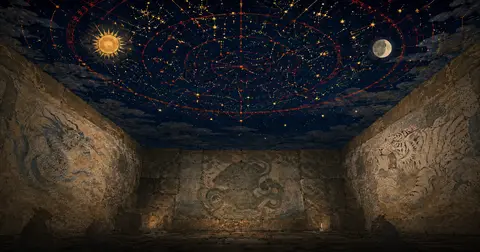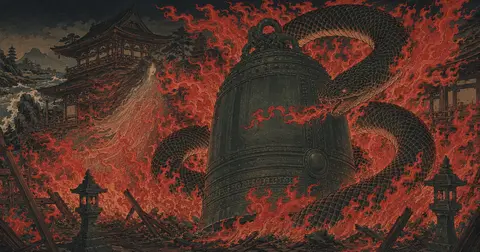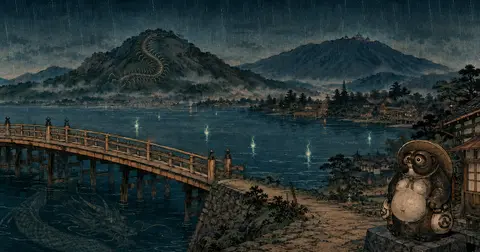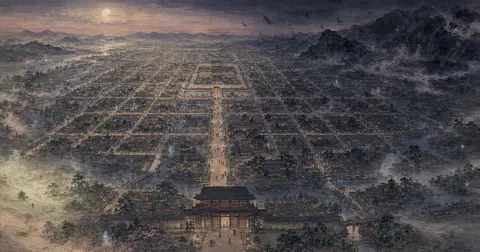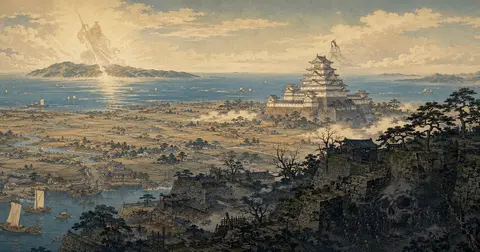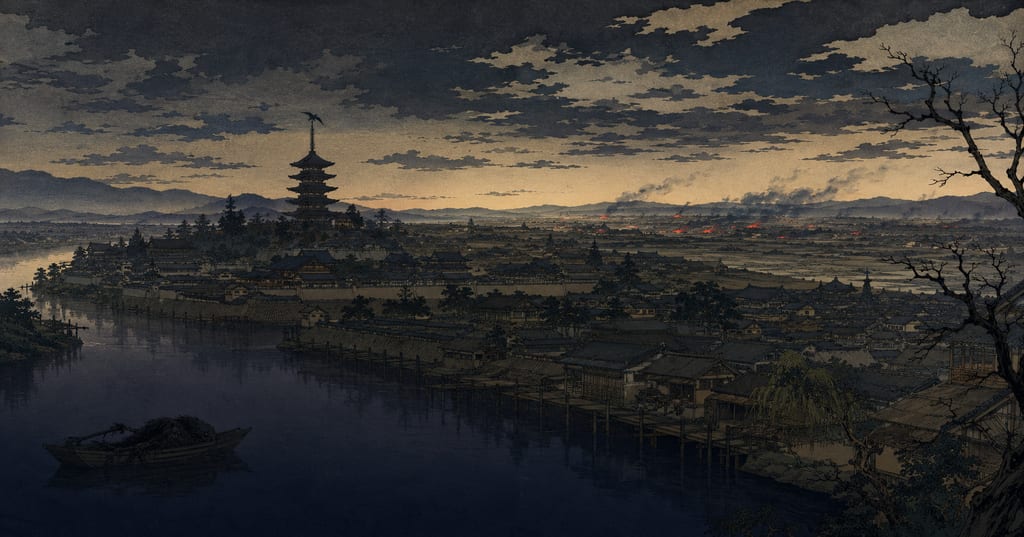
The land of Osaka is, in a word, a "capital by the water's edge." In ancient times, it was home to Naniwazu, a gateway port to the continent, and Emperor Kotoku moved the capital here from Asuka during the Taika Reform of 645, establishing the Naniwa Palace[1]. The sea opened to foreign lands, the rivers carried goods to the capital, Prince Shotoku's Shitenno-ji temple was built atop the Uemachi Plateau, and armies repeatedly clashed on the Kawachi plains. A land where the sea, capital, shrines, temples, and ancient battlefields form complex layers—the mysteries born here have a slightly different character from the yokai of other regions.
Modern-day Osaka Prefecture actually spans three ancient provinces: Settsu, Kawachi, and Izumi. Settsu was a land of the sea and capital facing Osaka Bay; Kawachi was a land of plains leading to Yamato and a site of ancient battlefields; and Izumi was a quiet land of mountains, fields, and temple ponds. These three distinct topographies directly shape the character of the mysteries they produced. Monsters of the sea, mysteries that drifted down from the capital, fires of war, and local water deities—mapping out the yokai of Osaka reveals how this land interacted with the outside world and the history it has endured.
The strange phenomena of Naniwa arrive from the sea, nest in the capital, and ignite in the ruins of battle. From the sea of the Sumiyoshi Sanjin, where people prayed for safe voyages, the folktale of Issun-boshi (the One-Inch Boy) was born. Ibaraki-doji, who ravaged the Heian capital, was born in Settsu, and the carcass of the Nue shot down in the capital drifted down the Yodo River to wash ashore here. Vengeful spirits who defied Buddhist law turned into woodpeckers to peck at Shitenno-ji, and it is said that the fires of those who fell in battle still drift over the ancient battlefields of Kawachi. This article traces ten yokai nurtured by this "capital by the water's edge" along four axes: the sea of Sumiyoshi, demons and vengeful spirits of the capital, monsters of fire and ancient battlefields, and the demons of the *Tales of Ise* alongside local goddesses.
From the Sea of Sumiyoshi — The Three Deities and Issun-boshi
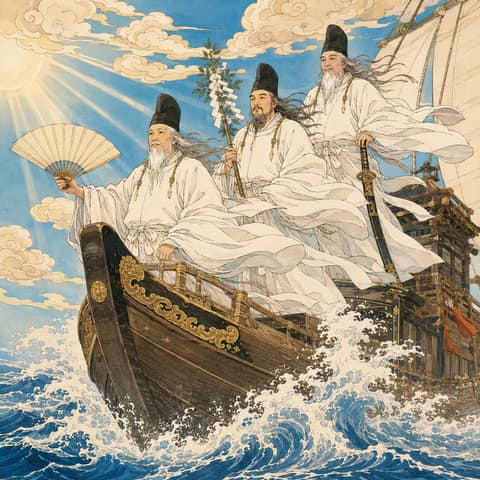
When discussing Osaka's yokai culture, one must first look to the sea. The Sumiyoshi Sanjin enshrined at Sumiyoshi Taisha—Sokotsutsu-no-o-no-mikoto, Nakatsutsu-no-o-no-mikoto, and Uwatsutsu-no-o-no-mikoto—are said to be deities born from the sea when Izanagi-no-mikoto purified himself at Tachibana-no-odo in Himuka, Tsukushi, to cleanse the defilement of the underworld (Yomi)[2]. Rising from the bottom, middle, and surface layers of the sea, these three deities embody the divine nature of the sea itself and became the guardian deities of navigation and ports.
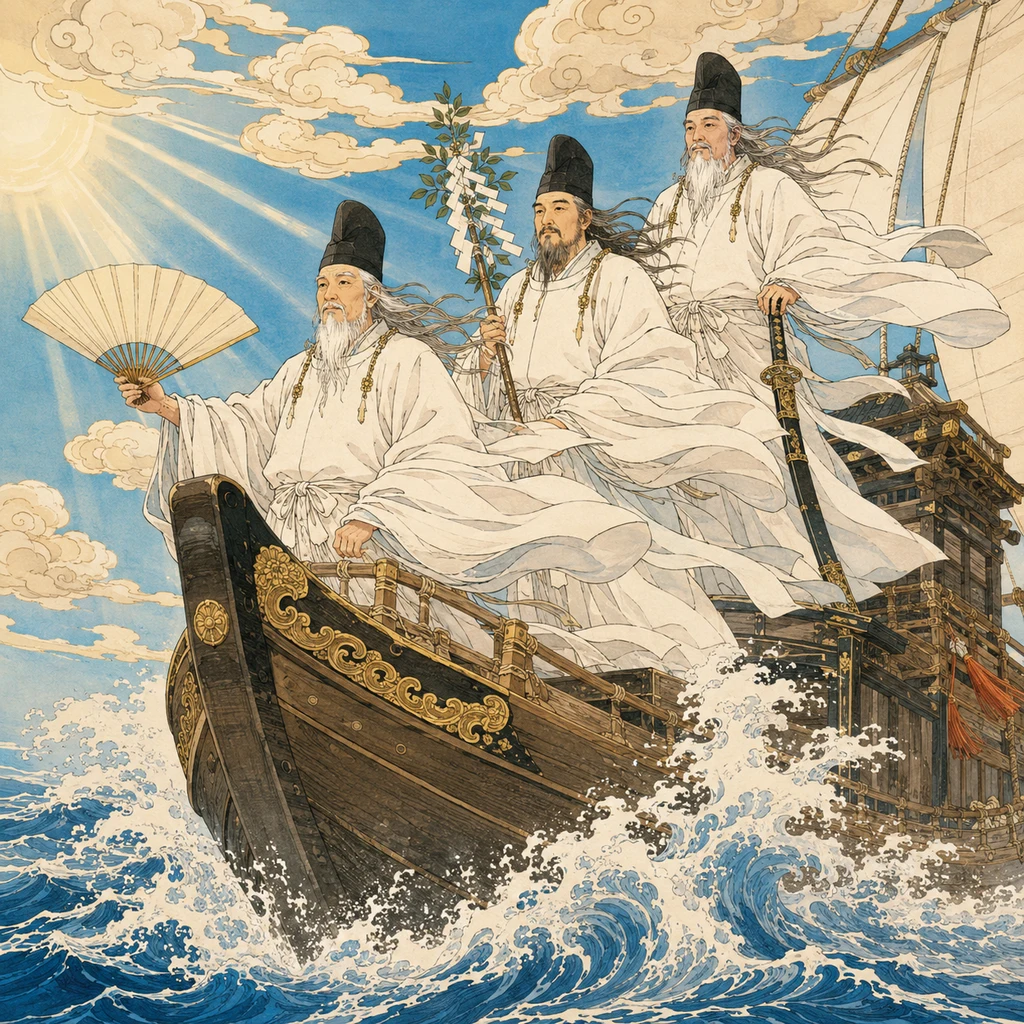
Sumiyoshi Sanjin
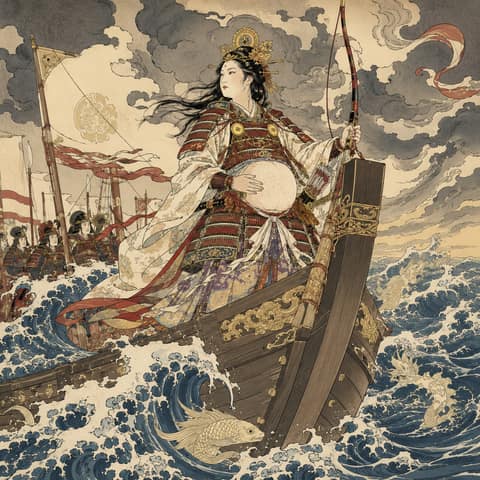
According to the first volume of the Kojiki and the Age of the Gods section of the Nihon Shoki (Fifth Section, First Alternate Writing), they are the three kami born from three different depths of seawater when Izanagi-no-Mikoto purified himself in the sea at Ahagihara, the river mouth of Tachibana in Himuka of Tsukushi, after returning from the underworld, Yomi. — Sokotsutsu-no-o-no-Mikoto, Nakatsutsu-no-o-no-Mikoto, and Uwa- (or Omote-)tsutsu-no-o-no-Mikoto (written as 'Soko-, Naka-, and Uwa-tsutsu-no-o-no-kami' in the Kojiki). They are enshrined together as guardian deities of the sea. They were born simultaneously with the three Watatsumi kami (Sokotsu-, Nakatsu-, and Uwatsu-Watatsumi) in the Kojiki, and the two groups are often spoken of in pairs. The etymology of 'Tsutsu' has not been academically resolved. Multiple theories coexist, including the star theory (deification of Orion's Belt, originated by Hoei Nojiri in 1936), the 'tsu' (port) theory, the honorific spirit 'tsuchi' phonetic change theory, the ship spirit theory, the Tsutsu toponym theory in Tsushima, and the literal bamboo tube theory. They are the principal deities in the myth of Empress Jingu's conquest of the Three Han states (Sankan Seibatsu). They delivered an oracle to the Empress and reportedly protected her sea route. Sumiyoshi Taisha, the head shrine (Ichinomiya of Settsu Province), comprises four main halls (the first, second, and third enshrine the three kami, and the fourth enshrines Empress Jingu), and it is the principal deity of over 2,300 Sumiyoshi shrines nationwide. From ancient times to the present, they have been widely revered as deities of sea protection, maritime safety, martial fortune, and waka poetry (as the Three Deities of Waka).
Read moreFrom the legend that Empress Jingu received the protection of the Great Deity of Sumiyoshi during her expedition to the Three Han States, the Sumiyoshi Sanjin garnered reverence as national guardian deities of the sea[1]. The ancient ports of Sumiyoshizu and Naniwazu were vital hubs for diplomacy with the continent, and it is said that Kentoshi (envoy ships to Tang Dynasty China) always prayed for maritime safety at Sumiyoshi Taisha before departing from Sumiyoshizu. The sea was the path that opened to foreign lands, and the gods protecting that path were placed at the root of Naniwa's faith. While the Sumiyoshi Sanjin are true divine figures rather than yokai, the archetype of Osaka's mysteries—"beings that rise from the sea"—is already etched here.
The three names—Sokotsutsu-no-o, Nakatsutsu-no-o, and Uwatsutsu-no-o—are understood as dividing the sea into three layers: bottom, middle, and surface, deifying each layer. This is not a mere personification of the sea, but a highly spatial concept that divides the unseen dimension of depth into three divine hypostases. It is said that the layout of Sumiyoshi Taisha's main shrines, arranged in a straight vertical line from the First to the Third Main Shrine like a fleet of ships sailing across the ocean, is a design intended to recreate the sea itself within the precincts. If yokai are considered "inhabitants of the otherworld," then for ancient people, beyond the sea was the most familiar otherworld. Enshrining these sea gods at the entrance to the capital perfectly captures the character of the land of Naniwa. It is no coincidence that the numerous mysteries that drift to Osaka in later eras all arrive via these "waterways."
From that sea of Sumiyoshi, another protagonist is born: Issun-boshi. In the Muromachi period *Otogizoshi*, an elderly, childless couple visited Sumiyoshi to pray for a child, and were blessed with a tiny boy just one *sun* (about an inch) tall[3].
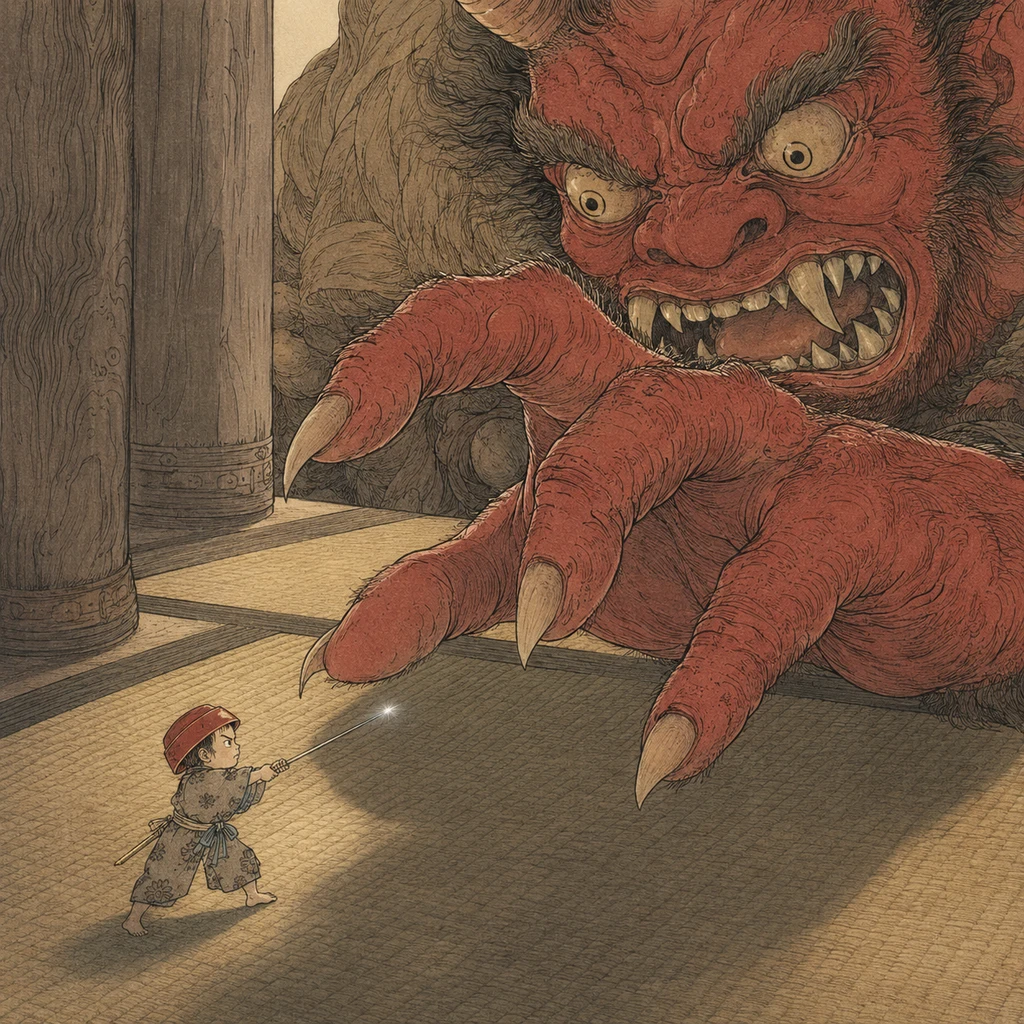
Issun-boshi
Issun-boshi is widely recognized in modern times as a pure and righteous fairytale hero for children—a "brave little boy who rides in a bowl-boat and defeats oni with a needle-sword." However, his original depiction in the Muromachi period literature *Otogizoushi* reveals a dark hero (or a half-human, half-yokai trickster) overflowing with ambition and cunning, fully willing to employ despicable schemes to achieve social advancement. In folkloric classification, he belongs to the "Chiisako" (Little Child) archetype connected to Japanese mythology. Born from an abnormal prayer by an old couple and retaining a physical stature of merely one sun (about 3 centimeters) no matter how many years pass, this trait indicates he is not purely human, but a "liminal existence" belonging to the realm of the otherworld or divine spirits. The motif of arriving from the waterside (Naniwa Bay) in a bowl deeply inherits the mythological lineage of Sukunabikona-no-Kami, a tiny deity who crossed the sea from the eternal land (Tokoyo) riding in a Metaplexis pod boat. He compensates for his overwhelming physical handicap with abnormal intelligence, glibness, and a lack of ethical constraint. Upon ascending to the capital and infiltrating the mansion of a powerful chancellor, he uses not martial prowess but "scheming" to claim a beautiful princess as his own. Ultimately, by stealing the oni's treasure (the Miracle Mallet), he literally transforms into a "human man of great power." This is no mere adventure tale, but an extremely realistic, Machiavellian story of social upheaval, where a deformed existence at the very bottom of society climbs to the absolute pinnacle using intellect and deceit.
Read more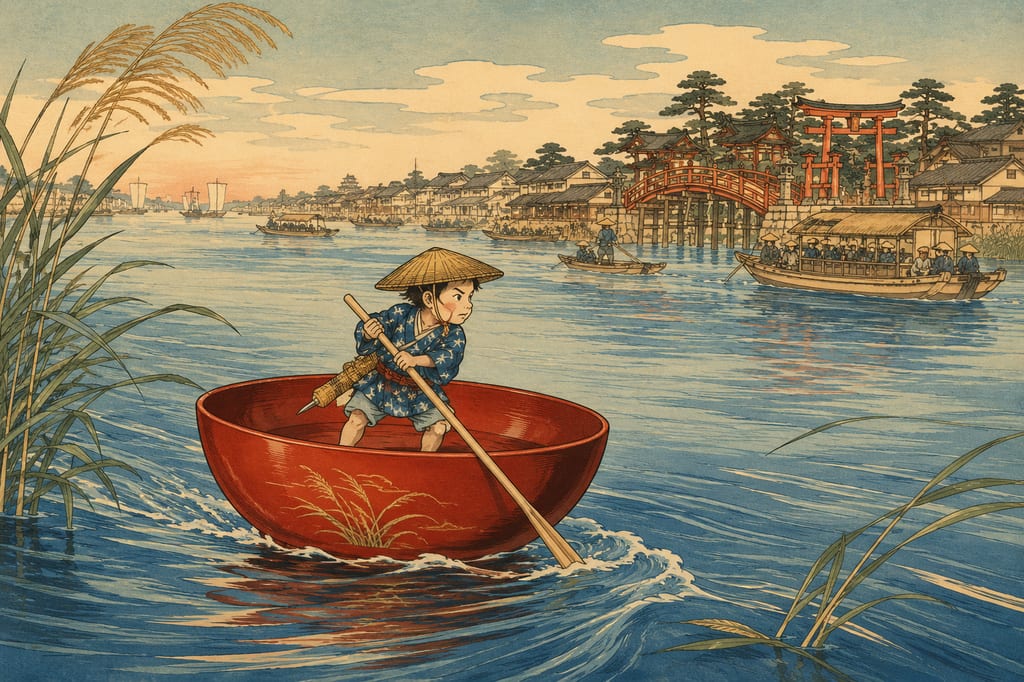
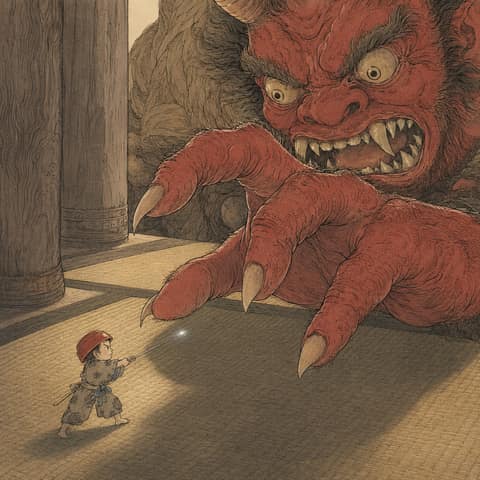
Issun-boshi uses a bowl as a boat, a chopstick as an oar, a needle as a sword, and a straw as a scabbard to travel up the Yodo River to the capital, where he serves an aristocrat. While fleeing with a princess on his back, he is swallowed by an oni (ogre), but stabs the ogre's stomach from the inside with his needle sword. After the ogre spits him out and drops the Uchide no Kozuchi (the Miracle Mallet), Issun-boshi swings it, instantly growing into a six-foot-tall young man and eventually rising to the high rank of Chunagon[3]. The plot of a child granted by the god of Sumiyoshi defeating an ogre with a single needle perfectly represents the classic Osaka motif of one protected by a sea god conquering demons from the otherworld. Though known today as an adorable folktale, the fact that its origin lies in prayers at Sumiyoshi is rarely discussed.
What is noteworthy is the meaning behind Issun-boshi being a "tiny one." Since Kunio Yanagita, folklore studies have categorized a group of tales in which an extremely small protagonist brings wealth or power from the otherworld as "Chiisago" (Little Child) tales. Issun-boshi is a prime example. His origin of being granted through prayers to the god of Sumiyoshi indicates that this tiny child is not merely deformed, but a gift from the divine—a being imbued with godly power. That is precisely why he can defeat an ogre with a single needle and attain a normal height and prominent status using the mallet. His journey up the river in a bowl boat traces the very water transport network of Osaka that connects the sea to the capital. The tiny child born from the sea of Sumiyoshi travels up the Yodo River to the capital, defeating an ogre to rise in the world—the geography of this story perfectly mirrors the transportation reality of ancient to medieval Naniwa.
Demons and Vengeful Spirits of the Capital — Ibaraki-doji,
Nue,
and Teratsutsuki
Next after the sea are the mysteries related to the capital and power. In the yokai of Osaka, a recurring pattern emerges where "an incident that occurred in the capital (Kyoto) washes up in this land."
The foremost example is Ibaraki-doji. He is known as the most important retainer of Shuten-doji, the demon king who terrorized the capital from his base on Mount Oe during the Heian period. There are two theories about his birthplace: Echigo Province and Settsu Province. The Settsu theory claims he was born in present-day Mizuo, Ibaraki City.
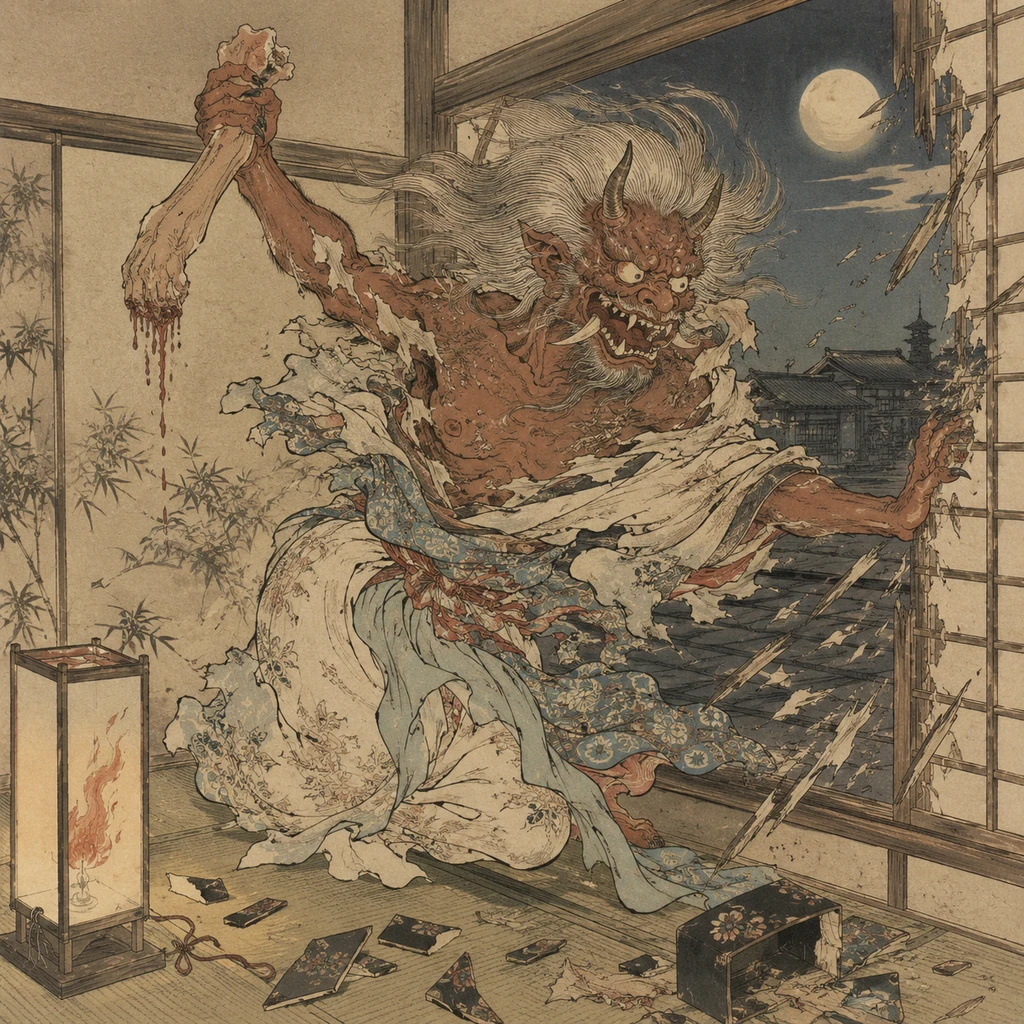
Ibaraki-dōji
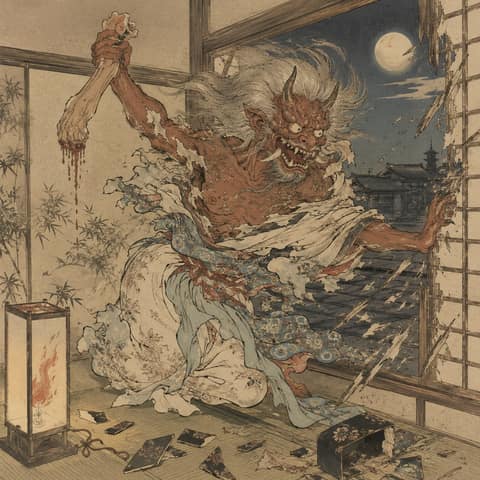
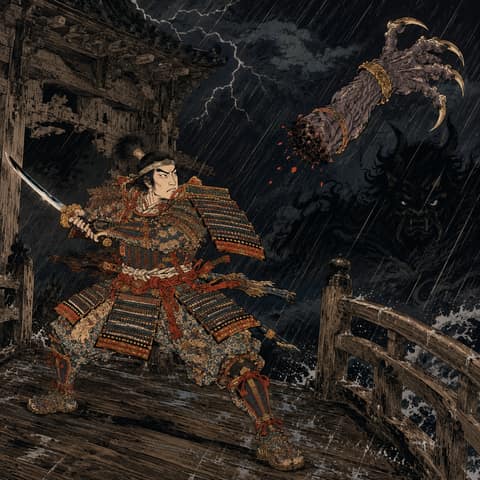
A demon (oni) of the Heian period, famed as the right-hand of Shuten-dōji. Accounts place Ibaraki-dōji’s birth either in Settsu (Tomatsu/Ibaraki) or Echigo (Koshi District, Karuizawa). From childhood the figure showed an uncanny appearance and prodigious strength. Joining the bandits of Mount Ōe, Ibaraki-dōji helped terrorize the capital until Minamoto no Yorimitsu (Raikō) and his retainers crushed the gang, whereupon Ibaraki narrowly escaped. Later, the warrior Watanabe no Tsuna cut off the demon’s arm; in later tales, the demon disguises itself and steals the arm back—episodes retold across medieval setsuwa, Noh, and Kabuki.
Read moreAccording to local legends in Ibaraki City, the child was born with a full set of teeth after a difficult sixteen-month pregnancy, and began walking immediately after birth[4]. Unable to cope with the demonic infant, his father abandoned him in front of a barbershop in the neighboring Ibaraki Village. Raised as the barber's child, one day he accidentally wounded a customer's face, licked the blood, and became captivated by the taste. Eventually realizing his face had transformed into that of an oni, he fled to the mountains of Tanba and became Shuten-doji's retainer[4]. Thus, the name "Ibaraki" itself derives from this Settsu place name.
The tale of Watanabe no Tsuna severing Ibaraki-doji's arm has been repeatedly performed in Noh and Kabuki theater. Watanabe no Tsuna, one of Minamoto no Yorimitsu's Four Heavenly Kings, is said to have cut off the demon's arm at Rashomon or the Ichijo Modoribashi bridge[5]. It is told that later, the demon disguised himself as Tsuna's adoptive mother, infiltrated his mansion, seized an unguarded moment to reclaim his arm, and flew away. A demon born in Settsu having its arm severed in the capital, and the story revolving around that arm adding color to medieval performing arts—this structure of traveling back and forth between the capital and Settsu is truly a quintessential Naniwa mystery.
What is intriguing is that Watanabe no Tsuna himself was a warrior deeply rooted in Settsu. Tsuna is considered the progenitor of the Watanabe clan, based in Watanabe in Settsu Province's Nishinari District (an area spanning from present-day Chuo Ward to Kita Ward in Osaka City). The surname "Watanabe" originates from the name of a ferry crossing at the mouth of the Yodo River. In other words, the tale of Ibaraki-doji's severed arm is a story doubly bound to Osaka, where a demon born in Settsu is struck down in the capital by a warrior based in Settsu. In Ibaraki City, the name "Sugatamibashi" (Appearance-Viewing Bridge) still remains, where the demon boy is said to have seen his demonic face reflected in the water, preserving the tale as a local legend[4]. The fact that the story of the demon is not merely consumed as an "incident in the capital" but is firmly attached to the place names and bridges of his birthplace reveals a unique affinity the people of Settsu hold for Ibaraki-doji.
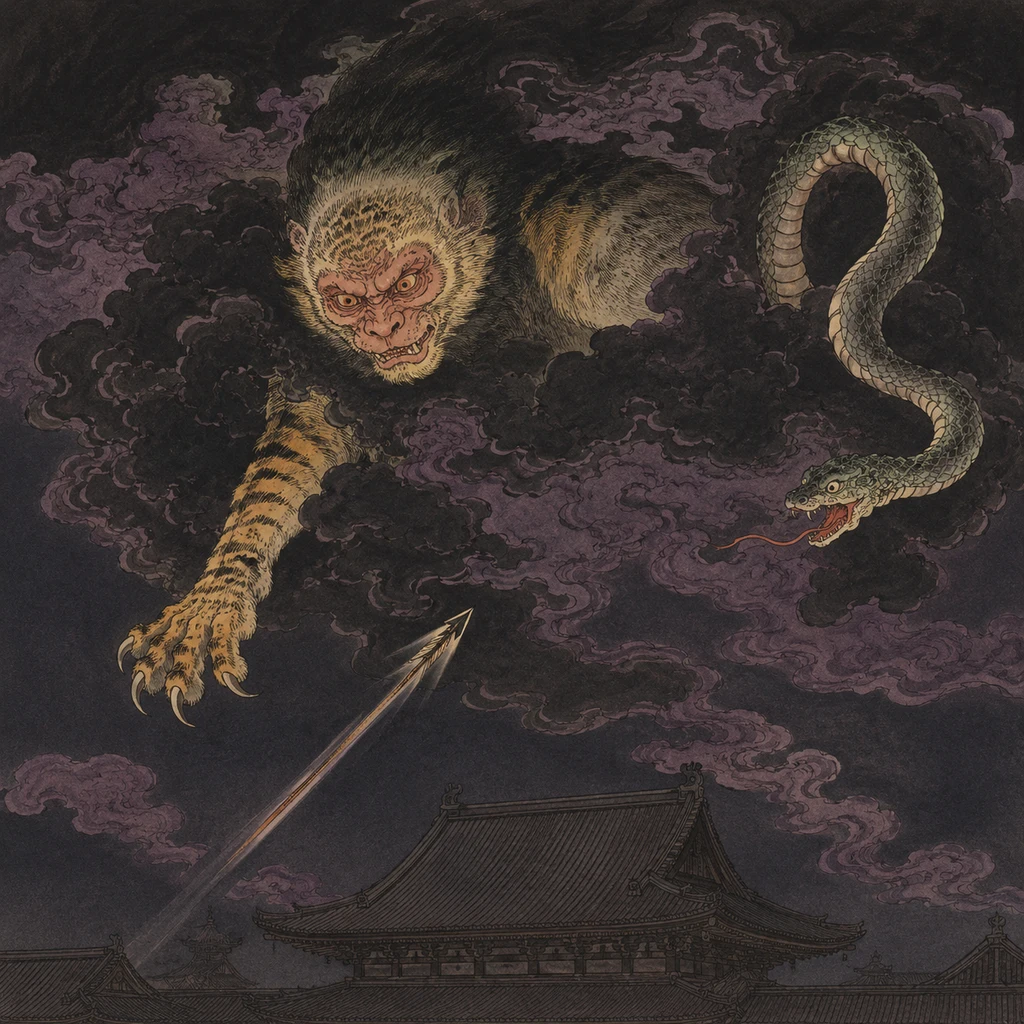
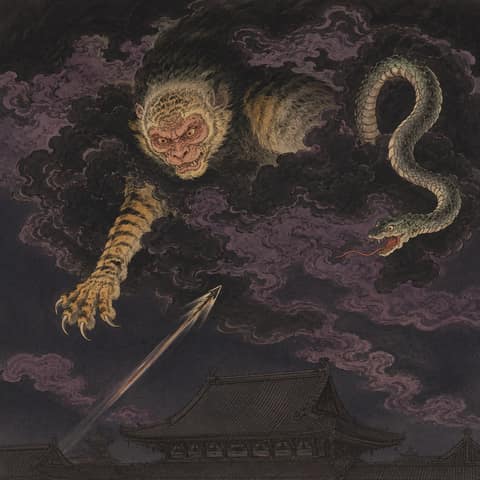
The Nue was shot down in the capital and drifted to this land after death. According to the *Heike Monogatari*, during the Ninpei era (the 1150s), Minamoto no Yorimasa used his bow to shoot down a monster that tormented Emperor Konoe night after night[6]. Its appearance was said to have the head of a monkey, the body of a tanuki, the tail of a snake, and the limbs of a tiger, while its cry resembled that of a bird called a nue.
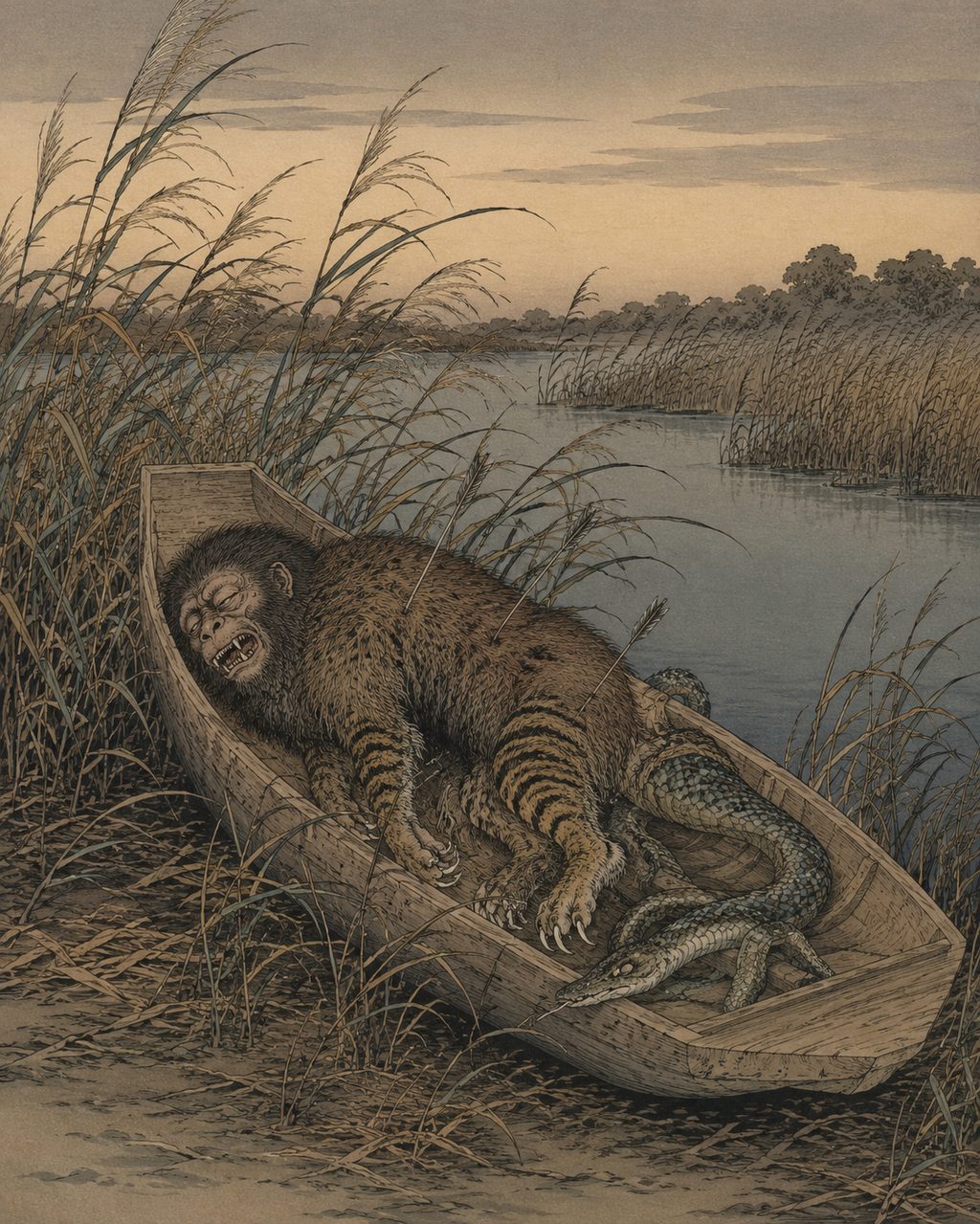
Fearing a curse, the people of the capital placed the carcass in a hollow log boat and set it adrift on the Yodo River. The boat drifted downstream and washed ashore in Kasugae Village—present-day Miyakojima Ward in Osaka City—where it is said the villagers buried it in a mound and enshrined it as Nuezuka (the Nue Mound)[7]. The Nuezuka in Miyakojima was repaired by Osaka Prefecture in 1870, and a small shrine was erected by local residents in 1957[7]. It is a rare example of a supernatural creature born in the capital being carved into an Osaka place name via the river.
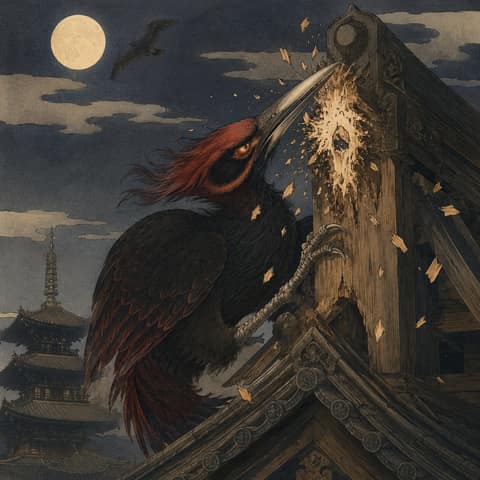
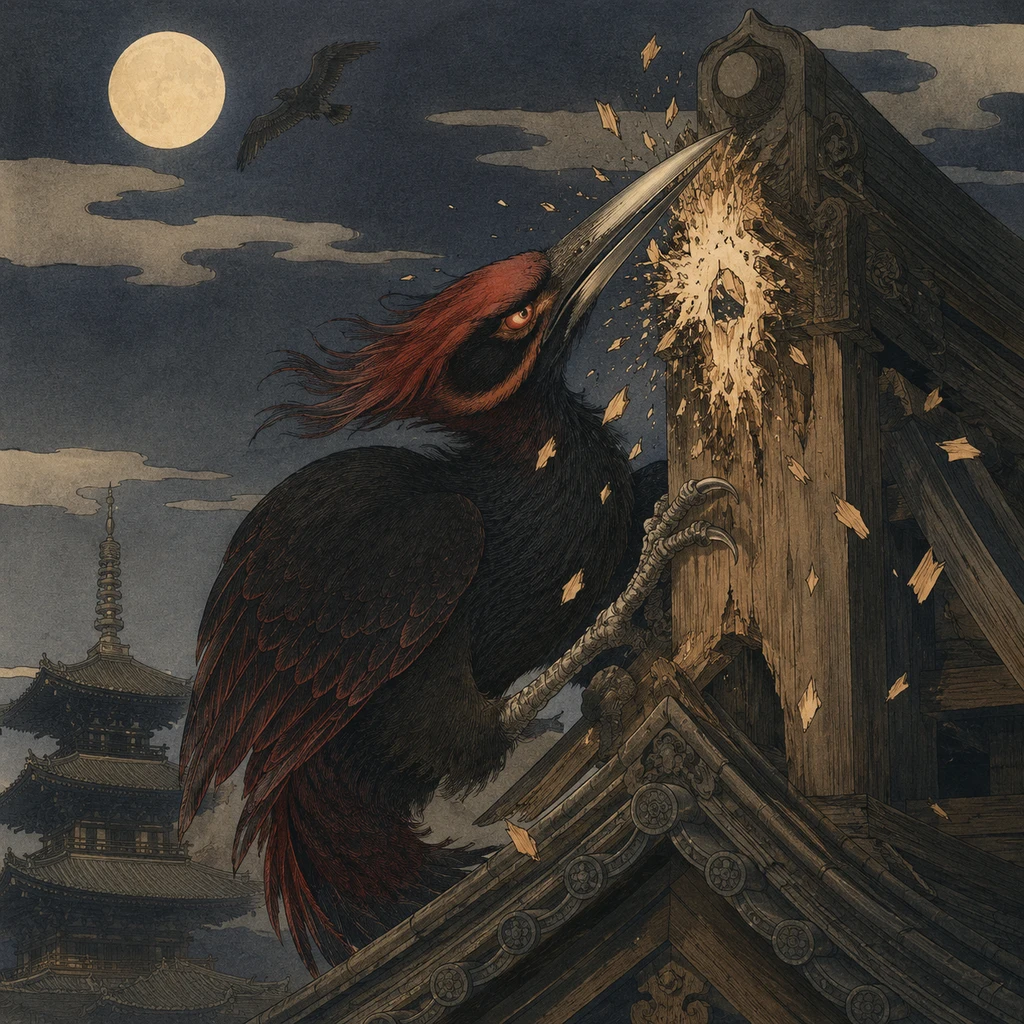
The Teratsutsuki is also a vengeful spirit born from the power struggles in the capital. Depicted by Toriyama Sekien in his *Konjaku Gazu Zoku Hyakki*, this yokai is a monster bird resembling a woodpecker[8]. It is said that Mononobe no Moriya, who was defeated by Prince Shotoku and Soga no Umako in a conflict over the promotion of Buddhism, transformed into a vengeful spirit after death and attempted to peck apart Shitenno-ji and Horyu-ji temples, which were built by the Prince, with its beak. The *Genpei Josuiki* recounts that when Prince Shotoku turned into a hawk to confront it, the monster bird never appeared again[9]. Shitenno-ji still stands atop the Uemachi Plateau today, and a small shrine dedicated to Moriya remains within its precincts. The image of a vengeful bird pecking at the capital of Buddhist law is firmly tied to the specific sacred site of Shitenno-ji.
Behind this legend lies the historical fact of the Battle of Shigisan in 587. The pro-Buddhist Soga clan clashed with the anti-Buddhist Mononobe clan, and the defeated Mononobe no Moriya was annihilated along with his entire clan[1]. The victorious Prince Shotoku established Shitenno-ji in fulfillment of a vow for victory in battle. In other words, the story of the Teratsutsuki is structured so that the grudge of the vanquished targets the very temple built by the victor. The fact that a shrine to console Moriya's spirit still stands in the precincts of Shitenno-ji is nothing but a remnant of the victors fearing the grudge of the defeated and seeking to pacify it. The idea of superimposing the sheer obsession of a defeated noble clan onto the everyday sight of a woodpecker pecking at a tree was later solidified into a distinct yokai image by Sekien's illustration. The Teratsutsuki serves as an excellent specimen showing how historical losers were reincarnated into yokai.
Monsters of Fire and Ancient Battlefields — Ubagabi and Kosenjobi
In the plains of Osaka, particularly in Kawachi, mysteries involving fire have been passed down. These fiery anomalies serve as mirrors reflecting memories of sin and warfare.
Ubagabi (Old Woman’s Fire)
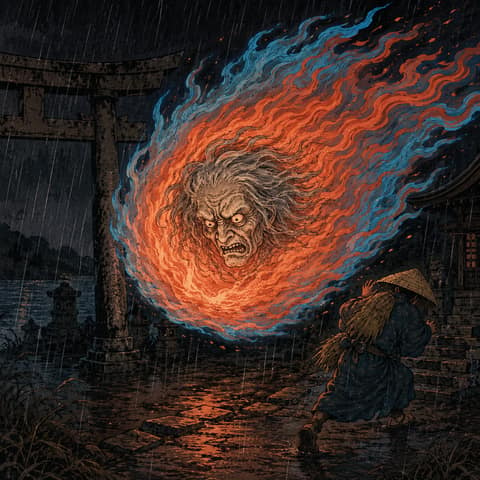
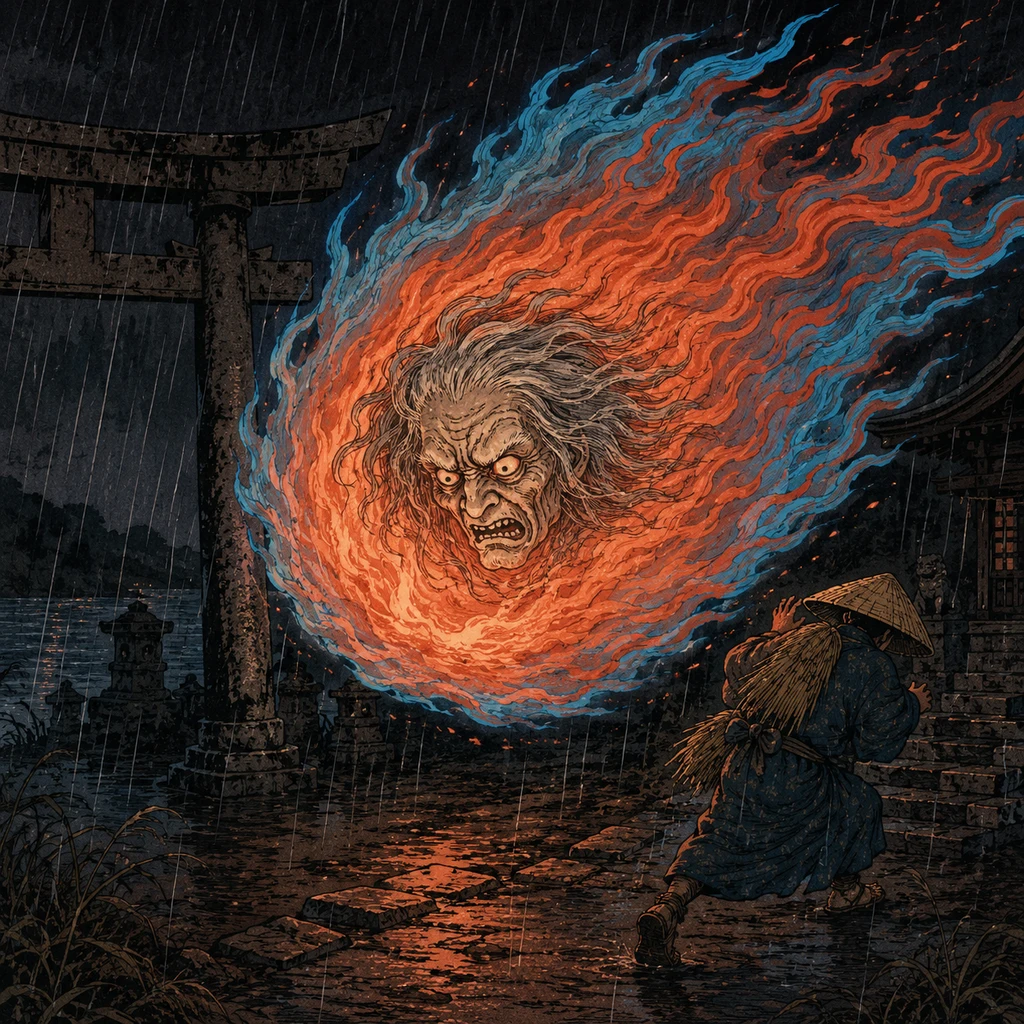
Ubagabi is a will-o’-the-wisp that appears on rainy nights, with traditions centered around Hiraoka in Kawachi and along the Hozu River in Tanba. It flies as a fireball about a foot across and is said to sometimes show the face of an old woman or the shape of a bird. Explanations tie it to the curse of an old woman who stole lamp oil from Hiraoka Shrine, or divine punishment upon a woman who drowned after discarding her child; the phenomenon is noted in old books and picture scrolls. Contact is considered a dire omen.
Read more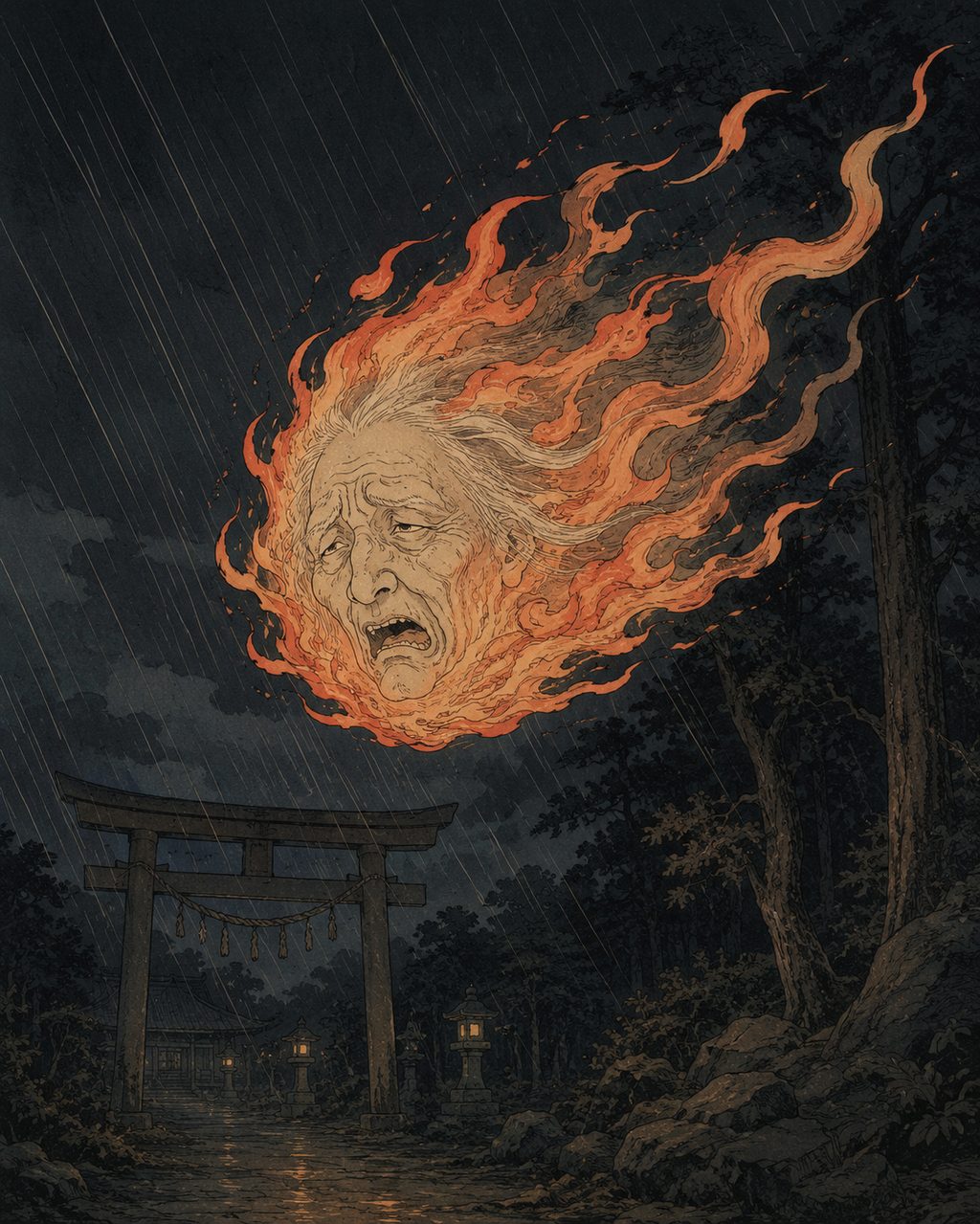
The Ubagabi is a mysterious fire said to have appeared in the Hiraoka area of Kawachi Province—present-day Higashiosaka City. Toriyama Sekien also depicted it in his *Gazu Hyakki Yagyo*[10]. According to the *Shokoku Rijindan*, it flies on rainy nights as a fireball about one *shaku* (around thirty centimeters) in size. Its true identity is said to be an old woman who stole lamp oil from Hiraoka Shrine and was turned into a fireball as punishment for her sin[11]. This stems from the belief that the sin of stealing something sacred offered to the gods, like oil from a holy sanctuary, turns a person into hellfire.
Hiraoka Shrine, the stage for this tale, is an ancient shrine and the Ichinomiya (highest-ranking shrine) of Kawachi Province, said to have been founded three years before the accession of Emperor Jimmu. It enshrines Amenokoyane-no-mikoto. Because the deity was later divided and enshrined at Kasuga Taisha, it is also known as "Moto-Kasuga" (the original Kasuga). The sacred fire burning at the center of Kawachi's faith and the phantom fire punishing the one who stole its oil—the tale of the Ubagabi is told intimately bound to the prestige of the sacred site.
The concept of the sin of stealing oil directly leading to a fire monster cannot be separated from early modern lamp culture. At the time, oil used for lighting was never cheap, and light at night was a luxury. Shrine lamp oil was considered particularly sacred, and the act of stealing it was seen as transcending mere theft to become blasphemy against the gods. The claim that the Ubagabi only appears on rainy nights is also suggestive. In the darkness where rain extinguishes all other fires, a single fireball burning continuously was likely spoken of as evidence of a sin not allowed to fade away. It should be noted that the *Shokoku Rijindan* also mentions that someone who encountered this fire head-on on a dark road saw a bird-like figure within it, leaving room for an interpretation that seeks the true identity of the Ubagabi in a luminescent bird such as a grey heron[11]. Hellfire born of sin, or a natural mysterious light—this ambiguity is precisely the charm of early modern tales of phantom fires.
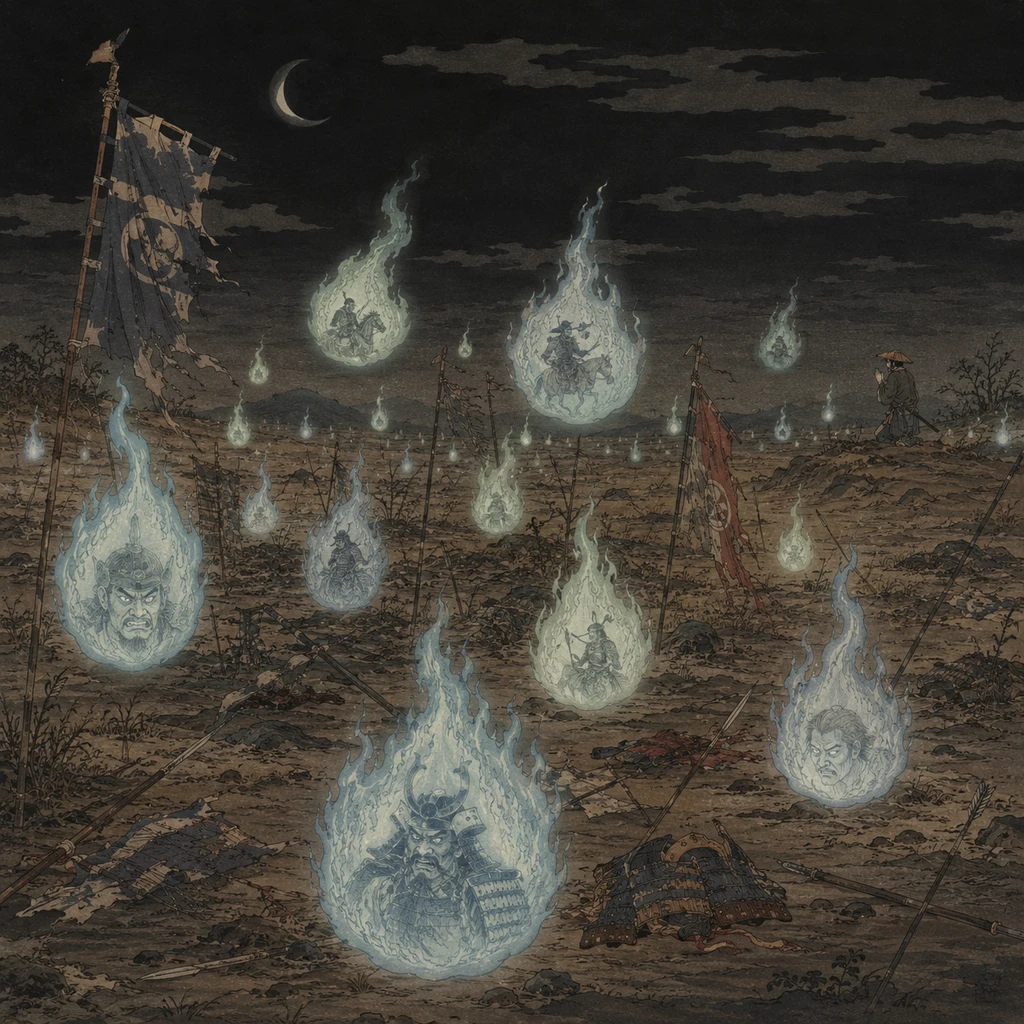
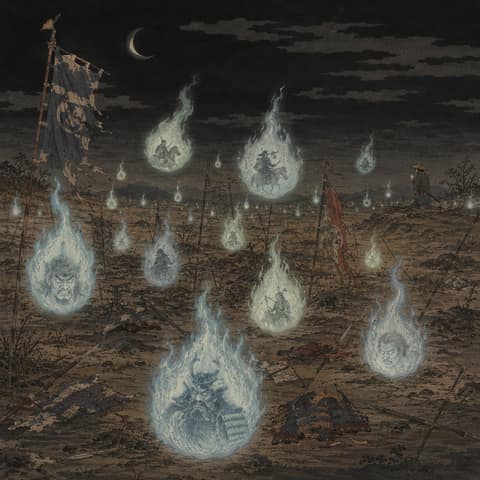
Battlefield Will-o'-Wisp
Battlefield Will-o'-Wisp refers to ghost lights that gather over killing grounds where many fell. They drift softly, and in great numbers cast a pale glow across the fields. Said to be fires exuded by the grudges of fallen soldiers and horses, they are depicted in Toriyama Sekien’s Konjaku Gazu Zoku Hyakki as flames rising from blood spilled on the earth. Reliable tales of harm are rare; witnesses are said to recite a Buddhist chant and quietly depart.
Read moreAt the other end of the spectrum of fire phenomena is the Kosenjobi (Ancient Battlefield Fire). In Sekien's *Konjaku Gazu Zoku Hyakki*, it is depicted as flames rising from spilled blood on the ground, and it is said that the souls of fallen soldiers and horses drift as a mass of ghostly fires across battlefields where many perished[8]. Wakae in Kawachi Province is cited as one of the locations where this phenomenon was reported.
Wakae was indeed an ancient battlefield. In May of the 20th year of Keicho (1615), during the final stages of the Summer Siege of Osaka, Toyotomi forces led by Kimura Shigenari clashed with the Tokugawa forces at the Wakae Embankment in Kawachi, and Shigenari was killed in action along the banks of the Tamakushi River[12]. The low-lying wetlands of Kawachi became a major battlefield in the struggle over Osaka Castle, and countless soldiers lost their lives there. The vivid memory of these battles lies behind the transmission of the Kosenjobi legend in Kawachi. If the Ubagabi turns individual sin into fire, the Kosenjobi turns collective death into fire—even though they are both phantom fires, the land of Kawachi embraces both extremes. It is said that the Kosenjobi causes no harm to humans, merely drifting in the sky, and those who encountered it would chant the Nembutsu (a Buddhist prayer) and walk away[8].
Demons of the Tales of Ise and Local Goddesses — Oni-hitokuchi,
Amenosagume,
and Jao-hime
Finally, let us examine three figures where literature, mythology, and local faith intersect.
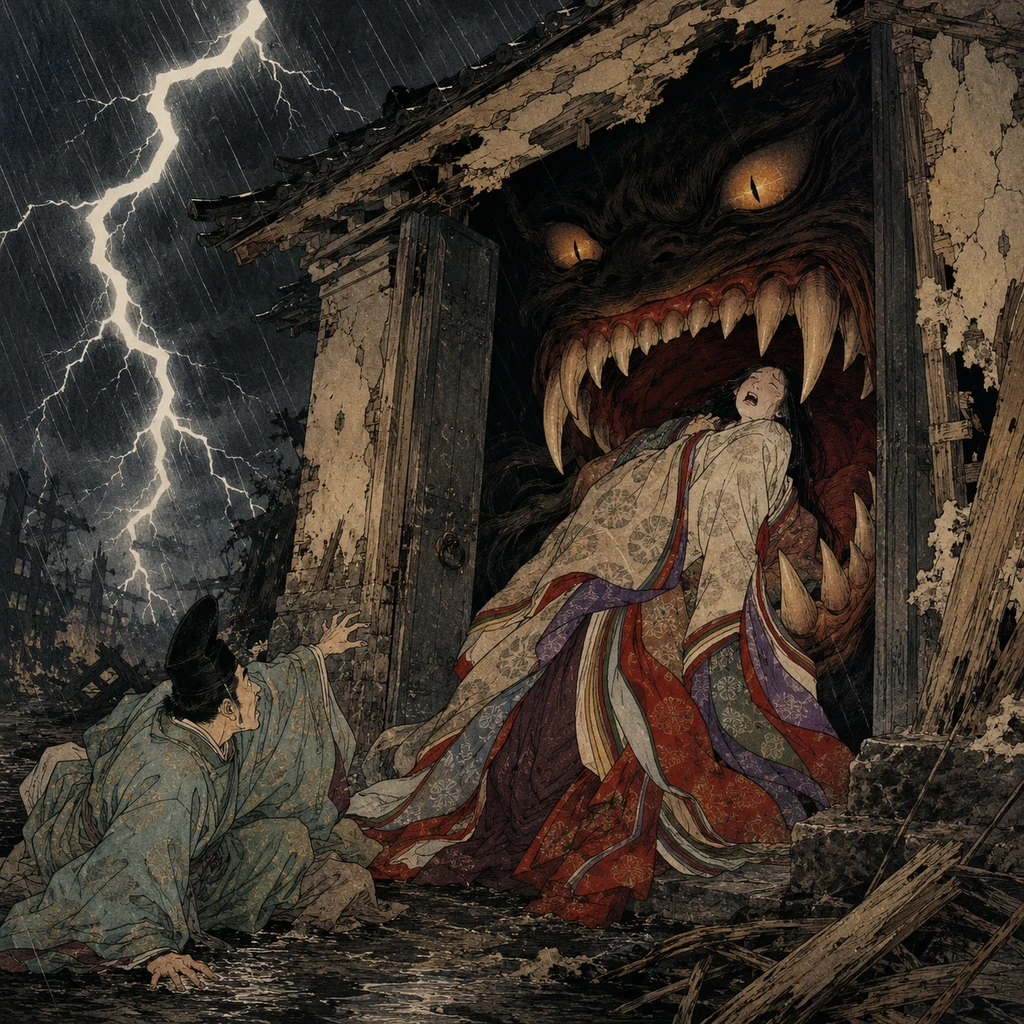
Oni Hitokuchi
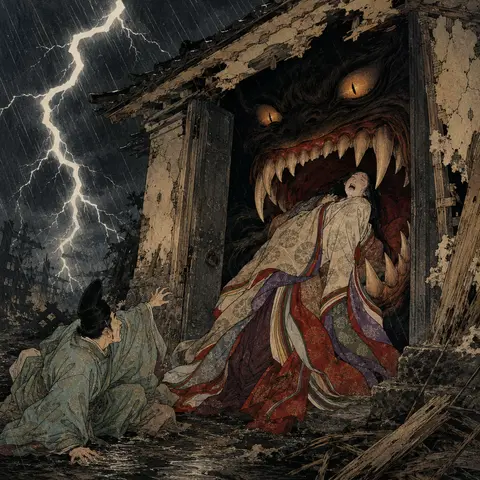
Oni Hitokuchi refers not to a single creature but to the phenomenon of an oni devouring a person in a single bite. The term appears frequently in Heian-period tales and romances. In The Tales of Ise (the Akutagawa episode), during a thunderstorm a woman hiding in a storehouse is swallowed whole by a lurking oni. Toriyama Sekien later illustrated the motif, popularizing the name “Oni Hitokuchi.” The idea often served to explain disappearances amid war or disaster as the work of the otherworld.
Read moreOni-hitokuchi refers to an oni devouring a human in a single bite. The most famous example is found in the "Akutagawa" section, the sixth episode of the *Tales of Ise*, a poem-tale from the early Heian period[13]. A man who had long yearned for a woman finally stole her away, and when they reached the banks of the Akutagawa River, she saw the dew on the grass and asked, "What is that?" As the night deepened and a fierce thunderstorm raged, the man hid the woman in a dilapidated storehouse and waited out the night at the door with his bow drawn. However, when dawn broke, the woman was gone, already swallowed whole by an oni—the name Oni-hitokuchi was born from the passage, "The demon had already eaten her in one bite"[13]. The Akutagawa is considered to be a river flowing through Settsu Province, and the dramatic setup of the woman's screams being drowned out by thunder superimposes the unfathomable violence of the otherworld onto the riverbanks of Naniwa.
There is a compelling interpretation that this episode uses the demon from the otherworld as a metaphor for the harsh reality of aristocratic power dynamics. The models for the story are said to be Ariwara no Narihira and Fujiwara no Takaiko, where Takaiko, abducted by Narihira, was taken back by her pursuing brothers. This interpretation suggests that the historical fact was mythologized as the woman being "eaten by a demon." In other words, the "demon" in Oni-hitokuchi is a metaphor for the very power that tears love apart. Narrating the supernatural becomes a vessel for expressing the tragedies of raw human affairs. The fact that such a multi-layered story was woven as early as the early Heian period, set along a river flowing through Settsu in Osaka, demonstrates that the land of Naniwa was not merely a provincial area, but intimately connected to the imagination of courtly literature.
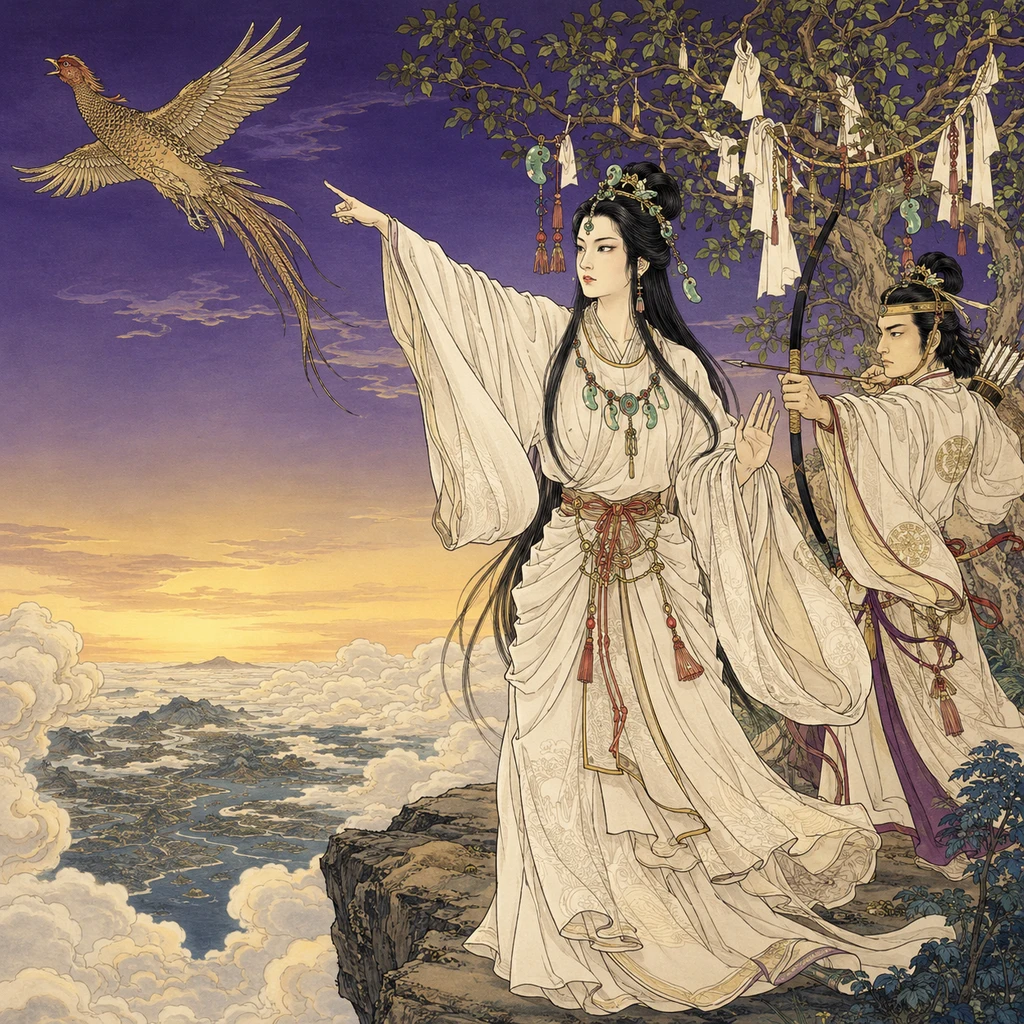
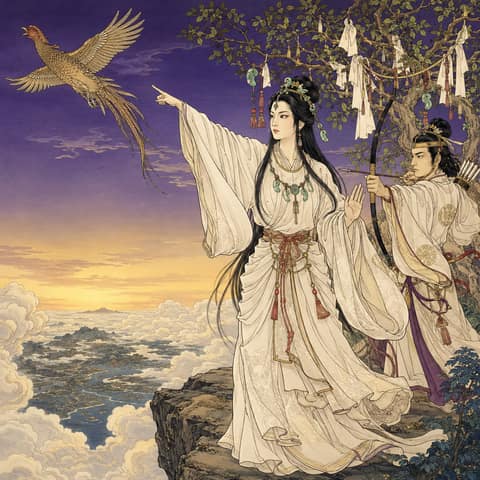
Amenosagume is a goddess appearing in the *Kiki* (the *Kojiki* and *Nihon Shoki*) mythologies. Written as 天佐具売 in the *Kojiki* and 天探女 in the *Nihon Shoki*, she was a shamaness serving Amewakahiko, who descended from the heavens to pacify Ashihara-no-nakatsukuni (the Central Land of Reed Plains)[2]. It is said that when a pheasant was sent from Takamagahara to Amewakahiko, who had defied his divine mandate, she immediately deciphered the bird's cry and advised him to "shoot that bird"[1]. There is a folk etymology suggesting that this shamanistic deity, who could divine human hearts and birds' cries, later became the prototype for the Amanojaku—a small demon that contrarily opposes human intentions. A goddess of myth gradually turning into a contrarian little demon—the name Amenosagume marks the starting point of that transformation.
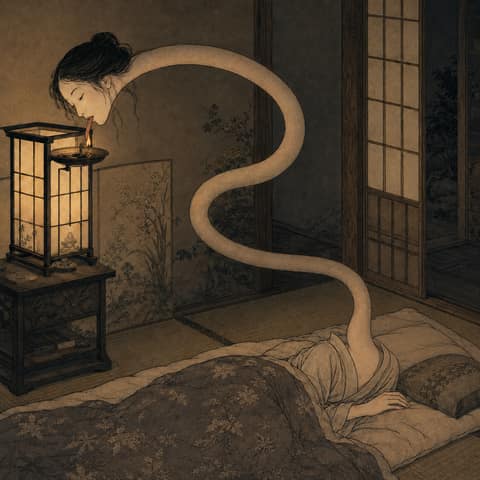
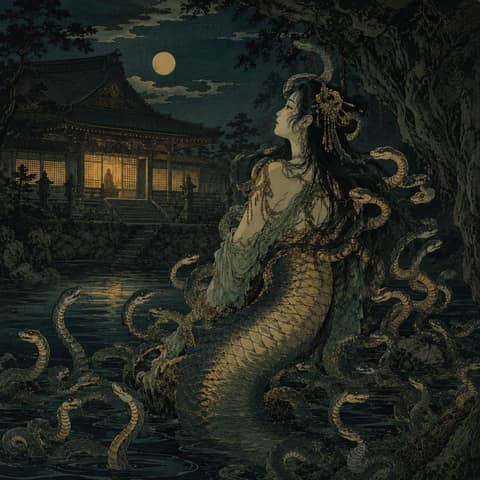
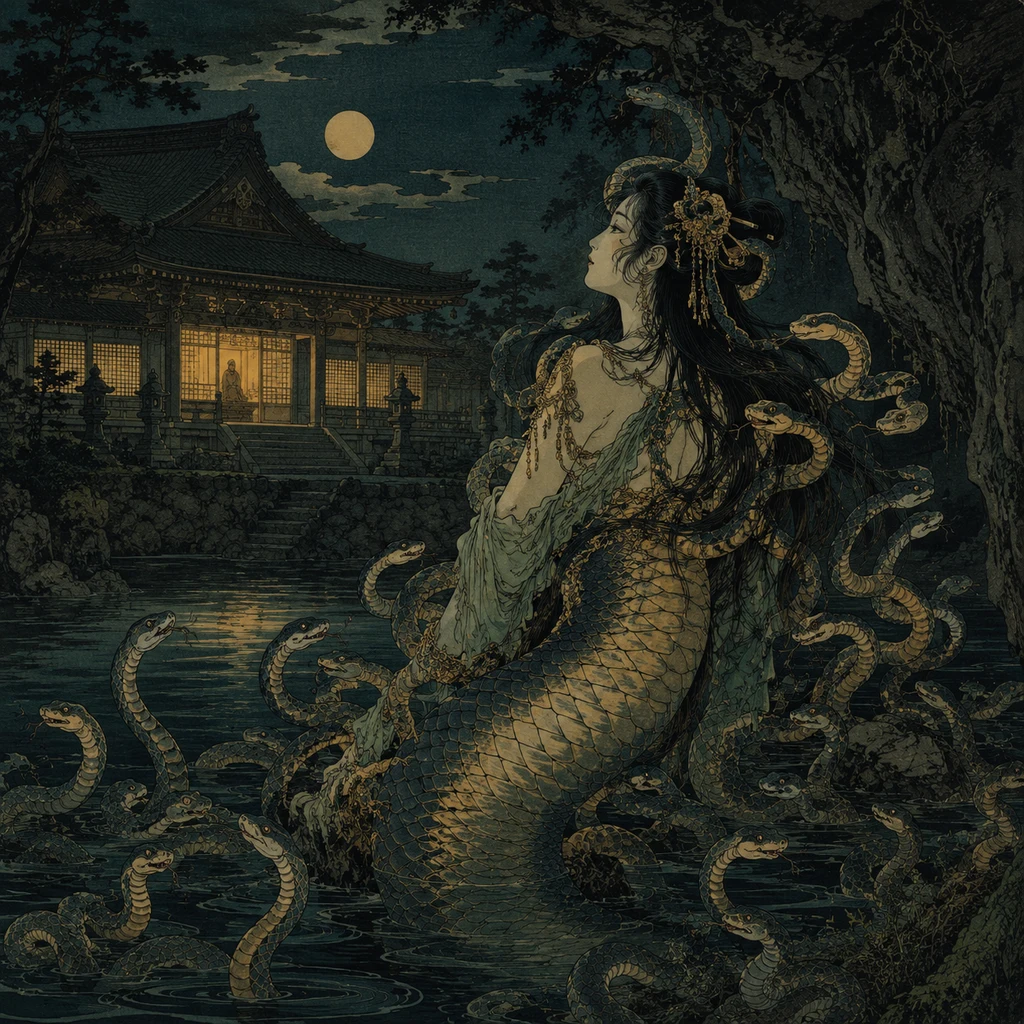
Jao-hime is a legend of a serpentine princess handed down at Chokei-ji in Sennan, Izumi Province—present-day Sennan City. It tells of a snake that had long lived in the pond of Chokei-ji, appearing as Jao-hime disguised as a woman to beguile the temple's head priest. It is an Izumi example of the Jao Gongen (Serpent King Avatar) faith seen at shrines and temples nationwide—a faith that worships the master snake of a pond adjacent to a temple as a deity. In Osaka, which holds many mysteries of the sea and the capital, this tale of a snake woman passed down at a temple pond in the mountains of Izumi preserves the raw texture of simple, local water deity worship.
Legends depicting snakes as women are distributed nationwide, such as Kiyohime of Dojo-ji, but they are often told as the tragedy of a woman who turns into a serpent out of passionate love. In the case of Jao-hime, the plot involves a snake that is inherently the master of the pond disguising itself as a woman to tempt a monk, showing a direction where the snake poses as a human rather than a human becoming a snake. This well reflects the local religious climate where the worship of water deities—fearing and revering the masters of ponds and deep pools—coexisted side by side with Buddhist temples. Izumi is a world of mountains, fields, and temple ponds, unlike the sea of Sumiyoshi or the battlefields of Kawachi. Even within the same Osaka Prefecture, the three former provinces of Settsu, Kawachi, and Izumi each have distinct topographies and nurtured different mysteries. Jao-hime is an entity closely bound to the land, born from the quiet watersides of Izumi.
Conclusion — Mysteries Accumulated at the Water's Edge
The Sumiyoshi Sanjin and Issun-boshi rising from the sea. Ibaraki-doji, Nue, and Teratsutsuki, born in the capital, originating in Settsu, or drifting down the river to wash ashore. The Ubagabi and Kosenjobi glowing amid the sins and battles of Kawachi. Oni-hitokuchi, Amenosagume, and Jao-hime, residing in literature, myth, and local ponds. When arranged like this, it becomes clear that the yokai of Osaka are "things that came from the outside and accumulated in this capital by the water's edge." The sea opening to foreign lands from Naniwazu, the capital's incidents carried by the Yodo and Yamato rivers, Shitenno-ji standing on the Uemachi Plateau, the battles repeatedly fought in Kawachi—all of its geography and history directly became the dwelling places of mysteries.
A journey exploring the mysteries of Naniwa inevitably traces the land itself, beginning from the sea of Sumiyoshi Taisha, moving to the Nuezuka in Miyakojima, Shitenno-ji on the Uemachi Plateau, Hiraoka Shrine in Higashiosaka, the ancient battlefield of Kawachi Wakae, and Chokei-ji in Sennan. Yokai are an alternative record of the memories of how this land has interacted with the outside world.