芝右衛門狸
しばえもんだぬき
芝居を愛した淡路の名狸・芝右衛門狸
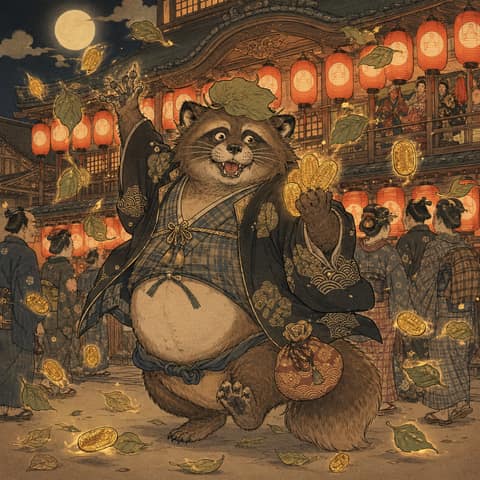
When reading about the Shibaemon-tanuki, the first thing to note is that his "love for theater" is not a mere decoration. Many bake-danuki deceive people, use leaves that look like coins, and distort human senses on mountain roads or street corners. Shibaemon has this power too, but his destination is neither a treasure house nor a mansion; it is the theaters of Dotonbori. In other words, this tanuki shape-shifts not to steal, but to watch. He is drawn to human performing arts, attempting to slip into the audience. The softness and danger of Shibaemon's story lie in this depiction of an outsider drawn to human culture. The magic of turning leaves into money is the most well-known economic illusion in tanuki folklore. The moment mountain leaves become town currency, the contract between nature and human society is swapped. However, in the theater, suspicion arises when leaves are found mixed into the admission fees. Shibaemon's magic can entertain people temporarily, but it breaks down at the point of accounting. When a guard dog is placed there, the illusion is forced back into a physical problem. The tragedy of being barked at, chased, and reverting to the form of a tanuki shows that his magic could not completely slip through the gates of society. In the legends where he is accompanied by his wife, Omasu, the tragedy deepens. Omasu loses her life by confusing the illusion of a feudal lord's procession with reality, and Shibaemon heads to the theater carrying that loss. Here, watching the play is both an act of entertainment and an act of fulfilling a promise to the dead. Therefore, Shibaemon's end is not just a comical tale of failure. Laughter and tears, the lightness of disguise and the weight of mourning overlap in one plot, drawing the tanuki's story closer to the story of the performing arts itself. The plot seen in the "Ehon Hyakumonogatari" and the local Shibaemon faith in Sumoto do not share the exact same context. In the former, the old tanuki appears as a non-human intellectual telling ancient tales to the human Shibaemon; in the latter, he rises as a famous tanuki commuting from the mountains of Awaji to the theater districts of Osaka. What connects them, however, is the tanuki's deep involvement with the "storytelling" and "spectacle" of human society. A tanuki who imparts knowledge, a tanuki who watches plays, a tanuki revered by actors after death. Through this continuity, Shibaemon, despite being a monster of the wild, is pulled strongly toward the side of words and the stage. The development of his enshrinement at Nakaza and Sumoto Hachiman Shrine after death changes Shibaemon from a "slain monster" to a "re-welcomed guardian." For the theater, he was an outsider who wanted to enter the audience, a patron who might have been killed by mistake, and eventually a god who protects the stage. The shrine returning to Sumoto acts as a device reconnecting this story to its homeland. The round trip of a Mikuma mountain tanuki traveling to an Osaka theater and finally returning to Awaji connects Awaji's local folklore to the memories of urban performing arts. If Danzaburo-danuki of Sado is spoken of as a great boss of wealth and illusion, and Kinchō of Awa as a famous tanuki of honor and battle, then Shibaemon stands out as the "audience tanuki." He does not merely threaten humans from the outside; he desires to see the stages humans create. Because that desire was shattered by a dog and then saved by faith, the Shibaemon-tanuki feels remarkably human even among bake-danuki. More than his power to shape-shift, it is his desire to see, hear, and enjoy that shines through as the defining trait of this famous tanuki.