Kuzunoha
くずのは
White Fox as a Human Wife
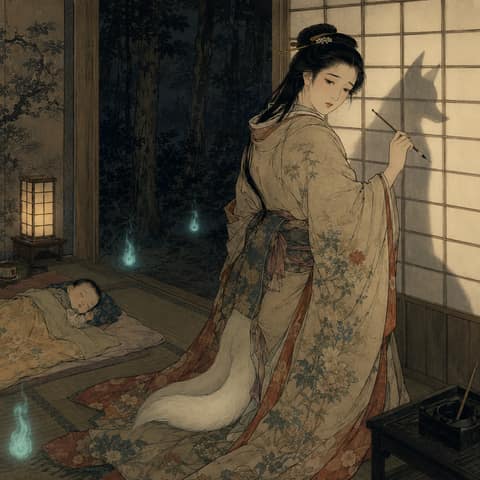
Kuzunoha of Shinoda Forest is an entity that transforms a fox's shapeshifting tale into a mother's story. Stories of foxes transforming into human women exist everywhere, but in Kuzunoha's case, seduction or mischief is not placed at the center. The rescued fox becomes a human wife as a repayment of kindness, gives birth to a child, and eventually returns to the forest upon having her identity discovered. While maintaining the ancient mold of an inter-species marriage, this plot connects the spiritual power of a fox and a human lineage into a single tragic family history by connecting it to the birth tale of the famous onmyoji, Abe no Seimei. The stage of the story is the Shinoda Forest. The white fox saved by Yasuna takes the form of Kuzunoha, they become husband and wife, and raise Dojimaru. However, a fox that has entered the human world cannot live in that form forever. When her true identity is exposed, Kuzunoha cannot continue to hold her child as a mother, nor can she discard her return to the forest as a fox; she cannot abandon either. In that torn moment, she leaves a farewell poem written on a sliding door (shoji). While indicating her whereabouts, the poem simultaneously implies that even if he goes there, a complete reunion will not be fulfilled. The forest of Shinoda is a place of homecoming, but at the same time, it becomes a place to pursue the mother lost from the human home. Ashiya Doman Ouchi Kagami turned this tale of a fox mother into a strong memory of the stage. The National Theatre performance script found in the NDL Search indicates that the "Kuzunoha scene" has been treated as subject matter for Kabuki appreciation classes even in modern times. The subtitle "Shinoda-zuma Urami Kuzunoha" in the Meiji-era publication pushes the sorrow of Shinoda's wife to the forefront right from the title stage. While Kuzunoha is often explained as "Seimei's mother," on stage she should rather be seen as a woman who leaves her name and departs, a fox whose true identity is known, an otherworldly being who cannot sever the fact that she is a mother. In iconography, Kuzunoha is remembered by the scene of parting with her child. Ashiya Doman Ouchi Kagami: Abe Yasuna, Kuzunoha, and Yokanpei by Toyohara Kunichika in the Izumi City Digital Archive is registered as an actor print depicting the performance at the Ichimura-za in 1865, conveying that Kuzunoha was firmly established in the visual culture of the stage. What is important here is the tension of the "fox mother in human form" played by the actor, rather than the figure of the fox itself. The audience views the parting as the sorrow of a human mother and child, even while knowing she is a fox. It is the moment when a yokai stands at the center of a human drama, and Kuzunoha's charm lies in this duality. The fox's power acts as inheritance rather than attack in Kuzunoha. The child she bears, Dojimaru, is later spoken of as Abe no Seimei. The explanation that Seimei possesses supernatural talent because he carries the blood of a fox is the logic of legend, not history. However, this logic functions to reconnect the onmyoji's spiritual authority back to the natural and otherworldly realms. Seimei's extraordinary abilities are supported not only by courtly knowledge but also by the power of his mother from the forest. There, Kuzunoha becomes a mediator passing the fox's demonic power to human society. Simultaneously, Kuzunoha restrains the dangerous allure often found in fox legends. While Tamamo-no-Mae and the Nine-Tailed Fox are spoken of as entities that disrupt the court, Kuzunoha does not destroy the home; she departs after establishing it. That is why it is sad. When her true identity is revealed, the story does not proceed in the direction of "exterminating the monster." She is depicted not as an enemy to be vanquished, but as a mother who must return. This distinction makes Kuzunoha uniquely special within the genealogy of fox yokai. The significance of reading Kuzunoha in an encyclopedia is to confirm that yokai are not made solely of terror. She is a fox, a wife, a mother, a famous scene on stage, and a geographic memory in Izumi. The figure returning to the Shinoda Forest is the moment the life that briefly opened between yokai and human closes. What remains there is not the eeriness of a supernatural entity whose true form was exposed, but the very process by which affection crossing boundaries is carved long into the land and performing arts. This figure can be read especially as the "mother who leaves her name" among tales of fox wives. Kuzunoha does not merely depart; she points the way to Shinoda Forest through her poem, carving her origins into her child's memory. In the sense that the mother's disappearance directly becomes the beginning of the Seimei legend, she is never a supporting character in the story, but the very entrance bringing spiritual authority from the Otherworld.