YOKAI.JP

葛の葉

くずのは

葛の葉

葛の葉

Their soul is listening — speak, and they will answer.

Basic Description

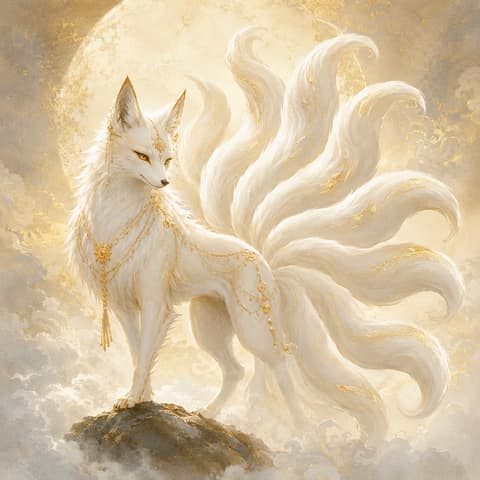
Kuzunoha is a shape-shifting fox living in the Shinoda Forest who becomes a human wife and is later spoken of as the mother of the onmyoji Abe no Seimei. While the core of the story is a tale of a fox's transformation, it places gratitude, the bond between husband and wife, and the parting of mother and child at the forefront, rather than the terror of shapeshifting to deceive humans. The plot—a fox saved in the Shinoda Forest transforms into a woman named Kuzunoha, marries Abe no Yasuna, and gives birth to Dojimaru—was largely solidified as "The Kuzunoha Fox" in early modern joruri and kabuki theater. In the bibliography of the National Diet Library, one can find the Ashiya Doman Ouchi Kagami lineage, which includes the title Shinoda-zuma Urami Kuzunoha (The Wife of Shinoda: The Sorrowful Kuzunoha). Kuzunoha has become more than just a fox wife; she is an entity that illuminates the Seimei legends from the perspective of a mother's story.

A characteristic of Kuzunoha is that her fox spiritual power is manifested inside the home. While the Nine-Tailed Fox or Tamamo-no-Mae often wear outward-facing demonic power that shakes royal authority, Kuzunoha's power dwells in domestic scenes: sliding doors (shoji), the delivery room, the child's name, and the waka poem left at her departure. When her true identity is revealed, the fox has no choice but to leave her child and return to the forest. The poem she leaves behind—"If you long for me, come seeking me in the forest of Shinoda in Izumi, the sorrowful Kuzunoha"—causes Kuzunoha to be remembered not as a terrifying monster, but as a mother who crossed boundaries. The Ashiya Doman Ouchi Kagami: Abe Yasuna, Kuzunoha, and Yokanpei in the Izumi City Digital Archive also conveys the scene of parting with her child, showing that the image of Kuzunoha was cultivated both on stage and in iconography.

Therefore, among fox yokai, Kuzunoha is an entity who makes us question "what she tried to protect even by shapeshifting" rather than her "ability to shapeshift." The land of Shinoda Forest, the name Abe no Seimei, the folktale of the fox wife, and the programs of kabuki and bunraku overlap, and she stands as a legendary figure who, despite being a yokai, bears the sorrow of motherhood and an inter-species marriage.

Folklore & Legends

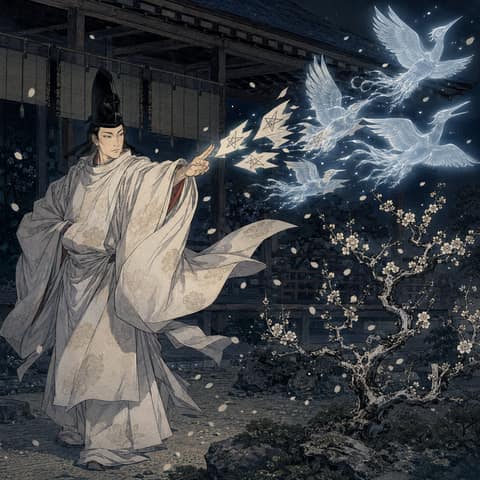
The Kuzunoha legend gained a strong outline in early modern performing arts when the tale of the fox wife of Shinoda Forest merged with the legend of Abe no Seimei. From the Middle Ages to the early modern period, Seimei was narrated as a master of divination and Onmyodo, and in later eras, stories surrounding his origins and the source of his spiritual power multiplied. One of these was the genealogy naming his father as Abe no Yasuna and his mother as the white fox of Shinoda Forest. Rather than narrating the historical Seimei as he was, placing an otherworldly mother provided a narrative explanation for his superhuman intellect.

A representative stage adaptation in the early modern period is Ashiya Doman Ouchi Kagami. The NDL Search reveals the National Theatre Kabuki Appreciation Class Script "Ashiya Doman Ouchi Kagami: Kuzunoha" and the Meiji-era publication "Ashiya Doman Ouchi Kagami: Also Known As The Wife of Shinoda, The Sorrowful Kuzunoha", confirming that Kuzunoha bore the main scenes of the play as a fox wife and mother. In the world of the play, the fox saved by Yasuna transforms into Kuzunoha, they become husband and wife, and raise their child, Dojimaru. However, due to the appearance of the real Princess Kuzunoha, her true identity is exposed, and the fox can no longer stay in the human house. The plot where she leaves a poem on the sliding door during their parting and returns to the Shinoda Forest is the most intense core of the Kuzunoha image.

What is important in the Kuzunoha legend is not the single point that a fox "transformed into a woman," but that after transforming, she truly lived within family relationships. In Japanese fox tales, there are widely stories of foxes deceiving humans, returning favors, or being enshrined as divine messengers. Kuzunoha stands at the intersection of these. As the fox saved by Yasuna, she possesses the structure of returning a favor; as a wife, she belongs to tales of inter-species marriage; and as Seimei's mother, she connects to tales of a hero's birth. The fox's spiritual power is inherited as the onmyoji's talent, but as a price, the mother retreats to the forest. Here, the warmth and pain of a story where an otherworldly being enters human society appear simultaneously.

Visual materials also established Kuzunoha as a famous scene on stage. The actor print by Toyohara Kunichika, featured in the Izumi City Digital Archive, depicts the performance of Ashiya Doman Ouchi Kagami at the Ichimura-za theater in Edo in 1865. It features Abe Yasuna, Kuzunoha, and Yokanpei, and is registered as a document conveying the scene of parting with her child. This tells us that Kuzunoha was not confined to local legends of Shinoda Forest, but was repeatedly visualized in Edo playhouses. The stage shows the mother's separation while letting the audience know the fox's true identity. Kuzunoha became the primary representative of fox wife tales precisely because the shapeshifting of a yokai and the parting of human emotion overlap in the same scene.

Geographically, Shinoda Forest, currently around Kuzunoha-cho in Izumi City, Osaka Prefecture, is the center of the legend. In the Geospatial Information Authority of Japan's address search, the location of 1-11-47 Kuzunoha-cho, Izumi City, Osaka Prefecture can be confirmed, and the memory of the land that receives the Kuzunoha legend remains, centered around the Shinoda-mori Kuzunoha Inari Shrine. The old province name of Izumi, the forest name of Shinoda, and the names of Abe/Yasuna overlap, and Kuzunoha continues to be spoken of not as "some random fox," but as the mother of the story extending from the forest of Izumi to the Seimei legends.

Related Yokai

Yokai deeply tied to this one in legend.

Detailed Analysis

Kuzunoha of Shinoda Forest is an entity that transforms a fox's shapeshifting tale into a mother's story. Stories of foxes transforming into human women exist everywhere, but in Kuzunoha's case, seduction or mischief is not placed at the center. The rescued fox becomes a human wife as a repayment of kindness, gives birth to a child, and eventually returns to the forest upon having her identity discovered. While maintaining the ancient mold of an inter-species marriage, this plot connects the spiritual power of a fox and a human lineage into a single tragic family history by connecting it to the birth tale of the famous onmyoji, Abe no Seimei.

The stage of the story is the Shinoda Forest. The white fox saved by Yasuna takes the form of Kuzunoha, they become husband and wife, and raise Dojimaru. However, a fox that has entered the human world cannot live in that form forever. When her true identity is exposed, Kuzunoha cannot continue to hold her child as a mother, nor can she discard her return to the forest as a fox; she cannot abandon either. In that torn moment, she leaves a farewell poem written on a sliding door (shoji). While indicating her whereabouts, the poem simultaneously implies that even if he goes there, a complete reunion will not be fulfilled. The forest of Shinoda is a place of homecoming, but at the same time, it becomes a place to pursue the mother lost from the human home.

Ashiya Doman Ouchi Kagami turned this tale of a fox mother into a strong memory of the stage. The National Theatre performance script found in the NDL Search indicates that the "Kuzunoha scene" has been treated as subject matter for Kabuki appreciation classes even in modern times. The subtitle "Shinoda-zuma Urami Kuzunoha" in the Meiji-era publication pushes the sorrow of Shinoda's wife to the forefront right from the title stage. While Kuzunoha is often explained as "Seimei's mother," on stage she should rather be seen as a woman who leaves her name and departs, a fox whose true identity is known, an otherworldly being who cannot sever the fact that she is a mother.

In iconography, Kuzunoha is remembered by the scene of parting with her child. Ashiya Doman Ouchi Kagami: Abe Yasuna, Kuzunoha, and Yokanpei by Toyohara Kunichika in the Izumi City Digital Archive is registered as an actor print depicting the performance at the Ichimura-za in 1865, conveying that Kuzunoha was firmly established in the visual culture of the stage. What is important here is the tension of the "fox mother in human form" played by the actor, rather than the figure of the fox itself. The audience views the parting as the sorrow of a human mother and child, even while knowing she is a fox. It is the moment when a yokai stands at the center of a human drama, and Kuzunoha's charm lies in this duality.

The fox's power acts as inheritance rather than attack in Kuzunoha. The child she bears, Dojimaru, is later spoken of as Abe no Seimei. The explanation that Seimei possesses supernatural talent because he carries the blood of a fox is the logic of legend, not history. However, this logic functions to reconnect the onmyoji's spiritual authority back to the natural and otherworldly realms. Seimei's extraordinary abilities are supported not only by courtly knowledge but also by the power of his mother from the forest. There, Kuzunoha becomes a mediator passing the fox's demonic power to human society.

Simultaneously, Kuzunoha restrains the dangerous allure often found in fox legends. While Tamamo-no-Mae and the Nine-Tailed Fox are spoken of as entities that disrupt the court, Kuzunoha does not destroy the home; she departs after establishing it. That is why it is sad. When her true identity is revealed, the story does not proceed in the direction of "exterminating the monster." She is depicted not as an enemy to be vanquished, but as a mother who must return. This distinction makes Kuzunoha uniquely special within the genealogy of fox yokai.

The significance of reading Kuzunoha in an encyclopedia is to confirm that yokai are not made solely of terror. She is a fox, a wife, a mother, a famous scene on stage, and a geographic memory in Izumi. The figure returning to the Shinoda Forest is the moment the life that briefly opened between yokai and human closes. What remains there is not the eeriness of a supernatural entity whose true form was exposed, but the very process by which affection crossing boundaries is carved long into the land and performing arts.

This figure can be read especially as the "mother who leaves her name" among tales of fox wives. Kuzunoha does not merely depart; she points the way to Shinoda Forest through her poem, carving her origins into her child's memory. In the sense that the mother's disappearance directly becomes the beginning of the Seimei legend, she is never a supporting character in the story, but the very entrance bringing spiritual authority from the Otherworld.

Character Profile

This section is our own creative profile for storytelling. It is not historical fact or scholarship.

Category
動物変化
Rarity
Legendary
Personality
She never forgets her gratitude to humans and pours deep affection both as a wife and a mother. She protects her family by hiding her true identity, but has the resolve to eventually return to the forest as an entity who crossed boundaries.
Compatibility
Resonates with stories of foxes, Abe no Seimei, inter-species marriage, and the parting of mother and child. Highly compatible with those who carry both sincerity and secrets simultaneously, and those who step away in order to protect.
Abilities
Transformation into a WifeFoxfire and IllusionsSpiritual Power to Protect Mother and ChildMemorializing Place via a Farewell PoemReturn to Shinoda ForestSpiritual Inheritance to the Onmyoji Legend
Weaknesses
She must continue hiding her true identity to stay in a human house for a long time. If her true form is known, she has no choice but to return to the forest despite her affection, severing the bond between mother and child.
Habitat
The forest of Shinoda in Izumi Province, currently around Kuzunoha-cho in Izumi City, Osaka Prefecture. In theatrical lore, Abe no Yasuna's house, the sliding door of the parting, and the path returning to Shinoda Forest are important scenes.
For more detailed information and diagnosis results about 信太森に帰る狐母・葛の葉, please click here.

Sources & References

4
  1. 芦屋道満大内鑑:一名・信田妻裏見葛葉.下の巻松本平助著(田中幸次郎, 1894) [古典文献]NDLサーチ書誌。信田妻・葛葉を副題に持つ明治期刊本。
  2. 蘆屋道満大内鑑阿部保名葛の葉与勘平豊原国周(和泉市デジタルアーカイブ(ADEAC), 1865) [図像資料]慶応元年の市村座上演を描いた役者絵。子別れの場面を伝える和泉市所蔵資料。
  3. 芦屋道満大内鑑:葛の葉:一幕三場竹田出雲作、戸部銀作補綴・演出(国立劇場, 2013) [上演台本]国立劇場歌舞伎鑑賞教室上演台本のNDLサーチ書誌。
  4. 国土地理院住所検索:大阪府和泉市葛の葉町一丁目11番47号国土地理院(国土地理院, 2026閲覧) [地理資料]信太森葛葉稲荷神社所在地として扱う住所の座標確認。

Interested in this type of yokai?

Discover the yokai most similar to your personality with our yokai diagnosis

Start Yokai Diagnosis

Meet your guardian yokai at the shrine

Draw an omikuji fortune and discover the yokai watching over you today.