YOKAI.JP

白蔵主

はくぞうす

白蔵主

白蔵主

Their soul is listening — speak, and they will answer.

Basic Description

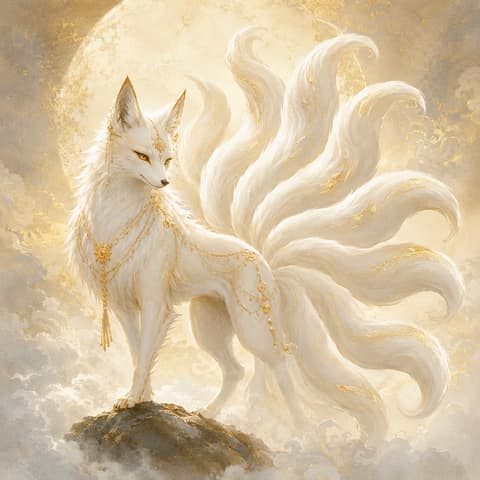
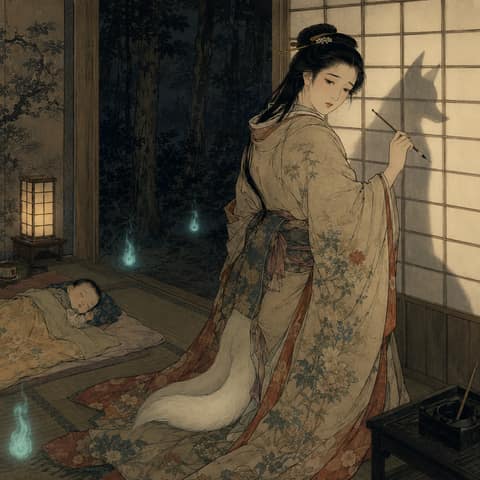
Hakuzosu is a shape-shifting fox that borrows the form of a monk, simultaneously illuminating human killing and the fox's instincts. The most widely known plot is from the kyogen play Tsurigitsune (Fox Trapping), where an old fox whose clan was trapped by a hunter disguises himself as the hunter's uncle, the monk Hakuzosu, and comes to preach to him to stop fox trapping. There, the fox is not merely a beast deceiving humans. The fox is spoken of as something close to a god, and manipulates words admonishing human killing, even drawing upon the historical tales of Tamamo-no-Mae and the Sessho-seki (Killing Stone). However, on the way home, the old fox cannot resist the smell of the bait placed in the trap, and finally reveals his fox form. The terror of Hakuzosu lies not only in the skill of his transformation, but in the moment when intellect and instinct, preaching and hunger, faith and bestiality tear apart within a single body.

Hakuzosu is also a yokai that makes us consider the meaning of the "form" a fox chooses when entering human society. In fox tales where they transform into beautiful women, mothers, or travelers, the transformation often becomes an entrance for emotion or desire. Hakuzosu, however, dons a monk's robes and stops a human with the voice of preaching. The form of a monk represents a form of knowledge and admonition trusted in the village, and the fox borrows that authority to move the hunter. Because Hakuzosu is also included in the Ehon Hyaku Monogatari (Picture Book of a Hundred Stories) published in 1841, this fox has been read not only as a stage role but also as a transforming fox preserved in late Edo-period ghost story art collections. If Kuzunoha of Shinoda Forest is a fox burdened with human love and separation, Hakuzosu is the old fox torn between monk's robes and a trap, an entity that carved the spirituality and peril of the fox into stage gestures.

Therefore, Hakuzosu is not a hero flaunting his transformation abilities, but a yokai showing where the transformation breaks down. The more he resembles a human, the more he can speak of human laws, but as long as he is a fox, he cannot separate himself from the bait, the smell, and the urge for revenge. This contradiction turns the fox tale into both an ethical drama and a ghost story.

Folklore & Legends

The folklore of Hakuzosu spans both stage performing arts and picture book ghost stories. In the kyogen play, an old fox whose family was trapped by a hunter disguises himself as the hunter's uncle, Hakuzosu, and comes to give him a piece of his mind. The old fox tells tales of how foxes are originally gods and how the lingering attachment of an exterminated fox became the Sessho-seki, convincing him to stop fox trapping[1]. What is important here is that the fox appears not merely as a being that bewilders humans, but as a narrator thrusting sin back onto the human side. The hunter is moved by the terrifying story and throws away his traps. However, on the way back, the old fox's heart is stolen by bait, and using the logic of revenge, he undoes his transformation and approaches the trap again. As the Japan Arts Council's commentary indicates, the core of this play lies in the struggle between the intellect of the fox disguised as an educated monk and the instinct drawn to the bait.

Hakuzosu was also included in the Ehon Hyaku Monogatari published in 1841. According to the National Diet Library's bibliography, the book is a five-volume set written by Momosanji and illustrated by Takehara Shunsen, and can be confirmed as a color-printed ghost story art collection with the alternative title Momosanji Yawa (Night Tales of Momosanji). As a modern published version, the bibliography of the Kokusho Kankokai edition "Ehon Hyaku Monogatari: Momosanji Yawa" can also be confirmed, making Hakuzosu an entry point for modern yokai research to reread classic ghost stories. The Hakuzosu of the picture book lineage, as a legend of Kai Province, links the monk's name and the fox's transformation more eerily. The fox wearing the name of a chief priest is not an apparition that appears from the mountains and fields for an instant and vanishes, but a monster that slips into the very trust of a human village.

The choice of a monk's form makes the legend of Hakuzosu heterogeneous even among fox tales. While foxes are revered as divine messengers of the Inari faith, they were also considered to bewilder humans as wild foxes or shape-shifting foxes. In Hakuzosu, this duality is consolidated into the form of a monk. The monk's form is a mask of mercy and admonition, and at the same time, it is a garment for diving deep into human society. If the fox only deceived the human, the story would end with the success of the transformation. However, while seeming to admonish and save the human, Hakuzosu is ultimately pulled back into his own bestiality. Overlaid there is the Japanese sensibility that views foxes as both sacred and dangerous.

Geographically, placing the main axis in Kai Province is the most cautious approach. While there are theories attempting to detail specific temple names or mountain honorifics (sango), placing coordinates on an encyclopedia requires individual verification. Here, the former province and modern Yamanashi Prefecture are linked, preserving the regionality of the legend without making unconfirmed temple names definitive on a map.

The kyogen play Tsurigitsune makes Hakuzosu a special fox even within the history of performing arts. In the Izumi school, there is a saying, "Begins with the monkey, ends with the fox," meaning the fox role is a graduation piece where the kyogen actor intentionally seals the techniques acquired up to that point and performs the fox's posture, footwork, and gestures in a specialized form[1]. Hakuzosu is simultaneously a yokai in a story and the name of a technique for physically becoming a fox. The fox manipulating human words eventually returns to a fox's body. This round trip is precisely the reason why Hakuzosu became not a mere fox tale, but an intense apparatus for showing the yokai called a fox on stage.

Related Yokai

Yokai deeply tied to this one in legend.

Related1

Detailed Analysis

Hakuzosu, disguised as a monk, is a particularly theatrical yokai even among tales of fox transformation. Foxes often transform into beautiful women, travelers, or close family members, but Hakuzosu chooses the form of a monk. That choice holds the power not only to reassure the other person but to move them with words. The old fox in Tsurigitsune disguises himself as the hunter's uncle and preaches on the sin of fox trapping. The persuasion succeeds to the point of making him throw away his traps, but the bait on the way home destroys that victory. Hakuzosu does not lose because he deceived a human. Because the fox, who spoke using human ethics, is ultimately pulled back into the fox's own hunger, he is comical, pitiful, and terrifying.

This form does not render the yokai called a fox a simple villain. Hakuzosu is on the side whose clan was killed; he is an avenger, and a preacher. His words contain a protest against killing, while simultaneously containing deception through transformation. If Kuzunoha of Shinoda Forest is remembered as a fox mother unable to sever ties with humans, Hakuzosu is an old fox breaking down between human law and a fox's body. Both are stories of foxes entering human society, but while Kuzunoha is a story of love and parting, Hakuzosu is a story of eloquence, traps, desire, and exposure.

The Hakuzosu of Tsurigitsune undergoes a double transformation on stage. The first transformation is within the story, where the fox transforms into the monk named Hakuzosu. The second transformation is in the actor's body, where the kyogen master adopts the fox's posture and movement, yet hides it beneath the behavior of a human monk. The struggle between intellect and instinct, pointed out as a key element of appreciation, appears not only in lines but in the way of walking, the way of looking back, and the spacing as he is drawn to the bait[1]. Therefore, Hakuzosu is a yokai that is read as well as a yokai that is performed. The true identity of the fox is not exposed at the end; it becomes visible as the body gradually returns to a fox.

On the other hand, the Hakuzosu of the Ehon Hyaku Monogatari lineage makes the monk-shaped fox look even darker as a ghost story accompanied by the place name of Kai Province. As seen in the National Diet Library bibliography, the book is a ghost story art collection written by Momosanji and illustrated by Takehara Shunsen, and late-Edo readers received this fox through a combination of pictures and captions. While the stage Hakuzosu returns to a fox through a momentary failure, the picture book Hakuzosu lurks long within human settlements. What becomes problematic here is not only how skillfully the fox transforms. It is how much people believe in the institutions of monk's robes, temples, and sermons. Hakuzosu exploits that form of trust.

The white fur of the fox and the human status overlap in Hakuzosu's name and notation. The variant spellings Hakuzosu (白蔵主, 伯蔵主, 白蔵司, 伯蔵司) gently oscillate readings between the fox's white hair, a monk's name, and a fox disguised as a human. While the names of transforming foxes often remain attached to lands or people's names, in Hakuzosu's case, the very act of "the fox borrowing a name" becomes the core of the apparition. To give one's name is to acquire a role in society. By taking a monk's name, Hakuzosu enters the inside of the temple, enters the inside of the hunter's house, and finally returns to a fox in front of the audience.

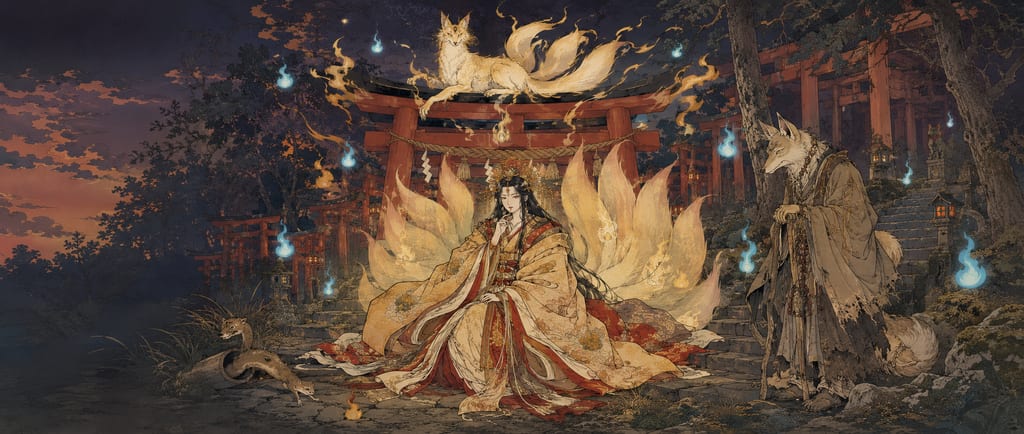
Placing Hakuzosu within the genealogy of foxes, he is not a great demon fox like the Nine-Tailed Fox or Tamamo-no-Mae that shakes royal authority. Nor is he a fox woman who leaves behind a child like Kuzunoha. Hakuzosu concentrates the point of contact between fox and human into "persuasion" and "traps." Humans catch foxes with traps, and foxes catch humans with words. Both are techniques reading the opponent's weakness, and those techniques succeed for just an instant. However, when the smell of bait, the desire for prey, and the logic of revenge overlap, the fox approaches his own trap. The reason the story of Hakuzosu has survived so long is that it depicts not a fox's cunning, but a weakness that is harder to escape the wiser one is.

Hakuzosu on an encyclopedia acts as a keystone expanding fox-type yokai horizontally. If the Nine-Tailed Fox bears the nation and calamity, Kuzunoha parent and child and parting, and the wild fox possession and marginality, Hakuzosu connects performing arts and narrative, monk's form and fox's body. The fox is not a single mold; it can be a divine messenger, a mother, a calamity, or an actor. By placing Hakuzosu, an axis of "the performed fox" is established within the vast yokai group called foxes.

Character Profile

This section is our own creative profile for storytelling. It is not historical fact or scholarship.

Category
動物変化
Rarity
Epic
Personality
An eloquent, mature fox who speaks of mercy and resentment with the same mouth. He sees through human sins, but cannot completely free himself from bait and instinct.
Compatibility
Resonates well with those interested in foxes, Inari faith, transformation tales, and Noh/Kyogen. Toward opponents who refuse to listen to admonitions or those who make light of bestiality, he mercilessly shakes their true nature.
Abilities
Transformation into a Monk's FormEloquence Admonishing KillingNarrative Knowledge Speaking of Fox SpiritualityKeen Sense of Smell for Traps and BaitInfiltration into Human SocietyExpression of the Fox Body through Kyogen Forms
Weaknesses
Weak to the smell of bait and hunger as a fox, the transformation unravels the instant he justifies himself with logic. While he can wear the trust of monk's robes, he is fragile to the observation of dogs or hunters who see through his true form.
Habitat
Appears in temple and shrine legends of Kai Province, fox trapping hunting grounds, the margins of the Inari faith, and the kyogen stage where Tsurigitsune is performed.
For more detailed information and diagnosis results about 僧に化けて狐釣りを止める白狐・白蔵主, please click here.

Sources & References

3
  1. 文化デジタルライブラリー 狂言「釣狐」日本芸術文化振興会(日本芸術文化振興会, 2023) [公式解説]狂言『釣狐』のあらすじ、白蔵主に化ける老狐、理性と本能のせめぎ合い、狐役の演技上の位置づけを確認する公式教材。
  2. 絵本百物語 5巻桃山人 作・竹原春泉 画(天保12年刊, 1841) [古典文献]白蔵主を収める江戸後期怪談画集『絵本百物語』の国立国会図書館書誌。桃山人作、竹原春泉画、天保12年刊、別題『桃山人夜話』。
  3. 絵本百物語 : 桃山人夜話竹原春泉 [画]ほか(国書刊行会, 1997) [研究書・注釈]国書刊行会版『絵本百物語 : 桃山人夜話』の書誌。近代刊行版・注釈参照用。

Interested in this type of yokai?

Discover the yokai most similar to your personality with our yokai diagnosis

Start Yokai Diagnosis

Meet your guardian yokai at the shrine

Draw an omikuji fortune and discover the yokai watching over you today.