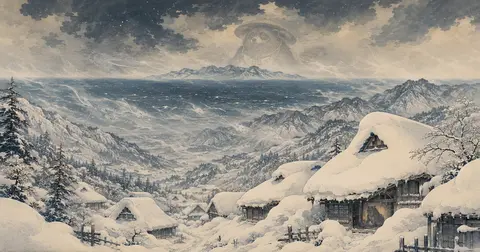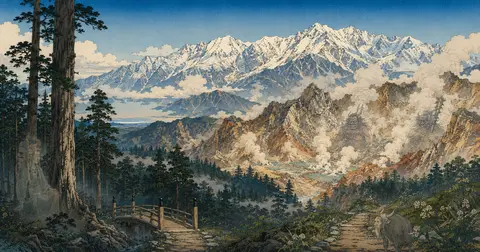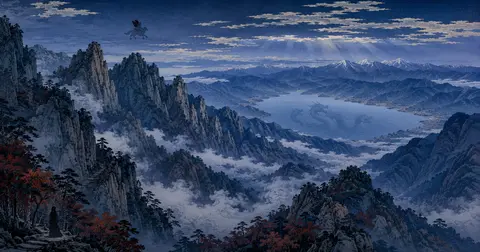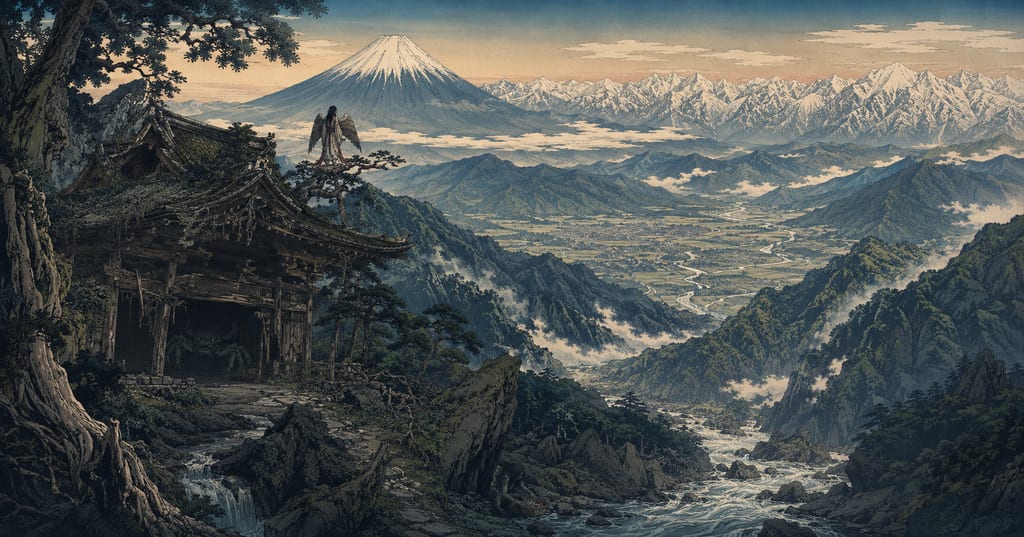
There are eight landlocked prefectures in Japan. Among them, Yamanashi is the most quintessential mountain realm, its borders entirely sealed by high ridges. Mount Fuji lies to the south, the Southern Alps (Akaishi Mountains) to the west, the Yatsugatake and Okuchichibu ranges to the north, and the Misaka and Daibosatsu mountains to the east. The city of Kofu rests at the bottom of the basin, where the Fuefuki and Kamanashi rivers merge to form the Fuji River, draining slightly into Suruga to the south. In this land, where salt and fish could only arrive across mountain passes from other provinces, the people did not fear the monsters of the rolling waves. Instead, they feared the sounds of the mountain streams, the shape-shifting creatures crouching in the darkness of temples, and the winged beings standing atop the mountain ridges.
The old province name is Kai. Since ancient times, it has been a center of Mitake worship that reveres Mount KinpuMount Kinpu[1] as a sacred peak. In the Middle Ages, the Takeda clan established the Tsutsujigasaki-yakata and united the entire province of Kai, and in the early modern period, the northern foothills of Mount Fuji became a sacred site for the Fuji-ko[2] (Fuji worshipers). The mountains embrace people's lives while simultaneously repelling them—this duality is the key to understanding the yokai of Kai. In this article, we will explore the yokai of Kai based on the region's geography and history, focusing on the giant crab 'Kani-bozu' who appears in temples to pose riddles, the 'Azuki-arai' who leaves only its sound by the water's edge, and the 'Onna-tengu' who stands in the space between the mountains and the rivers.
The Mountain Realm of Kai:
Why a Landlocked Province Teems with Apparitions
Approximately 80 percent of Yamanashi Prefecture is covered in forests. Arable land is restricted to the Kofu Basin and the few low-lying areas in the northern foothills of Mount Fuji and the Kyonan region. Consequently, human settlements have always been confined by towering mountain walls. Salt was transported along the 'Salt Road' from both the Pacific Ocean and the Sea of Japan, and seafood could only be obtained dried or salted. Therefore, the foundation for the development of sea monsters—such as the Umi-bozu or Funayurei (ship ghosts)—was entirely absent in this region.
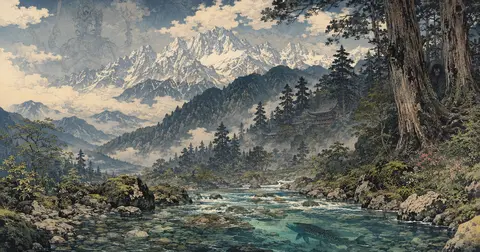
Instead, the supernatural occurrences here are deeply rooted in the mountains and water (mountain streams). The tributaries of the Fuefuki, Kamanashi, and Fuji rivers that carve deep valleys, the steep ravines, and the boundaries between human habitation and the mountains form the backdrop for these tales. The yokai of Kai stand squarely on these boundary lines.
Looking back through history, Kai has long been a land of sacred mountains. In the north, Kanazakura Shrine, which enshrines Mount Kinpu (Kinpusan) as its sacred body[1], served as a center for Shugendo (mountain asceticism), bridging ancient mountain worship with the Mitake faith, revering a massive granite boulder near the summit as a deity. Eventually, Mount Fuji in the south took center stage in local faith. Kawaguchi Asama Shrine[3], said to have been established to pacify the great eruption of Mount Fuji in the sixth year of the Jogan era (864–866), and Fuji Omuro Asama Shrine[4], purportedly founded in 699 and considered the oldest on Mount Fuji, stand side by side at the northern foothills. The mountain itself was a deity, penetrated by ascetics and ascended by commoners—for the people of Kai, the mountain was a place where both gods and monsters resided.
Turning to the west, the Akaishi Mountains, or the Southern Alps, tower like a folding screen separating Kai from Shinano and Suruga, featuring a series of peaks reaching 3,000 meters, including Mount Kita. These high peaks did not easily invite human presence, and only Shugendo ascetics or a handful of mountain laborers ventured into their depths. Practitioners of the Mitake faith originating from Mount Kinpu worshipped the boulder near the summit as a god, accumulating spiritual discipline while traversing the mountain ranges. The darkness of the deep mountains, where human feet could not reach, was the perfect stage for imagining the supernatural. It is fair to say that the fears of landlocked Kai were directly proportional to the height and ruggedness of the mountains that surrounded it in all directions.
Entering the Sengoku period, this mountainous province was unified by a single authority. Centered on the Tsutsujigasaki-yakata (now Takeda Shrine)[5], which served as the residence for three generations of the Takeda clan—Nobutora, Shingen, and Katsuyori—Kofu was developed as a castle town. The Shingen-tsutsumi (Shingen's Levee), said to have been built by Shingen on the Kamanashi River, was a massive undertaking to control the raging river and protect the basin from flood damage, engraving the theme of 'battling water' into Kai's history. The Takeda clan made Fuji Omuro Asama Shrine their place of prayer, linking sacred mountain worship with samurai authority. Mountains, water, and faith—it is precisely at the intersection of these three axes that the three yokai we will discuss emerge.
Takeda's Kofu and the Shadow of Those Who Tame the Water
When discussing the yokai of Kai, the landscape of Kofu built by the three generations of the Takeda clan is an indispensable backdrop. In the sixteenth year of the Eisho era (1519), Takeda Nobutora moved his residence from Isawa and established his base in Tsutsujigasaki, which his son Shingen then used as the headquarters to unify the province of Kai. The castle town was laid out in a grid, shrines and temples were arranged, and the residences of the vassal band were lined up—a city was born at the bottom of the basin surrounded by mountains. The early modern foundation upon which tales of the Kani-bozu of Chogen-ji Temple and the Azuki-arai of the mountain streams were passed down rests on the way of life in Kai established by the Takeda administration.
Particularly important is the theme of 'taming the water.' The Kofu Basin frequently suffered from flooding at the confluence of the Kamanashi and Midai rivers. The Shingen-tsutsumi (Shingen's Levee), purportedly constructed by Shingen, utilized sophisticated flood control techniques, dampening the river's momentum by directing the flow against bedrock and allowing floodwaters to escape through discontinuous levees known as 'kasumi-tei.' In this way, he controlled the raging rivers and protected the basin. Human activity in the mountainous province of Kai was an ongoing process of 'coming to terms with water.' The fact that the Azuki-arai leaves its sound in mountain streams and the Onna-tengu descends to the riverside is a reflection of how deeply the people of this land feared and relied upon water. Apparitions dwell where the central themes of daily life are found.
The 'Omiyuki-san' (the Grand Procession Festival of Kai Province's Ichinomiya Asama Shrine)[6], held annually on April 15, conveys the intertwining of flood control and faith in Kai to this day. Portable shrines (mikoshi) from three shrines—Ichinomiya Asama Shrine, Ninomiya Miwa Shrine, and Sannomiya Tamamoro Shrine—are carried in procession to Sansha Shrine near the Shingen-tsutsumi along the banks of the Kamanashi River. There, prayers for flood prevention are offered to Konohanasakuya-hime-no-mikoto, who is regarded as the goddess of Mount Fuji. This is a flood control festival held before rice planting, in anticipation of the flood season. Interestingly, the men carrying the mikoshi dress in women's clothing, wear makeup, and don flower hats—a custom said to prevent the goddess from becoming jealous. Faced with the repeatedly flooding Kamanashi River, the people not only built levees but also devised a festival to appease the deity governing the river. In mountain life, water was not merely an object of civil engineering; it was a spiritual force that needed to be pacified and revered.
Looking Up at Mount Fuji:
The Mountain of Faith and Its Darkness
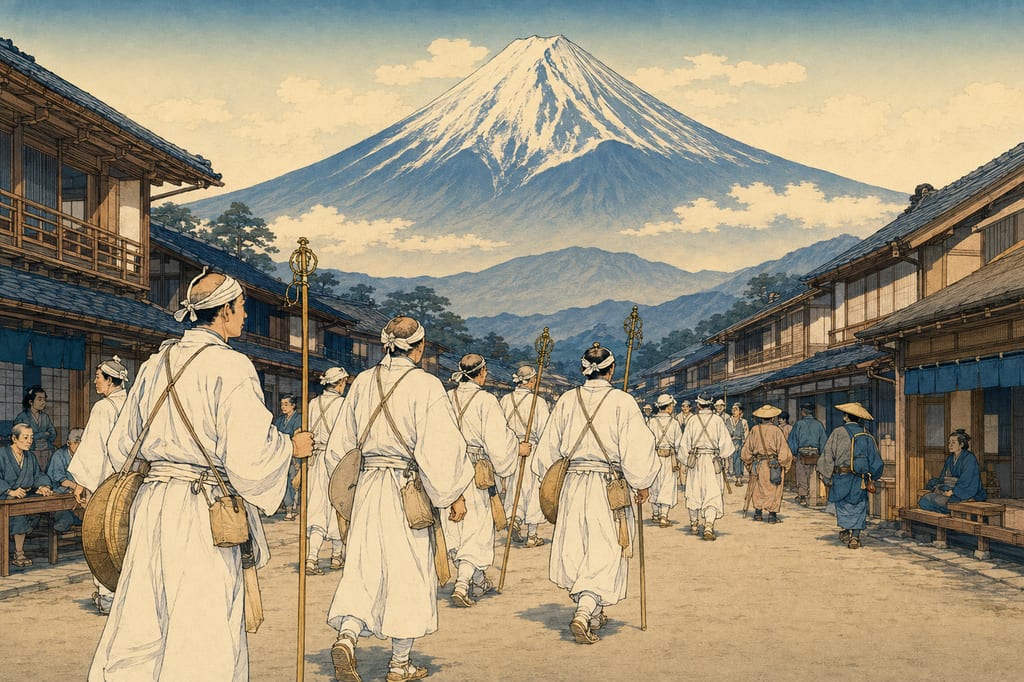
The presence that covers the southern half of Kai is Mount Fuji. Mount Fuji viewed from the Yamanashi Prefecture side is sometimes called 'Ura-Fuji' (Back Fuji), but in the history of faith, it was rather the main stage. Asama (or Sengen) Shrines are dotted across the northern foothills, pacifying and worshipping the fierce deity of the fire-breathing mountain—Asama-no-Okami (often identified as Konohanasakuya-hime). Kawaguchi Asama Shrine[3], said to have been founded in response to the great Jogan eruption, is a prime example of this, illustrating how the real-world catastrophe of an eruption spurred the imagination of gods and monsters.
Entering the early modern period, Mount Fuji became a destination for pilgrimages by commoners. Hasegawa Kakugyo (1541–1646)[2], revered as the founder of the Fuji-ko, underwent severe ascetic training in the Hitoana (man-made cave) at the foot of Mount Fuji, establishing a unique faith that positioned Fuji as the parent of this world and humanity. His teachings were passed down to his disciples, splitting into the two factions of Murakami Kosei and Jikigyo Miroku, and explosively spreading among the commoners of Edo. The sight of pilgrims clad in white robes climbing the Yoshida Trail while chanting 'Rokkon Shojo' (Purification of the Six Roots of Perception) was a hallmark of early modern Kai.
At the base of the Yoshida Trail, a unique town developed to welcome these pilgrim groups: the Oshi-machi of Kamiyoshida[7] in Fujiyoshida. An 'oshi' was a religious practitioner of the Fuji faith and the master of a shukubo (pilgrim's inn). They forged patron-client relationships with Fuji-ko groups across the country, hosting pilgrims from all over Japan in their inns during the summer climbing season, offering prayers, and assisting with the ascent. During its peak, oshi inns lined the area, creating a long, narrow townscape stretching toward Mount Fuji along the path leading to Kitaguchi Hongu Fuji Sengen Shrine—even today, historic houses remain along Oshi-machi Street. The faith of looking up at the mountain gave birth to an entire livelihood and town at its foothills. The mountain, home to both gods and monsters, simultaneously attracted substantial numbers of people and economic activity. The sentiment that the mountain is divine and that climbing it is a form of ascetic training resonates with the Mitake faith that reveres Mount Kinpu in the north. The gaze that reveres the mountain as sacred has always been inextricably linked to the gaze that finds apparitions in the very darkness of that mountain.
The Giant Crab Posing Riddles in the Temple's Darkness:
Kani-bozu and Chogen-ji
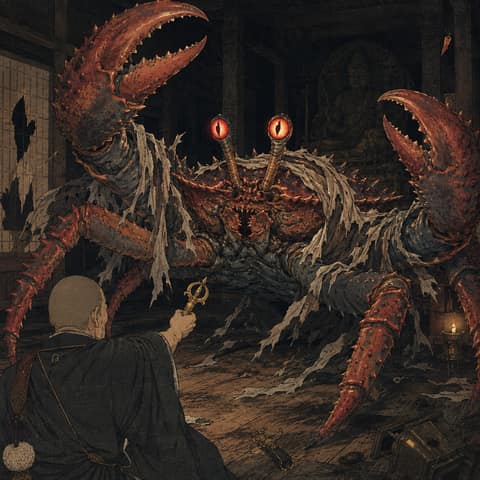
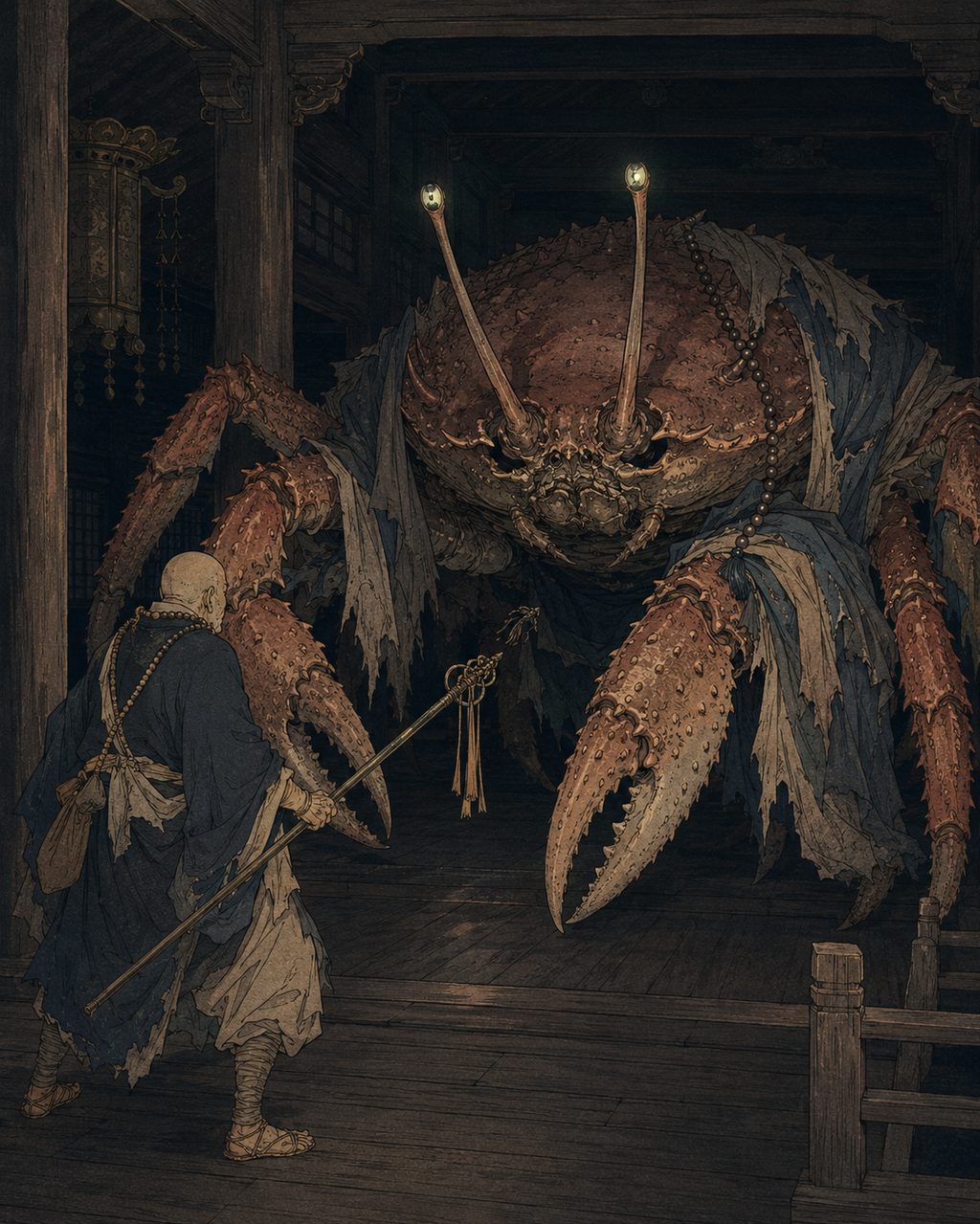
If one were asked to name just a single yokai of Kai, the choice would undoubtedly be the Kani-bozu. Passed down at Chogen-ji, an ancient Soto Zen temple in Manriki, Yamanashi City, this apparition stands out less for its bizarre appearance and more for the intellectual device of the 'riddle' (mondo).

Crab Monk
A crab yokai that disguises itself as a Buddhist monk to challenge travelers with riddles and Zen-style questions. It appears at abandoned temples or remote chapels late at night, testing resident or itinerant monks. Once its true nature is exposed, it either flees as a giant crab or is slain. The tale is famous at Chōgen-ji in Manriki, Kai, with close variants in Suzu (Ishikawa), Oyabe (Toyama), Fukutsu (Fukuoka), and Ichinoseki (Iwate). Scholars also note links to the kyōgen play “Kani Yamabushi.”
Read moreThe legend generally goes like this: Long ago, deep in the night at Chogen-ji, an apparition disguised as an itinerant monk (unsui) would appear and pose a riddle to the head priest. The phrase was, 'What has two legs, eight legs, two large legs, moves sideways freely, and points its eyes toward the heavens?'[8]—two legs, eight legs, two large legs, crawling sideways freely, with eyes pointing toward the sky. Monks who could not solve this riddle lost their lives one after another, leaving the temple practically deserted. One day, a traveling hoin (a high-ranking Shugendo monk) asked for a night's lodging. When the apparition challenged him with the usual riddle, the hoin immediately recognized it as a crab and threw his tokko (a vajra, an esoteric Buddhist ritual implement) at it. The monster revealed its true form—a giant crab said to measure nearly four meters square—fled into the valley, and eventually died. From then on, the supernatural incidents at the temple ceased.
The core of this tale lies in the fact that the riddle itself contains the answer. 'Two legs, eight legs' is a phrasing that counts out the crab's ten legs; 'moves sideways freely' accurately describes its lateral scuttling, and 'points its eyes toward the heavens' refers to the crab's eyes protruding on stalks. The monster recites its own physical description while trying to keep the listener from realizing it—this clever wordplay elevates the Kani-bozu from a mere monster to something greater. The official folk tale archive compiled by Yamanashi Prefecture includes it as 'The Giant Crab of Chogen-ji'[9], proving it is a deeply rooted local legend.
The hoin who subdued the monster later changed his name to Kyukai Hoin ('The Priest Who Saved the Crab') and became the temple's head priest. It is also said that he was deeply moved when the figure of a Thousand-Armed Kannon emerged from the giant crab's remains, so he enshrined it as the main deity. The one who destroyed the monster turns into the one who offers a requiem for it—this dual structure of subjugation and pacification reflects the sense of death and rebirth harbored by mountain temples. Incidentally, it is believed that the temple's mountain name (sango) was changed to 'Kanizawasan' after the 11th year of the Kyoho era (1726), and the literary establishment of the legend[8] is not thought to date back much further. This should be carefully noted as a historical fact.
What is fascinating is that this riddle-posing giant crab tale is not exclusive to Kai. Similar stories of a giant crab disguised as a monk posing riddles can be found scattered across the country at deserted temples and bridges, including Eizen-ji in Suzu City, Ishikawa Prefecture; Oyabe City, Toyama Prefecture (where the place name 'Kitakandani' remains); Fukutsu City, Fukuoka Prefecture; and Kanpo-ji in Ichinoseki City, Iwate Prefecture. The endings vary by region: in Fukutsu, the head priest is eaten, while in Ichinoseki, the crab is defeated with an iron fan. It has been pointed out that the origin of these tales is the Kyogen play *Kani Yamabushi* (The Crab and the Mountain Ascetic)[8], which features a dialogue between a yamabushi and a crab spirit. In other words, the Kani-bozu is a narrative archetype, polished as performing art, that landed at temples in various places, absorbed local names and Buddhist connections, and took root. Chogen-ji in Kai is the most famous among them precisely because it is equipped with unique details—Kyukai Hoin, the Thousand-Armed Kannon, and Kanizawasan—and has been handed down as a prefectural folk tale.
Furthermore, there is a variant of this riddle tale even within Kai. At Tenmokuzan Seiun-ji[10], an ancient Rinzai Zen temple in Tenge, Koshu City, reportedly founded by Gokkai Honjo in the 4th year of the Jowa era (1348), a giant crab riddle is also said to have been told. The very fact that multiple temples within a single prefecture embraced the same narrative archetype clearly demonstrates the 'mutability' of the Kani-bozu tale—its tendency to settle into deserted temples and deep mountain Zen monasteries across the land, absorbing the origins of each locale to take root. Rather than debating which temple is the 'origin,' the heavy truth is that the giant crab crouching in the temple's darkness was repeatedly imagined in various parts of mountainous Kai. Mountain Zen temples were places where practitioners faced deep darkness alone, and that darkness easily coalesced into the form of an apparition.
The Sound-Only Apparition Echoing in the Mountain Streams:
Azuki-arai
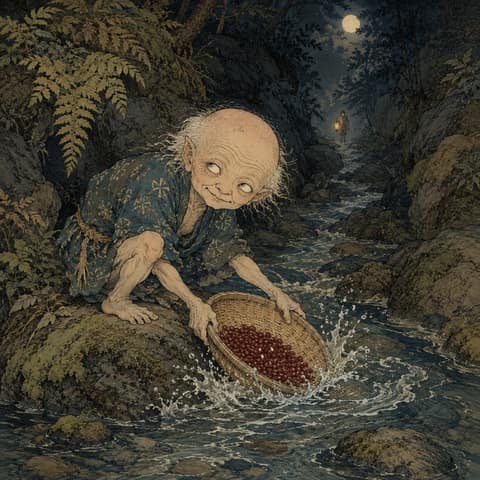
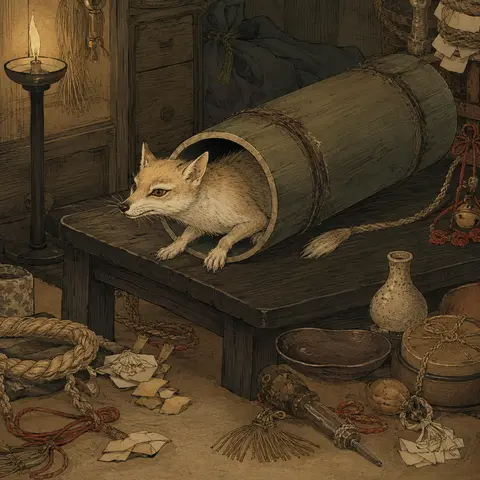
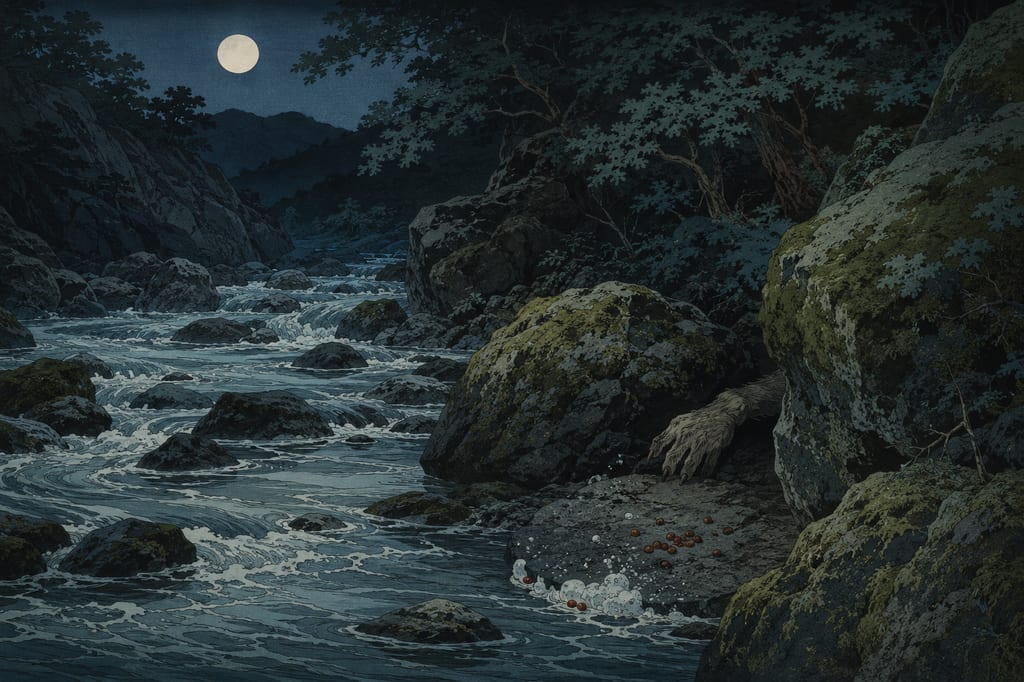
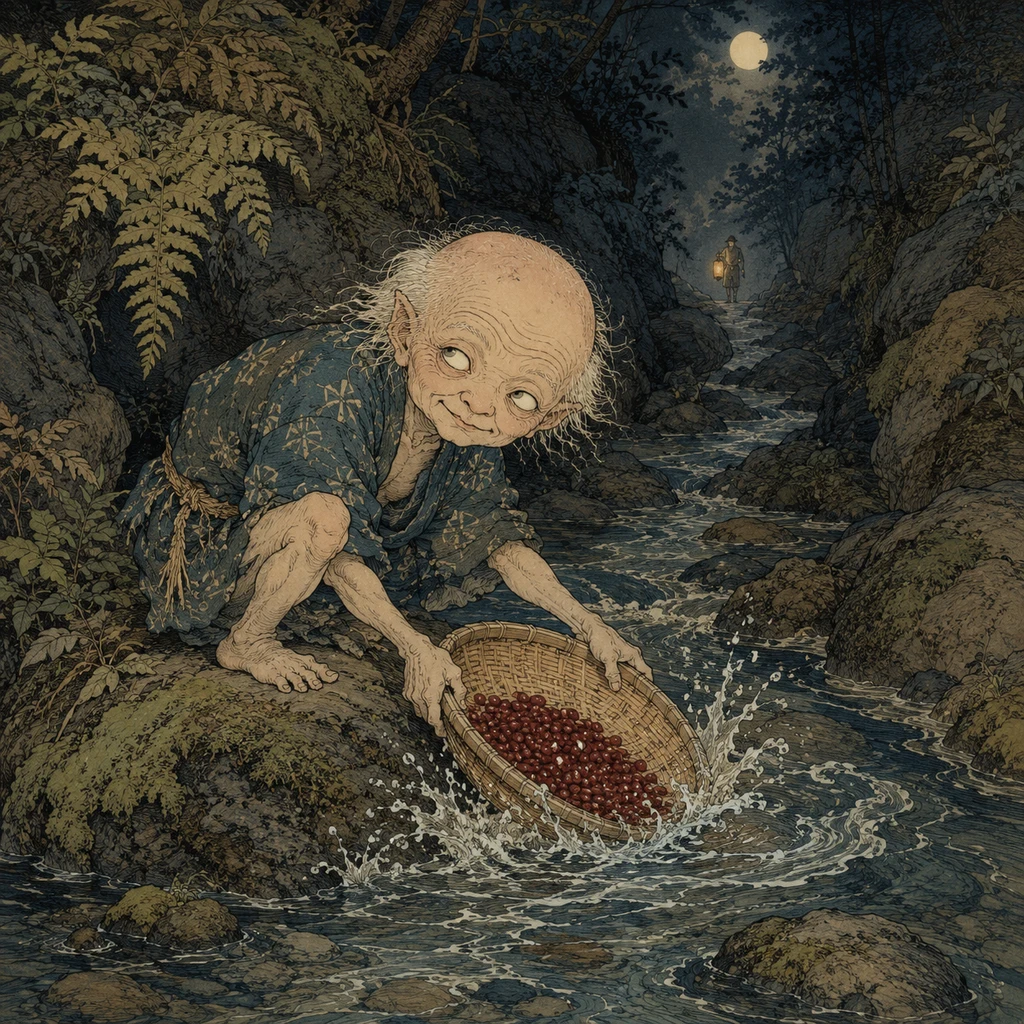
If the Kani-bozu is a monster of 'form and riddle,' the Azuki-arai is an apparition of 'sound only.' It almost never reveals its form. Deep in the night by the riverside or in ravines, only the sound of washing adzuki beans echoes—*shoki-shoki*, *zaku-zaku*, *sara-sara*—this is the Azuki-arai. In landlocked Kai, it was precisely the sounds of the dark mountain streams that frightened people most intimately.
Azuki-arai (Bean Washer)
A yokai that washes red beans at streams late at night, echoing with shoki-shoki or zaku-zaku sounds. It appears near human settlements, blending into the sound of running water. Descriptions vary: a small, wizened elder or, at times, a child. Rather than direct attacks, it deceives with its presence, luring people into slipping. It appears in Edo-period strange tales and picture scrolls, with some accounts noting its habit of counting beans with exactness.
Read moreThe Azuki-arai has indeed been spoken of in Yamanashi Prefecture. Academic databases compiling supernatural and yokai legends contain examples from Yamanashi Prefecture[11], noting that the sound of washing beans going *sara-sara* late at night in rivers flowing through towns is attributed to the Azuki-arai (recorded in 1943). The Azuki-arai of Kai has been remembered more for the texture of this sound than for its visual form. If one approaches, the sound stops abruptly; if one gets distracted by the noise and slips, they will tumble headlong into the deep valley. This monster functioned effectively as a cautionary device to engrave the dangers of the steep mountain ravines into the minds of children. The phrase 'The Azuki-arai will get you' was likely the easiest and most effective threat to stop a child from approaching the river at night. In fact, in lore across the country, it has different names depending on the region, such as Azuki-togi or Azuki-goshagosha, and many are inextricably linked to water-related dangers like 'eating children' or 'pulling people into the river.' This apparition, which halts people in their tracks with only its unseen sound, perfectly suited the topography of Kai, with its countless deep valleys.
In literature, the origin of the Azuki-arai is most famously recounted in *Ehon Hyaku Monogatari* (Picture Book of a Hundred Stories, 1841), Volume 5, 'Azuki-arai'[12]. It tells of a young monk at a mountain temple who was adept at washing adzuki beans; out of jealousy, an evil fellow monk pushed him into a mountain stream (or a well) to his death, and ever since, his spirit makes the sound of washing beans every night. This concept of attributing the source of the sound to the regrets of the living is common across regions. In Hinohara Village, Tokyo, it is told that the sound began after a woman threw herself into the river upon being scolded by her mother-in-law for leaving pebbles in the beans. The valleys of Yamanashi possessed the depth suitable for swallowing such sorrows.
On the other hand, those on the front lines of folk culture have also looked at the true nature of this sound with a cool gaze. Rational interpretations attributing it to the actions of beasts like weasels, foxes, raccoon dogs (tanuki), otters, and badgers (mujina), the croaking of toads, or natural phenomena like the babbling of streams or the rustling of bamboo leaves have been passed down alongside explanations of the supernatural. The ambiguous boundary between the supernatural and nature is the very essence of the Azuki-arai, a monster made solely of sound. Furthermore, there is no surviving drawing of the Azuki-arai by Toriyama Sekien, and the widely known image of a small monk-like figure today was largely determined in the modern era and beyond—especially by the depictions drawn by Shigeru Mizuki accompanied by the onomatopoeia *shoki-shoki*. We must not forget that what the people heard in the valleys of Kai was strictly a formless sound.
The Woman Standing Between the Mountains and Rivers:
Onna-tengu
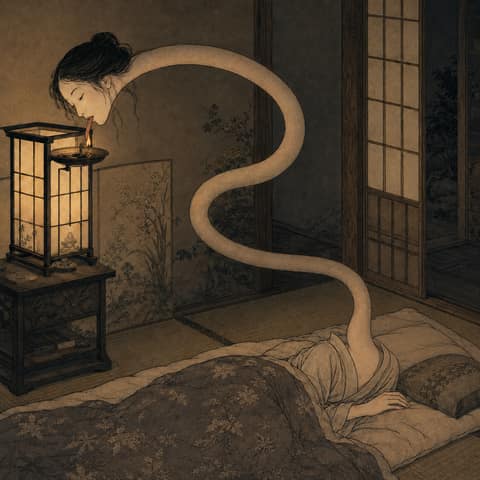
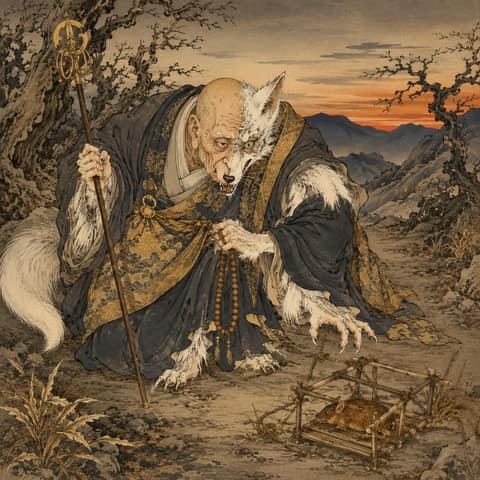
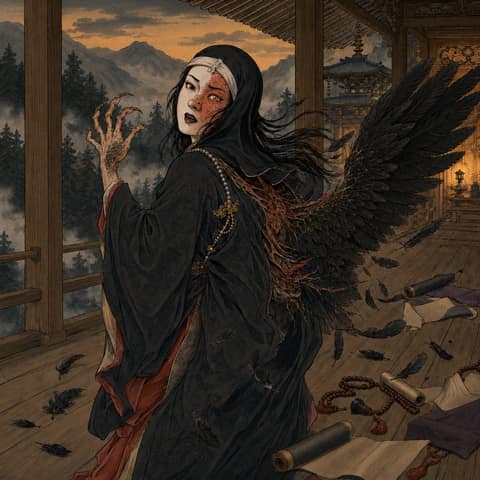
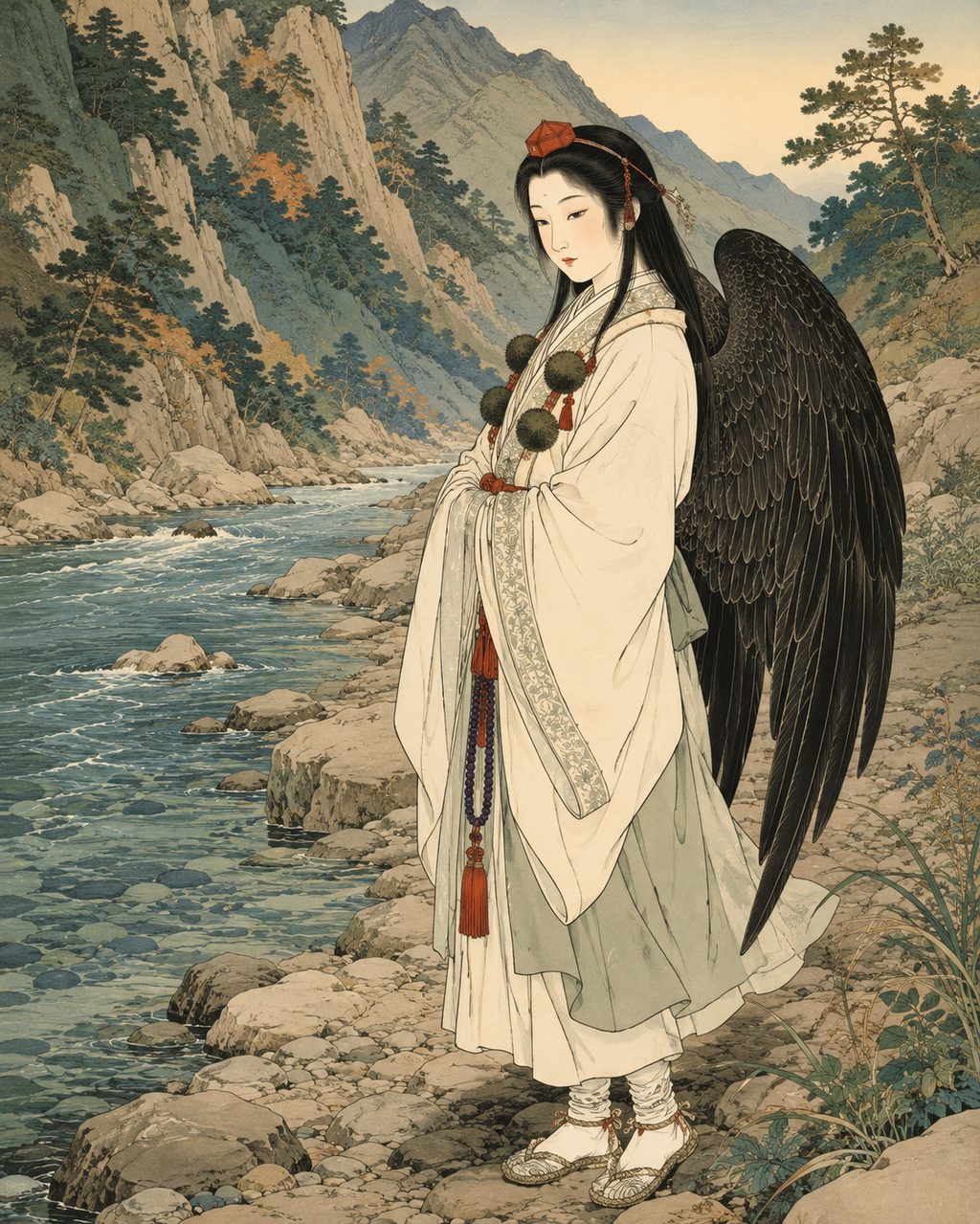
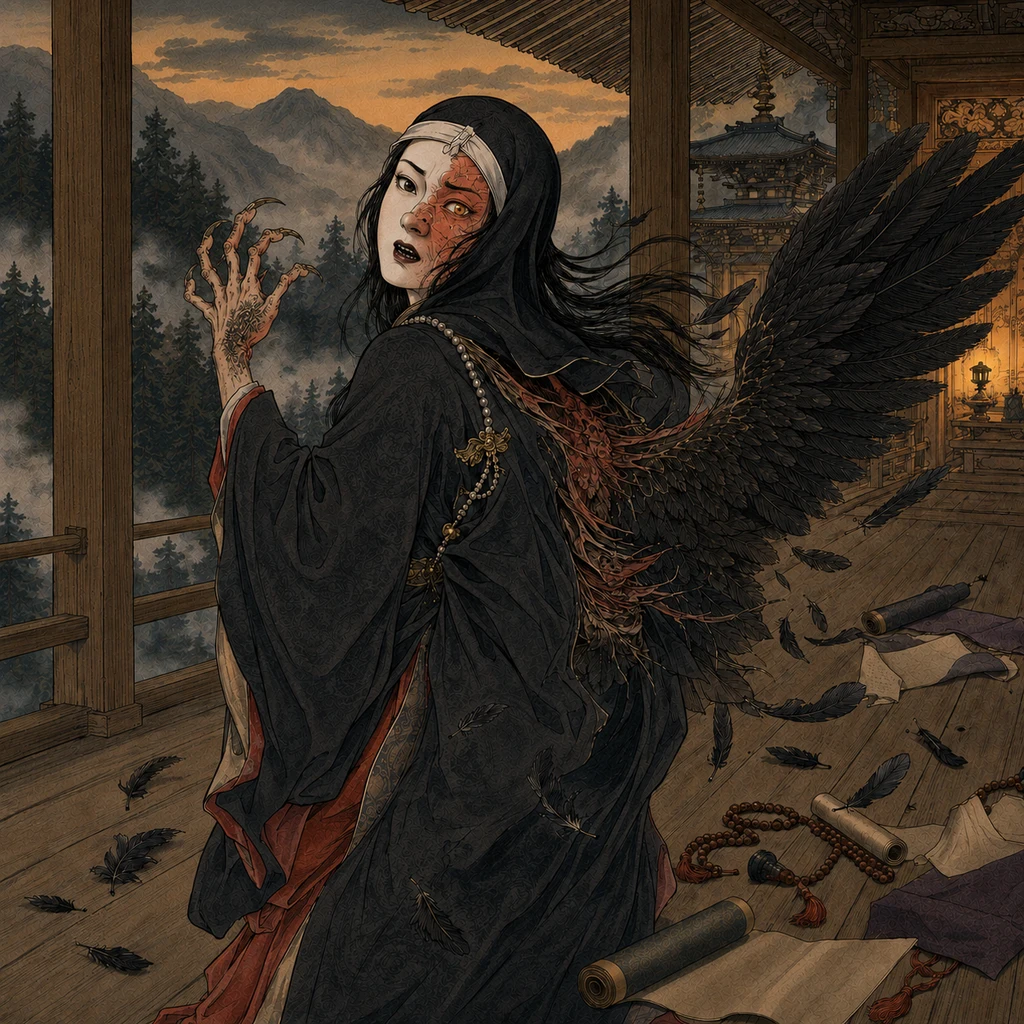
The third is the apparition with the most nebulous outline: the Onna-tengu (female tengu). When one thinks of a tengu, the widely known image is that of a red-faced man with a high nose dressed as a mountain ascetic (yamabushi); however, whether women exist in the tengu world has been inconsistent since ancient times. Kai is one of the regions that passed down tales of this ambiguous entity existing between the mountains and rivers.
Female Tengu
Female Tengu are the female-identified beings among the tengu. They are depicted with long hair, eyebrows darkened with ink, rouge and white powder on the face, teeth blackened with ohaguro, and dressed in scarlet hakama and gauzy robes, sometimes with wings on their back. Classical sources mention nuns who fall and become “nun tengu,” though records differ on whether women exist in the tengu world at all. Some regions describe river tengu with feminine traits, but details remain unclear.
Read moreIn classical literature, there is a description in the *Genpei Seisuiki* (The Tale of the Rise and Fall of the Minamoto and Taira Clans)[13] of an arrogant nun becoming an 'ama-tengu' (nun tengu), who bears wings on her back and wears monastic robes while remaining tonsured. On the other hand, many records from the Edo period state that mountains inhabited by tengu are strictly off-limits to women, meaning female tengu do not exist. When Hirata Atsutane questioned the Tengu-kozo Torakichi (the tengu boy), Torakichi reportedly answered that there were no women on Mount Iwama, Mount Tsukuba, and the like due to the ban on women. The disagreement over whether the Onna-tengu 'exists or not' is the true nature of this apparition—nothing certain can be concluded from historical materials. We must reserve judgment here.
Where the Onna-tengu shows an intriguing face in Kai is its connection with the 'Kawa-tengu' (river tengu). In Nanbu Town, Minamikoma District, Yamanashi Prefecture, the Kawa-tengu is also called the Onna-tengu, and is said to possess a gentler facial structure than a regular tengu[13]. It is not a stern male tengu reigning over the mountain peaks, but rather a presence with somewhat soft features lingering by the riverside—in landlocked Kai, even the tengu descend to the banks of the mountain streams. In Doshi Village, Minamitsuru District, there is a legend of a Kawa-tengu that lives in the river and loves fish; it is said that when someone drowns in a certain river, blue fire emerges from three old Japanese horse chestnut trees nearby, or that it appears calling out 'Child, child' to youngsters fishing in the village's streams. Here we find a variation unique to this region, where the tengu, a monster of the mountains, changes its form into a monster of the water.
Furthermore, there are reports from various regions of local names calling the yamanba (mountain hag) the 'tengu's wife'[13]. This is an idea that unites the yamanba, an old woman monster living in the mountains, and the tengu, who is often described as male, in a marital relationship. The Onna-tengu, Kawa-tengu, and yamanba—these beings melt into one another's outlines, standing between the mountains and the rivers as spiritual entities that are neither definitively male nor female. The deeper the mountains and the steeper the rivers of Kai, the more vividly their presence was likely felt.
Conclusion:
The Mountains Embrace,
The Mountains Reject
When we place these three yokai of Kai side by side, a single composition emerges. The Kani-bozu appears in the darkness of a temple (a human sanctuary), the Azuki-arai leaves its sound in the mountain streams (the boundary between humans and mountains), and the Onna-tengu stands between the mountains and the rivers. All of them exist on the 'boundary line between human settlements and the mountains.' In a landlocked mountain province, the spearhead of fear was always directed toward the mountains, and toward the water flowing down from them. In this land blocked off by Mount Fuji, the Southern Alps, and the Yatsugatake Mountains, where salt and fish could only arrive across mountain passes, the people relied on the mountains while simultaneously fearing them. The mountains embraced their livelihoods while also rejecting them. That duality crystallized into the giant crab in the temple, the sound in the mountain stream, and the female tengu by the riverside.
Takeda Shingen's Kofu, the Mitake faith of Mount Kinpu, and the Fuji-ko at the northern foothills of Mount Fuji—all were endeavors of confronting the mountains. Yokai are the reverse side of this; when faith revered the mountain as a god, there was always an apparition crouching in the darkness of that same mountain. The act of worshipping gods and the act of fearing monsters melt inextricably into one another in the mountains of Kai. The eyes that looked up at Mount Fuji found monsters in the dark valleys, and the hands that built the levees offered prayers to the gods of the river—this was the shape of faith in this landlocked mountain realm. Beyond the three entities discussed here, kappas (water imps) and their kin rule the waters of Kai's mountain streams, beasts that harm villages are passed down in the deep mountains, and named apparitions slumber in each of the steep ravines and deep pools. All of these are flowers of imagination that bloomed on the same topography of a landlocked mountain province. Tracing the yokai of Yamanashi Prefecture is nothing less than tracing how a landlocked people came to terms with the mountains.