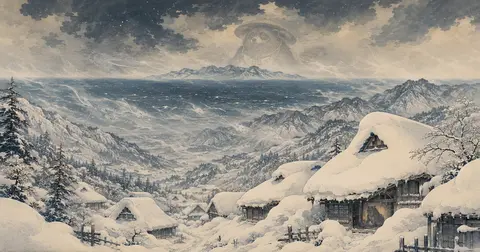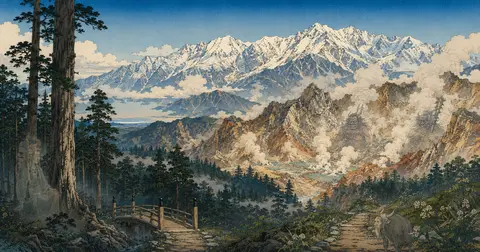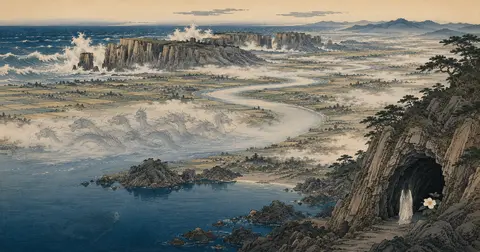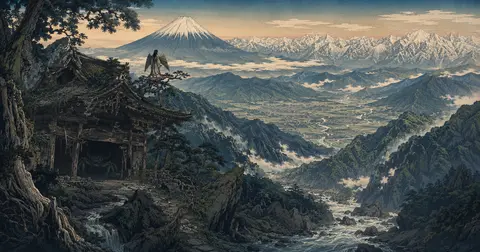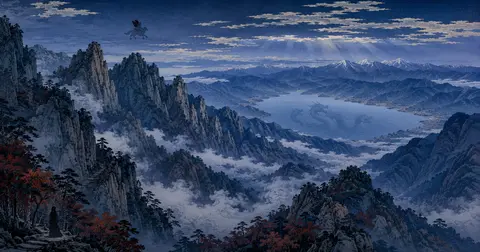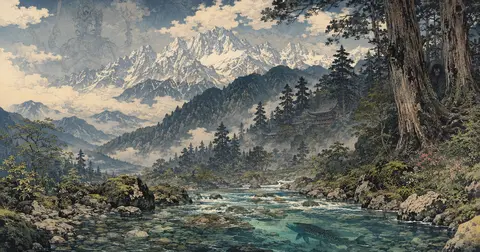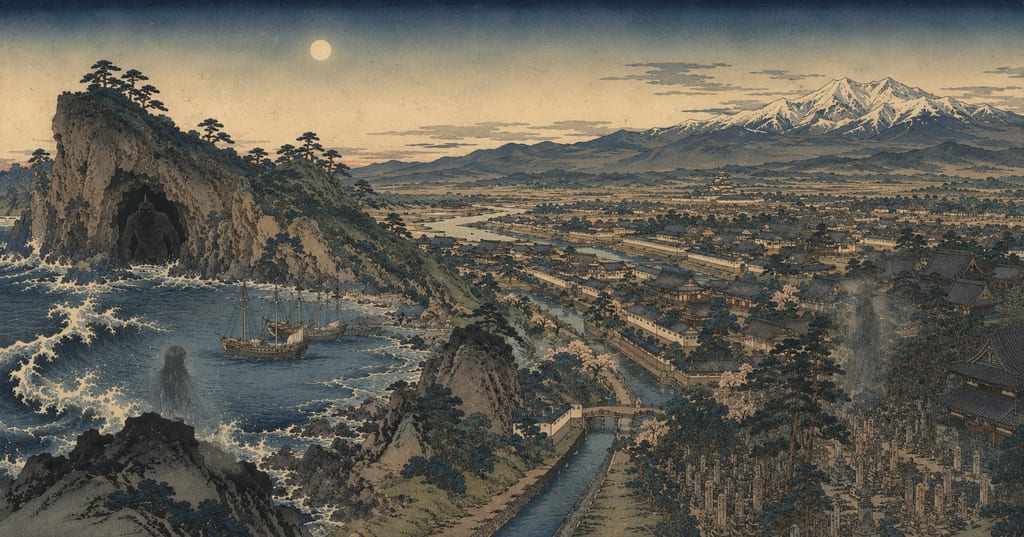
Ishikawa Prefecture consists of two regions with distinct characters: the Noto Peninsula, which juts prominently into the Sea of Japan, and the Kaga Plain, backed by the sacred peak of Mount Hakusan. Noto, stretching northward, is a maritime province of endless capes and inlets, while Kaga to the south is a land of agriculture and commerce, centered around Kanazawa, the castle town of the Maeda clan's million-koku domain. The sea and the mountains, the frontier and the castle town ── this stark contrast is the key to understanding Ishikawa's yokai culture.
Mount Hakusan, towering behind Kaga, is one of Japan's Three Holy Mountains, alongside Mount Fuji and Mount Tateyama, and has been revered since ancient times as a snow-capped mountain of the gods. According to shrine legends, the Shugendo monk Taicho of Echizen climbed and opened Hakusan in the first year of the Yoro era (717), enshrining Hakusan Myori Daigongen at the summit[1]. At the foot of the mountain, Shirayama Hime Shrine[1], the supreme shrine of Kaga Province, prospered as a base for the Zenjo-do pilgrimage routes, known as the "Kaga Baba" alongside the Echizen and Mino babas. The concept of viewing the mountain as a deity and the water flowing from its bosom as sacred is deeply rooted in Ishikawa. Yokai, too, took shape within this magnetic field of beliefs concerning water, mountains, and the sea.
Apparitions stand on the boundaries of human life. In Noto, anomalies were born on the rocky shores that mark the boundary between sea and land, in the ports that divide fishing villages from foreign lands, and in the crematories that separate the living from the dead. In Kaga, apparitions lurked just behind the scenes of daily life, such as in the storehouses of merchants who supported the prosperity of the castle town or in the privies of ordinary homes. This article will decipher four yokai passed down in Ishikawa Prefecture ── Iso-onna, Saru-oni, Kurote, and Sanmai-taro ── through the specific lands and literature to which they are bound.
The Woman of the Sea Who Drifted to the Port of the Kitamaebune ── Kaga Hashidate and Iso-onna
Located in the southwest of Kaga City facing the Sea of Japan, the small settlement of Hashidate was one of the wealthiest villages in early modern Japan. From the mid-18th century, shipowners of the Kitamaebune (northern-bound ships) emerged, numbering 34 shipowners and 8 captains by the eighth year of the Kansei era (1796). They accumulated such wealth that the village was introduced in a Taisho-era magazine as "the wealthiest village in Japan"[2]. A shipowner's estate featured a site of a thousand tsubo, a 30-tatami-mat *oe* (great hall) supported by 8-sun square zelkova pillars, and solid Akita cedar planks used for the massive doors. The Kitamaebune shipowner settlement of Hashidate, well-preserving its early modern land divisions and magnificent houses, was selected as an Important Preservation District for Groups of Traditional Buildings in 2005, and was certified as a Japan Heritage "Ports of Call and Shipowner Settlements of the Kitamaebune"[2] in 2017.
The Kitamaebune were not mere transport vessels, but "buying and shipping" merchant ships that bought goods cheaply in various regions and sold them at a high price. Loading salt, cotton, and sake gathered in Osaka, they traveled through the Seto Inland Sea, rounded Shimonoseki, headed north along the Sea of Japan to reach Ezo (Hokkaido), and returned laden with herring, kelp, and herring meal fertilizer. It is said they could earn a thousand ryo in a single voyage, and the shipowners of Hashidate built their fortunes upon these massive profits. However, the sea routes harbored dangers equal to their wealth. Storms, running aground, going missing ── sailors spent most of the year between unfamiliar ports and rough seas, and that anxiety gave birth to numerous ghost stories of the sea. Iso-onna, too, is an apparition passed down along with the memories of such sailors' journeys.

Iso-onna
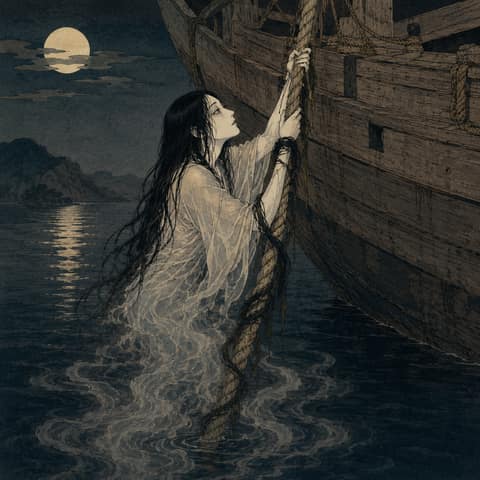
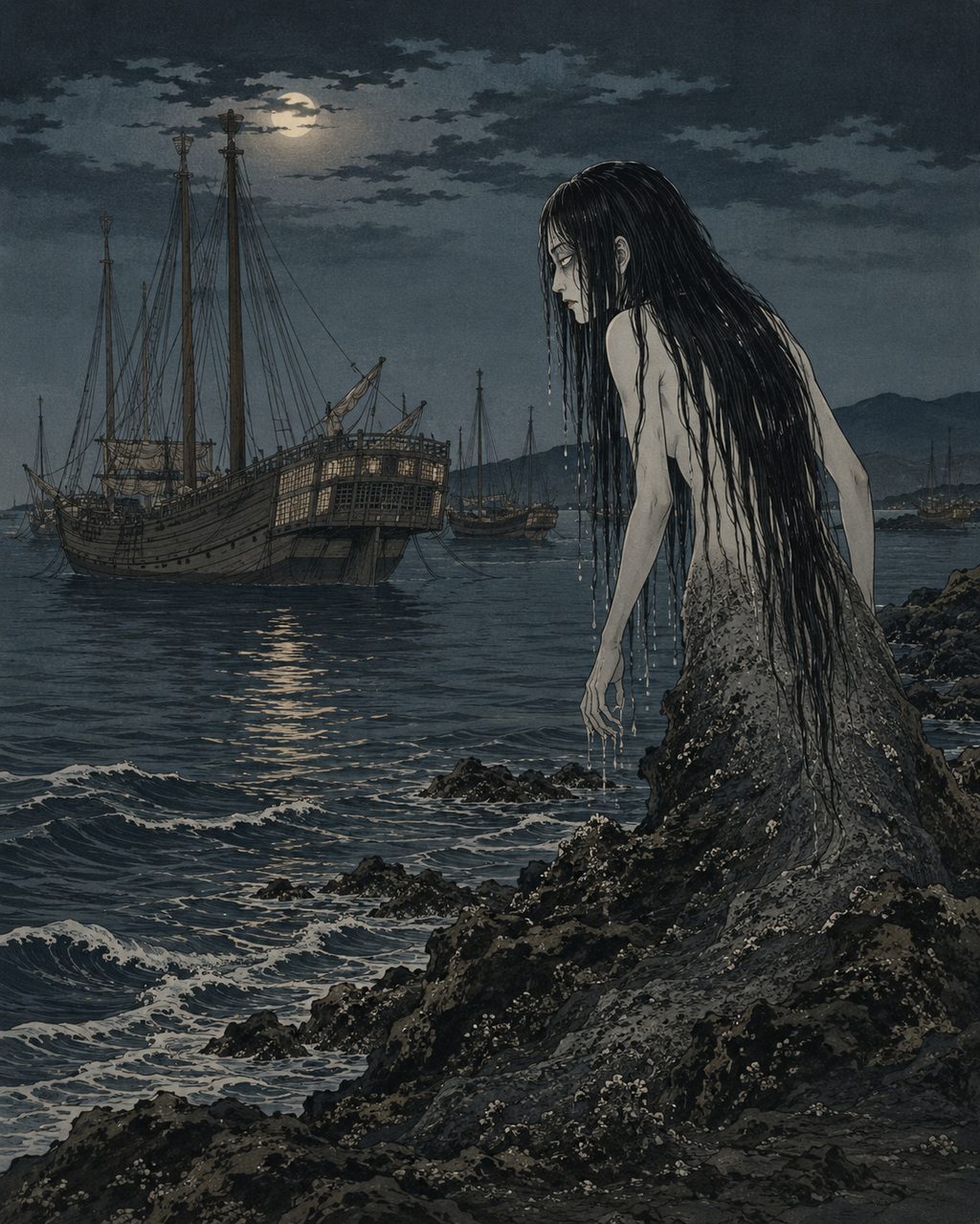
Iso-onna is a female sea apparition found along the northwestern coast of Kyūshū, including Amakusa, Shimabara, Tsushima, and Kakarashima. She approaches beaches, rocky shores, and moored boats, entangling people in her long hair and drinking their blood. Her upper body resembles a beautiful woman, while her lower half is said either to fade from view or to be serpentine; from behind, she may look like nothing more than a wet rock. Names vary by region, including Iso-joshi, Nure-joshi, Ama, and Umi-hime. She appears when the sea is calm and is sometimes linked with the resentful dead of maritime disasters. Some traditions also pair her with Ushi-oni, another dangerous being of the shore.
Read moreIso-onna was originally an apparition spoken of mainly along the northwestern coast of Kyushu ── Amakusa (Kumamoto), Shimabara (Nagasaki), Tsushima, and Kakarashima (Saga)[3]. It is said that she approaches sandy beaches, rocky shores, and anchored boats, entangling people with her long hair to suck their lifeblood. Her upper body resembles a beautiful woman, but her lower half is said to be vague or serpentine, and when viewed from behind, she appears as nothing more than a rock. In Minamishimabara, Nagasaki Prefecture, it is said that if you call out to an Iso-onna staring out to sea, she will let out a shrill scream, entangle you in her hair, and suck your blood. In Amakusa, because she sneaks onto boats at night via the mooring ropes to cover sleeping sailors with her hair and harm them, there was a custom at unfamiliar ports to drop only the anchor without tying a mooring rope[3]. On the Shimabara Peninsula, it is believed she can be warded off by sleeping with three thatch reeds placed on one's clothes.
What is important here is that Iso-onna is an apparition of the boundary, encountered by sailors on their travels at "unfamiliar ports" and "anchorages." It is said that the alternative name for this apparition originating in Kyushu reached as far as Kaga Hashidate in the Hokuriku region, passing through Goto and Tsushima. The Kitamaebune traveled from the Seto Inland Sea around the Sea of Japan, reaching as far north as Ezo. The sailors of Hashidate were travelers who spent most of the year in unfamiliar ports. The tradition that Iso-onna drifted to Hashidate is strongly characterized as the northernmost limit of her alternative name, and it is hard to say that a dense narrative unique to Kaga developed there. Yet, the very fact that a sea monster from Kyushu transmitted its name to a port town near the end of the Sea of Japan shipping route illustrates the vastness of the maritime network connected by the Kitamaebune. Iso-onna may have been an image formed by the travel anxieties of sailors who carried ghost stories along with their merchandise.
Furthermore, unlike monsters that directly attack boats offshore like the Umi-bozu or Funa-yurei, Iso-onna stands on the boundary between land and sea, such as rocky shores and anchorages. In northern Kyushu, there is a theory that Iso-onna is the incarnation of a crab, and in Ojika, she is considered the spirit of a drowned person. The fact that the shadow of this female apparition standing on the boundary between sea and land, the living and the dead, reached even the prosperous port of Hashidate quietly illuminates the world of the Kitamaebune, where the fear of shipwreck always lurked behind prosperity. In port towns where the wives and mothers of sailors prayed daily for the safety of husbands and sons who might not return, the shadow of a woman beckoning from the sea was not merely a fiction, but the very real terror of those who passed through the boundary between life and death year after year.
There are many tales of sea monsters passed down by the sailors of the Sea of Japan, such as the Funa-yurei demanding, "Lend me a ladle," or the Umi-bozu revealing its massive form on stormy nights. Many of these share the commonality of bringing disaster triggered by a perilous interaction between humans and the sea, such as "drawing water and sinking" or "responding to a beckoning hand." Iso-onna, too, causes harm when spoken to or when her hair is touched ── she is a monster that warns against careless interaction with the sea. The sailors of the Kitamaebune learned different maritime taboos at each unfamiliar port and protected themselves by following local customs. The reason the custom of warding off Iso-onna in Kyushu transmitted its name as far as Kaga Hashidate is precisely because there was a network of seafaring people who carried taboos and ghost stories from port to port.
The One-Horned Demon of the Noto Rock Cave ── Saru-oni and Iwaido Shrine
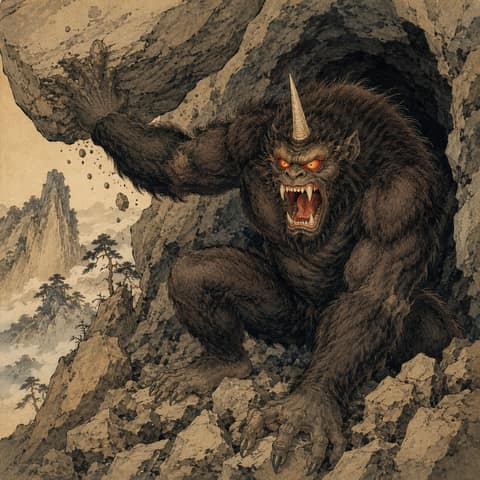
In Yanagida, Noto Town, Hosu District, inland on the Noto Peninsula, the legend of the Saru-oni, a demon with a single horn on its head, still remains strong today.
Saru-oni (Ape Ogre)
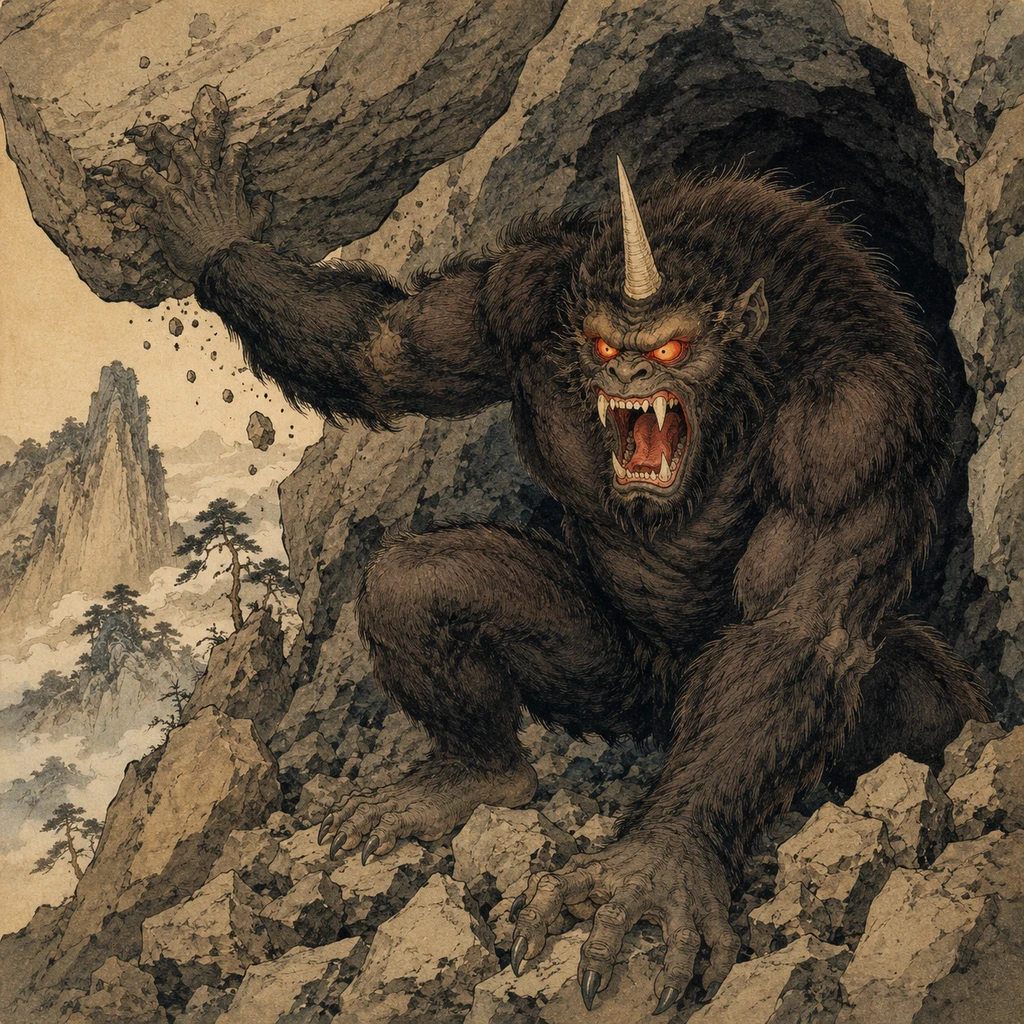
Saru-oni is an ogre from the Noto region that resembles a monkey and bears a single horn on its head. It was said to dwell in a rocky cave behind Iwaido Shrine in Yanagida (now Noto Town) and to trouble nearby villages. The local tutelary deity shot and slew it with an arrow; the spot where the arrow struck its eye became known as Atome, and the stream of its black blood formed the river called Kurokawa. Iyahime Shrine on Notojima preserves a relic said to be the saru-oni’s horn.
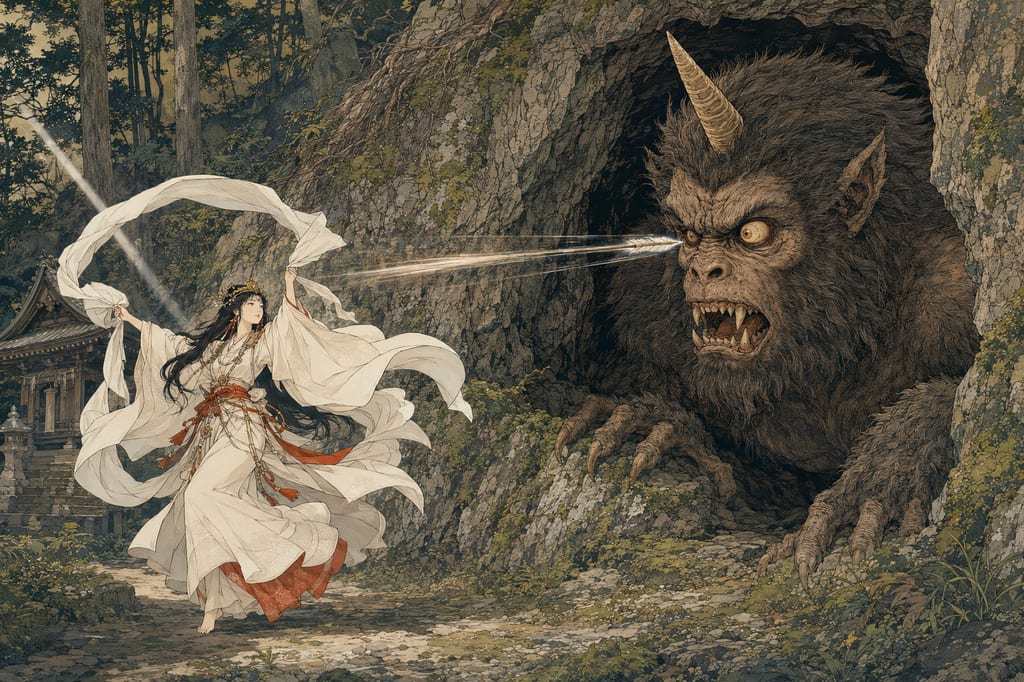
Read moreSaru-oni was a demon with an appearance similar to a monkey and a single horn growing from its head, which made its lair in a rocky cave behind the Iwaido Shrine in Yanagida[4]. Leading 18 demons, it is said to have ravaged surrounding fields, kidnapped young women, and caused harm in human settlements night after night. In response to the pleas of the people who could no longer handle the situation, the gods gathered in Izumo and, after consultation, decided that "the hardships of Noto should be quelled by the gods of Noto." Keta Daimyojin (Keta Taisha) was chosen as the commanding general, and Kamisugihime of the Mitsui Ohata Shrine as the vice-commander.
The subjugation sequence is dramatic. Kamisugihime danced in front of the rocky cave with a white cloth in hand, and when the Saru-oni emerged, mesmerized, it was shot by a hollow arrow loosed by Keta Daimyojin. According to local lore, when the Saru-oni caught the arrow, a poisoned arrow concealed within the hollow shaft flew out and pierced its left eye. Subsequently, Kamisugihime severed its head with the legendary sword "Onikirimaru," and the gods emerged victorious[4].
The true essence of this story lies in the fact that the memories of the battle are etched directly into the place names of Noto. The place where the arrow struck the eye became "Tome" (Targeting the Eye), the place where the Saru-oni treated its wounded eye became "Obako" (Large Box), and the place where the defeated Saru-oni's black blood flowed to form a river became "Kurogawa" (Black River), all tied to toponymic origin myths. The relic said to be the severed horn is still passed down at the Iyahime Shrine in Notojima, Nanao City. And Iwaido Shrine itself was built to console the spirit of the defeated Saru-oni; the cavern where it allegedly hid remains on the shrine grounds, now leaving only a depression-like hole. With four types of "evidence" ── place names, relics, shrines, and caves ── scattered throughout the area, the story continues to live on not merely as a folktale, but as a memory inscribed in the land itself.
While the Saru-oni tale appears to be an independent monster subjugation story in Noto, it actually connects to the broader archetype of "monkey god subjugation." The oldest layer of this can be seen in Volume 26 of the *Konjaku Monogatarishu* (Anthology of Tales from the Past). In the seventh tale, a monkey-shaped god enshrined at Nakayama in Mimasaka Province demands an unmarried young woman as a sacrifice every year, until a hunter from the eastern provinces named Inuyama trains his dogs, hides in a large chest in place of the daughter, and pins down the giant monkey that appears, putting an end to the sacrificial custom[5]. The eighth tale in the same volume features a similar story of subjugating a monkey god in Hida. From the medieval period onward, the subjugator shifted to the dogs themselves, and tales of spirit dogs such as Shippei-taro of Totomi and Haya-taro (Shippu-taro)[6] of Kozenji in Shinano, who hid in the chest in place of the chosen daughter and bit baboons or old monkeys to death, became widely distributed. In the early modern period, a variation emerged where a master swordsman performs the subjugation, and the tale of baboon subjugation where Iwami Jutaro disguised himself as a daughter, hid in the chest, and struck down the baboon that appeared expecting a sacrifice[7] spread nationwide through picture books and storytelling.
Noto tied this nationally distributed archetype to local gods like Keta Daimyojin and Kamisugihime, and to specific places like the rocky cave, Tome, and Kurogawa, rooting the subjugation tale as the origin of place names and shrine foundations. In particular, assigning the commanding role to the enshrined deity of Keta Taisha, the highest-ranking shrine in Noto, indicates that this story served not merely as entertainment, but as an origin myth asserting the authority of Noto's gods. Saru-oni is a brilliant example of localization, where a story from elsewhere has taken deep root in the climate of Noto.
A Hairy Hand Reaching from the Privy ── The Kurote of Noto's Toita Village
The monsters of Noto are not limited to magnificent demons in rocky caves. Apparitions have also reached out from the most private spaces of human dwellings ── the privy (toilet).
Black Hand
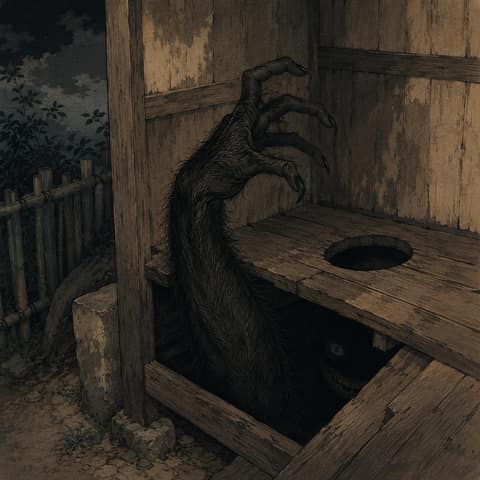
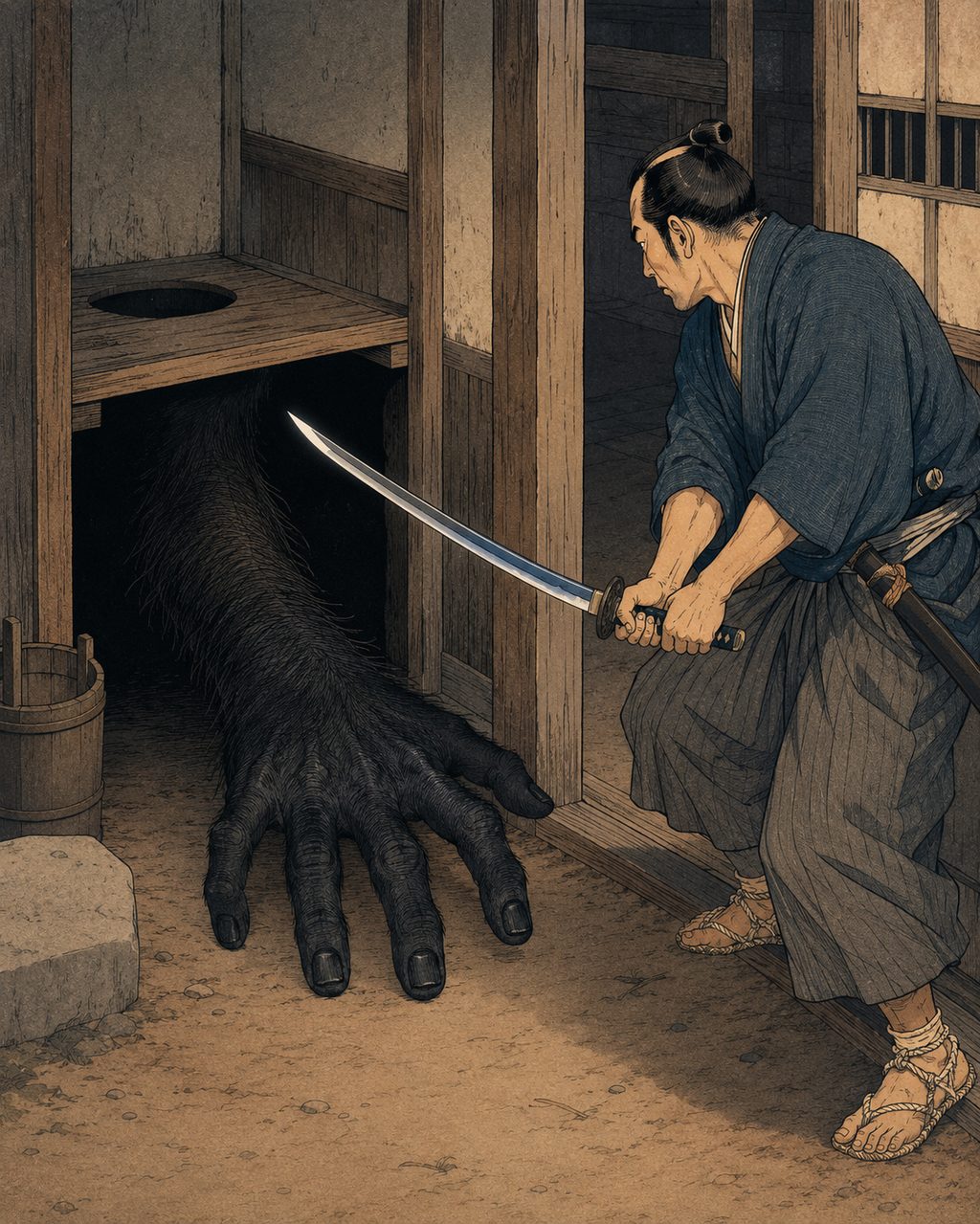
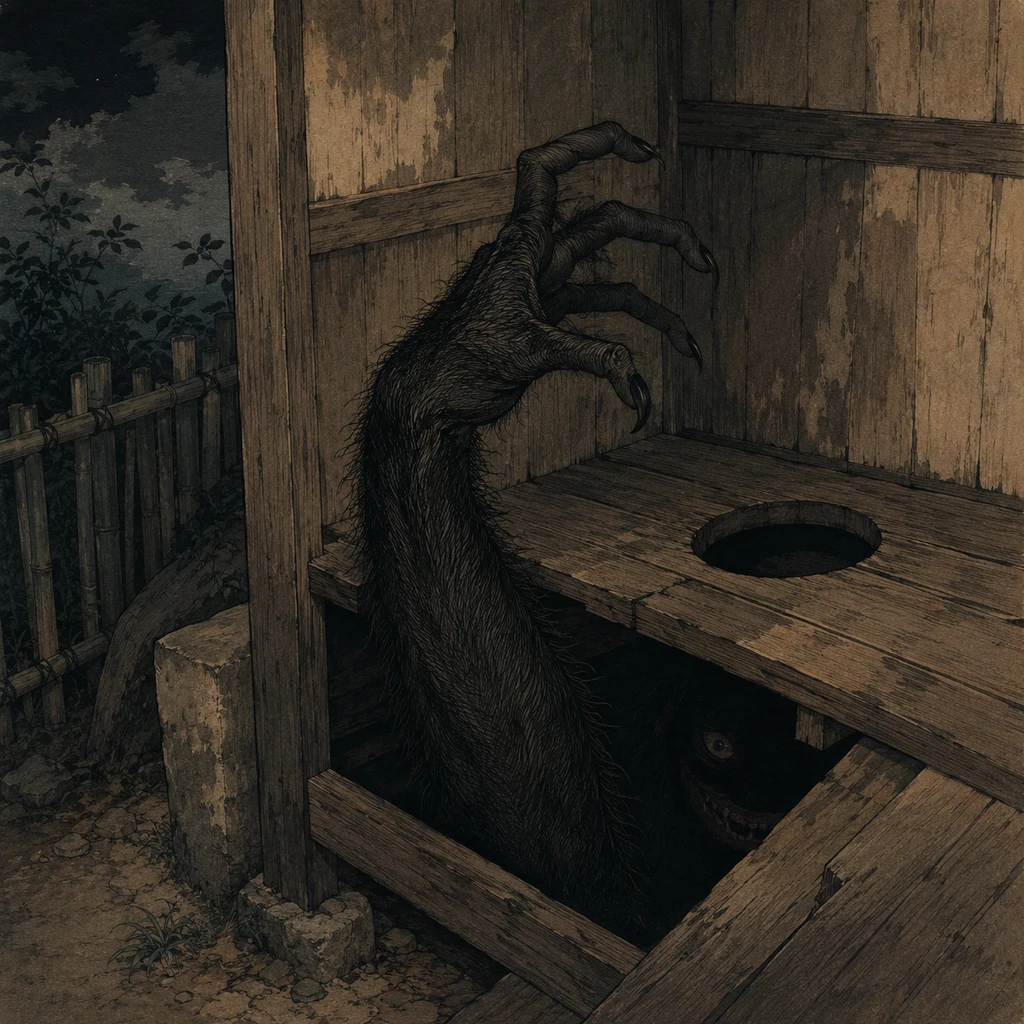
A toilet-dwelling apparition recorded in the Edo-period miscellany Shifugoroku (Four Unspoken Tales). It haunts household privies, extending a shaggy, pitch-black hand to stroke a person’s rear and perform other pranks. In Toita Village of Noto, it is said a villager cut off the black hand with a sword. Days later, a yokai disguised as a monk came to reclaim the severed hand; its true form was an uncanny giant nearly nine shaku tall. An archetypal tale of latrine-bound hauntings.
Read moreThe Kurote (Black Hand) is a toilet apparition recorded in the Edo-period essay *Shijiu-yuroku*, Volume 6, "Cutting the Black Hand"[8]. During the Keicho era, in the house of Kasamatsu Jingobei living in Toita Village, Noto, a bizarre occurrence continued where his wife's buttocks were stroked by something every time she entered the privy. Suspecting it to be the work of a fox or badger, Jingobei entered the privy with his sword drawn. When a hairy black hand appeared, he lopped it off.
A few days later, three monks visited the house and asked for the hand. When Jingobei, unaware of their true identity, showed them the severed hand, one of the monks receiving it said, "This is the Kurote that lives in the privies of human houses." Another monk shouted, "Were you the one who cut my hand?!" and transformed into a bizarre creature nine shaku (about 2.7 meters) tall[8], and all three vanished. Later, Jingobei was covered and lifted up by something on his way home, and when he came to, the very sword he used to cut the Kurote had been snatched away.
The privy is located in a dark area separate from the main building within a house, and since ancient times, it has been a boundary space associated with death, childbirth, and impurity. It is believed that a toilet god (Kawaya-gami) resides in the privy, deeply connected to the customs of the birthing room and funeral rites. Tales of apparitions with hands or stroking monsters lurking in such places exist in various regions, and monsters like Kanbari-nyudo that appear in privies on New Year's Eve are well known. However, what makes the Kurote tale stand out is the causal plotline of returning to reclaim the severed hand. The apparition does not merely inflict harm one-sidedly; it reclaims what was stolen, and even snatches away the sword as evidence before vanishing. The human who was supposed to be the victim is ultimately retaliated against by the apparition and loses even his weapon ── this reversal leaves an eerie lingering echo in the Kurote tale not found in other toilet apparition stories.
The fact that such a detailed ghost story was recorded in a Noto village during the Keicho era, a time when the castle town of the Kaga domain was being developed, shows that the frontier of Noto was by no means a cultural void. Rather, there was certainly a depth of culture in the local society of Noto where people who understood writing could record village incidents as essays.
The Spirits Gathering at the Crematory ── Sanmai-taro and the Flowing Water Ward
The fourth apparition stands at the very boundary between the living and the dead ── the sanmai-ba, or cremation ground.
Sanmai Tarō
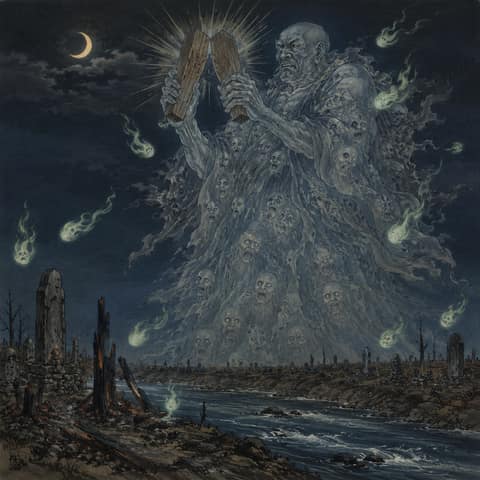
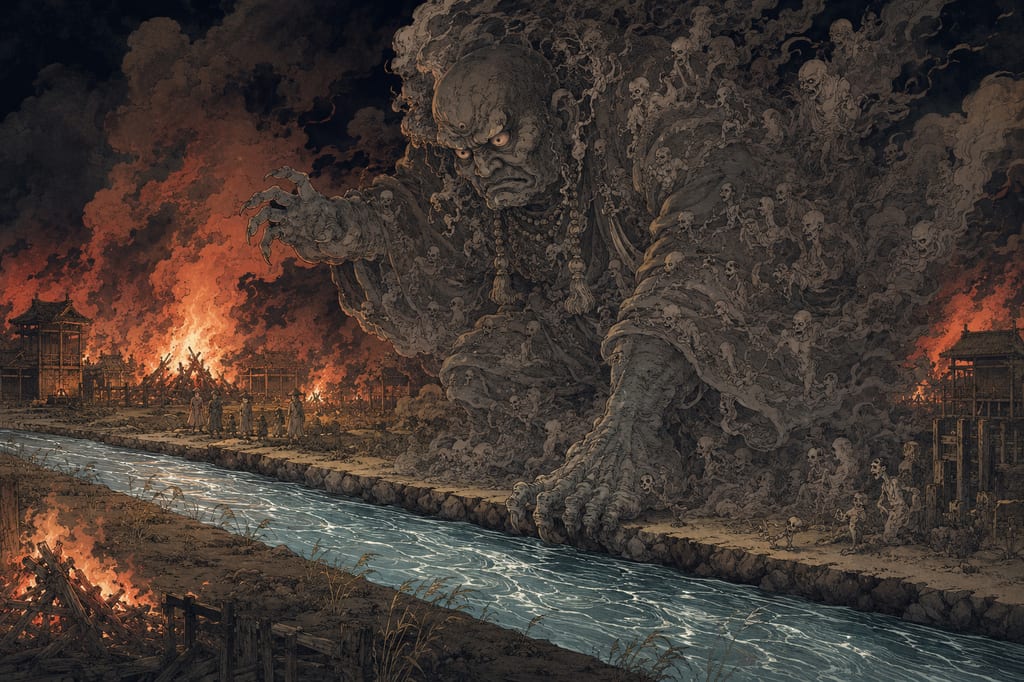
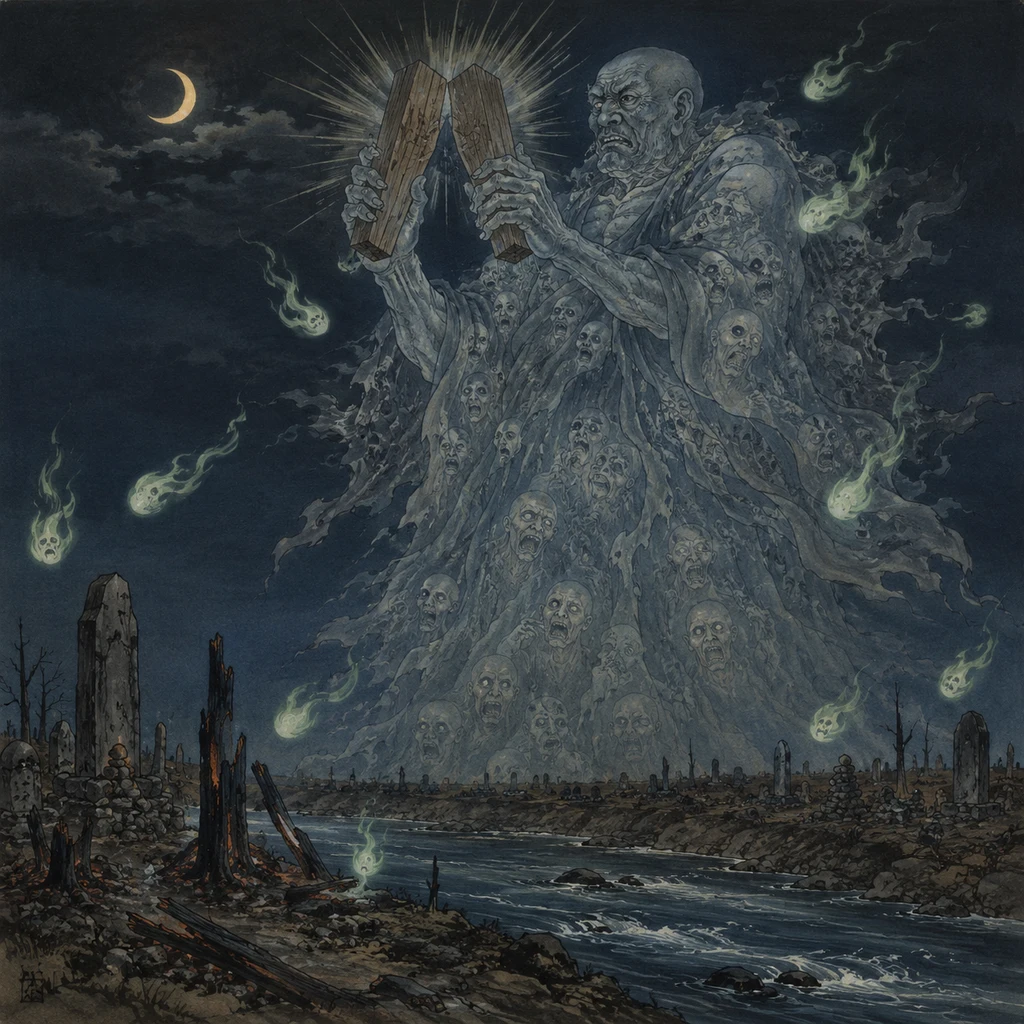
A haunting said to appear at cremation grounds (sanmai-ba) after many corpses are burned. The amassed dead form a humanlike figure; in some regions it appears as a giant nyūdō. It performs ominous acts tied to death—beating clappers at night or driving stakes into the cremation grounds—to frighten people. It reportedly loses power and vanishes when it crosses running water.
Read moreThe "sanmai" in Sanmai-taro is an old word referring to burial or cremation grounds. In the folklore of the Hokuriku region, it was believed that when a large number of corpses were burned at a sanmai-ba, the spirits of the burned dead would gather together to form a human shape, sometimes appearing in the form of a giant *o-nyudo* (large monk)[9]. In neighboring Toyama Prefecture, it is said that when more than a thousand corpses are burned at a sanmai-ba, the spirits of the dead gather, wrestle to terrify onlookers, or cause strange phenomena like striking wooden clappers on the eve of a funeral. In Ishikawa Prefecture, it is said that when a thousand corpses are burned, a terrifying giant nyudo called "Sanmai-taro" emerges from the knots of straw.
What is fascinating is the method of warding it off. In Noto and Etchu, there was a custom of digging a trench around the sanmai-ba to allow flowing water to pass through. Because Sanmai-taro cannot cross currents and vanishes if he crosses water[9], surrounding the crematory with flowing water acted as a barrier against the spirits. The concept that water purifies impurity and separates the realm of death from the realm of life is common in folklore across Japan, but the fact that it was incorporated into the very structure of the crematory reflects the Hokuriku region's view of life and death. Just as with the Sanzu River, water is the boundary dividing life and death, and the dead are not permitted to cross the water back to this shore ── the flowing water trench was a device that mapped this concept onto the physical earth.
Sanmai-taro has a different character from monsters like Kasha that directly snatch corpses. It is not an individual deceased person, but an accumulation of countless dead burned continuously in one place ── an apparition, so to speak, formed by the memories of the crematory taking on a human shape. It should be noted that primary literature corroborating this apparition is scarce, and it does not go beyond the scope of oral tradition in the Hokuriku region from the early modern to modern eras. Although one should avoid drawing absolute conclusions, it is certain that the concept of numbers, "appearing when a thousand bodies are burned," and the specific act of "warding off with flowing water" were passed down for a long time in the villages of Hokuriku. Deep in the mountains, surrounded by the sea, and closed off by snow during the long winters of Hokuriku, death was a close neighbor, and the sanmai-ba of each village was also a place to store the memories of the settlement. Sanmai-taro can be said to be an apparition that gained its outline as those memories swelled.
The Water of the Castle Town and the Salt of Noto ── The Soil of Life that Nurtured Apparitions
Behind the four apparitions lie the distinct ways of life inherent to their respective lands. Looking at the Kaga side, Kanazawa has grown into a major metropolis second only to Edo, Osaka, and Kyoto as the castle town of Kaga Hyakumangoku[10], ruling over Kaga, Noto, and Etchu since Maeda Toshiie entered the castle in the 11th year of the Tensho era (1583). Town development was completed during the generation of the third domain lord, Maeda Toshitsune; scattered temples were consolidated into the Teramachi plateau and Mount Utatsu, creating a unique landscape of continuous temple roof tiles[11]. After the great fire of the 8th year of the Kan-ei era (1631), the Tatsumi Canal was built to draw water from the Sai River for fire prevention, and it continues to moisten the meandering streams of Kenrokuen Garden to this day. Fifty-five canals drawing water from the Sai and Asano rivers flow like a web through the city, supporting life in the castle town.
Dark alleys of temple towns, wells by the canals, storehouses of samurai residences, backstreets of artisan districts ── the castle town, densely packed with people and buildings and crisscrossed by waterways, was fertile soil for the birth of new ghost stories. The very acts of living in a castle town ── fearing fire, drawing water, and gathering temples to mourn the dead ── were adjacent to the awe of the invisible. It is not hard to imagine that apparitions inside the home like Kurote, or apparitions of the place of death like Sanmai-taro, rose from such dense living spaces. The people living in the castle town, while grasping convenience and prosperity, always felt the shadows of fire, water, and death at their feet. The nights of Kanazawa, where temple bells announced the time and canals flowed incessantly, must have harbored a darkness where countless ghost stories were whispered, in stark contrast to its outward glamour.
On the other hand, Noto is a land of livelihood closely tied to the sea. In Ama-machi, Wajima City, the fishing of *ama* (female divers) who free-dive for abalone and turban shells in the waters around Hegurajima and Nanatsujima has been passed down since ancient times, and the "Ama Fishing Techniques of Wajima"[12] was designated an Important Intangible Folk Cultural Property of the country in 2018. For the ama diving into the deep sea with a single lifeline, the sea was a mother providing rich blessings, but at the same time, an abyss that could swallow life with a single mistake. At the tip of the peninsula in Suzu, *agehama* style salt production, said to have continued for about 1,300 years, is practiced. It spread when Maeda Toshitsune, the third lord of the Kaga domain, established a monopoly system and encouraged it in the fourth year of the Kan-ei era (1627). This grueling salt-making technique of drawing seawater, scattering it over the sand of the salt pans, drying it in the sun, and boiling it down was designated as an Important Intangible Folk Cultural Property of the country in 2008 as the "Agehama Style Salt Production Techniques of Noto"[13].
Diving into the sea, boiling salt, living in the fishing villages of the capes ── for the people of Noto who faced the sea daily, the sea was a blessing, but simultaneously an object of awe that could take their lives at any moment. Both Iso-onna standing by the rocky shores and the sea monsters passed down in cape villages took form amidst these ambivalent feelings toward the sea. Looking up to Hakusan as a god in the mountains, and risking their lives to obtain food in the sea ── the fact that the people of Ishikawa have lived in deep connection with water quietly directs the shape of the apparitions in this land. The rough Sea of Japan in winter, mountain villages sinking in snow, cremation grounds enveloped in darkness ── precisely because it is a land where the forces of nature mercilessly shake human life, people found apparitions at the boundaries, named them, and probably made their peace by enshrining them.
Sea,
Rocky Caves,
Privies,
and Crematories ── The Apparitions of Ishikawa Born on the Boundaries
The four apparitions we have looked at so far seem scattered, but they are pierced by a single theme. They are all apparitions standing on "boundaries."
Iso-onna stood at the rocky shore, the boundary between land and sea, and at the unfamiliar port, the boundary between travel and everyday life. Saru-oni invaded the boundary between human settlements and the mountains (rocky caves), was struck down by gods, and became a place name. Kurote reached out from the privy, separated from the main house, the boundary between the inside and outside of the home. Sanmai-taro stood at the crematory, the boundary between the living and the dead, barely sealed away by the barrier of flowing water. The maritime province of Noto, and the castle province of Kaga. These two lands, differing in topography and history, have each found apparitions at the boundaries of their respective lives.
The yokai of Ishikawa Prefecture are not a metropolis of great monsters roaring like thunder. Rather, life-sized apparitions closely attached to the land ── the female monster of the seaside, the horned demon of the rocky cave, the black hand of the privy, the spirit of the crematory ── have been quietly passed down as if to guard their respective boundaries. The sea routes carried by the Kitamaebune, the memories of subjugation etched into place names by the gods, the privy apparitions recorded in essays, the spirits sealed by flowing water ── when read together, the multi-layered nature of the land called Ishikawa Prefecture, backed by Hakusan and spreading from the capes of Noto to the castle town of Kaga Hyakumangoku, emerges. Mountains, sea, and castle towns, faith, livelihood, and death ── in all their boundaries, the apparitions of Ishikawa still quietly stand today.
Related: The old province articles of Noto and Kaga, and the landmark articles of Iwaido Shrine and Kaga Hashidate will be expanded in the future as deep dives closely tied to their respective lands.