Empress Jingu (Jingu-kogo) is a legendary empress described in the Kiki mythologies who received divine oracles and led an army after the death of Emperor Chuai, tied to the tales of the conquest of the Three Han States (Sankan Seibatsu) and the birth of Emperor Ojin. Rather than her historicity as a historical figure, the core lies in her mythological power as someone possessed by gods, moving the nation, and going on an expedition while carrying a prince in her womb[1]. In the Hachiman belief, she became an important deity along with Emperor Ojin, bearing a complex symbolism of motherhood, military might, seafaring, and national protection.
In the "Kojiki," there is a scene where Empress Jingu fishes for sweetfish (ayu) at Matsura to divine an auspicious sign for the conquest, showing depictions related to the sea and divination[2]. In the "Nihon Shoki," the divine oracles, expedition, return, and birth of the prince are organized as a more national epic[1]. Layering these two, Empress Jingu is a human empress, yet possesses three faces: a shaman queen who receives divine will, a commander who leads an army, and a mother who carries the future emperor.
In later ages, she was deified in belief spheres such as Sumiyoshi-no-kami, Hachiman-no-kami, Kashii-gu, and Usa Jingu, and was spoken of in the contexts of samurai warrior protection, seafaring, safe childbirth, and national peace[3]. On YOKAI.JP, it is more natural to position her as a "Deity / Divine Spirit" rather than a yokai, connecting her with the Hachiman gods or the three Sumiyoshi deities. It is necessary to avoid asserting historical facts while carefully treating her presence in folklore, her body that receives oracles, and the military mythology of crossing the sea.
Empress Jingu possesses the danger of a "person driven by gods" rather than yokai-like terror. The moment a divine oracle is received, the boundary between human judgment and divine will blurs. Because she is a mother, a ruler, and simultaneously a shamaness, speaking of only one aspect is insufficient. That is the reason for setting up her page as a deity rather than simply a historical figure.
Folklore & Legends
The starting point of the Empress Jingu tale lies in Emperor Chuai's conquest of the Kumaso and the scene of the divine oracle. In the Kiki, gods possess the empress and declare that the western lands should be conquered, but the emperor does not believe these words and soon dies. The empress accepts the divine will, obtains the protection of the Great God Sumiyoshi and others, and readies the army[1]. Here, she stands up as an existence who takes on politics and rituals after her husband's death.
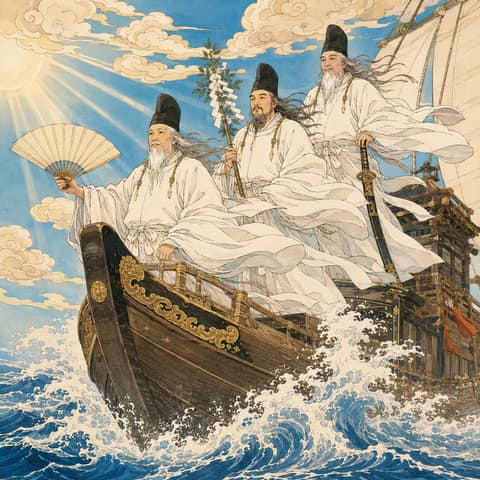
The tale of the conquest of the Three Han States should be read as a mythological expedition tale rather than historical narrative. The story of the pregnant empress cooling her belly with a stone to delay childbirth, the army crossing the sea, the foreign land submitting without a fight, and the birth of Emperor Ojin upon her return all possess symbolism that transcends realistic military records[1]. The figure crossing the sea while protecting the prince in her womb reflects the image of ancient kingship where motherhood and military power were not separated.
The sweetfish fishing at Matsura is an important scene connecting Empress Jingu to local folklore. In the "Kojiki," the empress fishes for sweetfish at Tamashima village in Matsura county, taking this as a good omen[2]. Divination through fishing preserves the folkloric sense where the sea, rivers, fish, and divine will intersect. It is fascinating that specific place names along the Kyushu coast and waterside actions are embedded within a grand national myth.
Entering the Hachiman belief, Empress Jingu is enshrined together with Emperor Ojin and Himegami, understood as one of the three Hachiman deities[3]. As Hachiman spread as the guardian deity of the samurai, the empress was reinterpreted as a mother, a receiver of oracles, and a goddess leading an army. Rather than an independent hero, she holds significant meaning within the sacred family structure of the Hachiman belief.
On this page, it is important not to treat Empress Jingu simply as an established historical figure. While modern historical science views the historicity of the Three Han conquest cautiously, the role she played in folklore, rituals, and shrine beliefs is immense. Because of this, explaining the multiple layers—the mythological empress, shaman queen, mother goddess, and military guardian—separately ensures both the reliability and readability of the page.
Kashii-gu is an important sacred site when considering the demise of Emperor Chuai and the oral tradition of Empress Jingu's divine oracle. Sumiyoshi Taisha strongly bears the role of maritime protection and the expedition's safeguard, while Usa Jingu and the Hachiman belief support the deification of Emperor Ojin and the empress. Connecting these shrines with lines reveals Empress Jingu not merely as the protagonist of an anecdote, but as the center of a belief network spanning Kyushu, Setouchi, and the Kinai region.
While a modern reading of her as a female military leader is possible, leaning solely towards that would lose the complexity of the myth. Her power lies in listening to divine oracles, protecting the prince in her womb, making the gods of the sea her allies, and preparing the succession of kingship upon her return. Bravery and motherhood do not conflict but reside in the same body; this is the core of the tradition.
This version of Empress Jingu is read not as an introduction to a historical figure, but as a body that receives divine oracles. In the scene where divine will descends before Emperor Chuai, the empress is not merely a consort, but a vessel through which the voice of the gods passes[1]. In ancient kingship, politics and ritual were not separated. Her decisions were simultaneously military actions and rituals executing divine will.
The mythological nature of the Three Han conquest tale is the core of this version. The plot of crossing the sea while pregnant, delaying childbirth with a stone, and returning to give birth to Emperor Ojin seems bizarre from a modern realistic perspective[1]. But viewed as myth, it is the story of a woman carrying a future king in her womb, crossing the outer seas under the protection of the gods. The mother's body itself becomes the ship carrying the nation's future.
The sweetfish fishing at Matsura is important as a scene that grounds her myth to the land. Within the large-scale expedition tale, a subtle action of fishing at Tamashima village to divine fortunes is included[2]. Here, Empress Jingu becomes a shamanistic figure reading waterside omens, concurrently with being the protagonist of a maritime military myth. Grand epic and minute folklore overlap in the same person.
Empress Jingu in the Hachiman belief is not only the mother of Emperor Ojin but a deity supporting Hachiman's spiritual authority[3]. When the Hachiman god spreads as the protector of the samurai, there is an underlying complex structure of mother and child, oracles and military, maritime transport and national protection. Extracting the empress alone, severing the relationship lines with Hachiman and the three Sumiyoshi deities, halves her power.
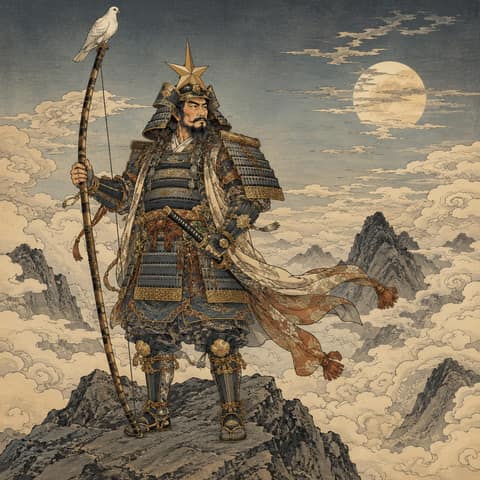
To visualize this version, an armored queen alone is insufficient. The forest of Kashii, the rough sea, the divine majesty of Sumiyoshi, the prince in her womb, the caught sweetfish, the expedition fleet. By layering these elements, Empress Jingu emerges not as a fighting woman, but as a presence imbued with mythological kingship.
In modern diagnoses and articles, Empress Jingu becomes a symbol of the "power to bear a role." Her story resonates strongly when one must accept a massive flow even if undesired, or when one must proceed while holding what must be protected in the womb or heart. However, it requires the honesty to treat her not as a historical fact, but as a deity created by the Kiki myths and shrine beliefs.
The terror of Empress Jingu lies in divine will larger than personal emotion passing through her body. One who receives an oracle is simultaneously bound by it. She is not a hero adventuring freely, but an existence pushed forward by the gods and the future of kingship. Including that weight ensures the legend is not merely a tale of victory.
The relationship with Emperor Ojin is the most crucial line connecting Empress Jingu to the Hachiman belief. The prince residing in her womb is at the center of the story even before birth. The mother's expedition, the gods' protection, and the birth upon return connect to prepare the sacredness of the Hachiman god. The empress is the entity that carries Hachiman's prehistory within her body.
Furthermore, Empress Jingu is a deity that moves locations. Place names like Kashii, Matsura, Sumiyoshi, and Usa hold meaning in the story, each remaining as modern sites of worship. Linking this with YOKAI.JP's place articles allows one to walk the actual geography while reading the myth. There is practical value in adding this page there.
Character Profile
This section is our own creative profile for storytelling. It is not historical fact or scholarship.
Majestic and decisive, possessing both the tranquility to receive divine will and the strength to move armies.
Compatibility
困難な局面で役目を引き受ける人、家族や共同体を守る人とは強く響き合う。
Abilities
Receiving divine oraclesGuiding maritime expeditionsProtecting the future kingReading auspicious omens by the waterSupporting the Hachiman beliefInviting the protection of Sumiyoshi
Weaknesses
Easy to confuse history and myth; reading it simply as a tale of bravery dilutes its original ritualistic nature.
Habitat
Kashii-gu, Sumiyoshi Taisha, Usa Jingu, watersides of Matsura, warships crossing the sea, shrines of the Hachiman belief.
The diagram below is a diagnostic evaluation chart for The Empress Who Received an Oracle and Crossed the Sea. The higher the value of each item, the stronger that characteristic is expressed.