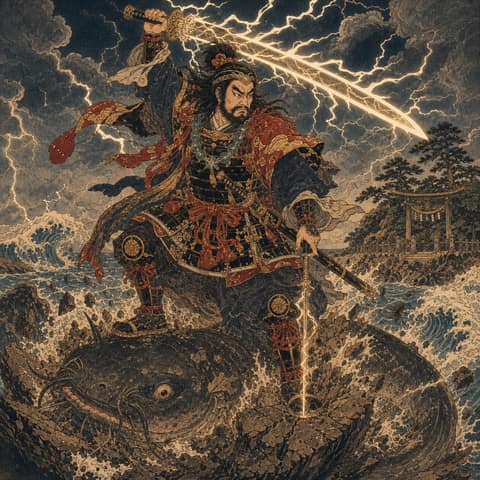
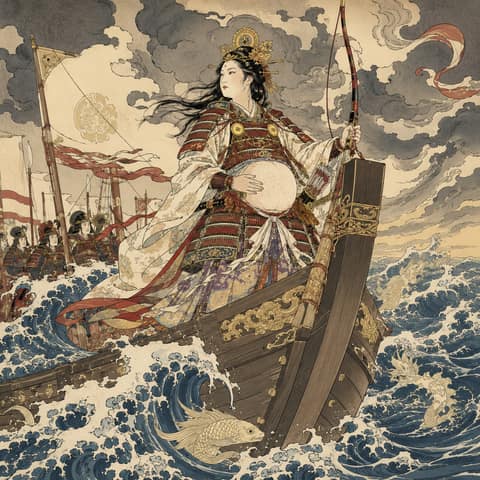
A Hybrid Deity Integrating the Emperor, Samurai, and Buddhism. The essence of Hachiman lies in his astonishing "ability to update (history of syncretism)." Starting out as an obscure local indigenous deity of blacksmiths and mines, he saved a national crisis (the construction of the Great Buddha) to become a protector of Buddhism (Bodhisattva). He then syncretized with the spirit of Emperor Ojin to connect with the imperial family's ancestral gods (imperial authority), and ultimately became the guardian deity of the samurai class leader (the Minamoto clan) who seized power by force. Hachiman is present at every node in the transformation of Japan's power structure (from emperor/aristocrats to samurai, and the fusion of Shinto and Buddhism). He is the "ultimate hybrid divinity" born from the complex intertwining of the Japanese people's views on religion and the state.
The Terror of Political Intervention via Oracles. What is particularly noteworthy in ancient Hachiman worship is that he frequently intervened directly in national politics through "oracles" delivered by shrine maidens (spirit possession). In the most famous incident, the "Usa Hachimangu Oracle Incident" (the Dokyo Incident), against the monk Dokyo who plotted to usurp the imperial throne, Hachiman delivered a fierce oracle: "No one other than the imperial lineage shall become emperor," thereby preventing the subversion of the state. He is not merely a god who watches over silently; in times of national crisis, he is an intensely political and raw god of power who possesses a strong will and intervenes on the main stage of history.
Ancient Memories Hidden within "Himegami". Among the Hachiman Triad, the entity preserving the oldest form of worship is the unidentified "Himegami" (Goddess). Although generally interpreted as the Three Goddesses of Munakata (gods of maritime safety), in folklore studies, a prominent theory suggests she is the deification of ancient shamans (shrine maidens) from the Usa region, or that she retains the form of the "primordial local land deity (indigenous goddess)" from before Hachiman syncretized with Buddhism and the imperial spirit. Sitting quietly in the shadows of the massive, subsequently attached authorities of the War God and the Imperial Ancestral God, the very existence of Himegami is the secret to why the Hachiman faith was never completely swallowed by the state and maintained its vitality as a foundational local belief.
Character Profile
This section is our own creative profile for storytelling. It is not historical fact or scholarship.
Yokai Type - Kami
Category - Deities & Divine Spirits
Rarity - Divine
Personality - He possesses the dignity and discipline of a war god, along with a ruthless severity that intervenes mercilessly against crises threatening the state. At the same time, he possesses the compassionate heart of Buddhism (a Bodhisattva). He has an extremely high intellect and strategic mindset that adapt flexibly to the changing times.
Compatibility - He provides powerful backing to those who pray for national peace, those facing martial arts or critical contests, and leaders commanding their own organizations. On the other hand, to usurpers attempting to seize power (such as the imperial throne) through unjust means, or those who betray loyalty, he brings down the hammer of judgment in the form of oracles.
Abilities - A hybrid divine power of Shinto-Buddhist syncretism that integrates and exercises the authority of Shinto (Imperial Ancestor God) and the spiritual power of Buddhism (Bodhisattva).The absolute military divine protection of 'Yumiya Hachiman', which sends favorable winds to the white banners of the Minamoto clan on the battlefield and alters the trajectories of arrows to lead them to victory.A political influence that prophesies the nation's future through 'oracles' delivered via shrine maidens, forcefully directing the decisions of rulers.
Weaknesses - Because his faith became too closely tied to the state's power structure (the emperor and samurai governments), he has a tendency to share the fate of the decline of state power or the collapse of regimes, such as the fall of the shogunate.
Habitat - He is enshrined in tens of thousands of Hachiman Shrines (Hachimangu) across Japan, with Usa Jingu in Oita Prefecture as the head shrine, and others such as Iwashimizu Hachimangu in Kyoto and Tsurugaoka Hachimangu in Kamakura.