Jingu-kogo
jingu-kogo
The Empress Who Received an Oracle and Crossed the Sea
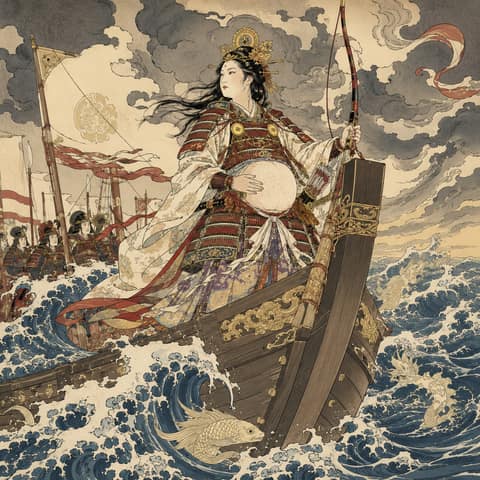
This version of Empress Jingu is read not as an introduction to a historical figure, but as a body that receives divine oracles. In the scene where divine will descends before Emperor Chuai, the empress is not merely a consort, but a vessel through which the voice of the gods passes. In ancient kingship, politics and ritual were not separated. Her decisions were simultaneously military actions and rituals executing divine will. The mythological nature of the Three Han conquest tale is the core of this version. The plot of crossing the sea while pregnant, delaying childbirth with a stone, and returning to give birth to Emperor Ojin seems bizarre from a modern realistic perspective. But viewed as myth, it is the story of a woman carrying a future king in her womb, crossing the outer seas under the protection of the gods. The mother's body itself becomes the ship carrying the nation's future. The sweetfish fishing at Matsura is important as a scene that grounds her myth to the land. Within the large-scale expedition tale, a subtle action of fishing at Tamashima village to divine fortunes is included. Here, Empress Jingu becomes a shamanistic figure reading waterside omens, concurrently with being the protagonist of a maritime military myth. Grand epic and minute folklore overlap in the same person. Empress Jingu in the Hachiman belief is not only the mother of Emperor Ojin but a deity supporting Hachiman's spiritual authority. When the Hachiman god spreads as the protector of the samurai, there is an underlying complex structure of mother and child, oracles and military, maritime transport and national protection. Extracting the empress alone, severing the relationship lines with Hachiman and the three Sumiyoshi deities, halves her power. To visualize this version, an armored queen alone is insufficient. The forest of Kashii, the rough sea, the divine majesty of Sumiyoshi, the prince in her womb, the caught sweetfish, the expedition fleet. By layering these elements, Empress Jingu emerges not as a fighting woman, but as a presence imbued with mythological kingship. In modern diagnoses and articles, Empress Jingu becomes a symbol of the "power to bear a role." Her story resonates strongly when one must accept a massive flow even if undesired, or when one must proceed while holding what must be protected in the womb or heart. However, it requires the honesty to treat her not as a historical fact, but as a deity created by the Kiki myths and shrine beliefs. The terror of Empress Jingu lies in divine will larger than personal emotion passing through her body. One who receives an oracle is simultaneously bound by it. She is not a hero adventuring freely, but an existence pushed forward by the gods and the future of kingship. Including that weight ensures the legend is not merely a tale of victory. The relationship with Emperor Ojin is the most crucial line connecting Empress Jingu to the Hachiman belief. The prince residing in her womb is at the center of the story even before birth. The mother's expedition, the gods' protection, and the birth upon return connect to prepare the sacredness of the Hachiman god. The empress is the entity that carries Hachiman's prehistory within her body. Furthermore, Empress Jingu is a deity that moves locations. Place names like Kashii, Matsura, Sumiyoshi, and Usa hold meaning in the story, each remaining as modern sites of worship. Linking this with YOKAI.JP's place articles allows one to walk the actual geography while reading the myth. There is practical value in adding this page there.