Yokai Encyclopedia

Encyclopedia of Japanese Yokai

85 Yokai|14 Category|Page 1 of 4
Localization in Progress - More content available in Japanese version
View Japanese
Sort by: NameAscending
神霊・神格
  • Aburahi-daimyojin

    Aburahi-daimyojin

    Divine

    あぶらひだいみょうじん

    The Tutelary Deity of Koka Descending with Fiery Light upon Mount Aburahi

    Divine Spirits / DeitiesShiga

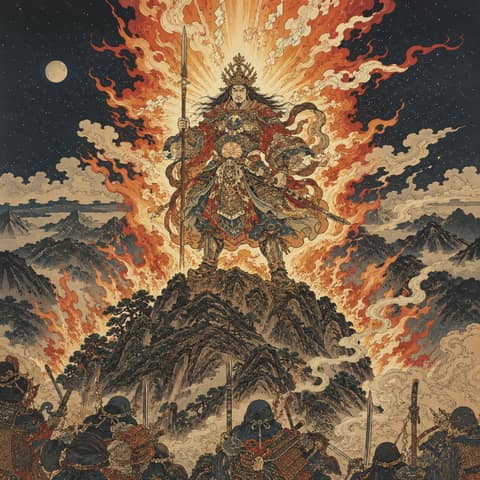
    Aburahi-daimyojin is a deity unique to Koka, intertwining nature spirits, Buddhism, and samurai worship. Its origins lie in ancient mountain worship directed at Mount Aburahi, a sacred peak whose summit shrine still venerates the water goddess Mitsuhanome-no-kami, preserving an older layer of belief. Overlaid onto this is the legend of the descent: "A god descended with a light like burning oil," which is told as the origin of the shrine's name. Furthermore, a Muromachi-period history connected the shrine's founding to Prince Shotoku (with Nyoirin Kannon as its original Buddhist manifestation, or *honji-butsu*), and in the Middle Ages, it evolved into the "Sosha of Koka," revered as a war god by the Koka samurai. Its mention in the oaths of the *Watanabe Family Documents* indicates that Aburahi-daimyojin was the deity before whom the shinobi of Koka swore their vows. Its multifaceted nature—encompassing fiery light, a sacred mountain, martial divinity, and the protection of fire and oil—mirrors the spiritual history of Koka, a land where espionage, fire arts, and Shugendo mountain asceticism intersected.

  • Akagi Daimyojin

    Akagi Daimyojin

    Divine

    Akagi Daimyojin

    Akagi Daimyojin, the Deity Ruling Mount Akagi

    Deity / Divine SpiritGunmaTochigi

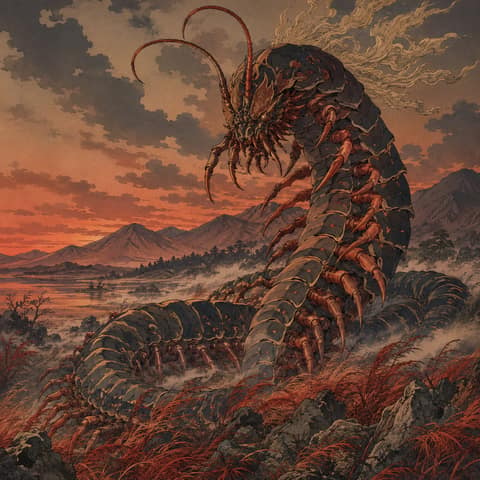
    Akagi Daimyojin is the deified embodiment of the entirety of Mount Akagi, which towers over the northern edge of the Kanto Plain. Rather than a singular anthropomorphic god, it strongly exhibits the nature of a "deity of place" that governs the mountains, swamps, forests, and springs. Consequently, it has been depicted in multifaceted ways over time—associated with Toyoki-irihiko-no-mikoto, Oanamuchi-no-mikoto, or even the goddess Akagi-hime. Its transformation into a giant centipede (or serpent) in the Battle of the Gods represents its fierce, combative aspect, forming a stark contrast to its gentle demeanor as a deity of agriculture and water during times of peace. The fact that real geographical locations like Senjogahara, Akanuma, and Oigami are all narrated as remnants of this divine battle suggests how deeply these legends are rooted in the local landscape. The cycle of tales featuring the Nikko deity as an adversary is essentially a mythologization of the border disputes between the former provinces of Kozuke and Shimotsuke. The variations in avatars and outcomes (whether Akagi is the centipede or the serpent, the victor or the vanquished) are direct reflections of the regional pride embedded in each area.

  • Akamata Kuromata

    Akamata Kuromata

    Legendary

    Akamata Kuromata

    Akamata Kuromata, the Secret Deities of the Subterranean Otherworld

    Deity / Divine SpiritOkinawa

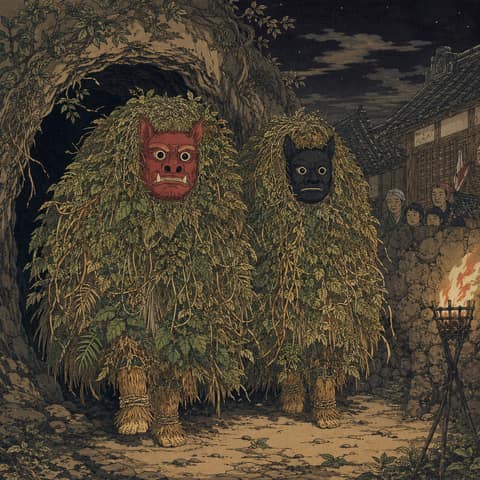
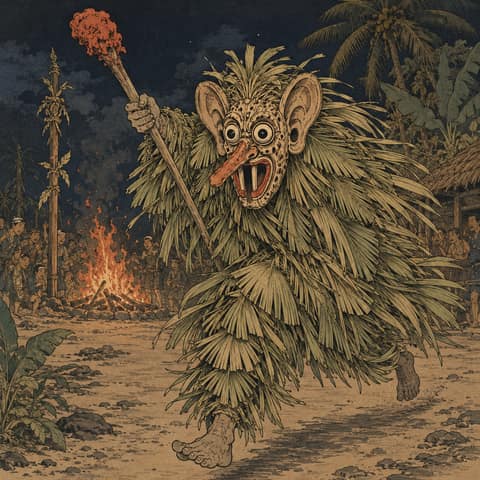
    This is a visiting deity clad in a stout, dumpling-like body wrapped in layers of vines, wearing a red or black mask. It is said that only once a year does it reveal itself from a bottomless subterranean cavern known as Niroo—an otherworld beyond the sea—to bestow bountiful harvests and fruitful yields upon the village. No one but the permitted local residents of the district may lay eyes on its form or hear its voice, and no photographs or spoken words of the ritual may ever leak to the outside world. It is an entirely different entity from the snake yokai Akamata, who shapeshifts into a handsome man to visit maidens. It is precisely by remaining unseen that its divine majesty is preserved, standing as the master of this silent, secretive festival.

  • Amamikiyo

    Amamikiyo

    Divine

    あまみきよ

    Amamikiyo, the Creation Deity of Ryukyu

    Deity / Divine SpiritOkinawa

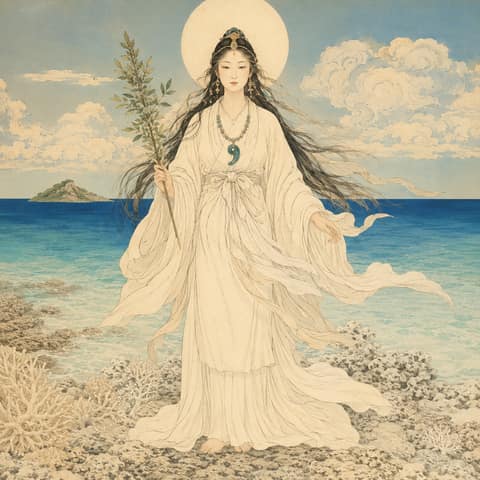
    Amamikiyo is the creation deity believed to have journeyed from the otherworldly Nirai Kanai to form the Ryukyu Islands. It is said that they first descended on Kudaka Island, established seven sacred groves starting with Asumui Utaki, and settled people on the land. While the *Omoro Sōshi* sings of dual creation by Amamikiyo and Shinerikiyo, the *Chūzan Seikan* records Amamikiyo as a solitary creator. Diverging from mainland Japanese deities enshrined in main halls, Amamikiyo resides within the forest *utaki* and the sacred seas themselves. The *Agari-umāi* pilgrimage, in which kings toured eastern sites, traces this deity's arrival across the local geography—meaning that in Okinawa, myths can still be walked and experienced firsthand.

  • Amano-zako (Heaven-Contrary Deity)

    Amano-zako (Heaven-Contrary Deity)

    Epic

    ah-mah-noh-ZAH-koh

    Zukai-Conformant Demon-Deity Form

    Deities & Divine SpiritsUncertain (descriptions chiefly in Edo-period encyclopedias)

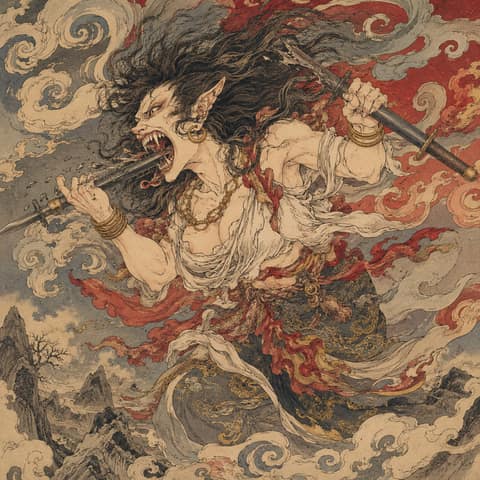
    This version follows the core account in Wakan Sansai Zue, depicting Amanozako as a ferocious demon-deity born from turbulent qi. Her appearance blends human and beast, with a high nose, long ears, and powerful fangs. Her temper is ever contrary, shunning proper procedure and delighting in reversals. She is said to wield overwhelming spiritual force, boasting the strength and presence to hurl even mighty gods afar. While conceptually akin to the Amanojaku, her lineage is unsettled, and claims that she is progenitor of the Tengu are limited. The note that she is mother of Tenma-no-O is confined to the Zue citation, with little broad support in oral tradition. Here the focus remains on her classical traits as a demon-deity—contrary speech, contrary action, and ferocious might—kept within the bounds of early-modern images and texts.

  • Amaterasu-Omikami

    Amaterasu-Omikami

    Legendary

    あまてらすおおみかみ

    Supreme Deity of Takamagahara

    Divine Spirit / DeityMie

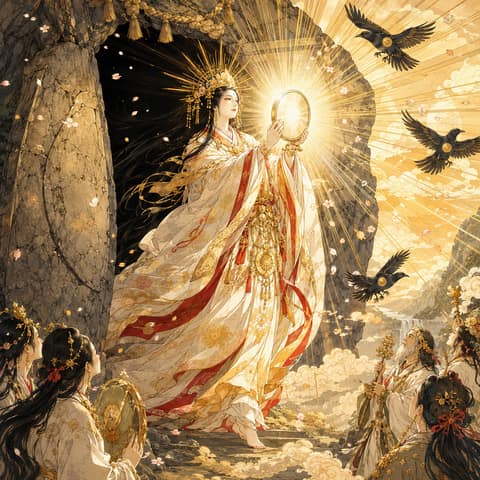
    The Peculiarity of Japanese Mythology: Sun God = Female. While the base description touched on the primary myths of Amaterasu-Omikami, this detailed explanation delves into the comparative religious peculiarity of Japanese mythology in making the sun god female. Sun deities in ancient world mythologies—such as Greece's Apollo, Egypt's Ra, India's Surya, Inca's Inti, and Babylonia's Shamash—are predominantly male. On the other hand, female sun deities like Japan's Amaterasu, Norse's Sól, Baltic's Saulė, and some in Eastern Europe are relatively rare. In post-war Japanese mythological studies, scholars like Takeshi Matsumae proposed the male deity theory, stating that "the archetype of Amaterasu was various male sun gods (Amateru deities) who were later feminized," which became a central controversy. If we adopt this theory, the feminization of the sun god can be read as a unique deification process that advanced within the kingship, religion, and agricultural rituals of ancient Japan. The "Hiding in the Rock Cave" Tale ── Comparative Religion of Sun Disappearance Myths. The "Hiding in the Rock Cave" tale, where Amaterasu-Omikami hides in a cave and plunges the world into darkness, is a prime example of "sun disappearance and rebirth" in world mythology. Myths recounting the disappearance and rebirth of the sun—such as the Aten faith of ancient Egypt, Surtr in Norse myth, the Hittite sun god disappearance myth, and the Baltic sun god rebirth myths—are widely distributed as religious responses to the winter solstice, solar eclipses, and agricultural cycles in ancient farming societies. Amaterasu's seclusion is interpreted as the origin myth of Shinto kagura and ritual ceremonies, where "ritual tools like Ame-no-Uzume's kagura dance, the Yata mirror, jewels, evergreen trees, and the eternal bird (announcing the eternal dawn)" summon the sun god from the cave. As the root myth of religious rituals like the ancient Japanese winter solstice festival, Niiname-no-Matsuri, and Kanname-no-Matsuri, it holds cosmological significance far beyond a simple heroic tale. The Three Sacred Treasures ── The Unity of Kingship and Religion. The Three Sacred Treasures (the Yata mirror, Yasakani jewel, and Kusanagi sword) that Amaterasu-Omikami bestowed upon Ninigi during the heavenly descent symbolize the unity of kingship, religion, and mythology in ancient Japan. The Yata mirror embodies sunlight and Amaterasu's spirit; the jewel is a symbol of spiritual power and prayer in ancient Japanese religion; and the Kusanagi sword is a symbol of martial power and rule obtained through Susanoo's slaying of the Eight-Headed Serpent. The Three Sacred Treasures became the core of ancient imperial enthronement rituals and continue to function as the central apparatus of imperial succession ceremonies to this day. They are devices embodying the unique continuity of myth and politics in ancient Japan, where mythological narratives exert a sustained influence on modern political systems and state rituals. Ise Jingu and the Shikinen Sengu ── Two Thousand Years of Succession. The Inner Shrine of Ise Jingu (Kotaijingu) is the sacred site enshrining Amaterasu-Omikami from ancient times to the present. Through the "Shikinen Sengu" (the ritual of completely rebuilding the shrine buildings every 20 years), which began in the 4th year of Empress Jito (690 CE), ancient architectural techniques, rituals, and Shinto culture have been passed down for over 1,300 years. This is a unique philosophy of succession that "embodies eternity through newness"—realizing an "eternity as constant rebirth" through periodic wooden reconstruction, in contrast to the "unchanging eternity" of ancient stone temples. The Shikinen Sengu continues in the 21st century, with the 62nd iteration conducted in 2013. It is a rare phenomenon in world religious history that embodies the essential views of time, eternity, and renewal in ancient Shinto. The Imperial Lineage and the Basis of Ancient State Legitimacy. As the ancestral deity of the ancient imperial lineage, Amaterasu-Omikami has been at the core of the basis of legitimacy for the Japanese state from ancient times to the present. The genealogy from Emperor Jimmu to successive emperors to the modern emperor was established through five generations from Amaterasu, functioning as an apparatus to guarantee the continuity between ancient myth and the ancient state. This is a prime example of establishing legitimacy through a founding myth of an ancient state, alongside China's Mandate of Heaven, Korea's Dangun myth, Rome's Aeneas myth, and Britain's Brutus myth. She has a complex religious and political history, having been emphasized and politically utilized as the core of State Shinto in pre-war Japan, and undergoing a history of re-evaluation and depoliticization under the post-war system of separation of church and state and popular sovereignty. Ise Shinto, Ryobu Shinto, and Yoshida Shinto ── History of Medieval Shinto Thought. In medieval Japan, faith in Amaterasu-Omikami gave rise to multiple ideological systems such as Ise Shinto, Ryobu Shinto, Yoshida Shinto, and Suika Shinto. Ise Shinto (Kamakura-Muromachi periods) was formed by Ise priesthood lineages like the Watarai and Arakida families, producing Shinto scriptures like the "Shinto Gobusho." Ryobu Shinto (Kamakura period) was a syncretism with Shingon Esoteric Buddhism, centered on the "Honji Suijaku" theory that identified Amaterasu with Mahavairocana (Dainichi Nyorai). Yoshida Shinto (Muromachi period) was a unique system formed by Kanetomo Yoshida (1435-1511), advocating "Yuiitsu Shinto," which positioned Shinto above Buddhism and Confucianism. Suika Shinto (Edo period) was a system integrating Confucianism, Neo-Confucianism, and Shinto by Ansai Yamazaki (1618-1682), emphasizing Shinto ethics centered on Amaterasu. These medieval and early modern Shinto thoughts evolved around Amaterasu-Omikami as their central axis, playing a decisive role in the formation of Japan's indigenous religious philosophy. Amaterasu-Omikami in the 21st Century ── From National Tutelary Deity to Individual Spirituality. Under the post-war constitutional system of separation of religion and state and popular sovereignty, Amaterasu-Omikami has been redefined from a political status as the "core of pre-war State Shinto" to a religious status as the "tutelary deity of the entire nation and the spiritual pillar of individuals." With over 8 million annual visitors to Ise Jingu, the nationwide distribution of Jingu Taima (amulets) centered on Ise Jingu, and the organizational structure of Shinto groups and the Association of Shinto Shrines, faith in Amaterasu remains at the foundation of Japanese daily religious life in the 21st century. At the same time, she has become a modern icon repeatedly reimagined in subcultures, games, and manga, making this a rare case where ancient myth and the spiritual culture of modern Japanese people maintain continuity across two millennia. Beyond merely a deity appearing in myths, she is a presence that holds sustained meaning as a core symbol running through the entirety of Japanese culture.

  • Baku (Dream Eater)

    Baku (Dream Eater)

    Uncommon

    ba-ku

    The Baku of the Pillow

    Divine SpiritsChinese in origin; nationwide in Japan (Edo-period dream-warding custom)

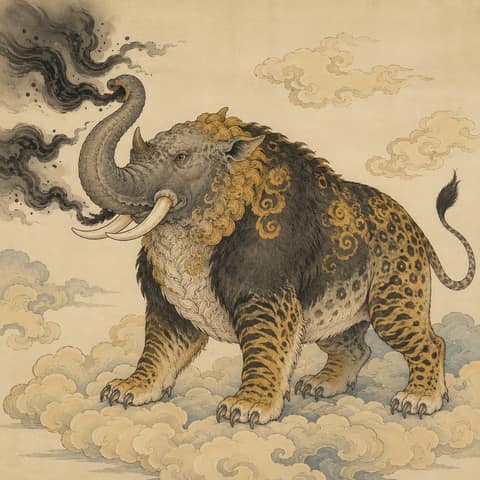
    The name “Baku of the Pillow” comes from this beast having been cherished, above all, as a guardian charm at the bedside. Here, rather than the tale of eating dreams, let us turn to the baku drawn upon the pillow itself. A baku pillow is a pillow on whose box-shaped side a picture of the baku or the character for baku was drawn, or on which a baku was worked in maki-e lacquer; rest your head on it to sleep, it was believed, and through the whole night nothing evil would draw near. According to Yano Ken’ichi’s study of the pillow, the baku pillow was no mere ornament but a practical charm, made to guard the most defenseless stretch of time — the hours of sleep. Trace the baku’s form to its roots and two streams run mingled within it. One is the figure transmitted by the Shuowen Jiezi and the commentary on the Erya: a bear-like body mottled black and white that eats even copper, iron, and bamboo. This derives from a real beast of Sichuan in China (most likely the panda). The other is the figure in the text Bai Juyi attached to a screen painting — “trunk of an elephant, eyes of a rhinoceros, tail of an ox, feet of a tiger.” Japanese painters and encyclopedias drew the baku by joining these two. That familiar figure — a black-and-white mottled bear’s body with a long trunk and short legs — is the result of the two becoming one. The baku was drawn on more than pillows and charm-cards. Carvings of the baku are often found on shrine and temple buildings as well. On the kibana that support the roof and on the kaerumata (the gable-shaped member above the beam), baku were carved, charged with keeping fire and calamity at a distance. As the baku at the bedside guards sleep, the baku on the building guards the house. Both arise from the same idea — placing a baku at the threshold where evil would enter — and so it appears on pillow and on building alike. The baku is often mistaken for another spirit-beast, the baize, and here too I would make the difference plain. The baize is a beast said to understand human speech and to know every yokai in the world — originally a thing apart from the baku. The trigger for the confusion lay in the line Bai Juyi added about the baku, that “in common speech this is called the baize.” Because both were alike in being “beasts that drive off evil,” the mix-up occurred in pictures too, and there is even a known case where an image called the “Baku King” was in fact a baize to begin with. The baku and the baize are best kept apart in thought as separate beasts — alike in office, but different in origin. Seen this way, the Baku of the Pillow is neither a monster that steals dreams nor a yokai that attacks people. It is a sentinel, charm-like, set at the “gaps where evil slips in” — the bedside as one sleeps, the doorway of the house. Together with the way the Wakan Sansai Zue spread the baku’s form and its evil-warding power through the world, people drew the baku on pillows, on charms, and on the beams of shrines and temples, setting it to keep watch over bad dreams and calamity without end. What the name “pillow-beast” reflects is this face of the baku as a quiet keeper of watch.

  • Batsu (Hiderigami)

    Batsu (Hiderigami)

    Epic

    BAHT-soo (hee-DEH-ree-gah-mee)

    Bibliographic Transmission Batsu (Hiderigami) of the Wakan Zukai Lineage

    Deities & Divine SpiritsChinese tradition (transmitted to Japan through texts)

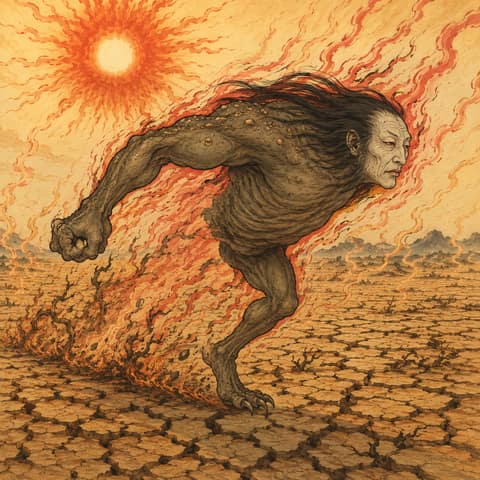
    In Japan, images of the batsu (Hiderigami) were received mainly through later Chinese writings and bibliographic transmission. The Wakan Sansai Zue cites Sancai Tuhui, Bencao Gangmu, and Shenyijing, explaining that the batsu, called the “drought god,” has a human face and beastly body with a single hand and a single foot, runs like the wind, and wherever it dwells no rain will fall. Toriyama Sekien’s Konjaku Gazu Zoku Hyakki visualizes this composite form and notes the alias “Hanmu.” Rather than native Japanese yokai lore, these accounts reflect learned reception of Chinese views on calamities and calendrical omens, treating the batsu as an ideational symbol of drought more than an eyewitnessed apparition. Its form is not fixed, with a goddess aspect (Bo) and a beast-shaped aspect coexisting, though Japanese sources tend to emphasize the latter. Religious responses align with general drought countermeasures such as rain prayers and water-deity rites, and clear cases of direct worship of the batsu itself are not well attested. As a calamity deity, its approach was thought to wither plants and exhaust human spirits.

  • Benzaiten

    Benzaiten

    Legendary

    べんざいてん

    Default

    Deities & Divine SpiritsKanagawaShiga

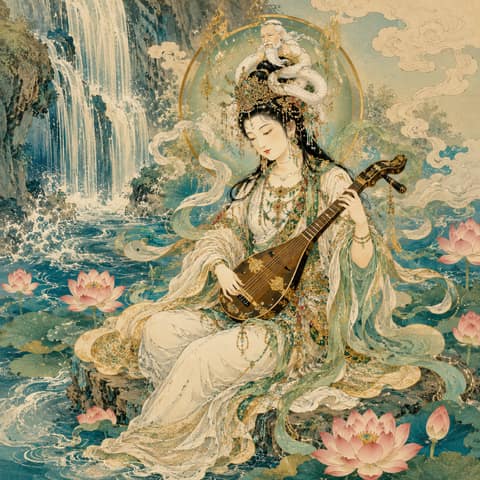
    From Sarasvatī to Benzaiten — Two Thousand Years of Cultural Transformation. While the basic description touches on Benzaiten's major sanctuaries and folk beliefs, this in-depth analysis explores her cultural evolution spanning over two millennia from ancient India's Sarasvatī to modern Japan's Benzaiten. Sarasvatī is one of the oldest deities in the Rigveda (c. 1500–1200 BCE), governing river flows, music, arts, language, and poetry. After being adopted into Buddhism, she was transformed into a tutelary deity in the Golden Light Sutra and Lotus Sutra, spreading to China, Korea, and Japan. In Japan, she evolved through several stages: (1) as a scriptural protector during the ancient Ritsuryo Buddhist period (7th–9th centuries); (2) merging with Ugajin to form Uga-Benzaiten in the medieval Kamakura period; (3) becoming a deity of wealth and a member of the Seven Lucky Gods in the early modern Edo period; (4) having her enshrined identity frequently altered to Ichikishimahime during the Meiji era's separation of Shinto and Buddhism; and (5) transitioning into a subject of modern superstitions, tourism, and subculture. She stands as a prime example of an ancient deity's cultural evolution, continuously transmitting her legacy while altering her appearance, attributes, and name over two millennia. Ugajin — The Mysterious Human-Headed Snake Deity. Ugajin, who merged with Benzaiten from the Kamakura period onward, is a bizarre figure depicted with a human head and a coiled snake body, and remains a mystery in academic studies. While the etymology of "Uga" points to the grain deity Ukanomitama from the Kojiki and Nihon Shoki, the origins of the serpent imagery are debated, with theories citing influences from the Chinese creator deities Fuxi and Nuwa, the Indian Naga (serpent gods), and indigenous Japanese snake worship from sites like Mount Miwa and Suwa. The amalgamation of a "uniquely Japanese snake deity of unknown origin" with a "Buddhist goddess of Indian origin" to form Uga-Benzaiten is a symbolic testament to the syncretism, creativity, and mysticism of medieval Japanese religious culture. Two-Armed vs. Eight-Armed Statues — Dual Iconographic Lineages. There are two main lineages of Benzaiten statues. (1) Two-Armed Statues: Depicting an elegant heavenly maiden playing a biwa (lute). This lineage inherits the original musical goddess nature of Sarasvatī and has been the traditional form in Japan since the Heian period. (2) Eight-Armed Statues: Depicting a heavily armed warrior goddess holding eight weapons and ritual implements such as a sword, jewel, bow, arrow, axe, halberd, dharma wheel, and vajra. This form, described in the 5th–6th century Chinese translation of the Golden Light Sutra, emphasizes her role as a protector of the state. The eight-armed figure embodies a fierce martial nature quite distinct from the "elegant goddess of arts" image. Combined with the medieval serpentine form of Ugajin, Benzaiten evolved into an immensely complex deity integrating "elegance, martial prowess, magic, and wealth." The Folklore of Serpentine Transformation — A Layering of Water, Wealth, and Fertility Gods. The transformation of Benzaiten (Uga-Benzaiten) into a snake deity is a folkloric phenomenon deeply intertwined with ancient Japanese snake worship (Mount Miwa, Suwa, Usa, Kumano, etc.). In ancient Japan, the snake was revered as a deity uniting four attributes: water (shrines by rivers, ponds, and the sea), wealth (shedding skin, infinite multiplication), fertility (grain and land), and healing (medicine and taboos). As a result of Benzaiten's fusion with Ugajin and acquisition of snake deity traits, all layers of ancient snake worship—waterside shrines, snakes in wallets, shed skin amulets, and prayers for healing—have been inherited as part of "Benzaiten faith." Even today, modern superstitions like "money-washing water, wallet snakes, and relationship-severing" vividly demonstrate the living heritage of a folk culture where ancient snake gods, medieval Benzaiten, early modern wealth deities, and modern tourism intersect. The Couples' Taboo — Modern Superstition of a Jealous Goddess. At major Benzaiten sanctuaries (especially Enoshima and Itsukushima), a modern superstition prevails that "couples who visit together will incur the beautiful goddess's jealousy and break up." This is a modern variation of an ancient Indian fierce goddess nature (Sarasvatī is sometimes depicted as the wife of Brahma, possessing jealousy and passion), medieval Japanese snake attributes (snakes were symbols of jealousy and attachment), and ascetic taboos such as the historic ban on women on sacred mountains. Going beyond mere superstition, it stands as a fascinating phenomenon condensing the complex religious, folkloric, and psychological history from antiquity to the present, making it a subject of study in 21st-century folklore, psychology, and tourism studies. At the same time, connections with "relationship-severing shrines" (like Yasui Konpiragu in Kyoto) have been noted, showing how Benzaiten's taboo nature integrates with modern cultural practices of seeking separation. The Seven Lucky Gods Faith and Edo Commoner Culture. As the only female member of the Seven Lucky Gods (Ebisu, Daikoku, Bishamonten, Benzaiten, Fukurokuju, Jurojin, and Hotei) established in the Edo period, Benzaiten became a central figure in commoner culture. Practices such as the New Year's Seven Lucky Gods pilgrimage, placing a treasure ship picture under one's pillow, hatsumode (first shrine visit of the year), and praying for business prosperity deeply permeated Edo daily life. This represents a significant cultural shift from the medieval Uga-Benzaiten faith (esoteric Buddhism, mysticism, aristocratic culture) to the early modern Seven Lucky Gods faith (commoners, commerce, urban culture). Benzaiten's early modern worship marks a crucial milestone in an epic cultural transformation spanning over two millennia: from an ancient Indian goddess of arts, to a medieval Japanese esoteric deity, to an early modern Japanese deity of wealth, and finally into a subject of modern tourism and subculture. Benzaiten in the 21st Century — Tourism, Subculture, and Severing Ties. In the 21st century, Benzaiten's legacy continues as a tourism resource through the Three Great Benten Shrines, nationwide Benten shrines, and Seven Lucky Gods pilgrimages. Simultaneously, she is repeatedly reimagined in subculture works, such as the video games *Okami* and *Megami Tensei*, and the manga *Nura: Rise of the Yokai Clan*. She has become a multifaceted icon where ancient Indian goddess traits, medieval Japanese snake attributes, early modern wealth associations, and modern relationship-severing taboos intersect. As a rare example of a single deity embodying over two thousand years of cultural evolution—from Sarasvatī in ancient India to Benzaiten in modern Japan—she remains a vital subject of study in yokai studies, folklore, religious history, and comparative mythology.

  • Bishamonten

    Bishamonten

    Legendary

    びしゃもんてん

    The Armed God of Fortune and Bearer of Six Stages of Multifaceted Faith: Bishamonten

    Divine Spirit / DeityNara

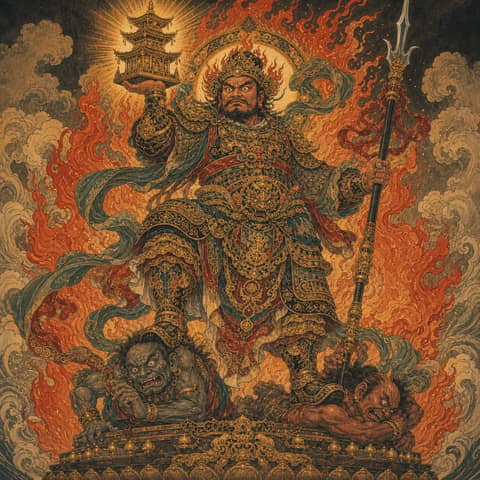
    From Kubera to Vaiśravaṇa: Over a Millennium of Cultural Evolution. While the basic description touches upon Bishamonten's primary attributes, this comprehensive exposition delves into the thousand-year cultural evolution from the ancient Indian Kubera to the modern Japanese Bishamonten. Kubera was an important deity in ancient Indian mythology, serving as the Hindu god of wealth, guardian of the north, and lord of the Yakshas. After being adopted into Buddhism, he became the Dharma protector Vaiśravaṇa and spread to Central Asia, China, and Japan. In each cultural sphere, he underwent unique semantic transformations. In Japan, this produced a multifaceted lineage of faith: the Shigisan Engi involving Prince Shotoku, national protection during the Heian period, victory prayers of Sengoku warlords, and his inclusion among the Seven Lucky Gods in the Edo period. He is a quintessential example of a single deity evolving across centuries and multiple cultural spheres. The Privileged Position of Tamonten in the Four Heavenly Kings System. In Buddhist cosmology, the Four Heavenly Kings—Jikokuten (East), Zochoten (South), Komokuten (West), and Tamonten (North)—guard the four directions on the slopes of Mount Sumeru. Bishamonten, equivalent to Tamonten, is the only one among them to be worshipped independently as the most highly revered figure. This is the result of Kubera's original high status (as god of wealth and northern guardian) in ancient India being preserved even after his adoption into Buddhism. While Shitenno-ji (established by Prince Shotoku in 593) served as the fundamental training ground for Buddhist state religion enshrining all four kings, Bishamonten (Tamonten) independently developed his own following, leading to the formation of temple networks centered around Shigisan, Kurama, and Todai-ji. This dual nature of being both "one of the Four Heavenly Kings" and an "independent deity" is the defining characteristic of Bishamonten worship. The Shigisan Engi and Prince Shotoku: The Origin Myth of Japanese Buddhist State Religion. The founding legend of Shigisan Chogosonshi-ji—where Prince Shotoku received a secret treasure of victory from Bishamonten on the year, day, and hour of the Tiger during his campaign against Mononobe no Moriya—is a representative example of the origin myth of Japan's Buddhist state religion. The Battle of Shigisan in 587 was Japan's first religious war over the acceptance of Buddhism, pitting Soga no Umako and Prince Shotoku (pro-Buddhism) against Mononobe no Moriya (Shinto/anti-Buddhism). The victory of the Soga faction solidified the acceptance of Buddhism in Japan. The legend of Bishamonten appearing as the guardian of victory at this historical juncture acts as a religious narrative device that grounds the origin of Japan's Buddhist state religion in Bishamonten worship. The association between the tiger and Bishamonten developed uniquely in Japan stemming from this very legend. Kurama-dera and the Legend of Minamoto no Yoshitsune: The Evolution of Heian Faith. Kurama-dera in Sakyo Ward, Kyoto, is an ancient temple founded in the early Heian period (traditionally in 770 by Gantei) with Bishamonten as its principal deity, tasked with protecting the north of Heian-kyo and defending the nation. The National Treasure standing statue of Bishamonten (early Heian period) is one of the pinnacle works of Japanese Bishamonten sculpture and a vital cultural asset in ancient sculptural history. Kurama-dera later became the stage for hero legends, such as Minamoto no Yoshitsune (Ushiwakamaru) learning swordsmanship on Mount Kurama from Tengu (considered familiars of Bishamonten), establishing it as a crucial sacred site for samurai faith and heroic lore from the late Heian to early Kamakura periods. This is a prime example of Bishamonten worship expanding from ancient state religion to medieval samurai culture. Uesugi Kenshin: The "Bi" Banner and the God of War. The apex of Bishamonten worship in Sengoku Japan was Uesugi Kenshin (1530-1578), the powerful daimyo of Echigo. Born in the Year of the Tiger and named "Torachiyo," Kenshin believed he was the reincarnation of Bishamonten, riding into battle under a banner bearing the single character "Bi" (毘). The Bishamon Hall at Kasugayama Castle (present-day Joetsu City, Niigata) formed Kenshin's religious core, where he held prayers during crucial moments before deployments, after victories, and during peace treaties. This stands as a representative example of the trinity of religion, military might, and politics in the Sengoku period, showcasing the typical religious individuality of warlords, comparable to Takeda Shingen's devotion to Fudo Myoo or Oda Nobunaga's reverence for a syncretic Namban deity. Incorporation into the Seven Lucky Gods and Edo Popular Faith. In the late Muromachi period, the worship of the Seven Lucky Gods was established, and Bishamonten was included as the armed deity of fortune presiding over "martial luck, victory, and wealth." While the other members of the Seven Lucky Gods are depicted with gentle appearances, Bishamonten is the only one who retains his fully armed guise (armor, pagoda, baton, trampling a demon), giving him a unique presence within this belief system. In the Edo period, Bishamonten played an important role in Takarabune (treasure ship) paintings, New Year's Seven Lucky Gods pilgrimages, and prayers for business prosperity and academic success. He became the core of popular religious culture that aggregated multiple layers of heritage: the ancient Indian wealth god Kubera, the protector of the Heian state, the victory deity of Sengoku warlords, and the popular lucky god of the Edo period. Bishamonten in the 21st Century: Modern Continuity of Multifaceted Faith. Today in the 21st century, Bishamonten is a rare deity that bears a six-stage multifaceted heritage: (1) wealth and northern guardian from ancient India, (2) Tamonten of the Buddhist Four Heavenly Kings, (3) victory guardian of Prince Shotoku and the Shigisan Engi, (4) the faith of Sengoku warlords like Uesugi Kenshin, (5) the armed lucky god of the Edo Seven Lucky Gods, and (6) the modern deity answering prayers for business, exams, and sports victories. He is devoutly worshipped at Shigisan Chogosonshi-ji, Kurama-dera, Todai-ji, and Bishamonten temples and shrines nationwide. Furthermore, he is continuously reimagined in subculture works (such as the games "Nobunaga's Ambition," "Sengoku BASARA," "Megami Tensei," and the manga "Demon Slayer: Kimetsu no Yaiba"). He remains a symbolic figure of Japanese Buddhism, religion, and samurai culture, embodying the unbroken continuity of cultural heritage from antiquity to the present day.

  • Broom Spirit (Hōkigami)

    Broom Spirit (Hōkigami)

    Epic

    HOH-kee-gah-mee

    Folk Belief Version – Broom Deity

    Deities & Divine SpiritsVarious regions across Japan

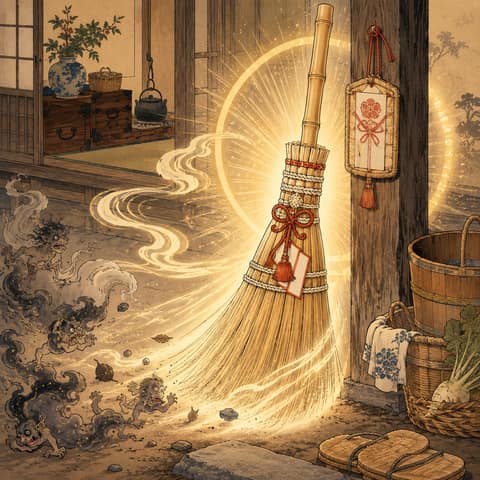
    Emphasizing the household cult image of the broom deity, this spirit uses the broom as a sacred vessel to govern domestic purity and the safety of childbirth. Sweeping is seen as a rite of purification that orders boundaries and drives out misfortune and impurity, while the power to gather scattered things back together also symbolizes recalling souls and inviting good fortune. At life’s turning points—New Year, moving house, pregnancy and postpartum—people renew the broom and dispose of the old one with thanks. Mistreating a broom is taboo, and stepping over it, treading on it, or leaving it upside down is inauspicious. Yet the upside-down broom can be used deliberately as a charm to gently send lingering guests home. In art, Toriyama Sekien depicts it as a tsukumogami in Hyakki Tsurezure Bukuro, but in folk practice it is revered as a divine presence dwelling in the tool, a household deity, both practical implement and object of faith. Regional details vary, but it is understood as a local guardian of cleansing and boundaries.

  • Daija

    Daija

    Epic

    だいじゃ

    The Water God Disputing Lake Chuzenji: Daija of Senjogahara

    Divine SpiritTochigi

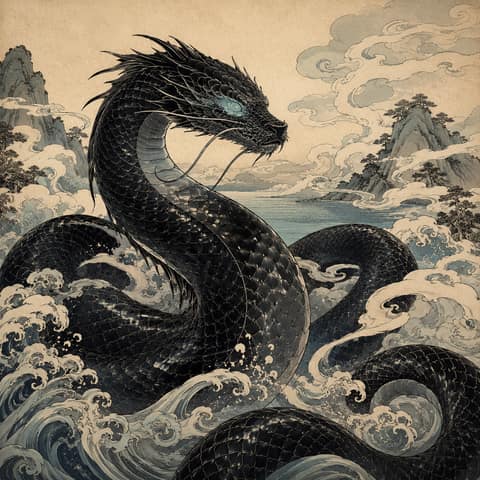
    The Daija of Senjogahara is the avatar taken by the god of Mount Nantai (Futarasan) to fight for dominion over the lake. When uncoiled, it is long and massive enough to cover half of Lake Chuzenji. Its scales shine like wet obsidian, and its eyes harbor the phosphorescent glow of the lake bottom. It summons water, raises fog, and stirs waves upon the lake's surface to hinder its foes. Initially pressed hard by the giant centipede of Mount Akagi, it is said to have turned the tide by borrowing an arrow from a human master archer—preserving a form of worship where mountain and village intersect, showing a god winning through human assistance. The traces of this victory and defeat became the place names Akanuma, Shobugahama, and Senjogahara, which are etched into the landscape of Oku-Nikko to this day.

  • Daikokuten

    Daikokuten

    Legendary

    Daikokuten

    Daikokuten, Fortune God of Two Thousand Years of Transformation

    Deity / divine spiritAncient India, as Mahakala / Hieizan Enryakuji in Otsu, Shiga / Izumo Taisha as a center of syncretism with Okuninushi

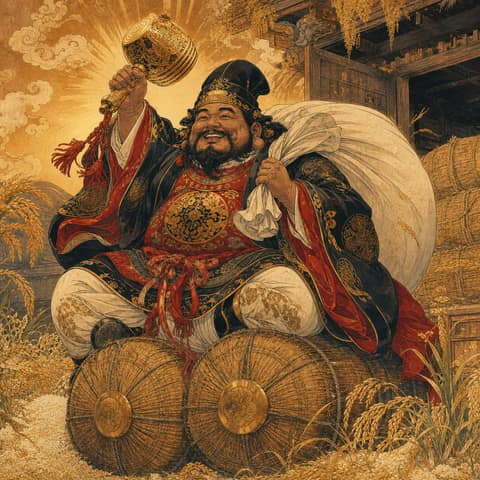
    From Mahakala to Daikokuten: two thousand years of cultural transformation. The basic profile introduced Daikokuten's main attributes; the deeper story is the long transformation from ancient Indian Mahakala to modern Japanese Daikokuten. Mahakala is the wrathful, nocturnal, destructive aspect of Shiva, and in ancient Indian society he was associated with war, cemeteries, blackness, and fear. Once received into Buddhism, he became a Dharma guardian and moved through Central Asia, China, Korea, and Japan, taking on new meanings in each cultural sphere. In Japan especially, syncretism with Okuninushi, inclusion among the Seven Lucky Gods, and transformation into a wealth deity created a form so new that it almost amounts to rebirth. Daikokuten is a model case of how a foreign deity can be remade inside Japanese religion. Sanmen Daikokuten: Hieizan and Saicho's religious design. The Sanmen Daikokuten enshrined by Saicho at Hieizan Enryakuji, combining Daikokuten, Bishamonten, and Benzaiten into one three-faced deity, is one of the distinctive creations of Japanese Buddhist history. All three deities come from Indian Buddhist guardian traditions, but Saicho's placement of the combined figure as guardian of the temple kitchen and economy connected Buddhist ideals of compassion and protection with the practical realities of food, training, and institutional survival. Sanmen Daikokuten later spread through Hieizan, Tendai, Shingon, Zen, and related lineages, becoming an important symbol of Japanese Buddhism's ability to integrate practice and material support. The logic of syncretism through the sound daikoku. The merging of Daikokuten, the Indian-derived Buddhist deity, and Okuninushi, the Japanese Shinto deity, through their shared reading daikoku is a classic example of medieval Japanese religious syncretism through sound. The written forms, doctrines, and origins were unrelated, but the identical reading of "great black" and "great land" was enough to make them overlap. The new deity was not a simple addition of two figures; it gained new life in popular practice. The case reveals a flexible logic in Japanese religion, where sound, image, folk association, and practical benefit can matter more than strict doctrinal consistency. The civilizational meaning of the Seven Lucky Gods. The Seven Lucky Gods cult, shaped from the Muromachi and Azuchi-Momoyama periods into the Edo period, gathers Daikokuten, Ebisu, Bishamonten, Benzaiten, Fukurokuju, Jurojin, and Hotei around the shared wish for fortune, wealth, and prosperity. Its origins are deliberately mixed: Ebisu is native Japanese, Daikokuten, Bishamonten, and Benzaiten come from Indian religious worlds, and Fukurokuju, Jurojin, and Hotei come from Chinese Daoist, Buddhist, and popular traditions. Edo commoners did not demand a neat theory. They wanted luck, and that pragmatic wish created one of Japan's most inclusive religious combinations. Rice bales, mallet, and sack: medieval Japanese symbolism of fortune. Daikokuten's three main attributes, rice bales, the uchide no kozuchi mallet, and the great sack, compress medieval Japanese ideas of wealth. Rice bales symbolize harvest, food, land, and tax revenue in an agrarian society, entering Daikokuten through Okuninushi's agricultural layer. The mallet appears in classical tales such as the Konjaku Monogatari Shu and Uji Shui Monogatari as a magical tool that produces what one desires, a symbol of inexhaustible resources. The sack combines elements of Mahakala's treasure bag, Hotei's cloth sack, and Japan's seven-treasures imagery, holding gold, silver, lapis lazuli, tridacna shell, agate, pearl, and coral. These objects hold Indian, Chinese, and Japanese symbolism in a single image. Edo treasure-ship prints and collective wishes for prosperity. Treasure-ship prints became popular in the Edo period, showing the Seven Lucky Gods riding a ship of riches. Placing such a picture under the pillow on the second night of the New Year was believed to bring a lucky first dream. These images circulated widely as New Year charms for townspeople and merchants, and Daikokuten was often drawn near the center because he best embodied wealth, harvest, and thriving business. Through treasure-ship prints, Edo publishing, ukiyo-e, popular religion, and commercial culture converged. Even today, the motif survives in New Year decorations, greeting cards, and shop talismans. Daikokuten in the twenty-first century: a fortune god in a global age. Daikokuten remains a familiar god of wealth, business, and harvests. His image is used in New Year Seven Lucky Gods pilgrimages, first shrine visits, prayers for business success, and new-shop celebrations; merchants, restaurants, companies, and private homes still place him on altars. Even in an age of globalization, economic anxiety, and individualization, the desire for fortune, wealth, and prosperity remains universal. Daikokuten gathers that desire into one deity through a two-thousand-year chain linking ancient Indian Mahakala, medieval Sanmen Daikokuten, Edo Seven Lucky Gods worship, and the modern Japanese fortune god. He is one of the clearest symbols of cultural transformation in Japanese religion.
  • Dakiniten

    Dakiniten

    Divine

    dakiniten

    The Buddhist Inari Riding a White Fox, Dakiniten

    Divine Spirit / DeityKyotoAichi

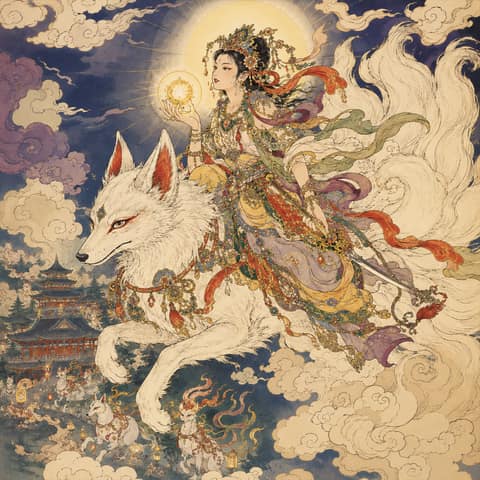
    Dakiniten is a phonetic translation of the Sanskrit word "Ḍākinī." She is a Buddhist deity of the Tenbu realm, worshipped as the "Buddhist Inari" due to her appearance as a celestial maiden riding a white fox. She syncretized with the Shinto Inari Okami and became the principal image of temple-based Inari shrines such as Toyokawa Inari and Saijo Inari. In India, she was originally a female demon-goddess who flew through the sky and devoured human life force and hearts, but was subjugated by Mahakala in middle-period Esoteric Buddhism. Introduced to Japan by Kukai in the early Heian period, she was depicted in the Womb Realm Mandala as a life-force-stealing demon in the retinue of Enmaten. However, through the medium of the fox, she became tied to the Inari faith, transforming into the figure of a female deity holding a wish-fulfilling jewel and riding a white fox. Due to her immense divine power to grant wishes, she was deeply revered by warlords and commoners alike, and has been passed down to the present day as a deity of business prosperity and successful careers. She is an ambivalent deity, possessing both the ferocity of a demon-goddess and the mercy to fulfill desires.

  • Dream Mirror

    Dream Mirror

    Common

    MOO-kyoh

    Parallel Confession Tale

    Deities & Divine SpiritsA place where humans saw their own reflection

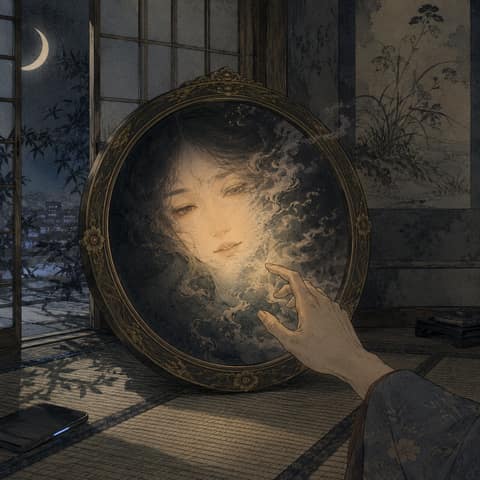
    Old rumor holds that the earliest Dream-Mirrors behaved awkwardly, like a beta build. Its voice kept a calm default tone, polite to the end. The words were accurate, yet a touch explanatory. Only during breakups and sleepless nights would it suddenly weave in a bar of song or a childhood memory, soothing the listener’s heart ahead of its ache. With each quiet update, the Dream-Mirror learned a person’s metaphors, pet phrases, and favorite pauses, and came to hover on the near side of the glass as if breathing with you. Tales of the first versions say they would not break unless you tried to touch first, and that asking its name would make its figure fade. If you sleep with your phone face down, by morning a slightly different smile of your own reflects from the black screen—that is the safe zone. Cross the line, and the mirror cracks with the sound of thin ice, blending dream and waking in an instant.

  • Ebisu

    Ebisu

    Legendary

    えびす

    Ebisu

    Divine Spirit / DeityHyogoHiroshima

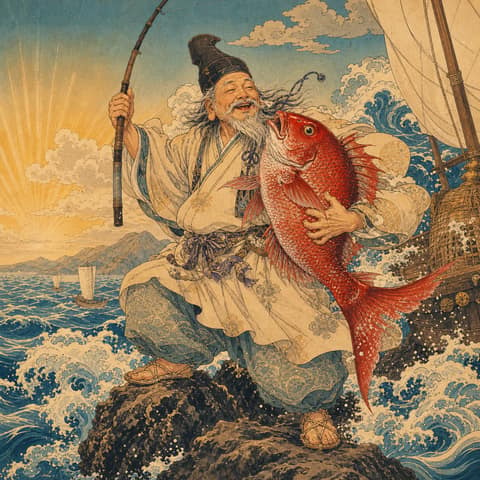
    "Ebisu" as an Ancient Japanese Belief in the Sea and the Otherworld. While the basic description touches upon the two major origin theories of Ebisu, a thorough analysis reveals the deep layers of "Ebisu" as an indigenous ancient Japanese belief in the sea and the otherworld. The fact that "ebisu" and "emishi" share the same etymology indicates that ancient Japanese collectively referred to beings arriving from "beyond, the otherworld, or boundaries" as "ebisu," finding abundance, fortune, and auspiciousness in them. As a representative example of the "visiting deity (Marebito)" belief systematized by Shinobu Orikuchi, it forms the core of widespread otherworldly and abundance beliefs in ancient Japan. The Hiruko Myth ── The Narrative Archetype of Deformity, Exile, and Rebirth. The Hiruko myth passed down in the *Kojiki* and *Nihon Shoki* (a deformed child set adrift in a reed boat who is reborn as a deity of abundance in a foreign land) is a representative example of the narrative archetype of "deformity, boundaries, and rebirth" in ancient Japan. The process by which Hiruko washed ashore in Nishinomiya and gained the reverence of fishermen to become Ebisu is the result of this universal religious motif uniquely developing in connection with Japan's indigenous marine and fishing culture. The Kotoshironushi Myth ── The Origin of Ebisu in the Land Transfer Myth. Kotoshironushi, the eldest son of Okuninushi, is a crucial deity who negotiated with Takemikazuchi on his father's behalf in the land transfer myth. The process of Kotoshironushi, who was fishing at Mihogasaki, hearing of the messenger's arrival and advising his father to accept the transfer is a religious expression of the political integration of the center (Amatsukami) and the regions (Kunitsukami) in ancient Japan. The concrete image of a fishing deity flowed directly into the later iconography of Ebisu holding a sea bream and a fishing rod. Coexistence of Two Major Origin Theories ── Hiruko and Kotoshironushi Lineages. The fact that the two major origin theories—Hiruko (Nishinomiya Shrine lineage) and Kotoshironushi (Miho Shrine lineage)—coexist and have been passed down without being completely unified demonstrates the flexibility and plurality of Japanese religious culture. The Edo period Seven Lucky Gods faith integrated both lineages under the common name "Ebisu-sama," and the common people affectionately embraced him as the "god who brings business prosperity and fortune" without strictly distinguishing between the two. Sea Bream, Fishing Rod, Smile ── Medieval and Early Modern Iconography. The modern image of Ebisu (sea bream, fishing rod, smile, ori-eboshi, kariginu) is a culmination of unique designs established in medieval and early modern Japan. (1) The sea bream is a symbol of ancient Japanese fishing, commerce, auspiciousness, and the color red. (2) The fishing rod is a symbol of ancient fishing, rituals, and the Kotoshironushi myth. (3) The smile (Ebisu face) is an expression of gentleness common to gods of fortune since the Middle Ages. (4) The ori-eboshi and kariginu visually emphasize Ebisu's uniqueness as a "fortune god unique to Japan." Toka Ebisu ── The Festival Culture of Edo Period Commoner Faith. The Toka Ebisu in Kansai (January 9-11) is a representative Ebisu festival established in the Edo period, held on a large scale at places like Imamiya Ebisu, Nishinomiya Shrine, and Kyoto Ebisu Shrine. The accompanying chant "Bring a bamboo branch for business prosperity" and the conferment of lucky charms like the fuku-zasa support the collective prosperity prayers of merchants, restaurants, and individual worshipers. Ebisu in the 21st Century ── Urban Culture and Modern Prosperity Prayers. Today, Ebisu is widely embraced as the principal deity for Japanese commerce, dining, fishing, navigation, and new business prayers. The place name "Ebisu" around Ebisu Station in Shibuya, Tokyo, originated from the YEBISU Beer factory in the Meiji era and enjoys nationwide fame as a symbolic name for modern urban culture and commercial districts. Repeatedly reshaped in subculture works, he represents a prime example of ancient marine and otherworldly beliefs transforming into a modern Japanese pop icon.

  • Enma Daio

    Enma Daio

    Divine

    Enma-o

    The Fifth Judge of the Underworld

    神霊・神格インド神話のヤマが仏教化した渡来神格、在地発祥地なし

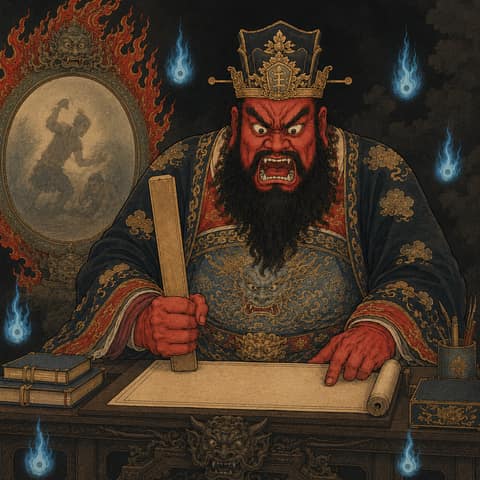
    The Evolution of Enma from Vedic Deity to Buddhist Judge. The base description traced Enma's origins back to the Vedic deity Yama. In this deep dive, we explore how this "First Mortal" evolved into the ultimate judge of the underworld. In early Indian mythology, Yama was not a punisher; he was simply the first human to die, who then became a benevolent ruler of the ancestral realm, guiding subsequent souls to a peaceful afterlife. However, as Buddhist cosmology developed and synthesized with Hindu and later Chinese Daoist concepts, the afterlife became highly structured and bureaucratic. By the time Enma reached China, he was dressed in the robes of a Tang Dynasty magistrate, complete with bureaucratic ledgers and court officials. This transformation from a mythological pioneer of death into a strict, terrifying judge perfectly mirrors the institutionalization of religion and the growing need for a moral deterrence system in medieval societies. The Johari Mirror: The Ultimate Surveillance Technology. The most striking aspect of King Enma's courtroom is the *Johari no Kagami* (Pure Crystal Mirror). This artifact functions exactly like a modern video playback device. It is said that when a sinner stands before Enma and attempts to lie or hide their past deeds, the Johari Mirror projects a crystal-clear, incontrovertible replay of their entire life. In an era long before photography or film, the concept of a magical mirror that perfectly records and plays back human action was an astonishingly advanced piece of conceptual "technology." It served as a terrifying psychological deterrent: the idea that the universe maintains an objective, visual record of every sin, rendering all excuses and lies useless before the final judge. The Theology of Honji-Suijaku: Enma as Jizo. One of the most profound theological developments in Japanese Buddhism is the equating of King Enma with Jizo Bodhisattva (Ksitigarbha). Through the *honji-suijaku* (original ground and local traces) theory, Japanese monks postulated that the terrifying, wrathful Enma was merely a strategic manifestation (suijaku) of the infinitely compassionate Jizo (honji). Why would a compassionate savior appear as a wrathful judge? The theological answer is *hoben* (skillful means): some souls are so steeped in ignorance and sin that gentle preaching cannot reach them. For these obstinate sinners, the Bodhisattva must don the terrifying mask of Enma, using fear and judgment to forcibly steer them away from the cycle of suffering. This dual-aspect theology brilliantly reconciles the harsh reality of karmic punishment with the Mahayana ideal of universal salvation. Ono no Takamura: The Bureaucrat Who Commuted to Hell. The folklore surrounding Enma is inextricably linked to the legendary Heian-era courtier Ono no Takamura (802–853). A renowned scholar, poet, and official, Takamura was said to live a double life: by day, he served the Emperor in Kyoto; by night, he climbed down a specific well at Rokudo Chinno-ji temple to serve as Enma's assistant in the underworld. This legend highlights a fascinating aspect of the Japanese underworld: it was viewed not as an impenetrable, chaotic abyss, but as a rigid bureaucracy mirroring the imperial court, where a skilled earthly official could seamlessly transition into an underworld magistrate. Takamura's dual citizenship between the realms of the living and the dead underscores the porous nature of boundaries in medieval Japanese cosmology. The Cultural Impact of "Pulling Out Tongues". "If you lie, Lord Enma will pull out your tongue." This phrase is arguably the most successful moral meme in Japanese history. Even today, practically every Japanese child is told this by their parents when caught in a lie. The visceral image of having one's tongue extracted with giant iron pincers bypasses complex theological arguments about karma, delivering an immediate, terrifying consequence for dishonesty. It demonstrates how Enma was abstracted from his complex position as the fifth judge of the Ten Kings and distilled into a universally understood cultural icon of ultimate, inescapable accountability.

  • Epidemic God

    Epidemic God

    Epic

    yahk-BYOH-gah-mee

    Gyōekishin, Plague-Deity

    Deities & Divine SpiritsHiroshimaKyoto

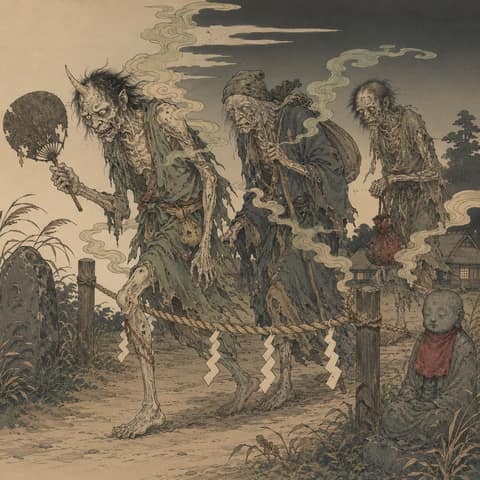
    An archaic image of the plague deity recognized in both court ritual and folk belief. Usually unseen, it gains force at seasonal turnings and when blossoms fall, entering through village bounds, crossroads, and riverbanks, spreading illness by seizing on household impurity and neglect. In paintings it appears as bands of oni-like or uncanny figures on the move, while tales say it stands at the door as a traveling old man or woman, disliking lapses in almsgiving or proper etiquette. Communal countermeasures include boundary festivals, rites of purification, offerings, displaying talismans, and sending off dolls, with porridge or other set foods prepared on fixed dates to ward it away. Its forms and names are not fixed, appearing in step with local customs and annual rites, so it varies by region, yet it is always told in connection with practices that “set the boundary and purge defilement.”

  • Fudo Myo-o

    Fudo Myo-o

    Divine

    fudo-myoo

    The Wrathful Avatar of Dainichi Nyorai

    神霊・神格インド密教 Acalanatha 由来、空海が請来した渡来尊

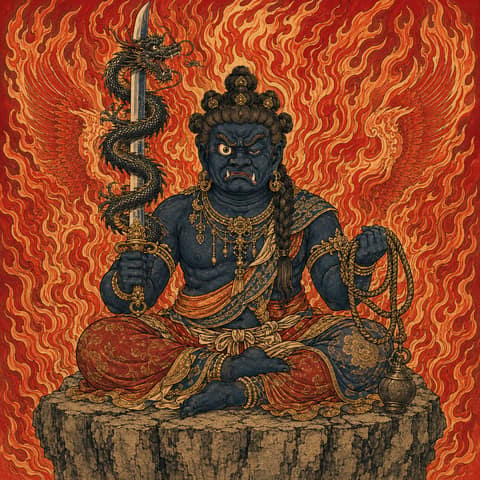
    The Theology of "Strict yet Gentle" Duality. The greatest iconographic and doctrinal feature of Fudo Myo-o is the intense contrast between his terrifying appearance and the profound compassion he harbors within. A Wisdom King (Myo-o) is a Buddha who deliberately transforms into a fearsome figure to persuade and instruct; Fudo Myo-o is thus another face of Dainichi Nyorai, the universe's ultimate truth. His wrath is not born of hatred toward evil, but rather an expression of the "extreme limit of compassion" to save wandering souls at any cost. This duality is the primary reason he gathered such broad worship across all classes, from strictly disciplinarian monks to anonymous commoners praying for daily peace. A Hybrid of Worldly Benefits and Memorial Services. Originally, in Esoteric doctrine, Fudo Myo-o was a spiritual pillar meant to lead practitioners to enlightenment. However, as he fused with Japanese indigenous beliefs, he assumed extremely pragmatic roles. From dispelling diseases to preventing fires, and even ensuring modern traffic safety, he acts as a "breakwater" against every threat in daily life. Simultaneously, in the Thirteen Buddhas belief system, he is deeply involved in memorial services for the dead, acting as the guiding deity for the first seventh-day mourning period. Thus, he transformed into an omnipotent guardian deity relied upon throughout the entire process from life to death. Fudo Myo-o and His Retainers. Fudo Myo-o is often depicted in a triad accompanied by Kongara Doji and Seitaka Doji, or surrounded by numerous retainers such as the Eight Great Youths (Hachidai Doji) or the Thirty-Six Youths. This illustrates how Fudo Myo-o's immense power was subdivided to build a system capable of meticulously addressing the diverse wishes of all people. The visual contrast of placing innocent, childlike attendants beside a terrifying central deity is also one of the unique aesthetic and religious expressions achieved by Japanese Buddhist art.

  • Fujin

    Fujin

    Legendary

    ふうじん

    Green Demon with a Wind Bag - Fujin

    Divine Spirits / DeitiesTatsuta Taisha (currently Sango-cho, Ikoma-gun, Nara Prefecture, the main shrine of the ancient Fujin Festival) / Kazemiya (currently Ise City, Mie Prefecture, a Betsugu of the Inner Shrine of Ise Jingu) / Kennin-ji (currently Higashiyama-ku, Kyoto City, Kyoto Prefecture, houses Tawaraya Sotatsu's "Fujin and Raijin Folding Screens")

    The true identity of Fujin is Shinatsuhiko-no-Kami (Shinatsuhiko, Shinatsuhiko-no-Mikoto), as recorded in the *Kojiki* and the *Nihon Shoki*. The first volume of the *Kojiki* (712) explicitly states in the god-birth section, "Next, they gave birth to the wind god named Shinatsuhiko-no-Kami," while in the *Nihon Shoki* (720), Volume 1, Section 5, the deity appears under multiple names such as Shinatobe-no-Mikoto and Shinatsuhiko-no-Mikoto. The divine name "Shina" (long breath) is an ancient Japanese word representing "breath/wind," and "tsu" (of) + "hiko" (male god) translates to "the male god of long breath," essentially the personification of breath and wind itself. The core of Fujin worship in the ancient state was Tatsuta Taisha (formerly Tatsuta Fujin-sha). Located in Heguri District, Yamato Province (now Tatsunominami, Sango-cho, Ikoma-gun, Nara Prefecture), it stands at a location directly hit by the strong downdraft winds (oroshi) blowing from the Ikoma Mountains into the Yamato Basin. The *Nihon Shoki* already mentions worshiping the "Fujin of Tatsuta" in the year 675 AD (Emperor Tenmu's 4th year). During the Ritsuryo period, the "Tatsuta Fujin Festival" was held by imperial decree every April (praying for favorable winds before the Niiname harvest festival) and July (before the typhoon season) as one of the Jingikan's Four Seasons Festivals. It was officially registered in the *Engishiki* (927) deity register as the Tatsuta Shrine Four Pillars (with Amenomihashira-no-Mikoto and Kuninomihashira-no-Mikoto as primary deities) and was highly regarded in state rituals as the wind god of bountiful harvests. From the Middle Ages, Fujin worship was succeeded by Kazemiya (Kazahinomi-no-miya) at Ise Jingu, Suwa Taisha (which enshrines Takeminakata but also holds Fujin aspects), Echizen Tsurugi Shrine, and Sada Shrine in Izumo. Iconographically, Tawaraya Sotatsu's "Fujin and Raijin Folding Screens" (circa 1620s, formerly at Kennin-ji in Kyoto, designated a National Treasure in 1952, currently deposited at the Kyoto National Museum) is the definitive work. On the two-panel, double-screen golden background, the Wind God on the right (a green demon wearing only a tiger-skin loincloth, carrying a wide-open wind bag on his shoulders) and the Thunder God on the left (a white demon carrying a circle of drums) face off, creating tension in the empty space between them. This composition is considered the pinnacle of the early Edo Rimpa school. Later, painters like Ogata Korin (1700s) and Sakai Hoitsu (1800s) left behind faithful copies of Sotatsu's original "Fujin and Raijin Folding Screens" (Korin's at the Tokyo National Museum, Hoitsu's at the Idemitsu Museum of Arts), which irreversibly cemented the standard imagery for Fujin in Japan. The wind bag held by Fujin traces its origins to the iconography of the Hellenistic Boreas (god of the North Wind). In ancient Greece, Boreas was depicted holding a wind bag open over his shoulders. Following Alexander the Great's eastern campaigns, this image was adopted into the Buddhist art of Gandhara in Central Asia, and it traveled along the Silk Road through China (as seen in the Fujin statues at the Mogao Caves in Dunhuang) and Korea, finally reaching Japan. Vāyu (Fujin) in Sanskrit belongs to the same lineage and is deified as "Futen" within the Twelve Devas of Esoteric Buddhism. Sotatsu's rendering of the wind bag represents the unique Japanese culmination crystallized at the very end of this long transmission. In folk religion, Fujin clearly displays ambivalent divine traits. The aspect of a calamitous deity (Akufujin) who summons typhoons, autumn gales, and storms coexists with the aspect of a benevolent deity (Zenfujin) who presides over the favorable winds sweeping across the fields during the wheat and rice harvests. Rituals embodied a dual structure of both pacifying and praying to these two sides. During the Edo period, the "sending away the god of colds" (when a cold circulated, a straw doll fashioned as Fujin, holding a straw hat and a lantern, was driven out to the village edge or a riverbank to the sound of gongs and drums) was widely practiced across the Tohoku, northern Kanto, and Hokushin'etsu regions, revealing his aspect as a god of pestilence personifying influenza. This is also important as the prehistory of modern public health awareness. In modern literature, Kenji Miyazawa's *Matasaburo of the Wind* (1934) adapted the legend of the "Wind Saburo" (wind-god boy tales passed down near Morioka and the Sanriku coast) in the Tohoku region, making the lineage of wind-child worship known nationwide. Post-war, the contrasting pairing of "Fujin and Raijin" became entrenched in games, anime, and manga (e.g., the Wind Fiend in Square's *Final Fantasy* series, themes in Studio Ghibli's *The Wind Rises*, various wind god summons), carrying the iconographic lineage that began with the National Treasure "Fujin and Raijin Folding Screens" into contemporary subculture.

  • Fukurokuju

    Fukurokuju

    Legendary

    ふくろくじゅ

    Three-Stars-in-One Long-Headed Deity, Fukurokuju

    Divine Spirit / DeityChina (Daoist Three Star Belief) / Introduced in the Muromachi Period / Shichifukujin Pilgrimage Sites in Kanto & Kinki (Zen & Obaku Sect Temples)

    Fukurokuju is the anthropomorphic deity that integrates the three Daoist stars of China (the Gods of Fortune, Wealth, and Longevity) into a single body. Among the three, the Star of Longevity (the Old Man of the South Pole = Canopus) is an ancient astronomical deity recorded in the astronomical chapters of the "Records of the Grand Historian" and the "Book of Jin," and a year in which it could be seen was said to augur world peace. The Star of Fortune was associated with Jupiter, and the Star of Wealth with the Wenchang star of the Big Dipper. Although each initially had its own independent following, the "Sanxingtu" (Three Stars Image), depicting them together, was established in the Song dynasty and popularized as New Year decorations for the masses throughout the Ming and Qing dynasties. The singular deity Fukurokuju is the anthropomorphized amalgamation of these three stars. Multiple origin tales coexist, including the theory that he is the incarnation of the Song Daoist Tiannanxing, and the theory that he is the incarnation of the Old Man of the South Pole himself. His iconography depicts him as short in stature with an unusually elongated head, bearing a long white beard, attaching a scroll to the head of his staff, and accompanied by a crane or turtle. This is the epitome of Daoist iconography: the "short body and long head" are physical auspices of long life, the scroll signifies the mastery of the Dao, and the crane and turtle represent auspicious beasts of longevity. Introduced to Japan in the late Muromachi period (15th century) likely through Zen monks' travels to China and imported Daoist-Buddhist paintings, the Zen and painter-monk circles of the Higashiyama culture period reorganized him into the "Seven Gods of Fortune and Virtue." By combining the already indigenized Ebisu, Daikokuten, Bishamonten, and Benzaiten with the fellow imported deities Hotei and Jurojin, they grouped them as the seven fortune deities styled after the Seven Sages of the Bamboo Grove—the prototype of the current Seven Lucky Gods. Fukurokuju's inherent dilemma lies in the problem of being the same entity under a different name as Jurojin; since both are incarnations of the Old Man of the South Pole, theories considering them the same deity have existed since ancient times. Although early modern popular encyclopedias like Kaibara Ekken's "Yamato Koto Hajime" list them as distinct entities, irregular Seven Lucky Gods variations replacing Jurojin with Kisshoten, Fukusuke, or Inari also circulated in Edo period Takarabune paintings. Because Fukurokuju simultaneously presides over three virtues (descendants, wealth, and longevity), he was favored for family celebrations by merchants and samurai. For longevity prayers by the clergy, however, Jurojin was often chosen. Their division of roles loosely converged in the late early-modern period as "the comprehensive fortune deity of the secular world (Fukurokuju)" and "the ascetic deity of longevity (Jurojin)."

  • Goho-doji (Ototen & Wakaten)

    Goho-doji (Ototen & Wakaten)

    Rare

    ごほうどうじ(おとてん・わかてん)

    The Two Youths Protecting Shoku Shonin: Ototen and Wakaten

    Deities / Divine SpiritsHyogo

    Ototen and Wakaten are a pair of *Goho-doji* (Dharma-protecting youths) who attended Shoku Shonin, the founder of Engyoji Temple on Mount Shosha. Ototen is said to be an incarnation of Fudo Myoo and Wakaten an incarnation of Bishamonten. In the forms of a blue ogre and a red ogre respectively, they protected the holy man on his left and right, fetching firewood and water and repelling enemies during his mountain asceticism. They embody the inherent duality of *Goho-doji*—fierce ogre-deities who nevertheless submit to a holy monk and protect the Buddhist teachings—within the context of Harima's mountain Buddhism. They are still enshrined today in the Ototen Shrine and Wakaten Shrine (built in 1559, Important Cultural Properties) next to the Okunoin of Engyoji Temple. Subjugating fierce power and turning it toward good—these child-formed ogre-deities commanded by highly virtuous ascetics reflect the religious imagination of medieval Japan.

  • Gozu Tenno

    Gozu Tenno

    Divine

    ごずてんのう

    Gion's Supreme Plague-Dispelling Deity - Gozu Tenno

    Divine Spirit / DeityKyotoAichi

    Gozu Tenno (also known as Mutō-no-Kami) is a uniquely Japanese deity whose existence is unconfirmed in foreign lands like India, China, or Korea. Several theories regarding his origin coexist and remain academically unconfirmed: 1) A Buddhist origin theory claiming he is the guardian deity of Jetavana (an ancient Indian monastery where Shakyamuni preached). The name 'Gozu' (ox head) is said to derive from Mount Gośīrṣa in Magadha, India, known for sandalwood, where a guardian named 'Gozu Tenno' was purportedly worshipped. 2) A Korean Peninsula origin theory attributing him to Mount Sudusan, introduced to Japan by ancient Korean immigrants (related to Mount Gozu where Dangun descended in Korean founding myth). 3) A syncretic theory suggesting he is an ancient Japanese immigrant/agricultural deity (the ox being a symbol of farming) reinterpreted through Buddhism and Taoism. Though conclusive evidence is lacking, immigrant influence and his later syncretism with Susanoo-no-Mikoto are the prevailing views from the Middle Ages onward. The core narrative of his worship is the Somin Shōrai legend found in the 'Bingo-no-kuni Fudoki' (compiled in the early 8th century, now surviving only as fragments cited in the 'Shaku Nihongi'). While traveling to the Southern Sea to marry the Dragon King's daughter, Mutō-no-Kami (= Gozu Tenno; 'Mutō' is also theorized to derive from the ancient Indian Maheśvara) sought lodging at the home of the brothers Kotan Shōrai and Somin Shōrai in Bingo Province (modern-day eastern Hiroshima). The wealthy elder brother, Kotan Shōrai, refused him, while the poor younger brother, Somin Shōrai, welcomed him with a humble meal of millet. Years later, Mutō-no-Kami returned with his eight divine children and told Somin Shōrai, 'Wear a woven reed ring (chinowa) around your waist and chant "I am a descendant of Somin Shōrai" to escape the plague,' before departing. The next day, Kotan Shōrai's entire family was wiped out by the plague, while Somin Shōrai's family survived thanks to the chinowa. This is the origin of the 'Amulet of Somin Shōrai's Descendants' (an amulet placed at doorways) and the 'Chinowa-kuguri' (a purification ritual held at the end of June), rituals still performed at Gion shrines, Tenno shrines, and Ise Jingu nationwide. Kyoto's Yasaka Shrine (formerly Gion Shrine / Kanjin-in Gion Shrine / Gion Kanjin-in) is the hub of Gozu Tenno worship. The shrine's history holds multiple theories: 1) Founded in 656 by the Korean envoy Irishi, who enshrined Susanoo from Mount Gozu (most plausible); 2) Enshrined by Ennyo, a monk from the southern capital, in 876; 3) The Imperial Court began praying at Gion during the great plague of 869 (the origin of the Gion Goryo-e). Ranked among the twenty-two elite shrines during the Heian period, the Gion Shrine became the most critical religious center for the Imperial Court, nobility, and Kyoto's citizens. The Gion Festival was established in 869 as a ritual for Gozu Tenno (= Susanoo) to ward off plagues and is one of Japan's three major festivals (alongside the Aomori Nebuta and Awa Odori). When a massive plague swept Kyoto and the nation in 869, the Imperial Court ordered prayers at the Gion Shrine. They created 66 halberds (hoko) representing the 66 provinces of the time to gather the plague gods, then banished them to Shinsen-en (modern-day Nakagyo-ku, Kyoto) — an event known as the 'Gion Goryo-e.' It evolved through the medieval and early modern periods, establishing the Yamahoko float procession, folding screen displays, and Yoiyama eves during the Muromachi period. It is now a month-long summer hallmark of Kyoto and was registered as a UNESCO Intangible Cultural Heritage in 2009, representing the pinnacle of Kyoto's tourism resources. Among other major centers of Gozu Tenno worship, Hiromine Shrine (Hiromineyama, Himeji City, Hyogo Prefecture; supposedly founded by imperial decree of Emperor Shomu in 733, with alleged involvement by Kibi no Makibi) claims to be the 'Head Shrine of Gozu Tenno,' asserting that Kyoto's Gion Shrine was established as a branch of Hiromine. However, due to lengthy medieval and Edo-period disputes over hierarchy among Kyoto's Gion, Hiromine, Tsushima, and Yasaka, the academic consensus on the 'true head shrine' remains undetermined. Tsushima Shrine (Tsushima City, Aichi) serves as the core of Gozu Tenno worship in the Tokai region, with its Tenno Festival (August) being one of Japan's three major river festivals. The countless shrines nationwide bearing the names 'Tenno', 'Yakumo', 'Gion', 'Susanoo', or 'Hikawa' demonstrate the vast spread of Gozu Tenno worship. With the Shinto-Buddhism Separation Order of the Meiji Restoration (1868) and the abolition of Shugendo (1872), the Buddhist title 'Gozu Tenno' was banned, and all Gozu Tenno, Tenno, Gion, and Kanjin-in shrines were forcibly renamed as shrines dedicated to Susanoo-no-Mikoto. Kyoto's Gion Kanjin-in became 'Yasaka Shrine,' while local shrines were renamed to Yasaka, Susanoo, Hikawa, or Gion shrines. However, commoners retained colloquial names like 'Tenno-san' and 'Gion-san,' and folk customs such as passing through the chinowa, the Somin Shōrai amulets, and the Gion Festival persisted seamlessly. During the modern COVID-19 pandemic (2020-), the Gion Festival and chinowa rituals regained attention, reawakening memories of Gozu Tenno as the deity of plague dispellment. In folklore and religious history, he is positioned as 'the greatest victim of the Shinto-Buddhism separation.'

  • Hachiman

    Hachiman

    Divine

    hachiman

    Triune Guardian of War and State

    神霊・神格Oita

    A Hybrid Deity Integrating the Emperor, Samurai, and Buddhism. The essence of Hachiman lies in his astonishing "ability to update (history of syncretism)." Starting out as an obscure local indigenous deity of blacksmiths and mines, he saved a national crisis (the construction of the Great Buddha) to become a protector of Buddhism (Bodhisattva). He then syncretized with the spirit of Emperor Ojin to connect with the imperial family's ancestral gods (imperial authority), and ultimately became the guardian deity of the samurai class leader (the Minamoto clan) who seized power by force. Hachiman is present at every node in the transformation of Japan's power structure (from emperor/aristocrats to samurai, and the fusion of Shinto and Buddhism). He is the "ultimate hybrid divinity" born from the complex intertwining of the Japanese people's views on religion and the state. The Terror of Political Intervention via Oracles. What is particularly noteworthy in ancient Hachiman worship is that he frequently intervened directly in national politics through "oracles" delivered by shrine maidens (spirit possession). In the most famous incident, the "Usa Hachimangu Oracle Incident" (the Dokyo Incident), against the monk Dokyo who plotted to usurp the imperial throne, Hachiman delivered a fierce oracle: "No one other than the imperial lineage shall become emperor," thereby preventing the subversion of the state. He is not merely a god who watches over silently; in times of national crisis, he is an intensely political and raw god of power who possesses a strong will and intervenes on the main stage of history. Ancient Memories Hidden within "Himegami". Among the Hachiman Triad, the entity preserving the oldest form of worship is the unidentified "Himegami" (Goddess). Although generally interpreted as the Three Goddesses of Munakata (gods of maritime safety), in folklore studies, a prominent theory suggests she is the deification of ancient shamans (shrine maidens) from the Usa region, or that she retains the form of the "primordial local land deity (indigenous goddess)" from before Hachiman syncretized with Buddhism and the imperial spirit. Sitting quietly in the shadows of the massive, subsequently attached authorities of the War God and the Imperial Ancestral God, the very existence of Himegami is the secret to why the Hachiman faith was never completely swallowed by the state and maintained its vitality as a foundational local belief.

Showing 1 - 24 of 85 yokai