Yokai Encyclopedia

Encyclopedia of Japanese Yokai

85 Yokai|14 Category|Page 4 of 4
Localization in Progress - More content available in Japanese version
View Japanese
Sort by: NameAscending
神霊・神格
  • Takemikazuchi

    Takemikazuchi

    Legendary

    たけみかづちのかみ

    God of Thunder, Swords, Martial Arts, Sumo, and Earthquake Pacification

    Divine Spirit / DeityIbaraki

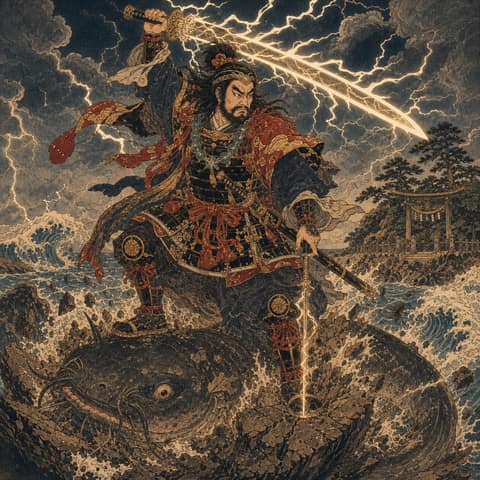
    The Unique Position of the 'God of War'. While many deities in ancient Japanese mythology center around agriculture and nature, Takemikazuchi uniquely symbolizes 'war, swords, power, and conquest' as a rare male war god. This reflects Japan's complex history of unification through military force, symbolizing the justification and sanctification of military power in ancient national mythology. The Kuniyuzuri Myth ── Mythologization of Ancient Political History. The test of strength with Takeminakata mythologically represents the political integration of the central Yamato court and the regional Izumo and Suwa factions. The narrative of deciding matters through a legitimate trial of strength rather than sheer oppression served to secure religious justification during this integration process. The Ancestral God of Ancient Military Clans. The Futsu-no-Mitama sword became the core of worship for the Mononobe clan, the ancient military clan of Japan. Takemikazuchi concurrently supported the tutelary worship of both the Nakatomi/Fujiwara and Mononobe clans, making him a central figure in ancient Japanese religion, politics, and military affairs. The Two Great Shrines of Kashima and Katori. Kashima Shrine and Katori Shrine have historically formed the core of ancient military worship in the Kanto region. They served as the highest religious authorities in eastern Japan, standing alongside Ise and Izumo in the ancient Shinto shrine system. Earthquake Pacification. The Kaname-ishi (Keystone) belief at Kashima Shrine added a new attribute to Takemikazuchi as a guardian against earthquakes. This represents a significant evolution of an ancient mythological deity into a figure of early modern disaster folklore. Two Thousand Years of Sumo. The religious essence of sumo, persisting from ancient court rituals to the modern Grand Sumo, stems from Takemikazuchi's mythological origins. Sumo remains a rare example of a globalized sport retaining its ancient mythological roots. Takemikazuchi in the 21st Century. Today, he is revered as a guardian of martial artists, the ancestral god of sumo, and a protector against disasters. As Japanese martial arts spread globally, his worship garners international attention as the religious origin of these disciplines.

  • Takeminakata

    Takeminakata

    Divine

    takeminakata

    Suwa Myojin: The Independent King of Water and War

    神霊・神格Nagano

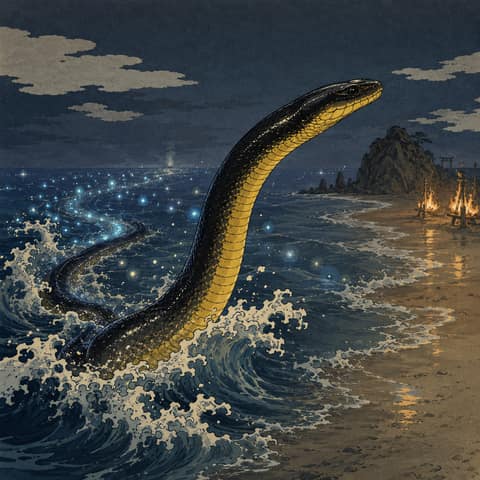
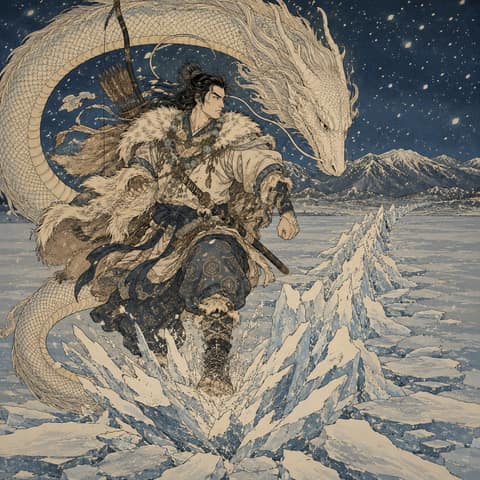
    Identity as the Resisting God. Takeminakata is the only rebellious deity who attempted physical resistance against the order of the heavenly realm (Takamagahara). The essence of "resistance against centralization" and "regional independence (indigeneity)" is deeply etched into his nature. His defeat and confinement in Suwa serve as a metaphor for the Yamato Kingship's pacification of the Japanese archipelago; yet, within the enclosed basin of Suwa, he never withered away. Instead, he cultivated a fierce, indigenous energy (epitomized by the frenzied Onbashira festival) powerful enough to surpass external authority. He possesses a dark hero-like charm—"defeated, yet unyielding"—which is exceptionally rare in Japanese mythology. Manifestation as a Dragon God (Water God). Takeminakata is also frequently spoken of in the form of a massive dragon or snake god dwelling in Lake Suwa. The natural phenomenon known as "Omiwatari," where the lake freezes completely in winter and the ice violently cracks and buckles upward with a roaring sound, is believed to be the trail left by Takeminakata (Kamisha) visiting his consort, Yasakatome-no-kami (Shimosha). For ages, this has been an important ritual for predicting the year's fortunes and agricultural yields. His power as a dragon god who controls wind and rain to bring water was an object of absolute awe and gratitude in agrarian societies. The Onbashira Festival and the Regeneration of Energy. Essential to the discussion of Takeminakata's worship is the "Onbashira Festival," an extraordinary nationwide festival held every seven years. Massive logs are cut from the mountains, ridden down steep slopes at the risk of people's lives (Ki-otoshi), and erected at the four corners of the shrines. This savage festival is the crystallization of indigenous tree worship—such as that of Mishaguji—and the ferocious martial spirit of Takeminakata. By periodically replacing the massive trees that house the divine spirit, the god's energy is regenerated and amplified, imparting vitality to the earth. It powerfully conveys the zenith of animism continuing from ancient times into the present day.
  • Toyotama-hime

    Toyotama-hime

    Divine

    とよたまひめ

    Grandmother of the Imperial Line

    Divine Spirit / Sea DeityNagasaki

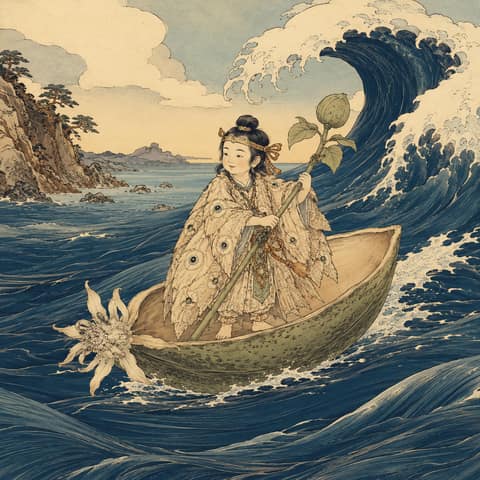
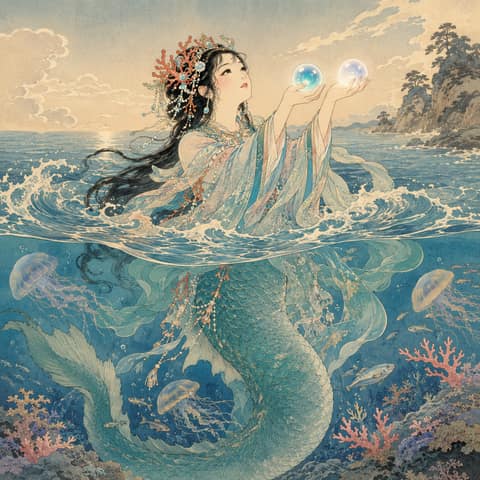
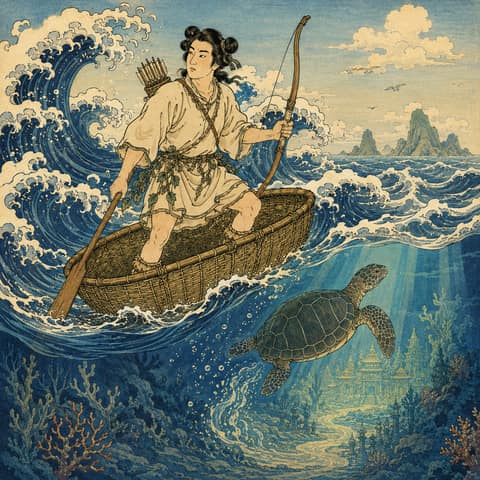
    Taking the form of a giant shark (eight-fathom wani) in the *Kojiki* and a dragon in the *Nihon Shoki*, she is the grandmother of the first emperor and the maternal origin of the seafaring Azumi clan. A sacred deep-sea shrine maiden symbolizing pearls, whose legends live on in Udo Jingu's Breast Rock and Watadzumi Shrine.

  • Treasure Ship

    Treasure Ship

    Divine

    TAH-kah-rah-boo-neh

    Traditional Version (Treasure Ship Print)

    Deities & Divine SpiritsAcross Japan

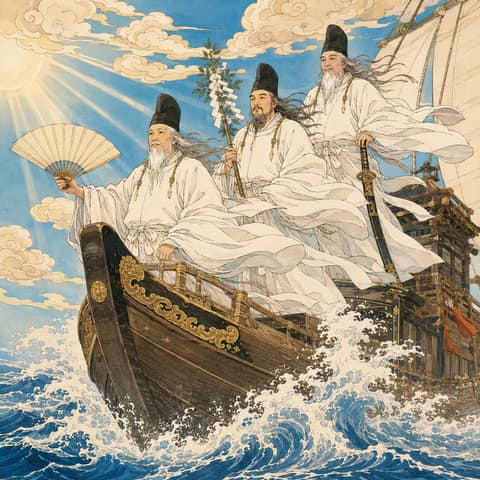
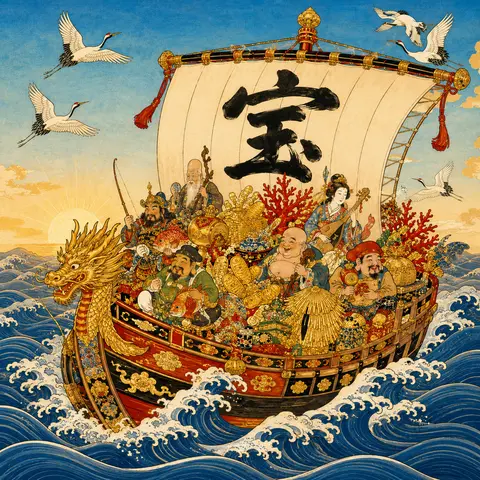
    The Treasure Ship print traces back to boat images used to cast off bad dreams, circulated through urban and temple–shrine annual events. By the early modern period, designs commonly featured the Seven Lucky Gods and heaps of treasures, with auspicious characters on the sail to amplify good omens. Appending a palindrome verse tied it closely to first-dream traditions, preserving the logic of keeping a good dream and consigning a bad one to the river. While designs vary by region and publisher, the print uniquely combines two layers of meaning: inviting fortune and transferring or dispelling impurity. Folklorically, it links to New Year’s purification from year’s end through the first week, backed by its spread as an urban print commodity, ties to temple and shrine origin tales, and the vogue for Seven Lucky Gods as playful stand-ins.

  • Tsukuyomi-no-Mikoto

    Tsukuyomi-no-Mikoto

    Legendary

    つくよみのみこと

    God of Night, Moon, and Calendar: Tsukuyomi-no-Mikoto

    Divine Spirit / DeityNagasaki

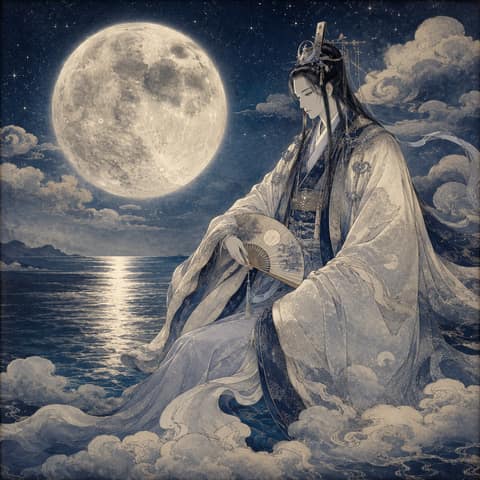
    Tsukuyomi's Position Among the Three Precious Children. While the basic description touches upon Tsukuyomi's primary myth, this detailed explanation delves into the deity's unique structural position within the "Three Precious Children" (Mihashira-no-uzu-no-miko). The tripartite rule by Amaterasu Omikami (Takamagahara, day, light), Tsukuyomi (Yoru-no-Oskuni, night, moon), and Susanoo-no-Mikoto (the sea, untamed force) established the three domains of day, night, and wild power in ancient Japanese cosmology. However, Tsukuyomi alone has almost no detailed mythological narratives throughout the *Kojiki* and *Nihon Shoki*, disappearing from the center of the story immediately after being entrusted with the "Yoru-no-Oskuni." The discrepancy between the high structural position as the middle child and the sparsity of mythological activity is a major point of discussion in the study of ancient Japanese mythology. The Slaying of Ukemochi — A Contrast with the Kojiki. Tsukuyomi's primary mythological tale, the slaying of the food deity Ukemochi, is recorded only in the *Nihon Shoki* and does not appear in the *Kojiki*. In the *Kojiki*, this identical narrative motif is performed by Susanoo-no-Mikoto against Ogetsuhime. This indicates that ancient Japanese mythology possessed a single narrative template for the "origin of grain = five cereals sprouting from a deity's corpse," which was assigned to different deities (Susanoo vs. Tsukuyomi) in the two texts. The difference in this allocation is a vital piece of evidence for examining the compilation process, variant transmissions, and cosmological consistency of ancient Japanese myths. The editorial intent of the *Nihon Shoki* in assigning the Ukemochi murder to Tsukuyomi is interpreted as an effort to emphasize the connection between the moon and the agricultural calendar. Comparative Religion of a "Quiet Deity". Tsukuyomi's "quiet, reclusive" personality is unique even when compared to lunar deities worldwide. From Selene and Artemis in Greece, to Luna in Rome, the Persian moon god Māh, the Chinese lunisolar calendar, and Korean lunar spirits, moon deities across the ancient world are often depicted as highly active and central figures. In contrast, Japan's Tsukuyomi is rare for having few myths and an emphasized serene, introverted, and mediatory nature. Scholars such as Shinobu Orikuchi and Eiichiro Ishida deciphered this characteristic, concluding that "the Japanese moon deity has a 'watchful' nature," and organized the ancient Japanese relationship with the moon not as one of "direct worship" but as a connection of "quiet watchfulness." Moon and Immortality Beliefs — Okinawa and East Asian Comparisons. Nikolai Nevsky, Shinobu Orikuchi, and Eiichiro Ishida positioned Tsukuyomi's primitive attributes within the broader East Asian beliefs linking the "moon and immortality". In Okinawa and the Ryukyu Islands, there is a tradition of "Sudemizu" (water of molting or rejuvenation), a water of immortality bestowed upon humanity from the moon, indicating a symbolic link between the moon's "molting" (the cycle from full moon to new moon) and immortality/rebirth. Similar "moon and immortality" beliefs are distributed across China, Korea, Mongolia, and Southeast Asia, framing the prototype of Tsukuyomi as a Japanese variation of this widespread belief system. The moon's periodicity, its association with feminine tides, the agricultural calendar, and the mystery of its waxing and waning all multi-layered the ancient faith. Gassan Shrine and Shugendo. Gassan Shrine in Yamagata Prefecture, a former Kanpei-taisha (Imperial shrine, 1st rank), served as the core of the Three Mountains of Dewa (Mt. Haguro, Mt. Gassan, Mt. Yudono) and became a center for mountain worship and Shugendo from the Heian period onward. Mt. Gassan is an extinct volcano standing 1,984 meters tall, where Shugendo practitioners envisioned a "Pure Land where Tsukuyomi resides" at the summit, aiming for the rebirth of the soul through rigorous mountain asceticism. Within Shugendo, Tsukuyomi developed uniquely as a deity symbolizing the "moon of death and rebirth," occupying a significant position within the complex evolution of mountain worship, Shugendo, and Pure Land Buddhism during the Heian, medieval, and early modern periods. Even today, the "Gassan-mode" (pilgrimage to Mt. Gassan) is carried on as a symbolic custom of Tohoku folklore and Shugendo. The Geography of Tsukuyomi Shrines. The enshrinement sites of Tsukuyomi are distributed across four main lineages: (1) Gassan Shrine in Yamagata Prefecture (Tohoku mountain worship); (2) Tsukiyomi Shrine in Kyoto (central Shinto under the ancient Ritsuryo system); (3) Tsukiyomi-no-miya and Tsukiyomi-no-miya as auxiliary shrines of the Inner and Outer Shrines at Ise Jingu in Mie Prefecture (State Shinto and the Ise Jingu system); and (4) Tsukiyomi Shrine in Iki City, Nagasaki Prefecture (the oldest Tsukuyomi shrine in Japan, tracing the Korean Peninsula route). The Kyoto shrine is considered to have derived its spirit from the Iki shrine, serving as valuable folkloric-geographical evidence showing the route through which lunar worship originating from the continent and the Korean Peninsula was transmitted to ancient Japan. This demonstrates that Tsukuyomi worship is not an isolated phenomenon unique to Japan but the result of formation within a broad East Asian network of lunar beliefs. Tsukuyomi in the 21st Century. In postwar Japanese subculture works—such as the *Megami Tensei* game series, *Okami*, and the "Moon Breathing" in the manga *Demon Slayer*—Tsukuyomi's attributes of tranquility, mystery, isolation, and dark-night moonlight have a high affinity with modern character design. The symbolic deity of "night, moon, tides, calendar, and immortality" in ancient Japanese cosmology continues to acquire new meanings in the 21st-century era of globalization, space exploration, and social media. Pilgrimages to Mt. Gassan, Ise, and various Tsukiyomi shrines are inherited today, and the serene, mysterious lunar faith has been deeply rooted in the spiritual culture of the Japanese from ancient times to the present. The fact that the deity with the least mythological activity continues to live on in the most serene form within modern Japanese spiritual culture symbolizes the profound wonder of how mythological culture is passed down.

  • Ubagami

    Ubagami

    Divine

    Ubagami

    Ubagami, the Old Goddess Who Saves the Women of Tateyama

    Deity / Divine SpiritToyama

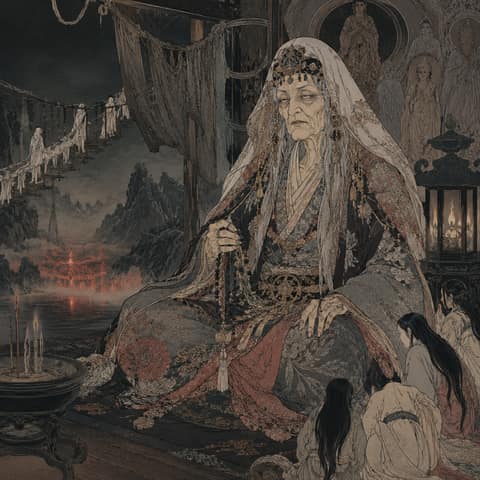
    Ubagami is not a mere yōkai, but a divine entity embodying the very structure of Tateyama—a sacred mountain where Hell and the Pure Land coexist. In the Tateyama Mandala, Ubagami is depicted alongside underworld motifs such as Sai-no-Kawara (Children's Limbo), the Sanzu River, and the Blood Pool Hell. She possesses two faces: that of Datsueba, who judges the dead, and that of a savior who sends women off to the Pure Land. From the Middle Ages onward, the Blood Bowl Sutra (Ketsubonkyō) faith propagated the belief that women were destined to fall into the Blood Pool Hell due to the supposed impurity of childbirth. Amidst this profound terror, Ubagami functioned as the sole savior for female believers. It is said that the sixty-six statues lined up in the Ubadō of Ashikuraji reflect the "Sixty-Six Provinces Pilgrimage" (Rokujūrokubu), an ancient practice of dedicating one copy of the Lotus Sutra to each of Japan's sixty-six historical provinces. During the Nunobashi Kanjō-e, the experience of crossing the bridge blindfolded and praying in the darkness is nothing less than a ritualistic death and rebirth—letting one's earthly self die temporarily in order to be reborn anew before Ubagami. The tradition identifying her as the wife of Enma Daio creates a complementary dynamic: while the husband acts as the King of Hell who judges the dead, the wife, Ubagami, serves as the compassionate mother who saves women. This interplay brings a sense of yin-yang balance to the underworld cosmology of Tateyama.

  • Umisachihiko

    Umisachihiko

    Divine

    うみさちひこ

    Elder Brother of Sea Bounties & Hayato Ancestor, Umisachihiko

    Divine Spirit / DeityMiyazaki

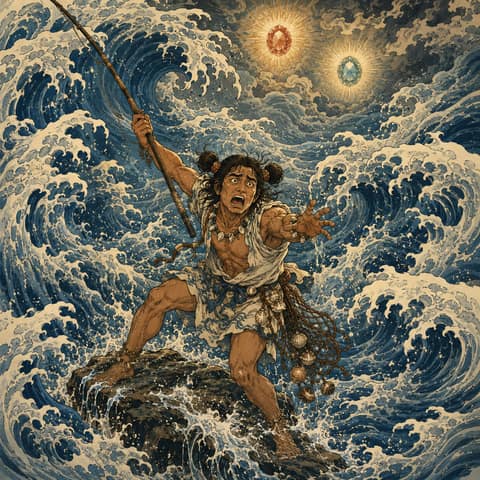
    The true identity of Umisachihiko is Hoderi-no-Mikoto, the protagonist of the final section of the upper volume of the Kojiki and the tenth section of the Age of the Gods in the Nihon Shoki (also known as Honosusori-no-Mikoto in the Nihon Shoki). Born in a fire, he is the eldest of three sons of Ninigi-no-Mikoto (the Heavenly Grandson) and Konohanasakuya-hime (daughter of Oyamatsumi-no-Kami). The middle son is Hosuseri-no-Mikoto, and the youngest is Hoori-no-Mikoto (Yamasachihiko). The prefix "Ho" (fire) in all three names stems from the myth that their mother gave birth in a blazing delivery room to prove her purity after a single night's conception. The name "Hoderi" means the most intense stage of fire, while "Honosusori" similarly implies the height of flames. The common name "Umisachihiko" is an occupational title meaning "the male deity who presides over the bounties of the sea," indicating his role as a god of fishing. The core of his story lies in his position as the older brother in the myth of Umisachihiko and Yamasachihiko. Umisachihiko presided over the sea's fish, while Yamasachihiko presided over the mountain's game, each making a living with their respective tools. One day, Yamasachihiko exchanged tools with his brother and went to the sea, but lost the fishhook. The older brother strictly refused, saying, "Return the original fishhook, I will not accept any other," and even rejected a thousand replacement hooks. Yamasachihiko then went to the sea palace of Watatsumi, received the tide-flowing and tide-ebbing jewels, and returned to hand back the hook while chanting a curse. Thereafter, Umisachihiko gradually became impoverished. Holding a grudge, he attacked Yamasachihiko, but Yamasachihiko used the tide-flowing jewel to drown him, then used the tide-ebbing jewel to save him when he begged for his life. By repeating this, he forced Umisachihiko into submission. Umisachihiko finally swore to serve Yamasachihiko eternally as a "person of wazaogi" (entertainer). It is one of the most dramatic sibling tales in the Kojiki and Nihon Shoki, epitomizing ancient curse culture, divine manifestations, and submission rituals. Umisachihiko is positioned as the ancestral deity of the Hayato people in southern Kyushu. The Hayato were indigenous people living in ancient Satsuma, Osumi, and southern Hyuga, who served the court as guards, ritualists, and performers under the Ritsuryo system. The myth of his submission created a decisive asymmetrical structure: Yamasachihiko became the grandfather of Emperor Jimmu (the direct ancestor of the imperial line), while Umisachihiko became the ancestor of the subjugated border people. This is academically interpreted as the political mythologization of the 7th-8th century Ritsuryo state's subjugation of southern Kyushu. The "Ashiura" gestures Umisachihiko made while drowning—rubbing his feet, chest, and cheeks—are said to be the origin of the Hayato-mai, a court ritual. The Hayato-mai was a dance performed by the Hayato for the emperor during the Daijosai, Niinamesai, and New Year ceremonies. The Engishiki records its movements, which are partially inherited by the modern Imperial Household Agency. Thus, his submission myth functioned as the mythological basis for ancient Japanese court rituals. The center of his worship is Ushiodake Shrine (Kitago, Nichinan City, Miyazaki), the only shrine nationwide where he is enshrined as the primary deity. It is said to be located where he arrived after losing to his brother, symbolizing the localization of his legend. The fact that the shrine is located in the mountains, away from the sea, reflects the folklore interpretation of Umisachihiko being "driven into the mountains as a loser" and the geographic distribution of Hayato clans. The asymmetry between Yamasachihiko being enshrined in three major shrines and Umisachihiko in only one vividly reflects the myth's dominance/submission structure in shrine worship. In folk belief, he is deeply worshipped as a local guardian of fishing, maritime transport, and Hayato-lineage clans, especially in southern Miyazaki and Kagoshima. Modern discussions re-evaluate his "tale of the loser," deconstructing the central vs. border dichotomy. In pop culture, he frequently appears alongside his brother as the tragic older brother.

  • Yamasachihiko

    Yamasachihiko

    Divine

    やまさちひこ

    Amatsuhikohikohohodemi-no-Mikoto

    Divine Spirit / DeityMiyazaki

    Also known as Amatsuhikohikohohodemi-no-Mikoto. In the Umisachi-Yamasachi myth, he visited the sea palace guided by Shiotsuchi-no-Kami. He married Toyotamahime and used the tide jewels to subjugate his brother. Breaking the taboo of looking led to his wife's departure, but their lineage established the imperial family tree. Venerated at Udo Shrine.

  • Yamata no Orochi

    Yamata no Orochi

    Divine

    Yamata no Orochi

    Serpent God of Izumo's Hii River: Yamata no Orochi

    Divine spirit / serpent deityShimaneHiroshima

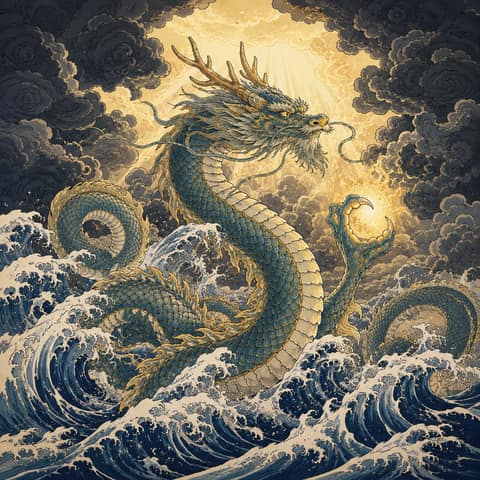
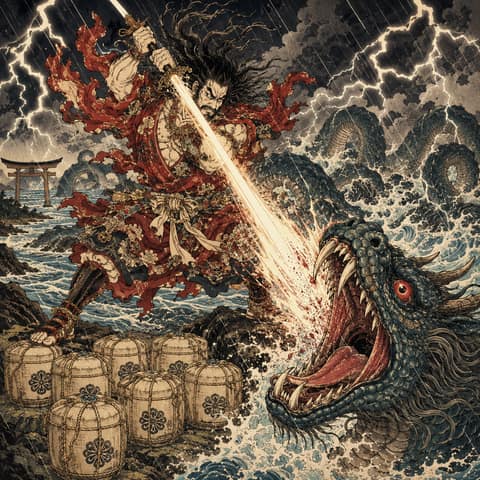
    Orochi is more than a snake. The old word orochi is often explained as combining a term for peak or ridge with chi, a word for spirit-power. The Kojiki describes moss, cypress, and cedar growing on the serpent and a body spanning eight valleys and eight ridges. That is closer to a living mountain range than to an animal. Other Japanese serpent-slaying tales, from Koga Saburo at Suwa to the Yahiko serpent of Echigo and the Aso traditions around Takeiwatatsu, can be read in the same serpent-deity line. The Kojiki's account of Omononushi in the reign of Sujin, where a god appears as a snake, forms another great pole of ancient Japanese serpent worship. Sand iron and the bloody riverbed. Oku-Izumo was a center of sand iron and tatara smelting. Kanna-nagashi washed mountain soil through channels, separating sand iron and staining riverbeds with red earth and iron. The Kojiki's image of Orochi's belly as always bloody and raw can therefore be read as the mythic language of a red river. Furnace fire, the relative independence of ironworking groups, and the seizure of good blades by central power all make the ironmaking reading persuasive. Mizu no Bunka issue 54 presents this as one of the key local theories. The repeated eight. Yamata, eight heads and eight tails, eight valleys and eight ridges, yashiori sake, eight vats, and the "Yakumo tatsu" poem all make eight the story's organizing number. It may mean literal eight, sacred multiplicity, or both. The eightfold fence around Kushinada-hime gives the number a ritual and spatial force. Even the placement of the tale in book one, section eight of the Nihon Shoki has invited speculation, though that remains an inference about editorial intent. Izumo drawn into Yamato myth. Orochi's defeat can also be read politically. A serpent deity of Izumo is slain by Susanoo from the Takamagahara sphere, and the treasure inside its tail enters the imperial regalia. The later kuni-yuzuri myth of Okuninushi follows the same broad problem: how Izumo is brought into the central mythic order. The Izumo no Kuni no Miyatsuko lineage claims descent in the Susanoo line while serving Okuninushi's cult, so the story survives both as a myth of conquest and as Izumo's own ritual memory. Iwami Kagura keeps the serpent moving. Iwami Kagura's Orochi turns the ancient myth into a present-day bodily performance. Paper-and-bamboo serpent bodies coil and strike across the stage, and several serpents may fight at once. Once an offering at shrine festivals, the performance also became a postwar attraction and regional symbol. What the audience sees is not an abstract myth, but the way Izumo and Iwami continue to tell the serpent story through movement, sound, and spectacle.

  • Yamato Takeru

    Yamato Takeru

    Legendary

    Yamato Takeru

    Yamato Takeru, the tragic hero and greatest warrior of ancient Japan

    Divine spirit / deified heroShiga

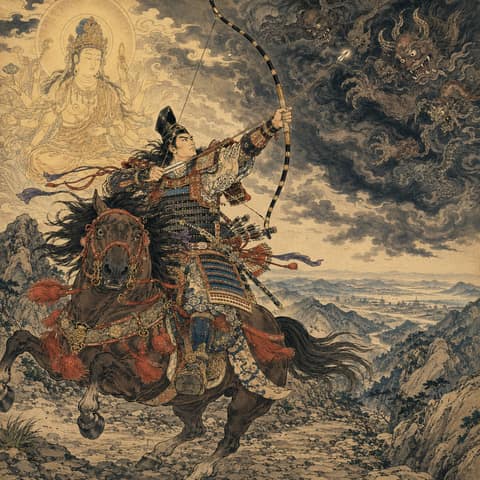
    The ancient mythic type of the tragic hero. The general entry covered Yamato Takeru's myth. Here the focus is the ancient pattern of the tragic hero. Yamato Takeru is a rare heroic deity who unites the tragic hero, short-lived warrior, father-son conflict, sacrificial love, and ascent after death in a single figure. He begins with fratricide, is rejected by his father and sent on campaigns, survives through his wife's sacrifice, and dies from a mountain god's curse. That arc is structurally close to tragic heroes across the ancient world, including Heracles, Sigurd, and Arjuna. It is a Japanese form of a widespread story pattern: the fate, suffering, and heavenly transformation of the hero. Father-son conflict and the myth of heroic exile. Yamato Takeru is estranged from Emperor Keiko and repeatedly ordered to go on distant campaigns. In comparative mythology, this belongs to the broad pattern of a dangerous son being exiled, tested, and made to conquer. Stories in which a father or ruler sends such a figure away are often compared with traditions surrounding David, Sigurd, and Zheng He, and they reflect questions of patriarchy, succession, and kingship. The tale marks the killing of the brother as a failure of human restraint, yet it also shows the father's coldness. That double structure gives the story a tragic intelligence beyond simple good and evil. Disguise as a young woman: strategy turned into myth. In the Kumaso episode, Yamato Takeru disguises himself as a young woman, enters the enemy camp, and kills the chieftain. The scene is a memorable mythic rendering of military strategy, disguise, and surprise attack. Yet the female disguise is more than tactics. In ancient Japanese myth and folklore, reversal, thresholds, and the crossing of gendered boundaries can be sources of ritual power and sacred danger. Yamato Takeru's disguise can therefore be read not simply as deception but as an act that embodies the magical force of inversion. It also stands as a mythic ancestor to later religious and theatrical traditions of cross-gender performance in kagura, noh, and kabuki. The Kusanagi sword and the Three Sacred Treasures. Yamato Takeru receives the Kusanagi sword from Yamato-hime, escapes the Yaizu fire with it, and after his death the sword is enshrined at Atsuta Jingu. Kusanagi is one of the Three Sacred Treasures at the core of ancient Japanese royal legitimacy. Its transmission runs from Susanoo's defeat of Yamata no Orochi, to presentation to Amaterasu, to the heavenly descent of Ninigi, to Yamato-hime, to Yamato Takeru, and finally to Atsuta Jingu. Through that chain, myth, sacred object, and imperial lineage are joined in material and religious form. Yamato Takeru is one of the few figures who actually uses a sacred treasure in battle, making him a symbol of the union of artifact, hero, and state. Ototachibana-hime's sea sacrifice and the origin of Azuma. Ototachibana-hime's self-sacrifice at sea and Yamato Takeru's cry, "Azuma haya," are treated as the mythic origin of Azuma, the eastern lands and eastern Japan. Ancient myth did not only entertain; it gave meaning to names, geography, land, and local custom. Here a woman's sacrifice becomes attached to the name of the entire east. Hashirimizu Shrine in Yokosuka still enshrines Ototachibana-hime, showing that the episode continues not only in texts but also in place names, worship, and local memory. The death poem and ancient Japanese longing for home. The death poem Yamato Takeru sings at Nobono, "Yamato wa kuni no mahoroba," has long been cherished as one of ancient Japan's foundational expressions of homeland, longing, and love of country. Mahoroba means an excellent, beautiful place, and the word condenses an early feeling for the homeland and the land itself. It influenced later waka traditions such as the Man'yoshu, Kokinshu, and Shinkokinshu. The structure is powerful: a hero at the edge of death praises the place he longs to return to. In modern Japan, the poem has continued to appear in education, literature, music, and public speech. The white-bird legend and ancient Japanese ideas of ascent and rebirth. After death, Yamato Takeru becomes a white bird, rises from his tomb, passes through Kotohiki-no-hara in Yamato and Shiki in Kawachi, and flies high into the sky. The legend is a representative example of the ancient Japanese idea that a hero may ascend and be transformed after death. In early Japan, the white bird could be imagined as a bearer of souls or a messenger of the gods. Beliefs in the dead soul becoming a bird and rising to the sky also have affinities with northern Asian, Siberian, and Korean ideas of birds, funerary practice, and the soul. The image later resonated with Pure Land faith, Shinto views of death, warrior ethics, and even the spiritual culture around the kamikaze special attack corps. It is not merely an ending to a hero tale. It is one of the narratives through which ancient Japan thought about death, religion, and beauty. Yamato Takeru in the twenty-first century. Today Yamato Takeru remains a subject of ancient-history research, local tourism, Shinto worship, and popular culture. Visits to Nobono, Kotohiki-no-hara, Atsuta Jingu, Yaizu Shrine, and Hashirimizu Shrine continue. He is repeatedly reshaped in works such as the game Okami, the 1994 film Yamato Takeru, and manga including Demon Slayer. Across more than two millennia of cultural memory, he has remained a symbol of the tragic hero, the short-lived warrior, love and sacrifice, and ascent after death. From political emphasis in prewar State Shinto, through postwar cultural reinterpretation, to plural retellings in the twenty-first century, he is a model case of how an ancient divine figure can keep entering modern culture.

  • Yomotsushikome

    Yomotsushikome

    Legendary

    よもつしこめ

    Underworld Pursuer of the Kojiki: Yomotsushikome

    Divine Spirit/DeityYomi (Mythology) / Yomotsu Hirasaka Lore Site (Higashi-Izumo-cho Iya, Matsue City, Shimane Prefecture)

    The Position of Grotesque Deities in Kiki Mythology. While the basic description touches on the accounts in the *Kojiki* and *Nihon Shoki*, the deep dive explores Yomotsushikome's position as a "grotesque deity" within the mythological system. Deities in *Kiki* mythology are broadly classified into three layers: (1) Takamagahara lineage (heavenly/pure deities), (2) Ashihara-no-Nakatsukuni lineage (earthly/indigenous deities), and (3) Yomi lineage (deities of the dead/grotesque deities). Yomotsushikome belongs to the third lineage, forming a cohesive system alongside Izanami (the goddess stationed in Yomi), the Eight Thunder Deities, and the Underworld Army. *Kiki* mythology is not a simple dualism of good and evil; it possesses a three-tiered structure of "life, purity, and light" versus "death, impurity, and darkness," where grotesque deities are positioned as essential entities upholding the order of the underworld. Etymology of "Shiko"—The Semantic Field of Ancient Japanese. Interpreting "shiko" as "ugly" is a reductive interpretation from the Middle Ages onwards. In ancient Japanese, "shiko" was a rich word connoting "strength, hardness, and terror." Cognate words like "shikobuchi" (rocky abyss) and "shikofune" (sturdy boat) express the hardness of coastal rocks. "Shikome" was not merely an "ugly woman" but understood as a "hard, strong, and terrifying female demon-deity." The names of ancient deities tended to be based on "spiritual power and function" rather than "visual features," positioning Yomotsushikome as a "female demon-deity with terrifying power governing death." The fixed image of a "flesh-rotting, fanged hideous hag" in medieval picture storytelling is a later reconstruction distinct from her original mythological figure. East Asian Comparison of Peach Warding Beliefs. The episode of Izanagi using peaches to repel Yomotsushikome serves as a key subject in comparative religion regarding East Asian warding culture. In Chinese Taoism, warding off evil spirits using peach wood swords, peach charms, peach seals, and peach offerings was systematized and widely spread to East Asian regions. The magical power of the peach repeatedly used in Japanese court rituals (Tsuina, Tango no Sekku, Momo no Sekku) was formed through the complex intertwining of the Izanagi myth in the *Kojiki* and Chinese Taoist peach worship. This is a classic example of how ancient Japan constructed its unique system while assimilating the religious cultures of the Chinese mainland and the Korean peninsula. The Pursuit Tale as a Narrative Type. A hero escaping from the land of the dead by throwing magical items that transform to delay pursuers—this is known in world mythology as the "Magic Flight" motif, a widely distributed narrative type. Similar tales exist in the Greek myth of Orpheus and Eurydice, Eastern European folklore of Baba Yaga, and Native American creation myths, demonstrating a universal structure of ancient human concepts of the underworld and escape narratives. The tale of Izanagi and Yomotsushikome holds exceptionally high comparative mythological value as one of the oldest literary records of this global narrative type in East Asia. The Geography of Yomotsu Hirasaka—Relationship with the Izumo Belief Sphere. The modern estimated site of Yomotsu Hirasaka in Higashi-Izumo-cho Iya, Matsue City, Shimane Prefecture, is located in the core region of the ancient Izumo belief sphere, alongside the Izumo Kuni-no-Miyatsuko stronghold, Kumano Taisha, and Kamiarizuki legends. In the *Kojiki* and *Nihon Shoki*, Izumo is depicted as the intersection of the three mythological layers—Takamagahara, Ashihara-no-Nakatsukuni, and Yomi—and placing the "entrance to Yomi" in Izumo was no coincidence. It reflects Izumo's status as the religious center for "death, the otherworld, and Ne-no-Katasukuni" in ancient Japan. Myths involving Okuninushi, Susanoo, Izanagi, and Izanami intersect in this region, serving as the key to deciphering ancient religious geography. Reduction Since the Middle Ages and Modern Renewed Interest. In medieval sermons, picture storytelling, Noh, and Joruri theater, Yomotsushikome was fixed into the image of a "flesh-rotting, fanged hideous hag," losing the original ancient semantic field of a "strong female demon-deity." However, since the 2010s, amidst a renewed interest in Japanese mythology, re-evaluations based on findings in ancient linguistics, mythology, and archaeology are progressing. Modern subcultures such as the *Megami Tensei* game series, *Record of Ragnarok* manga, and *Demon Slayer* anime functionally reconstruct ancient mythological materials, thereby reintroducing the mythological worlds of Yomotsushikome, the Underworld Army, and Yomi to younger generations. This is a symbolic example of cultural historical circulation from ancient to modern times. Positioning as "Japan's Oldest Yokai". Yomotsushikome is a female demon-deity appearing in the *Kojiki* (712 CE), Japan's oldest extant book, giving her a unique status not just as a "post-Heian yokai" but as a "grotesque deity recorded in the original texts of Japanese mythology." Predating the yokai systems involving oni, tengu, and kappa that formed from the Middle Ages onwards—in an era where the boundary between ancient gods (kami) and yokai was still undifferentiated—she is a core subject for tracing the origins of yokai studies. Dismantling the binary opposition of "is it a god or a yokai?", she serves as an excellent starting point for examining the rich, multi-layered nature of ancient Japan's grotesque deities.

  • Yudonosan-daigongen

    Yudonosan-daigongen

    Divine

    Yudonosan-daigongen

    The Unspeakable Deity of the Sacred Rock of Mount Yudono

    Divine Spirits / DeitiesYamagata

    Yudonosan-daigongen does not have a tangible statue form; instead, a giant, brownish-red sacred rock spewing hot water serves directly as the object of worship, preserving the oldest form of nature worship in Japanese mountain faith. The Dewa Sanzan are considered a trinity of ascetic training grounds: Mount Haguro symbolizes worldly happiness in the present, Mount Gassan represents the afterlife, and Mount Yudono signifies the future of rebirth. Therefore, Mount Yudono, as the inner sanctuary, is positioned as the final destination of the three-mountain pilgrimage. The object of worship has neither a shrine building nor a roof. Pilgrims must take off their footwear and walk barefoot on the approach mixed with earth and stones to climb the sacred rock. The strict taboo against disclosing one's experiences on the mountain—"Do not speak of it, do not ask of it"—is still observed today, and photography is strictly prohibited. Although it lost the title of "gongen" during the Meiji era's anti-Buddhist movement and became a shrine dedicated to deities like Ōyamatsumi-no-Mikoto, the faith itself—pressing one's hands together in prayer to the silent sacred rock—has never been broken. It is the silent divine entity of Dewa that presides over rebirth and *sokushin-jōbutsu*.

  • Zhong Kui (Shōki)

    Zhong Kui (Shōki)

    Divine

    SHOH-kee

    Traditional Iconography Shoki, Warding Demon-Queller

    Deities & Divine SpiritsKyoto

    Shoki, a demon-quelling deity spread across East Asia from Tang dynasty lore, took root in Japan as a talismanic power against calamity and smallpox. He is depicted as a bearded martial figure in official robes and cap, glaring with fierce eyes and wielding a sword in one or both hands. He often appears hunting, trampling, or bagging small demons. At New Year and Boys’ Festival he is displayed on hanging scrolls, banners, and screens, and many townhouses placed ceramic Shoki figures on eaves or roof corners. In Japan the earliest examples trace back to late Heian apotropaic paintings; from the Muromachi period the theme became established, and by late Edo he also appeared as May Festival dolls. Images and figures were hung at entrances, gates, or the upper seat of reception rooms to stop plague deities and malign spirits. Although dedicated shrines are limited today, regional folk belief since early modern times continues, and rooftop Shoki statues are still found from Kinki through the Chubu region. His powers are symbolized by the subduing glare and swordplay that drive off evil sprites, functioning as amulets against drug harm and epidemics.

Showing 73 - 85 of 85 yokai