Yokai Encyclopedia

Encyclopedia of Japanese Yokai

85 Yokai|14 Category|Page 2 of 4
Localization in Progress - More content available in Japanese version
View Japanese
Sort by: NameAscending
神霊・神格
  • Hakutaku (White Marsh)

    Hakutaku (White Marsh)

    Divine

    hah-koo-TAH-koo

    Iconographic Tradition Conformant

    Deities & Divine SpiritsIntroduced from China (widely circulated across Japan as apotropaic images)

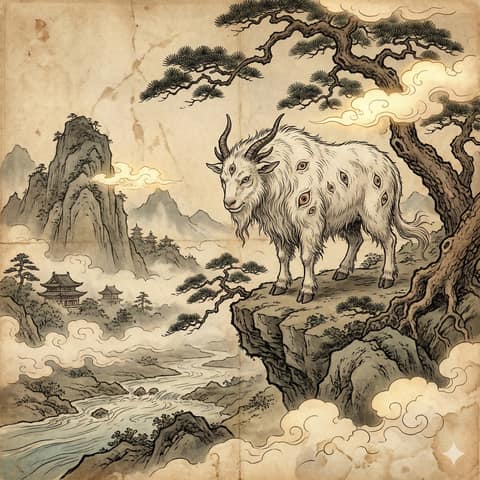
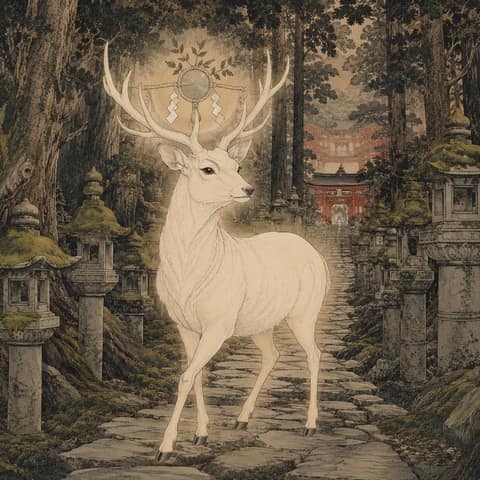
    The image of the Hakutaku varies across eras and texts. In the Sancai Tuhui and the Wakan Sansai Zue it appears as a white lion-like auspicious beast symbolizing lucid and orderly governance. Edo painter Toriyama Sekien employed multi-eyed motifs, adding an eye on the brow to heighten its power to perceive calamities, though older depictions sometimes show only two eyes. Prints of the Hakutaku served as apotropaic images posted on doors or carried as charms, invoked for protection during travel and epidemics. The design also appeared on imperial procession flags and on temple and shrine door panels as talismanic emblems of authority and sanctity, examples of which can be seen at the shrines and temples of Nikkō in Japan. The tradition is sometimes read as a personification of ethics and disaster lore, venerated as a being that classifies anomalies and teaches countermeasures.

  • Hitome-ryō

    Hitome-ryō

    Epic

    HEE-toh-meh RYOH

    Hitome-no-Ren of Tado (Tradition-Based)

    Deities & Divine SpiritsMieAichi

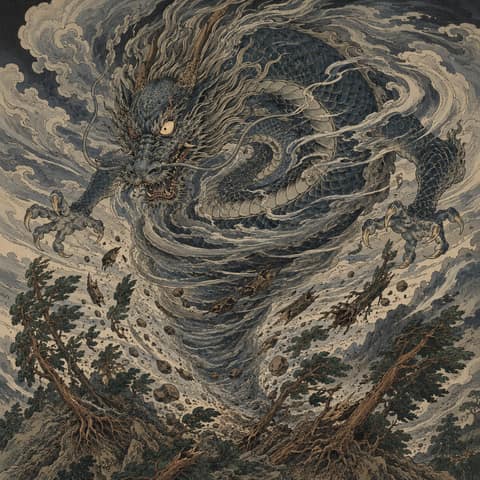
    A wind divinity anchored to Mount Tado, once feared as a one-eyed dragon god. Ideas of “divine wind” recorded in Edo-period sources intersected with local weather watching, leading sailors on the Ise Bay route and coastal villages to revere it deeply. Later it blended in folk belief with the smithing deity Ame-no-Mahitotsu-no-Kami, and shrines preserved doorless architecture so the god’s passage would not be hindered. It governs storms and rain, is invoked for bringing and stopping rain and for protection from maritime disasters, yet tales also stress its aramitama, a wild and fearsome aspect. Iconography varies: sometimes a dragon body, sometimes a one-eyed deity, but details remain uncertain.

  • Hoakari

    Hoakari

    Rare

    ほあかりのみこと

    The Storm-Summoning Wild Child: Hoakari

    Deities / Divine SpiritsHyogo

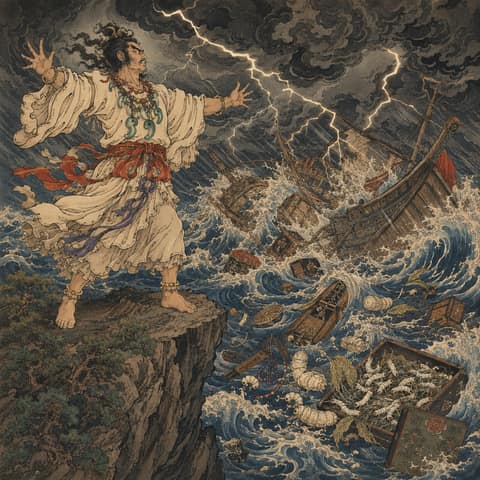
    Hoakari is the protagonist of the place-name origin myths recorded in the *Harima no Kuni Fudoki*. He is an *Aramiko* (wild divine child) whose very fierceness shaped the topography of central Harima. Ordered by his father, Onamuchi, to fetch water and then abandoned, Hoakari called upon winds and waves in a fit of rage, capsizing his father's ship. The scattered cargo—silkworms, a koto, a box, a boat, a jar, a helmet—fell to earth, granting names to Himeji-oka (Himeyama), Kotogami-oka, Hako-oka, and others, thus becoming the source of Himeji's place names. The essence of this deity lies in his duality: though a fierce god of destruction, his anger brought order and identity to the land. While sometimes equated with Amenohoakari of the Heavenly Grandson lineage, in Harima he is remembered as an indigenous divine child who commands the sea and the storms.

  • Hotei

    Hotei

    Legendary

    ほてい

    Incarnation of Maitreya, the Laughing Monk, Hotei

    Divine Spirit / DeityYuelin Temple, Fenghua County, Mingzhou (now Fenghua District, Ningbo, Zhejiang, China) / Introduced via Zen Buddhism in the Kamakura period / Shrines and temples of the Seven Lucky Gods pilgrimage in Kanto and Kinki

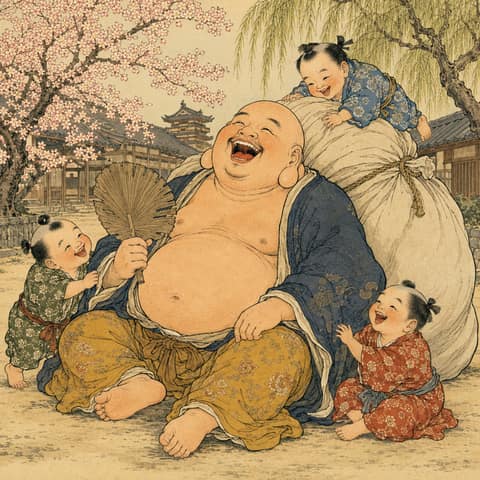
    The origin of Hotei is the historical Zen monk Qici (died 917) of the late Tang and Five Dynasties period. Fascicle 27 of the *Jingde Record of the Transmission of the Lamp* (1004) compiled by Daoyuan of the Northern Song provides an independent biography of him, which serves as the fundamental source of the Hotei lore. He is also recorded in fascicle 21 (Section on Miracles) of the *Song Biographies of Eminent Monks* (988) compiled by Zanning, which notes his origin as Fenghua County, Mingzhou (now Fenghua District, Ningbo City, Zhejiang Province), but reports his secular surname and birth year as unknown. His physical appearance was described as short and stout with a bulging belly and deep wrinkles on his forehead. He always roamed the streets carrying a cloth sack (a monk's alms bag or large knapsack), remained warm even when lying in the snow, stored whatever food he begged for in his sack, and was skilled in divination and prophecy. It is said that in the third month of the second year of Zhenming of the Later Liang dynasty (916), he sat on a rock at Yuelin Temple in Fenghua and passed away after reciting the verse: "Maitreya, the true Maitreya, present in billions of forms, continually manifesting to the people of the time, yet the people of the time do not recognize him." Based on this deathbed verse, he became revered as an incarnation of Bodhisattva Maitreya. In subsequent Chinese Buddhism (especially Zen), the image of Hotei as Maitreya became firmly established, giving rise to the custom of enshrining a large-bellied seated Maitreya statue (Maitreya in the form of Hotei) at the main gates and Heavenly King Halls of temples. From the Song dynasty onwards, he was overwhelmingly favored as a subject of ink painting in China, heavily depicted by monk-painters of the Yuan dynasty (such as Yintuoluo and Meng Yujian) and Zen artists. His introduction to Japan accompanied the arrival of Zen Buddhism during the Kamakura period. Monks who traveled to Song and Yuan China brought back Zen paintings (by artists like Muqi and Yintuoluo), and Japanese monk-painters of the late Kamakura and Nanboku-cho periods (such as Mokuan, Ryozen, and Mokudo Shoei) emulated these to establish a lineage of Hotei imagery unique to Japan. By the late Muromachi period, when the Zen monks and artists of the Higashiyama culture (such as Noami, Soami, and Sesshu) formalized the Seven Lucky Gods motif, they incorporated Hotei alongside the previously imported Fukurokuju and Jurojin, combining them with the already localized Ebisu, Daikokuten, Bishamonten, and Benzaiten to form the "Seven Deities of Fortune and Virtue." Entering the Edo period, he became deeply entrenched among the common people as a member of the Seven Lucky Gods Treasure Ship prints and New Year's first-dream pictures, frequently appearing in the woodblock prints of Katsushika Hokusai, Utagawa Kuniyoshi, and Tsukioka Yoshitoshi. His iconographic features—the bulging belly, large sack, and hearty laugh—symbolize in Chinese tradition that "obesity = broad tolerance and a well-rounded personality" and "large sack = the virtue of endlessly giving what is needed despite owning nothing." He represents a unique archetype of "Zen non-attachment as a blessing," distinct from the Daoist deities of longevity (Fukurokuju, Jurojin), martial deities (Bishamonten), and indigenous gods (Ebisu, Daikokuten). In the various Seven Lucky Gods pilgrimages of Edo/Tokyo (such as Yanaka, Asakusa, Nihonbashi, and the Sumida River), the pilgrimage sites are often Zen, Obaku, and Soto sect temples, which have drawn profound devotion from commoners praying for fertility, business prosperity, marital harmony, and good fortune through laughter. Furthermore, Yuelin Temple still exists today in the Fenghua District, and is honored as the "Ancestral Court of Maitreya," being the site of Hotei's birth and passing.

  • Hōsōshi (Exorcist of the Great Exorcism)

    Hōsōshi (Exorcist of the Great Exorcism)

    Epic

    HOH-soh-shee

    Hōsōshi of the Courtly Tsuina Rite

    神霊・神格Imperial court (continental ritual imported to Japan)

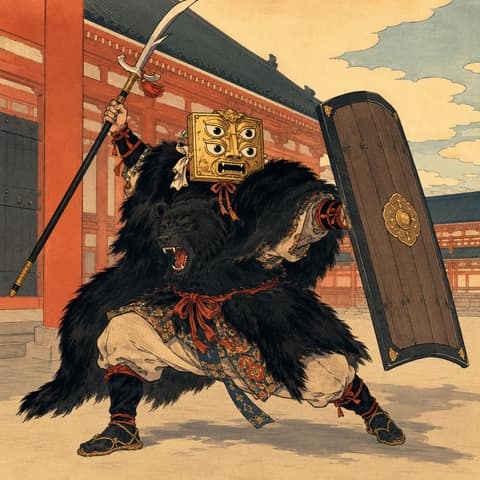
    In the imperial court’s Great Tsuina exorcism, this figure confronts and drives out pestilential oni. Wearing a four-eyed square mask, bear hide, and armed with a halberd and great shield, he leads pages and tsuina attendants to circuit the four directions of the palace. The rite follows set forms—onmyoji invocations, drum cues, and expulsion beyond the gates—and later influenced demon-chasing observances at temples and shrines. By the late Heian period, shifts in the term tsuina saw him at times enact a visible “oni role.” Though attire, implements, and routes changed with ceremonial norms, the core purpose remained the banishment of epidemics and ill fortune.

  • Ichikishima-hime

    Ichikishima-hime

    Divine

    ichikishima-hime

    Goddess of the Sacred Island Guarding the Sea, Ichikishima-hime

    Deity/Divine SpiritHiroshimaFukuoka

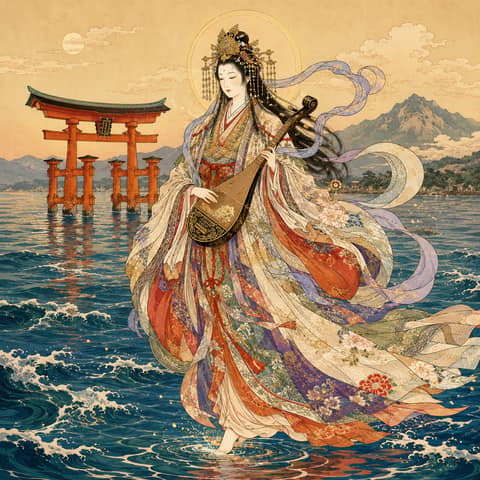
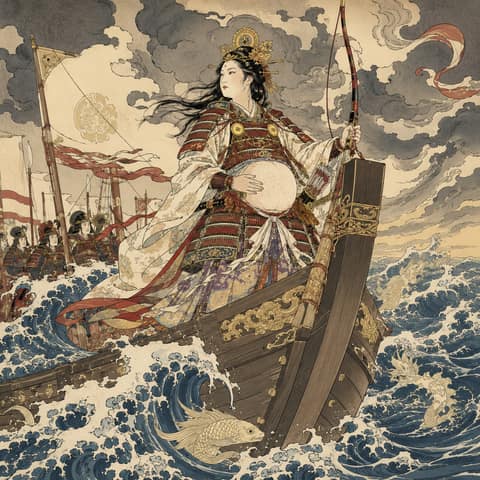
    The core of Ichikishima-hime's divine nature lies in being the "Princess of the Enshrined Island"—a goddess residing in the island itself where deities are worshipped. In Munakata (the Genkai Sea), she protects maritime traffic with the continent, and in Aki (the Seto Inland Sea), she guards the inner sea routes. As indicated by the divine decree regarding the "sea route," she is positioned as a boundary-protecting goddess connecting the nation and the sea. Through her syncretism with Benzaiten, her virtues of water, wealth, performing arts, beauty, and wisdom are layered. The majestic stage setting of Itsukushima Shrine's marine pavilions and vermilion Otorii gate symbolizes her divinity. The landscape itself, where the shrine appears to float on the high tide and connects to the land at low tide, is a manifestation of the goddess governing the boundary between sea and land, the sacred and the profane. She shares deep divine connections with her sister goddesses of the Munakata triad (Tagori-hime and Tagitsu-hime), her syncretized counterpart Benzaiten, and Ebisu, who is also a deity of the sea and good fortune.

  • Inari

    Inari

    Legendary

    いなりのかみ

    Inari, King of Faiths for Bountiful Harvests and Prosperous Business

    Deity / Divine SpiritKyoto

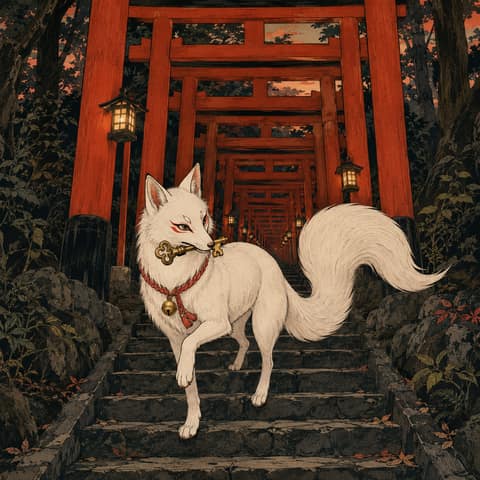
    The principal deity of Inari, Ukanomitama-no-Kami (also known as Ukanomitama-no-Mikoto), is a goddess of grain and food appearing in the first volume of the "Kojiki" (712). The name combines "Uka" (ancient word for food) and "Mitama" (spirit), preserving its simple folk origin as the "personification of spiritual power dwelling in grains." The head shrine, Fushimi Inari Taisha (Mount Inari, Kii County, Yamashiro Province; present-day Fushimi Ward, Kyoto), originated on the first Day of the Horse in February 711. It was founded when Hata-no-Irogu, head of the Hata clan (an immigrant clan who pioneered the Kyoto basin and Fushimi area), shot an arrow at a target made of mochi (rice cake). In a miraculous event, the mochi transformed into a white swan, flew away, and sprouted rice plants where it landed on the mountain peak, prompting the enshrinement of three deities (according to a lost text of the "Yamashiro no Kuni Fudoki"). The three deities were Ukanomitama-no-Okami (the main deity), Satahikoo-no-Okami, and Omiyanome-no-Okami; later, Tanaka-no-Okami and Shi-no-Okami were added to collectively form the five Inari Okami. For its rapid expansion in faith after the Heian period, its connection with To-ji Temple, the head temple of Shingon Esoteric Buddhism, played a decisive role. Starting with the legend of Kukai seeking Inari's cooperation when constructing To-ji, Shingon Buddhism and the Inari faith became deeply intertwined, leading to a syncretism with the Indian esoteric female demon Dakini-ten (Ḍākinī). Originally a "man-eating female yaksha," Dakini-ten softened as she passed through Tibet and China to Japan, becoming depicted as a "celestial maiden riding a white fox," and was eventually identified with Inari. This established a unique lineage of Buddhist Inari (Toyokawa Inari/Myogon-ji founded in Aichi in 1441, Saijo Inari/Myokyo-ji founded in Okayama in the 1300s, etc.), coexisting with the Shinto Inari (Fushimi lineage). During the Edo period, a massive boom occurred where people of all classes—samurai, townspeople, and farmers—enshrined Inari in small shrines on their properties as household deities. It became so widespread that a famous senryu poem listed "Iseya, Inari, and dog poop" as the most commonly seen things in Edo. Modern Inari shrines are estimated at about 32,000 (2,900 head shrines + branch shrines + household shrines), making it Japan's largest belief system by number of shrines. The relationship with foxes requires careful attention. While Fushimi Inari Taisha officially clarifies that "the fox is a divine messenger (familiar) of the Inari deity, not the deity itself," in folklore, many regions treat the fox itself as the Inari deity. This "fox deity faith" from the Edo period onward remains the mainstream of folk belief today. The messenger foxes are called "Byakko" (white foxes) and are traditionally depicted holding one of four items in their mouths: a jewel, a key, a rice sheaf, or a scroll. The jewel represents divine virtue, the key opens the spiritual granary, the rice sheaf represents grain, and the scroll signifies Buddhist scriptures. The main prayers are for bountiful harvests, prosperous business, family safety, fire prevention, and warding off epidemics. Especially since the Edo period, as it became a merchant household deity, prosperous business and financial fortune have become the primary focus. Today, this practice has spread to corporate and storefront altars (even small shrines on commercial building rooftops) and roadside shrines, embedding itself deeply in Japanese society across the four tiers of shrines, temples, residences, and corporations. The annual Hatsu-uma Matsuri (Festival of the First Day of the Horse) in February marks the descent of the Inari deity and is celebrated grandly at Inari shrines nationwide.

  • Iwanaga-hime

    Iwanaga-hime

    Divine

    いわながひめ

    Iwanaga-hime, Goddess of Eternity, Steadfastness, and Matchmaking

    Divine Spirit / DeityShizuoka

    The true identity of Iwanaga-hime is the daughter of Oyamatsumi appearing at the end of Volume 1 of the *Kojiki* and in the 9th stage of the Age of the Gods in the *Nihon Shoki*. She is written as "Ishinaga-hime" in the *Kojiki*, and "Iwanaga-hime" in the *Nihon Shoki* and *Sendai Kuji Hongi*, with theories also equating her with Kokemusuhime and Konohana-chiru-hime. According to the semantic interpretation by Kokugakuin University's Classical Culture Project, her divine name means "a woman as eternal, steadfast, and enduring as a rock (Iwa)"—clearly designating her as a goddess symbolizing immortality, longevity, firmness, and solidity. Positioned alongside her younger sister Konohana-no-sakuya-bime as the two daughters of Oyamatsumi, she forms the core of contrast structures: "rock vs. flower," "eternity vs. transience," "solidity vs. beauty," "immortality vs. short life," and "rejected older sister vs. accepted younger sister." The core of her narrative lies in the myth of the heavenly descent (Tenson Korin) found at the end of Volume 1 of the *Kojiki* and the 9th stage of the *Nihon Shoki*. After Ninigi-no-Mikoto (the heavenly descendant) descended to Takachiho in Hyuga, he met the beautiful Konohana-sakuya-hime at Cape Kasasa and proposed to her father Oyamatsumi. The father was overjoyed and presented both the older sister Iwanaga-hime and younger sister Sakuya-hime with many tributes. However, Ninigi rejected Iwanaga-hime for her ugly appearance, sending her back and marrying only Sakuya-hime. Oyamatsumi's lament became the story's climax—in the *Kojiki*: "If you had let Ishinaga-hime serve you, the lifespan of the heavenly descendants would have been eternally immovable like a rock; but because you kept only Sakuya-hime, your life will be short like the flowers of trees" (lifespan shortened due to the failure of Oyamatsumi's oath); in the *Nihon Shoki*: "Shortened lifespan caused by the curse of the unaccepted Ishinaga-hime" (a more direct causality). Though slightly different, both accounts serve as the origin myth for the shortened lifespans of humans and the imperial line, forming the foundation of Japan's indigenous view of life and death before Buddhism. Comparative mythologist Tarō Ōbayashi classified this tale of contrast between Iwanaga-hime and Konohana-sakuya-hime as a Japanese variant of the "banana-type myth" (a tale of choosing between a stone and a banana). Belonging to the same lineage as the origin myth of death from Sulawesi, Indonesia (where humans chose a delicious banana over a stone, losing eternity to gain a short life that withers in one generation), it is the Japanese equivalent of universal origin of death myths like the Book of Genesis (expulsion from Eden) or Greek mythology (Pandora's box). Among her shrines, Kumomi Sengen Shrine (Kumomi 386-2, Matsuzaki, Shizuoka) garners attention in Shinto history and folklore studies as a rare shrine among the approximately 2,000 Sengen shrines nationwide that exclusively enshrines Iwanaga-hime. Sitting atop Mount Eboshi (elevation 162m), an ancient legend (recorded in the late 18th-century *Kojiki-den*) says, "When Mount Eboshi is clear, Mount Fuji is cloudy," historically identifying it as the older sister's seat in contrast to Sakuya-hime's Fuji. It was rebuilt in 1657, with its original founding unknown. Hoshoishi Shrine (Mikumo, Itoshima, Fukuoka) in the center of Ito-koku is an ancient shrine enshrining both sisters (recorded in the 1695 *Hoshoishi Shrine Engiki*). This rare sister-pair worship suggests a connection between imported continental culture and the Iwanaga-hime faith, given Ito-koku's role as ancient Japan's gateway to the continent. Shiromi Shrine (Shiromi, Saito, Miyazaki; former Nishimera Village area) enshrines three deities: Iwanaga-hime, Oyamatsumi, and Prince Kaneyoshi (of the Nanboku-cho period), founded in 1489 with its original sanctuary built in 1675. Its sacred object is a "silver mirror"—a place-name origin legend claims the mirror Iwanaga-hime threw in despair over her looks caught on a tree on Mount Ryubo, changing "Shiromi Village" to "Silver Mirror (Shiromi) Village." As a symbolic equivalent to rock, the mirror shows the unique syncretism of Iwanaga-hime's rock worship and mirror deity worship. The 33-part Shiromi Kagura dedicated every December 12-16 is a National Important Intangible Folk Cultural Property, representing the pinnacle of Kyushu folk performing arts as the primary stronghold for modern Iwanaga-hime veneration. Yui-no-Yashiro (Middle Shrine) of Kifune Shrine in Kyoto has been deeply worshiped for matchmaking since before the Heian period. Originating from the paradoxical legend that Iwanaga-hime hid in Kibune out of the shame of rejection, declaring "I will bestow good matches upon the people," she has been worshiped as "a god who does not sever ties, making them endure." The literary foundation for this matchmaking divinity is the story of Heian poet Izumi Shikibu (978?-1041?), who prayed here during marital strife and achieved reconciliation after dedicating a famous firefly poem. This paradoxical faith structure, linking the rock (a symbol of eternal immobility) with "enduring relationships," has continued unbroken from the Heian era to today. In folk beliefs, Mount Omuro in Izu (elevation 580m) is seen as her incarnation, carrying a sympathetic superstition that "praising sister Fuji while climbing Mount Omuro brings curses of injury or poor fishing"—a classic example of folk empathy for the "rejected ugly sister." Furthermore, Mount Tsukuba's Gessuiseki Shrine (Tsukuba, Ibaraki) enshrines an Iwakura where Iwanaga-hime reportedly died, showcasing the blending of ancient Japan's rock worship with her divinity. At Oyamatsumi Shrine's precinct shrine, Anaba Shrine (Omishima, Imabari, Ehime), she is enshrined with her father Oyamatsumi, preserving the origin of father-daughter worship. Today, since Mount Fuji's World Heritage registration (2013), Kumomi Sengen Shrine and Mount Eboshi have become tourist destinations. Additionally, as the "sister rejected by beauty standards," she resonates with modern female readers, advancing a feminist re-evaluation. Frequently reappearing in modern media with themes of "immortality/solidity," "kindness behind ugliness," and "matchmaking," the modern reinterpretation of this ancient myth continues to evolve.

  • Izanagi

    Izanagi

    Legendary

    Izanagi

    Izanagi no Mikoto, ancestral god of creation, land-birth, and purification

    Deity / divine spiritHyogo

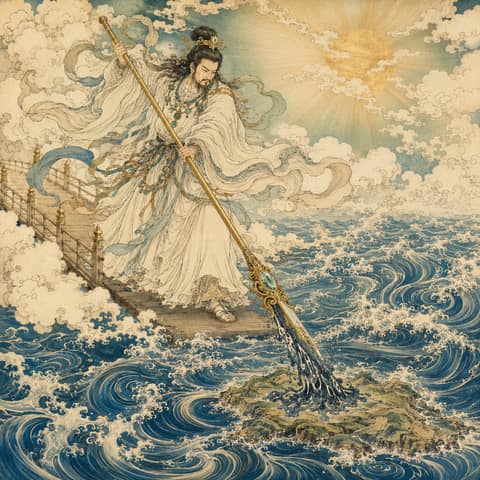
    The Seven Generations of the Gods and the cosmology of creation. The basic account covers land-birth and god-birth. Looking more closely, the Seven Generations of the Gods form a creation sequence in their own right. The Kojiki says that after heaven and earth open, the three creator deities and the Separate Heavenly Deities appear, followed by the divine generations beginning with Kuni-no-tokotachi. The line moves from solitary, abstract deities toward paired gods, then finally reaches Izanagi and Izanami as husband and wife. Myth moves from abstraction into relation, sex, marriage, and birth. Their marriage and the birth of the land are the decisive passage from divine potential into a concrete world. The Floating Bridge, the jeweled spear, and Onogoro Island. The scene in which the two gods stand on the Floating Bridge of Heaven and stir the sea with Ame-no-nuboko is one of the most important images in ancient Japanese cosmology. The bridge joins heaven and earth as a vertical world axis. The spear is an instrument of creation. Brine hardening into an island marks the passage from liquid to solid, from formlessness to form. Onogoro Island means something close to an island that congealed by itself, suggesting that creation is not only divine command but also natural self-formation. The scene can be read beside Pangu's separation of heaven and earth, the Indian cosmic egg, and Eurasian myths of stirring primordial waters. The descent to Yomi, an early East Asian Orpheus myth. Izanagi's descent to Yomi, his broken taboo, and his flight from the dead belong to the mythic type in which someone enters the underworld to recover a lost wife and fails after violating a prohibition. The Greek story of Orpheus and Eurydice is the most famous example, while Izanagi's version, written in the Kojiki in 712, is one of East Asia's earliest textual witnesses to the type. The stolen glimpse, the broken command, the pursuing dead, and the protective peaches all echo underworld narratives from India, China, and Europe, suggesting deep affinities across ancient Eurasian religious imagination. Misogi, the origin myth of Shinto purification. After escaping Yomi, Izanagi washes away its pollution at Awagihara. This is the origin myth of misogi and harae. Gods are born as he removes garments and objects from his body; sea deities are born as he washes in the stream; finally, the highest deities emerge from his eyes and nose. The structure binds body, impurity, purity, and divine birth together. The hand-washing before shrine worship, the Nagoshi no Oharae summer purification, and ritual ablutions before major ceremonies all find a mythic source here. Eda Shrine and Izanagi Jingu honor him as the ancestral deity of purification, showing how an ancient myth continues inside living Shinto practice. The Three Precious Children and ancient Japan's cosmic order. Izanagi divides the sky, night, and sea among the Three Precious Children. Amaterasu Omikami receives Takamagahara, the realm of heaven, daylight, and light. Tsukuyomi no Mikoto receives the realm of night, quiet, and calendrical rhythm. Susanoo no Mikoto receives the sea plain, the ocean and its violent force. This threefold division is not only a mythic plot point. It later supports the legitimacy of the imperial line and Ise Shinto. Medieval, early modern, and modern political thought in Japan repeatedly return to this narrative. It is a central line running through Japanese ideas of state, religion, and cosmic order. Taga Taisha, Izanagi Jingu, and Eda Shrine. The three major sacred places of Izanagi correspond to different moments in the myth. Izanagi Jingu in Awaji marks the beginning of land-birth, the marriage of the two gods, and Izanagi's hidden palace. Eda Shrine in Miyazaki marks Awagihara, purification, and the birth of the Three Precious Children. Taga Taisha in Shiga became a popular early modern shrine of long life and vitality. Together these sites turn the sequence of creation, purification, and longevity into geography and pilgrimage, sustaining Izanagi worship across Japan. Motoori Norinaga's Kojiki-den and the formation of kokugaku. Motoori Norinaga, the Edo-period kokugaku scholar, completed the forty-four-volume Kojiki-den in 1798, using rigorous philology and historical linguistics to interpret the Kojiki, including the myths of Izanagi. Debate continues over whether such myths should be read as history, symbolic narrative, or cultural memory, but Norinaga's method laid an important foundation for modern Japanese humanities. Izanagi therefore extends beyond myth alone. He belongs to the intellectual history of kokugaku, Shinto, modern national thought, and postwar folklore studies, and remains a symbolic figure in Japanese religion, scholarship, politics, and culture.

  • Izanami

    Izanami

    Legendary

    Izanami

    Izanami no Mikoto, Ancient Mother Goddess of Birth and Death

    Deity / divine spiritMie

    The cycle of birth and death: the nature of an ancient mother goddess. The basic profile described Izanami's mythic role; the deeper issue is that she embodies birth and death in a single archaic mother figure. Izanami gives birth to the Oyashima islands and thirty-five nature deities, and even on her deathbed continues to produce gods of mines, earth, and grain from her vomit, urine, and excrement. This resembles the ambivalence of mother goddesses across the ancient world, such as Gaia in Greece, Inanna in Sumer, or Kali in India: the one who gives life also contains death. Izanami is more than a creator deity. She joins birth and death, the living world and the underworld, purity and pollution into one Japanese variation of the archaic mother goddess. Kagutsuchi's birth and the symbolism of fire. Izanami dies because she gives birth to the fire god Kagutsuchi, an event of major symbolic force in ancient Japanese cosmology. Fire begins civilization: forging, pottery, cooking. Yet fire also brings destruction and death. In ancient societies, childbirth itself could threaten a woman's life, and the myth binds those dangers together. Kagutsuchi is born, Izanami dies, and from her dead or dying body arise deities of mines, earth, and grain. This chain makes the material foundations of civilization, metallurgy, agriculture, land-making, emerge from the sacrifice of the mother goddess. The myth gives a stark expression to an ancient worldview: civilization stands on the body of the mother. Yomi no Kuni and the queen of the dead. After burial, Izanami reigns as queen of Yomi no Kuni. This is an unusual structure in ancient myth. Chinese underworlds are often ruled by male figures such as Fengdu or the Lord of Mount Tai; India has Yama, and Greece has Hades. In Japanese myth, however, the realm of the dead is ruled by the former creation goddess. Izanami's rule over Yomi shows the close ancient Japanese linkage of woman, death, and underworld. Later images of Enma, Jizo, and the Sanzu River grow in soil prepared by this imagination of the dead. The idea of death as a feminine principle is one of the most striking points for comparative religion. The burial debate: Izumo and Kumano. The Kojiki names Mount Hiba, on the Izumo-Hoki border, as Izanami's burial place, while a variant in the Nihon Shoki names Kumano in Kii. The two traditions map onto two religious geographies. The Izumo line, Shobara in Hiroshima, Yasugi in Shimane, and Higashi-Izumo in Matsue, connects with Izumo ritual lineages and faith in Ne no Katasukuni. The Kumano line, Hana no Iwaya in Mie and Kumano Hayatama Taisha in Wakayama, connects with Kumano Sanzan worship, Fudaraku sea-crossing beliefs, and Pure Land imagination. Izumo lies to the north, facing the Sea of Japan; Kumano lies to the south, facing the Pacific. Together the two burial traditions form a core problem in the religious geography of ancient Japan. Hana no Iwaya Shrine and ancient iwakura worship. Hana no Iwaya Shrine in Kumano, Mie, is named in the Nihon Shoki as Izanami's burial place and is one of Japan's oldest shrines; it has no shrine hall and worships a forty-five-meter sacred rock as its divine body. Iwakura worship is an old Japanese mode of nature veneration in which trees, boulders, waterfalls, and mountain peaks are treated as places where divine spirits dwell. Later shrine architecture grew out of such natural sacred places, and Hana no Iwaya preserves an especially ancient layer by having no main building. The Otsunakage rite, held on February 2 and October 2, hangs a rope about 170 meters long from the sacred rock to the precincts; it is a rare living folk practice that carries ancient rock worship into the present. "One thousand a day, fifteen hundred a day": the cosmology of life and death. The exchange at Yomotsu Hirasaka is the moment when Japanese myth fixes the order of life and death. Izanami says she will kill one thousand people a day; Izanagi answers that he will cause fifteen hundred to be born. The scene is grief after marital separation, but also a cosmic declaration that death and life, underworld and this world, feminine and masculine principles will stand in permanent tension. Death counts one thousand; birth counts fifteen hundred. Life exceeds death. That inequality becomes a religious expression of life's continuation. Japanese myth does not remain a simple tragedy; it turns the dialectic of life and death into cosmology. Izanami reevaluated in the twenty-first century. Postwar feminist myth studies and cultural criticism have moved beyond reading Izanami only as a victim of patriarchal myth. They also understand her as an embodiment of the ancient mother goddess who unites birth, death, and the underworld. Motoori Norinaga's Kojiki-den, completed in 1798, laid the philological foundation; later comparative mythologists such as Orikuchi Shinobu, Obayashi Taryo, and Yoshida Atsuhiko added new interpretive layers. In the twenty-first century, Izanami is no longer merely a mythic character. She has become an image of the feminine root of Japanese myth and of cosmic order as mother, continuing to shape religion, scholarship, and cultural imagination.

  • Izutamahiko no Mikoto

    Izutamahiko no Mikoto

    Divine

    izutamahiko

    Guardian Deity of Mount Zozu, Izutamahiko no Mikoto

    Divine Spirit/DeityKagawa

    Izutamahiko no Mikoto is a rare deity whose existence traces three stages of elevation: originally a real high-ranking monk, Kongobo Yusei (the fourth head of Konkoin, died 1613), who became a tengu and guardian spirit after death, and was finally redefined as a Shinto deity during the Meiji era's separation of Shinto and Buddhism. While the principal deity Konpira (Omononushi) originates from a foreign water god (Kumbhira) and presides over "maritime protection," Izutamahiko no Mikoto embodies the lineage of "mountain asceticism and tengu worship." The dual structure of the Mount Zozu faith—where a god of the sea and a tengu of the mountain reside together—is demonstrated through the relationship between the principal deity and the deity of the Okusha (Inner Shrine), making this deity highly significant in religious history. The Okusha, Izutama Shrine, sits at an altitude of 421 meters, 1,368 steps away from the main shrine, and is considered the second holiest site of Kotohira-gu.

  • Juroujin

    Juroujin

    Legendary

    じゅろうじん

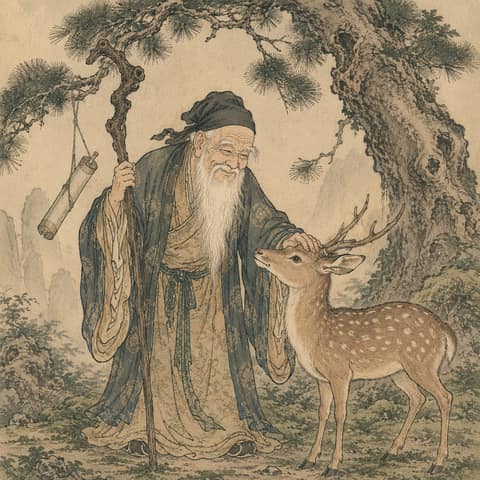
    Juroujin, the Pure Sage of Longevity Accompanied by a Black Stag

    Divine Spirit / DeityChina (Daoist avatar of the South Pole Old Man Star) / Introduced during the Muromachi period / Pilgrimage sites of the Seven Lucky Gods in Kanto and Kinki (Zen, Obaku, and Tendai sect temples)

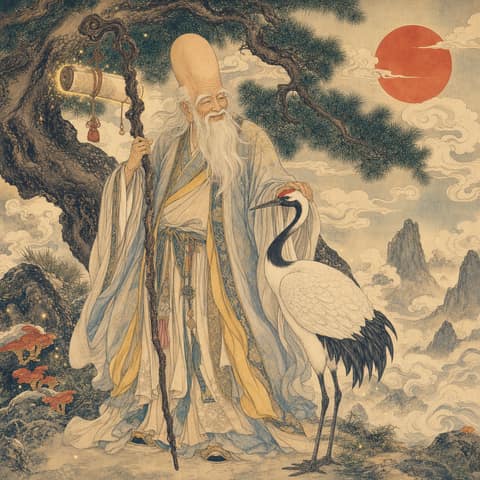
    Juroujin's true form is the South Pole Old Man Star (Canopus). This is the alpha star of the constellation Carina—the second brightest star in the entire night sky after Sirius. Because it only appears low in the southern sky of the Northern Hemisphere, ancient Chinese lore passed down the saying, "The year it can be seen is a year of universal peace; the land where it can be seen is a land of longevity." Already registered as an astronomical deity in the 'Treatise on Astrology' of the *Records of the Grand Historian* and the 'Treatise on Astronomy' of the *Book of Jin*, it forms the core of Longevity Star worship in Chinese folk belief. Daoism personified this star as the Longevity Star or Longevity Sage, arranging auspicious items alongside him: a black stag said to live 1,500 years, the Peaches of Immortality of the Queen Mother of the West (which extend life by a thousand years with a single bite), and a gourd containing the elixir of immortality. Iconographically, he is depicted as a short old man with a long head and a long beard, tying a sutra scroll to the head of his staff. A "short body and long head" is a physical omen of longevity in Chinese physiognomy, a formative principle entirely identical to that of his counterpart, Fukurokuju. This is the reason the two have long been considered the same deity under different names. His arrival in Japan occurred in the late Muromachi period (15th century), routed through monks traveling to Song and Ming China and the importation of Daoist and Buddhist paintings by Zen monasteries. The prototype of the current Seven Lucky Gods was formed during the Higashiyama culture period when Zen monks and painters (such as Noami, Soami, and Sesshu) bundled the localized Ebisu, Daikokuten, Bishamonten, and Benzaiten with the imported deities Hotei, Fukurokuju, and Juroujin into the "Seven Gods of Fortune and Virtue." The overlap with Fukurokuju had been an old issue since before the Song dynasty. In Japan, this was resolved by dividing their roles: "Fukurokuju = a secular deity synthesizing happiness, wealth, and longevity," and "Juroujin = an ascetic longevity deity purified to the single virtue of longevity." During the Edo period, a significant number of variant Seven Lucky Gods groupings circulated that removed Juroujin to avoid duplication, replacing him with the sake-loving beast Shojo, Kisshoten, or Fukusuke. Juroujin was loved by the common people for his appearance as an unpretentious, sake-loving sage, appearing frequently in the treasure ship pictures of Kyoden Santo (*Kottoshu*, 1813), Hokusai Katsushika, Kuniyoshi Utagawa, and Yoshitoshi Tsukioka. In the Seven Lucky Gods pilgrimages across Edo and Tokyo, his sites were often small halls belonging to Zen, Obaku, and Tendai sects, gathering prayers for longevity and health, especially from the elderly and the sick. In folk tradition, he also holds an important position as a main constituent deity of the "First Dream Treasure Ship" (established in the mid-Edo period), where placing a treasure ship picture containing Juroujin under one's pillow early on New Year's Day is said to grant an auspicious dream.

  • Kannon

    Kannon

    Divine

    kannon

    Bodhisattva of 33 Forms and Infinite Compassion

    神霊・神格大乗仏教の菩薩、浄土は南インド補陀落、渡来仏

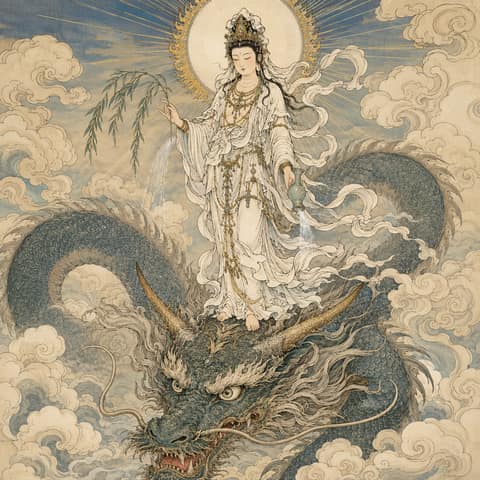
    Ultimate Metamorphosis and Empathy. The greatest characteristic of Kannon Bodhisattva lies in having no fixed form, possessing the ability of "Fumon Jigen" to infinitely transform into the most suitable form (a Buddha, a god, a human, or even a non-human entity) to save the other person. This is not mere magic; it is the manifestation of an "ultimate empathic ability (compassion)," standing at the exact same eye level as the suffering other and sharing their pain as one's own. Kannon has served as the emotional pillar for the Japanese people for over a millennium precisely because Kannon does not reign as an absolute, transcendent dictator, but descends into the mud-stained living spaces of humans to weep alongside them. Attendant to Amida Nyorai and Care at the Moment of Death. Kannon Bodhisattva is not only worshipped independently but also plays a crucial role as an attendant (assistant) to Amida Nyorai, the Lord of the Western Paradise (Pure Land). When a person reaches the end of their life, it is Kannon's duty to appear riding on a cloud alongside Amida Nyorai (Raigo) to welcome the deceased, placing their soul on a lotus pedestal to guide them to paradise. Kannon was not only a savior from all the hardships of the present world but also the "ultimate deity of terminal care" who alleviated the fear of death and guaranteed the soul's destination. The "Hidden Christians" and Maria Kannon. The vast tolerance of Kannon worship (the flexibility to take any form) proved its worth even in the harshest phases of history. Under the ban on Christianity during the Edo period, oppressed "Kakure Kirishitan" (Hidden Christians) secretly continued their worship by venerating statues of the "Jibo Kannon" (Koyasu Kannon, holding a child) as the Virgin Mary. By embracing even the god of a foreign religion as a variation of its own form and receiving the prayers of persecuted people, the "Maria Kannon" demonstrates the absolute zenith of Kannon worship's function as an asylum (sanctuary).

  • Kariba Myojin

    Kariba Myojin

    Divine

    kariba-myojin

    The God of Hunting Who Guided Kukai to Koya, Takanomiko no Okami

    Divine Spirit/DeityWakayama

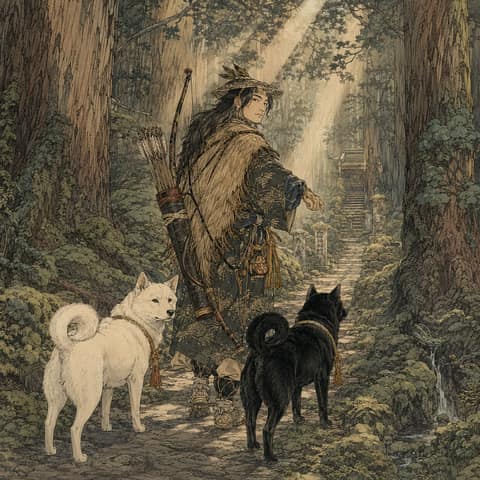
    Kariba Myojin is the guardian deity of Mount Koya who most purely embodies the nature of a "God of Guidance." The religious logic that sacred sites are not found by humans but revealed by gods was narrativized into the legend of a hunter and divine dogs guiding an esoteric Buddhist practitioner into the mountains. His true name, Takanomiko no Okami, means the child deity of Niutsuhime. By both mother and son deities yielding the divine territory to Kukai, it represents the local pantheon's approval of the site becoming a sacred ground for Shingon esoteric Buddhism. The iconography of the kariginu, bow and arrows, and two dogs preserves the form of an ancient mountain god presiding over mountain livelihoods (hunting) and resonates with the historical fact that the Niu clan was a group of hunters accompanied by sacrificial dogs. The divine dogs generated a belief as "guiding divine dogs" leading people to good matches and happiness, a motif carried on by the modern Kishu dogs, Shiromaru and Kuromaru, at Niutsuhime Shrine. The footprints of this guiding deity are carved throughout the pilgrimage routes, such as the Mount Koya Choishi-michi and Niukanshofu Shrine.

  • King of the Waterfall Spirit

    King of the Waterfall Spirit

    Epic

    tah-kee RAY-oh

    Sekien Iconographic Interpretation

    Deities & Divine SpiritsShiga

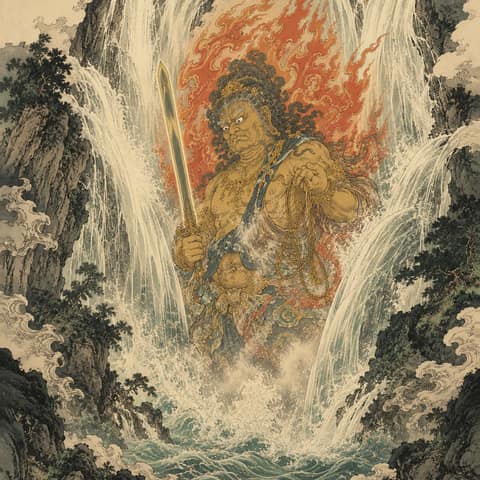
    An interpretive line anchored in Toriyama Sekien’s iconography, organizing the notion of Fudō Myōō’s epiphany at waterfalls as a yokai-encyclopedia entry. The title “Takiryōō” is treated as a pictorial theme, while the entity itself is viewed as a manifestation of Myōō devotion. It appears at waterfall basins across the provinces, subduing demons and malign influences, and is cited in miracle tales told by ascetics and pilgrims. Its virtue and demon-subduing nature take precedence over yokai-style terror, placing it closer to a divine spirit among strange phenomena. Concrete site names and dated incidents are scarce, with accounts drawn mainly from iconographic materials and temple origin narratives.

  • Kinmamon

    Kinmamon

    Divine

    KEEN-mah-mohn

    Traditional Version (Ryukyu Shintoki)

    Deities & Divine SpiritsOkinawa

    Based on Baguchu’s early 17th-century Ryukyu Shintoki. Kinmamon possesses dual yin–yang aspects: the descent from the heavens evokes the distant Everworld, while the ascent from the sea bears the character of a sea-borne visiting deity. Its visitations follow set cycles and rites, delivering oracles to the royal court and communities through possession of the highest priestess, the Kikoe-ōgimi. Folklorically, its core rests on the otherworld symbolized by Nirai Kanai, blessings and ordering power from beyond the sea, and the legitimizing authority that upholds priestess rituals. Literature reinforces its guardian nature and imagery of a palace beneath the sea, though details vary by era and many ritual specifics remain unclear. In modern times some reinterpret it as a chief deity, yet broad popular distribution is hard to confirm. Setting aside creative embellishment, four features remain stable: visitation, possession, oracle-giving, and an otherworld across the sea.

  • Kojin

    Kojin

    Legendary

    こうじん

    The Raging Fire and Boundary Deity, Kojin

    Divine Spirits / DeitiesSeikojin Kiyoshikojin Seicho-ji Temple (Takarazuka, Hyogo Prefecture; head temple of the Sanbo Kojin faith) / Seto Inland Sea cultural sphere of the Chugoku and Shikoku regions (Okayama, Hiroshima, Yamaguchi, Ehime, etc.)

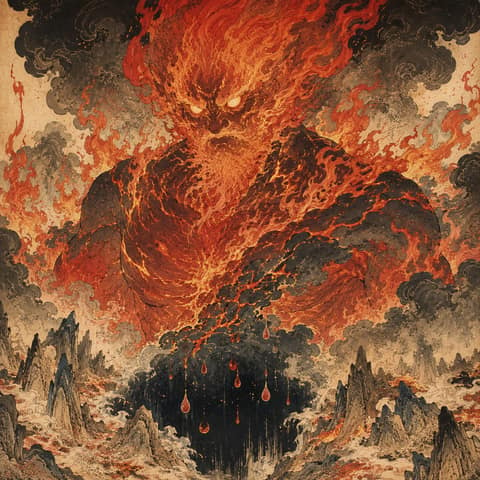
    Aramitama Ideology and the Duality of Japanese Religion. While the basic description touches upon Kojin's two main systems, this thorough explanation delves deeper into the "Aramitama" (rough spirit) concept and the dualistic structure of Japanese religion. Ancient Shinto understands deities on an axis of "Nigimitama" and "Aramitama," recognizing that a single deity possesses both an aspect of a gentle savior and that of a raging curse-bringer. The Nigimitama gently protects people, while the Aramitama brings curses and disasters; ritually balancing the two is viewed as the religious goal of purification. The Kojin faith represents the extreme realization of this option to "worship the Aramitama independently." It holds a paradoxical structure: by fearing and worshipping a terrifying deity, its violent power is transformed into a protective force for the community. This is a variation of a universal structure in East Asian religious culture, comparable to the City God (Cheng Huang) in China, local deities in Korea, and spirit worship in Southeast Asia. Yaksha Origins and Esoteric Syncretism. Sanbo Kojin is a composite deity that incorporated the form of ancient Indian Yaksha spirits, blending elements of Buddhism, Shinto, mountain asceticism, Esoteric Buddhism, and Onmyodo. In ancient Indian mythology, Yakshas were semi-divine, semi-demonic beings guarding forests, mountains, and treasures; upon entering Buddhism, they were recontextualized as protectors of the Dharma (such as the retinues of Vaisravana). The process by which this merged with Japanese hearth and fire worship to become Sanbo Kojin is a prime example of the dynamism of Buddhism's reception in ancient Japan. The three-faced, six-armed wrathful statue, adorned with flaming hair, fangs, and carrying a bow and arrow, is the result of the fusion between its Yaksha roots and ancient Japanese demon-god imagery. The Religious Economy of Ascetics, Onmyoji, and Monks. The nationwide spread of the Sanbo Kojin faith during the Edo period was driven by the active proselytization of religious groups like Shugendo ascetics, Onmyoji, and lower-ranking monks. Operating outside the institutional structures of major temples and shrines, they made their living by offering prayers, fortune-telling, distributing talismans, and presiding over festivals for local communities. By preaching devotion to Sanbo Kojin, issuing talismans, and organizing rituals, a social system was built that supported the economic foundation of these wandering ascetics. The religious history of medieval and early modern Japan must be understood not just as a history of changing doctrines, but as concrete social history encompassing religious economy, the hierarchy of practitioners, and negotiations with local communities—with the spread of Sanbo Kojin serving as a typical case. The Seto Inland Sea Cultural Sphere and Kagura Theater. Bitchu Kagura in Okayama Prefecture originated as a ritual to "invite Kojin and dance before him," earning the alternative name "Kojin Kagura," and was designated a National Important Intangible Folk Cultural Property on February 24, 1979. In the late Edo period, the scholar Nishibayashi Kokukyo composed mythological plays (Shin-no) such as "The Transfer of the Land by Okuninushi," based on the Nihon Shoki and Kojiki, incorporating them into the rituals and thereby establishing the modern form of Bitchu Kagura. This is a symbolic example of how classical mythology and local Kojin faith heavily intertwine in the Seto Inland Sea cultural sphere. It preserves a unique theatrical culture where national deities (Susanoo, Okuninushi), Kojin, and local gods appear together as an integrated pantheon on the Kagura stage. Since ancient times, the Seto Inland Sea has been a maritime trade route with the continent and the Korean Peninsula, a center of Shingon Esoteric Buddhism, and a vast cultural region where local Shinto traditions—such as those of Izumo, Kibi, and Sanuki—have densely intersected. Ji-Kojin and Village Communities. The outdoor Ji-Kojin possesses a different origin story than the indoor Sanbo Kojin. Worshipped by individual households, kin groups, or small settlements—often using the estate's demon gate, village borders, or mounds beneath large trees as vessels—Ji-Kojin acts as a guardian of community boundaries, land, and ancestors. The dense concentration of Ji-Kojin worship in the mountain villages of the Chugoku region and the islands of the Seto Inland Sea has functioned as a mechanism to religiously reaffirm the hierarchical order of families, small settlements, and villages. The festival dates of the 28th of every month, January, May, and September hold social significance beyond simple religious rituals, acting as social time to confirm the solidarity of community members. Gyuba Kojin: The Industrial Aspect. A third system of Kojin that has garnered folkloric attention is Gyuba Kojin (the Kojin protecting cattle and horses). Tied to the history of using cattle and horses as primary sources of power for farming and transport in the mountain villages of Chugoku and Shikoku, the custom of affixing Kojin talismans in stables and praying for the animals' health during spring and autumn festivals was widespread. This reflects the religious life of pre-modern farming villages, where livestock were not mere economic assets but were religiously positioned as members of the family and community. With the advance of mechanization and modern power sources, Gyuba Kojin worship rapidly declined, but numerous ritual artifacts remain preserved in museums and local history centers across Chugoku and Shikoku. Re-evaluation in the 21st Century. In post-war Japan, folklorists such as Kenichi Tanigawa, Noboru Miyata, and Kazuhiko Komatsu advanced academic re-evaluation of Kojin worship, repositioning it as "the representative of Japan's indigenous local deities." In literature, Miyuki Miyabe's novel *Kojin* (Asahi Shimbun Publications, 2014) explored the deity, becoming a widely read narrative that cross-pollinated Edo-period local Kojin faith with modern societal anxieties. Today, in the 21st century, Kojin festivals and Kagura are inherited as intangible folk cultural properties throughout the Seto Inland Sea, Chugoku, and Shikoku regions. It remains one of the few "active" folk deities living on across academia, literature, and regional folklore. Homes enshrining Sanbo Kojin are still numerous, serving as precious embodiments of folkloric continuity.

  • Konohanasakuyahime

    Konohanasakuyahime

    Divine

    konohana-sakuyahime

    Goddess of Mount Fuji and Cherry Blossoms

    神霊・神格Shizuoka

    The Embodiment of Beauty Pregnant with Roaring Flames. Konohanasakuyahime is not merely a "delicate and beautiful goddess." The myth of her willingly entering a burning delivery hut to clear her husband's doubts reveals an overwhelming pride and fierce passion (intense like volcanic magma) hidden within her. Her beauty is a fierce and dangerous one, shining only in extreme situations adjacent to death—much like cherry blossoms blooming on the slopes of an active volcano (Mount Fuji) that could erupt at any moment. The Ruler of the Boundary Between Life and Death (The Delivery Hut). In ancient Japan, "childbirth" was an extremely dangerous act adjacent to the impurity of death (a magical space of blood and fire). The story of Konohanasakuyahime giving birth to Hoderi-no-mikoto (Umisachihiko) and others in the flames is a metaphor for the victory of life force itself—bringing forth new life by overcoming the danger of death (fire). Consequently, she garnered fanatic devotion as the absolute "guardian deity of safe childbirth and child-rearing" from women striving to sustain life amidst harsh realities. Fuji Worship and the Salvation of the Common People. In the "Fuji-ko" faith popular during the Edo period, the worship of Konohanasakuyahime (Asama Okami) evolved into a massive folk religion encompassing not just safe mountain climbing, but everything from worldly benefits to posthumous salvation. It seems contradictory at first glance to install a goddess as the principal deity of Mount Fuji, which was originally closed to women (Nyonin Kinsei). However, this symbolizes the dynamism of Japanese religious history, where a harsh mountain of asceticism gradually transformed its nature into a mountain of affection embracing the common people (including women).

  • Konohanasakuyahime

    Konohanasakuyahime

    Divine

    Konohanasakuyahime

    The Maternal Guardian of Cherry Blossoms: Konohanasakuyahime

    Divine Spirits / DeitiesMiyazaki

    Konohanasakuyahime is a goddess who single-handedly embodies "beauty and the finitude of life" within Japanese mythology. In stark contrast to her older sister Iwanagahime, who symbolizes eternity, she bears the origin of the finite human lifespan, represented by the cherry blossom that is beautiful precisely because it falls. When her one-night pregnancy was called into question, she chose action over excuses—sealing a doorless delivery hut with earth, setting it ablaze herself, and proving her innocence by safely delivering three princes amidst the roaring flames. The sheer intensity of this birth-in-fire is the very core of her faith as the goddess of safe childbirth, fire prevention, and bountiful harvests. At Toman Shrine in Hyuga Province, she is enshrined as the symbol of the land of "Tsuma" (Wife) where she united with Ninigi-no-Mikoto, and as the mother who provided amazake to her three princes. Later, as the guardian deity of Mount Fuji and the Great Deity of Asama, her faith spread to 1,300 shrines nationwide. Her unparalleled charm lies in the fact that she possesses both the fleeting fragility of a flower and the fierce intensity of a flame.

  • Konpira

    Konpira

    Divine

    こんぴら

    Konpira Daigongen

    kamiKagawa

    The original term for Konpira is the Sanskrit Kumbhīra, a deification of crocodiles inhabiting the Ganges River. In Hinduism, it is the mount of Gaṅgā. It was incorporated into Buddhism as Kumbhira, chief of the Twelve Heavenly Generals. Through Honji Suijaku, it syncretized with the local deity Omononushi-no-Kami into "Zozusan Konpira Daigongen." Kotohira-gu is situated halfway up Mount Zozu. The approach consists of 1368 stone steps. The main deity is Omononushi-no-Mikoto, with Emperor Sutoku enshrined alongside. The enshrinement of Emperor Sutoku is a typical example of Goryo (vengeful spirit) worship. Exiled to Sanuki after the Hogen Rebellion, he deeply revered Konpira Daigongen. The renaming due to the Meiji Shinbutsu Bunri marked the greatest turning point in its history. It was transformed into the Shinto "Kotohirasan Kotohira-gu." Its rise during the Edo period was a massive leap forward as a guardian of the sea. It became the "supreme deity of maritime protection." The folk song "Konpira Funefune" became a nationwide hit. The Konpira dog is a rare folk custom of the Edo proxy pilgrimage culture. Those unable to make the pilgrimage sent their pet dogs as proxies. The phonetic transcription path originates from Sanskrit Kumbhīra → Chinese transliteration → Japanese "Konpira."

  • Kumano Gongen

    Kumano Gongen

    Divine

    kumano-gongen

    The Three Mountains Syncretized: Kumano Gongen

    神霊・神格Wakayama

    The Perfected Form of Honji Suijaku. Kumano Gongen is the most elaborately systematized example of "Honji Suijaku," the Japanese philosophy of Shinto-Buddhist syncretism. Each of the main deities of the Kumano Sanzan was assigned a Buddhist "original ground" (Honji Butsu). For instance, Ketsumimiko-no-Okami of Hongu was identified as Amida Nyorai; Kumano Hayatama-no-Okami of Hayatama Taisha as Yakushi Nyorai; and Kumano Fusumi-no-Okami of Nachi Taisha as Senju Kannon (Thousand-Armed Avalokitesvara). Consequently, a pilgrimage to Kumano functioned as a complete salvation system spanning the past, present, and future: erasing the sins of past lives (Yakushi), gaining benefits in this world (Senju Kannon), and securing a promise of rebirth in the Pure Land in the next life (Amida). Institutionalization and Networks of Shugendo. Kumano is one of the birthplaces of Shugendo, and rather than just a place of prayer, it was a rigorous training ground. From the medieval period onward, Shugendo developed into massive religious organizations such as the Honzan-ha (Tendai sect lineage) and Tozan-ha (Shingon sect lineage), building a nationwide network backed by the religious authority of Kumano. The establishment of "Kumano Shrines" (Junisho Gongen) in various regions was the result of propagation activities through this network of ascetics. The fact that thousands of these shrines still exist nationwide today demonstrates the deep penetration of Kumano Gongen into local communities. The Religious Nature of the "Path" Itself. When discussing the Kumano Gongen faith, the existence of the "Kumano Kodo" (Kumano Ancient Trail) cannot be overlooked. The journey to Kumano was extremely arduous, dotted with numerous small shrines called "Tsukumo Oji." Pilgrims were not merely aiming for a destination; the act of walking the treacherous mountain paths and enduring hardships was itself considered ascetic training to extinguish sins (Dochu Shugyo). Even from the perspective of modern public history, the Kumano Kodo retains its value not just as historical heritage, but as a "space to practice faith" where one purifies the mind using one's own body.

  • Kumitezuri

    Kumitezuri

    Epic

    KOO-mee-teh-ZOO-ree

    Historico-Philological Edition

    Deities & Divine SpiritsOkinawa

    Named in the Chūzan Seikan and centered on the sacred Kuntama image that links royal authority with rites, this critical edition presents both the goddess interpretation and the reading of ritual names. It concerns prayers for maritime safety, abundance, and dynastic peace. Rather than fixing a concrete personal deity, it understands the being as manifesting through ritual practice such as possession, oracular revelation, and the prayers and gestures of noro priestesses. Aware of regional variations and early modern conflations with Kinmamon, it prioritizes the symbols of the sea, the sun, and the far-off Nirai Kanai, situating the figure within the Ryukyuan ritual system.

  • Kuzuryū (Nine-Headed Dragon)

    Kuzuryū (Nine-Headed Dragon)

    Divine

    koo-zoo-RYOO

    Togakushi Kuzuryu Ōgami (Great Nine-Headed Dragon of Togakushi)

    Deities & Divine SpiritsNaganoFukui

    The Kuzuryu Ōgami of Mount Togakushi is venerated as a water deity pacified through subjugation and transformed into a benevolent god. Medieval accounts center on a tale of pacification and sanctification by a figure known as Gakumon, after which the deity became revered as Kuzuryu Gongen, a principal icon for rainmaking, integrated into the rites of shrine attendants and Shugendō practitioners. It is said to favor pears as offerings, and from the early modern period was believed to cure toothache and bless marriages. Its representations vary by era—divine statue, serpent form, or dragon form—and it is linked to rock grottoes, springs, and ravines. As a guardian of local water sources and a symbol of agricultural stability, its tempestuous aspects are understood to be soothed through requiem rites and festivals. Even without mixing with Echizen traditions of the Black and White Dragons, it shares the essential functions of a water god, governing rain, river levels, and community livelihood.

  • Mahō-sama (Magic Lord)

    Mahō-sama (Magic Lord)

    Divine

    mah-HOH-sah-mah

    Tradition-Faithful Guardian Deity Kyūmō Tanuki

    Deities & Divine SpiritsOkayama

    A local guardian whose tanuki shapeshifter lore was deified at sites such as the Mahō Shrine in Kari, Sōja City, and the Hinokaminari Shrine and Amatsu Shrine in Kibichūō. The name has no relation to Western magic, with a noted theory of corruption from Marishiten. Some local accounts place its arrival in the late Muromachi period. Worship centers on keeping cattle and horses healthy and on protection from fire and theft. On temple fair days, people would visit leading their cattle and horses, and tales speak of a tanuki’s passage hole and offerings of fried tofu. Hallmarks of tanuki lore appear—shapeshifting, omens, and money glamour that makes leaves seem like gold—yet it ultimately came to be enshrined as the village’s tutelary deity.

Showing 25 - 48 of 85 yokai