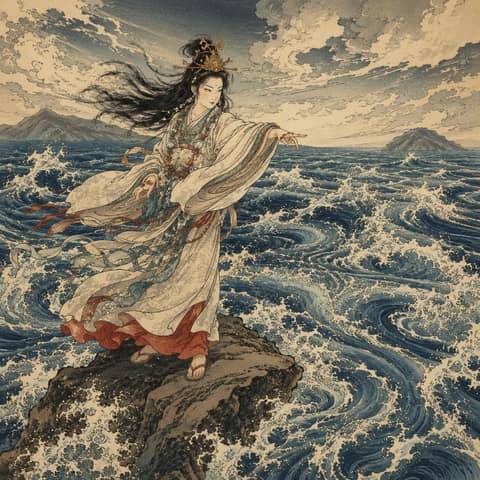
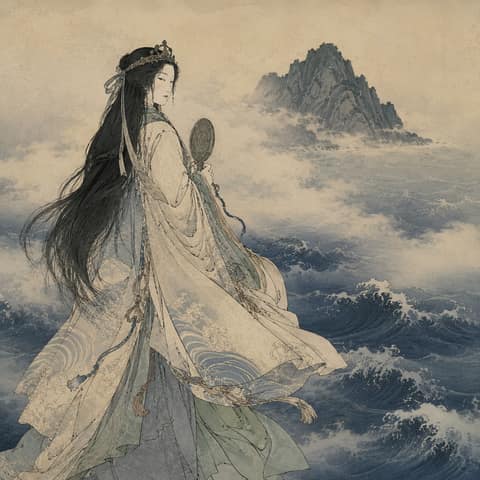
Ichikishima-hime-no-Mikoto is one of the Three Munakata Goddesses—Tagori-hime, Tagitsu-hime, and Ichikishima-hime—and a principal deity of the World Heritage-listed Itsukushima Shrine on Miyajima[1]. In the oath, or ukei, myth of the Kojiki and Nihon Shoki, Amaterasu breaks Susanoo's ten-span sword, chews the pieces, and breathes out a mist from which the three goddesses are born. The element ichiki in her name is associated with ritual service to a deity, giving rise to the interpretation 'princess of the island of worship.' She governs the sea, navigation, and water. The Three Munakata Goddesses guard the sea routes across the Genkai Sea from their shrines at Munakata Taisha; their worship was brought to Itsukushima in Aki, where they became protectors of passage through the Seto Inland Sea. In the medieval blending of kami and Buddhism, Ichikishima-hime was identified with Benzaiten through their shared ties to water, wealth, and the arts and revered as Itsukushima Daimyōjin. The Meiji separation of Shinto and Buddhism placed Benzaiten at Daiganji and Ichikishima-hime at Itsukushima Shrine, but both retained the image of a beautiful goddess of water.
Folklore & Legends
Birth in the ukei myth.The Kojiki and Nihon Shoki present Ichikishima-hime as one of the Three Munakata Goddesses born during the oath between Amaterasu and Susanoo[1]. Doubting Susanoo's intentions after he ascends to Takamagahara, Amaterasu breaks his ten-span sword into three pieces, rinses them in the water of Ame-no-Manai, chews them, and breathes out the mist that becomes Tagori-hime, Tagitsu-hime, and Ichikishima-hime. By Amaterasu's command, the goddesses descend to the 'northern sea route' across the Genkai Sea linking Kyūshū with the Korean Peninsula and the continent. Their duty is to receive imperial rites, protect the realm, and safeguard maritime traffic. This becomes the foundation of Munakata worship: Tagori-hime at Okitsu-gū on Okinoshima, Tagitsu-hime at Nakatsu-gū on Ōshima, and Ichikishima-hime at Hetsu-gū in Tashima.
From Munakata to Miyajima. Itsukushima Shrine tradition dates its foundation to 593, when Saeki no Kuramoto received an oracle and enshrined the Three Munakata Goddesses. Miyajima, or Itsukushima, was regarded in its entirety as sacred ground; residence, childbirth, and burial on the island were once governed by strict taboos. In the late Heian period, Taira no Kiyomori became an ardent patron and, around 1166–1169, oversaw the large-scale construction of the shinden-style sanctuary over the water. Itsukushima flourished as a guardian shrine of the Taira, whose devotion is embodied in the lavish Heike Nōkyō sutra scrolls.
Separation and the present. The 1868 policy separating Shinto and Buddhism divided this syncretic identity institutionally: Benzaiten remained at Daiganji, while Ichikishima-hime continued as a principal deity of Itsukushima Shrine. Today the Three Munakata Goddesses receive prayers for safe voyages and travel, wealth, the arts, and relationships. At high tide, the vermilion gate and shinden-style halls appear to float; at low tide, they join the shore. Architecture and the moving Seto Inland Sea together make visible Ichikishima-hime's divinity at the boundary of water and land.
The heart of Ichikishima-hime's identity lies in the idea of the 'princess of the sacred island': a goddess who dwells in the island where divine service is performed. At Munakata on the Genkai Sea, she protects routes toward the continent; at Itsukushima in Aki, she watches over the passages of the Seto Inland Sea. The divine command concerning the northern sea route makes her a guardian of the boundary joining the realm to the ocean.
Her historical identification with Benzaiten layered the virtues of water, wealth, music and performance, beauty, and wisdom upon this maritime guardianship. Itsukushima Shrine's halls over the water and great vermilion gate provide its most majestic expression. At high tide the sanctuary seems to float; at low tide it reconnects with the land. The changing waterline continually redraws the boundary between sea and shore, sacred precinct and human world—the very boundary she guards.
Ichikishima-hime remains inseparable in lineage from her sister goddesses Tagori-hime and Tagitsu-hime, and historically cannot be understood without Benzaiten, the deity with whom she was joined. Ebisu, another deity of the sea and good fortune, echoes parts of her religious role. She is therefore more than a local goddess of Miyajima: her worship spans the Genkai Sea and Seto Inland Sea and brings safe navigation into relation with cultural and material flourishing.
Character Profile
This section is our own creative profile for storytelling. It is not historical fact or scholarship.
Noble and pure, deep and calm as the sea. She joins the sanctity of ritual service with the beauty and artistic radiance associated with Benzaiten, quietly watching over sailors and worshippers.
Compatibility
She is close to people whose lives touch sea, water, art, or prosperity, and resonates strongly with her sisters Tagori-hime and Tagitsu-hime, with Benzaiten, and with other deities of sea and fortune such as Ebisu.
Abilities
Protecting sea routes, vessels, and sailorsGoverning water and the tidal boundaryGranting prosperity, artistic skill, and wisdom through the history of Benzaiten worshipGuarding the boundary between sacred and ordinary space, sea and landAnswering prayers for relationships and safe travel
Weaknesses
Because the whole of Miyajima was treated as sacred ground, strict taboos historically governed childbirth and burial on the island; the Meiji separation of Shinto and Buddhism also divided her institutionally from Benzaiten.
Habitat
The over-water sanctuary of Itsukushima on Miyajima, the three Munakata shrines by the Genkai Sea, and the shifting boundary between island and water.
The diagram below is a diagnostic evaluation chart for Ichikishima-hime, Goddess of the Sacred Island and Sea Routes. The higher the value of each item, the stronger that characteristic is expressed.