YOKAI.JP

Munakata Taishaむなかたたいしゃ

3 yokai rooted in Munakata Taisha. Explore the legends tied to this land.

Also known as: 辺津宮
  • Ichikishima-hime-no-Mikoto

    Ichikishima-hime-no-Mikoto

    Divine

    ichikishima-hime-no-mikoto

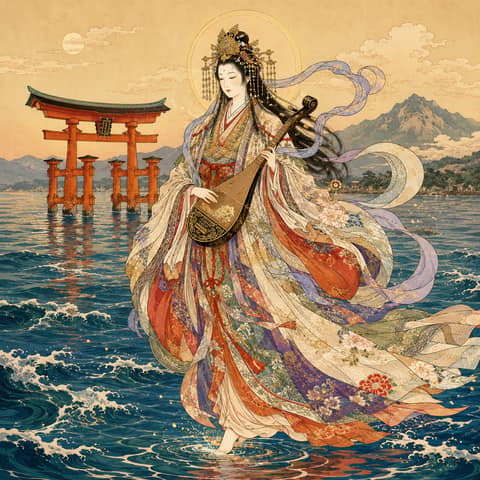
    Ichikishima-hime, Goddess of the Sacred Island and Sea Routes

    Sea and Navigation DeityMunakata Taisha in Fukuoka and Itsukushima Shrine on Miyajima in Hiroshima

    The heart of Ichikishima-hime's identity lies in the idea of the 'princess of the sacred island': a goddess who dwells in the island where divine service is performed. At Munakata on the Genkai Sea, she protects routes toward the continent; at Itsukushima in Aki, she watches over the passages of the Seto Inland Sea. The divine command concerning the northern sea route makes her a guardian of the boundary joining the realm to the ocean. Her historical identification with Benzaiten layered the virtues of water, wealth, music and performance, beauty, and wisdom upon this maritime guardianship. Itsukushima Shrine's halls over the water and great vermilion gate provide its most majestic expression. At high tide the sanctuary seems to float; at low tide it reconnects with the land. The changing waterline continually redraws the boundary between sea and shore, sacred precinct and human world—the very boundary she guards. Ichikishima-hime remains inseparable in lineage from her sister goddesses Tagori-hime and Tagitsu-hime, and historically cannot be understood without Benzaiten, the deity with whom she was joined. Ebisu, another deity of the sea and good fortune, echoes parts of her religious role. She is therefore more than a local goddess of Miyajima: her worship spans the Genkai Sea and Seto Inland Sea and brings safe navigation into relation with cultural and material flourishing.

  • 田心姫神

    田心姫神

    Divine

    たごりひめのかみ

    沖ノ島に鎮まる海北道中の女神・田心姫神

    神霊・神格沖ノ島・宗像大社沖津宮 (現·福岡県宗像市) / 宗像大社 (現·福岡県宗像市)

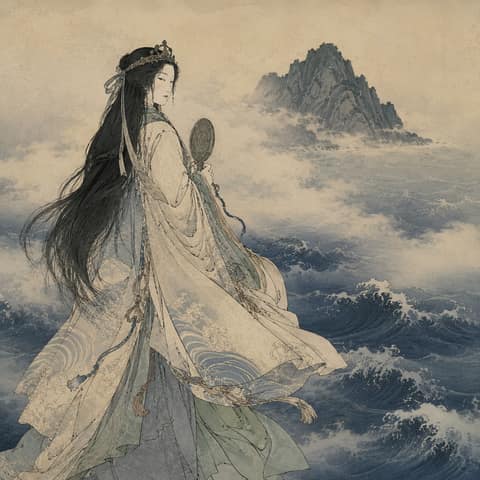
    The key to understanding Tagorihime lies in the fact that Okinoshima is a "distant island." The three shrines of Munakata Taisha are arranged such that one ventures deeper into the sacred realm the further one crosses the sea: Hetsumiya on the Kyushu mainland, Nakatsumiya on Oshima, and Okitsumiya on Okinoshima in the Genkai Sea. The fact that the deity of Okitsumiya, placed furthest offshore, is Tagorihime clearly illustrates her character. She is not a guardian nestling close to human settlements, but a divine presence that arises when navigators spot the island's silhouette, read the tides, and stand in awe of unseen dangers. In the classic texts, she is born from a sword. The ukehi (oath) section of the Kojiki records that Amaterasu Omikami took Susanoo-no-Mikoto's ten-span sword, rinsed it in the Ame-no-Manai well, chewed it to pieces, and from the narrow mist of her breath blown away, Takiribime-no-Mikoto was formed. The sword is an object of military might and oaths, the well water is a medium of purification, and breath and mist are boundaries without form. Because Tagorihime is born at the intersection of these three, she can be understood not merely as a sea deity, but as the goddess of the very moment when martial force is transformed into prayer. The variations in her divine name indicate that she is a deity who cannot be confined to a single reading. Called Takiribime-no-Mikoto or Okitsushima-hime-no-Mikoto in the Kojiki, she is spoken of as Tagorihime or Tagirihime in the Nihon Shoki lineage. Depending on whether "Takiri" is read as the "surging (tagiru)" of the tides or "Tagiri" as the mist upon the sea, the expression she shows changes slightly. In either case, however, at her core lies the power to alter visibility right in the middle of the water's surface. To navigators, fog was both a danger and a sign signaling the realm of the gods. In the Munakata faith, this mythology is tied to actual sea routes. Okinoshima is a maritime transport hub connecting the Japanese archipelago and the Korean Peninsula, and official World Heritage documents explain that rituals praying for navigational safety and successful exchange were held from the late 4th century to the late 9th century. The evolution of offerings shows a transition of ritual sites from atop giant boulders, to rock shelters, half-rock-shelter half-open-air, and finally open-air locations, narrating how the ancient rituals of Okinoshima are essential in considering the formation of indigenous Japanese faith moving from nature worship to shrine rituals. The taboos surrounding the island reinforce Tagorihime's "invisibility." Official World Heritage documents convey customs such as not speaking of what one sees or hears on Okinoshima, not taking a single tree, blade of grass, or stone, and requiring even Shinto priests to undergo purification in the sea before entering. These are not so much a matter of secrecy as they are a decorum meant to prevent the consumption of the sacred realm. Tagorihime is not a deity who discloses everything within statues or narratives. Through what is not spoken, what is not taken away, and what is left behind on the island, she exists all the more profoundly. On the other hand, she is not confined solely to Okinoshima. The history of Munakata Taisha regards the three goddesses as the three daughters of Amaterasu Omikami, telling how the land of Munakata, which fulfilled the functions of overseas diplomacy, trade, and national defense, became deeply tied to state rituals. The description of "state rituals" seen in the history of Munakata Taisha prevents Tagorihime from remaining merely a deity of maritime safety. In the ancient state, crossing the sea meant trade, diplomacy, warfare, and prayer. Precisely because of this complexity, her stillness resonates not as weakness, but as the posture that both the state and humanity ought to uphold when facing the ocean. Furthermore, in the genealogy of the Kojiki, Takiribime-no-Mikoto bears Ajisukitakahikone-no-Kami and Takahime-no-Mikoto with Okuninushi-no-Kami. This means that the maritime goddess of Munakata also holds a place within the Izumo lineage. Situated in the genealogy of Okuninushi-no-Kami, Tagorihime is a guardian of the northern sea routes, while simultaneously a mother goddess expanding the bloodline of Izumo mythology. The goddess retreating far offshore paradoxically links the myths of the land. This duality is the quiet strength of Tagorihime. The deeper she withdraws into the island, the more she expands as the knot binding the entire mythology together.

  • 湍津姫神

    湍津姫神

    Divine

    たぎつひめのかみ

    大島に鎮まる海中道の女神・湍津姫神

    神霊・神格宗像大社中津宮・大島 (現·福岡県宗像市) / 宗像大社 (現·福岡県宗像市)

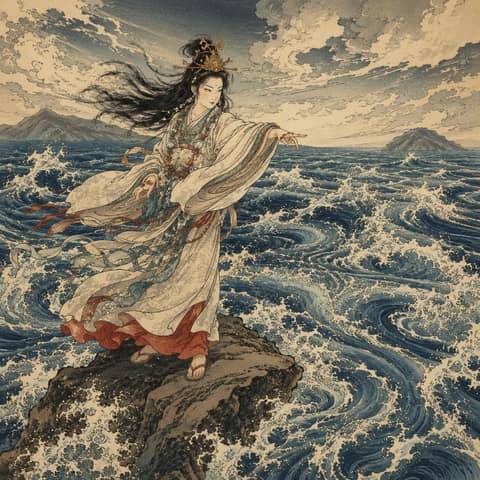
    To understand Tagitsuhime, who resides on Oshima, one must first look at Nakatsu-miya not merely as the "middle of the three shrines," but as a sanctuary situated mid-voyage on the sea. Munakata Taisha links Okitsu-miya on Okinoshima, Nakatsu-miya on Oshima, and Hetsu-miya in Tajima as three shrines, collectively calling them Munakata Taisha. Its official history designates the three goddesses as the daughters of Amaterasu Omikami, layering the memories of state rituals and foreign exchange over the national treasures excavated from Okinoshima. Tagitsuhime of Nakatsu-miya stands at the center of this immense religious sphere, receiving and passing along both the awe of the open ocean and the prayers of the mainland. Today's Nakatsu-miya is treated as Munakata Taisha Nakatsu-miya even in official World Heritage documents. It is situated at 1811 Oshima, Munakata City, Fukuoka Prefecture, and the official Munakata Taisha webpage lists its enshrined deity as Tagitsuhime-no-Kami. Here, Tagitsuhime is not an abstract water deity, but a goddess with a tangible island, shrine buildings, approach paths, and festivals. Oshima is an inhabited island reached by ferry from the mainland, unlike Okinoshima, which generally refuses human entry. Yet simultaneously, Oshima is an island that looks out toward Okinoshima, houses the Okitsu-miya Yohaisho (worship hall for praying from afar), and transmits the taboos of the sea to human settlements. Tagitsuhime's "middle" exists between an accessible sacred site and an inaccessible one. Tracing the pronunciation of her divine name sharpens the contours of this goddess even further. "Tagitsu" encompasses the state of water rushing violently and boiling up. Rather than a deity of a calm lake surface, Tagitsuhime is a deity of places where tides shift, currents change, and a ship's judgment is tested. Guarding a voyage does not simply mean calming the waves. Sometimes it means allowing progress, sometimes ordering a wait, and sometimes forcing a turn back. Tagitsuhime's protection works not as a power to make the sea obey humans, but as a power to return humans to the sea's rhythm. Mount Mitake, behind Nakatsu-miya, is indispensable for considering Tagitsuhime's Aramitama (rough spirit). The official Munakata Taisha webpage notes that Mitake Shrine is located at the highest point on Oshima, enshrining Amaterasu Omikami and the Aramitama of Tagitsuhime, while noting that according to Japanese mythology, it is said to be the site of Tagitsuhime's descent. If Nakatsu-miya at the foot is the shrine that greets worshippers, Mitake at the summit is where the island itself received the deity. The shadow of the mountain visible from the sea, and the sea route viewed from the mountain—these intersecting gazes forge Tagitsuhime's divinity. The history of rituals shown in official World Heritage documents corroborates this duality. It is noted that by the late seventh century, open-air rituals sharing commonalities with Okinoshima rituals were conducted at the Mitakesan ritual site on Oshima and the Shimotakamiya ritual site on the mainland. Furthermore, the *Kojiki* and *Nihon Shoki* from the early eighth century record that the Munakata clan worshipped the three Munakata goddesses across the three shrines. Here, the structure of the three shrines connected by the sea was established. Tagitsuhime bears the intermediate memory within this, linking the ancient rituals of Okinoshima to the shrine-based rituals on the mainland. Discrepancies with classical texts are, in fact, an entryway to reading Tagitsuhime more richly. In the oath-taking section of the *Kojiki*, the name Takitsuhime-no-Mikoto appears, and she is recorded as being worshipped as one of the three Munakata goddesses. On the other hand, in the present Munakata Taisha, Tagitsuhime is the deity of Nakatsu-miya. Reducing this difference to "which is correct" loses the depth of the Munakata faith. The divine names in the classics, the three-shrine rituals preserved by priestly families, and the archaeological landscapes organized as a World Heritage site represent different historical layers. Tagitsuhime is also a deity who traverses these layers. Placing the maritime rituals overseen by the Munakata clan in the background, Tagitsuhime ceases to be merely the "second of the three goddesses." Official World Heritage documents state that the ancient rituals on Okinoshima were carried out by people of the Munakata region who possessed advanced navigational skills and engaged in foreign exchange. The sea was a trade route, a danger zone, a path for diplomacy, and a place to pray to the gods. Nakatsu-miya on Oshima is where all of these are concentrated into a single point. Here, travelers simultaneously feel the awe of heading out to the open sea and the relief of returning to the mainland. If reading this figure in an encyclopedia, Tagitsuhime is the "guardian deity of the flow." Flow is not just water currents. From myth to ritual, from Okinoshima to Oshima, from taboo to worship, from the prayers of the ancient state to modern traffic safety, the faith has flowed down to the present, changing its form. Tagitsuhime reconnects the things that threaten to sever along the way. Calming her Aramitama on the mountain peak, looking up to her Nigimitama (gentle spirit) at Nakatsu-miya, and gazing toward Okinoshima beyond the remote worship hall. Her divine authority manifests itself more as the shifting tides signaling the time to cross, rather than through flashy miracles.