YOKAI.JP

Sumiyoshi Sanjin

すみよしさんじん

Sumiyoshi Sanjin

Sumiyoshi Sanjin

Their soul is listening — speak, and they will answer.

Basic Description

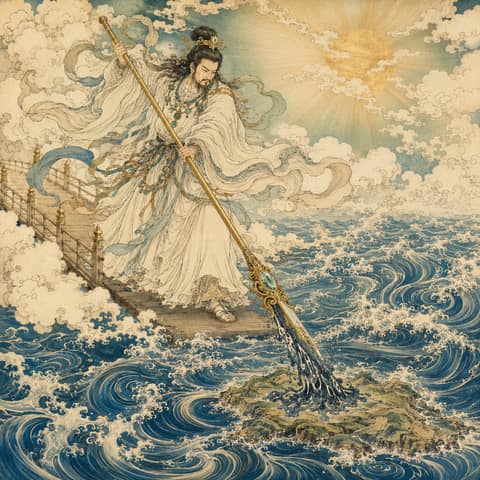
According to the first volume of the Kojiki and the Age of the Gods section of the Nihon Shoki (Fifth Section, First Alternate Writing), they are the three kami born from three different depths of seawater when Izanagi-no-Mikoto purified himself in the sea at Ahagihara, the river mouth of Tachibana in Himuka of Tsukushi, after returning from the underworld, Yomi. — Sokotsutsu-no-o-no-Mikoto, Nakatsutsu-no-o-no-Mikoto, and Uwa- (or Omote-)tsutsu-no-o-no-Mikoto (written as 'Soko-, Naka-, and Uwa-tsutsu-no-o-no-kami' in the Kojiki). They are enshrined together as guardian deities of the sea. They were born simultaneously with the three Watatsumi kami (Sokotsu-, Nakatsu-, and Uwatsu-Watatsumi) in the Kojiki, and the two groups are often spoken of in pairs. The etymology of 'Tsutsu' has not been academically resolved. Multiple theories coexist, including the star theory (deification of Orion's Belt, originated by Hoei Nojiri in 1936), the 'tsu' (port) theory, the honorific spirit 'tsuchi' phonetic change theory, the ship spirit theory, the Tsutsu toponym theory in Tsushima, and the literal bamboo tube theory. They are the principal deities in the myth of Empress Jingu's conquest of the Three Han states (Sankan Seibatsu). They delivered an oracle to the Empress and reportedly protected her sea route. Sumiyoshi Taisha, the head shrine (Ichinomiya of Settsu Province), comprises four main halls (the first, second, and third enshrine the three kami, and the fourth enshrines Empress Jingu), and it is the principal deity of over 2,300 Sumiyoshi shrines nationwide. From ancient times to the present, they have been widely revered as deities of sea protection, maritime safety, martial fortune, and waka poetry (as the Three Deities of Waka).

Folklore & Legends

The true identity of the Sumiyoshi Sanjin is the three kami of purification belonging to Izanagi-no-Mikoto, appearing in the first volume of the Kojiki (Age of the Gods). When Izanagi returned from Yomi (the underworld) and performed misogi (purification) at Ahagihara in Himuka of Tsukushi, he submerged himself in seawater to cleanse his body. From three different depths, three deities were born: recorded as 'Sokotsutsu-no-o-no-kami, Nakatsutsu-no-o-no-kami, Uwatsutsu-no-o-no-kami' in the Kojiki, and as 'Sokotsutsu-no-o-no-Mikoto, Nakatsutsu-no-o-no-Mikoto, Omotetsutsu-no-o-no-Mikoto' in the Nihon Shoki. The orthographic difference between 'Uwa' (upper) in the Kojiki and 'Omote' (surface) in the Shoki is one basis for the later interpretation of 'tsutsu' as layers of water. Simultaneously, the three Watatsumi kami (Sokotsu, Nakatsu, Uwatsu Watatsumi) were born, making Sumiyoshi and Watatsumi a paired dual structure—bottom = Sokotsutsu/Sokotsu Watatsumi; middle = Nakatsutsu/Nakatsu Watatsumi; surface = Uwatsutsu/Uwatsu Watatsumi. This tripartite structure is common to both texts.

Because the etymology of 'Tsutsu' has not been academically resolved, the major theories are listed alongside each other: ① Star theory — 'Tsutsu' is an archaic word for 'star' (hoshi); it deifies the three central stars of Orion as navigational stars for ancient seafaring clans (advocated by Hoei Nojiri in "Japanese Stars" 1936; this is a modern theory with no direct supporting primary texts from early folklorists like Orikuchi or Yanagita); ② Tsu (port) theory — 'Tsu' is a particle meaning 'of', and the second 'tsu' means 'port/sea route'; ③ Tsuchi phonetic change theory — 'Tsu' is a particle, and 'chi' is an honorific spirit suffix (akin to Orochi or Nozuchi); ④ Tsutsu-ro theory — 'Tsuchi' equals 'tsuji' meaning sea route; ⑤ Ship spirit theory — ancient ship spirit worship enshrined at the bottom of a boat; ⑥ Tsutsu toponym theory — derived from Tsutsu at the southern tip of Tsushima, the origin of seafaring clans; ⑦ Literal tube theory — using bamboo tubes as a yorishiro (vessel). Listing multiple theories is academically accurate, and it is particularly imprecise to refer to the 'star theory' as the 'accepted folkloric theory'. Labeling it as a 'modern constellation theory starting with Hoei Nojiri' is safer.

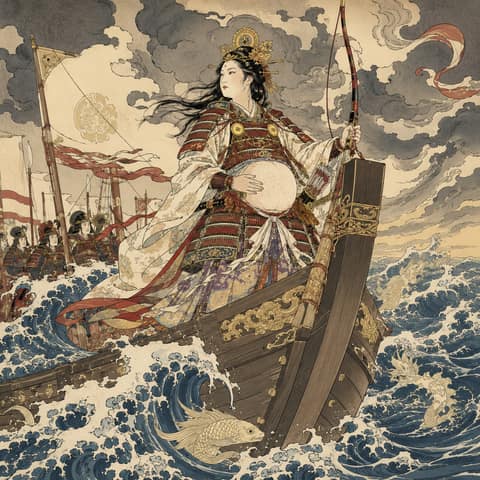
The Empress Jingu legend is the most important narrative in the history of Sumiyoshi Sanjin worship. According to the Nihon Shoki, when Empress Jingu became possessed after Emperor Chuai's death, the Sumiyoshi kami delivered an oracle: "Conquer Silla, a land filled with gold and silver. If you worship us three deities, Silla and Kumaso will submit." They protected her maritime expedition (subjugating Silla, Baekje, and Goguryeo), and upon her return, a second oracle commanded: "Enshrine our Aramitama (rough spirit) in Yamada village of Anato (Nagato)" — this became the origin of the Shimonoseki Sumiyoshi Shrine. Enshrining the Nigimitama (gentle spirit) in Settsu became the origin of Sumiyoshi Taisha. The structure of jointly enshrining Empress Jingu and Sumiyoshi Sanjin originated here, with the Empress enshrined in the Fourth Main Hall. However, the dating of the Empress Jingu chronicles is heavily debated by scholars, and treating the legendary date (211 AD) as historical fact requires extreme caution.

Sumiyoshi Taisha, the head shrine (2-9-89 Sumiyoshi, Sumiyoshi-ku, Osaka), is the Ichinomiya of Settsu Province and one of the Twenty-Two Shrines (Middle Seven Shrines). Its official history dates its founding to the 11th year of Empress Jingu's regency (211 AD) on the first Day of the Hare in the Month of the Hare — a legendary date without archaeological proof. Its four main halls have a unique layout: the First, Second, and Third Halls line up vertically (facing west, toward the sea), while the Fourth Hall sits south of the Third, forming an L-shape. The First Hall enshrines Sokotsutsu-no-o, the Second Nakatsutsu-no-o, the Third Uwatsutsu-no-o, and the Fourth Empress Jingu. "Sumiyoshi-zukuri" is considered the oldest style in shrine architectural history, characterized by a gabled roof, cypress bark thatch, and red and white walls. The current main halls were built in 1810 and are all designated National Treasures. The steeply arched red Sorihashi (Taiko Bridge) is the iconic visual symbol of the Sumiyoshi faith.

There are over 2,300 branch shrines nationwide (the official number from Sumiyoshi Taisha, whereas Wikipedia undercounts at ~600). The distribution is concentrated along coastlines, ports, the Seto Inland Sea, Kyushu, and northern Japan, proving it to be the most vital faith for fishermen, shipping merchants, and navy personnel from ancient to modern times.

The "Three Great Sumiyoshi" and ancient shrine dispute: ① Sumiyoshi Taisha (Osaka) = Settsu Ichinomiya, Nigimitama, Head Shrine; ② Sumiyoshi Shrine (Shimonoseki, Yamaguchi) = Nagato Ichinomiya, Aramitama, site of Empress Jingu's return oracle; ③ Sumiyoshi Shrine (Hakata, Fukuoka) = Chikuzen Ichinomiya, self-proclaimed "Japan's First Sumiyoshi-gu", oldest theory identified with Ahagihara. Additionally, Hon-Sumiyoshi Shrine in Kobe is based on an influential Edo-period theory by Motoori Norinaga identifying Settsu's Sumiyoshi village as the ancient "Nanakura's Long Strait". Academically, the "first Sumiyoshi" cannot be determined, with each shrine claiming primacy based on its own legends.

In ancient and medieval times, it was customary for Japanese envoys to Sui and Tang China to pray at Sumiyoshi Taisha before departing, as noted in the "Tosa Nikki" (935). As deities of martial fortune, they garnered reverence from samurai clans like the Minamoto due to the Empress Jingu legends. As deities of poetry, they stand at the head of the "Three Deities of Waka", appearing frequently in the Kokin Wakashu and Shin Kokin Wakashu. The Noh play "Takasago" features the "Pines of Sumiyoshi and Takasago" as symbols of marital harmony and longevity. The rice-planting ritual (Otaue Shinji), a National Important Intangible Folk Cultural Property, is its most representative festival.

Today, visits by the Maritime Self-Defense Force, merchant ships, fishermen, and shipping businesses remain robust. It is one of Osaka's premier spots for New Year's visits, Shichi-Go-San, and shrine weddings. Affectionately called "Sumiyoshi-san" in the Kansai region, the Sumiyoshi Sanjin are a national divine presence offering wide-ranging blessings for maritime protection, safety at sea, poetry, scholarship, marital harmony, safe childbirth, and business prosperity.

Related Yokai

Yokai deeply tied to this one in legend.

Detailed Analysis

The true identity of the Sumiyoshi Sanjin is the three kami of purification belonging to Izanagi-no-Mikoto, appearing in the first volume of the Kojiki (Age of the Gods). When Izanagi returned from Yomi (the underworld) and performed misogi (purification) at Ahagihara in Himuka of Tsukushi, he submerged himself in seawater to cleanse his body. From three different depths, three deities were born: recorded as 'Sokotsutsu-no-o-no-kami, Nakatsutsu-no-o-no-kami, Uwatsutsu-no-o-no-kami' in the Kojiki, and as 'Sokotsutsu-no-o-no-Mikoto, Nakatsutsu-no-o-no-Mikoto, Omotetsutsu-no-o-no-Mikoto' in the Nihon Shoki. The orthographic difference between 'Uwa' (upper) in the Kojiki and 'Omote' (surface) in the Shoki is one basis for the later interpretation of 'tsutsu' as layers of water. Simultaneously, the three Watatsumi kami (Sokotsu, Nakatsu, Uwatsu Watatsumi) were born, making Sumiyoshi and Watatsumi a paired dual structure—bottom = Sokotsutsu/Sokotsu Watatsumi; middle = Nakatsutsu/Nakatsu Watatsumi; surface = Uwatsutsu/Uwatsu Watatsumi. This tripartite structure is common to both texts.

The etymology of 'Tsutsu' has not been academically resolved. Major theories are listed alongside each other:Star theory — 'Tsutsu' is an archaic word for 'star' (hoshi); it deifies the three central stars of Orion (ancient name 'Miboshi') as navigational stars for ancient seafaring clans. However, this is a modern theory advocated by Hoei Nojiri in "Japanese Stars" (1936), and there are no direct supporting primary texts from early folklorists like Orikuchi or Yanagita; treating it as the 'accepted folkloric theory' is academically inaccurate. ② Tsu (port) theory — 'Tsu' is a particle meaning 'of', and the second 'tsu' means 'port/sea route', an interpretation from Orikuchi's lineage; ③ Tsuchi phonetic change theory — 'Tsu' is a particle, and 'chi' is an honorific spirit suffix (akin to Orochi or Nozuchi); ④ Tsutsu-ro theory — 'Tsuchi' equals 'tsuji' meaning sea route; ⑤ Ship spirit theory — ancient ship spirit worship enshrined at the bottom of a boat; ⑥ Tsutsu toponym theory — derived from Tsutsu at the southern tip of Tsushima, the origin of seafaring clans; ⑦ Literal tube theory — using bamboo tubes as a yorishiro (vessel). Listing multiple theories is academically accurate, and it is particularly imprecise to refer solely to the 'star theory' as the accepted view.

The Empress Jingu legend is the most important narrative in the history of Sumiyoshi Sanjin worship. According to the Nihon Shoki, when Empress Jingu became possessed after Emperor Chuai's death, the Sumiyoshi kami delivered an oracle: "Conquer Silla, a land filled with gold and silver. If you worship us three deities, Silla and Kumaso will submit." They protected her maritime expedition (subjugating Silla, Baekje, and Goguryeo), and upon her return, a second oracle commanded: "Enshrine our Aramitama (rough spirit) in Yamada village of Anato (Nagato)" — this became the origin of the Shimonoseki Sumiyoshi Shrine. Enshrining the Nigimitama (gentle spirit) in Settsu became the origin of Sumiyoshi Taisha. The structure of jointly enshrining Empress Jingu and Sumiyoshi Sanjin originated here, establishing the unique four-hall structure of Sumiyoshi Taisha. However, the dating of the Empress Jingu chronicles is heavily debated by scholars, and treating the legendary date (211 AD) as historical fact requires extreme caution—archaeologically, it is pointed out as potentially reflecting events from the 4th century onwards.

Sumiyoshi Taisha, the head shrine (2-9-89 Sumiyoshi, Sumiyoshi-ku, Osaka), is the Ichinomiya of Settsu Province, one of the Twenty-Two Shrines (Middle Seven Shrines), and a former Kanpei-taisha. Its official history dates its founding to the 11th year of Empress Jingu's regency (211 AD) on the first Day of the Hare in the Month of the Hare — a legendary date without archaeological proof. Its four main halls have a unique layout: the First, Second, and Third Halls line up vertically (facing west, toward the sea), while the Fourth Hall sits south of the Third, forming an L-shape. The First Hall enshrines Sokotsutsu-no-o, the Second Nakatsutsu-no-o, the Third Uwatsutsu-no-o, and the Fourth Empress Jingu. "Sumiyoshi-zukuri" is considered the oldest style in shrine architectural history, characterized by a gabled roof, cypress bark thatch, and red and white walls. The current main halls were built in 1810 and are all designated National Treasures. The steeply arched red Sorihashi (Taiko Bridge) is the iconic visual symbol of the Sumiyoshi faith, frequently appearing in ukiyo-e, paintings, and waka poetry.

There are over 2,300 branch shrines nationwide (the official number from Sumiyoshi Taisha, whereas Wikipedia undercounts at ~600). The distribution is concentrated along coastlines, ports, the Seto Inland Sea, Kyushu, and northern Japan, proving it to be the most vital faith for fishermen, shipping merchants, and navy personnel from ancient to modern times.

The "Three Great Sumiyoshi" and ancient shrine dispute: ① Sumiyoshi Taisha (Osaka) = Settsu Ichinomiya, Nigimitama, Head Shrine; ② Sumiyoshi Shrine (Shimonoseki, Yamaguchi) = Nagato Ichinomiya, Aramitama, site of Empress Jingu's return oracle; ③ Sumiyoshi Shrine (Hakata, Fukuoka) = Chikuzen Ichinomiya, self-proclaimed "Japan's First Sumiyoshi-gu", oldest theory identified with Ahagihara. Additionally, Hon-Sumiyoshi Shrine in Kobe is based on an influential Edo-period theory by Motoori Norinaga (1764-1798) identifying Settsu's Sumiyoshi village as the ancient "Nanakura's Long Strait". Academically, the "first Sumiyoshi" cannot be determined, with each shrine claiming primacy based on its own legends.

In ancient and medieval times, it was customary for Japanese envoys to Sui and Tang China to pray at Sumiyoshi Taisha before departing. The "Tosa Nikki" (Ki no Tsurayuki, 935) also notes prayers for maritime safety to the Sumiyoshi deities. In Heian-period waka by poets like Izumi Shikibu, Ki no Tsurayuki, and Ono no Komachi, Sumiyoshi frequently appears, positioning the kami at the head of the "Three Deities of Waka". In the medieval and early modern periods, the Noh play "Takasago" featured the "Pines of Sumiyoshi and Takasago" as a symbol of marital harmony and longevity, often performed at shrine weddings. The Noh play "Sumiyoshi Mode" is another masterpiece representing this faith. The rice-planting ritual (Otaue Shinji), a National Important Intangible Folk Cultural Property, is Sumiyoshi Taisha's most representative festival, sanctifying the entire rice-farming cycle from planting to harvest.

As a samurai faith from the medieval to Edo periods, they garnered reverence from warrior clans like the Minamoto due to Empress Jingu's Sankan Seibatsu legends. During the Muromachi and Sengoku periods, Sumiyoshi Taisha received immense veneration from the shipping industry in the Seto Inland Sea, Settsu, and Izumi, actively participating in both commercial and military affairs as the guardian of maritime traffic in Osaka Bay.

Today, visits by the Maritime Self-Defense Force, merchant ships, fishermen, and shipping businesses remain robust. It is one of Osaka's premier spots for New Year's visits, Shichi-Go-San, and shrine weddings. Affectionately called "Sumiyoshi-san" in the Kansai region, the Sumiyoshi Sanjin are a national divine presence offering wide-ranging blessings for maritime protection, safety at sea, poetry, scholarship, marital harmony, safe childbirth, and business prosperity. The 2,300 branch shrines, known as Sumiyoshi Shrine, Sumiyoshi-sha, Sumie Shrine, or Sumiyoshi Jinja, line Japan's coastlines and ports, forming the backbone of an uninterrupted maritime faith from ancient times to the present day.

Character Profile

This section is our own creative profile for storytelling. It is not historical fact or scholarship.

Yokai Type
Kami
Rarity
Divine
Personality
海の三層 (底·中·表) を分担する三神一体構造。 静謐にして力強い、 神功皇后の三韓征伐を導いた決断力と慎重さを併せ持つ気質。
Compatibility
海上守護·航海安全·漁業·海運業·海上自衛隊関係者と最も相性が良い。 和歌·文学·学問·夫婦和合·安産も。
Abilities
Maritime protection (core of shipping faith from ancient to modern times)Safety at sea (prayers by envoys to Sui and Tang China)Oracle of the Sankan Seibatsu (Empress Jingu legend)Gods of Waka poetry (Head of the Three Deities of Waka)Martial fortune and samurai protectionThree Deities of Purification (born from Izanagi's misogi upon returning from Yomi)
Weaknesses
The fact that the etymology of 'Tsutsu' remains unresolved with various competing academic theories is a focal point of debate in the history of religion and Shinto. The uncertainty surrounding the chronological dating in the Empress Jingu chronicles.
Habitat
Sumiyoshi Taisha (Osaka, Ichinomiya of Settsu, head shrine) / Shimonoseki Sumiyoshi Shrine (Yamaguchi, Ichinomiya of Nagato, Aramitama) / Fukuoka Sumiyoshi Shrine (Ichinomiya of Chikuzen) / Hon-Sumiyoshi Shrine (Kobe, Hyogo) / Over 2,300 Sumiyoshi shrines nationwide, shipping hubs, and ports.
🔮Yokai Compatibility Test

For more detailed information and diagnosis results about Guardian of the Sea & Waka Kami (Default), please click here.

Sources & References

4
  1. 住吉三神·伊邪那岐禊三神『古事記』 上巻·『日本書紀』 神代上 第五段(記紀·神社史·神道学·民俗, 712·720) [宗教·神話·神社]伊邪那岐命の黄泉国帰還後の禊祓で生まれた三柱。 古事記=底筒之男·中筒之男·上筒之男、 日本書紀=底筒男·中筒男·表筒男。 ワタツミ三神と対偶的に水底·中·表の三層対応。
  2. 「ツツ」 語源論争 (諸説併存)近代~現代神道学·民俗学·野尻抱影『日本の星』 1936(記紀·神社史·神道学·民俗, 近代) [宗教·神話·神社]星説 (オリオン三つ星·野尻抱影近代提唱)·津 (港) 説·ツチ転訛霊格説·船魂説·対馬豆酘地名説·筒説等。 学術的に決着していない。 星説は野尻抱影に始まる近代説で折口·柳田直接の支持文献なし。
  3. 神功皇后·三韓征伐譚 (『日本書紀』 神功皇后紀)『日本書紀』 神功皇后摂政前紀(記紀·神社史·神道学·民俗, 720) [宗教·神話·神社]仲哀天皇崩御後の神懸かりで住吉三神が新羅征討を神託、 皇后の三韓征伐を海上守護。 帰途「荒魂を穴門に祀れ」 の再神託で下関住吉神社·摂津住吉大社が分立。
  4. 住吉大社·摂津国一宮·総本宮住吉大社公式·『延喜式神名帳』(記紀·神社史·神道学·民俗, 伝承 211 年·927 神名帳) [宗教·神話·神社]大阪府大阪市住吉区住吉 2-9-89。 摂津国一宮·二十二社中七社·旧官幣大社·住吉造四本宮国宝。 創建神功皇后摂政 11 年 (211) は伝承年代、 考古学的確証ではない。

Interested in this type of yokai?

Discover the yokai most similar to your personality with our yokai diagnosis

Start Yokai Diagnosis

Meet your guardian yokai at the shrine

Draw an omikuji fortune and discover the yokai watching over you today.