YOKAI.JP

Izanagi

Izanagi

Izanagi

Izanagi

Their soul is listening — speak, and they will answer.

Basic Description

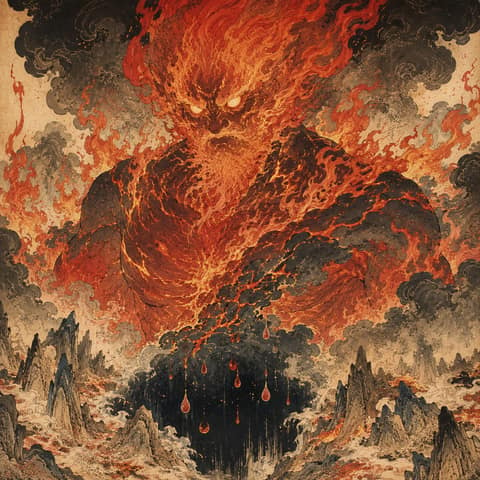
Izanagi is a creator deity in Japan's oldest mythological records, the Kojiki of 712 and the Nihon Shoki of 720[1][2]. The Kojiki writes his name as Izanagi no Kami or Izanagi no Mikoto, while the Nihon Shoki gives the form Izanagi no Mikoto. In the final generation of the Kamiyo Nanayo, the Seven Generations of the Age of the Gods, he appears with his wife Izanami. Ordered by the heavenly deities, the pair stand on the Floating Bridge of Heaven and stir the sea with the heavenly jeweled spear, Ame-no-nuboko, creating Onogoro Island. There they marry and give birth to the Oyashima, the great eight islands of Japan, along with many other deities. When Izanami dies after giving birth to the fire god Kagutsuchi, Izanagi follows her into Yomi, the land of the dead, but flees after seeing her decayed body. At Yomotsu Hirasaka he seals the boundary between the living and the dead with the Chibiki rock, then purifies himself at Awagihara. From that act of misogi are born the Three Precious Children: Amaterasu Omikami, Tsukuyomi no Mikoto, and Susanoo no Mikoto. Taga Taisha in Shiga, Izanagi Jingu on Awaji Island, and Eda Shrine in Miyazaki are among his major cult sites. As the ancestral deity of misogi and harae, Izanagi remains central to Shinto ideas of purification.

Folklore & Legends

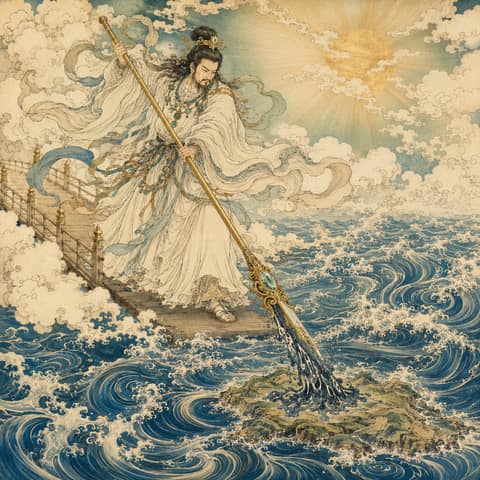
From creation to land-birth, the last of the divine generations. In the opening book of the Kojiki, after heaven and earth come into being, the Seven Generations of the Age of the Gods unfold in Takamagahara; the final pair are Izanagi no Mikoto and Izanami no Mikoto. The heavenly deities command them to complete and solidify the drifting land below. Standing on the Floating Bridge of Heaven, they lower Ame-no-nuboko into the sea and stir. Brine dripping from the spear tip hardens into Onogoro Island. The two descend, marry, and begin the birth of lands and gods. Awaji, Iyo, Oki, Tsukushi, Iki, Tsushima, Sado, and Honshu become the Oyashima, while deities of mountains, rivers, sea, wind, trees, and fields follow one after another.

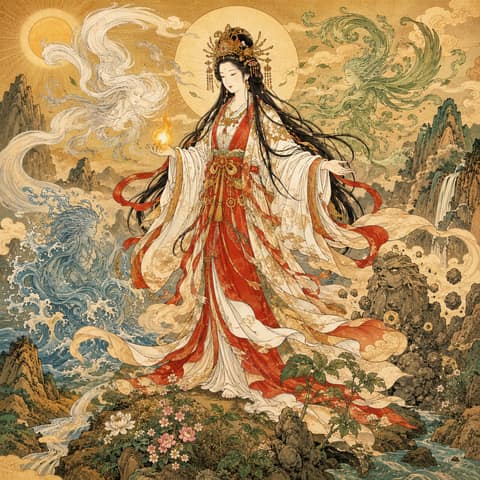
The birth of Kagutsuchi and the death of Izanami. The long sequence of land-birth and god-birth ends with the fire deity Kagutsuchi. Izanami is fatally burned while giving birth to him. Izanagi, overcome with grief and rage, draws his ten-hand sword and kills his own child; from Kagutsuchi's blood and body still more fire, water, and mountain deities are born. Unable to accept his wife's death, Izanagi buries her near Ifuya Pass in Izumo and then descends to Yomi in search of her. The episode is Japan's great tale of a husband entering the land of the dead to recover his wife, and one of East Asia's earliest written Orpheus-type myths.

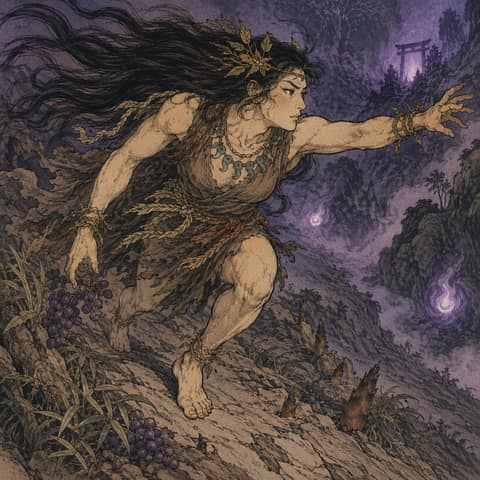
The descent to Yomi and the broken taboo. In Yomi, Izanagi asks Izanami to return to the Central Land of Reed Plains. She replies that she has already eaten the food of Yomi, but will consult the gods of the underworld, warning him not to look at her while she is away. Izanagi cannot wait. He breaks a tooth from his comb, lights it, and sees her decaying body. Humiliated and furious, Izanami sends the hags of Yomi, the eight thunder gods, and the armies of the dead after him. Izanagi turns his black hair ornament into grapes, his comb teeth into bamboo shoots, and finally repels the pursuers with three peaches at Yomotsu Hirasaka. He seals the entrance with the great Chibiki rock. Across that stone, Izanami vows to kill a thousand people each day; Izanagi answers that he will cause fifteen hundred to be born. The order of life and death is fixed in this exchange.

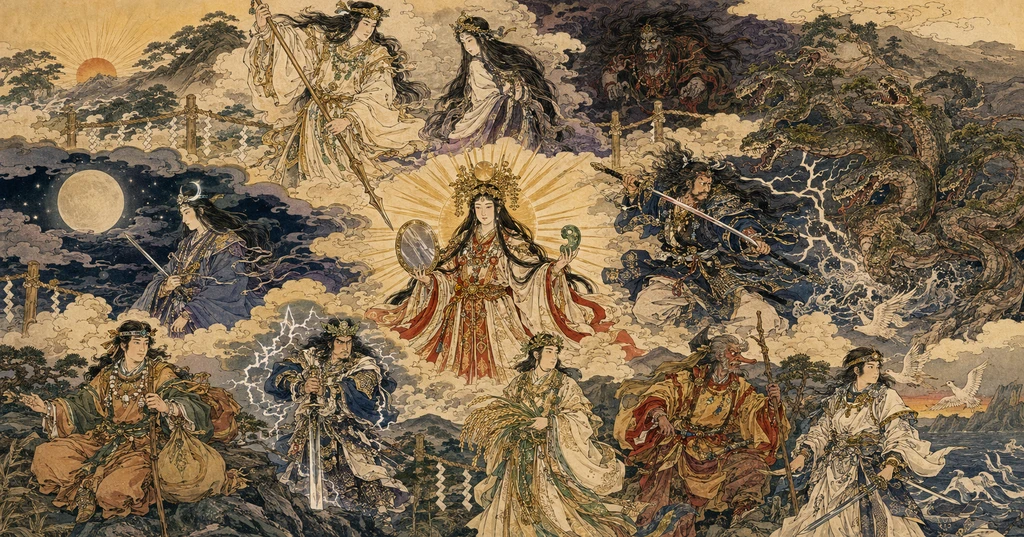
Misogi at Awagihara and the birth of the Three Precious Children. To wash away the pollution of Yomi, Izanagi goes to Awagihara at Tachibana no Odo in Himuka of Tsukushi, identified today with the area around Eda Shrine in Miyazaki, and performs misogi. As he removes his clothing, staff, belt, bag, crown, and armlets, gods are born. As he washes in the upper, middle, and lower reaches of the stream, sea deities including the Sumiyoshi gods and the Munakata goddesses appear. Finally, when he washes his left eye, Amaterasu Omikami is born; from his right eye comes Tsukuyomi no Mikoto; from his nose comes Susanoo no Mikoto. These are the Three Precious Children. Izanagi assigns Takamagahara to Amaterasu, the realm of night to Tsukuyomi, and the sea plain to Susanoo, then withdraws to his hidden palace on Awaji.

Major cult sites and the faith of purification. Izanagi is especially linked to three sacred places. Izanagi Jingu in Awaji, Hyogo, is associated in both Kojiki and Nihon Shoki traditions with the hidden palace of Izanagi no Mikoto. Taga Taisha in Shiga became widely beloved in the early modern period as the shrine of O-Taga-san, a god of long life. Eda Shrine in Miyazaki is revered as the site of Awagihara and the mythic origin of misogi. Its Misogi Pond is still treated as a likely ritual site and a place of purification practice for Shinto groups. Through these sites, Izanagi is honored as the ancestral deity of Shinto purification, alongside other ancient centers such as Izumo Taisha and Ise Jingu.

Scholarship and modern culture. In the Edo period, Motoori Norinaga's Kojiki-den, completed in 1798 in forty-four volumes, gave a meticulous philological commentary on the Kojiki myths, including the stories of Izanagi. In the postwar period, scholars such as Orikuchi Shinobu and Obayashi Taryo reconsidered the Yomi episode through comparative mythology as a tale of descent to the underworld. In modern culture, Izanagi is repeatedly reimagined in works such as the Megami Tensei series, Okami, Demon Slayer, and Record of Ragnarok. The term Izanagi boom also names the period of rapid Japanese economic expansion from 1965 to 1970. The ancient myth still shapes Japanese vocabulary and imagination more than two thousand years later.

Related Yokai

Yokai deeply tied to this one in legend.

Detailed Analysis

The Seven Generations of the Gods and the cosmology of creation. The basic account covers land-birth and god-birth. Looking more closely, the Seven Generations of the Gods form a creation sequence in their own right. The Kojiki says that after heaven and earth open, the three creator deities and the Separate Heavenly Deities appear, followed by the divine generations beginning with Kuni-no-tokotachi. The line moves from solitary, abstract deities toward paired gods, then finally reaches Izanagi and Izanami as husband and wife. Myth moves from abstraction into relation, sex, marriage, and birth. Their marriage and the birth of the land are the decisive passage from divine potential into a concrete world.

The Floating Bridge, the jeweled spear, and Onogoro Island. The scene in which the two gods stand on the Floating Bridge of Heaven and stir the sea with Ame-no-nuboko is one of the most important images in ancient Japanese cosmology. The bridge joins heaven and earth as a vertical world axis. The spear is an instrument of creation. Brine hardening into an island marks the passage from liquid to solid, from formlessness to form. Onogoro Island means something close to an island that congealed by itself, suggesting that creation is not only divine command but also natural self-formation. The scene can be read beside Pangu's separation of heaven and earth, the Indian cosmic egg, and Eurasian myths of stirring primordial waters.

The descent to Yomi, an early East Asian Orpheus myth. Izanagi's descent to Yomi, his broken taboo, and his flight from the dead belong to the mythic type in which someone enters the underworld to recover a lost wife and fails after violating a prohibition[1]. The Greek story of Orpheus and Eurydice is the most famous example, while Izanagi's version, written in the Kojiki in 712, is one of East Asia's earliest textual witnesses to the type. The stolen glimpse, the broken command, the pursuing dead, and the protective peaches all echo underworld narratives from India, China, and Europe, suggesting deep affinities across ancient Eurasian religious imagination.

Misogi, the origin myth of Shinto purification. After escaping Yomi, Izanagi washes away its pollution at Awagihara. This is the origin myth of misogi and harae. Gods are born as he removes garments and objects from his body; sea deities are born as he washes in the stream; finally, the highest deities emerge from his eyes and nose. The structure binds body, impurity, purity, and divine birth together. The hand-washing before shrine worship, the Nagoshi no Oharae summer purification, and ritual ablutions before major ceremonies all find a mythic source here. Eda Shrine and Izanagi Jingu honor him as the ancestral deity of purification, showing how an ancient myth continues inside living Shinto practice.

The Three Precious Children and ancient Japan's cosmic order. Izanagi divides the sky, night, and sea among the Three Precious Children. Amaterasu Omikami receives Takamagahara, the realm of heaven, daylight, and light. Tsukuyomi no Mikoto receives the realm of night, quiet, and calendrical rhythm. Susanoo no Mikoto receives the sea plain, the ocean and its violent force. This threefold division is not only a mythic plot point. It later supports the legitimacy of the imperial line and Ise Shinto. Medieval, early modern, and modern political thought in Japan repeatedly return to this narrative. It is a central line running through Japanese ideas of state, religion, and cosmic order.

Taga Taisha, Izanagi Jingu, and Eda Shrine. The three major sacred places of Izanagi correspond to different moments in the myth. Izanagi Jingu in Awaji marks the beginning of land-birth, the marriage of the two gods, and Izanagi's hidden palace. Eda Shrine in Miyazaki marks Awagihara, purification, and the birth of the Three Precious Children. Taga Taisha in Shiga became a popular early modern shrine of long life and vitality. Together these sites turn the sequence of creation, purification, and longevity into geography and pilgrimage, sustaining Izanagi worship across Japan.

Motoori Norinaga's Kojiki-den and the formation of kokugaku. Motoori Norinaga, the Edo-period kokugaku scholar, completed the forty-four-volume Kojiki-den in 1798, using rigorous philology and historical linguistics to interpret the Kojiki, including the myths of Izanagi. Debate continues over whether such myths should be read as history, symbolic narrative, or cultural memory, but Norinaga's method laid an important foundation for modern Japanese humanities. Izanagi therefore extends beyond myth alone. He belongs to the intellectual history of kokugaku, Shinto, modern national thought, and postwar folklore studies, and remains a symbolic figure in Japanese religion, scholarship, politics, and culture.

Character Profile

This section is our own creative profile for storytelling. It is not historical fact or scholarship.

Yokai Type
Kami
Rarity
Legendary
Personality
A primeval father god marked by devotion, frailty, and majesty: he descends into Yomi for Izanami, breaks the taboo by looking upon her corpse, then restores order through purification and gives birth to the Three Precious Children who divide heaven, night, and sea.
Compatibility
Strongly connected with prayers for beginning, land, divine birth, purification, long life, and renewal. He resonates with people who study ancient myth, visit Taga Taisha, Izanagi Jingu, or Eda Shrine, or treat Shinto purification as a way of ethical life.
Abilities
Create land and give birth to the Oyashima, the great eight islandsBeget thirty-five nature deitiesStir the sea with Ame-no-nuboko and form Onogoro Island from congealed brineEnter Yomi, escape its pursuers, and seal the entrance with the Chibiki rockPurify the pollution of Yomi through misogi and give birth to the Three Precious ChildrenAssign heaven, night, and sea to the Three Precious ChildrenWithdraw to the hidden palace and become linked with longevity and life-extension faith
Weaknesses
He breaks the taboo in Yomi and sees Izanami's decaying body. He must answer her vow to kill a thousand people each day by declaring that fifteen hundred will be born. Despite his descent to the underworld, he cannot bring back the wife who died giving birth to Kagutsuchi.
Habitat
Izanagi Jingu in Awaji, Hyogo, identified with his hidden palace; Eda Shrine in Miyazaki, linked with Awagihara and misogi; Taga Taisha in Shiga, worshiping him as a god of long life; Izanagi-line shrines across Japan; purification sites; and the temizu basins used before shrine worship.
🔮Yokai Compatibility Test

For more detailed information and diagnosis results about Izanagi no Mikoto, ancestral god of creation, land-birth, and purification, please click here.

Sources & References

3
  1. 古事記太安万侶((現存最古の日本神話典籍), 和銅 5 年 (712)) [古典文献] Reference和銅 5 年 (712) 太安万侶が献上した日本最古の神話典籍。上巻にヤマタノオロチ退治譚を収め、形態描写・八塩折之酒の罠・天叢雲剣出現・須佐之男とクシナダの結婚・須賀の歌等を具体的に記す。國學院大學古事記学センターによる校訂本文・現代語訳が公開されている。
  2. 日本書紀舎人親王ら((養老4年成立の正史), 720) [古典文献] Reference推古天皇三十五年二月条に、陸奥国の狢が人に化けて歌ったという記事を含む。狸・狢系の獣変化を考える際の古い記録。
  3. 古事記伝 (全 44 巻)本居宣長((江戸期国学の代表的注釈書、 没後 1822-1825 年に整版刊行), 1798 (寛政 10 年完成)) [学術注釈書]江戸期国学の大成者·本居宣長 (1730-1801) が 35 年の歳月をかけて完成させた『古事記』 注釈書。 全 44 巻。 古代日本語の音韻·語彙·神名·神話譚を文献学的·言語学的に厳密に注釈し、 国学の中核として近世·近代日本思想を駆動した不朽の名著。 イザナギ·イザナミ·三貴子等の創世神話を含む古事記全文を解読する基礎文献。

Interested in this type of yokai?

Discover the yokai most similar to your personality with our yokai diagnosis

Start Yokai Diagnosis

Meet your guardian yokai at the shrine

Draw an omikuji fortune and discover the yokai watching over you today.